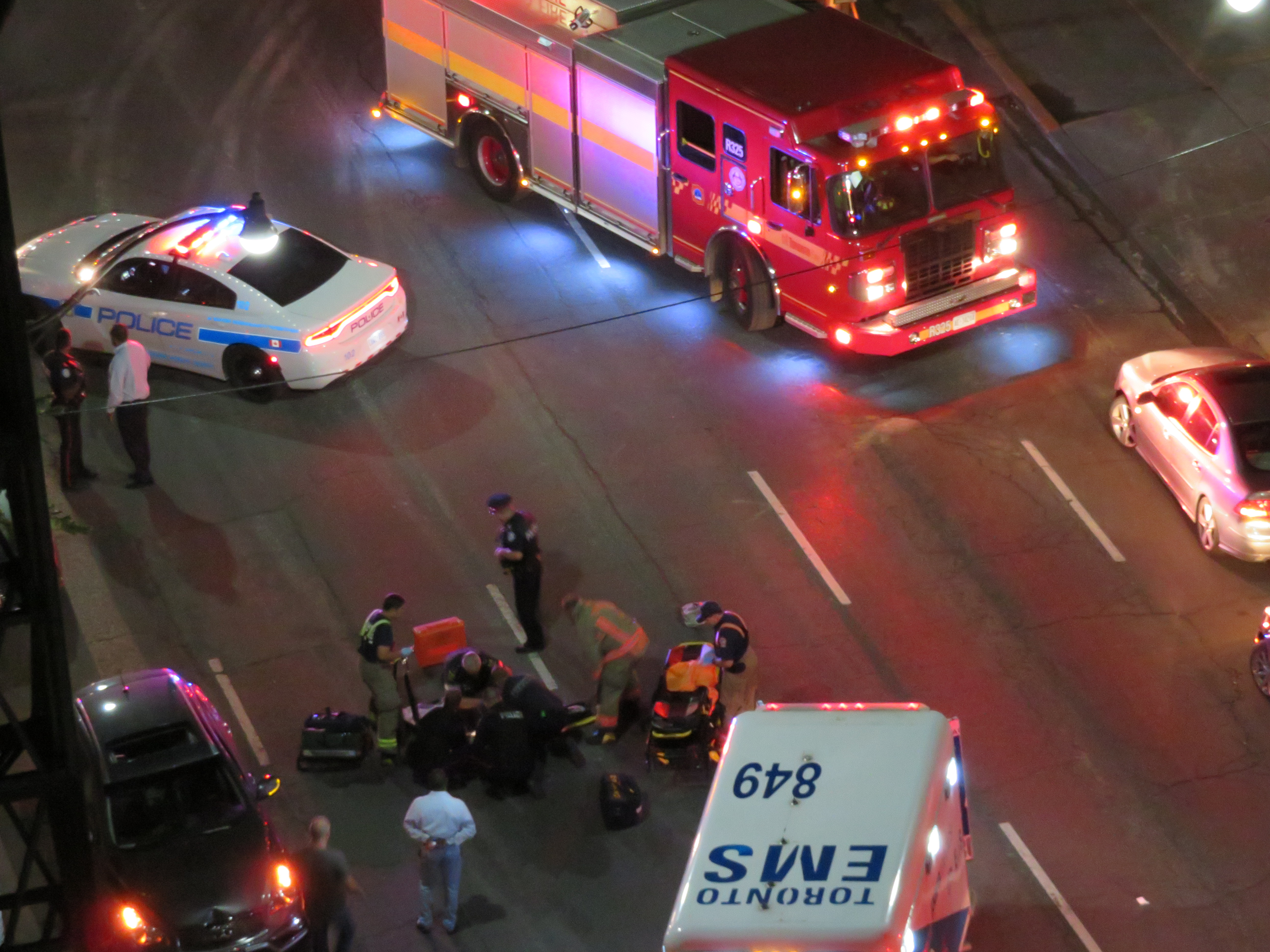
After five pedestrians were killed on Toronto’s streets during the two weeks of 2018, Toronto Police have announced another pedestrian safety campaign promising increased enforcement and education efforts. Sadly, I do not have faith that the local police service will properly address the safety of vulnerable road users.
Police are once again advising pedestrians to avoid crossing mid-block, to make eye contact with motorists before crossing the street, remove earphones and hoods when crossing, put away mobile devices, and be visible. These are all generally good ideas, but they ignore the larger issue — aggressive and inattentive motorists are most at fault. Most collisions in which pedestrians are seriously injured and killed are in the suburbs, and not in the downtown core, where most pedestrian safety blitzes take place. And some of the advice the police gives pedestrians is not that helpful.
Previous pedestrian safety campaigns have targeted downtown pedestrians crossing with a flashing hand countdown signal or distracted by their phones. The message is usually the same: in 2012, Toronto police were also saying to “cross the street as if your life depends upon it,” the same as this year’s message. Targeting downtown walkers is an easy way to get a message across, but it is not a very effective one, yet we see it every year.
Statistics collected by the City of Toronto show that most pedestrians hit by motorists were crossing legally in a crosswalk, with the right of way. This latest campaign ignores that very fact.
On January 7, Jessica Renee Salickram was killed trying to cross the street after getting off a TTC bus at Steeles Avenue East and Eastvale Drive, on Toronto’s border with Markham. The intersection does not yet have a traffic signal, and it is nearly 300 metres from the nearest signalized crossing, at Tapscott Road. The eastbound TTC bus stop does not even have a sidewalk, one of many inaccessible bus stops in suburban Scarborough. This was not a mid-block crossing, as it was at an intersection. The TTC has since suspended service at this stop, but that is not an acceptable solution.
Pedestrian fatalities in Toronto in 2018
The Toronto Police’s advice to make eye contact with motorists is often difficult — persons with visual impairments have as much right to cross as anyone else. It is also very difficult to make eye contact with distracted motorists, and drivers in cars and trucks with deep-tint windows. Police are advising pedestrians to cross at crosswalks, yet they are often blocked by vehicles.
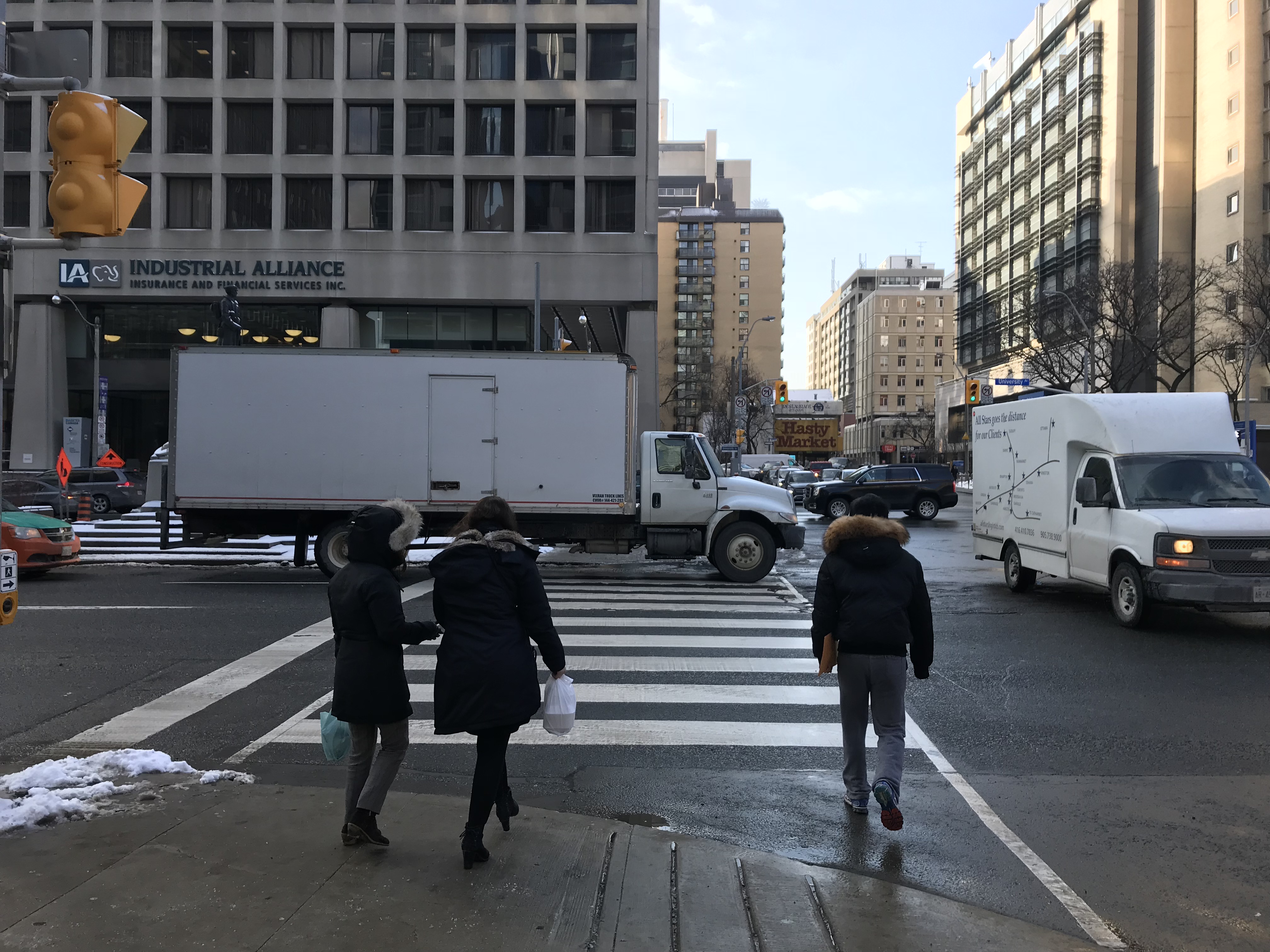
It’s pretty much impossible to cross the street safely when the crosswalk is blocked.
Global News has found that the Toronto Police Service has been issuing far fewer traffic tickets in recent years. Last November, Global reported that Toronto police issued half the number of Highway Traffic Act infractions — fines for speeding, running red lights and stop signs and other unsafe driving — were down by half between 2011 and 2016, as well as a significant drop in impaired driving charges during the same time. It seems wrong that pedestrians are once again being targeted while bad drivers are let off the hook.
https://twitter.com/sean_yyz/status/953343384122355712
As I have written here before, civic leaders have not taken pedestrian and cyclist safety seriously enough. There are a few token gestures to Vision Zero, but “Senior Safety Zones” and reduced speed limits on a few streets are not enough to send the message that we truly value the lives of all vulnerable road users — particularly children and seniors, who are disproportionately at risk. One more quick and easy police blitz on pedestrians at busy downtown intersections does not address the problem.


Leave a Reply