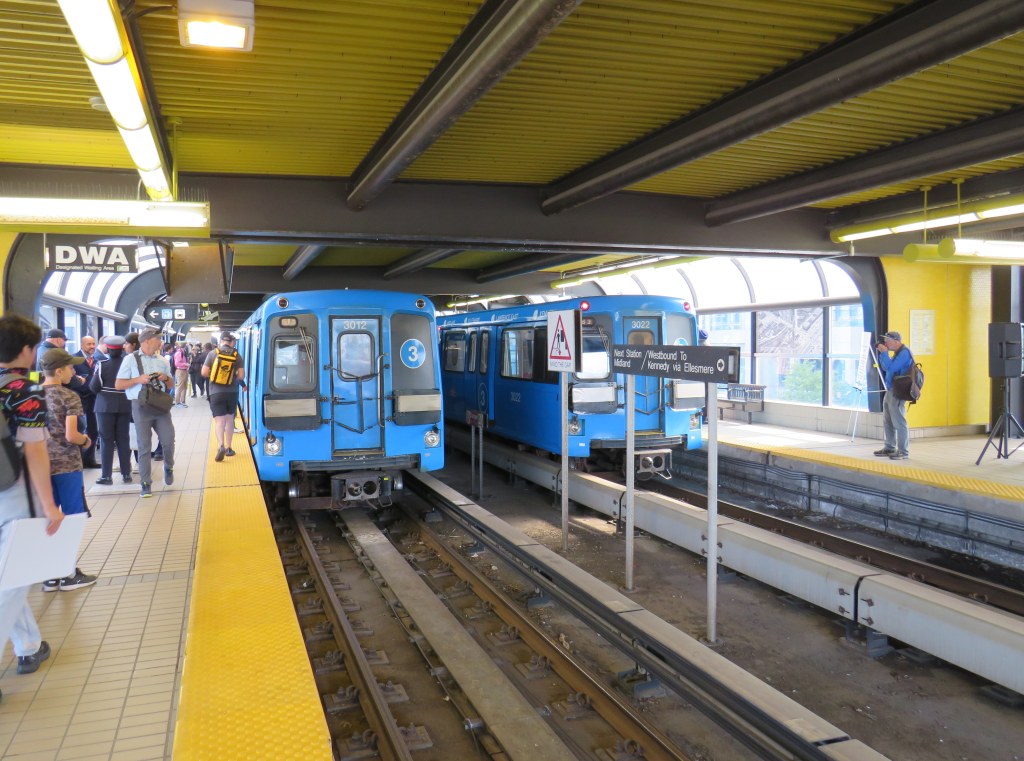
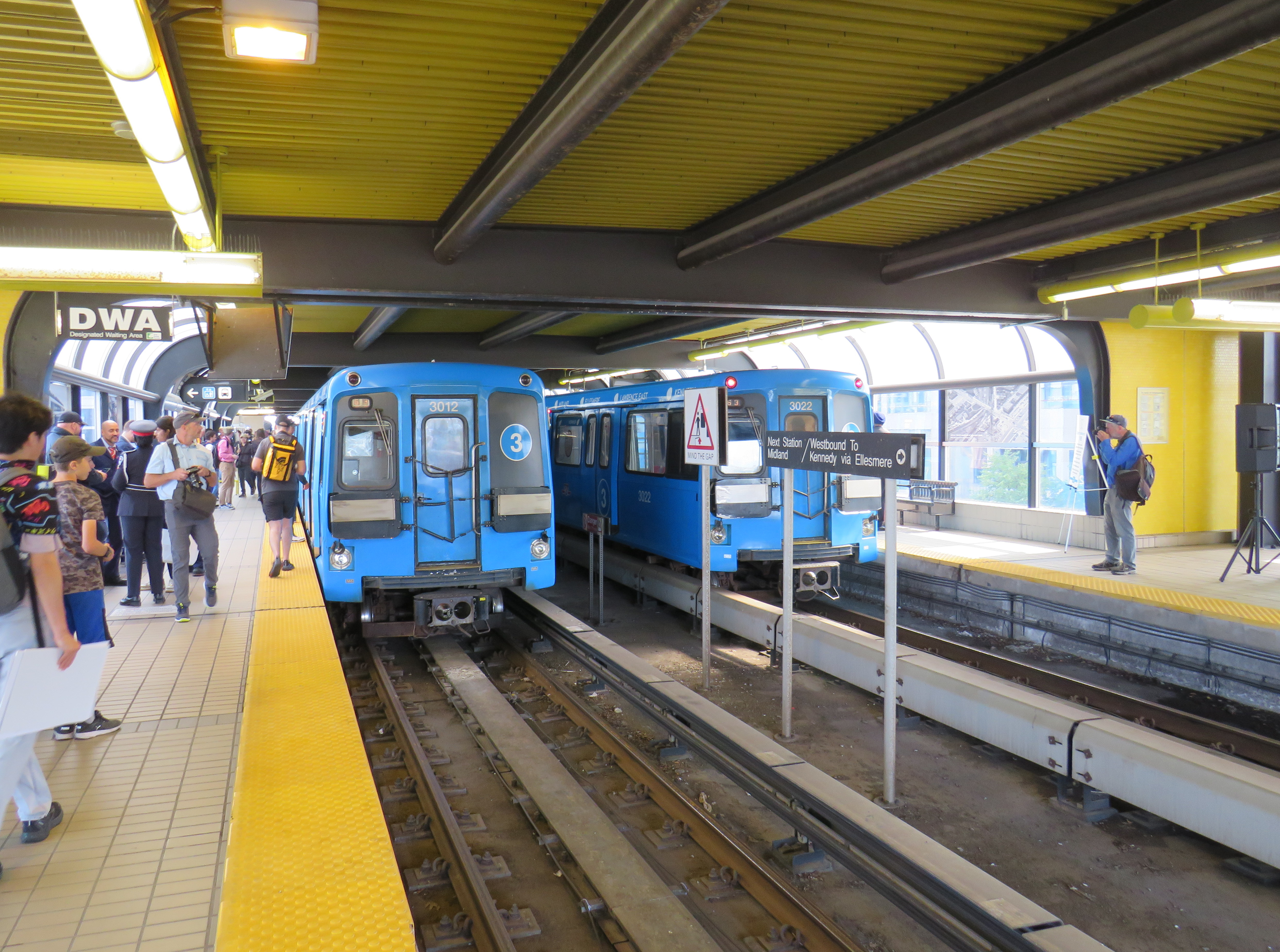
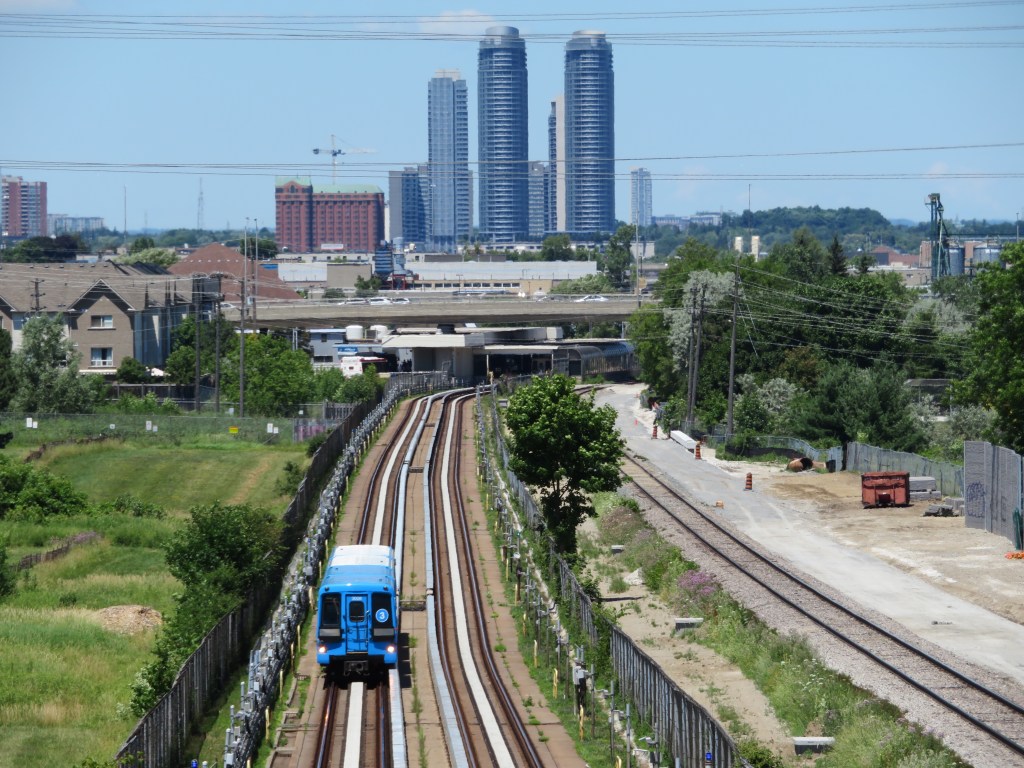
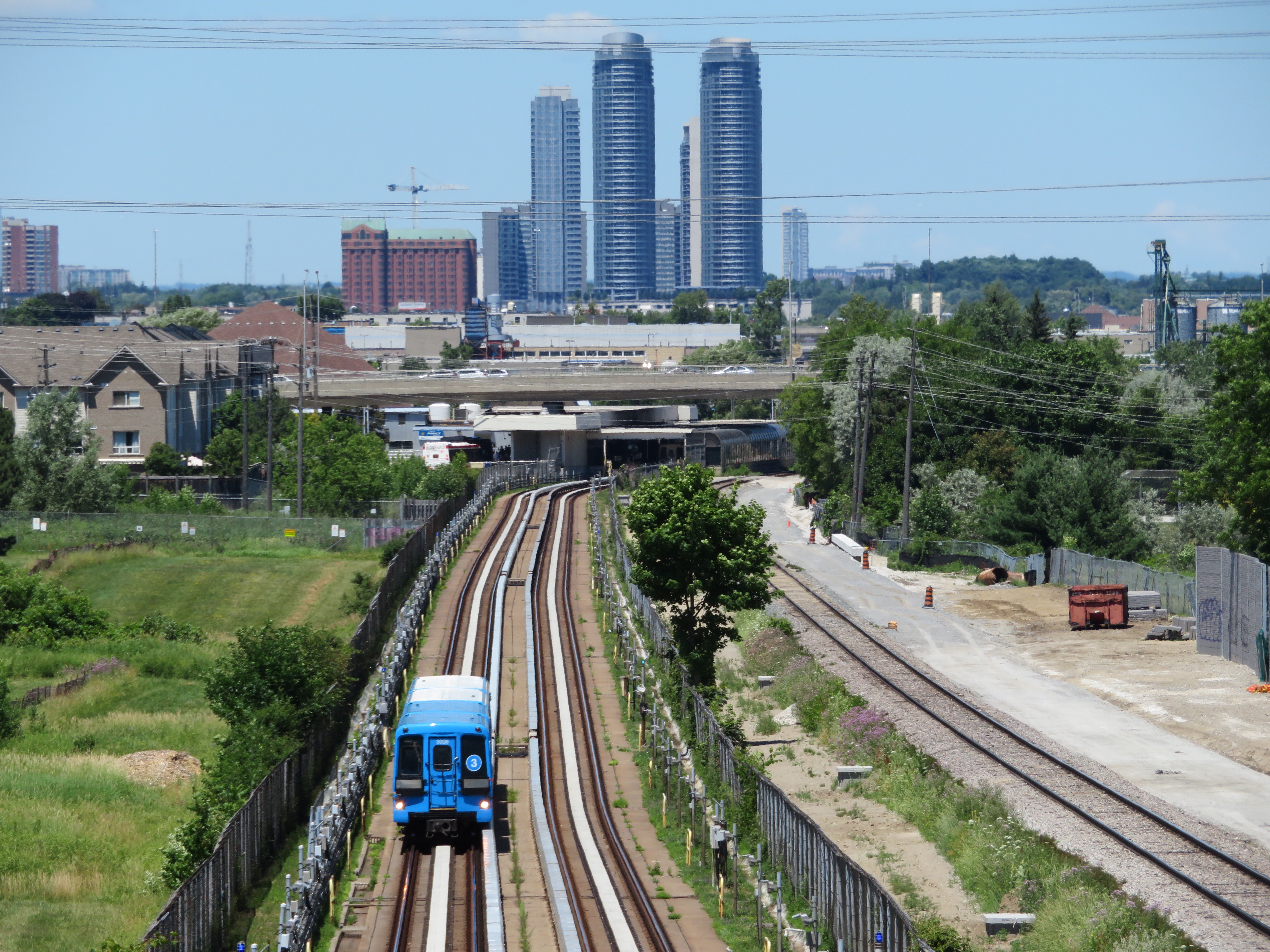
On July 24, 2023, 38 years of Line 3, the Scarborough RT, came to an ignoble end when a car came off the tracks just south of Ellesmere Station, four months ahead of the scheduled closure of the deteriorating line. Though the City of Toronto and the Toronto Transit Commission (TTC) were hesitant to say so at the time, it was apparent that the July derailment meant Line 3’s permanent closure. A farewell party, with two SRT cars, was held at Scarborough Centre Station on September 23, 2023, allowing the public to have one last sit in the venerable cars.
I went to check out the new temporary bus lanes on Midland and Kennedy, installed ahead of a planned busway between Kennedy and Ellesmere Stations. The busway, which will open in 2025 after the old SRT right-of-way is decommissioned, will include a new stop at Tara Avenue, at the Meadoway trail.
In the meantime, most drivers appear to be respecting the new painted lanes, even on busy Kennedy Road. With several bus routes from north and east Scarborough diverted to Kennedy Station to provide a more pleasant ride, the bus lanes are very well used.
Streetcars backed up eastbound at King and University, November 28, 2023
On Tuesday, November 28, the University of Toronto’s School of Cities released their report that looked at vehicle movement and traffic violations on the King Street Transit Priority Corridor. They found that there are, on average, 6,800 illegal turns and through movements at intersections on the corridor, and less than 0.3% of offenders are stopped by Toronto Police and ticketed. Traffic enforcement was heaviest between November 2017 (when the pilot began) and March 2020 (when the COVID-19 pandemic restrictions began). Enforcement has not caught up since then.
The U of T School of Cities has provided invaluable quantification of what many Torontonians have suspected for years: the King Street Transit Priority Corridor is broken, and that there is little being done to fix it.
The transit priority corridor, which runs between Bathurst Street in the west and Jarvis Street in the east, has restrictions on through vehicle movements, where motorists must turn right at most intersections. Until 10 PM daily, only TTC buses and streetcars, emergency vehicles, and bicyclists are exempt. After 10 PM, taxis may also continue through the corridor.
The pilot program launched on November 12, 2017. The initial pilot, in which signs were erected, Jersey barriers placed to restrict the curb lane, and TTC stops moved to the far side of most intersections, was intended to optimize permanent streetscaping improvements, streetcar stop placement and transit optimization, get motorists acquainted with the new rules (at first, only warnings were issued by police) and allow time for Toronto City Council to decide on whether the pilot should be made permanent. Council approved making the transit priority corridor permanent on April 16, 2019.
Though Toronto City Council voted to transform King Street permanently, no work has started on the streetscape or public realm to do so. Just like Union Station, temporary Jersey barriers remain in place. The relocated TTC streetcar stops are left at road level, without transit shelters or accessible curbs. Drivers routinely ignore restrictions, with only a 0.3% chance of getting a $85 or $110 ticket. Meanwhile streetcars get stuck and transit riders get nowhere. On Wednesday, November 8, a Toronto police officer decided to enforce congestion on King Street… by ticketing a streetcar operator stuck in the intersection at University Avenue.
A motorist, ignoring several signs, proceeds straight through on King Street eastbound at Spadina Avenue
The problem is not just limited to through movements on King Street, though. On Tuesday, November 28, I stood at the corner of King and Spadina between 4:00 PM and 4:20 PM. The backup of cars and trucks headed southbound towards the Gardiner Expressway extended into the south side crosswalk and into the eastbound lanes at times. Motorists are not permitted to enter an intersection on a green light if they cannot clear it before the light turns red; this causes gridlock. But on more than one occasion, streetcars and pedestrians were impeded by illegal intersection blocks.
At Spadina and King, a truck and three passenger vehicles block the south side crosswalk and prevent a streetcar from proceeding straight on a green light
After standing at King and Spadina, I walked over to King and University, where the Toronto Police charged a streetcar operator earlier this month. At 5 PM, eastbound streetcars were lining up between University and John Street, unable to proceed.
Traffic jammed at King Street eastbound at University Avenue
However, motorists were able to turn right and left from University Avenue to eastbound King, blocking the east side crosswalk to pedestrians and ensuring that no streetcar could continue across. I spoke to one operator, who told me that the day before, he was stuck there for a half hour before he could move across.
The University and King intersection, at 5:00 PM on Tuesday, November 28. Note the blocked crosswalk and the line of streetcars, all with their hazard lights blinking. Eventually, one streetcar operator decides they had enough, and occupies the intersection.
While there, I counted several motorists who passed to the right of the stopped streetcar, and instead of turning right as permitted, they went straight, only contributing to the blockage ahead.
Two eastbound cars pass a stopped streetcar on the right to join the congestion ahead
The problem downtown is exasperated by several road closures. Queen Street is closed between Bay and Victoria Streets for Ontario Line construction; this will last for at least five years. Adelaide Street, which is one-way eastbound is closed at York Street due to the delayed Adelaide Street diversion track installation that is supposed to allow Queen Streetcars to divert around the Ontario Line closure. York Street is also closed at Adelaide. There are several other lane closures on Bay, Yonge, and Richmond Streets and University Avenue for utility work.
Adelaide Street is likely to remain closed at York until early 2024
Yet, one would hope that something was done to allow transit riders to get through the downtown core, especially as the city has been aware of the severe congestion for weeks at this point. The city needs to move ahead on permanent streetscape changes to further discourage through traffic on King Street by closing the curb lanes at the far side of each intersection.
It is also clear that the Toronto Police are not too interested in ticketing motorists on King Street. Even if they were, it wouldn’t be enough, as it takes 10-15 minutes to stop and ticket a driver; automatic ticketing, similar to red light cameras, would be more effective, though traffic officers can still be strategically deployed at congestion hotspots.
It’s beyond time for this city to take transit seriously again. King Street would be a great place to start.
On Saturday August 19, while my spouse and I were paying a visit to the renewed AKG Art Gallery in Buffalo, a thief broke into our building and made off with my bicycle. The well-equipped thief broke into our building’s front entrance using a pry bar, and then used a heavy-duty bolt cutter to cut the rack my bicycle was attached to, taking care to watch for any activity in the garage by hiding in an adjacent stairwell. He spent nearly an hour in the building in total.
This was the second time my bicycle was stolen. This time, I thought I had a better lock. The old spot I had was hidden from the cameras and out of view of most people in the garage — the new spot was in a more prominent location.
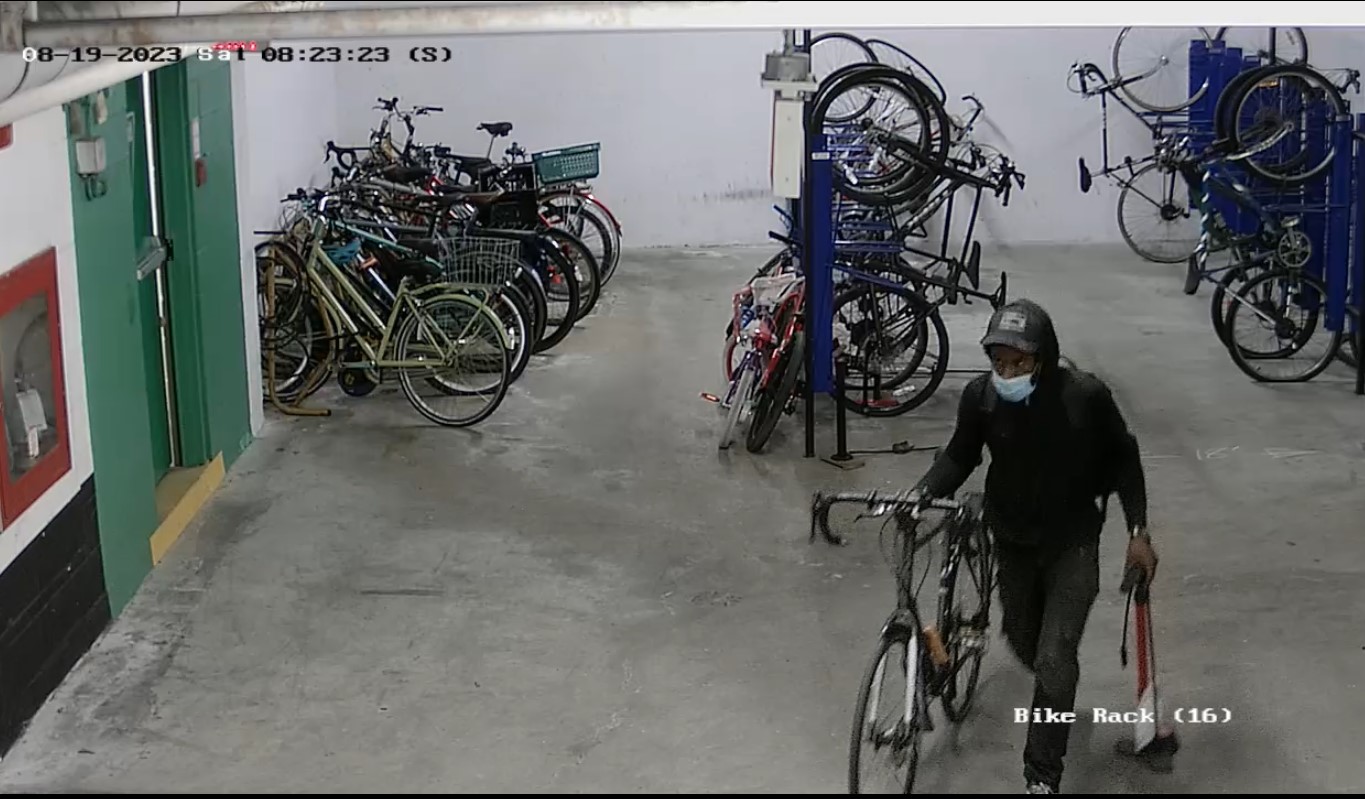
The thief, walking away with my bicycle.
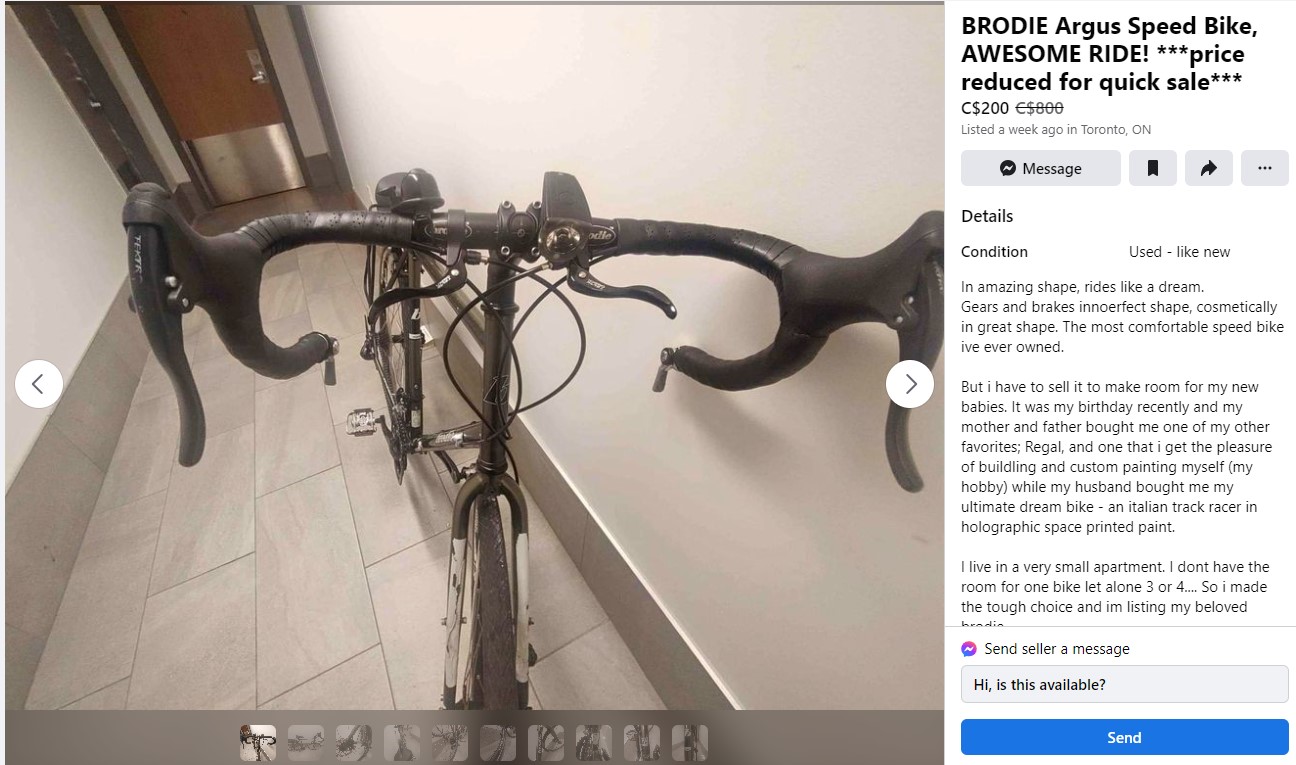
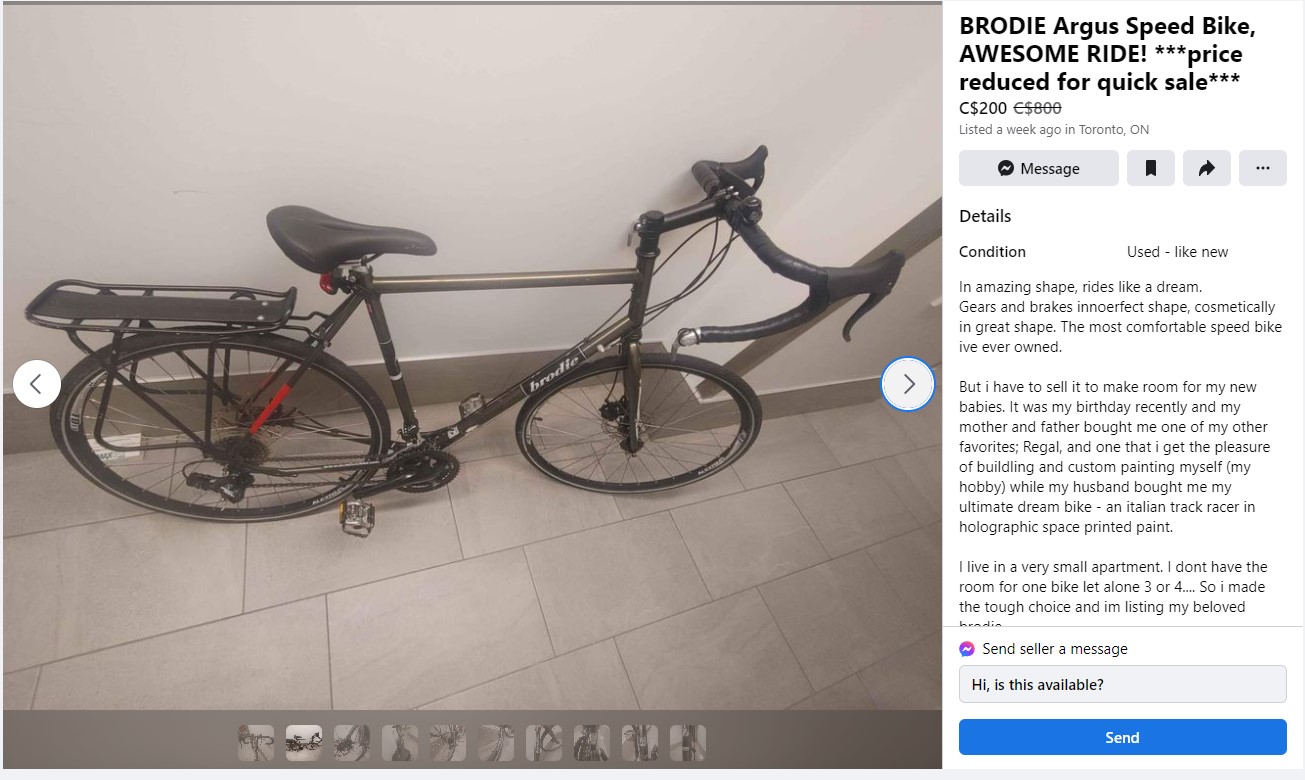
My Brodie touring bicycle was quite distinguishable, with dual-sided pedals (flat on one side, clipless on the other), additional handlebar-mounted brake pedals, fenders and a rear rack, Marathon tires, reflective tape on the forks and seat stays, and the dealer’s original decal on the frame. When I bought it from Bateman’s Bicycle Company in March 2015, I had the extra brake pedals installed as I was unused to having a bike with drop bars, and I wanted a more upright position when riding on city streets.
It took over a week before I discovered the bike missing as I had been really busy in August. When I discovered the theft, I informed the building management, and was able to get still photos and video of the thief. He was dressed in a black hoodie, with a black baseball cap and a surgical mask covering part of his face. His backpack had several tools, so he came in with a specific purpose. He did not cut the Kryptonite lock; instead he cut the rack and left with the lock still attached to the frame.
I reported the theft to Toronto Police, firstly by going on their website, as I had registered my bicycle. (The last time I had a bicycle stolen, the police actually recovered the frame, which I later donated to Bike Sauce.) I saved a service receipt with the bicycle’s make, model, and serial number, and had photos to provide. However, since it involved a break-and-enter, I learned that I actually had to call the police and make a verbal report. After calling, I learned that I had to wait for an officer to arrive so I could give him a narrative. Our building maintenance manager expected it to take a few days; the officer arrived within a few hours, which impressed me. I posted the still photos to social media, including the Cycling in Toronto Facebook group, with the hope that someone might know something.
I was able to provide a detailed timeline to the police based on the security videos, and provided still photos. A week later, a different police officer called me as he wasn’t able to meet the manager to review the videos; I was able to make a copy and dropped off a USB stick to 51 Division the next day. That was the extent of communications from Toronto Police.
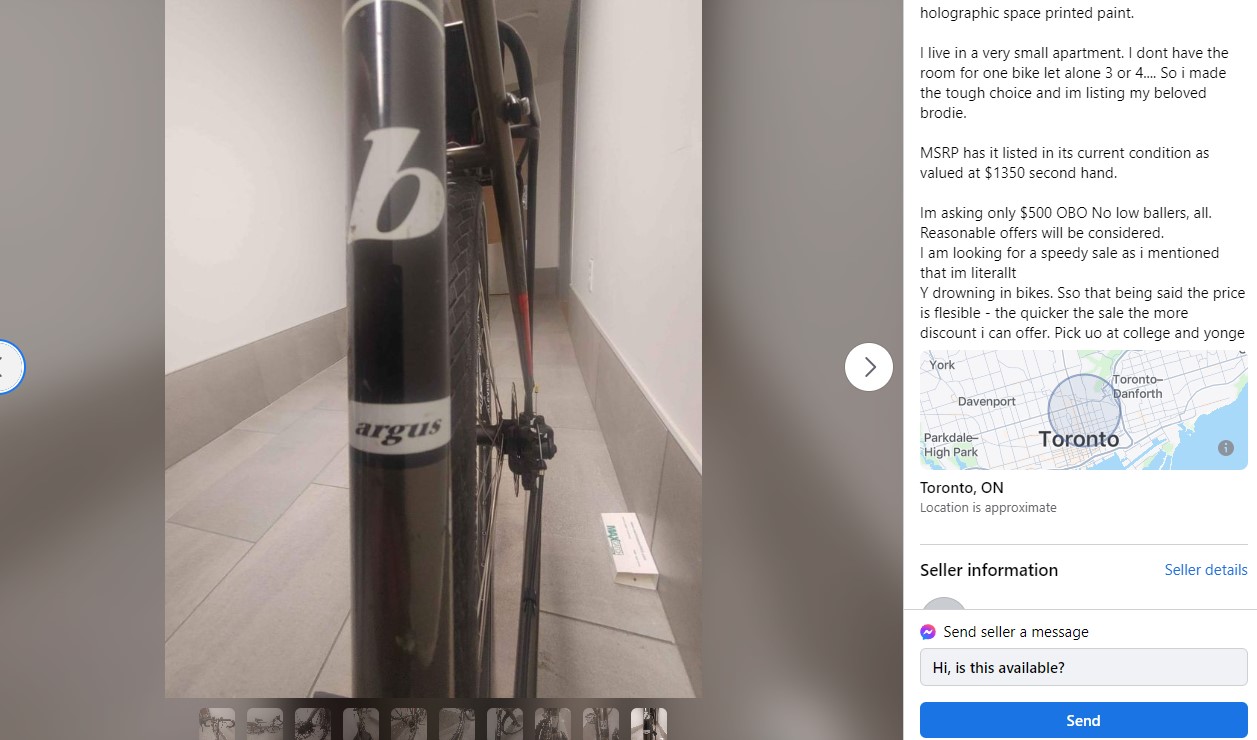
On Monday, September 18, I got a Facebook message from a friend of a friend telling me they found a Facebook Marketplace listing with a bike that matched my bike’s description. It looked like a match, with the extra brake pedals, the red and white tape, the dual pedals, and the Bateman’s dealer sticker. Missing were the fenders and water bottle cage, and cheap new lights were added, replacing the bare mounts.
I had not thought of looking at Facebook Marketplace, but it appears to be a popular place to sell stolen goods. After my spouse searched Kijiji, there was a similar listing. But seeing one’s prized procession taken, and then put up for sale elsewhere felt like it added insult to injury. We had checked these sites before, with no matches.
Screenshot of FB Marketplace listingScreenshot of FB Marketplace listingScreenshot of FB Marketplace listing
I brought this to the police’s attention, hoping for at least advice. I emailed the officer assigned to the case, and heard nothing. I went down to 51 Division again with printed screenshots. I heard nothing.
Back on the Cycling in Toronto Facebook Group, members suggested posting to another FB group, called Stolen Bikes – Toronto. After my membership was approved, I posted about the theft, and a member there quickly messaged me saying that they had just acquired the bike. I could meet him the next day, and I could get it from him. The person who purchased the bike said he followed the listing, feeling especially suspicious. Originally, it was listed for $400, but the person I met was able to get it for $150.
I was so happy to get the bike back, after three weeks of anxiety, especially when I learned of the sale listing. I was worried I wouldn’t see it again, and that an unsuspecting or predatorial buyer would pick it up.
Though I am not out a bike anymore, I will still need new locks and a safe place to store it. I will probably get new fenders when I take it in for an inspection. Until then, my bicycle is safe in our apartment. Luckily, our building allows bikes in the elevators and hallways.
Having distinguishable characteristics helped to identify the bike when I shared the theft on social media; keeping a record of the make, model and serial number also helped. I also choose to secure the wheels with custom locks, which kept the bike intact. Finally, the cycling groups on Facebook proved to be an invaluable resourse for getting people to watch out, and eventually, getting the bike back. I am grateful for the people who kept an eye out and especially to the person who got it back in my possession.
2018 view of the Scarborough RT, looking north towards Ellesmere Station
On Monday July 24, at 6:45 AM, a Scarborough RT car on Line 3 derailed soon after departing Ellesmere Station. Forty-five passengers were on board, and five suffered minor injuries. The Scarborough RT, which opened in March 1985, was suspended, and then permanently closed, four months ahead of its planned shutdown on November 18, 2023. For the first time in its history, Toronto’s rapid transit map has shrunk.
Last week Monday, I was at Spacing’s election night party at a pub in the Annex, watching the results of the election roll in after 8PM. Public polls consistently saw former Toronto city councillor and NDP MP Olivia Chow leading an especially crowded race of 102 candidates for mayor. It was the most exciting election I’ve followed since at least 2014.
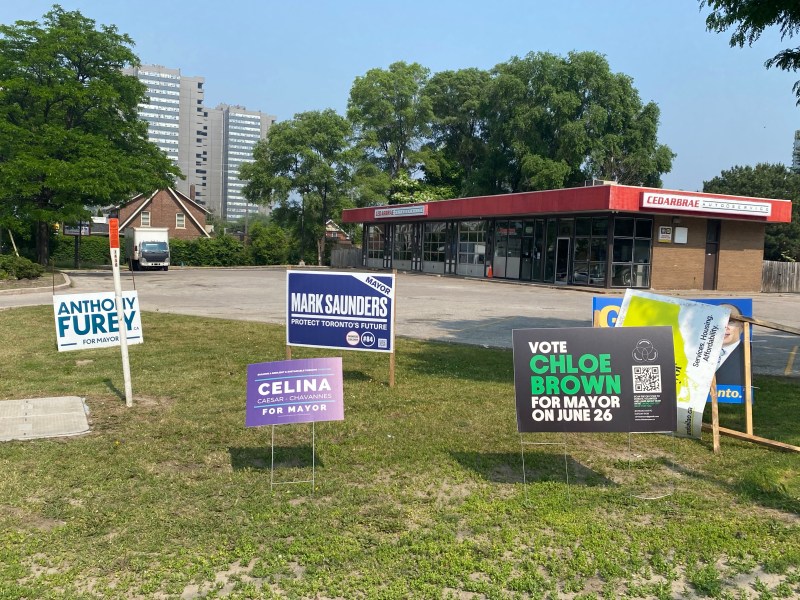
Former three-term councillor Ana Bailão, one of former mayor John Tory’s protégées, was consistently in second place, followed by former Toronto Police Chief (and provincial PC candidate) Mark Saunders, sitting councillors Josh Matlow (who ran as a progressive) and Brad Bradford (who ran to the right), and right-wing columnist Anthony Furey. Though Bailão, a centrist, had the endorsements of multiple sitting councillors, Liberal MPs and MPPs, and several public and private sector unions, she had difficulty positioning herself as the presumptive centre-right challenger, especially with Premier Doug Ford backing Saunders.
It was not until the advance polls had closed that Deputy Mayor Jennifer McKelvie, the Toronto Star Editorial Board, and then Tory himself endorsed Bailão, likely spooked by Chow’s continued lead. (David Rider and Ben Spurr at the Star wrote a great article about the leadup to Tory’s endorsement.) Tory, who resigned after admitting to a long-term city hall affair, hummed and hawed over providing his endorsement, and hid from reporters even while robocalling Torontonians pleading them to vote for his appointed successor.
It is quite possible that Tory’s endorsement came too little, too late for Bailão. Nearly 150,000 electors (representing 21.7% of all votes cast) already voted in advance polls or by mail, and their votes were locked in. But the late push for Bailão was able to convince at least some election day voters to choose strategically — the percentage of voters who chose Saunders, Furey, and Matlow fell, while Bailão’s share grew on election day. Indeed, Bailão placed first among election day voters. But Chow, whose campaign encouraged advance voting, carried the day in the end.
For example, Josh Matlow placed a close second in Ward 12 in the advance polls (with 30.6% of the vote), where he’s a popular local councillor. On election day, Matlow placed third behind Bailão and Chow, with Chow eking out a narrow win overall there. In every ward, Chow placed first in the advance polls, but when all votes were counted, she placed first in 14 of the 25 wards. The table below shows how the vote shifted.
Table of ward-level mayoral byelection results, showing advance poll and election day results for the leading five candidates. PDF version here.
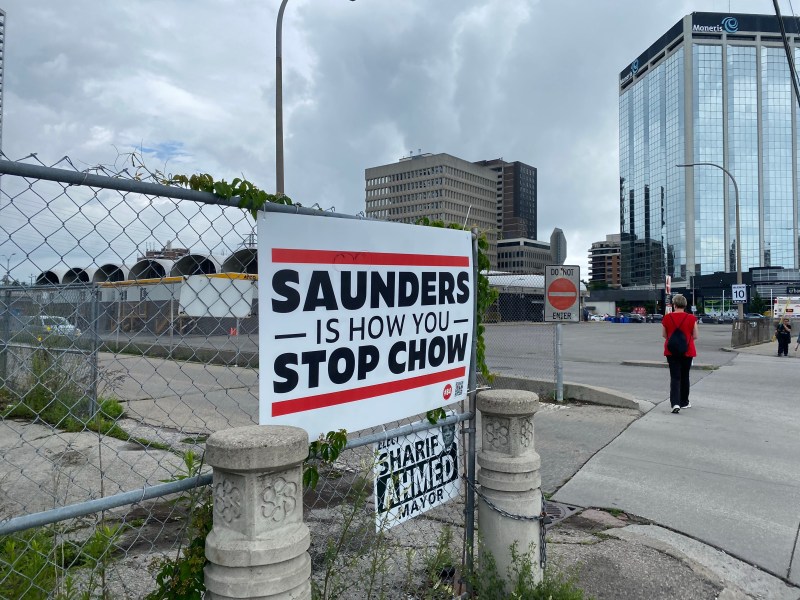
Chow won with 269,372 votes (37.2%) to Ana Bailão’s 235,175 (32.5%). Saunders, Ford’s pick, got just 8.6% of the vote despite his positioning as the only candidate to “stop Chow.” Furey placed a distant fourth, with 5%, and Matlow got 4.9%, acknowledging that Bailão’s late surge draw support away from him and towards Bailão and Chow. Brad Bradford was the biggest loser of the night, netting just 1.3% and placing fifth in his own ward.
“Saunders is how you stop Chow” sign
Though I was skeptical of Olivia Chow’s second run for mayor after an uninspiring run against Rob and Doug Ford and John Tory in 2014 (she placed third), she proved herself worthy this time around. She was more relaxed, more herself, and certainly tapped into a desire for change after eight years of Tory’s dull austerity and four years of chaos under Rob Ford (enabled by his brother Doug).
I fear Toronto’s political establishment — both Conservative and Liberal — will try to make Chow’s term as mayor difficult, even though their low-tax, low-spend agenda caused many of the problems that she will have to tackle. But for now, I’m pleased we will try it her way.
I created an interactive map showing the results of the election at the ward and electoral subdivision (poll) level. For the wards, I provided information on the advance and election day poll results.
Note that not all polls are mapped. Until the City of Toronto releases revised electoral subdivision boundaries (I suspect due to poll consolidations), there are some missing polls. However, 95% of all polls are depicted, and the results are interesting.
I look forward to your feedback as well; I approve all reasonable comments and reply to most emails.
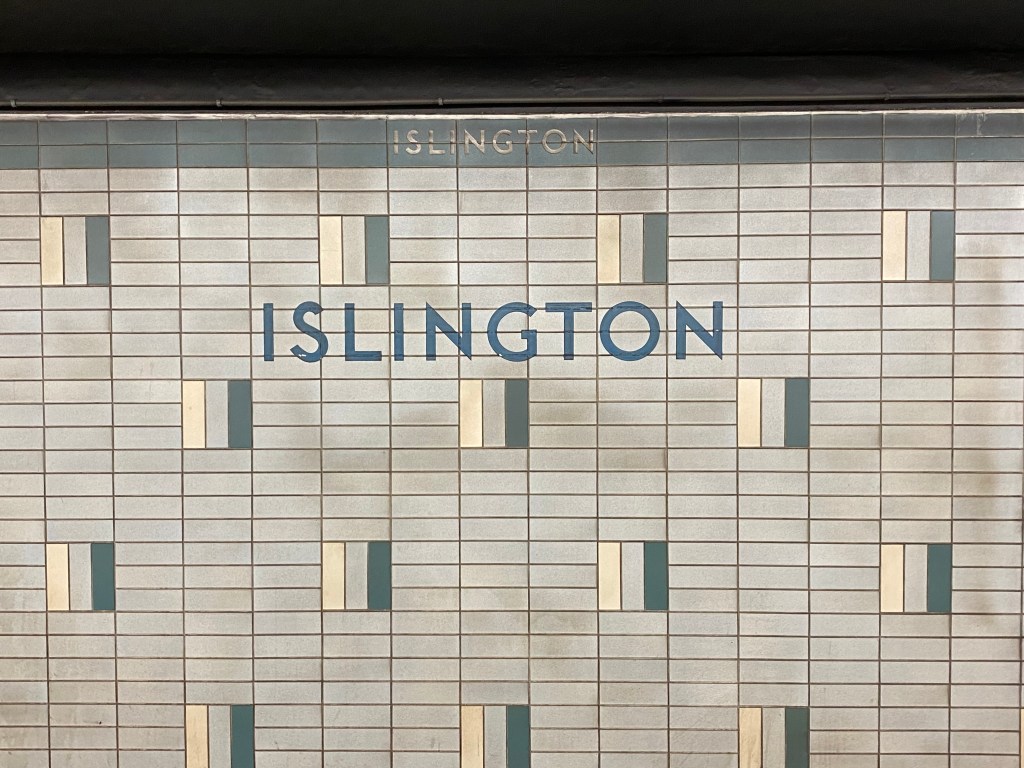
Islington Station, opened in 1968 as part of a major expansion of the Toronto subway system into Etobicoke and Scarborough, is now literally falling apart.
At platform level, Islington looks little different than most stations on the Bloor-Danforth Line with the faded wall tile, coated with a layer of brake dust. Upstairs, on the concourse level and the old bus terminal, the station is in far worse shape. Wear and tear from hundreds of buses entering and exiting the station every day, along with water seepage from an underground stream, has caused the station to look much older than it actually is.
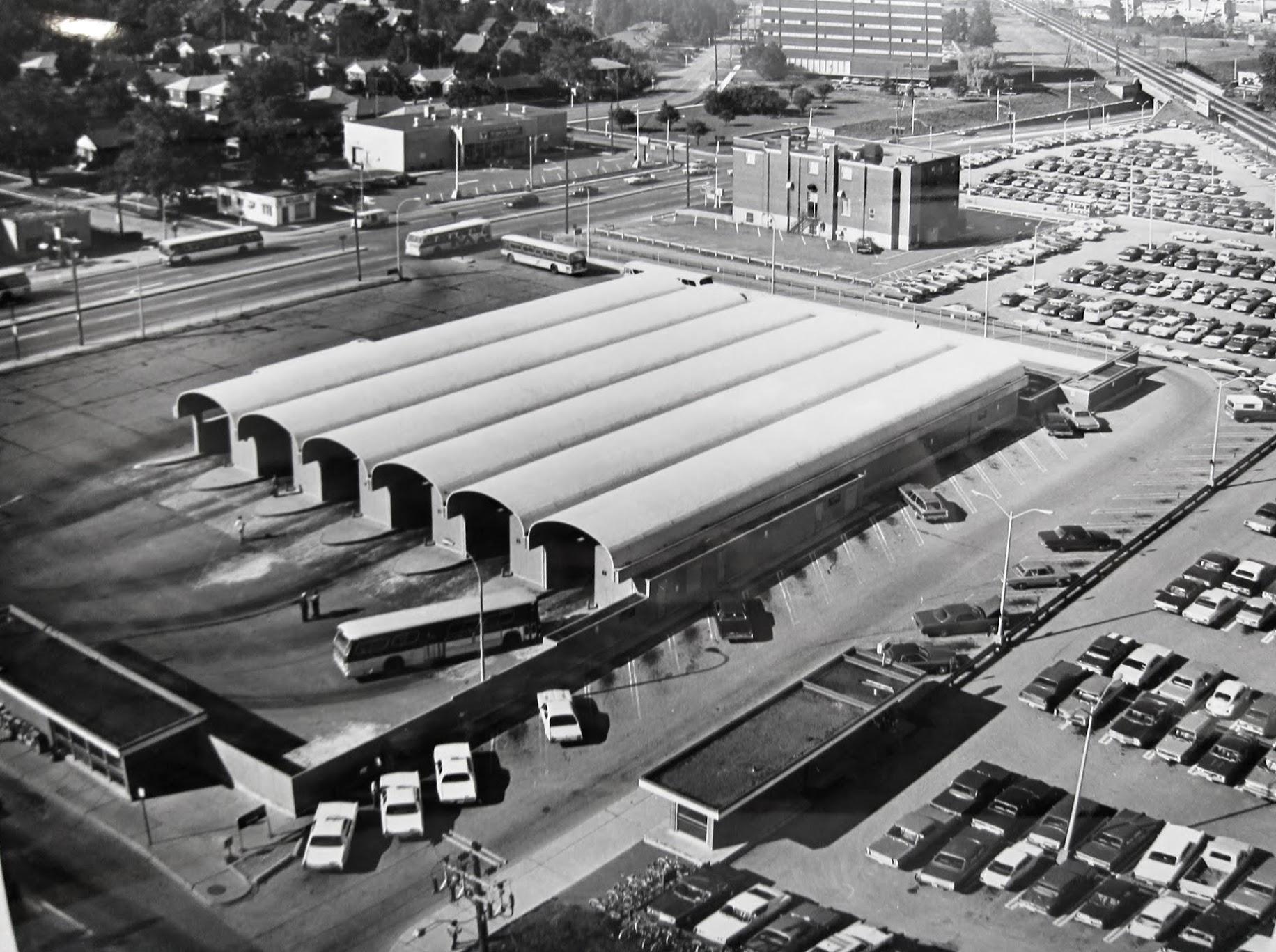
From 1968 to 1980, Islington Station was the Bloor-Danforth Line’s western terminus, with buses branching out to points all over Etobicoke. The bus terminal boasted six bus bays, each with its own driveway. One of the six platforms was dedicated for Gray Coach services, which included an express bus to Pearson Airport.
An arriving bus would first pull into the east side of the terminal, with all passengers descending a set of stairs to the subway concourse, either to transfer to the subway, exit the station, or transfer to another bus route. The bus, once the operator took their break, would then pull forward to the boarding area, where a second set of stairs emerged from a waiting area. Below, on the concourse level, a flashing light would alert waiting passengers that their bus was boarding. The terminal design was similar to the original bus terminal at Eglinton Station; at Warden Station, the levels are reversed, with the bus bays below the passenger concourse.
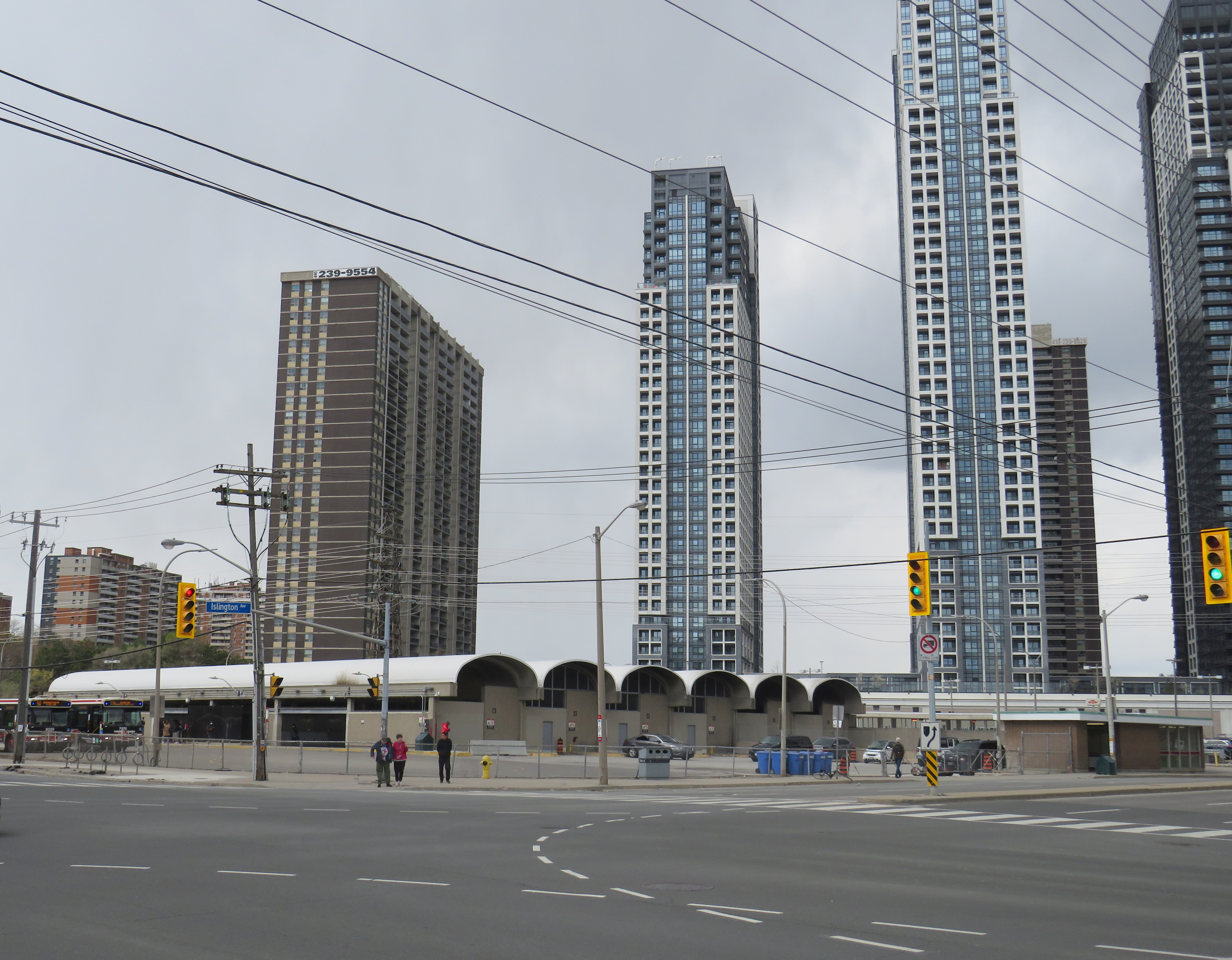
Aerial view of Islington Station’s bus terminal in 1975, City of Toronto Archives, Series 836, Subseries 4, File 46. Note the Mississauga Transit bus passing by on Bloor Street. Looking northwest toward the sealed-off bus terminal, May 2023
In 1980, the subway was extended one stop westward to Kipling. The extension allowed the TTC to reroute most of its Etobicoke routes from Islington, which provided new space for Mississauga Transit, whose buses now loaded inside the bus terminal. (As the bus bays are inside the station’s fare-paid area, Mississauga Transit buses off-loaded passengers outside the station’s main entrance on Islington Avenue.) A seventh bay, located to the south of the original structure, was added to provide additional capacity for Mississauga Transit, however, only simple bus shelters provided protection from the rain and snow.
But by 2016, the bus terminal area was starting to crumble, and bus bays 1 and 2 (the bus bays closest to the subway platforms) were closed permanently to prevent further structural damage. Mississauga and GO Transit planned for a new terminal adjacent to Kipling Station, but it was delayed by several years. Part of the delay was caused by Hydro One — owner of the transmission lines that parallel the subway and adjacent Canadian Pacific Railway corridor — who refused to allow a terminal building under its wires.
The opening of the new Kipling terminal for GO and Mississauga Transit buses in May 2021 (repositioned to avoid the hydro corridor) allowed the TTC to permanently close the crumbling bus terminal bays. All remaining buses — 37/937 Islington, 50 Burnhamthorpe, and 110 Islington South — began only using the outer bus loading area in late 2021.
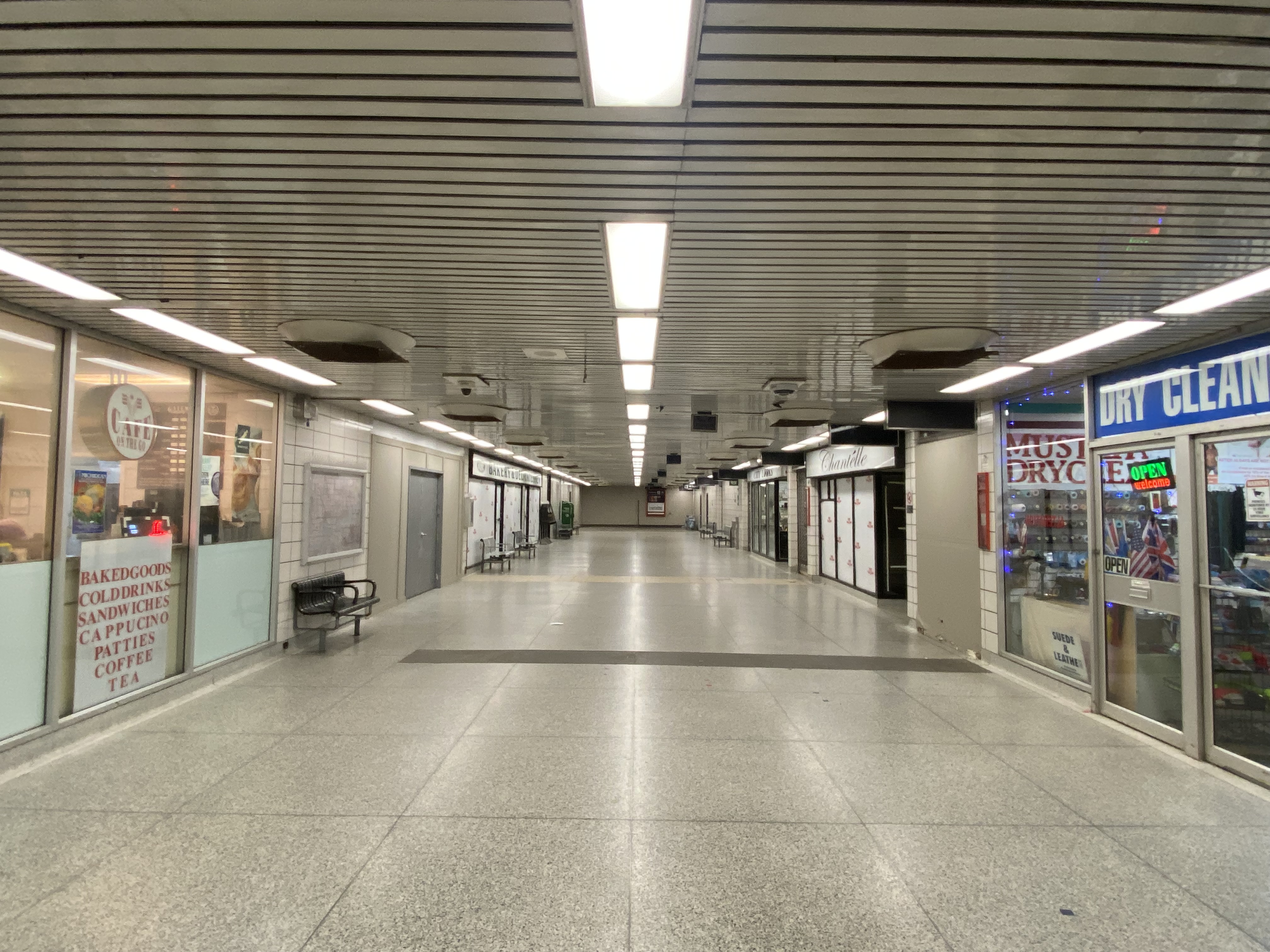
Bus passage, Islington Station. Stairways to the old bus bays are sealed off, with the signs above the old stairways blacked out. Passengers transferring to TTC buses must walk to the far end of this corridor and then up a stairway to access the outer bus bay.
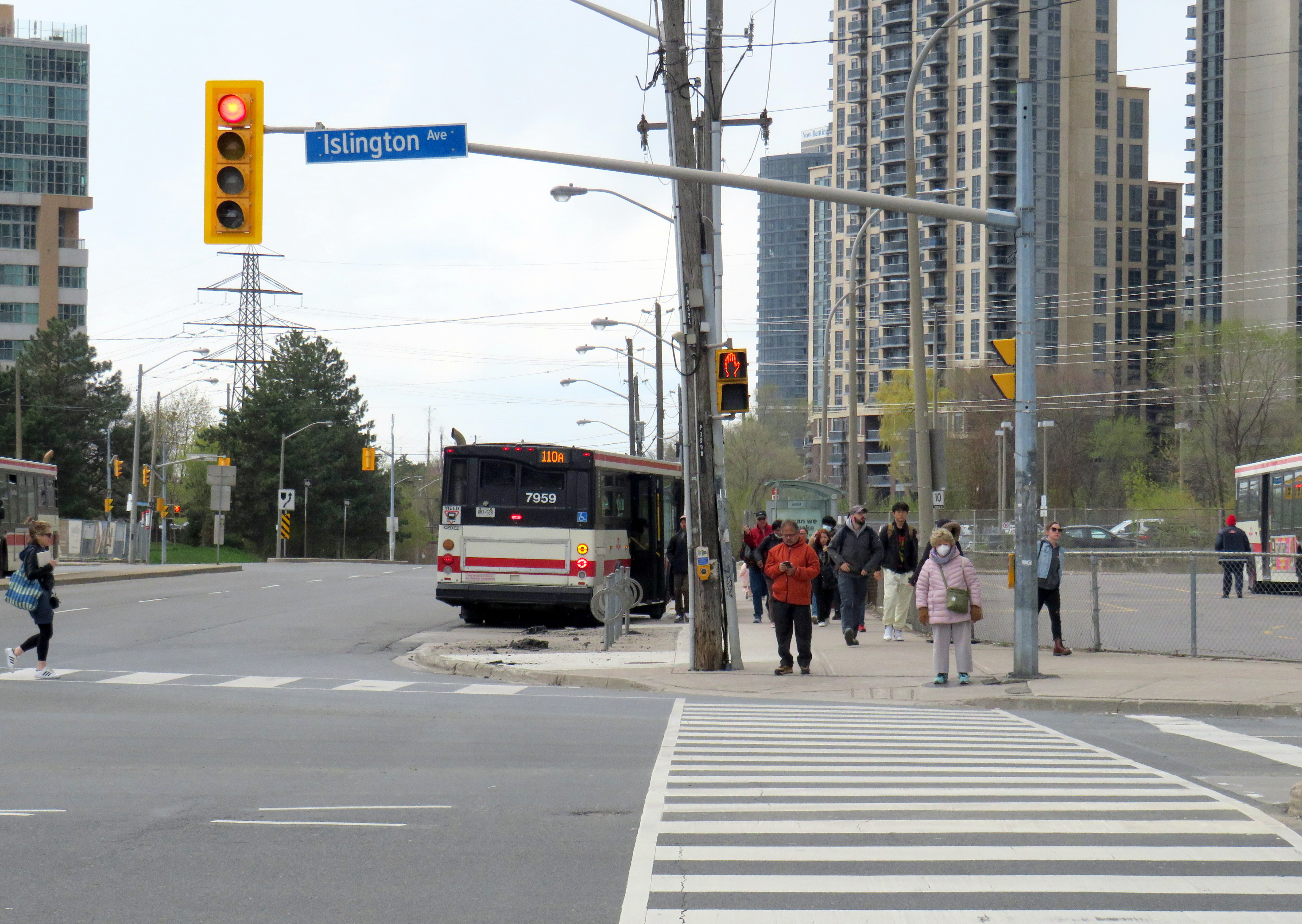
With little room remaining for buses to load, offload, and layover, passengers on TTC buses arriving at Islington are now let off on the street and must walk to the main entrance and show their transfer or tap their Presto card to enter the subway or transfer to another bus. Though Route 37/937 and 50 buses stop right in front of the station entrance on Islington Avenue, Route 110 buses off load on Bloor Street, a two-minute walk to the subway entrance.
A Route 110A Islington South bus off loads on Bloor Street; passengers must walk north to the subway entrance on Islington Avenue, to the right of this photograph
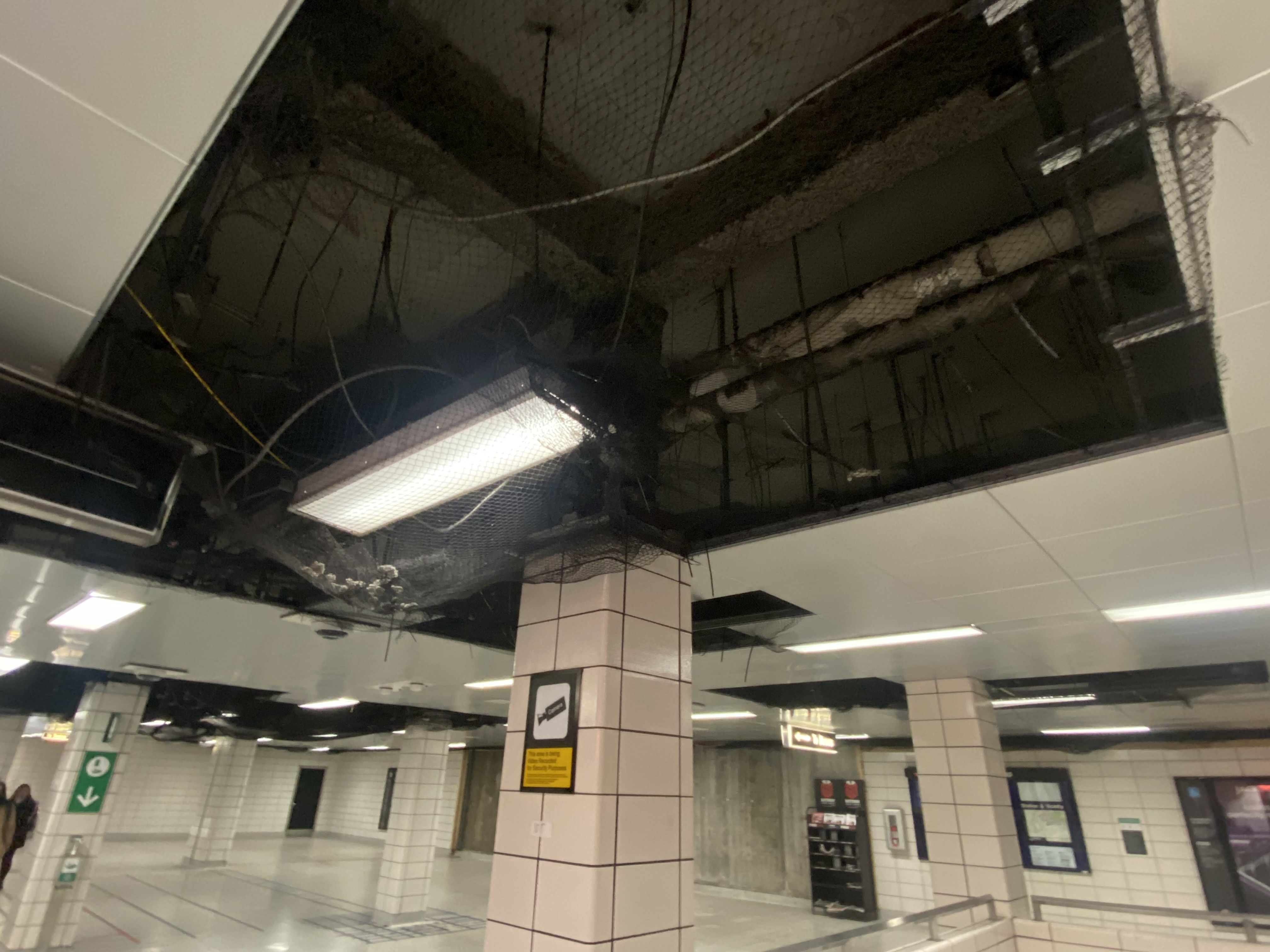
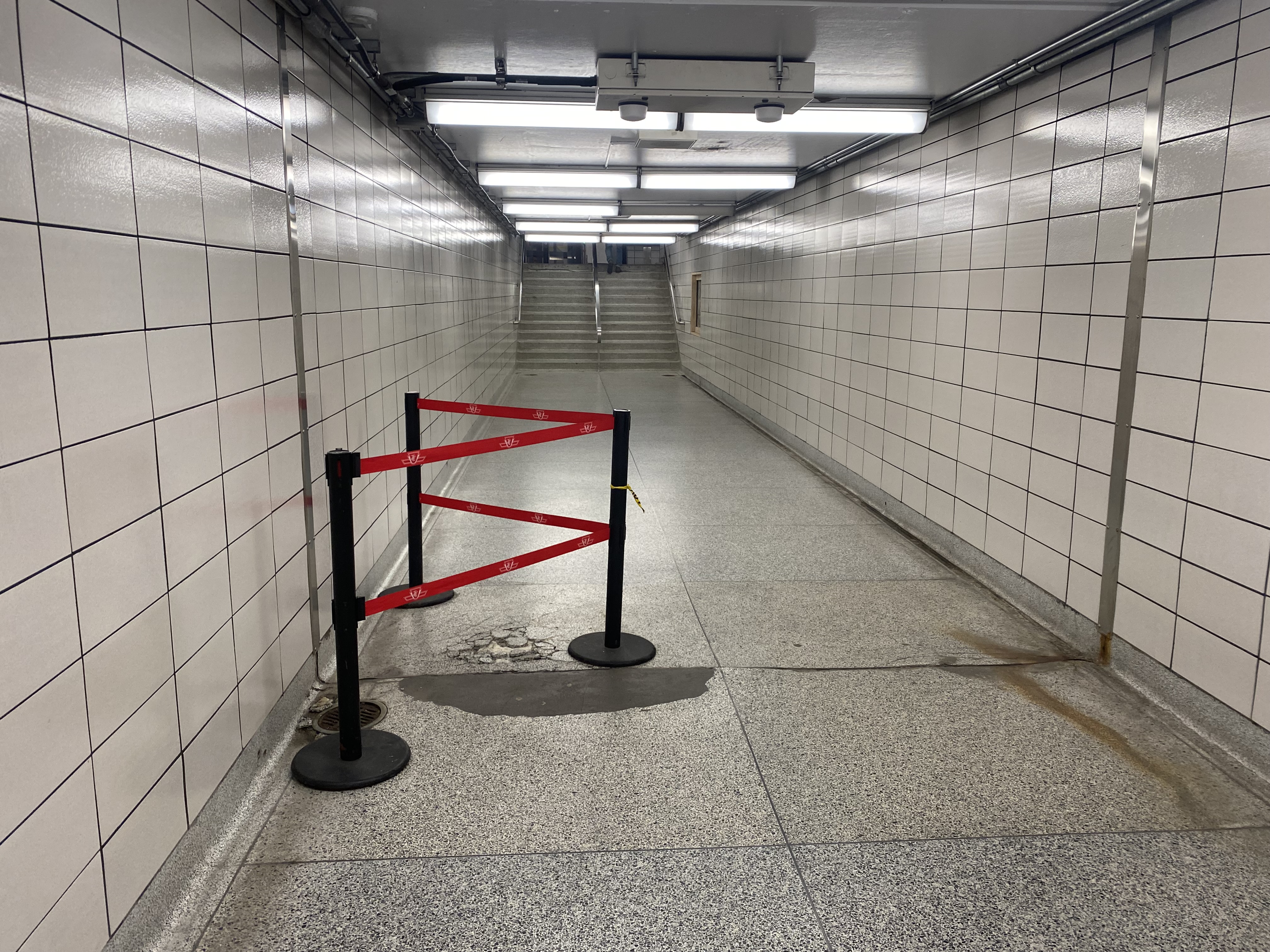
Since the bus terminal closure, the decay at Islington Station has extended beyond the bus area. On the mezzanine level, ceiling tiles were removed, while black netting catches chunks of broken concrete. Removed wall tiles reveal crumbling concrete and exposed rebar. Water leaks cover the mezzanine floor. There are no signs advising passengers of work underway or future construction, though there have been several plans to rebuild the station and promote new development on the site.
Fare gates partially obscured by temporary columns
Not only is reconstruction needed to rectify the deteriorating state of the station, Islington is also one of 15 subway stations that still do not have barrier-free access for passengers using wheelchairs or other mobility devices. Islington and Warden were left at the bottom of the list for station retrofits largely due to the difficulty of providing barrier-free access. The outdated bus terminal layouts at those stations require complete redesigns, and both stations are good candidates for urban development.
Netting keeps chunks of concrete from falling onto passengers’ headsCrumbling terrazzo floor in the passageway underneath Islington AvenueWater leak on the concourse level
There have been several proposals for redevelopment at Islington, taking advantage of its large bus terminal area and parking lot. The city first looked at redevelopment in 2006. At that time, there was a proposal from engineering firm SNC-Lavalin for a new office building that would incorporate a rebuilt station. However, that proposal deal fell through.
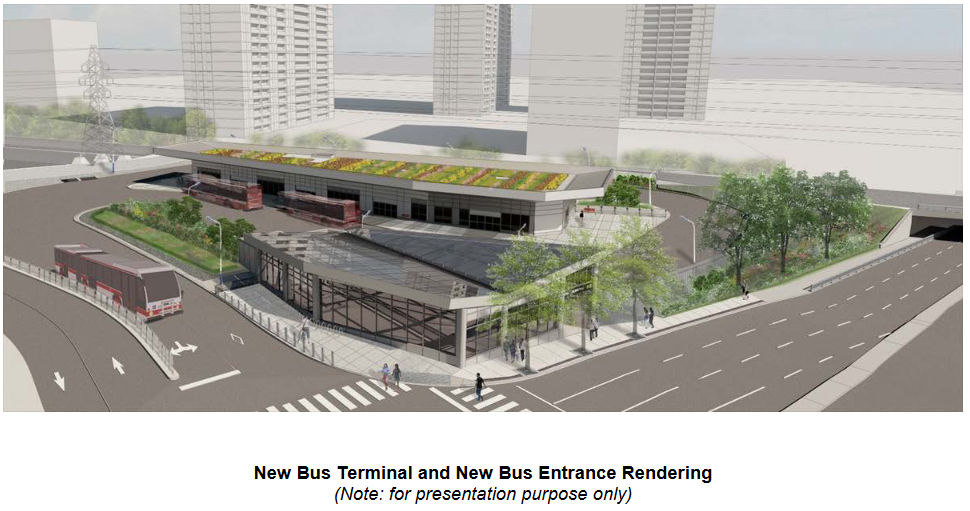
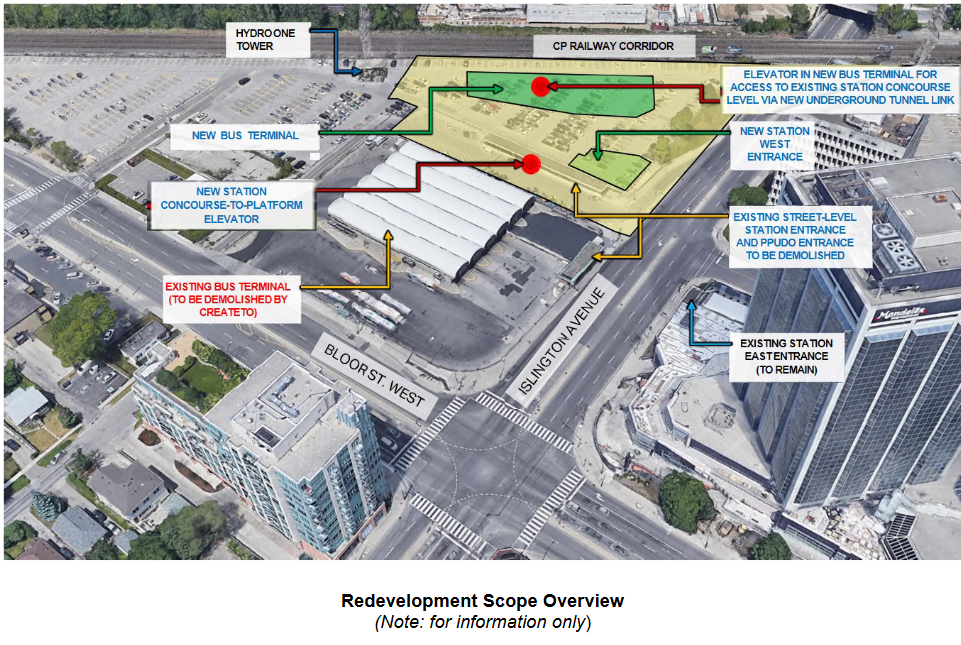
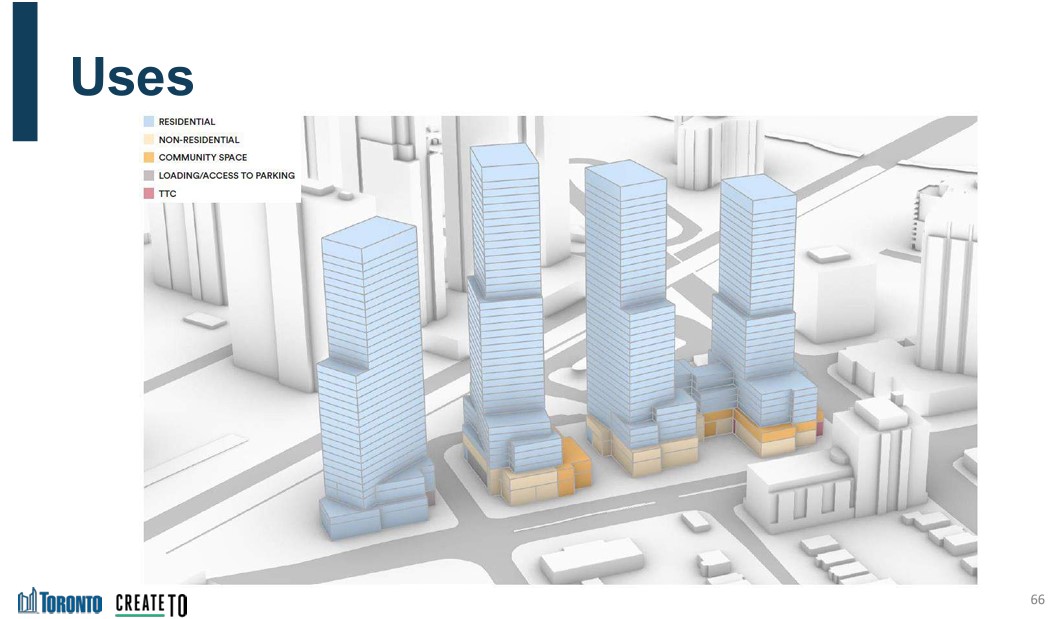
In 2021, a new plan to rebuild the station was presented to the public. It would include a new six-bay bus terminal in the commuter parking lot north of the existing terminal. Upon completion, the old bus area would be redeveloped under the city’s CreateTO housing program. Aberfoyle Crescent, which connects Islington Avenue and Bloor Street, would be extended through the station property to provide bus access and allow for development of the rest of the station property. The site is constrained by the same Hydro One corridor that stymied construction of the new Kipling terminal (much of the parking lot is under hydro wires), but this is a much smaller bus terminal, and hopefully lessons were learned this time.
Work on station construction was scheduled to begin in Spring 2023.
Rendering of new bus terminal and station entranceSchematic of the TTC station redevelopmentCreateTO development blocks at Bloor and Islington, from 2021 presentationCreate TO conceptual plan for Islington Station site
It is now mid-June 2023, and for now, there is no sign of work. Inside the station, there are no signs informing customers of impending construction, even if only to reassure passengers that the decrepit conditions are being addressed.
The many delays at Islington Station are also indictive of the difficulties of redeveloping even city-owned properties for new, much needed housing. It won’t be until 2026 — at the earliest — that new development can take place.
Until then, TTC customers must put up with a rapidly deteriorating station.
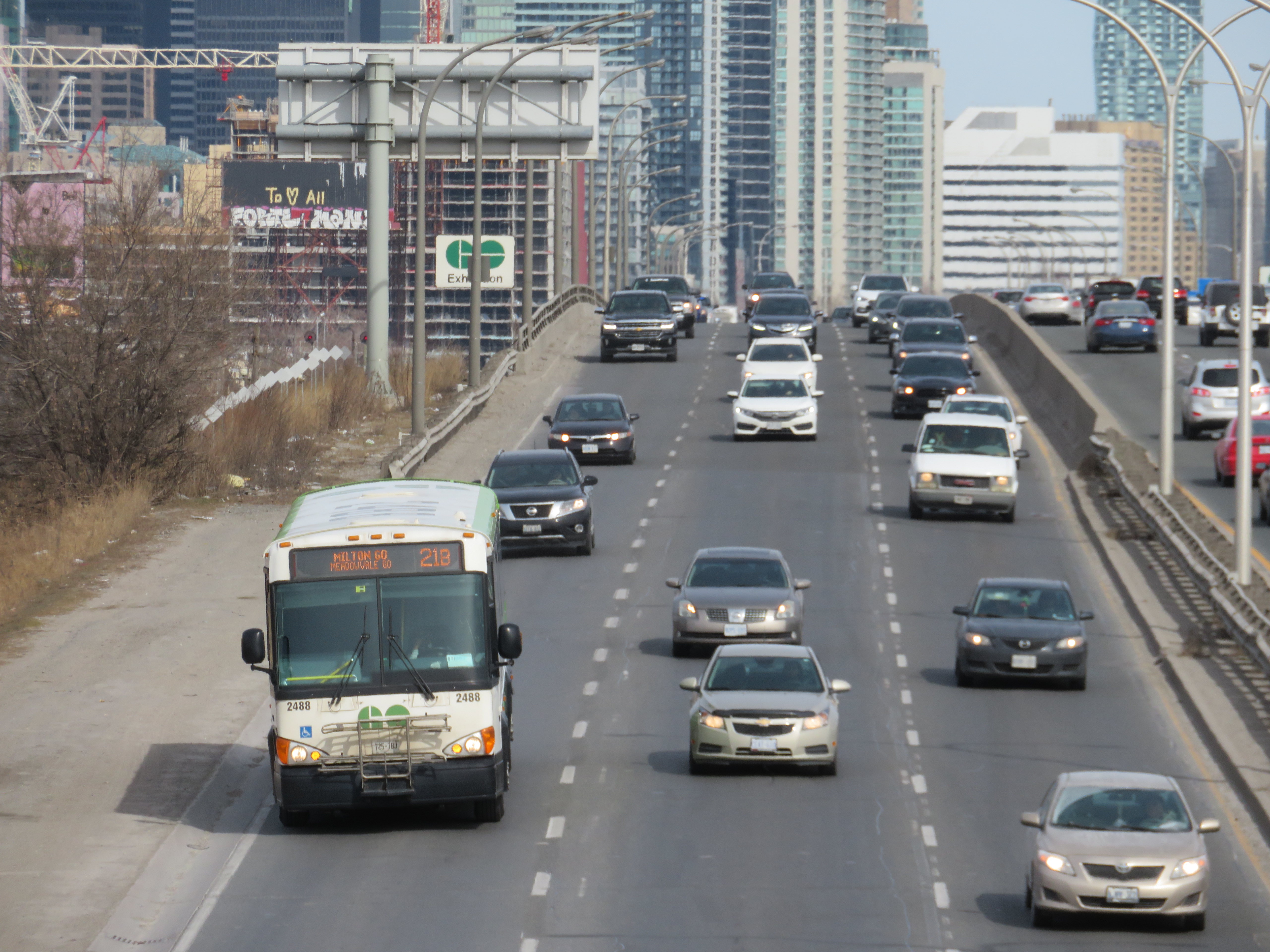
GO Transit bus on the Gardiner Expressway. Route 21 will se major changes with the new schedules
On Saturday, April 8, GO Transit will introduce big changes to its rail and bus services. Brampton and Waterloo Region will see the biggest benefits, while a major gap in Ontario’s intercity bus network will finally get filled.
However, major construction work on the Barrie and Stouffville Lines will require the bustitution of most trains on those two corridors for at least a few months. Most buses serving the Milton Line will no longer operate to or from Union Station, but instead connect with the Lakeshore West Line. Finally, one of GO Transit’s oldest bus routes will finally disappear for good.
Though the scale of these service changes is truly impressive, there are some drawbacks that hopefully will be addressed in the near future.
As part of the April 2023 changes, GO Transit will finally introduce hourly weekend service on the Kitchener Line between Union Station and Mount Pleasant GO in northwest Brampton. Most Route 31 “train-bus” trips will be cancelled, while Route 33 (Guelph-Brampton-North York) takes over the Guelph via Highway 7 service completely.
With the exception of weekday counter-peak periods, early mornings, and late evenings (when Route 31 will still operate), Brampton finally has the all-way, two-way, every day train service it has been requesting for decades. Because of schedule constraints, and limited track space, weekend trains will not be stopping at Etobicoke North.
Route 30, the Bramalea-Kitchener-Waterloo bus, will also operate 7 days a week, with an easy transfer at Bramalea GO Station. This is the fastest and most frequent service between Toronto and Kitchener-Waterloo (private intercity bus service to Kitchener are limited, and they only stop at Sportsworld, near Highway 401), and should help build ridership for future train service expansion.
Unfortunately, there remains no quick GO bus service between Toronto, Brampton, and Guelph; passengers must still endure the Route 33 milk run on Highway 7 through Georgetown, Acton, and Rockwood. Weekend service on Route 48, the Guelph-Bramalea-Highway 407 route, timed to connect to Kitchener Line trains, could provide this useful link until track capacity is improved west of Bramalea and through Halton Region and Wellington County.
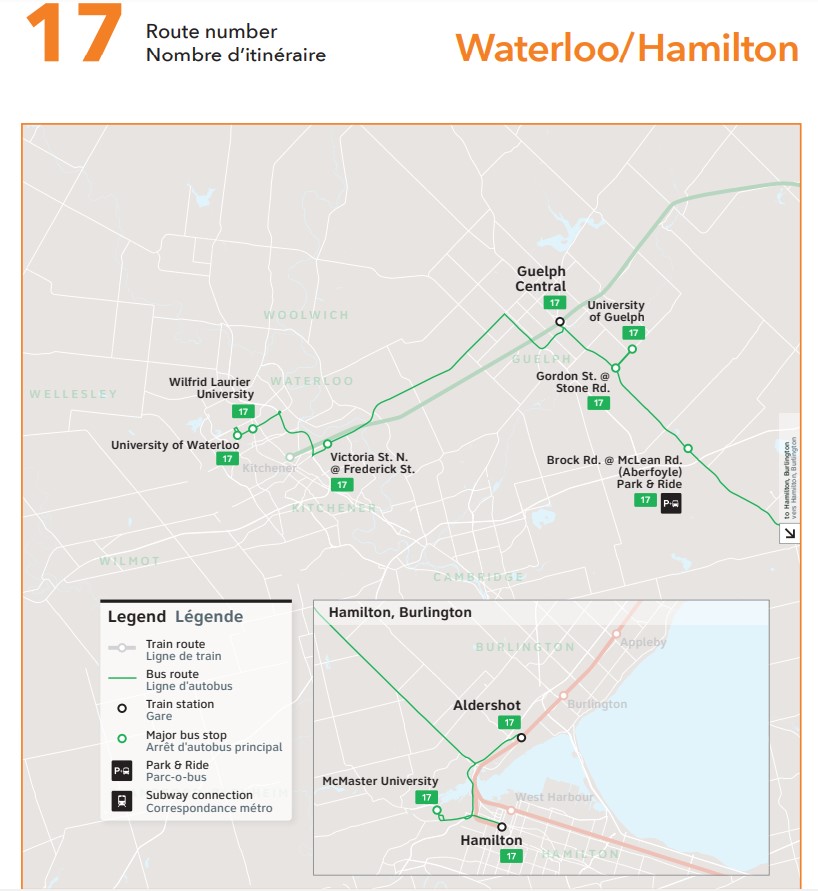
The introduction of GO Transit Route 17 between Kitchener-Waterloo, Guelph, and Hamilton is, in my view, even more significant than the new weekend train service on the Kitchener Line.
This new bus route is the first time a GO Transit service has gone against its 55-year-old business model of a Toronto-centric system, where all train services converge on Union Station, and all bus services supplement the train corridors or connect to a suburban Toronto terminal. This might even be the most significant GO Transit service change since the first Highway 407/York University bus service began in September 2000. The 407 Corridor, originally a single bus route connecting Oakville, Mississauga Square One, Bramalea, York University, and Markham, has expanded into a multi-branched 24-hour/7-day corridor that now extends to Oshawa, Guelph, and Hamilton.
Route 17, which will run hourly on weekdays, directly serves four university campuses (University of Waterloo, Wilfrid Laurier University, University of Guelph, and McMaster University), a record for any single bus route in Canada (only the TTC Yonge-University Subway serves as many university campuses in a one-seat ride). It also provides a direct Guelph-Kitchener-Waterloo link (which was only provided by infrequent Greyhound buses before 2020) and replaces former Coach Canada/Megabus routes abandoned prior to or during the COVID-19 pandemic.
Though Route 17 finally fills several gaps in the Greater Golden Horseshoe, it is, at best, a first good step.
For one thing, Route 17 is too slow to effectively serve as a great Kitchener-Waterloo/Hamilton connection. The travel time from University of Waterloo to Downtown Hamilton is between two hours and twenty minutes and two hours and thirty minutes. The typical driving time is about one hour. It is more competitive between Guelph and Hamilton, though the route diverts to Aldershot GO Station to connect with the GO Transit Lakeshore West corridor, adding 15-20 minutes of travel time over a direct McMaster/Downtown Toronto routing.
Finally, there is no weekend service offered at this point, and the new route misses Downtown Kitchener, diverting via the Conestoga Parkway, though a stop at Victoria and Frederick Streets east of downtown provides connections to several GRT bus routes. There is also a need for better connections between Cambridge and Guelph, something that GRT, Wellington County, and Guelph should work together to fix.
I am hopeful that the new hourly weekday service is attractive to students and commuters, and that ridership grows to a point that GO considers weekend service and either express runs, or a restructuring of the corridor to provide more direct services.
Route 21, the Milton GO bus corridor, provides Milton-Mississauga-Toronto service at all times except the weekday peak period direction, when GO operates seven trains between Milton and Union Station. Unfortunately, the busy Milton Corridor is Canadian Pacific’s mainline between Toronto and Chicago. Unlike CN (whose mainline is used by GO’s Kitchener Line between Bramalea and Georgetown), CP has been less amiable to GO service expansion outside the peak period window.
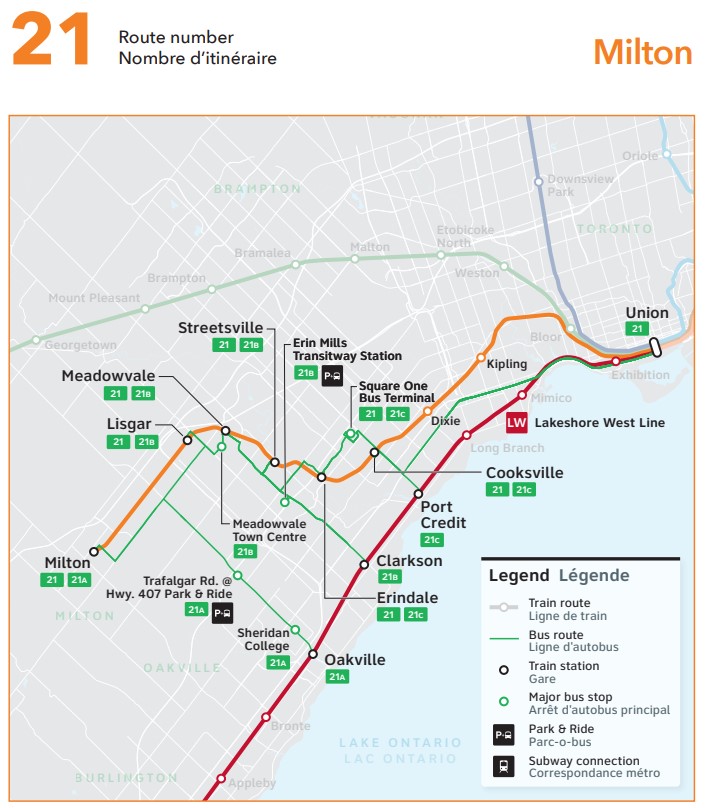
Because of passenger demand in central Mississauga, Route 21 has traditionally been one of GO Transit’s most complex routes, with ten distinct branches, with service to each station every 15-30 minutes at most times. With increasing traffic into and within Downtown Toronto, especially on summer weekends, Route 21 can be very slow and unreliable, with GO Transit forced to divert its buses on Route 21 and 31 away from its Union Station Bus Terminal to Port Credit GO.
Though weekend train service on the Kitchener Line solves the problem for Route 31, without access to CP’s tracks, Milton Line passengers must ride buses, which have to go somewhere.
The solution, then, was to permanently divert Milton Line buses to the Lakeshore West rail corridor. Route 21A will operate between Milton GO Station and Oakville GO Station, serving Sheridan College’s Oakville campus and the 407 Corridor at Trafalgar Road (allowing for new transfers from Milton to Hamilton/McMaster and Mississauga/Pearson Airport). Route 21B will run from Lisgar GO, serving Meadowvale GO, Streetsville GO, and Erin Mills Transitway Station before connecting to trains at Clarkson GO. Route 21C runs between Erindale GO, Square One, Cooksville GO, and Port Credit GO. Only during early mornings and late evenings will Route 21 serve Union Station, making all stops to and from Milton.
Dixie Station also loses its weekday Route 21 service. The station is not well connected with local transit nor is it in a walkable area, so it is completely dependent on drive-up traffic. That should be fine for commuters who can rely on the regular train schedules, and who don’t need to leave Toronto early or late, but it worth pointing out.
These changes simplify Route 21, and provide a reliable and predictable, albeit slower, connection to Downtown Toronto. They provide new connections to the busy Highway 407 bus corridor, and allow GO to divert buses and drivers to other services.
One thing GO can do to improve the utility of its realigned bus service is operate the new branches at all time periods to maximize ridership. For example, Route 21A, while providing new useful links between Milton, the Highway 407 corridor, and Sheridan College, does not run in the peak direction when the Milton Line trains are running, with no southbound buses from Milton to Oakville between 5:03 AM and 9:28 AM. A similar gap exists northbound in the late afternoon on weekdays.
Other changes
The Stouffville Line, which enjoys hourly train service seven days a week, goes down to just peak period rail service starting April 8. Work to double-track the corridor through Scarborough has been continuing, albeit slowly, so hopefully the suspension of off-peak trains will help speed up construction. Work to expand the Lakeshore East/Stouffville corridor through Toronto’s east end has also forced train service reductions between Toronto and Oshawa.
Route 81, one of the older bus routes in GO Transit’s network, will finally disappear. The bus route, connecting Whitby GO Station, Port Perry, and Beaverton, has seen low ridership, with alternative service provided by Durham Region Transit’s Route 905 to Port Perry and DRT’s rural on-demand service.
Finally, though they are not amongst the major upcoming changes, GO Transit’s services to Orangeville and Peterborough remain inadequate. Route 37, between Brampton and Orangeville, still does not operate on weekends, nor is there a morning northbound bus from Brampton. Ironically, there is better service leading north from Orangeville towards Shelburne, Dundalk, and Owen Sound operated by Grey County’s rural bus system.
Meanwhile, Route 88, which connects Oshawa GO Station with Peterborough and Trent University, was diverted several years ago to serve Bowmanville, replacing since-cancelled Route 90. Unfortunately, this results in a long, nearly two-hour bus ride between Oshawa and Trent University, or four hours between Toronto Union Station and Trent. The drive, with moderate traffic, is less than half that. Though Rider Express now operates a bus from Toronto to Ottawa via Peterborough, it only runs once a day, four days a week.
It would be great if GO Transit could speed up Route 88 to make it a viable and attractive option between Toronto, Durham Region, and Peterborough.
Finally
On the whole, I am pleasantly surprised by GO Transit’s April service changes. Weekend service on Route 30 and the new Route 17 between Hamilton, Guelph, and Kitchener-Waterloo close some major gaps in that part of the province. The Route 21 changes make a lot of sense and open up new connections, though many bus passengers will not be happy with the new forced transfer to get to or from Downtown Toronto. Though bustitutions on the Barrie and Stouffville Lines are not ideal, they will allow for important work to improve rail service on those two corridors. Finally, attention to bringing faster and fuller service on some bus routes – like 21A, 37, and 88 will help build a complete transit network across the Greater Golden Horseshoe.
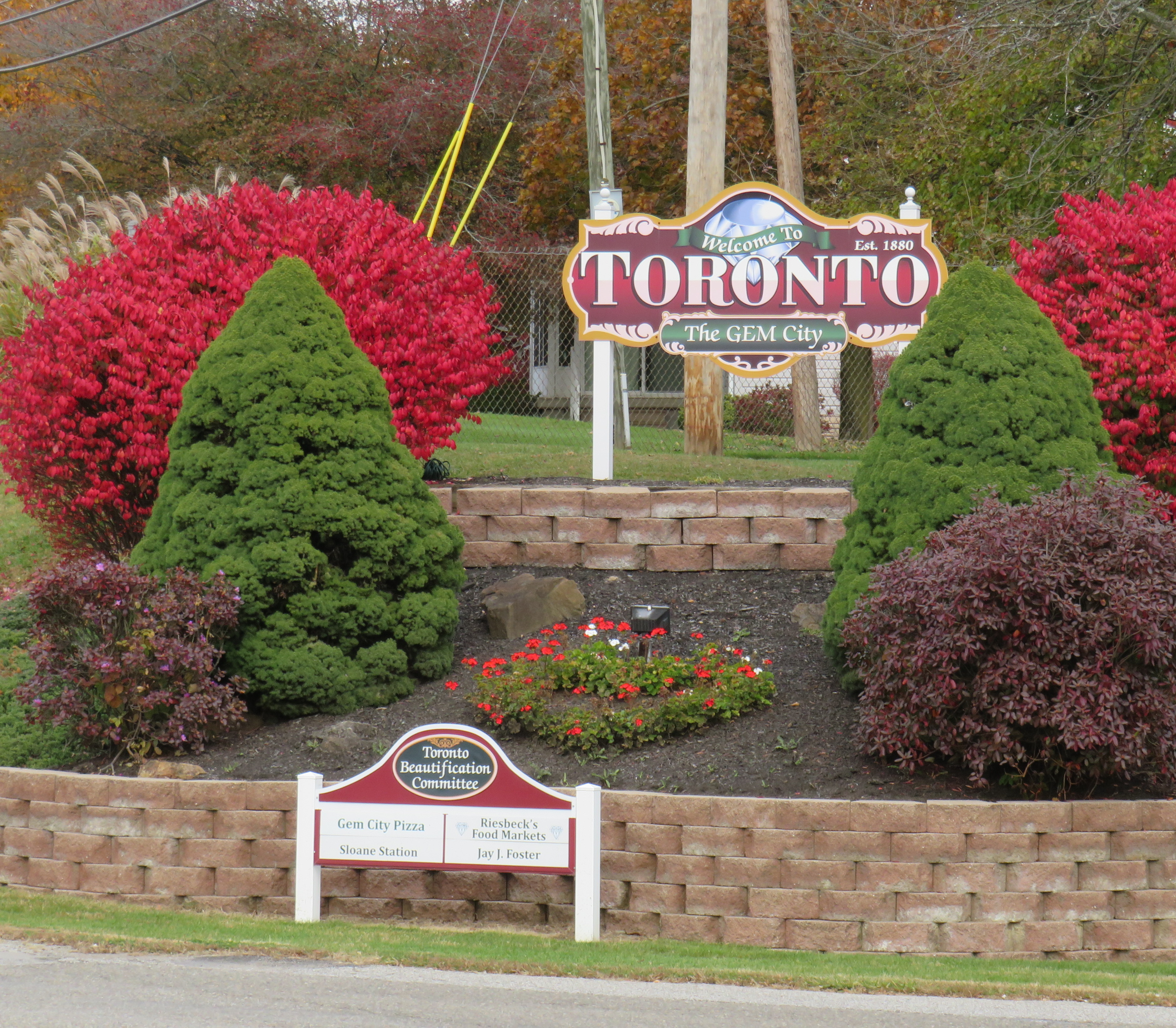
The small Ohio community was originally named Sloan’s Station, but when it was incorporated as a city, they chose “Toronto” because local businessman W.F. Dunspaugh, a Toronto (Ontario) native, thought his hometown was “a place worth emulating.” Toronto, Ohio is the only other city named Toronto, but other Torontos exist, including the town of Toronto, South Dakota (population 212) and the town of Toronto, New South Wales, Australia (population 5,161).
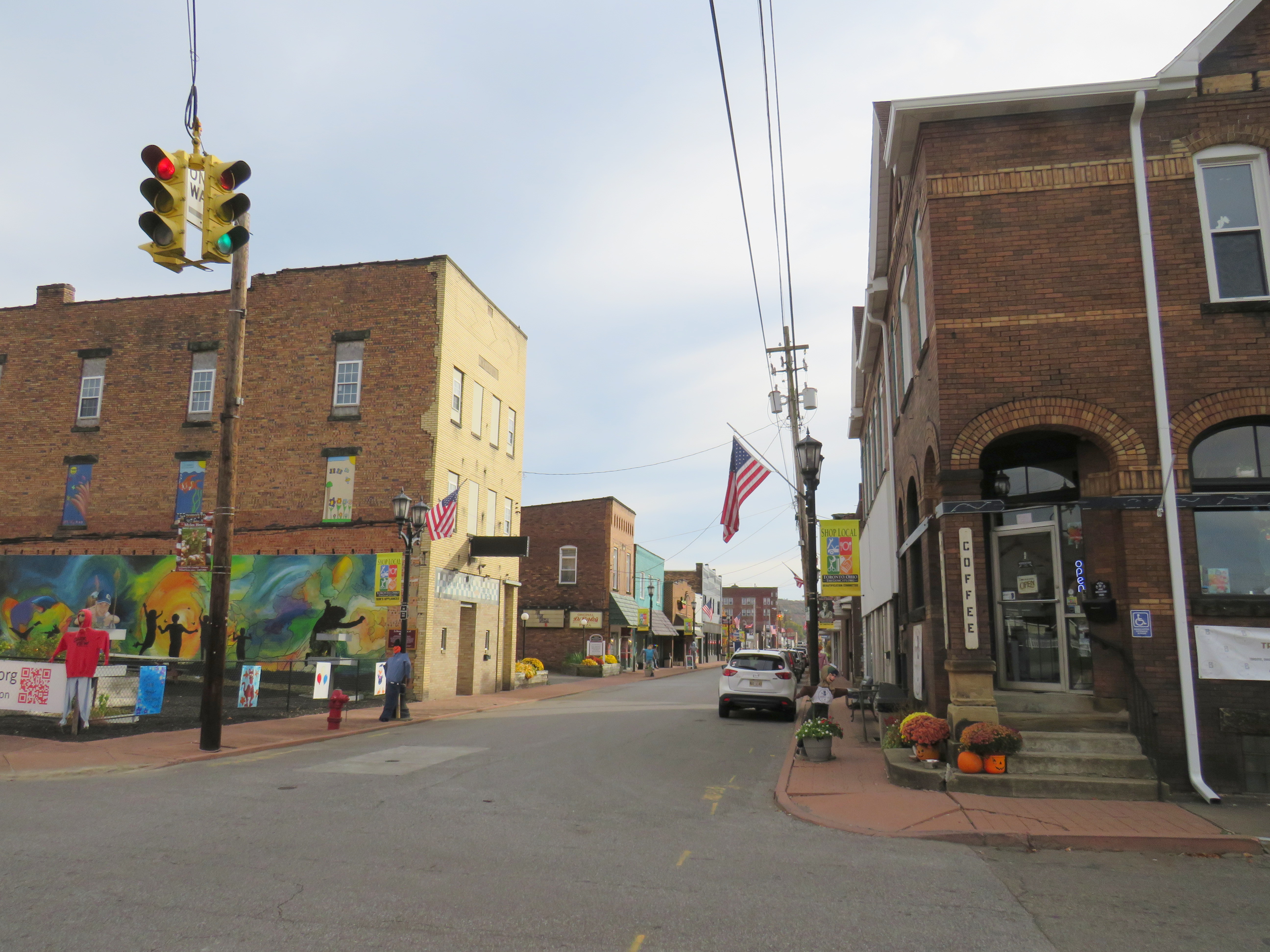
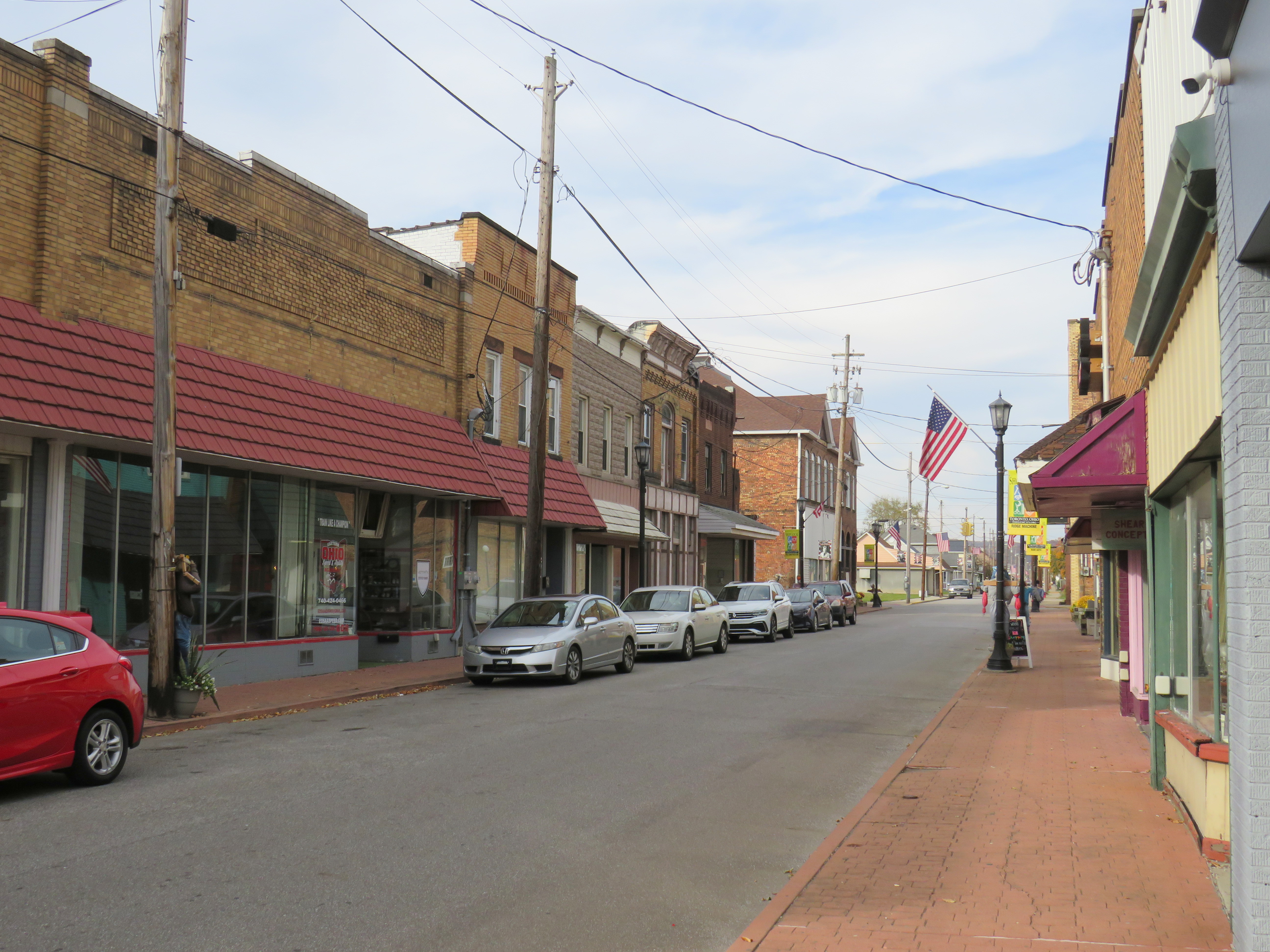
In 2012, Downtown Toronto had only a handful of stores, including a Dollar General, a bar, pizzeria, a Hallmark gift shop, and a hair salon. Apart from the bar (which I went into ten years ago), those businesses are still there today, but there was also a new barbecue restaurant, and a coffee shop. Up the street, a disused auto shop was transformed into a pretty good taco joint. Though downtown wasn’t especially busy, the parking spots along 4th Street were mostly full.
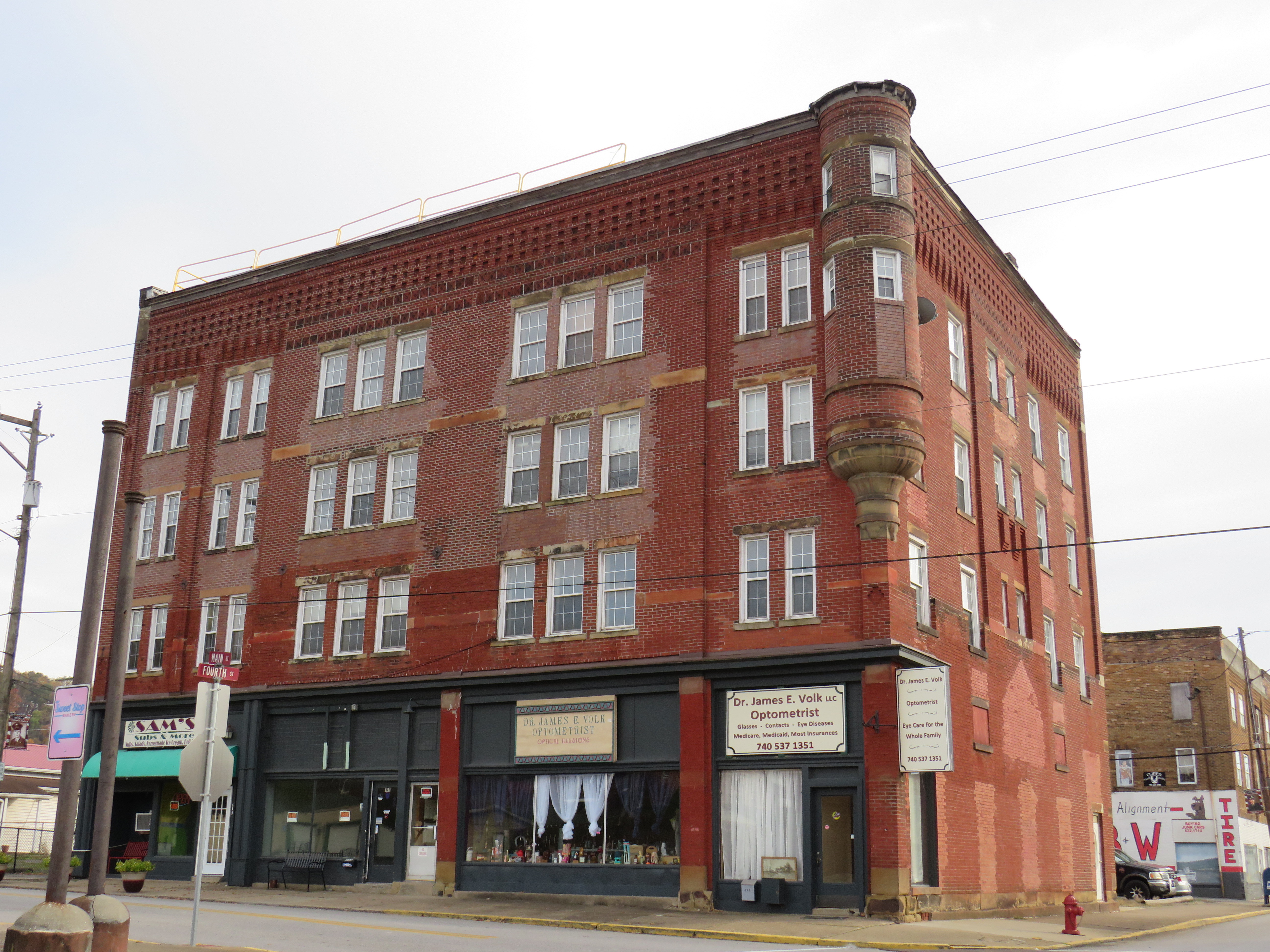
Downtown Toronto. A community garden sits on a vacant lot on the corner. 4th Street, Toronto’s main street The old hotel, now shops and apartments
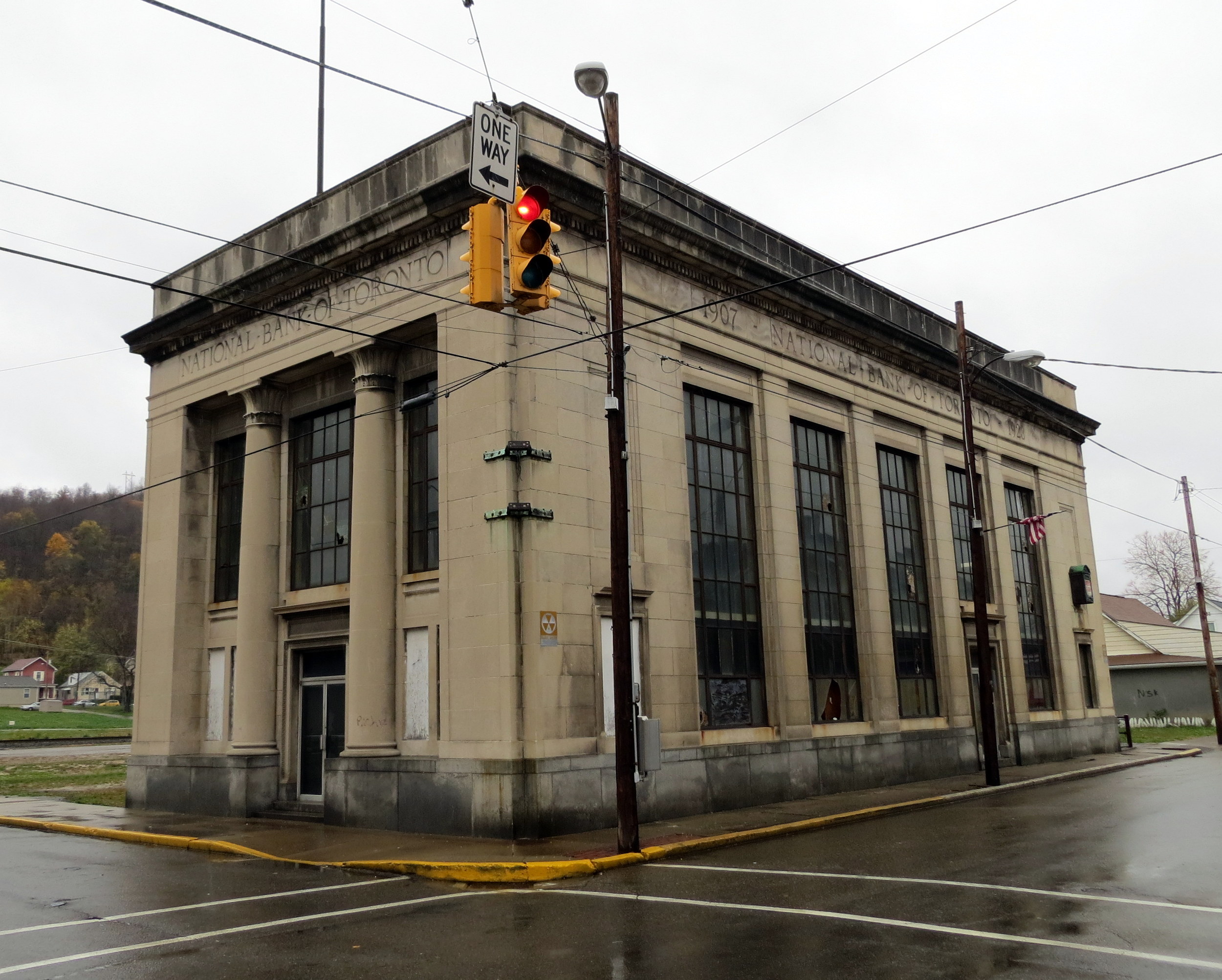
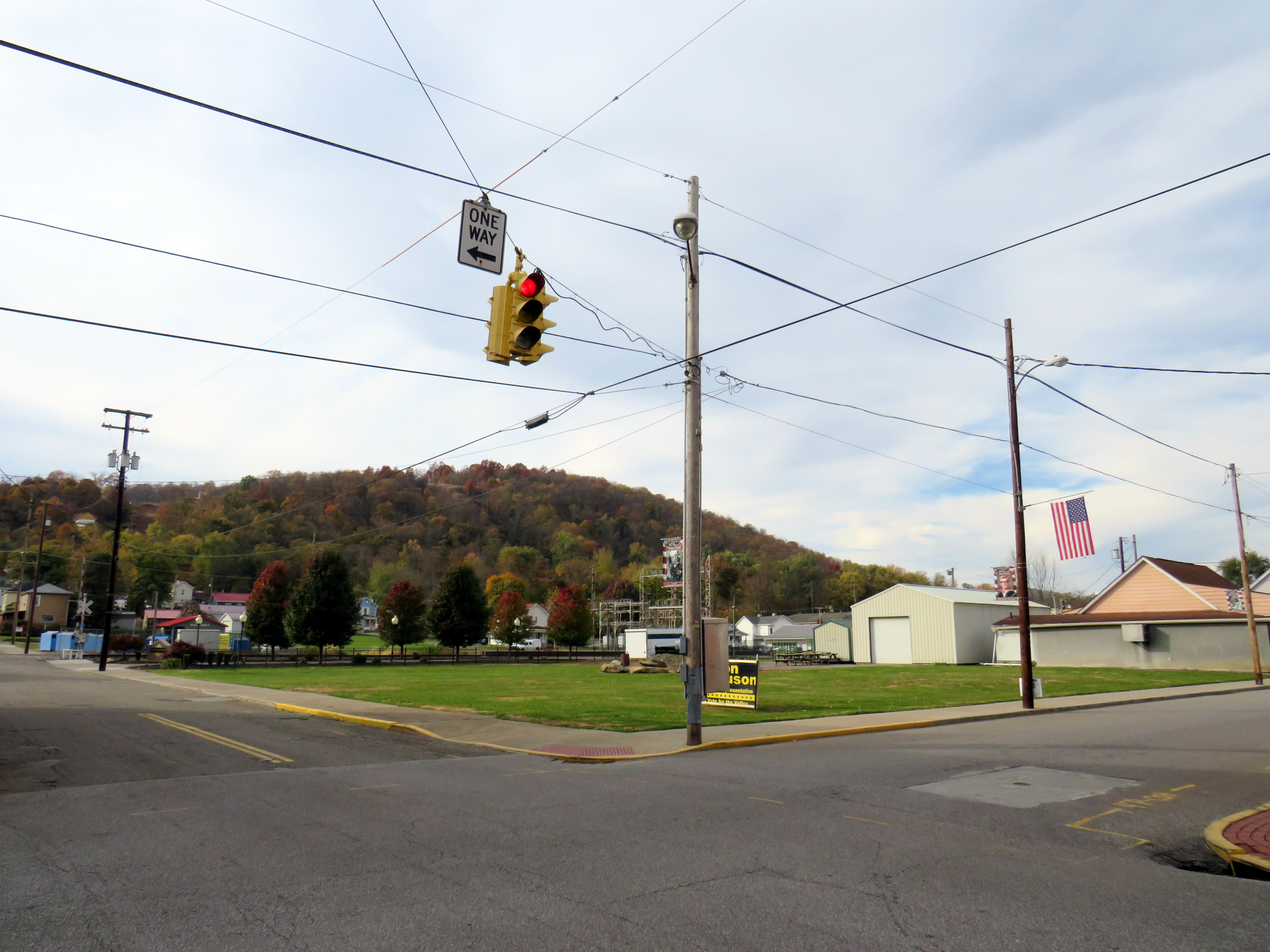
Sadly the abandoned, yet still handsome National Bank of Toronto building was torn down a few years ago. Otherwise, Toronto continues to hold its own, with a well-kept little downtown and more places to sit and eat than before.
Former National Bank of Toronto, October 2012Site of the former National Bank of Toronto, October 2022
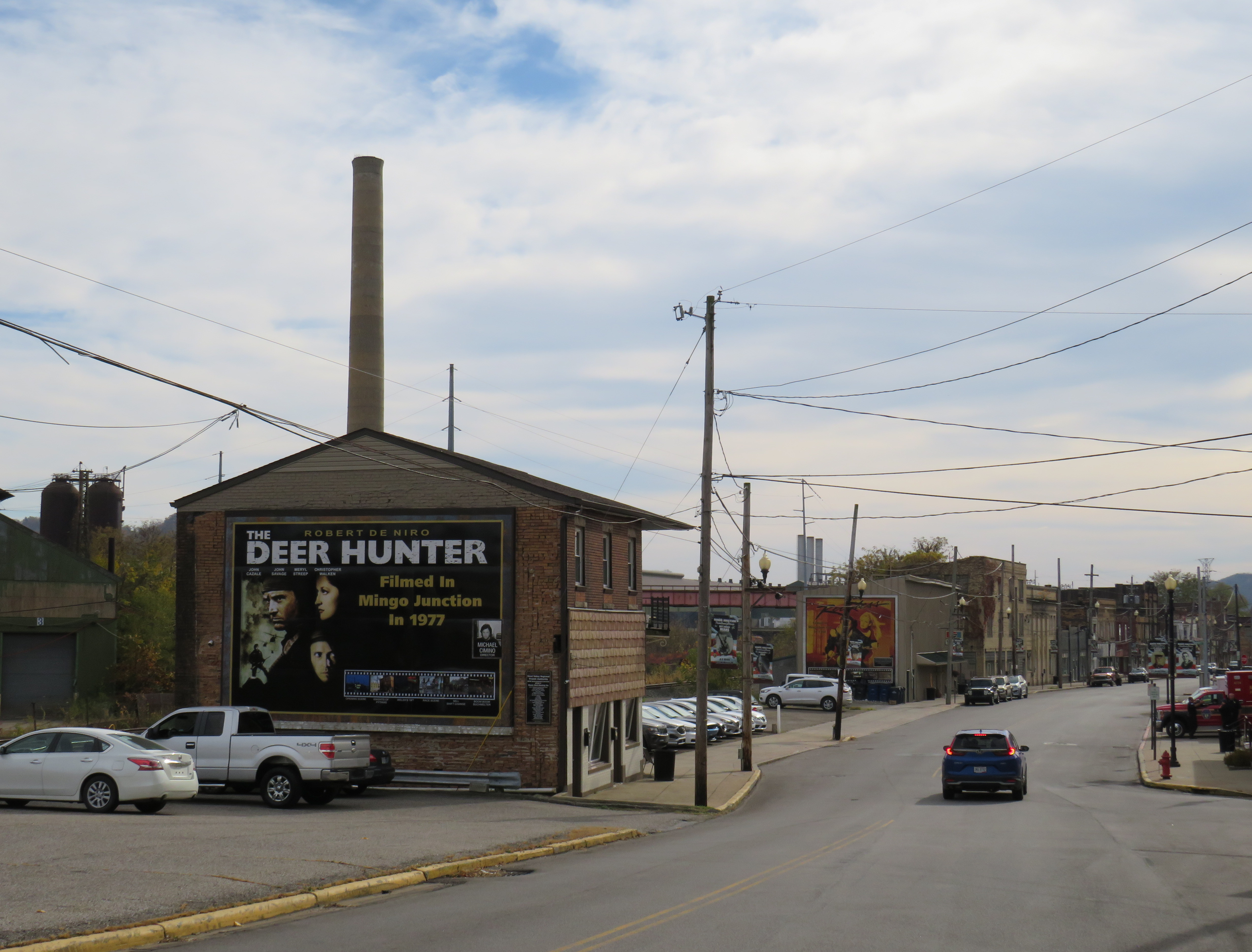
Just a few miles to the south is the town of Mingo Junction, Ohio, one of many industrial communities along the Ohio River in Pennsylvania, West Virginia, Ohio, and Kentucky. Mingo Junction is best known as a filming location for movies including the acclaimed 1977 film “The Deer Hunter.” The town now celebrates its cinematic history with large vinyl signs displayed on the north end of Mingo Junction’s main street.
Large sign celebrating the filming of “The Deer Hunter” in Mingo Junction, Ohio
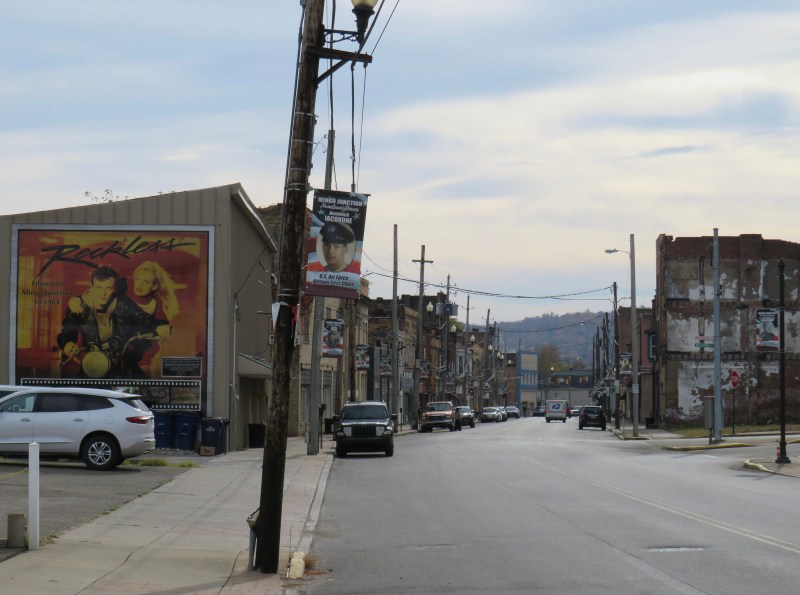
While Toronto’s economy is based on a still-busy titanium mill, Mingo Junction is a old steel town, hit hard by the deindustrialization of northeast Ohio in the 1970s and 1980s. The condition of its Main Street
Mingo Junction’s Main Street, bypassed by a newer expressway. Another mural celebrates “Reckless,” a 1984 film also filmed in town.
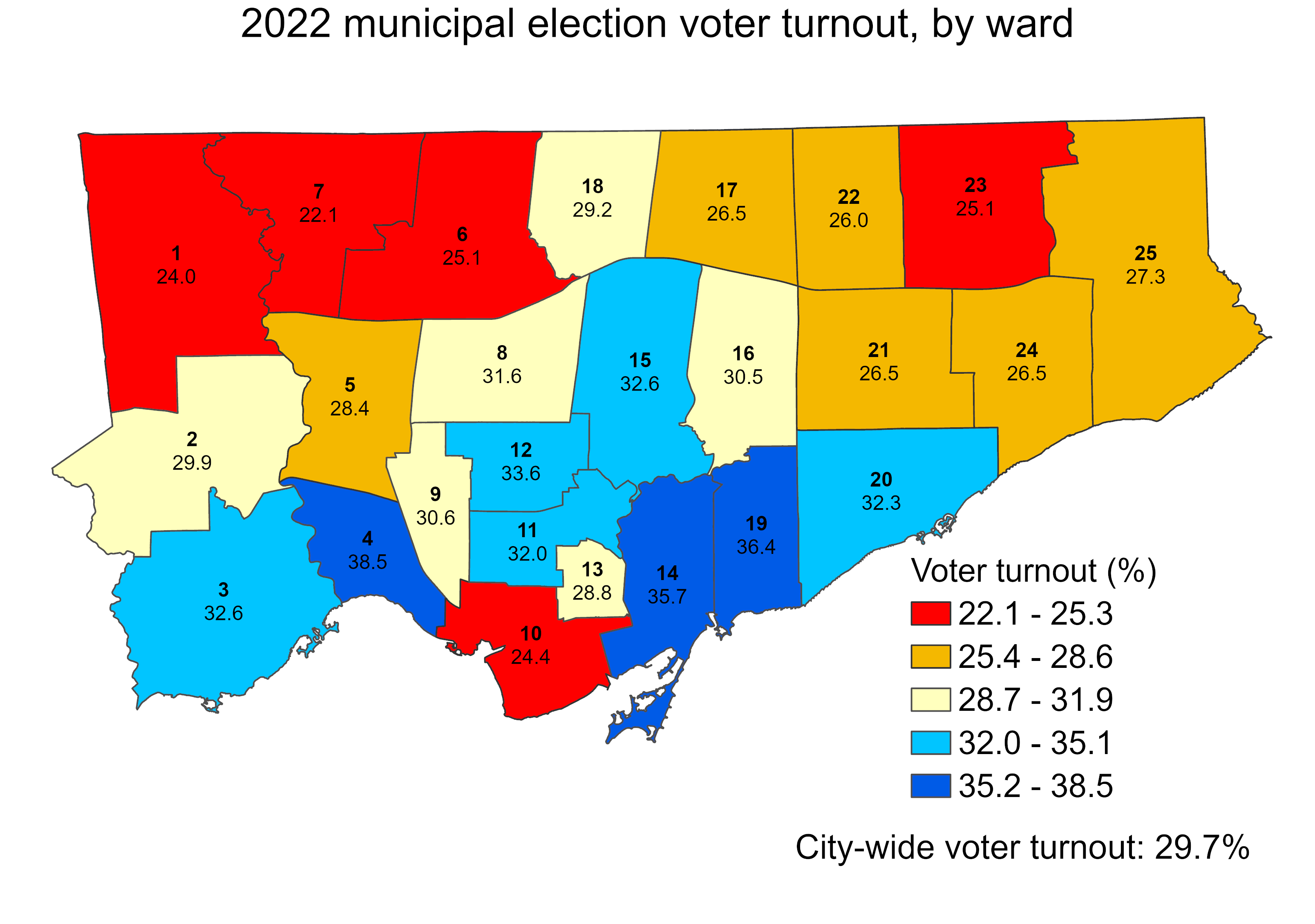
Ever since John Tory was elected mayor of Toronto in 2014, voter turnout in municipal elections has been in decline. In 2010, the year Rob Ford was elected mayor, turnout was 50.4 percent. Four years later, 54.7 percent of all eligible voters went to the polls to elect a new chief magistrate. However, in 2018, just 40.9 percent bothered to vote, and in 2022, turnout fell further, to just 29.7 percent.
With the recent release of detailed voter statistics from the 2022 municipal election in the Toronto Open Data catalogue, it is now possible to see how much turnout dropped in each ward.
I dig deeper into the last election’s dismal showing, and what it might mean for the upcoming mayoral by-election, at Spacing Toronto.
Who knew, just two weeks ago, that Torontonians would be returning to the polls to elect a new mayor of Toronto?
Looking back on John Tory’s last eight-and-a-half years in office, the biggest disappointment might have been that he spent so little of the political capital that he had accumulated after decades as a backroom power broker, corporate executive, provincial party leader, talk radio host, and supporter of NGOs such as CivicAction and the United Way. Despite his promise as a business-friendly, progressive conservative leader who knew how to build partnerships and work with other levels of government, there’s little to show for it. SmartTrack? That was always a fantasy which has now been mostly forgotten. An improved public realm, including a new Rail Deck Park? That never happened either. Heck, we can’t even get a decent WiFi connection in the subway, never mind a cell signal, despite the mayor’s close ties with the telecommunications industry.
To be fair, there are a few things one can point to that got done during Tory’s tenure: new bike routes on Bloor-Danforth, Yonge, and University Avenue, some improvements to the TTC surface network, the King Street transit priority pilot, and surprisingly good pandemic responses, including excellent city-run vaccine clinics, weekend street closures for active transportation, and new street-level patio space to help restaurateurs recover from pandemic shutdowns.
But in 2022, the ActiveTO street closures faded away, partially due to influence from the Toronto Blue Jays management (note: the baseball team and its stadium are owned by Rogers), the King Street transit priority corridor deteriorated from neglect. As the homelessness crisis worsened, Tory and his allies backed repressive and violent clearances of public parks, without supplying enough alternatives for housing or supporting the most vulnerable in this city. A series of municipal budgets in which property taxes were kept low while other expenses piled up has caused this city to become reliant on the support of the province and federal governments to bail us out.
With Tory gone — brought down by his own error in judgment — we will have thirteen lost years in which Toronto will have to catch up. That’s a tall order.
I can’t claim to have all the answers, but I have a few ideas to share to help make Toronto a safer, more fun, more comfortable, and more humane place to live. If I were a mayor with strong powers, here’s what I would do:
A progressive property tax system. An unfortunate reality for Ontario municipalities is that they have very limited tools for raising revenue: property taxes, user fees (like TTC fares and recreation fees), and in Toronto’s case, vehicle registration fees. Municipalities are also given grants from the province and federal government for specific purposes, such as providing mandated services. Unlike sales, income, and business taxes, property taxes do not grow with the economy, so municipalities must raise the property tax mill rate every year to keep up with inflation and/or fund new or expanded services. However, no matter the assessed worth of the property, the tax percentage remains the same.
A progressive property tax system can be used then to raise more money from higher-valued properties. For example, for residential properties, a basic tax rate could apply for the assessed value up to $1 million. Beyond that first $1 million, a higher bracket comes into effect. Such a policy could minimize tax increases for those in smaller or starter homes. To encourage the construction of secondary suites, high-value properties could then get tax breaks for every additional self-contained unit on site, provided they are inspected and meet fire code. A progressive property tax system could help raise revenue, encourage the construction of more housing units, and provide a more equitable revenue source.
A real Vision Zero plan. Putting up “Senior Safety Zone” signs and lowering speed limits on four and six lane streets does little when the roadway remains designed for high speeds, and motorists race through intersections with limited enforcement. To protect pedestrians and cyclists (as well as other drivers and their passengers), the roads themselves must be re-engineered for lower speeds. This means “daylighting” pedestrian crossings by ensuring crosswalks are always well-lit, crosswalks raised where possible to improve visibility and curbs extended to both reduce the amount of roadway that pedestrians must cross, and signal to drivers to slow down. Furthermore, a blanket right-turn-on-red prohibition, like those in New York, Montreal, and Mexico City, would eliminate a common cause of pedestrian-motorist collisions and make those new leading pedestrian intervals at Toronto’s street corners fully effective.
Prioritize transit and clean up the TTC. When I say “clean up the TTC” I don’t mean throwing more cops at the problem of safety on our subways, streetcars and buses. Under CEO Rick Leary’s leadership, it feels as if the TTC has given up on many of the gains brought forward by Andy Byford. Customer service has fallen by the wayside, wait times have increased, the streetcar network is faltering with trams running slower than ever before, communications have become unreliable, and customer confidence in the system has fallen. When customers no longer feel valued, they themselves give up.
After cancelling upcoming service cuts contained in Tory’s last budget, one of the easiest things to do to show that transit riders matter is making King Street great. This means installing permanent streetcar platforms in the curb lanes along the streetcar priority zones and making it even more clear that drivers are prohibited from using King as a throughway. Eliminate the night time taxi exception to simplify signage, and automate enforcement with video cameras mounted at intersections and on streetcars themselves, as is done on some Select Bus Service routes in New York.
Haffiz A., via Twitter, shows how King Street could look:
The TTC also needs to modernize its street railway infrastructure so that streetcars no longer have to stop and crawl across every track intersection. Electric dual-blade junctions and wayside signals — used just about everywhere else — allow streetcar operators to know which way the track is pointed ahead of the intersection and can allow streetcars to glide through junctions at regular traffic speed.
Finally, get TTC staff and all councillors riding the TTC on a regular basis. Meet passengers. Let them know they matter, and inform them of improvements, and be visible.
Build affordable housing. Lots of it. Use increased revenues from the progressive tax system proposed above to build more affordable housing directly (instead of just relying on market solutions like inclusionary zoning), including the co-operative home model. While doing so, shame the provincial and federal governments for pulling out of funding new construction in the 1990s. The city owns lots of land in good areas, such as Green P parking lots, TTC stations, works yards, suburban office spaces, and even on parts of municipal golf courses, which, of course, should be converted to general year-round public spaces.
Stand up to the bullies at Queen’s Park. One of Mayor Tory’s biggest failures was to ignore the province’s meddling in Toronto’s affairs and impose the province’s unpopular plans upon the city. This city should have the right to decide the composition of its own council; there was not nearly enough protest from city leadership when Doug Ford forced a cut in council from 47 to 25 (which will likely go down to just 24 in 2026) after an unprecedented level of public consultation in shaping the approved boundaries. Instead of waiting forever for a ministerial zoning order that was never going to come for a modular housing project in North York, real leadership would have gotten it built, the province be damned. Call their bluff.
Meanwhile, Premier Doug Ford — the man Tory beat to become mayor in 2014 — is imposing his own ideas on Ontario Place, provincially owned public lands on Lake Ontario. If one could not get Rail Deck Park built, Ontario Place could have been the site for a renewed public realm, much like some of New York City’s new waterfront parks. Some vision, some willingness to spend political capital, and a good advocacy campaign could have stopped the plans for an overbearing private megaspa that effectively closes off major portions of our public waterfront.
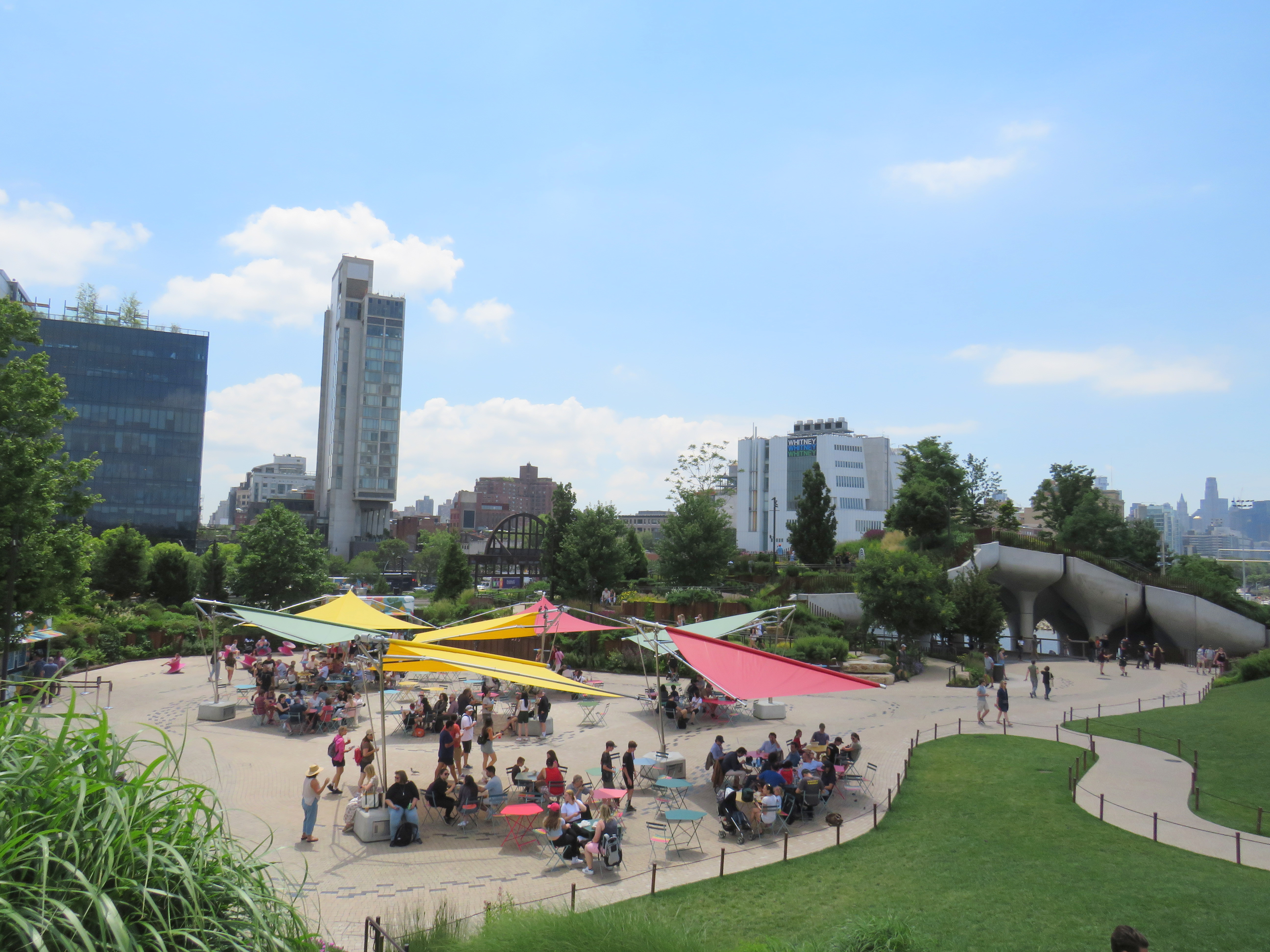
New York City’s “Little Island” could have been an inspiration for a renewed Ontario Place
There will be some people who will be happy that I am not serious about running for mayor. For one, I don’t have the people skills, the connections, nor the energy to make a serious bid. But if I see some of the ideas suggested above make it into a mayoral platform, I would not be above making a personal endorsement.










 Sean Marshall