Though much of the information I received was redacted, I was able to learn that the Cities of Brampton and Mississauga had already come up with a brand for the new transit line. Metrolinx and the provincial government had to reimburse them for the costs once the Minister of Transportation intervened to force a new name upon the project, which cumulated with a love-in photo op on February 14, 2022.
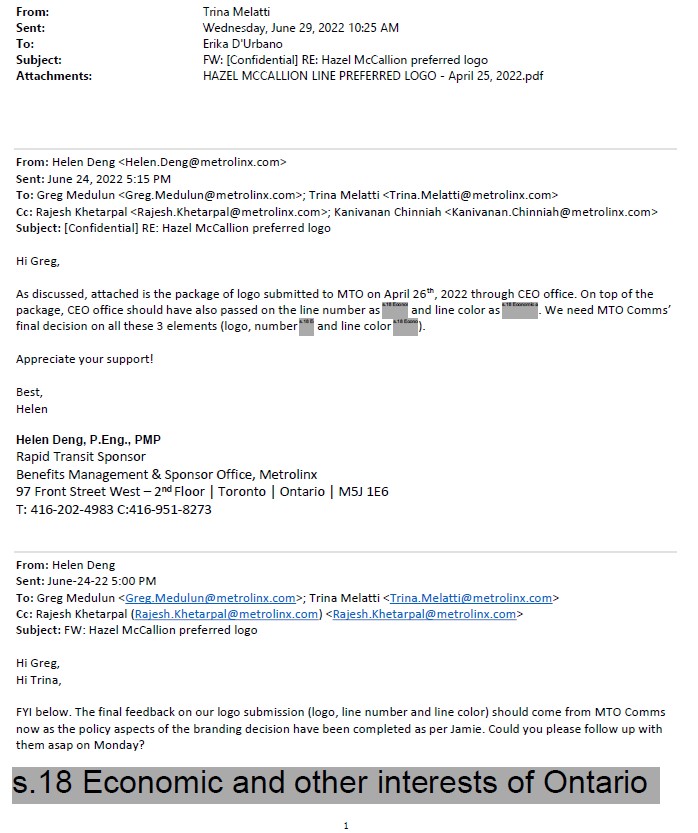
Among the information redacted in the information package sent to me, six months after my initial Freedom of Information request, was the LRT line’s colour and number. They were redacted under Section 18(1) of the provincial Freedom of Information and Privacy Protection Act, citing economic and other interests of Ontario.
Redacted line colour, number, and logo
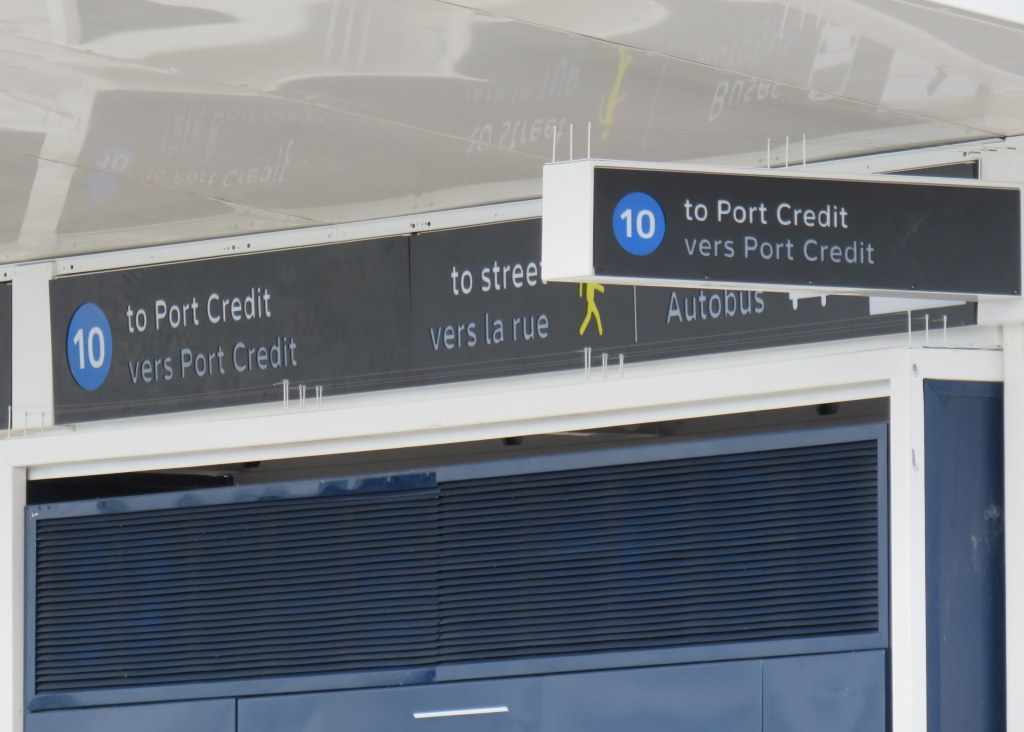
At Derry Road, though, the secret is out. The Hurontario Line will be Line 10, represented by a bright blue colour similar to the former Line 3 Scarborough RT.
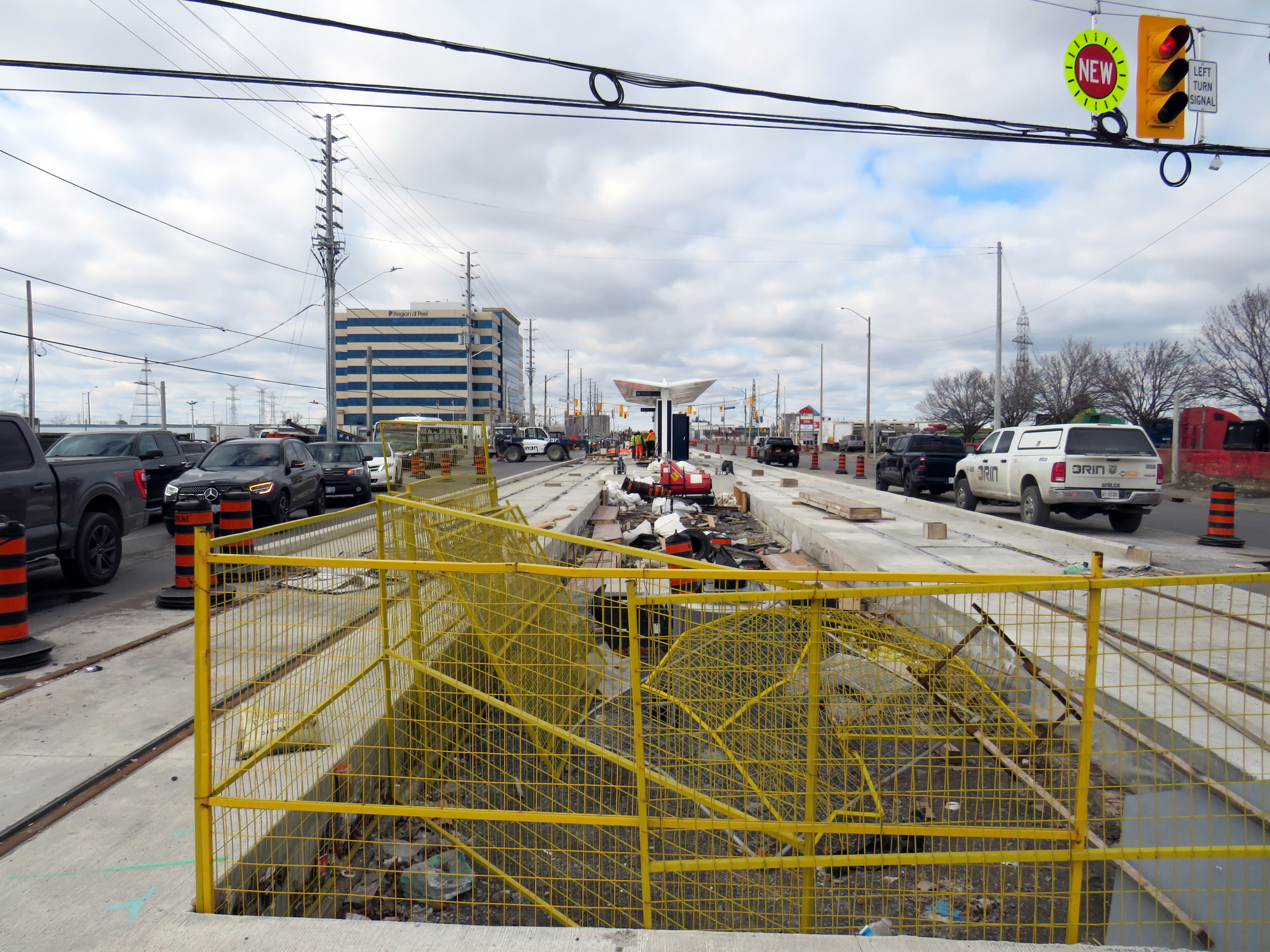
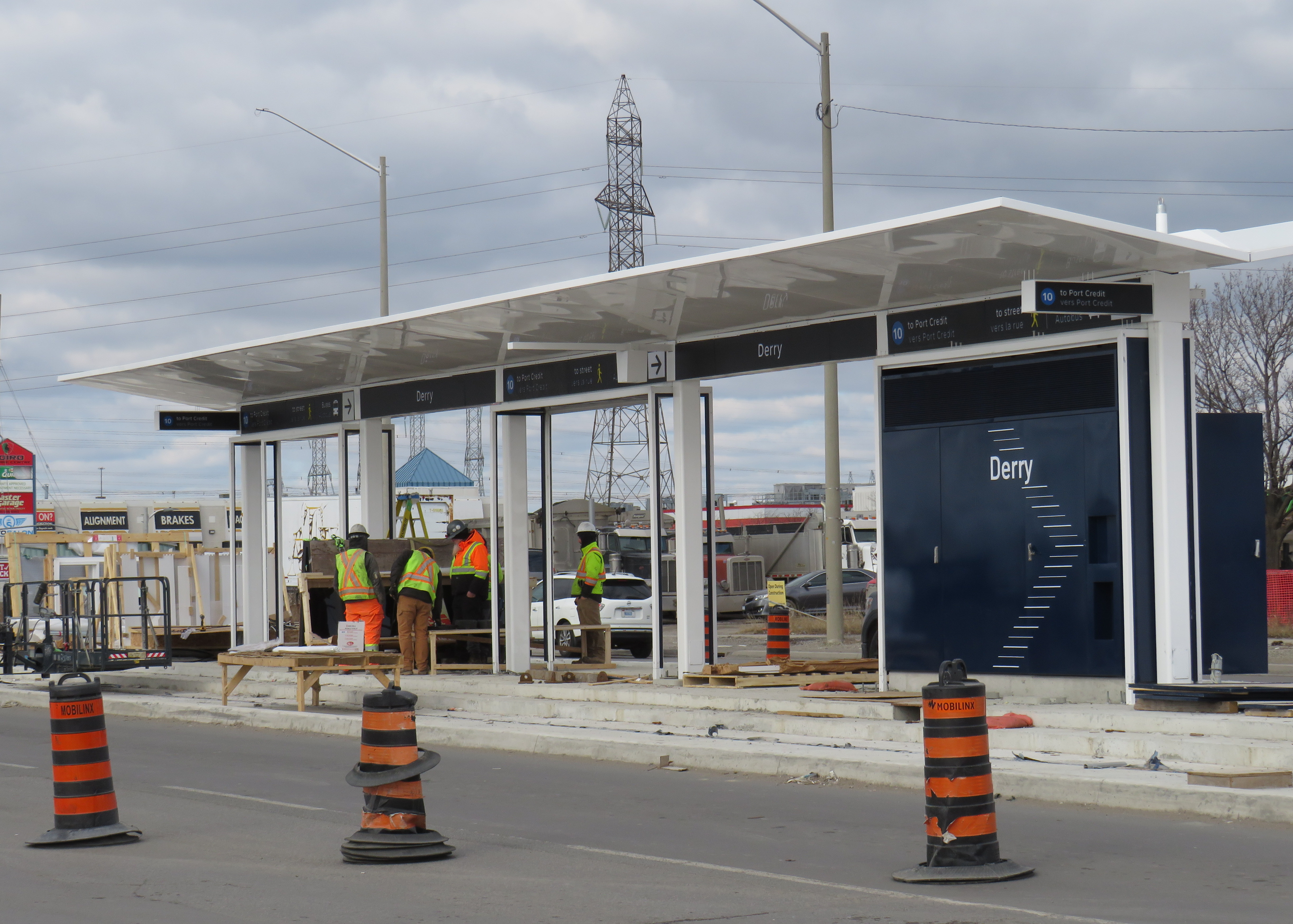
Derry LRT station under construction
Line 10 is a good choice for this corridor. Hurontario Street and Main Street through Mississauga and Brampton used to be part of provincial Highway 10, which was later bypassed by Highway 410 and downloaded to the two cities between the 1980s and the 2000s. It will also be the first Metrolinx-managed rapid transit project completely outside the City of Toronto, where Lines 1 through 6 are already assigned to the existing subway and the Eglinton-Crosstown and Finch West LRTs (with Line 3 reused for the Ontario Line when it opens).
Brampton Transit and Miway currently operate bus services with that route number (10 South Industrial and 10 Bristol-Britannia), but those should be easy to change in advance of the LRT’s opening, which will take place in late 2025 or early 2026, given the construction progress so far.
I remain puzzled and somewhat annoyed that this information was kept secret, and for what reasons. Revealing a line number and colour in a freedom of information request should not have been important. If it was to protect for another government photo opportunity, then that is now moot. Who is the Hurontario LRT for? The Doug Ford-led provincial government, or the people who will ride it?
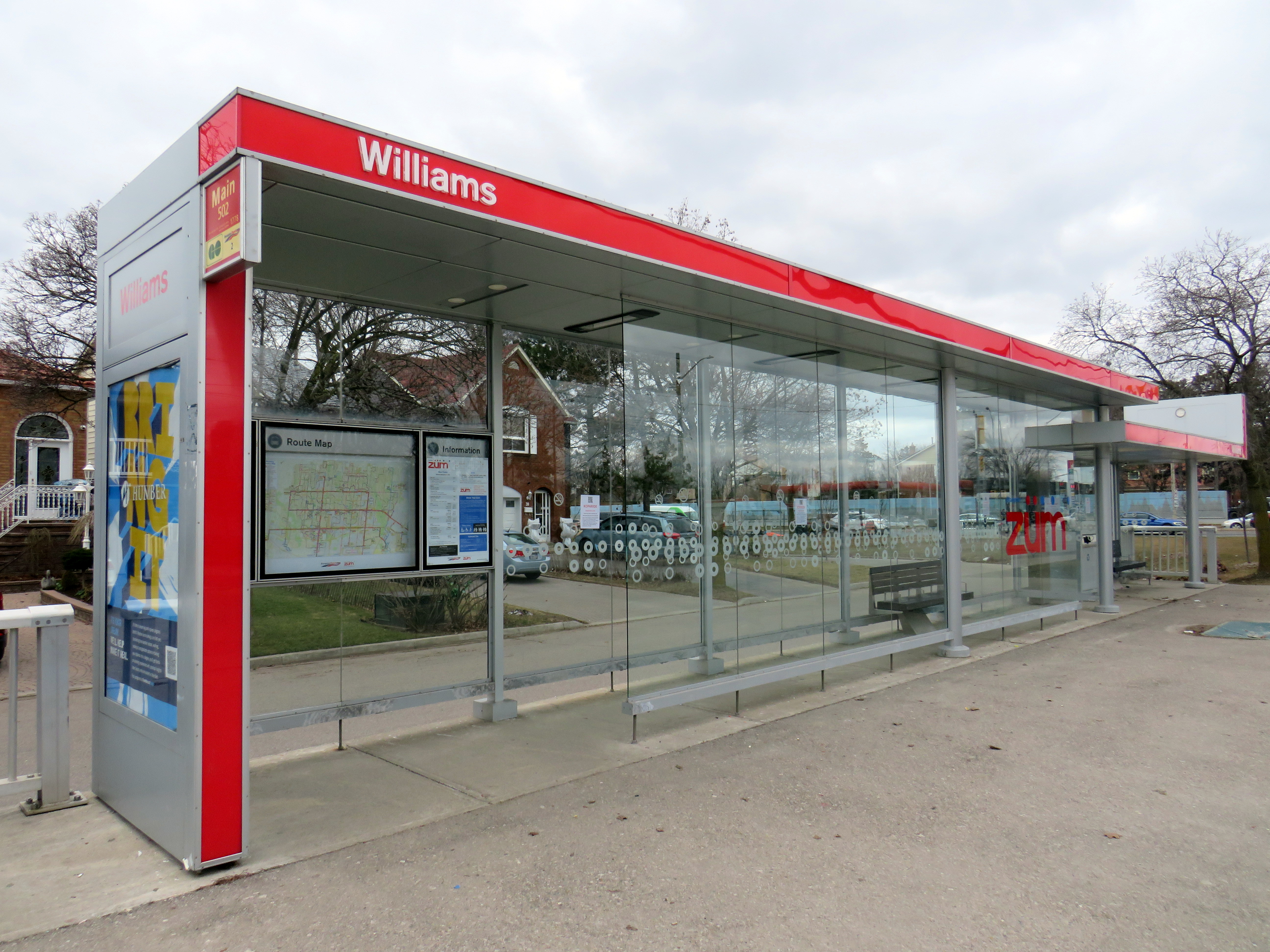
Finally, I note that like the shelters going up for the Finch West LRT and the surface stops of the Eglinton LRT, there is very little protection from the elements at the Hurontario LRT stops, with only a canopy and a single wall supplying shade and cover from the rain or snow. Compare the Derry Road LRT stop with older Brampton Züm shelters, which include enclosed waiting areas, benches, and even winter heating.
Brampton Züm stop with full glass enclosure, benches, and a button to activate a heater in the winter
One more thing…
To my longtime followers as well as my occasional readers, thank you for your interest and support. Last year’s FOI request cost me $525.00. Sadly, freedom of information isn’t free. If you like my work and want to contribute to my online mapping and webhosting costs, please consider buying me a coffee.
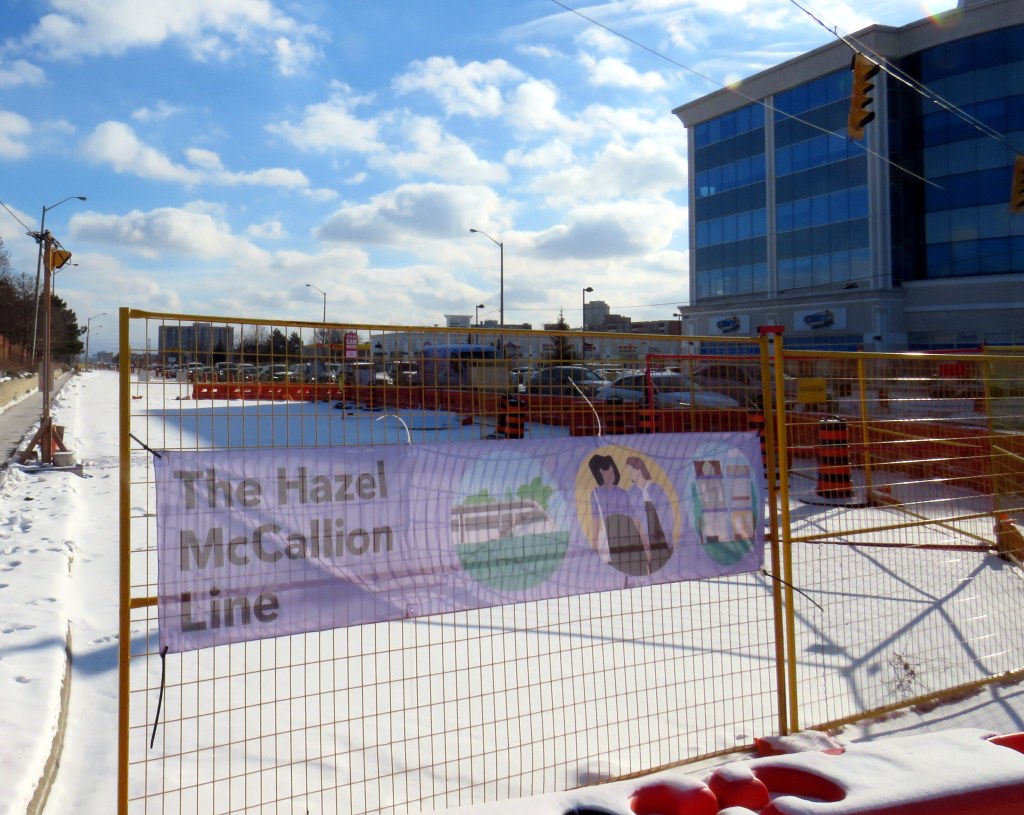
Banner promoting “The Hazel McCallion Line” on Hurontario Street in Brampton, January 2024
Previously on this website, I wrote about the renaming of two GO Transit stations: Oshawa and Brampton. I explained why renaming transit infrastructure is problematic, especially when they violate wayfinding standards, which call for simple, accurate, unique, and self-locating names.
Both GO Transit stations were renamed by provincial agency Metrolinx, on behalf of the provincial government. Metrolinx operates GO Transit buses and trains, the UP Express airport link, administers the Presto fare payment system, and oversees the construction of new rapid transit projects in the Greater Toronto and Hamilton Area. The Hurontario LRT, which is currently under construction between Port Credit GO Station in Mississauga and Steeles Avenue in Brampton, is just one of many transit projects managed by Metrolinx.
On February 14, 2022, at Cooksville GO Station, Premier Doug Ford, then Transportation Minister Caroline Mulroney, then Mississauga Mayor Bonnie Crombie, and Metrolinx CEO Phil Verster joined former Mississauga mayor Hazel McCallion announcing the name change from the Hurontario LRT to the Hazel McCallion LRT. The occasion also marked McCallion’s 101st birthday.
Hazel McCallion with Metrolinx CEO Phil Verster, February 14, 2022 (Metrolinx photo)
This is the first rapid transit line in North America to be named for a person, contradicting established standards for transit projects.1 Though McCallion was a formidable and popular mayor whose political career spanned seven decades, she was also very close to the Ford government in the last few years of her life. She also had many other public facilities named in her honour — a senior public school in Mississauga’s Streetsville neighbourhood, the library at University of Toronto’s Mississauga campus, the City of Mississauga’s central public library, a walkway leading to Square One Shopping Centre, and the Mississauga campus of Sheridan College. There is also the Hazel McCallion Auditorium at Mississauga Valley Community Centre and the Hazel McCallion Hall at Vic Johnston Community Centre. There was no need for yet another civic asset to be renamed for her.
In Toronto, most former mayors have just one public asset named for them: David Crombie, Art Eggleton, June Rowlands, and Barbara Hall have parks dedicated in their honour. Mel Lastman — mayor of North York for 24 years before being elected mayor of amalgamated Toronto for another six — and Nathan Phillips have major public squares.2 In Mississauga, there was no need to rename yet another piece of civic infrastructure for the same person.
Furthermore, there was no public consultation about the name change — even officials at the cities of Brampton and Mississauga were kept in the dark — while the name itself contravenes Metrolinx’s own naming conventions.
In July, 2023, I submitted an access to information request to Metrolinx, the second time I went through the freedom of information process to find out more about the light rail transit project. There were several delays, and I did not receive my requested documents and communications until late January 2024.
A deep dive into the background of the Hurontario LRT project, the person it is being renamed for, and my findings and impressions follow.
On Monday, October 30, the new Old Elm GO Station opened in the town of Whitchurch-Stouffville, northeast of Toronto. Located two kilometres away from Stouffville’s small downtown core, Old Elm is focused on park-and-ride passengers arriving from nearby communities such as Goodwood, Uxbridge, Port Perry, Beaverton, and from within Stouffville itself.
The new station is relatively simple, with a covered platform, a bus loop with several bays directly adjacent to the single platform, heated shelters, and a 673-spot parking lot. As a relatively quiet station with limited train service, there is no indoor waiting room or ticket office.
The bus loop is directly adjacent to the train platform
Though train service is limited to weekday rush hours and a few evening and weekend departures, there is regular GO Transit bus service connecting Uxbridge and Goodwood to Old Elm Station, and onwards to midday and weekend train connections at Mount Joy or continuing to Toronto Union Station. There are no York Region Transit connections at Old Elm.
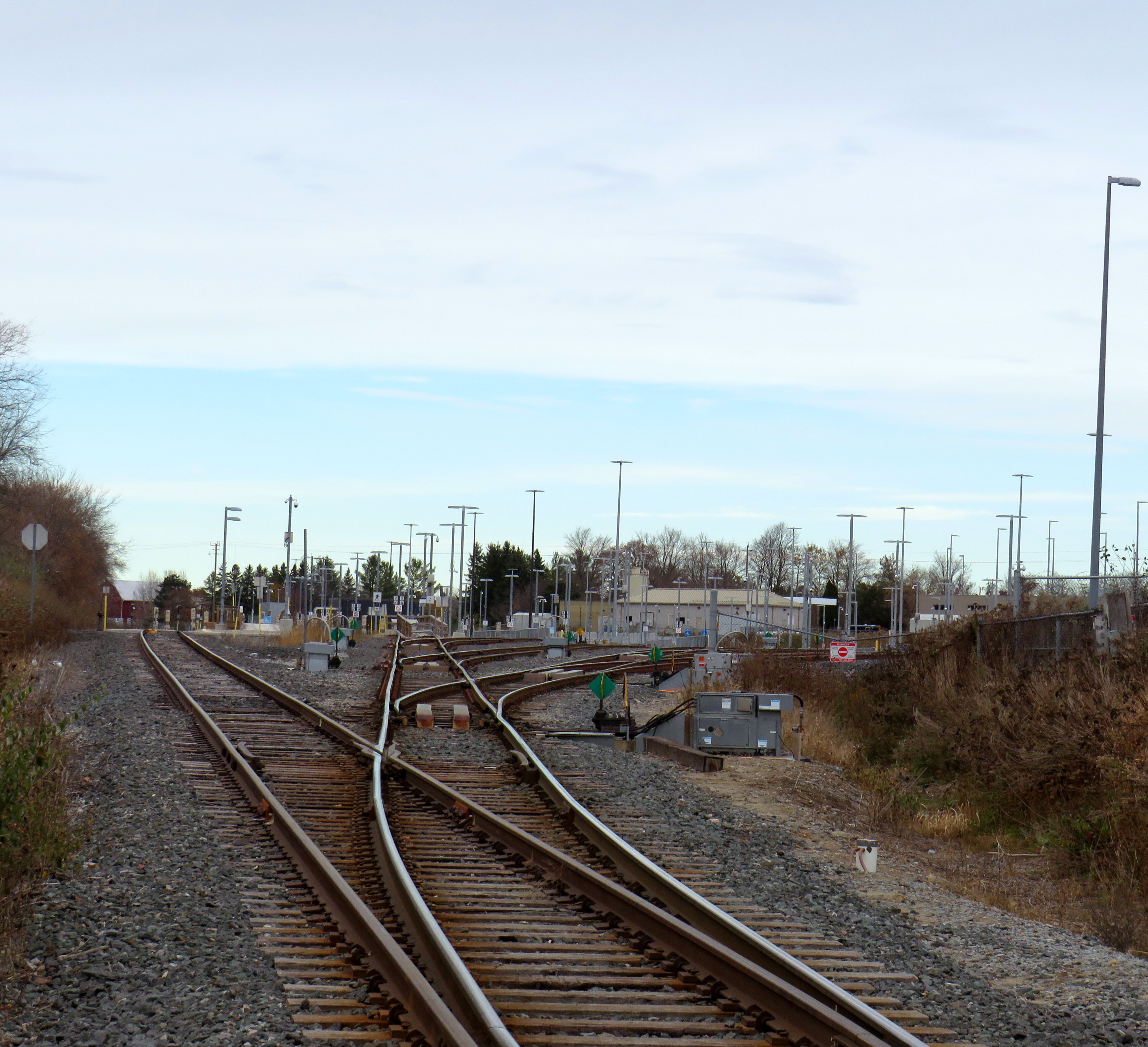
The Lincolnville layover yard, which was also the Lincolnville/Old Elm station location until October 2023
Previously, Old Elm Station was located a few hundred metres away, northeast of the Tenth Line/Bethesda Side Road intersection at the Lincolnville layover yard, where Stouffville Line trains continue to be stored overnight and weekends. That station, originally named Lincolnville for a nearby hamlet, was opened in 2008 to accommodate service expansion and relieve the small station at Stouffville, which had no room for a bus loop or additional parking. Since Lincolnville was a yard terminus, passengers had to walk across tracks to reach the next departing train, and each departing and arriving train had to crawl through the yard before reaching the mainline. (As Georgetown GO Station is also within a layover yard, trains passing through on their way to and from Kitchener must also crawl through. A new layover yard near Heritage Road in Brampton will allow for a rebuilt Georgetown Station with faster arrivals and departures.)
Lincolnville Station was confusingly renamed Old Elm in 2021, even though that new name referred to a tree on the new station site that didn’t open for two more years. Had the new name taken effect with the location change, it would have made more sense.
The new station site, located outside of the Lincolnville yard, allows for smoother and faster arrivals and departures, shaving several minutes off the trip for passengers to and from Lincolnville.
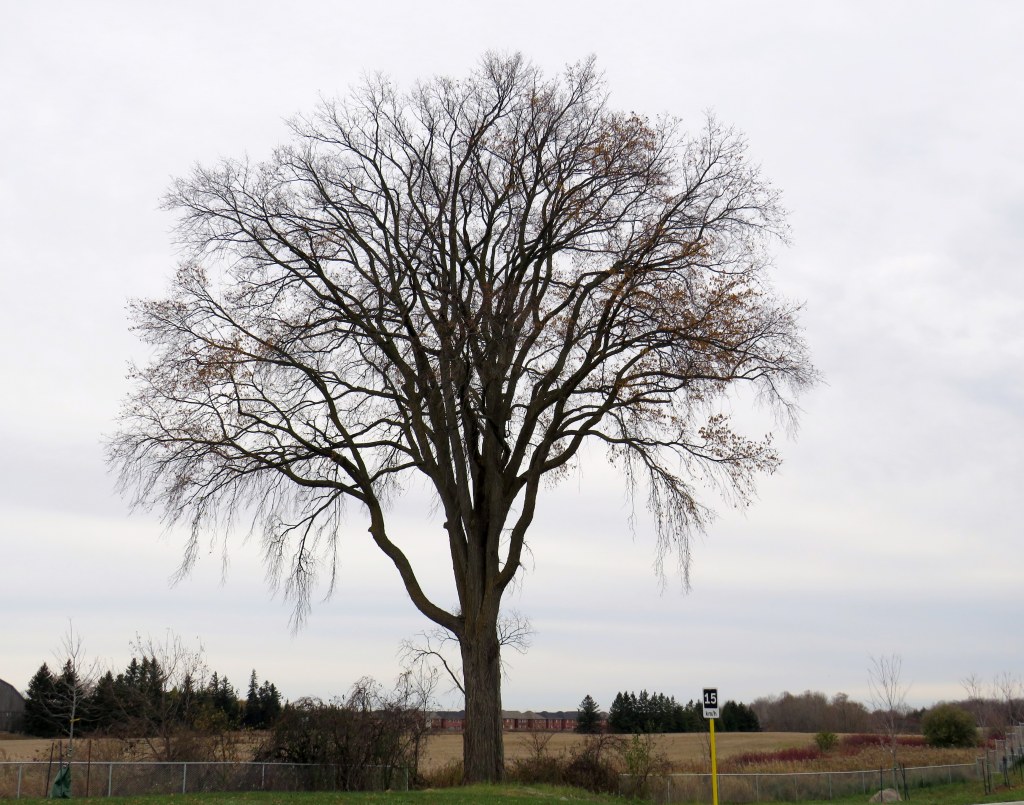
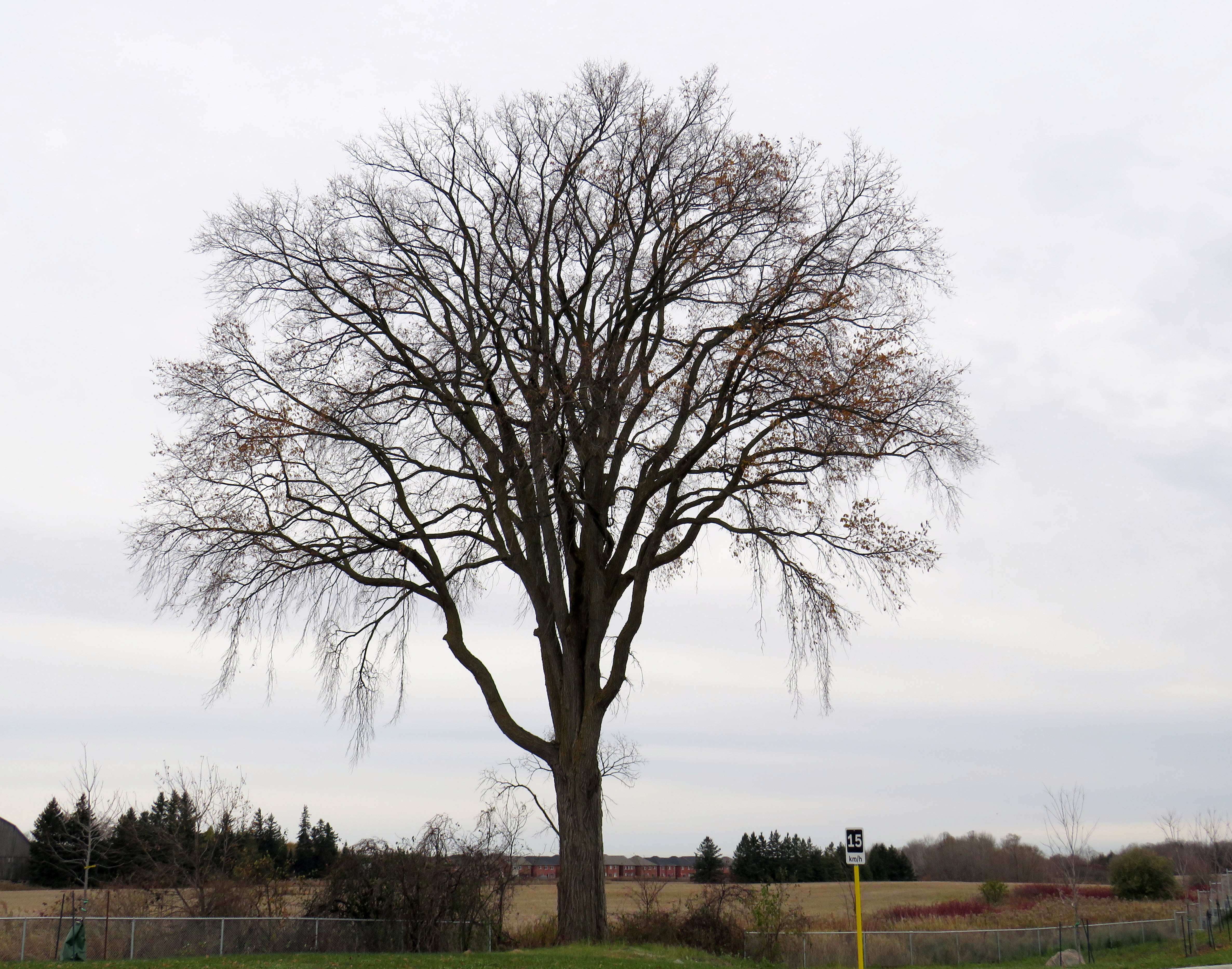
The station’s namesake, an old elm tree on the south end of the GO Transit property
Though Lincolnville/Old Elm is located in the Greenbelt, and the station is unable to support transit-oriented urban development, there was a need for the layover yard. Adding a small, auto-focused station was quite sensible. This is no Garage Mahal.
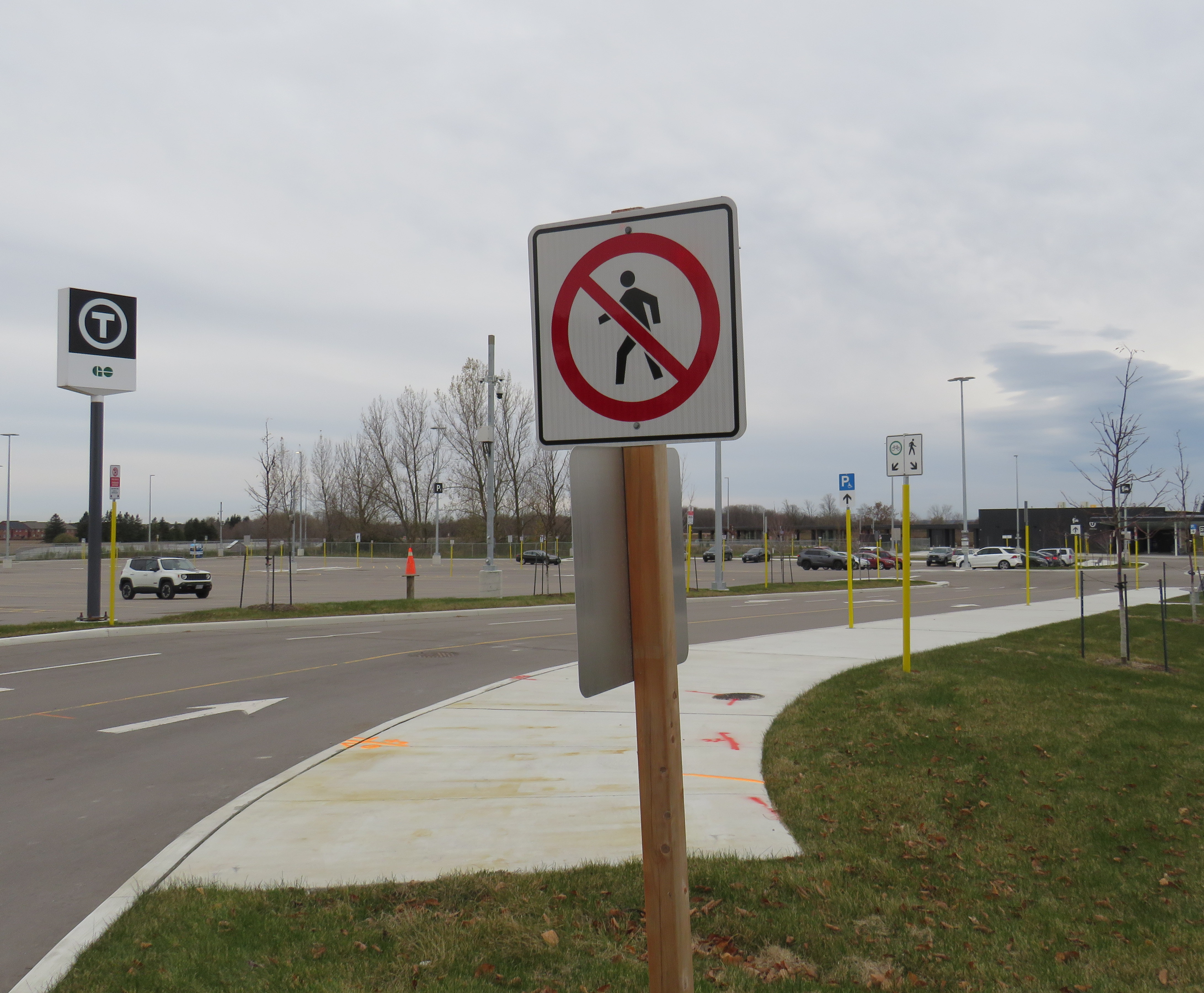
The one unfortunate feature is the complete lack of active transportation access beyond the station property. Though Metrolinx built a wide concrete walkway from Tenth Line to the station platforms, there are no sidewalks, no crosswalks, and no pedestrian signals at either the main entrance or the bus loop entrance, which are both signalized intersections. Instead, there are “no pedestrians” signs facing all directions.
“No pedestrians” sign placed in front of the new concrete pathway into Old Elm Station
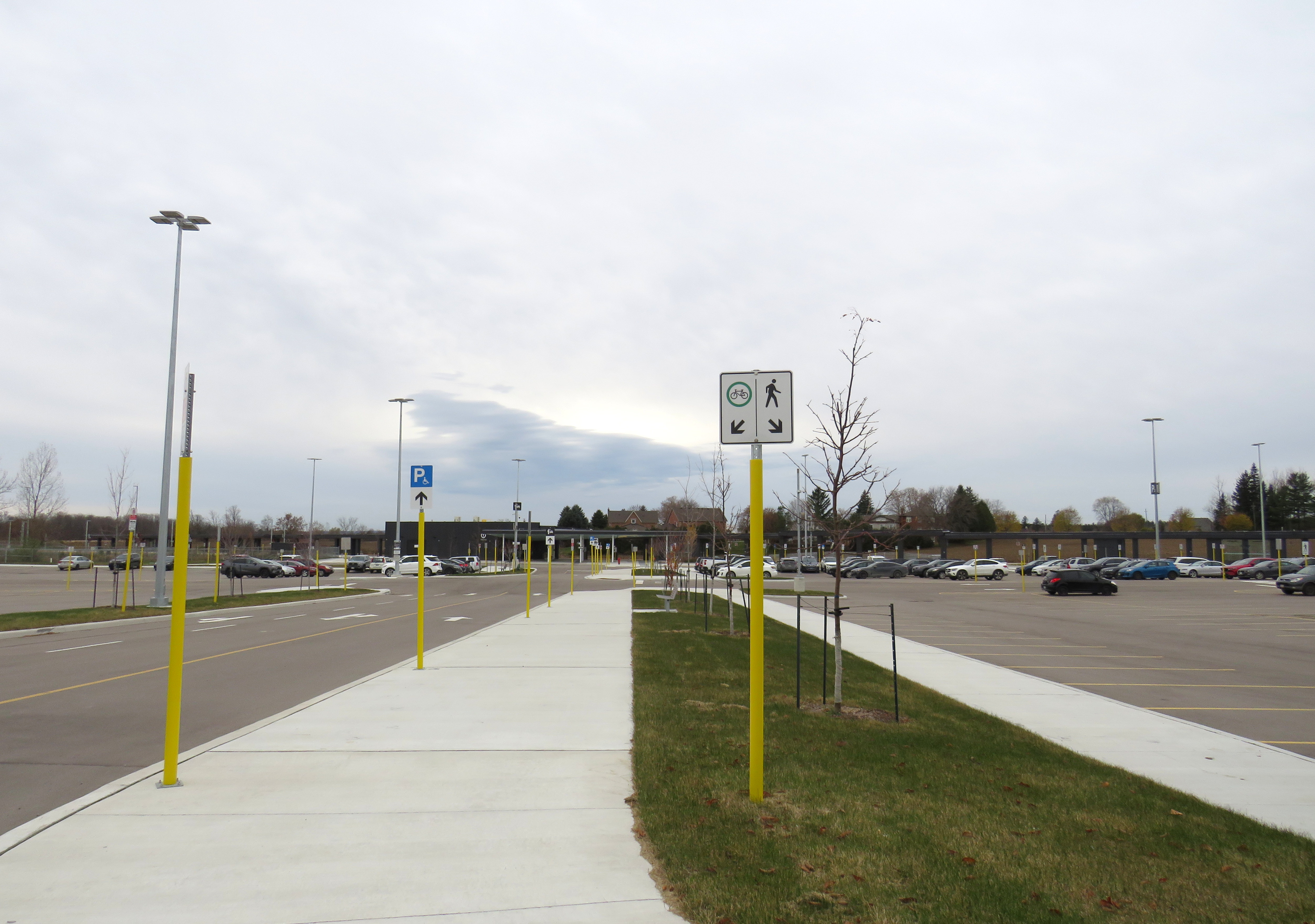
Once on Metrolinx property, though, there is a wide pathway, presumably for cyclists and pedestrians. Interestingly, the sign below shows that cyclists should keep to the left, on the wide pathway, while pedestrians are directed into the grass to the right.
Beyond the “no pedestrians” sign at the intersection, another sign instructs cyclists to keep to the left and pedestrians to the right – into the grass
I doubt Metrolinx intended for the hostile intersections to forbid any pedestrian activity. I note too that despite the rural locale, there are several neighbouring homes and businesses along Tenth Line and Bethesda Side Road. The nearest subdivision is less than a 15-minute walk away, a healthy stroll’s distance. A new residential development, Elm Villa, is planned for the site immediately to the south of the bus loop. Tenth Line is maintained by the Town of Whitchurch-Stouffville, so it is likely they are responsible for the oversight. Still, it is not a great look.
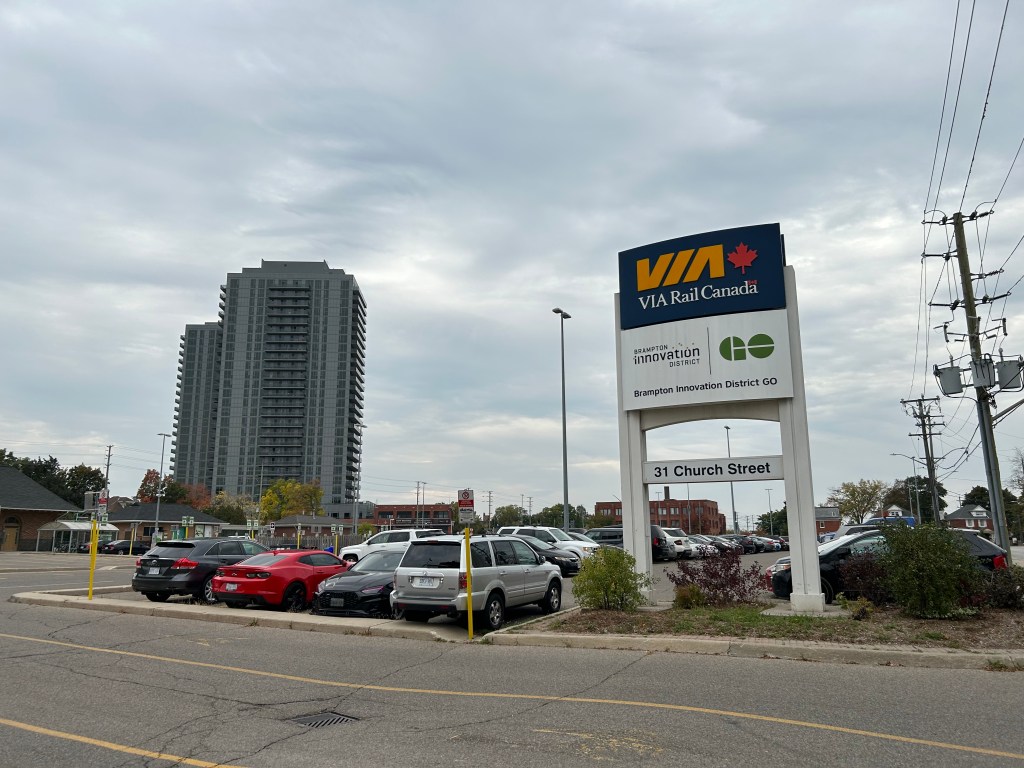
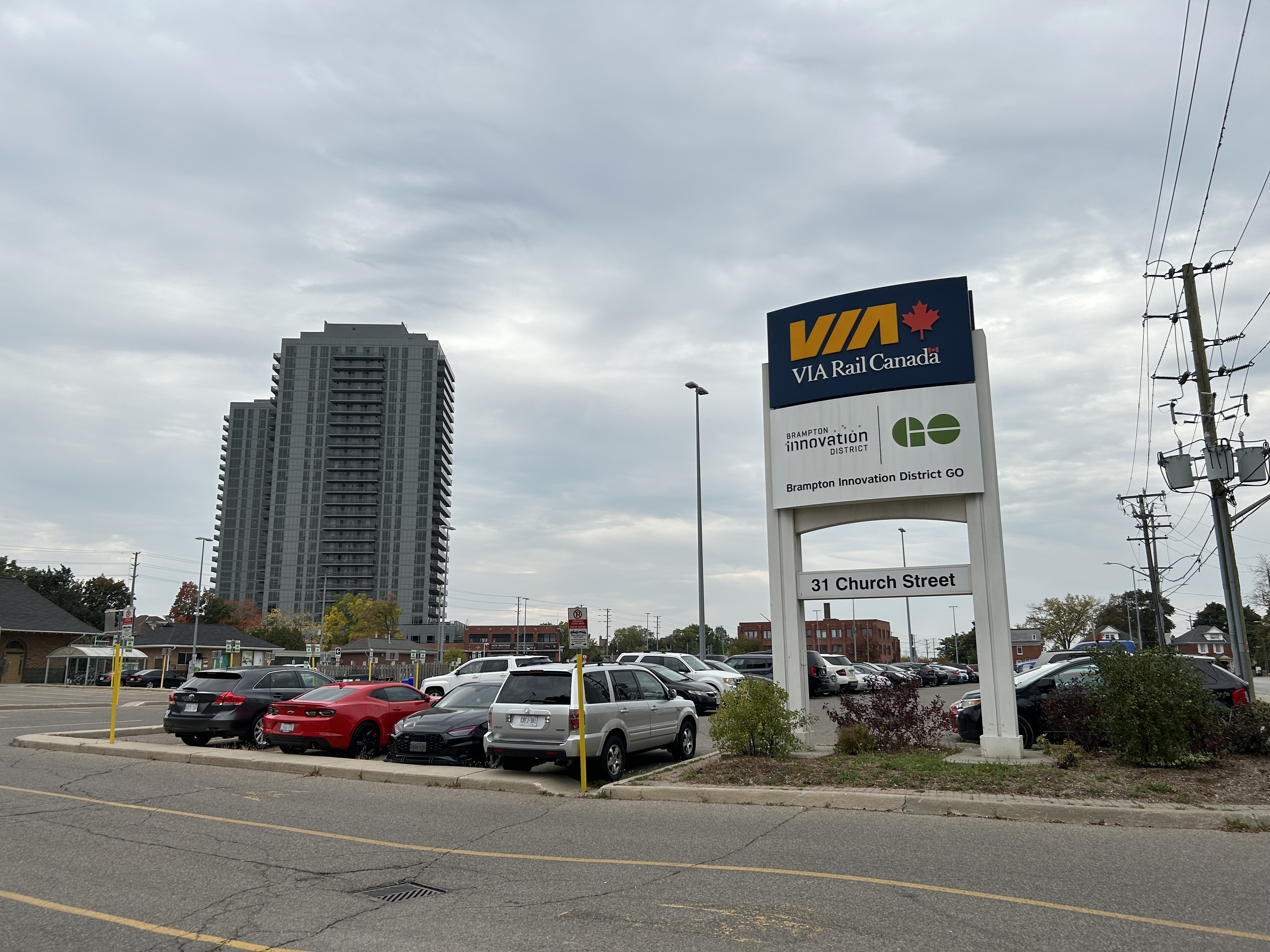
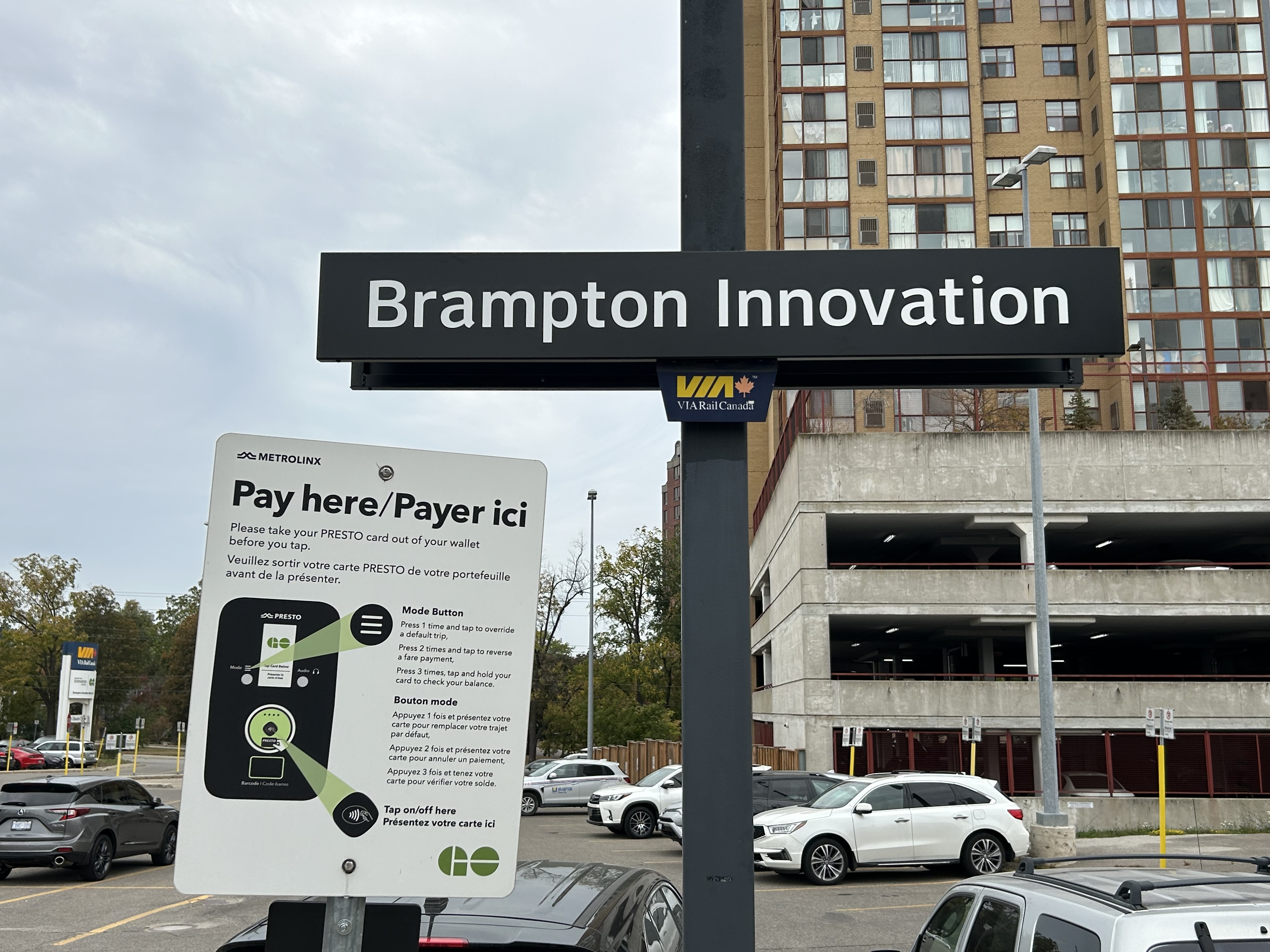
On June 29, 2023, the City of Brampton announced a naming rights agreement with Metrolinx to rename the Brampton GO Station to “Brampton Innovation District GO” for a 10-year period. This was Metrolinx’s second naming rights agreement, after renaming Oshawa GO Station for Durham College in 2022. The name change took effect in September, with new signs installed.
The Brampton Innovation District is a city-led project in Downtown Brampton to support higher education and entrepreneurship. It includes co-working spaces such as BHive and the Brampton Enterprise Centre incubator, the Rogers Cybersecure Catalyst, as well as partnerships with Sheridan College, Toronto Metropolitan University, and Algoma University. Rogers has committed to relocating its Brampton offices to the downtown core, while the city is planning the Brampton Centre for Innovation, which will include a new central library. There are a lot of interesting things happening in Downtown Brampton, though without the exposure more established tech hubs enjoy.
Through increased awareness of the Brampton Innovation District, this partnership with Metrolinx will further enhance Brampton’s position as an innovation and technology event destination to host tech sector events and international delegations, and enhance Brampton’s unique ability to attract highly skilled tech talent from both Toronto and Waterloo.
Unlike “Durham College Oshawa GO,” at least “Brampton Innovation District GO” is at the place it is named for. Having the name show up on maps, signage, and announced by GO Transit staff will raise awareness of the district’s current and future potential, especially once some of the built infrastructure, such as the Centre for Innovation, the new downtown transit hub, and the new Rogers campus, is constructed.
The “GO Brampton” sign has been replaced by “Brampton Innovation”
But at the same time, I still feel uneasy about renaming stations and transit lines. The new, longer names are harder to fit on maps and signage. They can lead to confusion, and in this case speak more to the city’s ambitions than what most travelers are actually looking for. It’s also interesting that the only two naming rights deals made by Metrolinx so far are with public-sector organizations: a provincially funded college, and a municipality.
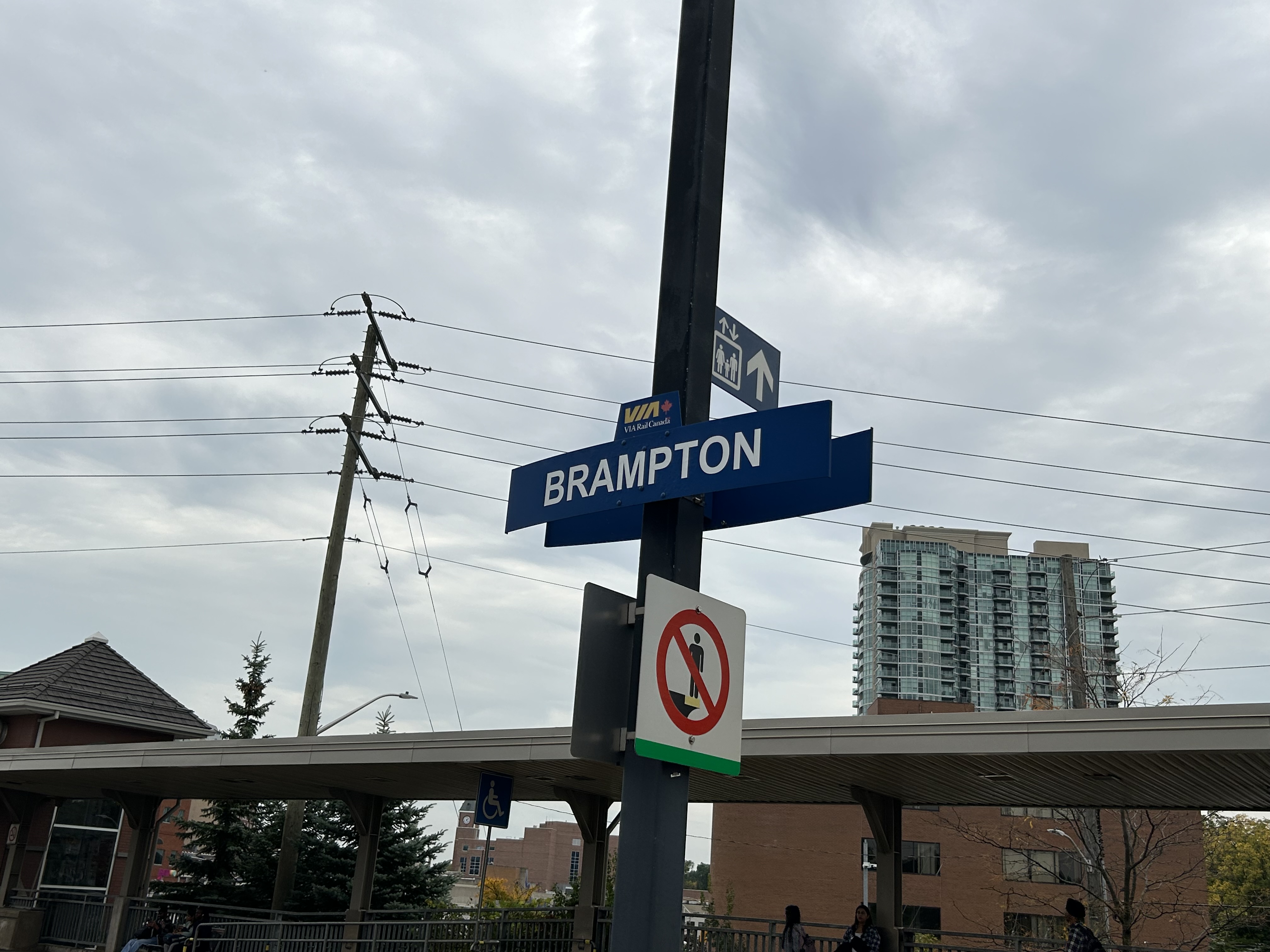
I also note that VIA Rail, which also uses the station, still refers to it simply as “Brampton,” just as it still simply refers to “Oshawa.”
A busy GO Transit Route 88C bus loads passengers in front of the Peterborough Bus Terminal in the city’s downtown core
Peterborough, Ontario, a city of 84,000 people, is about a 90-minute drive from Downtown Toronto, without heavy traffic. A regional centre for central-east Ontario, Peterborough is home to Trent University, a mid-sized liberal arts institution with about 10,000 full time students, and Fleming College, which has over 6,000 full time students and 10,000 part time students.
Given its relative importance and its proximity to the Greater Toronto Area, especially Durham Region, one might expect to find good transit links from Peterborough to not only Toronto, but elsewhere in Ontario. Unfortunately, this is not really the case.
Prior to the COVID-19 pandemic and the closure of Greyhound Canada’s remaining service in Ontario and Quebec, there were four daily Greyhound buses between Peterborough and Toronto (three on Saturdays and Sundays), with one of those daily runs continuing east on Highway 7 to Ottawa, with stops in towns such as Havelock, Madoc, and Perth.
The scheduled time between the old Toronto Coach Terminal at Bay and Dundas Streets and Downtown Peterborough was between one hour and 45 minutes (making only an intermediate stop at Scarborough Centre Station) and two hours, 15 minutes (making local stops in Ajax, Oshawa, and Orono).
2019 Greyhound timetable for Ottawa-Peterborough-Toronto service. Note the overnight 5757/5790 runs that also followed Highway 7, but only stopped at Madoc for a rest break.
In September 2009, GO Transit first started a bus service between Oshawa GO Station, Downtown Peterborough, and Trent University, following the success of other bus services to universities and colleges in the region. Before 2020, that route made only four stops between Oshawa Station and Downtown Peterborough; all were park-and-ride lots adjacent to Highway 35/115; the bus would take just over an hour between the station and Downtown Oshawa.
Despite GO Transit’s competition, the Greyhound service remained popular, as it offered a direct, faster, one-seat ride between Downtown Toronto and Downtown Peterborough, with most buses only stopping at Scarborough Town Centre along the way. Three days a week, there were connections to Bancroft and Pembroke. GO Transit’s advantage was a slightly cheaper fare, connections to local transit and other GO services, and a more convenient service for passengers travelling between Durham Region and Peterborough. Unlike Greyhound, GO Transit continued to Trent University. Apart from the Newcastle (Hwy 2 at Hwy 35/115) park-and-ride, where passengers could connect to GO Transit routes 90/91 to Newcastle, Bowmanville, Courtice, and Downtown Oshawa, the park-and-ride stops were little-used.
GO Transit Route 88 map, January 2020. There were only four stops between Oshawa GO Station and Peterborough Bus Terminal
In mid-2020, with the COVID-19 pandemic causing major reductions in bus and rail ridership, GO Transit cut and consolidated several services, particularly in areas where local transit agencies operate. Route 90 was reduced to early morning and late-night service between Union Station and Oshawa GO when trains were not operating. The remainder of Route 90 through Courtice, Bowmanville, and Newcastle was cut entirely. Route 91 was merged into Route 88, which added new stops in Courtice and Bowmanville.
Route 88B, which includes stops at park-and-ride lots at proposed new GO Stations in central Oshawa and Courtice, takes up to 120 minutes to get from Trent University to Oshawa Station. The regular 88 bus takes 105 to 115 minutes to complete the trip. That is a very long time to sit on a bus, especially one not equipped with a lavatory.
GO Transit’s Route 88 bus timetable, including connecting train service from Toronto Union Station (click for larger size)
On Thursdays and Fridays, during regular school days between September and April, there are several express 88C buses, that only stop at Trent University, Peterborough Bus Terminal, and Oshawa GO. They make the complete trip in 1 hour 20 minutes; from Union Station to Downtown Peterborough is 2 hours, 20 minutes, not much slower than the slowest Greyhound bus.
The Route 88 route map in September 2023
Granted, for anyone living in Bowmanville and headed to Peterborough, the route is an improvement, with a new one-seat-ride now possible. While travelling to Peterborough earlier in September, I noted several passengers getting on in Downtown Bowmanville. But for through passengers, the backtrack to get to the Clarington Boulevard Park & Ride (the proposed location for the Bowmanville GO Station) and then the local stops to Newcastle are a bit annoying. Once on the highway, the bus has to get off at the Highway 35/115 split near Pontypool, and again at County Road 10 near Cavan and Millbrook, despite the very occasional time a passenger wants to get on or off (which has never happened when I rode Route 88). These diversions add 2-3 minutes each to the trip.
Pulling up to a deserted GO bus stop at County Road 10 near Cavan
These carpool stops might be useful if there were connecting transit services, rather than just a parking lot and a bus shelter. The 35/115 lot near Pontypool is 34 kilometres to Lindsay, a town of nearly 20,000 people, but whose only transit connection is a 3 day/week TOK coach bus between Haliburton and Toronto. A shuttle connection to Lindsay (which has a local transit service) would provide new links to Toronto, Durham Region, and Peterborough. Meanwhile, the Highway 2 carpool lot does not have direct Durham Region Transit service either.
Since Greyhound Canada’s withdrawal from the Canadian market, GO was the only intercity operator serving Peterborough until earlier this year, when Rider Express and Flixbus resumed service on the Toronto-Peterborough-Ottawa route. Both companies offer express, one-seat rides to downtown Toronto, but they have two major disadvantages over GO or even the old Greyhound service: frequency and in-town connections.
Flixbus offers one daily round trip, leaving the Union Station Bus Terminal at 11:00 AM and arriving at a Tim Hortons parking lot (at 1200 Lansdowne Street West, on the southwest side of Peterborough), at 1:05 PM, with stops near Scarborough Town Centre and at Thickson Road and Highway 401 in Whitby. The return trip leaves Peterborough at 9:05 PM, arriving in Toronto at 11:05 PM.
Boarding a Flixbus coach in a parking lot behind a Tim Horton’s in Peterborough’s suburbs
Rider Express runs on the same route four days a week, leaving Union Station at 12:00 PM, arriving at a different Tim Horton’s parking lot (on Ashburnham Road, on the southeast side of Peterborough) at 1:45 PM, making one stop in Scarborough. The return trip leaves Peterborough at 10:05 PM and arrives in Toronto at 11:35 PM. The map below shows where GO, Flixbus, and Rider Express stop in Peterborough.
While GO stops at Trent University, Downtown Peterborough, and a park-and-ride lot on the south end of the city, Flixbus and Rider Express only stop at locations close to the main highway on the south side of Peterborough, pulling into parking lots with nowhere to sit and no real amenities, unless waiting passengers had a car to wait in or paid for a coffee or snack at the Tim Horton’s. The old Greyhound terminal, which was located on the same block as the downtown transit terminal, has since been sold, and is now converted for local community services. Though they offer a much faster ride to downtown Toronto, the private operators are neither frequent enough nor convenient enough to compete with GO.
One day, Peterborough may get intercity rail service again thanks to the federal High Frequency Rail project, still in the early procurement phase, which would provide the speedy, frequent intercity service Peterborough needs. Until then, Metrolinx should revise the entire Peterborough bus service, including working with Durham Region and the City of Kawartha Lakes to make the service more useful for more riders, with a mix of daily express buses and enhanced local connections. The Selwyn Link bus service, which connects GO and Peterborough Transit with Selwyn Township and Curve Lake First Nation at Trent University, is great example to build upon.
I have updated the Ontario Intercity Transport Map for September 2023 with new and revised routes right across the province. The notable losses include Prescott-Russell’s abandonment of its rural on-demand service, the closure of Grey Transit Route’s service between Walkerton and Flesherton, and Trailways’ stop in Chatham. The London-to-St. Thomas gap remains unfilled, and there’s a clear gap in Huron and Bruce Counties, especially with the loss of service to Walkerton. For the most part, it is good to see most regional transit services continuing, with mostly minor adjustments.
I look forward to sharing my Canada Intercity Transit Map, based on work I recently completed for Infrastructure Canada, in the near future.
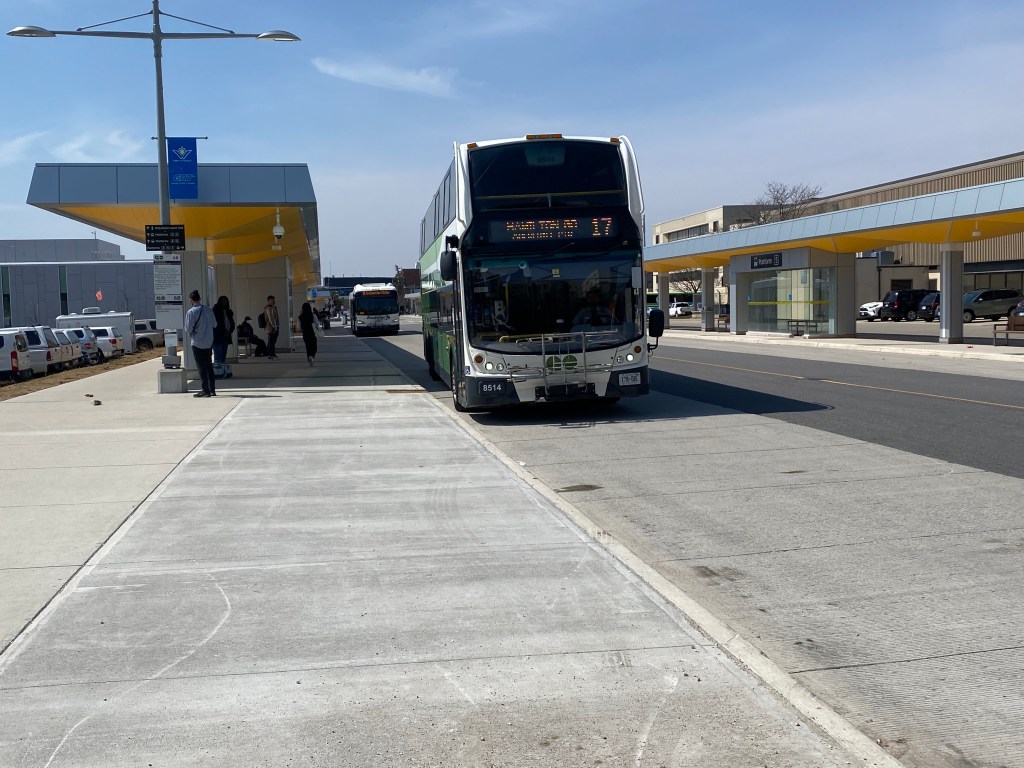
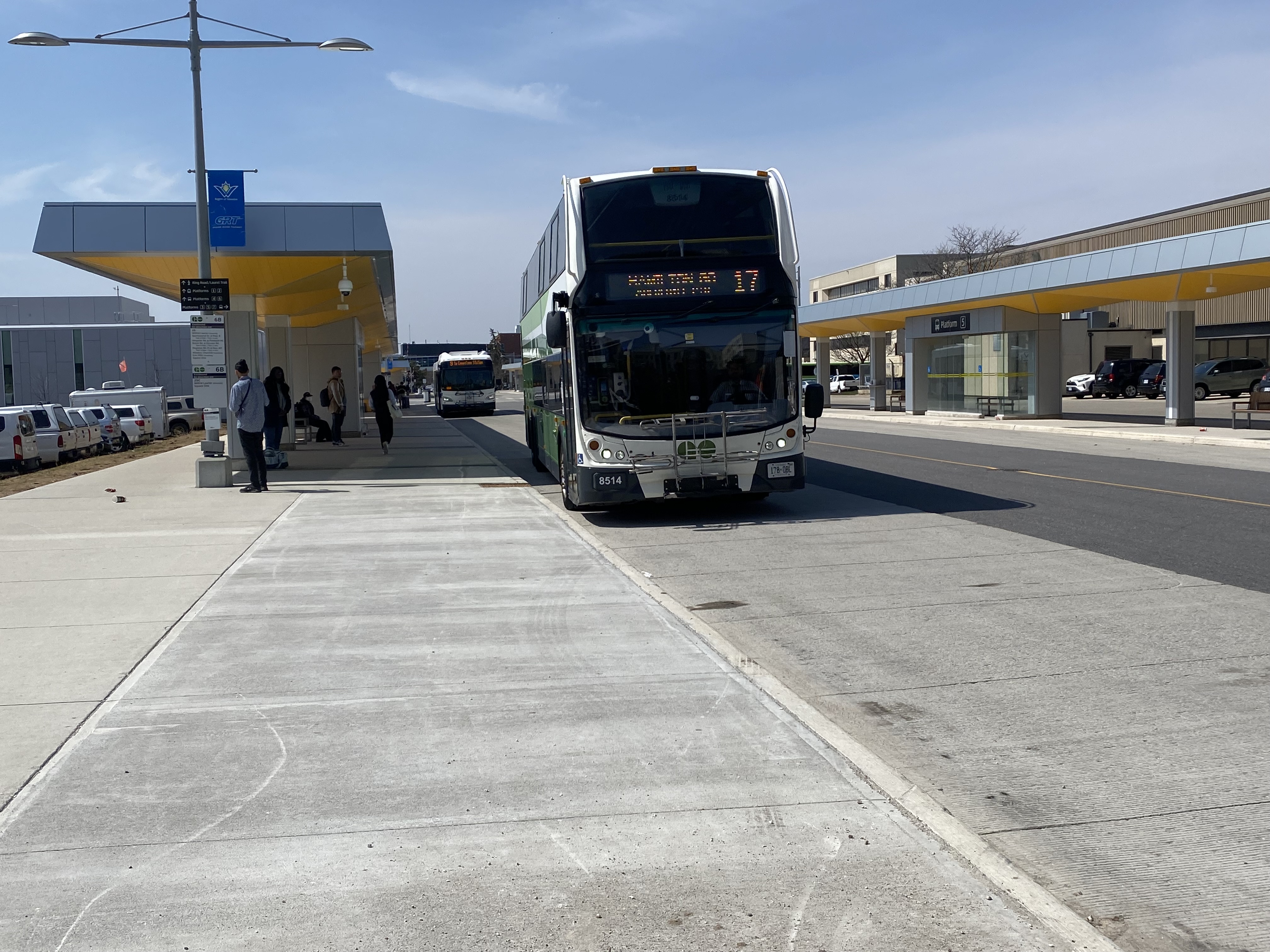
Route 17 bus arriving at University of Waterloo Station
On Monday, April 10, 2023, GO Transit filled a big hole in Ontario’s intercity transportation web with Route 17, which connects three major urban centres, four universities, and two existing GO Transit rail corridors. On that day, I made my way to Waterloo and rode one of those first buses south towards Hamilton. Nearly a month later, I made a second trip, from Guelph and Downtown Hamilton, on May 5.
Sign post at University of Waterloo indicating the stops for Route 17
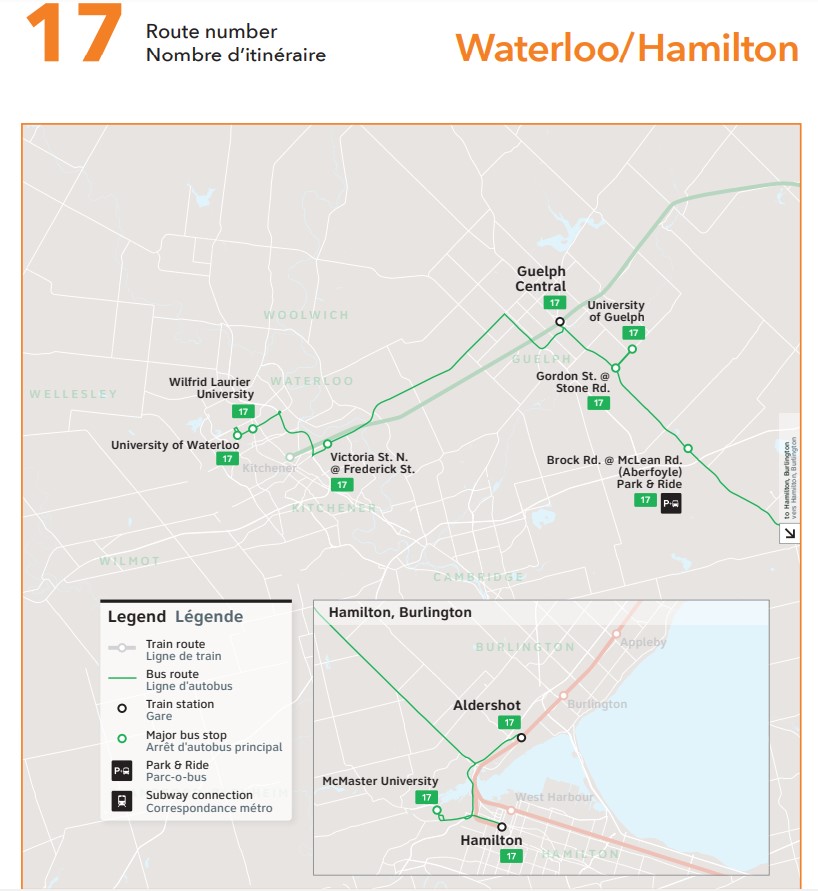
The bus originates at the new University of Waterloo bus terminal, located adjacent to the Ion LRT corridor and on the far east side of the university campus. It then stops in front of Wilfrid Laurier University, on Victoria Street North in Kitchener’s east end, at Guelph Central Station, University of Guelph, the park & ride lot in Aberfoyle, Aldershot Station, McMaster University, and Hamilton GO Centre.
Waterloo-bound Route 17 bus at Guelph Central Station, May 5, 2023
On the first day, the experience was more interesting than I expected, as the driver, new to the route, missed the turn from the Hanlon Expressway (Highway 6 through Guelph) towards Downtown Guelph. Luckily, dispatchers were able to guide the driver back on route after a short delay, so it only made for a roundabout tour of some of Guelph’s residential neighbourhoods, where GO Transit has certainly not gone before (and probably won’t, ever again).
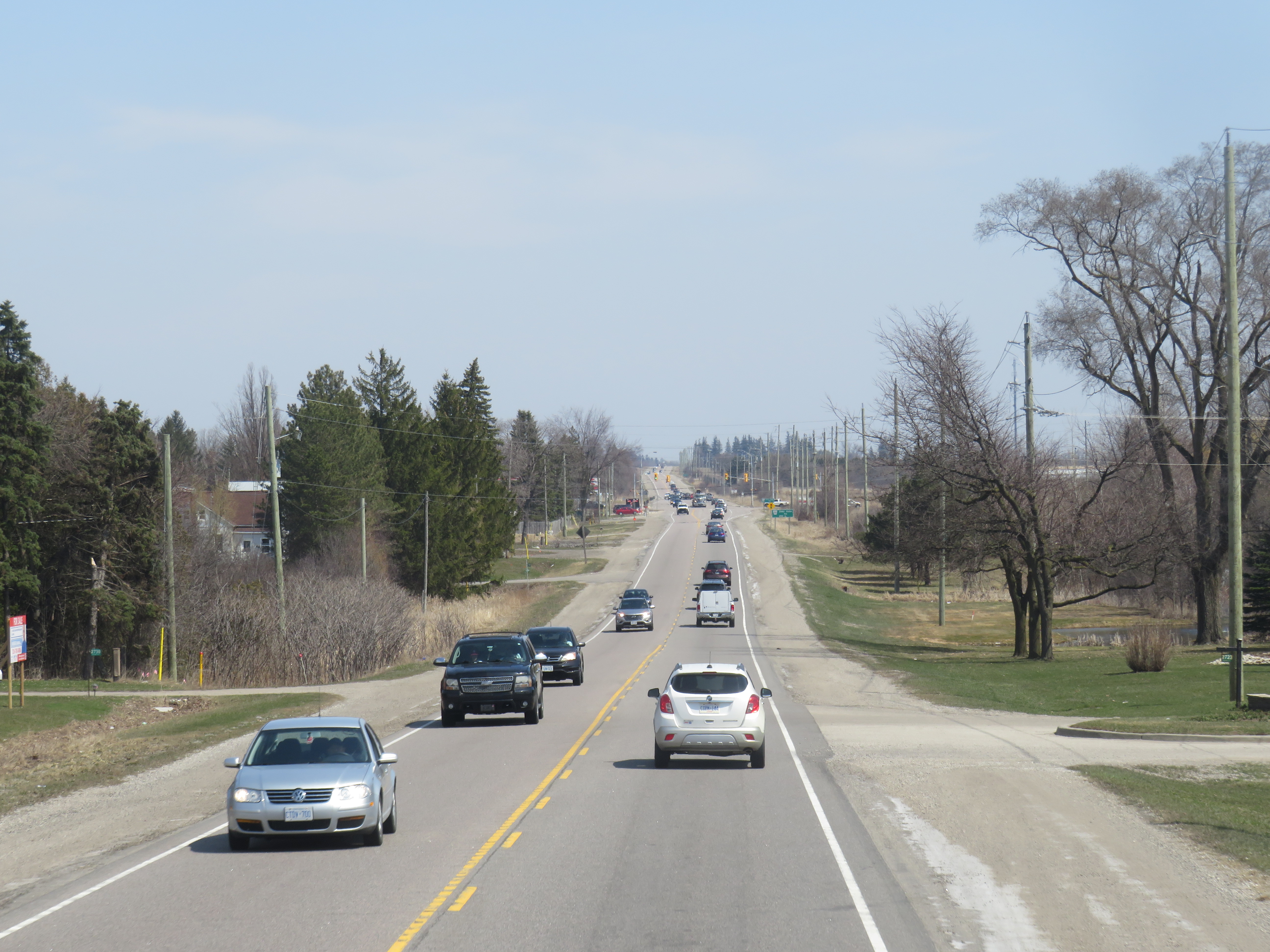
On congested Highway 7 between Kitchener and Guelph
Sitting at the top of the front of a double decker bus (so far, I had my choice of seats as the route is still new and not too busy) gave me a view of the traffic congestion in the western Greater Golden Horseshoe. Highway 7 between Kitchener and Guelph is still a two-lane road, without even paved shoulders to make it a bit more cycling friendly. Though there are a few GO trains on the adjacent railway, the service is sporadic and only runs on weekdays. A new four-lane freeway has been planned for decades, with some preliminary work started, but a regular two-way, all-day train service, and more bus links to places like Cambridge, would be even more effective in meeting travel demands in the region.
Highway 6 south of Highway 401 is also very congested, and a new highway bypass is planned to divert traffic around a two-lane section through Morriston and Puslinch Station. Clearly, there’s a lot of travel demand between Kitchener-Waterloo, Guelph, and Hamilton, but transit options have always been severely limited.
Thankfully, Metrolinx is upgrading the western portion of the Kitchener Line, with a second platform under construction at Guelph Central Station, and work started on new passing sidings between Kitchener and Georgetown. But it will be several years at least before the upgrades allow for regular, two-way, daily passenger rail, so the bus will have to do.
At Aldershot Station
In my review of GO’s service changes earlier this month, I argued that Route 17 was trying to do too much with a single bus route. Riding the corridor from end-to-end (albeit on two separate occasions), I could not help but feel frustrated by the southern end of the route, where the GO bus goes east on Highway 403 to connect with Aldershot Station, then backtracks to get to McMaster University, then turns around to get to Downtown Hamilton. I understand that all three destinations are important trip generators (Aldershot allows passengers from Burlington, Oakville, and southern Mississauga to get to Guelph and Waterloo, McMaster University is a reliable trip generator, and Downtown Hamilton is a busy urban hub), but for someone to get between Hamilton and Guelph or Waterloo, it’s a long way out of their way.
I am hopeful that GO Transit uses the summer down time to see where passengers are going and coming from and make route adjustments or add express runs once classes resume in September.
Map of GO Transit Route 17
A note on Route 21
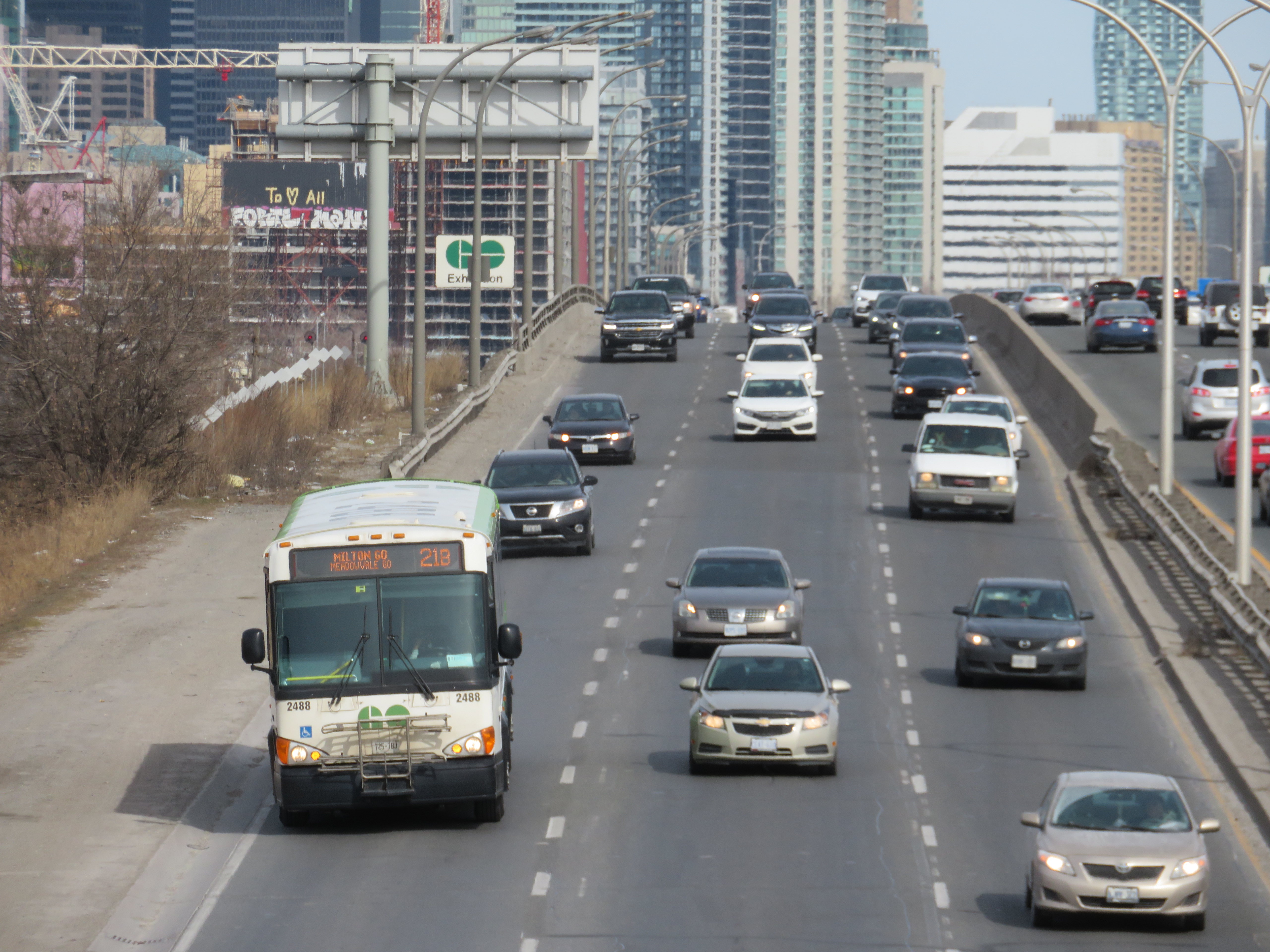
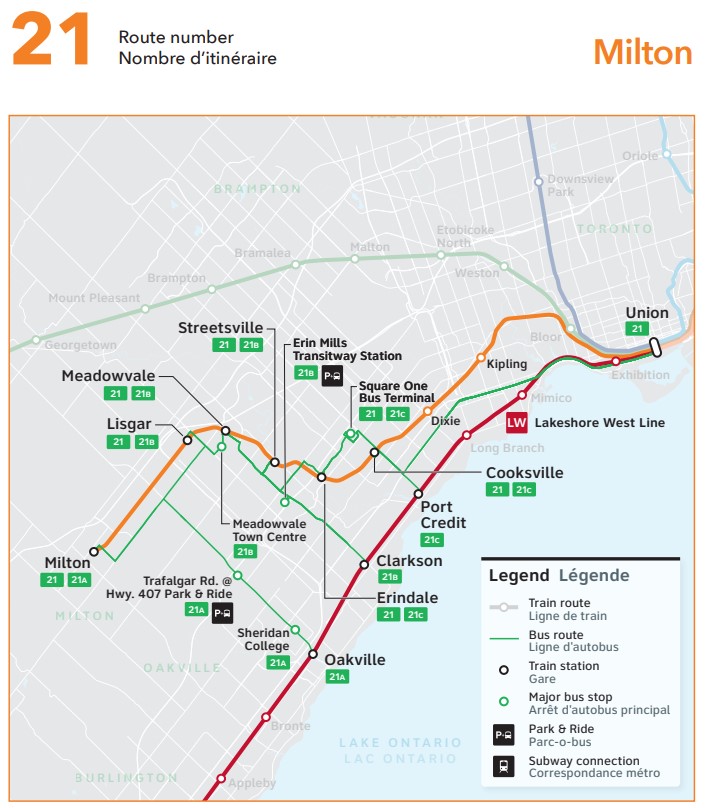
Last month, when previewing the new GO Transit changes, I discussed the changes to Route 21 (the Milton Corridor train-bus service), in which most buses were pulled from Union Station, instead diverted to three stations on the Lakeshore Line. Though at the time, I explained that the change made sense given severe traffic delays on the Gardiner Expressway and around the new GO Bus Terminal, it would mean a longer trip, and an unpopular transfer.
I underestimated the aggravation and anger transit riders had when the new schedules were put into service. The loss of direct GO bus service between Milton and Mississauga along Derry Road is also a new gap that should be re-filled.
I suggest three changes, though I acknowledge that the continued shortage of train crews and budget issues might make these more difficult:
Restore 15-minute rail service on the Lakeshore West corridor. This would at least ensure that transferring Route 21 customers aren’t stranded up to 30 minutes at Oakville, Clarkson, and Port Credit stations. Since GO Transit’s ridership has recovered faster off-peak versus peak periods, the extra capacity will be helpful.
Restore all-day, regular bus service on Derry Road between Milton and Meadowvale, perhaps extending to Bramalea Station and/or Highway 407 terminal. This would provide new connections, including the new weekend Kitchener Line trains.
Extend more buses between Square One and Kipling Terminal. Though the new Kipling Station bus terminal was a Metrolinx project, only Route 29 (Guelph-Square One-Kipling) uses it. It could then be an alternative to transferring to Union Station for some passengers.
This section of the LRT, planned last decade, was narrowly rejected by Brampton City Council in a 6-5 vote, with then-mayor Linda Jeffrey supporting the transit line’s construction. Unfortunately, six city councillors sided with several downtown merchants and affluent Main Street South residents (including former premier Bill Davis), who did not support a surface tram on Main Street, back in October 2015.
In 2019, a newly elected council, led by a new mayor, Patrick Brown, was willing to revisit the LRT decision, again backing a direct Main Street alignment. City staff were directed to update the original, approved 2014 Transit Project Assessment Process (TPAP). In 2021, staff narrowed the alternatives to just two options: an all-surface alignment from Steeles Avenue to the GO station in Downtown Brampton, and an underground option between Nanwood Avenue and the rail corridor. Meanwhile, Brampton staff and elected officials tried, without success, to restore the north-side LRT terminal at Steeles Avenue/Gateway Terminal.
Now that the 30% design work for the two options is complete, city officials must decide how to proceed, especially if they expect senior levels of government to cover the costs of this major transit project.
The alignments
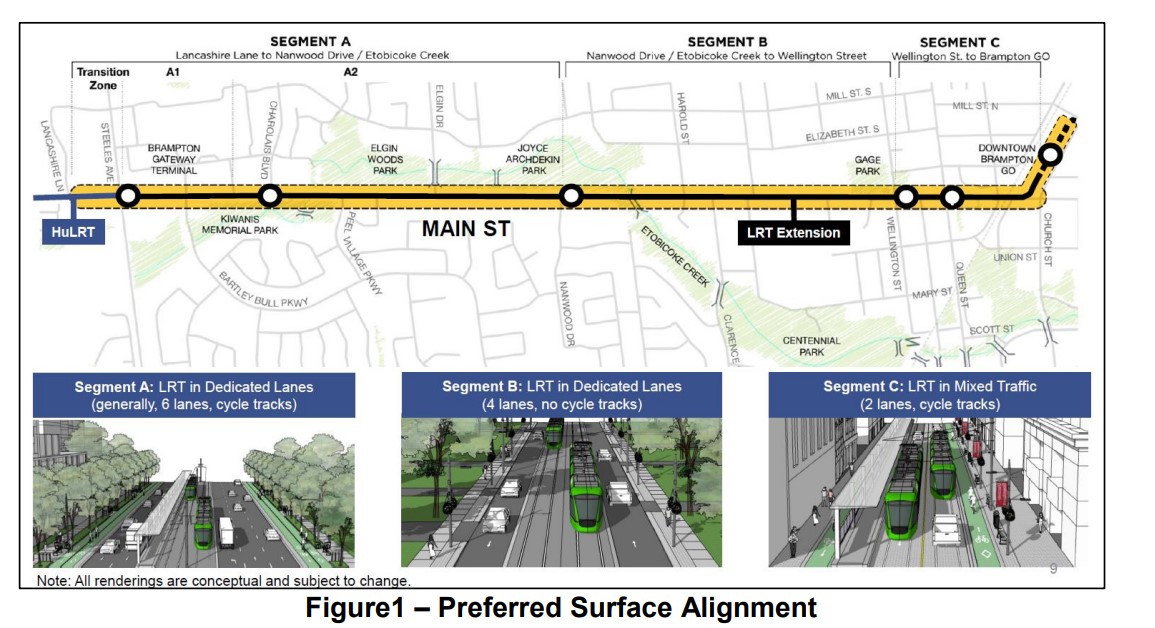
The all-surface alignment three stops in each direction between the Gateway Terminal at Steeles Avenue and the Brampton GO Station: at Charolais Boulevard, Nanwood Drive, and split northbound and southbound stops between Wellington and Queen Streets. These stop locations match the existing 502 Züm Main stops on this section of Main Street.
Between Nanwood Drive and Wellington Street, the LRT would operate in dedicated lanes, with general traffic in the outer two lanes. There would not be room for bicycle lanes, and left turns would be prohibited at non-signalized intersections. North of Wellington, the LRT would run in mixed traffic, with cycle tracks and widened sidewalks on both sides of the street.
The preferred surface alignment
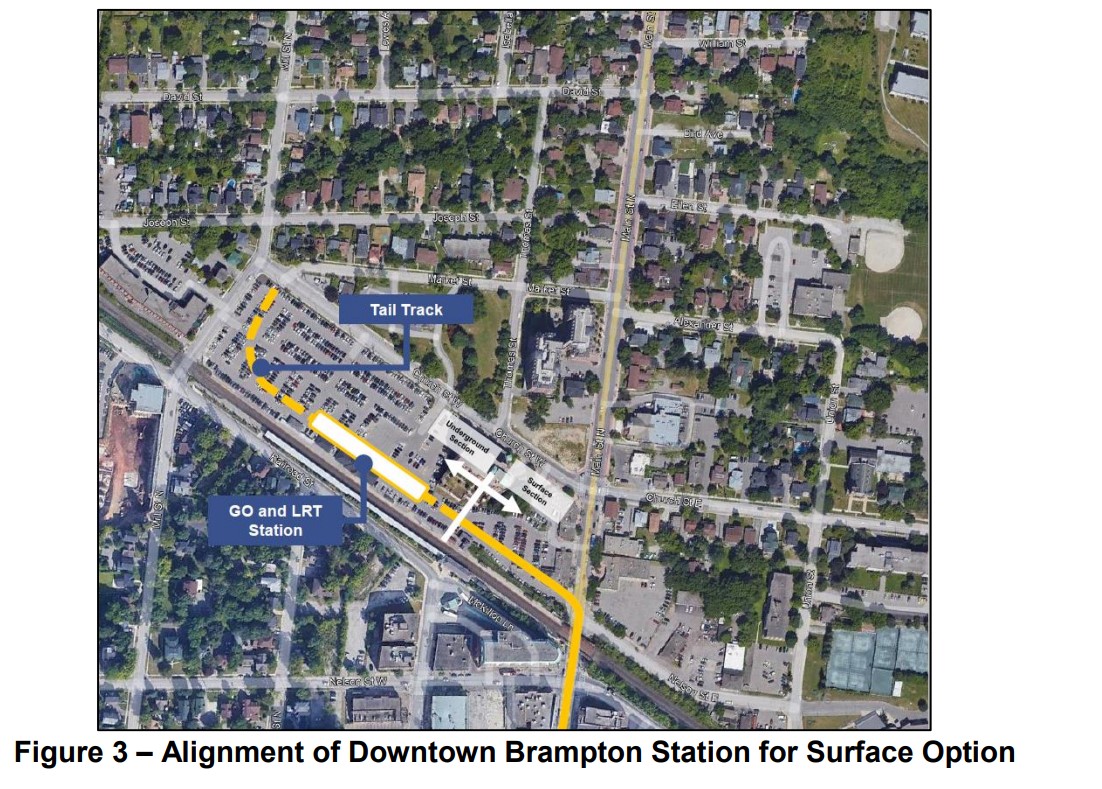
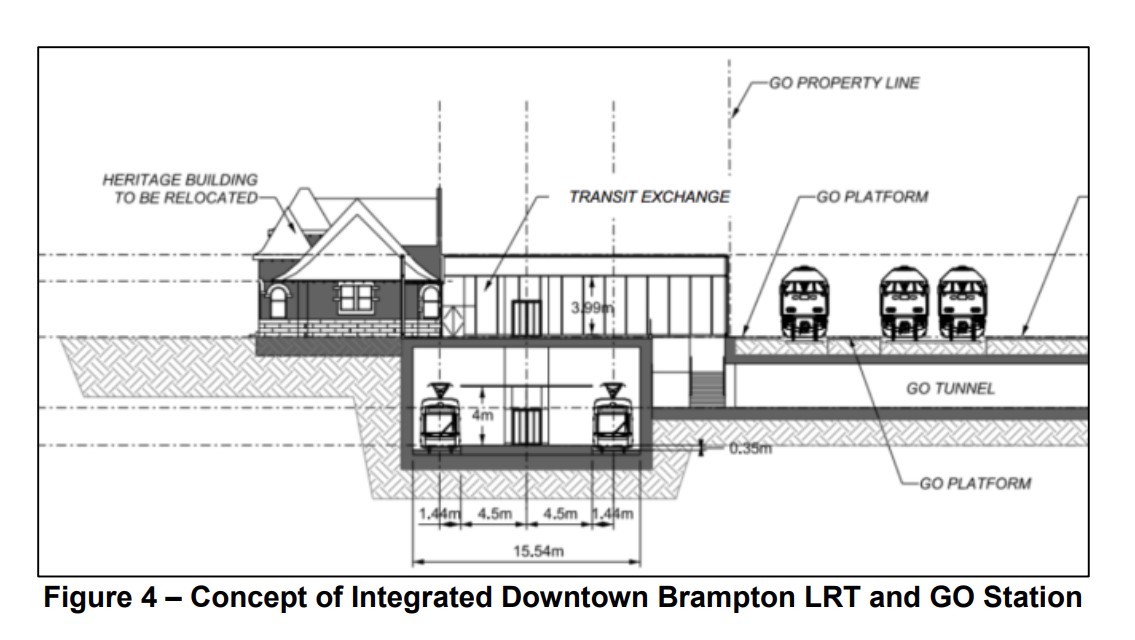
The northern terminus would be on the GO Station property, on the west side of Main Street, in a below-grade trench. Stairs and elevators would connect the platform with the GO Station, while the historic 1907 station building would be moved to support GO train service expansion on the busy CN freight corridor. The street surface would need to be lowered by one metre for the light rail vehicles and the overhead wire to clear the railway underpass.
Alignment of off-street surface LRT alignment on the GO Station property Design concept for the GO and LRT terminal
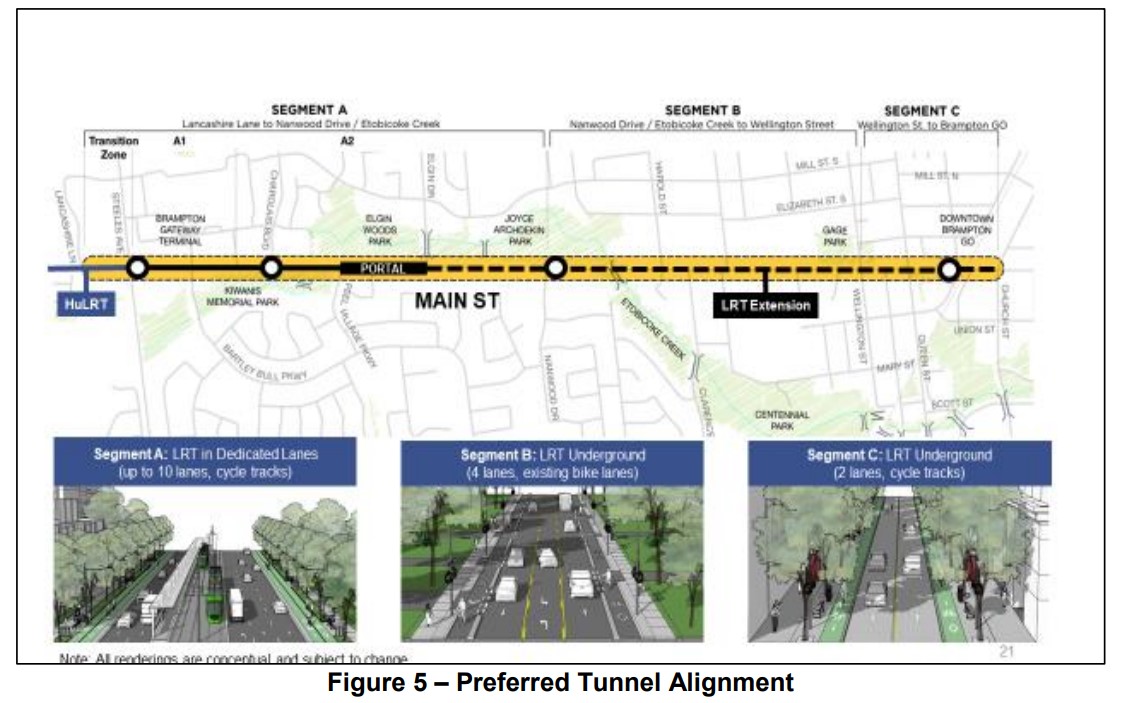
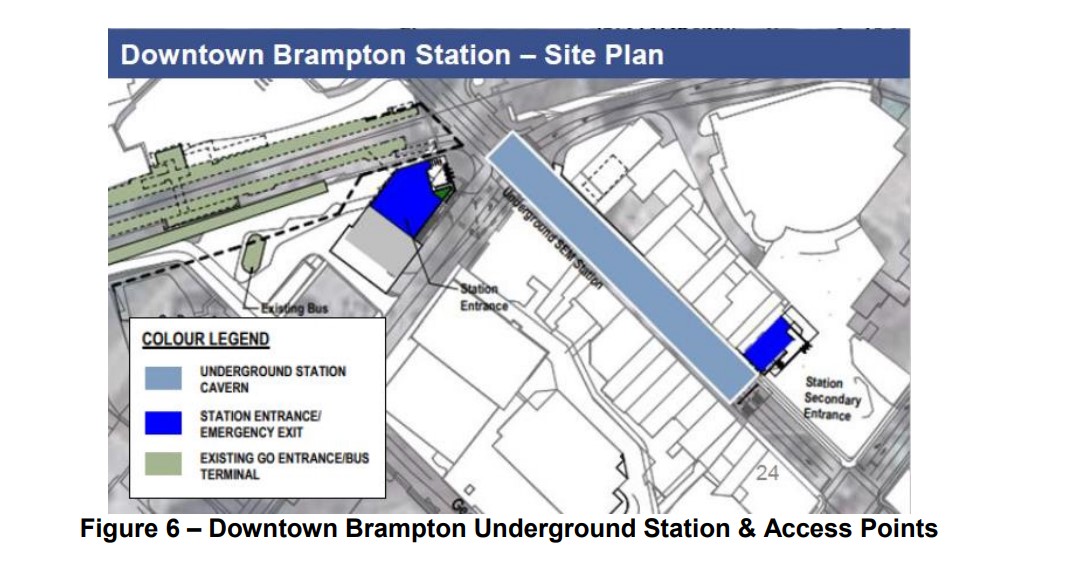
The tunnel alignment – which was not part of the approved 2014 TPAP – includes the same surface stops at Brampton Gateway Terminal and Charolais Boulevard, and two underground stations, at Nanwood Drive and the terminal, just south of the GO Station. Between Elgin and Nanwood, the tunnel would be dug in the traditional cut-and-cover method while the portion under Etobicoke Creek and the downtown core would be constructed using the sequential excavation method.
The tunnel portal would be located at Elgin Drive, several hundred metres south of Nanwood. The longer tunnel section is required to avoid the Etobicoke Creek floodplains. Though Nanwood Drive has no intersecting transit routes and relatively low density, the rundown Brampton Mall property would be an ideal urban development site, as would the commercial properties immediately to the south.
The preferred tunnel alignment
The downtown terminal station would include a primary access at the corner of Main and Nelson Streets, to provide access to the GO Station and the proposed new transportation hub, as well as a secondary entrance closer to Queen Street and Garden Square.
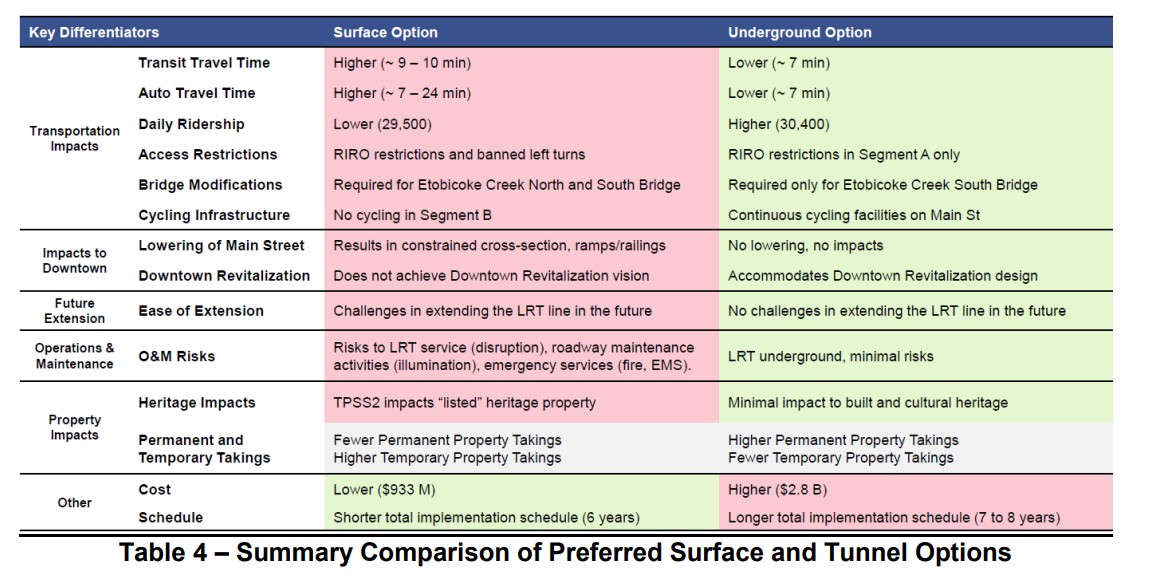
The two options were compared, putting the tunnel alignment ahead in all categories apart from cost and schedule. The tunnel would allow for continuous cycling infrastructure on Main Street, minimize traffic impacts, while having slightly higher ridership and somewhat faster transit. The tunnel would also better satisfy homeowners and businesses along the corridor. Staff also note that the tunnel alignment, without the bend into the GO station property, would be easier to extend farther north.
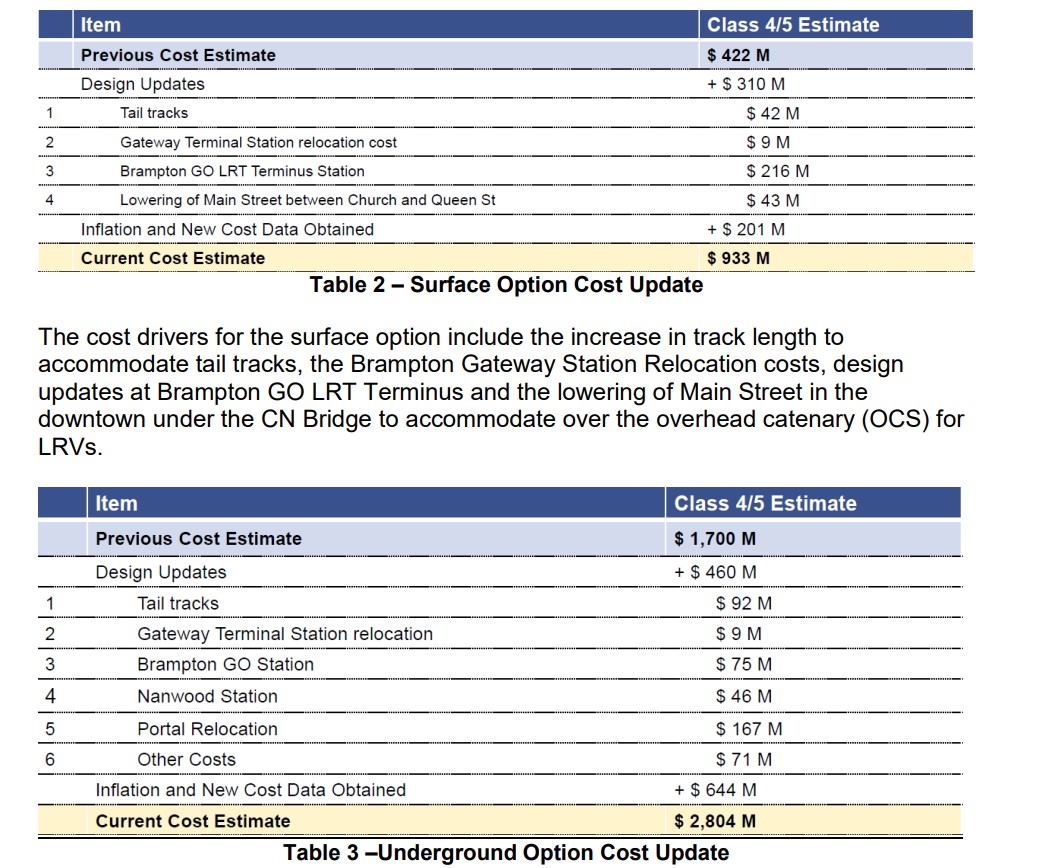
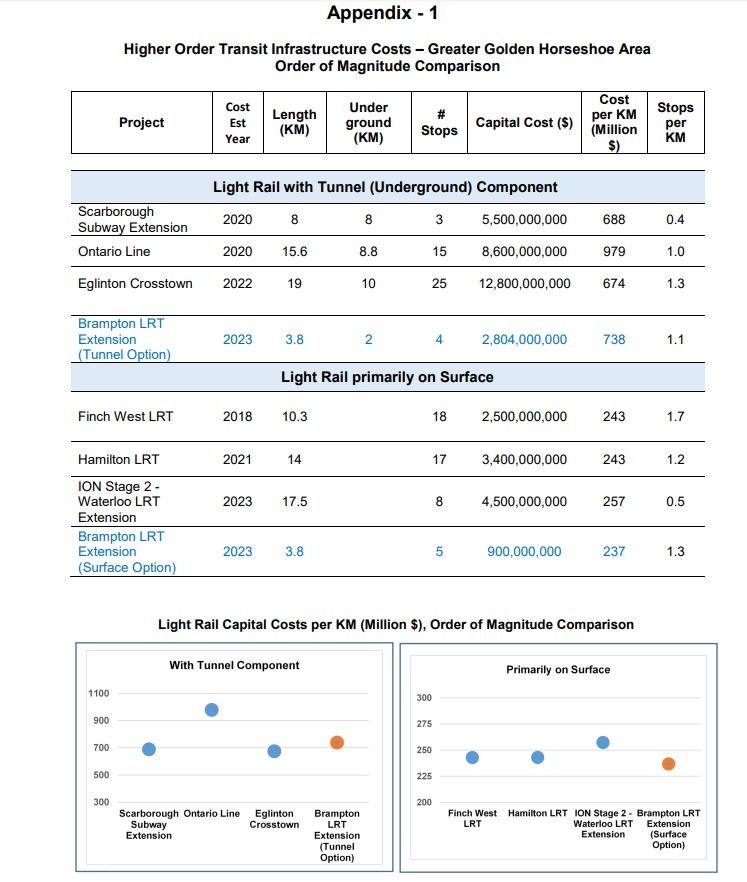
As with other transit projects, the costs of delaying this segment of the LRT are subject to inflation. The surface alignment would cost $933 million, while the tunnel route would cost $2.8 billion. The surface option would take one to two fewer years to complete, an important consideration given Brampton’s fast-growing transit ridership and delays on other complex LRT projects, such as the Eglinton-Crosstown line.
Cost comparisons for the tunnel and surface alignments
The Pitch
Towards the end of the staff report is a section called “Funding Advocacy.” Staff rightfully point out the need for the LRT extension, given the city’s and the province’s goals of directing high density development to the downtown core and other transit station areas, as well as the city’s record of continuous ridership growth and transit improvements.
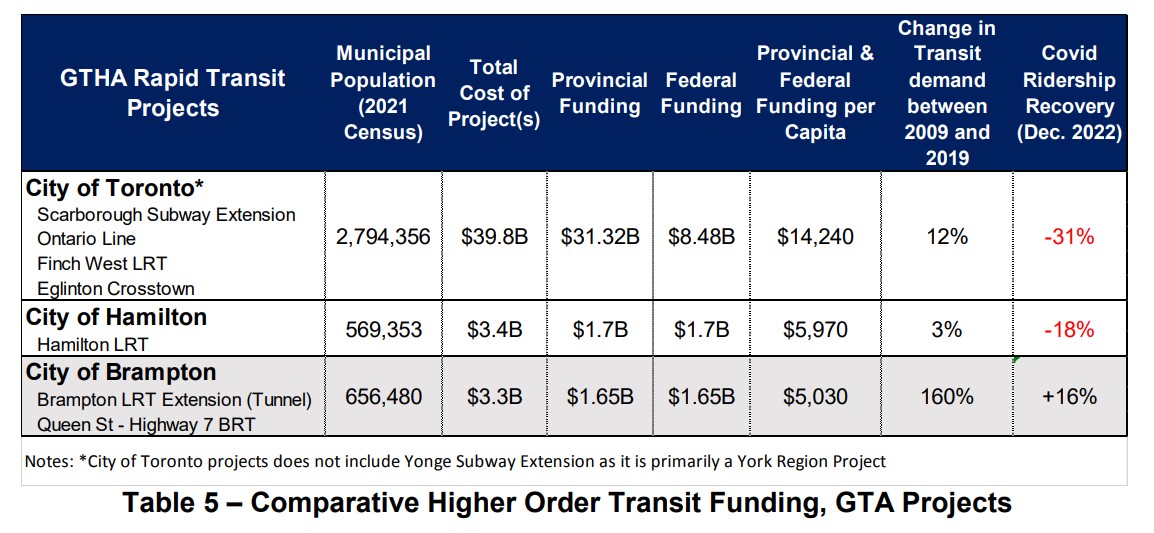
They also point out that the funding that Brampton is seeking (for the Queen Street BRT project and the LRT, specifically the tunnel option) is comparable to other transit projects in the Greater Toronto and Hamilton Area. The table below compares the costs and funding sought for Brampton’s proposed projects to those funded and underway in Toronto and Hamilton.
Table comparing costs, funding and system ridership for Toronto, Hamilton, and Brampton
An appendix to the staff report compares the cost of the tunnel option with other tunnelled Ontario projects (the Scarborough Subway Extension, the Ontario Line, the Eglinton-Crosstown), and the surface alignment with other surface projects (Finch West LRT, Hamilton LRT, Ion LRT extension in Cambridge).
Concluding thoughts
It is still a shame that Brampton City Council put the interests of a small, but affluent, minority of voters first back in 2015-2016. Had they not prevailed, the LRT into Downtown Brampton would have been under construction right now – at the same time that critical water infrastructure is being replaced in Downtown Brampton, and we would be looking forward to it being open in just two years. However, just three of the eleven council members that voted on the LRT in 2015-2016 remain at Brampton City Hall, and two of those three councillors supported the original project.
The arguments in favour of the tunnel are enticing: a faster transit ride though a congested part of the city, an appeal to provincial and federal governments that have historically short-changed Brampton on its infrastructure needs, in a city that will have six seats up for grabs in the next elections.
However, a surface LRT will be quicker and much cheaper to build. I also do not see the need for further extensions northward, at least via Main Street, and even then, it would require a second tunnel portal somewhere near Vodden Street, adding at least $1 billion to future costs. The GO station terminal points towards the abandoned Orangeville-Brampton Railway, which could provide a good alignment northward from Downtown Brampton, even with a parallel cycling path.
More than anything, I want to see the Hurontario-Main LRT completed to Downtown Brampton as soon as possible, especially as work progresses on all-day hourly train service between Toronto and Kitchener and revitalization and intensification of Downtown Brampton accelerates.
The provincial government has signaled that they prefer the surface alignment for cost reasons (notwithstanding it spending billions of dollars on an unnecessary tunnel on Eglinton West in Etobicoke), as does the Brampton Board of Trade. It is also worth noting that this study is only at the 30% design phase, detailed engineering work may find further costs.
The surface option was the right choice in 2015, and it remains the right choice today. This time, maybe, Brampton will get it right.
GO Transit bus on the Gardiner Expressway. Route 21 will se major changes with the new schedules
On Saturday, April 8, GO Transit will introduce big changes to its rail and bus services. Brampton and Waterloo Region will see the biggest benefits, while a major gap in Ontario’s intercity bus network will finally get filled.
However, major construction work on the Barrie and Stouffville Lines will require the bustitution of most trains on those two corridors for at least a few months. Most buses serving the Milton Line will no longer operate to or from Union Station, but instead connect with the Lakeshore West Line. Finally, one of GO Transit’s oldest bus routes will finally disappear for good.
Though the scale of these service changes is truly impressive, there are some drawbacks that hopefully will be addressed in the near future.
As part of the April 2023 changes, GO Transit will finally introduce hourly weekend service on the Kitchener Line between Union Station and Mount Pleasant GO in northwest Brampton. Most Route 31 “train-bus” trips will be cancelled, while Route 33 (Guelph-Brampton-North York) takes over the Guelph via Highway 7 service completely.
With the exception of weekday counter-peak periods, early mornings, and late evenings (when Route 31 will still operate), Brampton finally has the all-way, two-way, every day train service it has been requesting for decades. Because of schedule constraints, and limited track space, weekend trains will not be stopping at Etobicoke North.
Route 30, the Bramalea-Kitchener-Waterloo bus, will also operate 7 days a week, with an easy transfer at Bramalea GO Station. This is the fastest and most frequent service between Toronto and Kitchener-Waterloo (private intercity bus service to Kitchener are limited, and they only stop at Sportsworld, near Highway 401), and should help build ridership for future train service expansion.
Unfortunately, there remains no quick GO bus service between Toronto, Brampton, and Guelph; passengers must still endure the Route 33 milk run on Highway 7 through Georgetown, Acton, and Rockwood. Weekend service on Route 48, the Guelph-Bramalea-Highway 407 route, timed to connect to Kitchener Line trains, could provide this useful link until track capacity is improved west of Bramalea and through Halton Region and Wellington County.
The introduction of GO Transit Route 17 between Kitchener-Waterloo, Guelph, and Hamilton is, in my view, even more significant than the new weekend train service on the Kitchener Line.
This new bus route is the first time a GO Transit service has gone against its 55-year-old business model of a Toronto-centric system, where all train services converge on Union Station, and all bus services supplement the train corridors or connect to a suburban Toronto terminal. This might even be the most significant GO Transit service change since the first Highway 407/York University bus service began in September 2000. The 407 Corridor, originally a single bus route connecting Oakville, Mississauga Square One, Bramalea, York University, and Markham, has expanded into a multi-branched 24-hour/7-day corridor that now extends to Oshawa, Guelph, and Hamilton.
Route 17, which will run hourly on weekdays, directly serves four university campuses (University of Waterloo, Wilfrid Laurier University, University of Guelph, and McMaster University), a record for any single bus route in Canada (only the TTC Yonge-University Subway serves as many university campuses in a one-seat ride). It also provides a direct Guelph-Kitchener-Waterloo link (which was only provided by infrequent Greyhound buses before 2020) and replaces former Coach Canada/Megabus routes abandoned prior to or during the COVID-19 pandemic.
Though Route 17 finally fills several gaps in the Greater Golden Horseshoe, it is, at best, a first good step.
For one thing, Route 17 is too slow to effectively serve as a great Kitchener-Waterloo/Hamilton connection. The travel time from University of Waterloo to Downtown Hamilton is between two hours and twenty minutes and two hours and thirty minutes. The typical driving time is about one hour. It is more competitive between Guelph and Hamilton, though the route diverts to Aldershot GO Station to connect with the GO Transit Lakeshore West corridor, adding 15-20 minutes of travel time over a direct McMaster/Downtown Toronto routing.
Finally, there is no weekend service offered at this point, and the new route misses Downtown Kitchener, diverting via the Conestoga Parkway, though a stop at Victoria and Frederick Streets east of downtown provides connections to several GRT bus routes. There is also a need for better connections between Cambridge and Guelph, something that GRT, Wellington County, and Guelph should work together to fix.
I am hopeful that the new hourly weekday service is attractive to students and commuters, and that ridership grows to a point that GO considers weekend service and either express runs, or a restructuring of the corridor to provide more direct services.
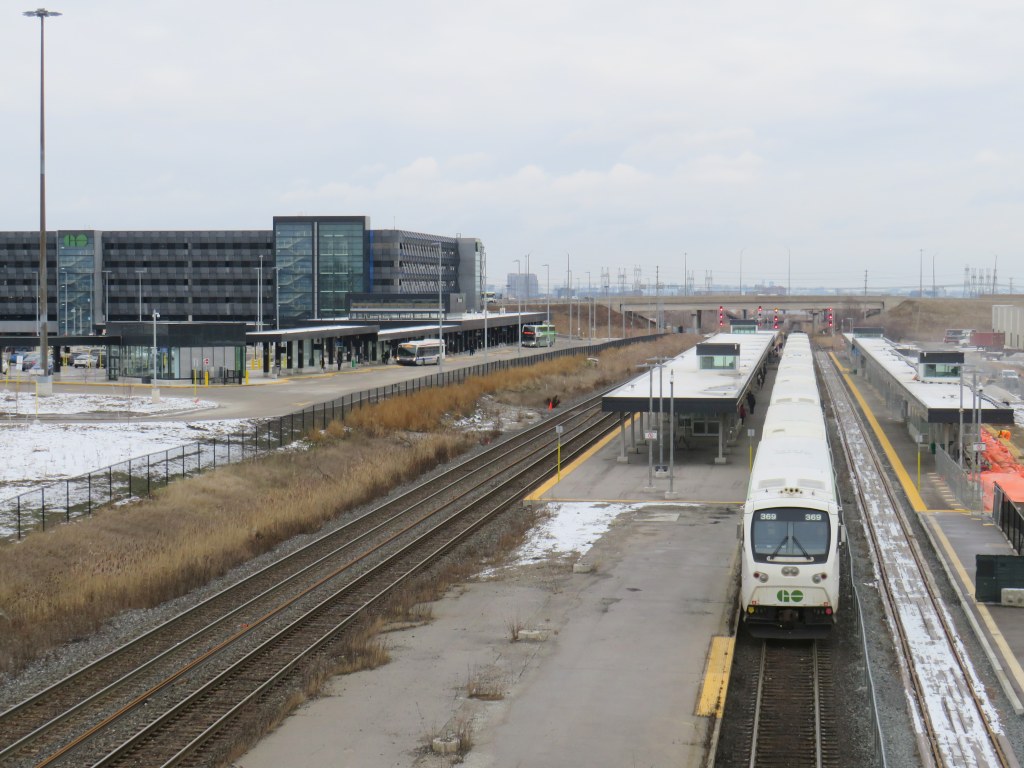
Route 21, the Milton GO bus corridor, provides Milton-Mississauga-Toronto service at all times except the weekday peak period direction, when GO operates seven trains between Milton and Union Station. Unfortunately, the busy Milton Corridor is Canadian Pacific’s mainline between Toronto and Chicago. Unlike CN (whose mainline is used by GO’s Kitchener Line between Bramalea and Georgetown), CP has been less amiable to GO service expansion outside the peak period window.
Because of passenger demand in central Mississauga, Route 21 has traditionally been one of GO Transit’s most complex routes, with ten distinct branches, with service to each station every 15-30 minutes at most times. With increasing traffic into and within Downtown Toronto, especially on summer weekends, Route 21 can be very slow and unreliable, with GO Transit forced to divert its buses on Route 21 and 31 away from its Union Station Bus Terminal to Port Credit GO.
Though weekend train service on the Kitchener Line solves the problem for Route 31, without access to CP’s tracks, Milton Line passengers must ride buses, which have to go somewhere.
The solution, then, was to permanently divert Milton Line buses to the Lakeshore West rail corridor. Route 21A will operate between Milton GO Station and Oakville GO Station, serving Sheridan College’s Oakville campus and the 407 Corridor at Trafalgar Road (allowing for new transfers from Milton to Hamilton/McMaster and Mississauga/Pearson Airport). Route 21B will run from Lisgar GO, serving Meadowvale GO, Streetsville GO, and Erin Mills Transitway Station before connecting to trains at Clarkson GO. Route 21C runs between Erindale GO, Square One, Cooksville GO, and Port Credit GO. Only during early mornings and late evenings will Route 21 serve Union Station, making all stops to and from Milton.
Dixie Station also loses its weekday Route 21 service. The station is not well connected with local transit nor is it in a walkable area, so it is completely dependent on drive-up traffic. That should be fine for commuters who can rely on the regular train schedules, and who don’t need to leave Toronto early or late, but it worth pointing out.
These changes simplify Route 21, and provide a reliable and predictable, albeit slower, connection to Downtown Toronto. They provide new connections to the busy Highway 407 bus corridor, and allow GO to divert buses and drivers to other services.
One thing GO can do to improve the utility of its realigned bus service is operate the new branches at all time periods to maximize ridership. For example, Route 21A, while providing new useful links between Milton, the Highway 407 corridor, and Sheridan College, does not run in the peak direction when the Milton Line trains are running, with no southbound buses from Milton to Oakville between 5:03 AM and 9:28 AM. A similar gap exists northbound in the late afternoon on weekdays.
Other changes
The Stouffville Line, which enjoys hourly train service seven days a week, goes down to just peak period rail service starting April 8. Work to double-track the corridor through Scarborough has been continuing, albeit slowly, so hopefully the suspension of off-peak trains will help speed up construction. Work to expand the Lakeshore East/Stouffville corridor through Toronto’s east end has also forced train service reductions between Toronto and Oshawa.
Route 81, one of the older bus routes in GO Transit’s network, will finally disappear. The bus route, connecting Whitby GO Station, Port Perry, and Beaverton, has seen low ridership, with alternative service provided by Durham Region Transit’s Route 905 to Port Perry and DRT’s rural on-demand service.
Finally, though they are not amongst the major upcoming changes, GO Transit’s services to Orangeville and Peterborough remain inadequate. Route 37, between Brampton and Orangeville, still does not operate on weekends, nor is there a morning northbound bus from Brampton. Ironically, there is better service leading north from Orangeville towards Shelburne, Dundalk, and Owen Sound operated by Grey County’s rural bus system.
Meanwhile, Route 88, which connects Oshawa GO Station with Peterborough and Trent University, was diverted several years ago to serve Bowmanville, replacing since-cancelled Route 90. Unfortunately, this results in a long, nearly two-hour bus ride between Oshawa and Trent University, or four hours between Toronto Union Station and Trent. The drive, with moderate traffic, is less than half that. Though Rider Express now operates a bus from Toronto to Ottawa via Peterborough, it only runs once a day, four days a week.
It would be great if GO Transit could speed up Route 88 to make it a viable and attractive option between Toronto, Durham Region, and Peterborough.
Finally
On the whole, I am pleasantly surprised by GO Transit’s April service changes. Weekend service on Route 30 and the new Route 17 between Hamilton, Guelph, and Kitchener-Waterloo close some major gaps in that part of the province. The Route 21 changes make a lot of sense and open up new connections, though many bus passengers will not be happy with the new forced transfer to get to or from Downtown Toronto. Though bustitutions on the Barrie and Stouffville Lines are not ideal, they will allow for important work to improve rail service on those two corridors. Finally, attention to bringing faster and fuller service on some bus routes – like 21A, 37, and 88 will help build a complete transit network across the Greater Golden Horseshoe.
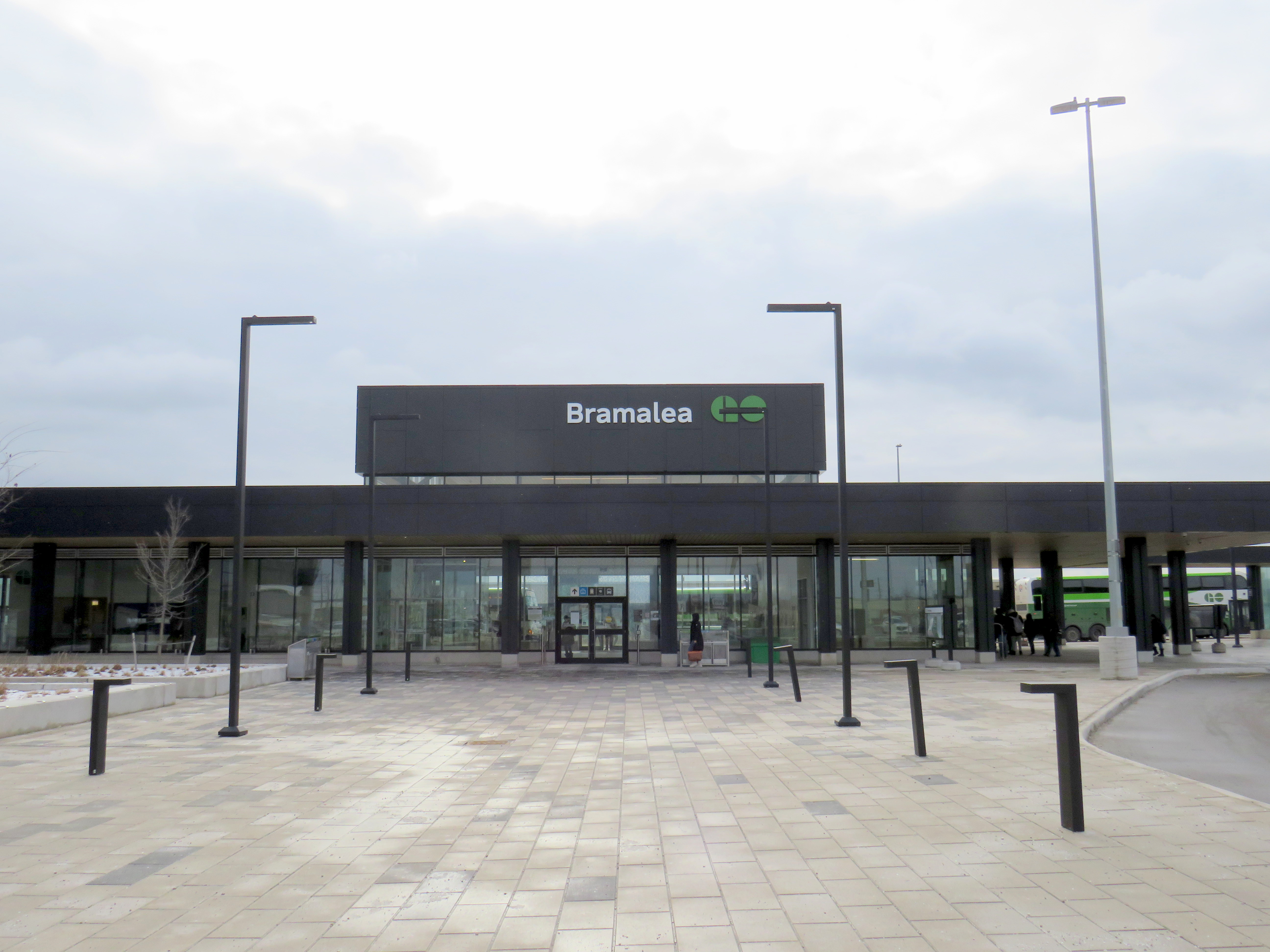
But in January 2023, I returned to Bramalea GO Station and came away feeling satisfied. Metrolinx has finally built a Bramalea GO Station that works. Now it is time to use the rebuilt station to its full potential.
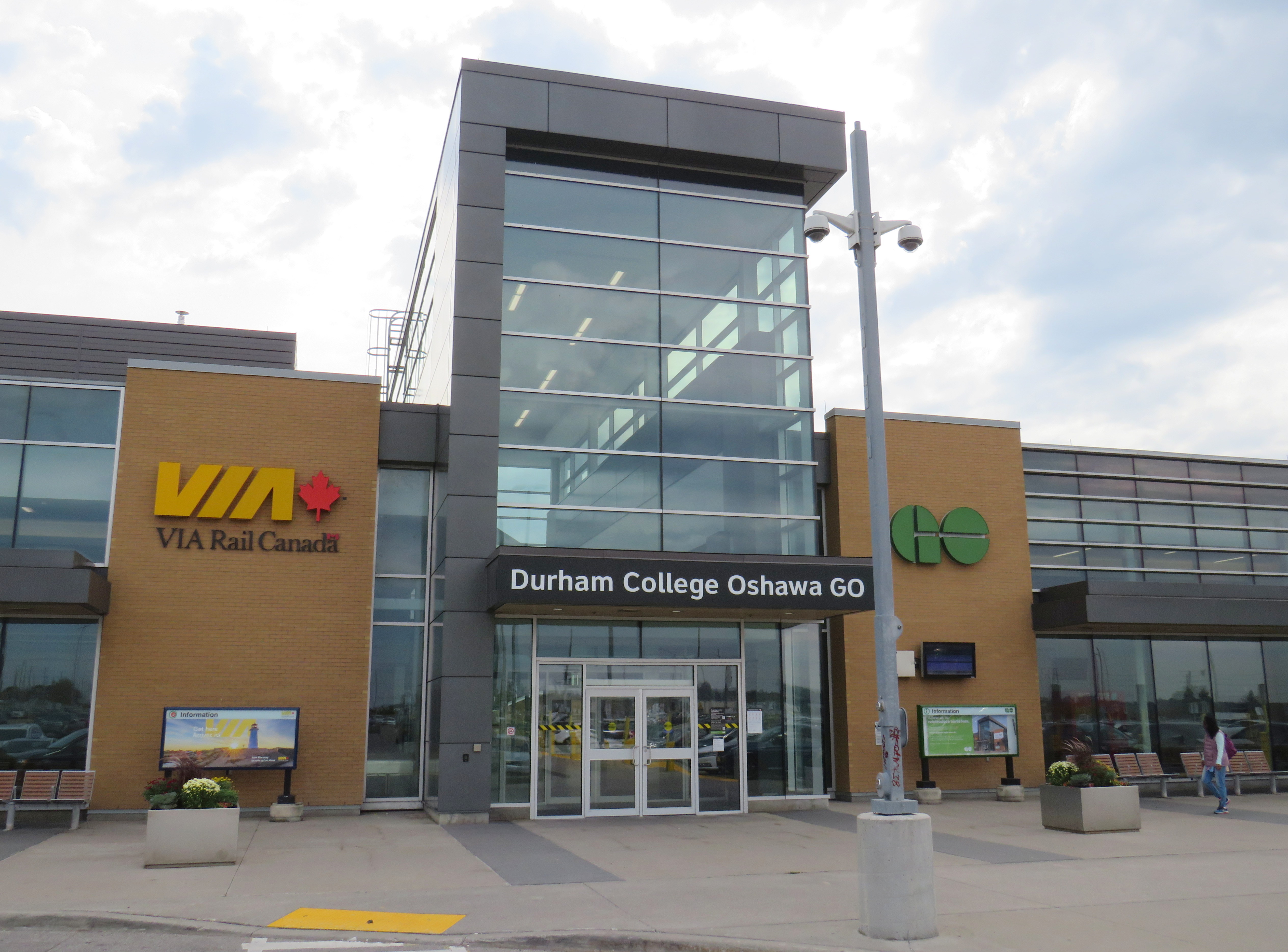
On Tuesday, October 4, Metrolinx announced a new name for Oshawa GO Station, the eastern terminus of its busy Lakeshore Corridor. In a ten-year agreement with Durham College, a publicly funded post-secondary institution, the station will now be known as “Durham College Oshawa GO.” This was announced on Metrolinx’s Twitter account, Durham College’s social media, and on the GO Transit Lakeshore East Twitter account, which usually advises passengers of train delays and cancellations.
📢 Oshawa GO is now Durham College Oshawa GO!
Customers will start see the new name on the station building itself and on assets throughout our system. pic.twitter.com/dAAvCjOz2e
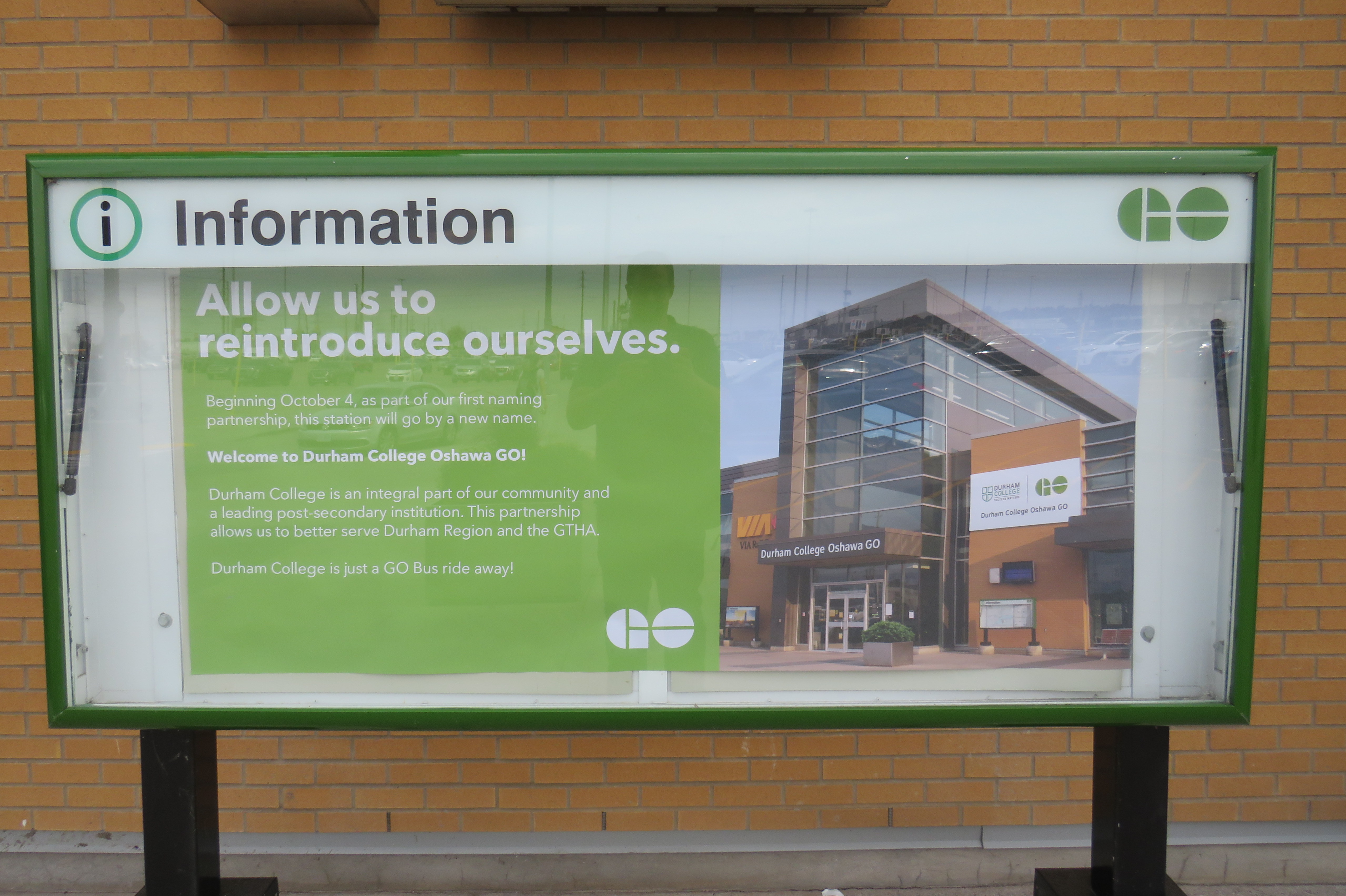
GO Transit Lakeshore East Train tweet on October 4“Allow us to reintroduce ourselves” – promotional poster at Oshawa Station proclaiming the new “Durham College Oshawa GO” name
Metrolinx, the regional transit agency that operates GO Transit, claims that “the partnership allows us to better serve Durham Region and the GTHA” in its communications, including an informational poster in front of the station building.
The news did not go over well with GO Transit customers and transit users across the Greater Toronto Area; Metrolinx later deleted its tweet after it was “ratioed” — meaning that negative comments and quote-tweets outnumbered the number of positive responses by a large margin. It is easy to understand why the station renaming was not popular.
Firstly, though “Oshawa” remains in the station name, Durham College comes first with the new moniker. Schedules, signs, and maps will be updated to reflect the new name, while announcements by on-board staff and digital schedule information already reflect the new name. VIA Rail, which shares the station with GO Transit, is not a party to the agreement, and will likely continue referring to the station as “Oshawa.”
Specific details of the agreement, such as how much Durham College is paying for the branding agreement, remain confidential.
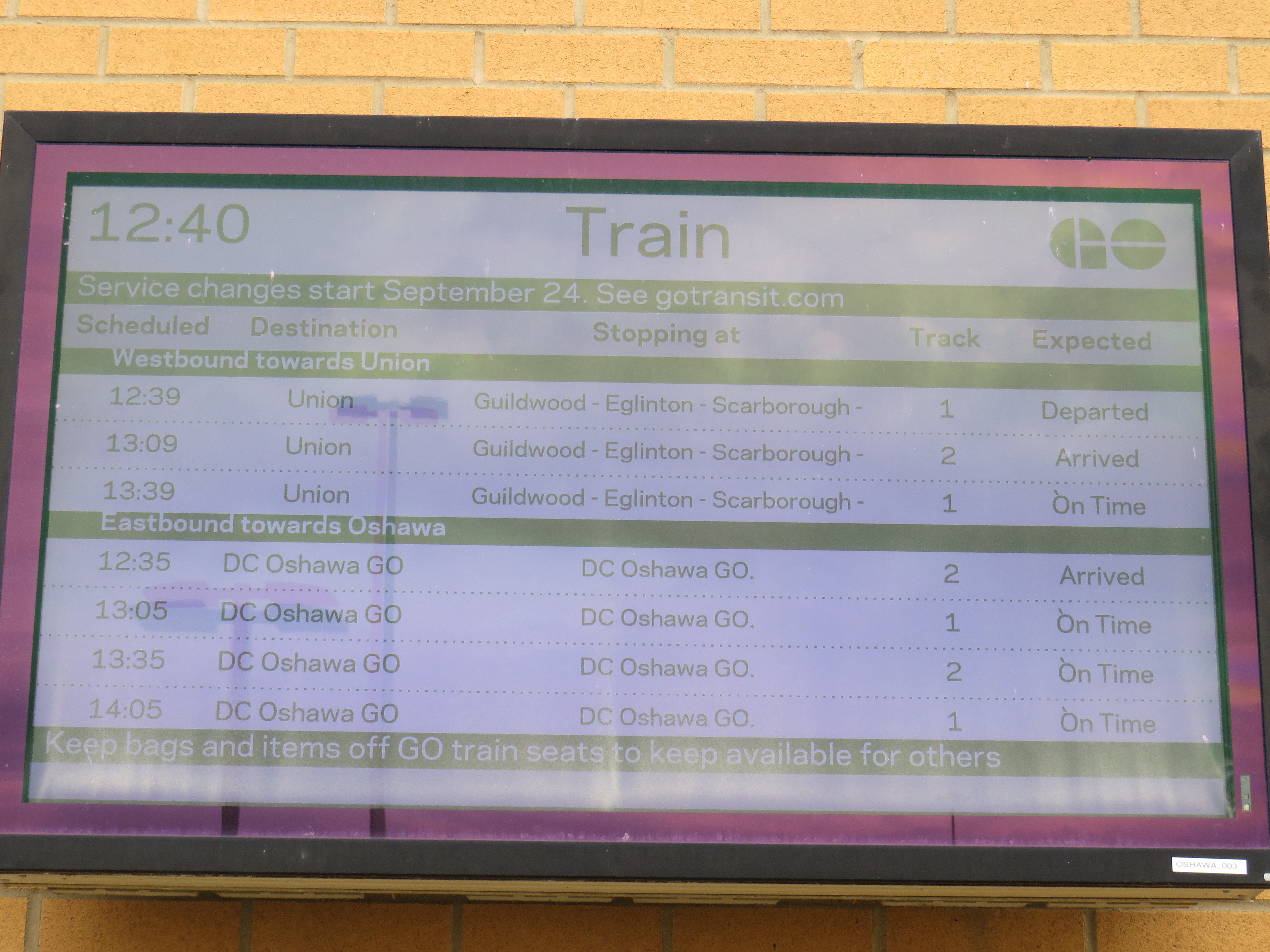
On GO Transit schedule boards, Oshawa Station now appears as “DC Oshawa GO”
The new policy of naming rights agreements goes against years of Metrolinx policy for naming stations. When planning the Eglinton-Crosstown LRT, it developed five standards for naming stations and stops:
1. Simple. Simple names are easier to remember
2. Logical. Logical names provide a mental link when trip planning: they should be relevant to the area they reside
3. Durable. Names should be relevant as long as the station exists
4. Self-Locating. Names should allow users to mentally locate themselves within the region
5. Unique. A unique name is one that cannot be confused with any other.
“Durham College Oshawa GO” violates most of the above principles. The name is now a mouthful, much like “Vaughan Metropolitan Centre” (another controversial station name that the TTC objected to, but was overruled due to political considerations), and is no longer simple. The agreement only lasts ten years, so it is not durable. As I will explain further, the name is also neither logical, self-locating, nor unique.
Durham College has three campuses. Its main campus is located in the north end of Oshawa, on a site shared with Ontario Tech University. GO Transit has a bus stop there called “Ontario Tech/Durham College” that is served by GO Transit Route 56 on weekdays, and Route 52 on weekends and holidays. The main Oshawa campus is a two hour walk from the GO station, a 25-35 minute GO bus ride, or a 20 minute drive from the station. This was the main reason why transit users were ridiculing the new station name on Twitter.
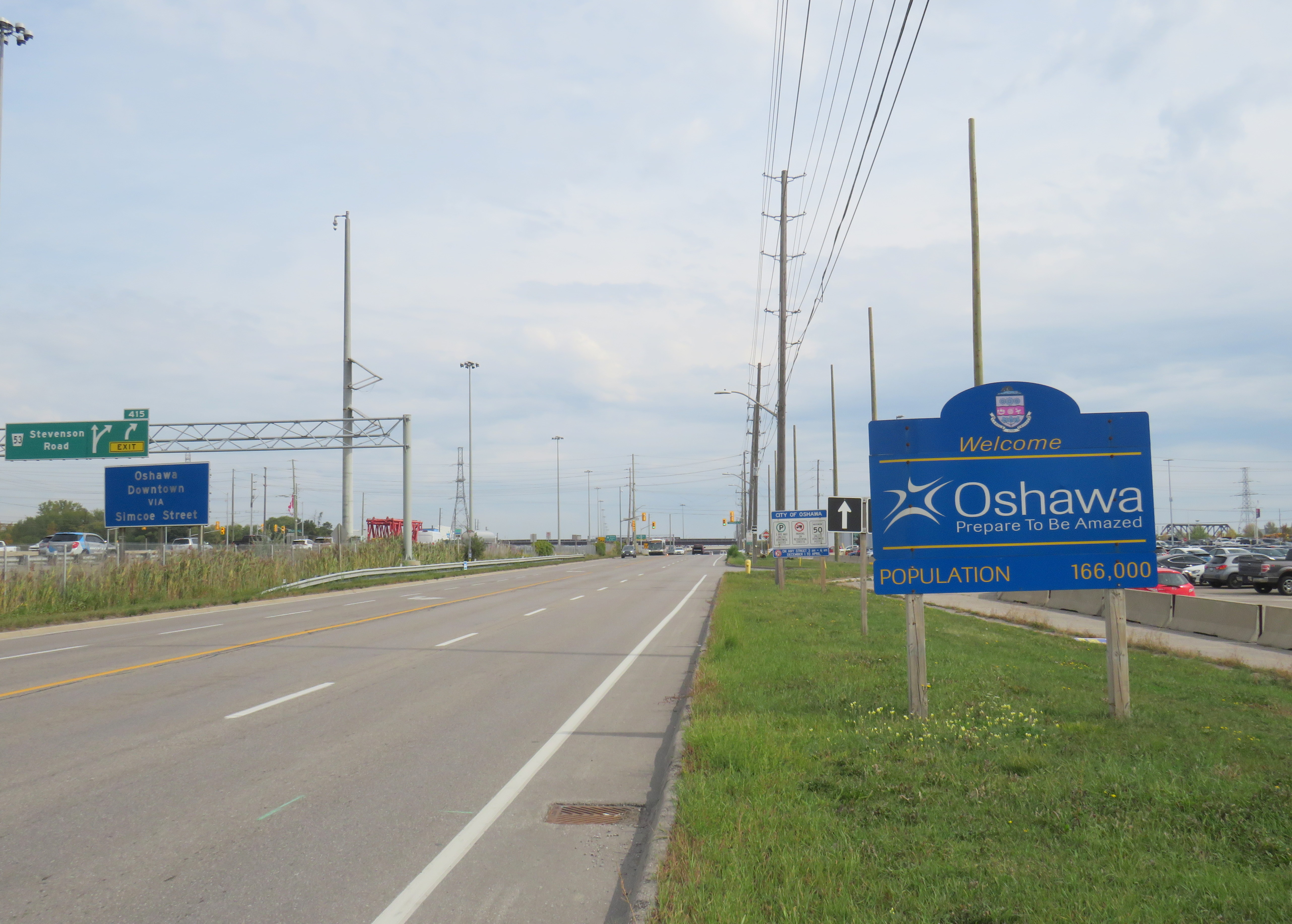
Durham College’s Whitby Campus is much closer to Oshawa GO Station, in fact, it is less than 500 metres from the Oshawa GO Station parking lot as the crow flies. Oshawa Station is actually right on the border of Oshawa and Whitby, with the “Welcome to Oshawa” signs next to the main GO Transit parking lot. The overflow lot for Oshawa GO is actually in the Town of Whitby.
The “Oshawa: Prepare To Be Amazed” sign marking the city limit sits next to the GO Station parking lot.
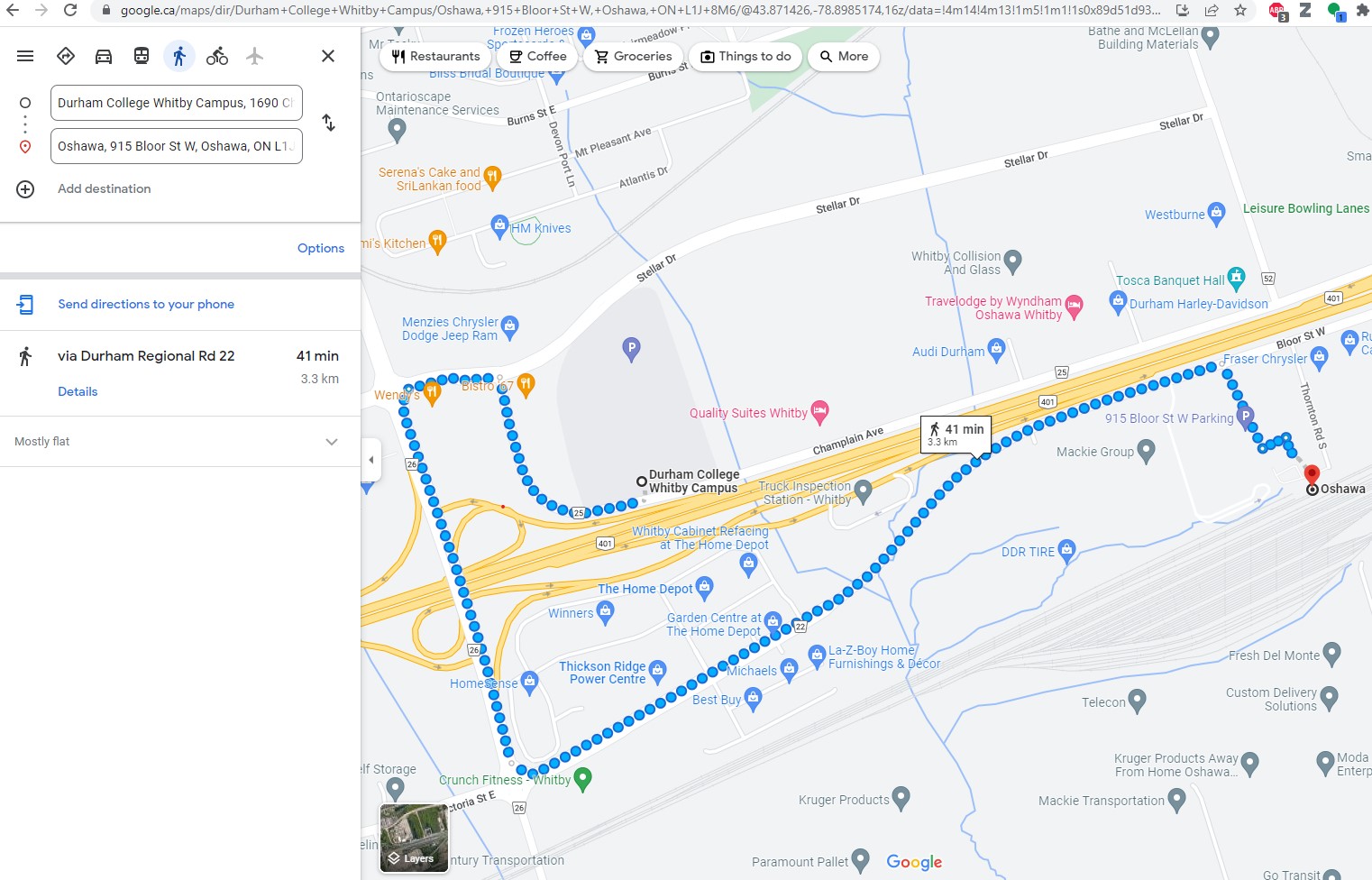
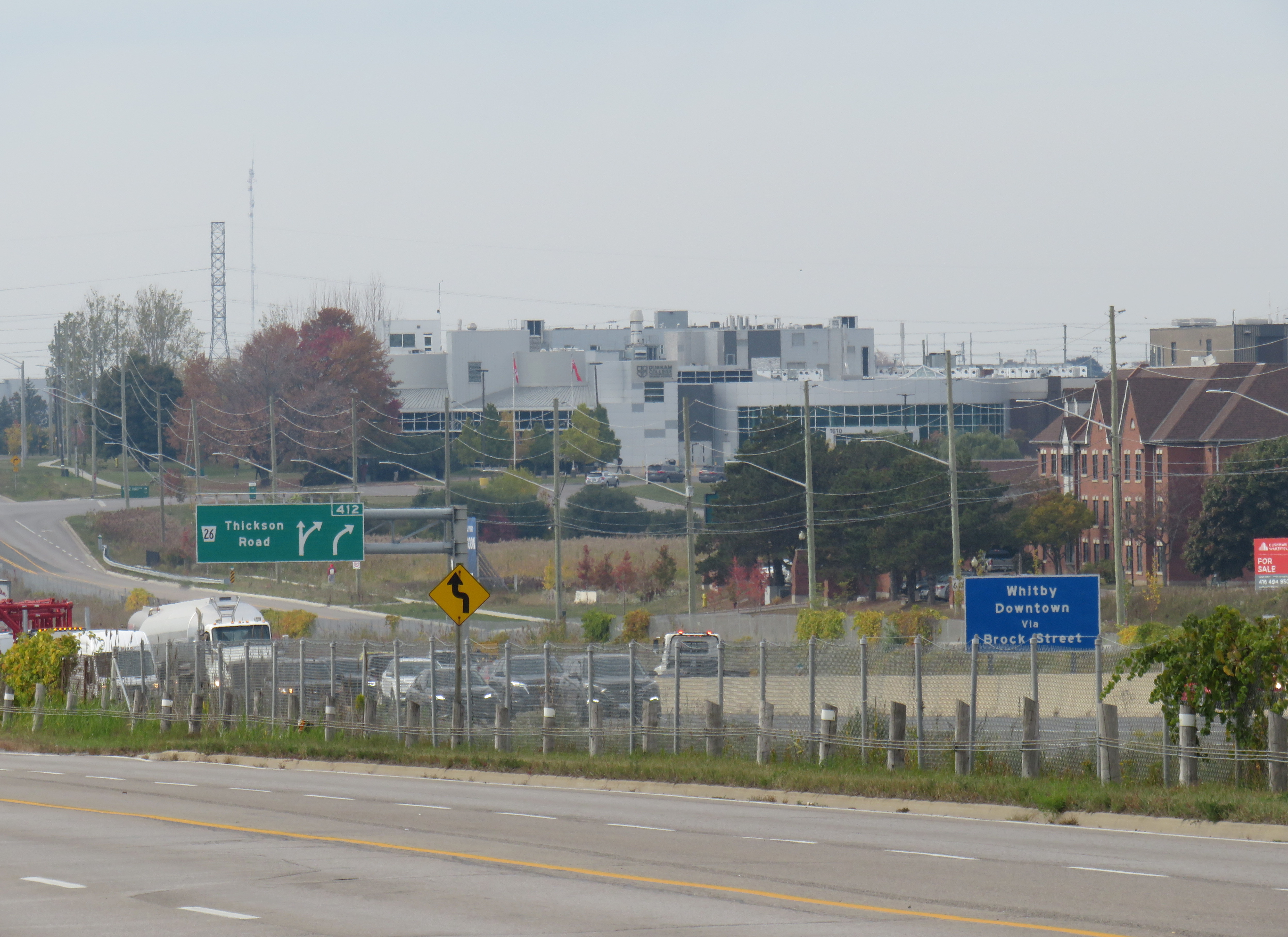
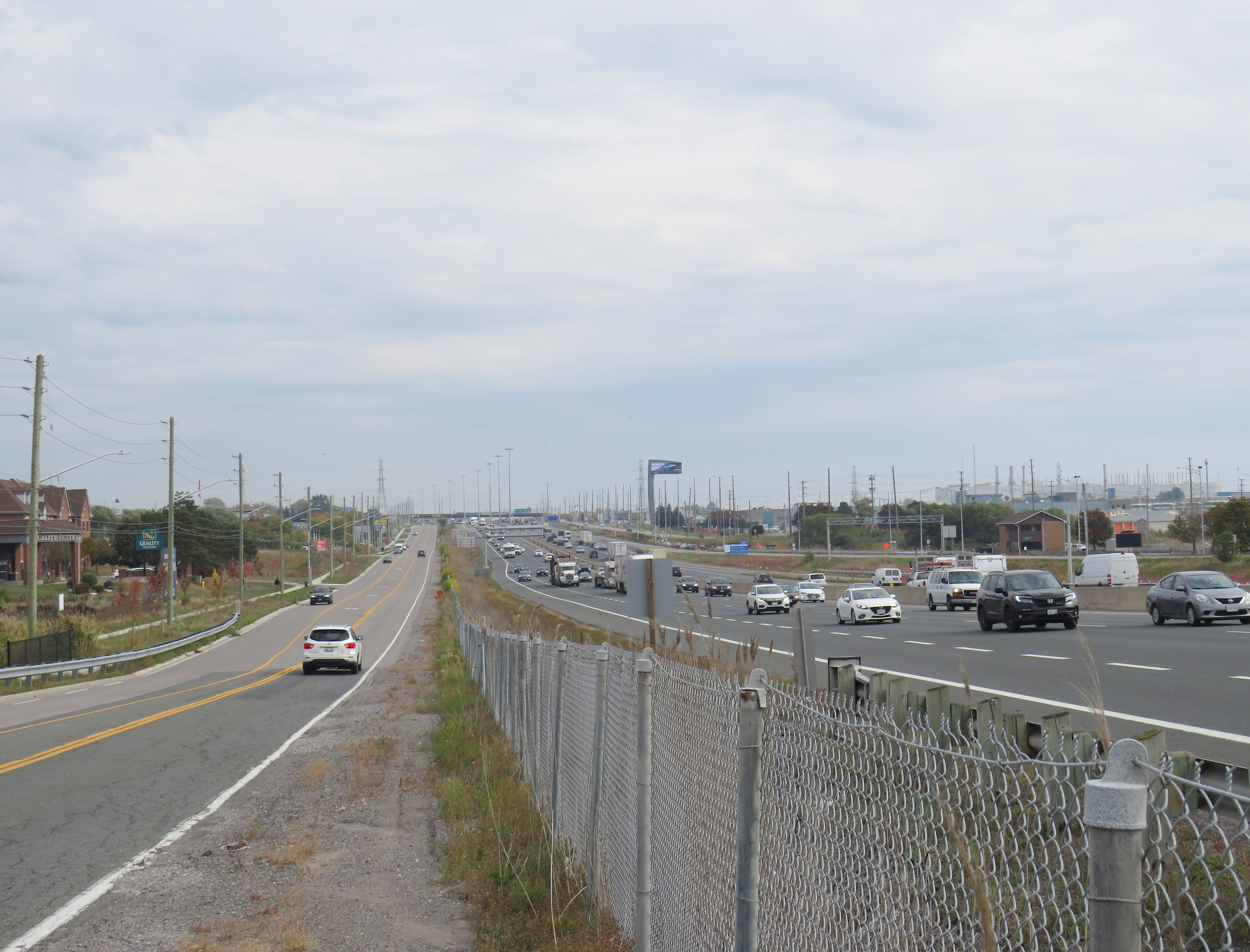
However, the Whitby campus is even harder to get to from Oshawa GO than the main Oshawa campus because it is separated by Highway 401. It is a 41 minute walk between the station and the Whitby college campus along Victoria Street (which has no sidewalks along most of its length), Thickson Road, Stellar Drive, and Champlain Avenue, though a footbridge over the highway would reduce the walking time to a more comfortable 15 minutes.
Google Maps directions from Oshawa Station to Durham College Whitby CampusLooking northwest from the Oshawa GO parking lot towards Durham College Whitby Campus, the large grey building above and to the right of the green Thickson Road exit signLooking east on Champlain Boulevard in front of the Whitby campus across Highway 401 towards Oshawa GO Station, which is marked by the tall digital billboard towering over the roadway
The irony is that both major Durham College campuses are better reached from Whitby Station than the newly named “Durham College Oshawa GO.” There are no direct buses to the Whitby Campus from Oshawa Station, but Durham Region Transit (DRT) Route 917 provides regular service from Whitby Station. Furthermore, DRT operates more frequent service on Route 905 between Whitby Station and the Oshawa Campus than GO Transit does from Oshawa Station. Google Transit itself recommends transferring at Whitby to DRT, rather than at Oshawa, because the connections are more convenient. GO Route 56 operates only every hour on weekdays, and Route 52 runs every two hours on weekends and holidays. Meanwhile Route 905 stops in front of the Oshawa campus every 15-30 minutes, 7 days a week.
The connection at Oshawa Station to Durham College’s main Oshawa Campus makes sense only when transferring from a VIA Train, or from GO Transit Route 88 from Peterborough and Clarington.
Excerpt from Durham Region Transit system map, with Oshawa and Whitby stations and both Durham College campus locations highlighted
Therefore, at this point, renaming Oshawa Station to “Durham College Oshawa GO” makes no sense. The new name violates basic wayfinding standards, while Durham College itself is better accessed from a different GO Station. Perhaps Durham College could operate a shuttle service to its campuses from the station, making the co-branding a more plausible.
Though I am critical of the process, I am sympathetic to Metrolinx’s position. I do not believe they were supportive of the province’s decision to rename a major LRT project for a political ally and paid advisor to Doug Ford’s Progressive Conservatives. I strongly believe there are many within the organization who are not happy about the station renaming agreements either. They must work with a very “hands on” government that is eager to promote new transit projects and benefit their supporters.












 Sean Marshall