Tag: Metrolinx

  • Digging a hole on Main Street

    Fullscreen capture 29022016 113646 PM

    Most people that know me know that I’m a fan of The Simpsons. There’s a scene at the end of a classic episode, entitled “Homer the Vigilante,” where several characters, including Homer Simpson, Otto Mann, Mayor Quimby, and Police Chief Wiggum are stuck in a hole, looking for a non-existent buried treasure.

    The final few minutes of the episode are a spoof of the 1963 comedy epic It’s a Mad, Mad, Mad, Mad World: a cat burglar tricks the people of Springfield into seeking his buried treasure while he escapes from the police lockup. A briefcase found quickly when digging under a “Big T” says as much, but a few determined souls decide to keep digging in the vain hope of finding that promised treasure. Finally, after digging for hours and finally realizing that there was no fortune to be found, the remaining excavators decide to dig their way out of the deep hole they find themselves in. As the final scene fades into the credits, Wiggum suggests they’re all doing it wrong, providing some nonsensical advice: “No, no. Dig up, stupid.”

    On October 27, 2015, Brampton City Council decided, in a 5-4 decision, to terminate the provincially funded LRT line at Steeles Avenue. Council was pressured by local opposition from wealthy landowners on Main Street South and several downtown businesses. Construction on the shortened transit corridor is scheduled to begin in 2018.

    After rejecting the recommended surface alignment, Council asked staff, which twice recommended the original surface route, to come back with alternative alignments. Late last week, staff released its report on the various options for extending the Hurontario LRT from Steeles Avenue (Shoppers World). That report, buried in a large PDF document, starts at page 238. The report will be brought to the Planning and Infrastructure Committee on Monday, March 7, and will likely presented at a special public meeting on Monday, April 18.

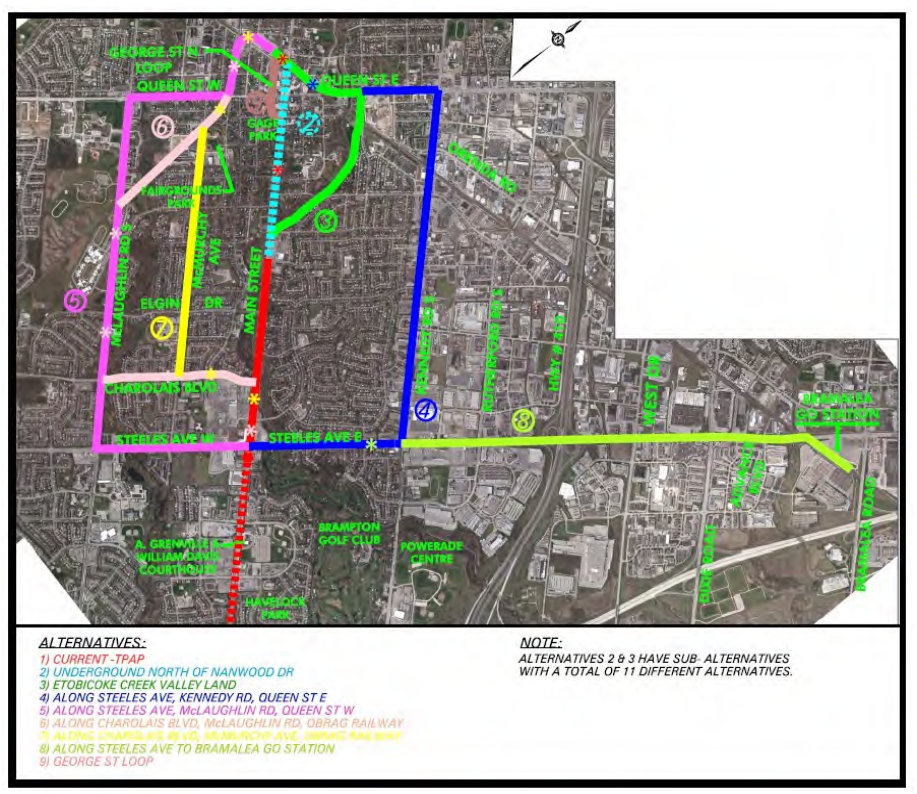
    Yesterday, in Bramptonist, Divyesh Mistry summarized the report’s recommendations. Staff recommended  two tunnel options. Both potential tunnel alignments would extend from a portal between Elgin Drive and Nanwood Drive under Main Street to the GO Station, either with underground stations at Nanwood and Wellington Street (at Brampton City Hall and Gage Park), or running straight through without stops, but a new surface stop at Elgin Drive. The first option, with underground stations at Nanwood and Wellington, would cost $570 million; the second tunnel option would be cheaper, costing $410 million. The tunnel would have to clear the Etobicoke Creek bed, and each underground station would require stairways and elevators to provide access.

    Staff recommended that council authorize $2.5 million for a new transit project assessment process (TPAP), including technical and design work, that would take two years to complete.

    Fullscreen capture 01032016 120953 AM
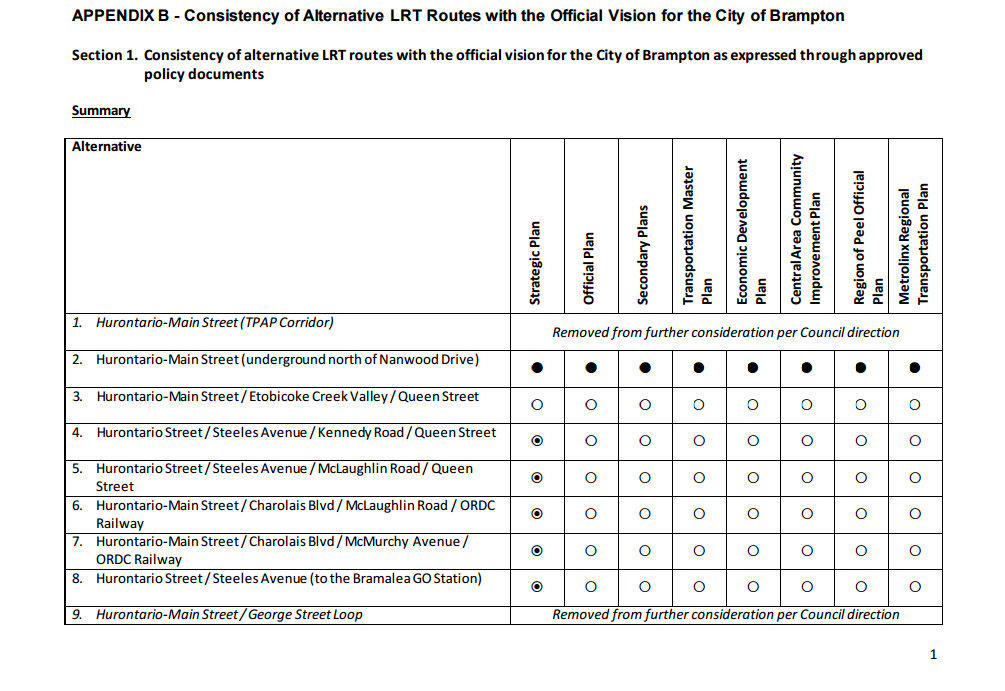
    Appendix B from the City of Brampton staff planning report, which outlines each LRT routing option’s consistency with city, regional, and provincial planning policies

    Of course, cheapest and most obvious option, running the new light rail line on the surface between Nanwood Avenue and the Brampton GO Station, was “removed from further consideration per Council direction.” Various other alignments that would have seen the light rail line follow  McMurchy Avenue, McLaughlin Road, Etobicoke Creek and/or the Orangeville-Brampton Railway were rejected as they were found to be inconsistent with various planning policies, including the city and regional official plans and economic and transportation policies. The various other alignments would be less direct, follow active railways or floodplains, and move the LRT away from Main Street, but in the neighbourhoods of other, less wealthy residents.

    Fullscreen capture 01032016 121050 AM
    Appendix A: from the City of Brampton staff planning report, a map of alternative LRT alignments north of Steeles Avenue

    If money weren’t an object, the first tunnel option, with stops at Nanwood and Wellington, would be a reasonable compromise. It maintains the linear alignment most suited to moving passengers, it gets the LRT to Downtown Brampton, the Queen Street corridor, and the GO/VIA station, and it placates the local NIMBYs worried about light rail trains operating on Main Street.

    But the City of Brampton, when it rejected the alignment north of Steeles Avenue planned during a multi-year TPAP, threw away the $200 million the province was prepared to spend on that segment. If Brampton ends up deciding to extend the LRT, it’s already in a $200 million hole, unless it can convince Queen’s Park to give that money back. If it decides to build a tunnel, it will dig itself even deeper into that hole. The cheaper of the two tunnel options misses useful stops at Wellington and at Nanwood, where the Brampton Mall lands provide an excellent opportunity for urban intensification.

    So I see three options going forward:

    • The status quo. Brampton City Council balks at the costs of each alternative alignment, and the Hurontario-Main LRT terminates at Shoppers World. Maybe in a few years, Brampton will realize its mistake, à la Mesa, Arizona, and approve and build the extension. I see this as the most likely outcome.
    • A return to the surface TPAP LRT alignment. Brampton City Council, once again faced with a staff report advocating the direct Main Street alignment, balks at the cost of the tunnel, and decides to reverse position, even begging Queen’s Park to provide funding. Will a dysfunctional Brampton City Council come to this decision? Possible, but unlikely.
    • A go-ahead for a tunnel. With the recent election of a new Liberal government committed to building infrastructure, there’s a slight chance that Brampton would find enough support from upper levels of government for partial funding for a $410-570 million tunnel into Downtown Brampton. But it will be up against many competing bids for transit funding. London, Ontario has a plan for a rapid transit system. Ottawa is ready to start building Phase II of the Confederation Line LRT. And, of course, Toronto has several plans for new subways and LRT lines. Will Brampton be willing to go it alone?

    As Lisa Stokes points out, Brampton already has a $1.5 billion infrastructure gap, and there are many other projects that the city needs in the short to medium term, such as a second full-service hospital campus, a central library, a permanent market space, or simply repairing the roads, parks, and recreation centres in dire need of attention.

    So because of its rejection of a financially and technically sound surface routing last October, the City of Brampton will likely go through a new round of project assessments. It will also have to go begging for money to build their preferred alternative. Without even starting construction, City Council dug a pretty deep hole for itself. Can it dig itself out?

  • The upshot of the new, lower UP Express fares

    24281427544_ddb67d604d_k

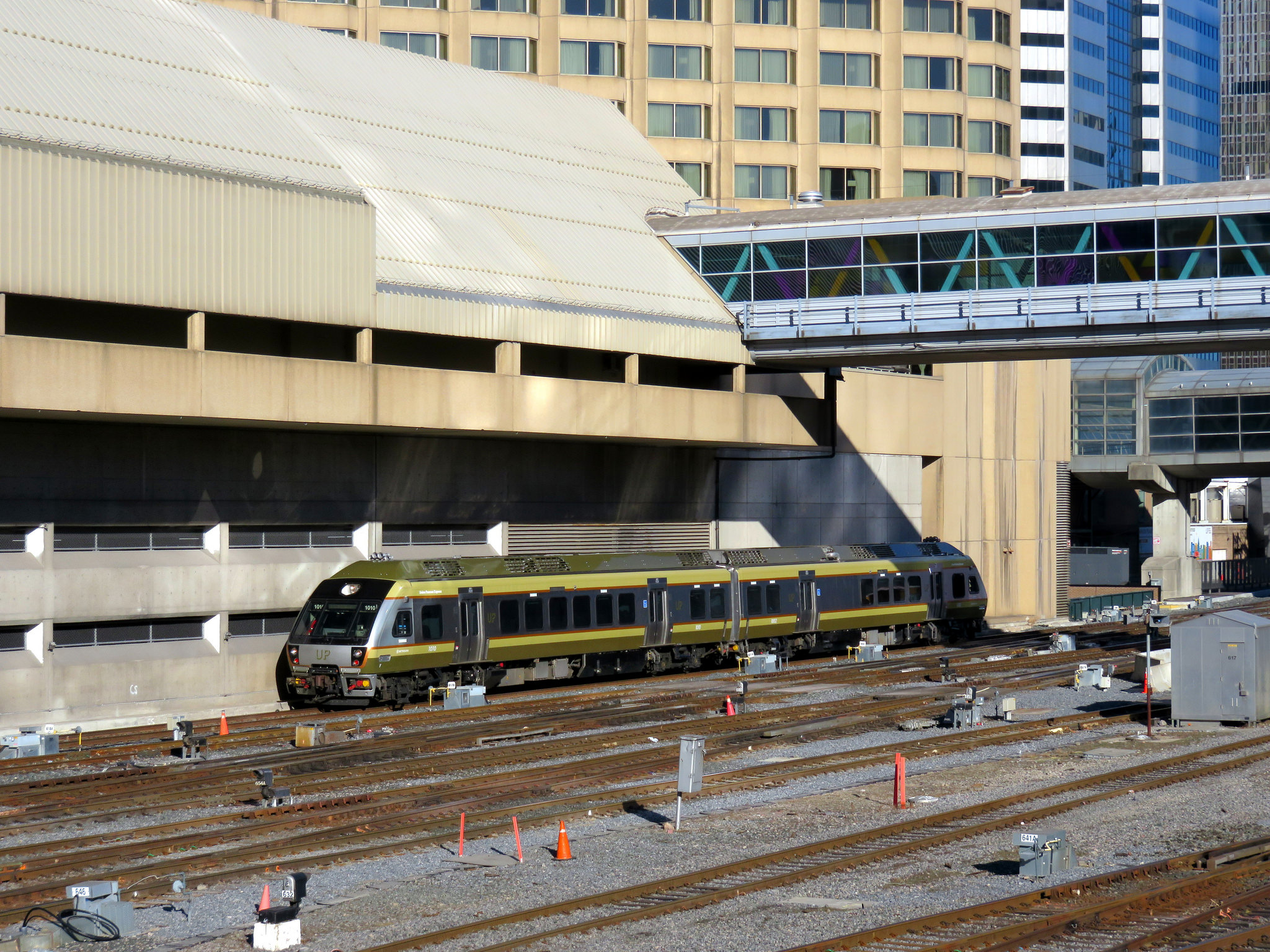
    Earlier this month, I commented on the poor ridership numbers of UP Express, Metrolinx’s airport rail link between Toronto’s Pearson International Airport and Union Station. I suggested that despite the embarrassing ridership figures, UP Express (UPX) was no white elephant. I argued that instead, the rail service could be a useful transit link for residents of North Etobicoke, Weston, Mount Dennis, and West Toronto.

    Later today, Metrolinx’s Board of Directors is expected to approve a major fare reduction for UPX slashing fares by over 50 percent. The Globe and Mail broke the story yesterday; today the Toronto Star has more details.

    The one-way cash fare between Union Station and Pearson Airport will drop from $27.50 to $12.00; the fare charged to Presto cards will drop from $19.00 to $9.00. Fares between Union Station, Bloor and Weston will drop to the equivalent GO fares. (The 2016 GO Transit fare from Bloor to Union Station is $5.30, or $4.71 with Presto; from Weston, it is $5.65, or $5.02 with Presto).

    The UPX fare between Union Station and Pearson will still be priced at a premium compared to the equivalent GO Transit fare — the cash fare from Union to Malton Station is $7.70, or $6.84 with a Presto card.

    Interestingly, before UPX was launched, Metrolinx conducted studies on potential ridership and fares. One study, by Steer Davies Gleave, that some UPX trains might even at capacity by August. You can read Metrolinx’s market research and ridership studies (with some details redacted) here. Obviously, there weren’t enough well-heeled business travellers willing to ride UPX for $27 each, or even enough local residents willing to pay $19 with their Presto card.

    This change in pricing makes UPX much more attractive for commuters in the Junction/Junction Triangle neighbourhood, as well as those living in Weston. The lower fares should help increase ridership between Pearson Airport and Union Station as well. It’s a good start, but it isn’t enough.

    Last year, I commented on GO Transit’s “fare by distance” structure, which charges disproportionately high fares for short distances, and very inexpensive fares for long commutes.  While GO offers co-fares to suburban transit agencies, it offers no such fare integration with the TTC. GO Transit offers free parking at suburban rail stations, burying the cost of building and maintaining its parking lots into the fares of every passenger, whether they need parking or not.

    The charts below show the single ride and Presto fares, per distance travelled in 2016, with the new UPX fares. Per distance travelled, a GO Transit fare to Union Station to Exhibition, Bloor, and Danforth is more expensive than going from Toronto to Pearson Airport via UP Express.
    2016CashFares 2016PrestoFares

    Metrolinx is in the midst of developing a new fare integration strategy, so hopefully these concerns will be addressed. Once the TTC completely rolls out Presto at all subway stations and on all buses, it will be technically simple to adopt a GO-TTC co-fare, and UPX should be part of this as well. There are tens of thousands of jobs at the airport and in the surrounding offices and industrial parks. With proper fare integration with TTC, Miway and Brampton Transit (all of which serve Terminal 1), UPX could become much more useful to many more commuters.

    Lowering UP Express fares is a good start, a welcome acknowledgement that the rosy forecasts of business travellers crowding the airport trains were never reached. But lowering fares isn’t enough: with proper fare integration, UP Express can offer far more utility than simply being an airport rail link.

  • Down is the new UP: Thoughts on dismal UP Express ridership

    19008325386_9c321ac7ab_k

    At February 10th’s Metrolinx board meeting, there was an update on the Union Pearson (UP) Express ridership. The news isn’t good, as ridership dropped in the last few months, instead of growing according to Metrolinx’s rosy projections.

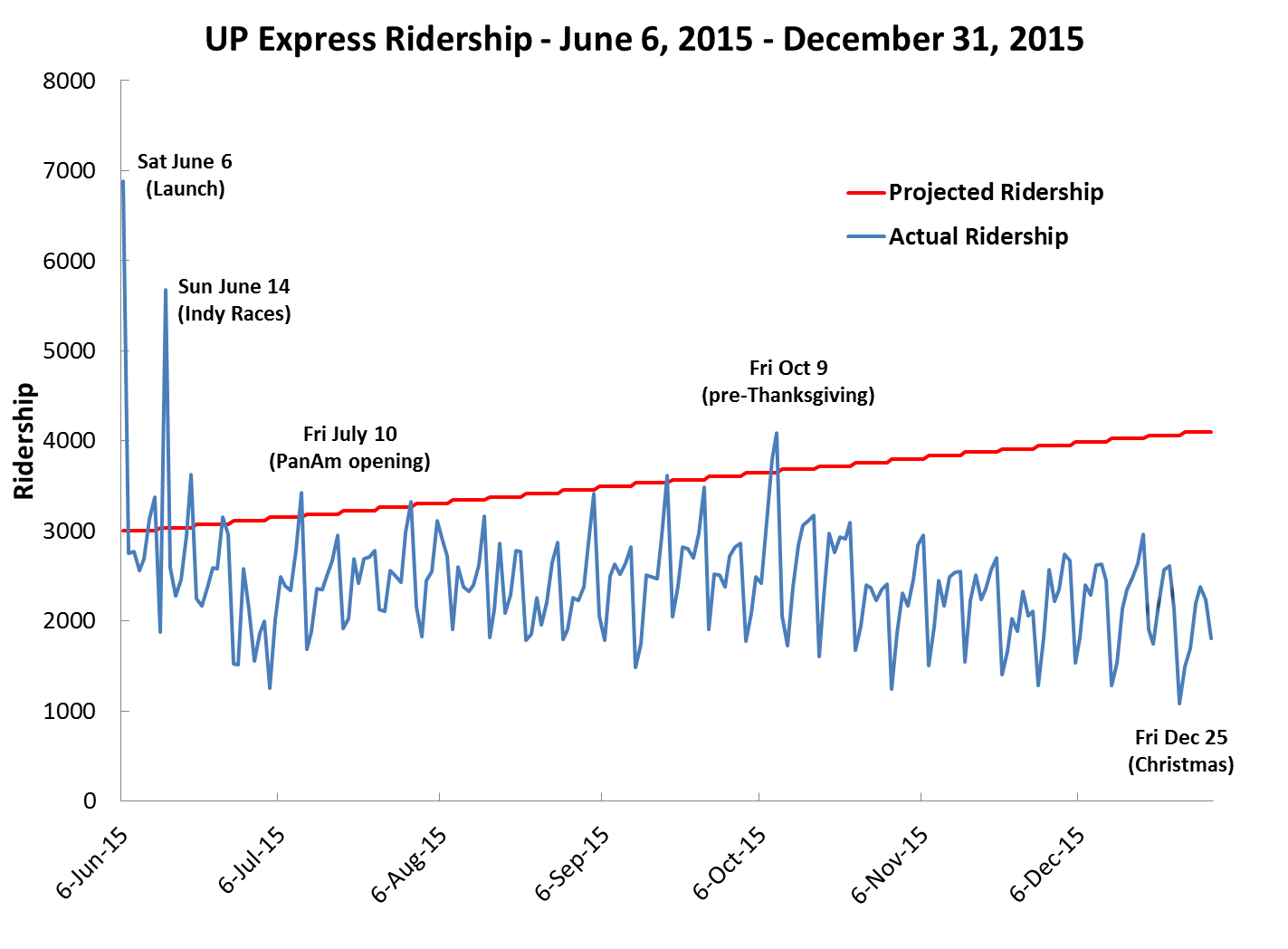
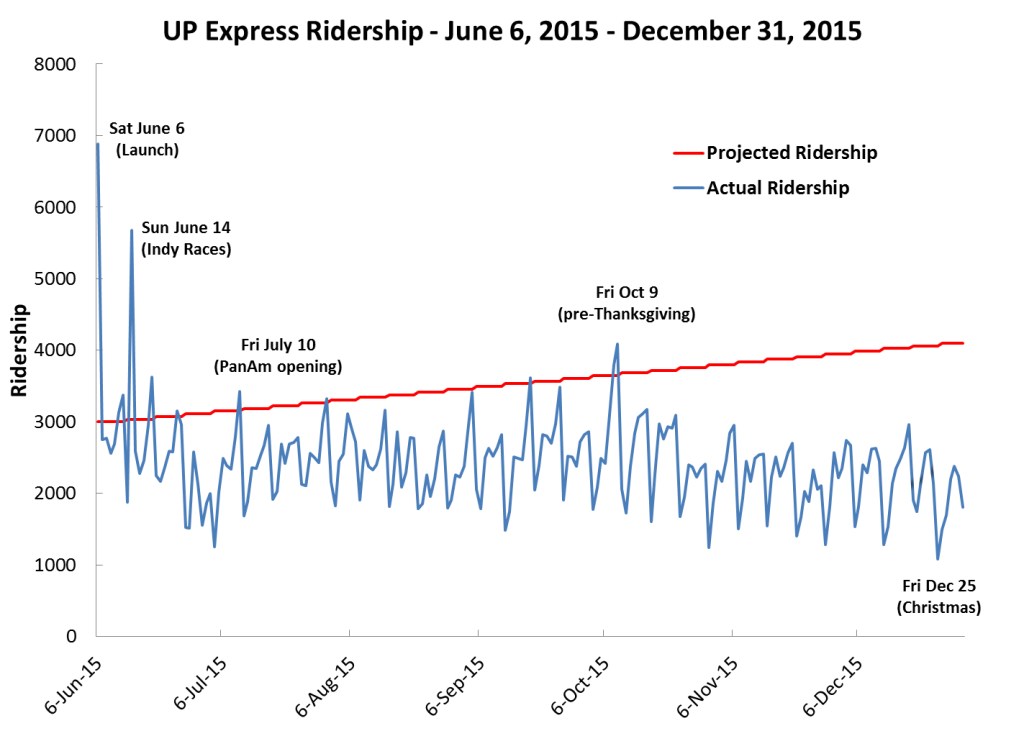
    UP Express launched on Saturday, June 6, 2015, a month prior to the 2015 PanAm/ParapanAm Games. I was one of thousands to ride the train on that inaugural day; thousands of free tickets were given to the public. Nearly 7,000 rides were taken that Saturday, a number that has yet to be surpassed. Metrolinx estimated that UP Express would start off with an average of 3,000 daily riders, and within a year, there would be 5,000 daily riders. While the base one-way fare for UP Express is $27.50, the fare for Presto cardholders is $19.00.

    The line chart below shows the projected ridership (increasing weekly towards 5,000 riders by June 2016) and the actual daily ridership. As one can see, the ridership varies by the day of the week, mirroring trends in air passenger traffic. Fridays are generally the busiest day of the week for UP Express, while Saturdays are the quietest.
    UO

    After the June 6 launch, the busiest day for UP Express were Sunday, June 16, which coincided with the Honda Indy at Exhibition Place, when 5,673 passengers used the train. There were peaks on Friday, June 19 (3,628 customers), Thursday June 25 (3,077 customers), and on Friday, July 10, when 3,424 riders took UP Express, the day of the opening ceremonies for the Toronto 2015 PanAm Games.

    But ridership plateaued after October, which had the highest monthly ridership recorded, at 79,010, which works out to a daily average of 2,548 passengers. The last peak was on Friday, October 19, the day before the Canadian Thanksgiving long weekend. Nearly 5,000 passengers rode UP Express. Ridership dropped in November and December, a busy travelling season. The daily average ridership dropped to 2,169 in December, a new low, and never was above 3,000 after Friday, October 23. Ridership bottomed out on Christmas Day, when a mere 1,086 rode the train.
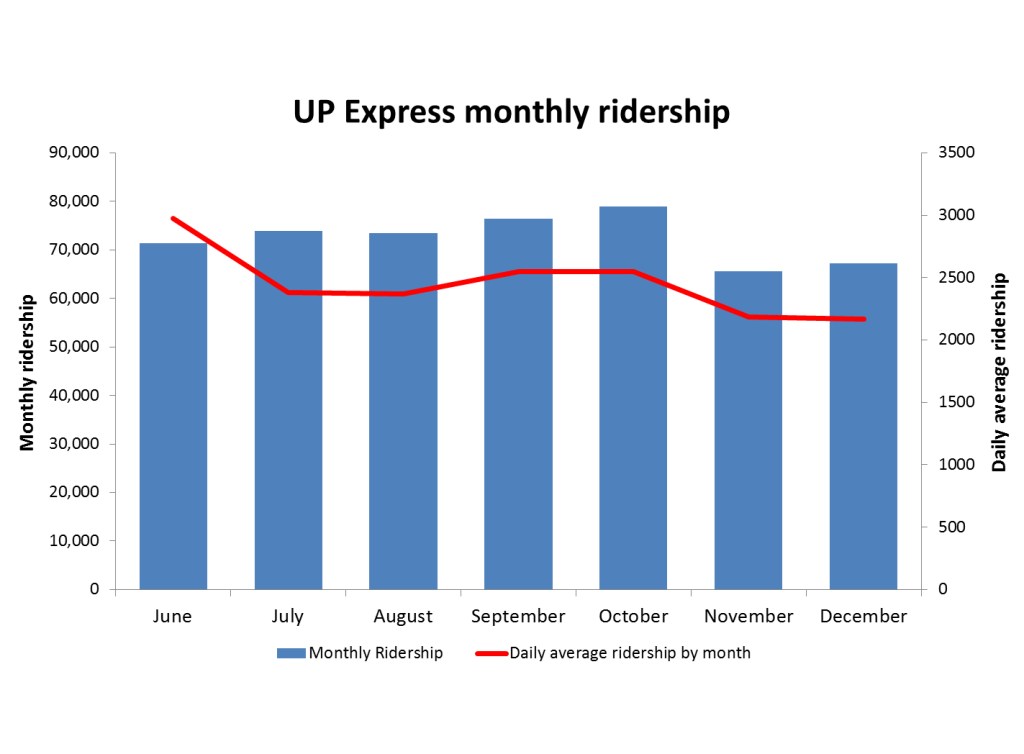
    MonthlyUPXMetrolinx should be embarrassed by these extremely low ridership figures. UP Express is a semi-autonomous operating division of the provincial transportation agency with its own President, Kathy M. Haley. The agency spent $4.5 million on a contract for branding with Winkreativewhich included special uniforms and even an “in-flight” magazine. The TTC’s 192 Airport Rocket, which has its own dedicated bus fleet, carries 4,700 passengers on an average weekday. The TTC doesn’t have a special operating division or President for that route, even though it carries nearly twice the number of passengers.

    For comparison, in 2014 — the last year for which detailed ridership data is available — only twenty-five regular TTC bus routes had a daily weekday ridership that was lower than the UP Express for the months of November and December. The 48 Rathburn Road bus route, a minor feeder route in Etobicoke, carries approximately the same number of people as the airport rail link.

    GO Transit’s Richmond Hill corridor — the lowest ridership of GO’s seven rail lines, with only 11 trains daily — had a daily ridership of 10,587 according to GO Transit’s Spring 2015 cordon counts, an average of nearly 1,000 riders per train. UP Express, with 156 trains a day averages just over 15 passengers per train.

    The narrative in the local media is that UP Express fares are too high; that ridership will improve if the fares are lowered. Metrolinx CEO Bruce McCuaig claims that “a lack of awareness” is the cause for the low ridership. Given the media hype surrounding the launch, and the improved wayfinding signage at Union Station and Pearson Airport, I don’t think that awareness is the problem.

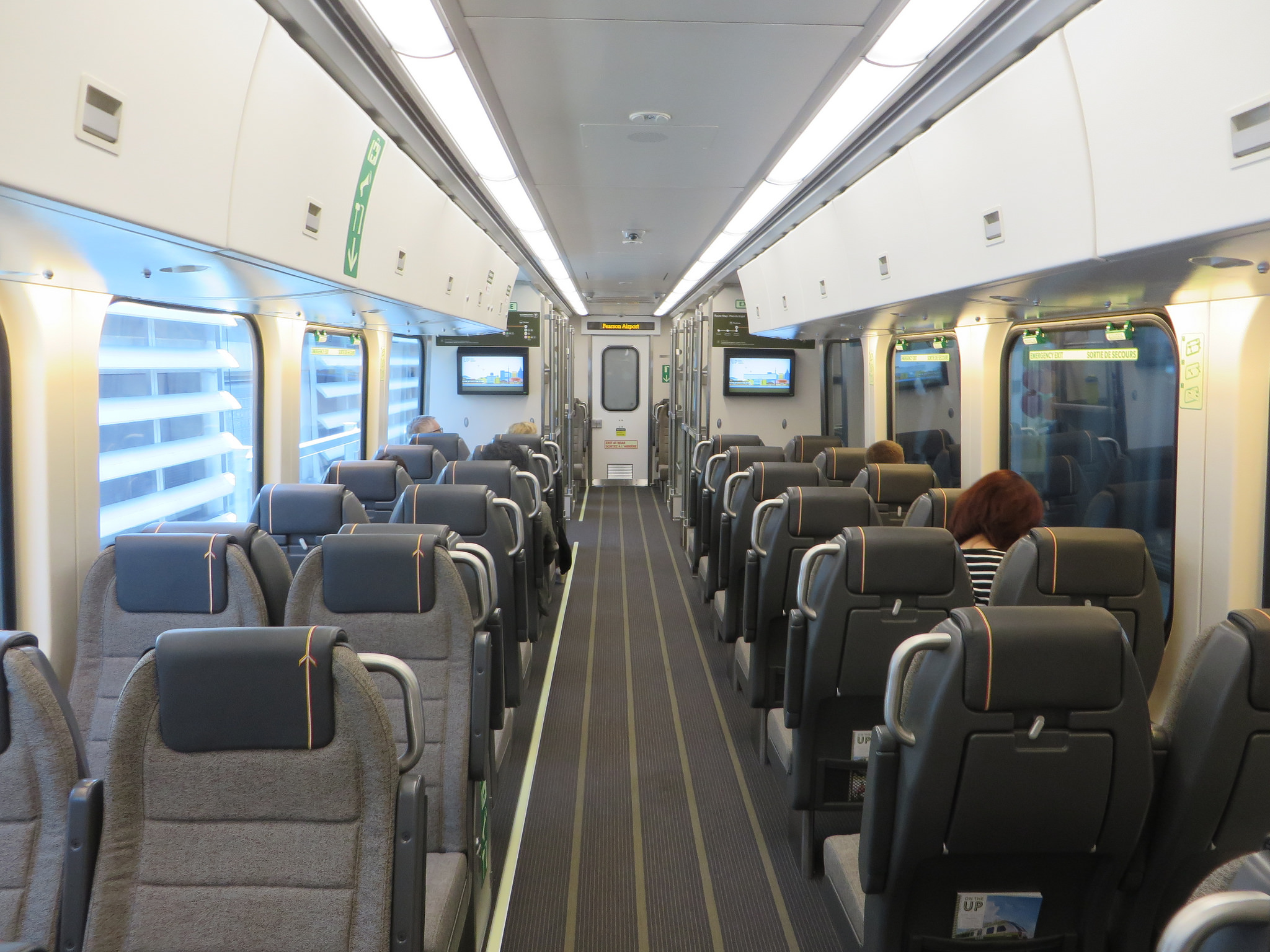
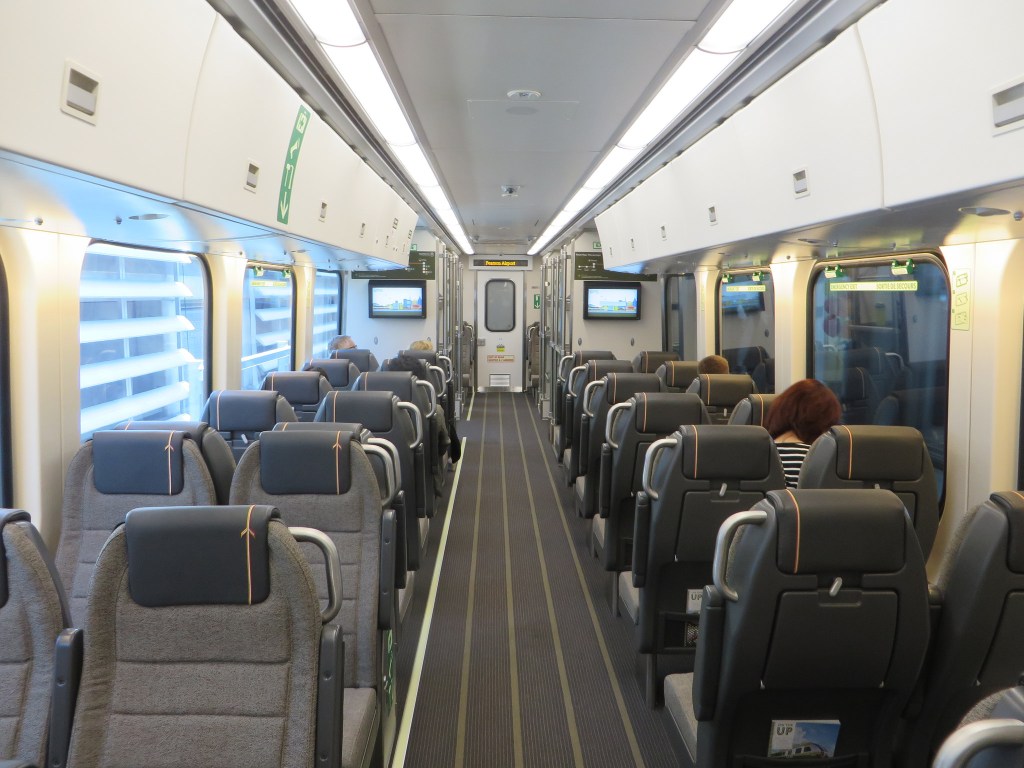
    I also don’t think that lowering UP Express fares, without looking at fare and service integration, is going to be a magic bullet either. Last year, I was pleasantly surprised by the announcement that Presto fares were going to be $19 for Presto cardholders, which was slightly less expensive than I expected. Travelling alone, it’s a bargain compared to riding a taxi or limo, especially if your origin or destination is in Toronto’s financial district. . (Connections at Bloor Station and in Weston are less useful.) I live about 15 minutes away from Union Station by foot, and I’ve taken advantage of UP Express. The cars are comfortable, the wi-fi is a nice perk, and the service is fast, friendly, and reliable.

    Happily, UP Express isn’t a white elephant. Most of the sunk costs — $456-million — are salvageable, and a rail link to Pearson remains an excellent idea.

    I think the answer is making UP Express more of a transit link, useful for residents of North Etobicoke, Weston, Mount Dennis, and West Toronto. The service would be more like Vancouver’s Canada Line; a part of the local transit network, but with a premium on single-ride fares from the airport to recover costs. Metrolinx could start by integrating UP Express with its GO Transit operating division, phasing out the ridiculous branding and separate bureaucracy.

    UP Express could even be part of a re-routed “SmartTrack” corridor, where it would make a few additional stop. But most importantly, it would become part of Toronto’s transit system, rather than a boutique airport shuttle service. The rail infrastructure improvements built for UP Express go a long way towards improving GO train service to Bramalea and points west. Hopefully, we get a revised airport rail link somewhat similar to that of Philadelphia, with fares integrated with the TTC and GO Transit. It’s also worth noting that Pearson Airport offers transit connections to GO Transit buses to Richmond Hill and Hamilton, as well as express and local Mississauga and Brampton Transit routes. There’s a need to recognize Pearson Airport’s role as a regional transit hub, not just a hub for Air Canada and WestJet.

    But the UP Express fiasco raises other questions. How can we expect Metrolinx to come up with a credible fare integration strategy when it can’t even get GO Transit fares right, never mind the UP Express? Yes, there are many fine people working at Metrolinx, but the UP Express hurts the organization’s credibility.

    All that said, I still sometimes feel optimistic about Toronto’s transit progress in recent years. The UP Express, while suffering from poor ridership, is still useful. The Eglinton-Crosstown LRT is underway, and might be extended in both the east and west. The [Downtown] Relief Line subway plan is still a viable project. And despite John Tory’s budget cuts, TTC bus service has been expanded in 2015 and 2016.

    Meanwhile, UP Express will be offering free fares this Family Day weekend. It will be interesting to know whether this promotion will increase ridership on the weekend or not.


    Thanks to Steve Munro for providing me with a copy of Metrolinx’s ridership numbers for UP Express.

     

  • A smarter SmartTrack

    ST - Before 2016
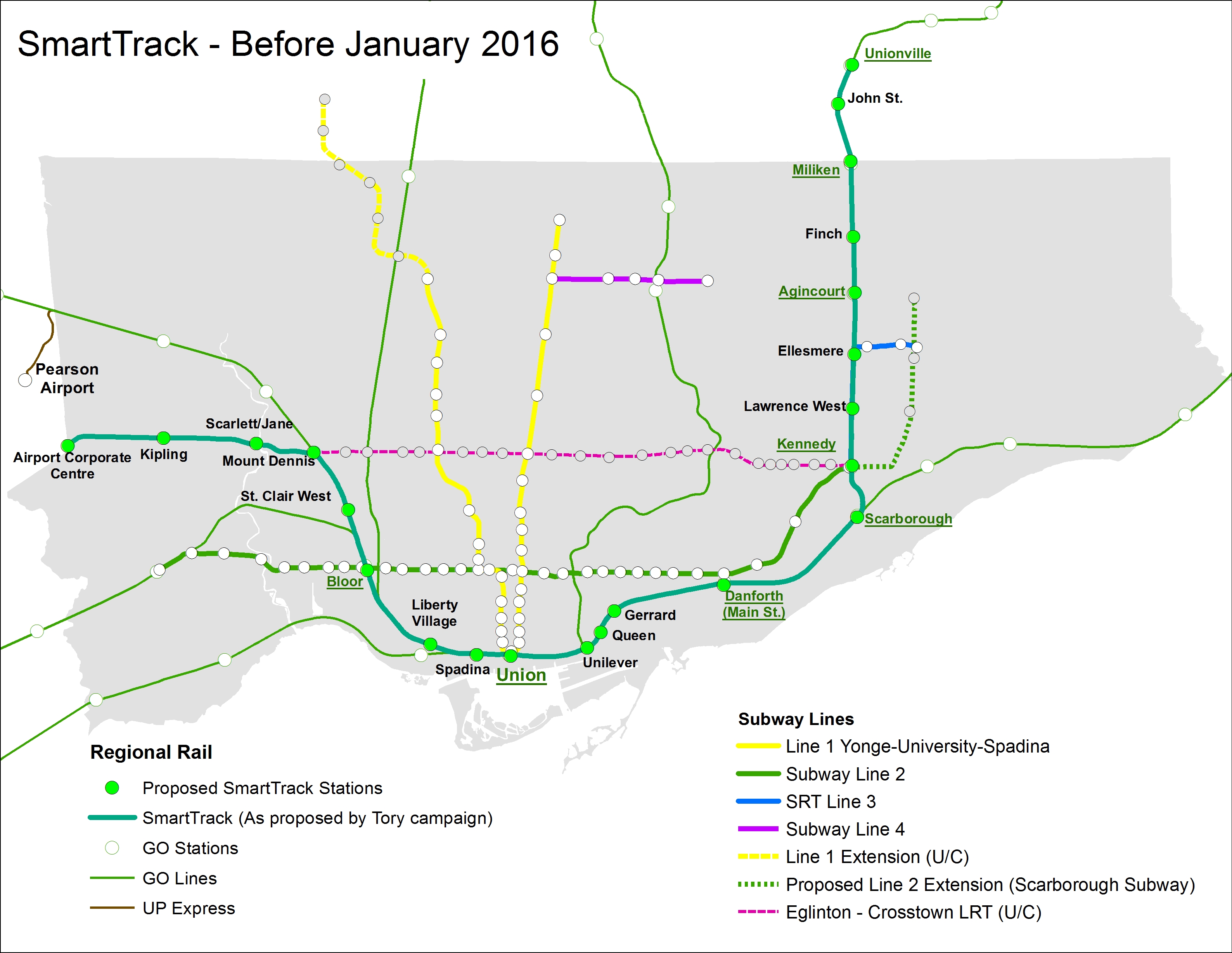
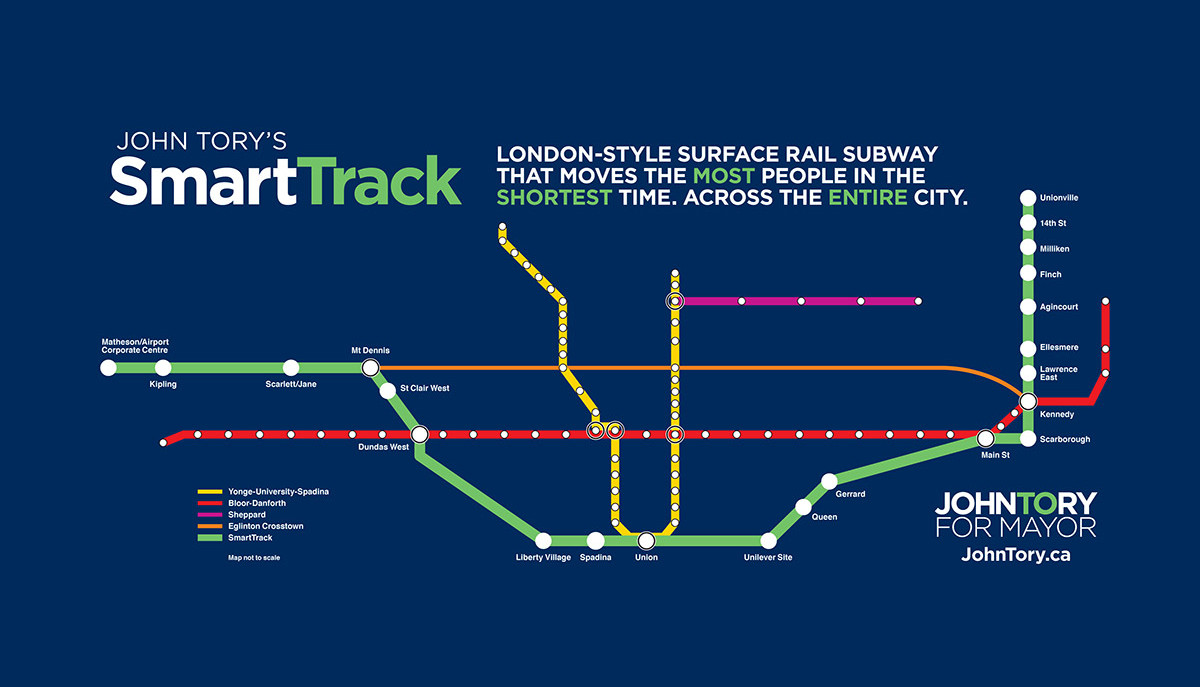
    John Tory’s original SmartTrack plan, shown with the existing TTC Subway and GO Rail networks. 

    In Friday’s Globe and Mail, we were treated to a scoop by Oliver Moore, that newspaper’s excellent transportation reporter, on behind-the-scenes revisions to Mayor John Tory’s SmartTrack rail transit platform, a topic that I discussed several times in this blog.

    Tory’s SmartTrack plan, dreamed up by a private-sector planning firm, was intended to connect office parks in Mississauga and Markham to Downtown Toronto, as well as serve the proposed First Gulf development at the Unilever site near the mouth of the Don River. Tory promised that it would provide relief to Toronto’s overburdened subway system, but that was never the main objective.

    I have been aware of rumours that Tory’s SmartTrack plan was going to be walked back due to mounting costs and technical issues of implementing the mayor’s campaign promise. The team that came up with the idea of a U-shaped rail network intended to connect several suburban employment centres with Downtown Toronto overlooked some important details, such as the availability of land along the former Richview Expressway corridor along Eglinton Avenue West. SRRA, the private-sector planning organization that came up with SmartTrack, assumed that the Richview lands were available and owned by the province, but the city owned the land, and sold much of it off for development in 2011 and 2012.

    The cost of building the western spur between Mount Dennis and the Airport Corporate Centre was, in all likelihood, found to be prohibitive, though we have yet to find out what the estimated costs for a tunnel along that section. The eastern section, north of Kennedy Station, would have closely paralleled both the Scarborough RT and the proposed extension of the Bloor-Danforth Subway to McCowan Road, a project that Tory also backed.

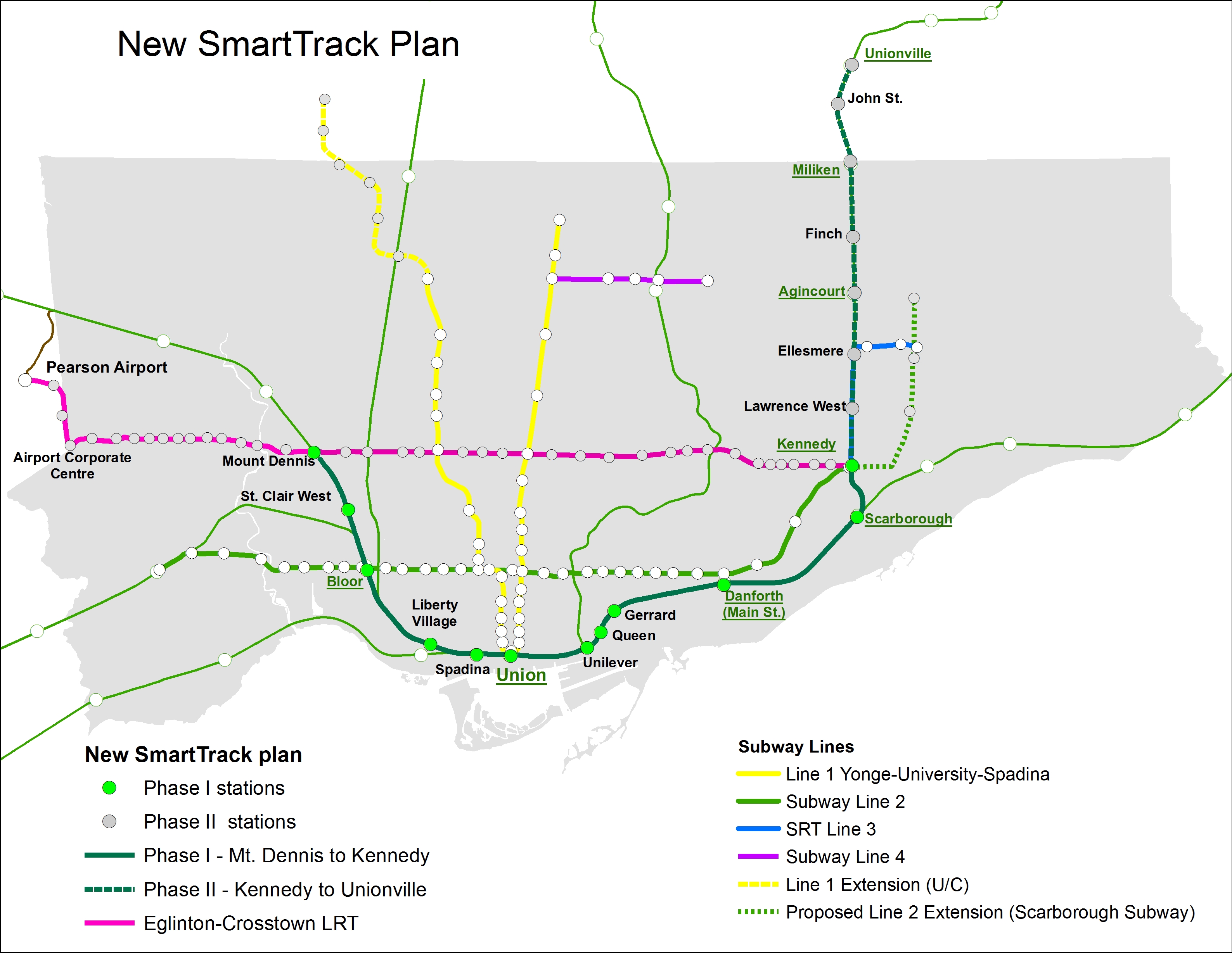
    The Globe and Mail’s Oliver Moore reports that SmartTrack will cover a much shorter section than the map on John Tory’s 2014 campaign brochures. Frequent rail service will complement existing GO Transit Regional Express Rail (RER) services on the Kitchener and Stouffville Corridors, terminating at Mount Dennis and Kennedy Stations. The Eglinton West section will be covered by the “shovel-ready” Phase II of the Eglinton-Crosstown light rail transit line (ECLRT), which is already under construction east of Mount Dennis. (The provincial government deferred funding for this section of the ECLRT in 2010 for budgetary reasons.) The north-eastern section of SmartTrack, between Kennedy Station and Unionville Station in Markham, will be deferred.

    This new plan, which is being finalized and will likely be officially announced later this year, will cost an additional $2-billion to $3.5-billion to the existing plans for RER, in order to facilitate more frequent, subway-like frequencies, as well as complete the western section of the ECLRT.

    If Moore’s reporting is accurate (and I have seen maps and other materials that collaborate his report), then Tory will have to eat some crow. Spin doctors will have to figure out how to polish this turd as Tory seeks a second mandate in 2018. It’s also inevitable that the new additional service on this corridor will continue to be branded as “SmartTrack.” But this is the best solution, and maybe this is a sign that Tory is learning on the job.

    At the end of the day, what Toronto gets is what Metrolinx’s “Big Move” plan envisioned: upgrades of most GO Transit corridors to RER, as well as Phase II of the Eglinton-Crosstown LRT line to Pearson Airport. (The Finch West and Sheppard East LRTs are also approved, but have yet to start construction.) The paired-down SmartTrack plan, if trains are frequent enough, and with attractive transfers with the subway and TTC surface routes, will draw some riders. It could help provide medium-term relief as the [Downtown] Relief Line Subway is studied and built.

    New SmartTrack PlanThe new SmartTrack plan, including Phase II of the Eglinton-Crosstown LRT

    But where I find myself annoyed is when I realize that we wasted over a year on Tory’s campaign slogan without any progress on the Relief Line (which will offer real, long-term relief to the Yonge Subway), the Waterfront West LRT, or other transit priorities such as accessibility at all existing subway stations. I remember during the 2014 election campaign, critics of Tory’s simplistic and flawed SmartTrack plan were dismissed without acknowledging their objections. It’s also worth noting that Tory also adopted rival Olivia Chow’s bus plan, after belittling it during the campaign.

    In order to provide fast and reliable transit to the Airport Corporate Centre and Pearson Airport itself, there are opportunities to refine the western section of the Eglinton-Crosstown LRT. The environmental assessment called for 15 stops between Mount Dennis and Pearson Airport, while SmartTrack would have had as few as three stops along the same section. If the ECLRT can be sped up at all, it would be worth considering. I would also be interested in whether the SmartTrack corridor could be integrated with the UP Express rail link, whose ridership started off quite low.

    And maybe, just maybe, the high costs of constructing the Scarborough Subway extension will also prompt a rethink, going back to the original LRT replacement and extension plan. As the Spadina Subway extension to York University and Vaughan is now two years late (and yet another $400 million over-budget), maybe there’s an opportunity to get it right there as well. It’s also imperative that proponents of the Relief Line Subway strike now.

    I could be giddy with the revelation that Mayor Tory’s signature campaign platform is coming undone, having foreseen the problems with his plan. But I’m not. However, I do take pleasure in knowing that we have a smarter plan in the works.


  • Metrolinx’s strange priorities

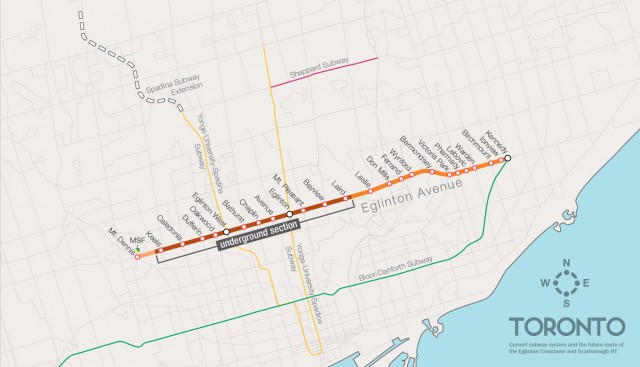
    crosstownroutemaplarge-640x367Map of the Eglinton Crosstown LRT showing the original working station names along the corridor
    It’s too often that we hear from business leaders, planning experts, and pundits that politicians should be kept out of transit planning. To some degree, this makes sense. We saw what happened when politicians, pandering for votes from Scarborough, derailed a viable, ready-to-go transit plan in favour of a shiny, unfunded, subway line.

    Metrolinx’s appointed board is made up of developers, business people, advisers, administrators, and two retired politicians. It seems like the kind of place where smart, level-headed, apolitical decisions could be made. That is, until board members start bickering about station names.

    In December, Metrolinx rubber-stamped, with little debate, a problematic GO Transit fare increase. But it then spent four times as long debating the names of three stops on the Eglinton-Crosstown LRT corridor. And today, there will be a special teleconference meeting to decide – hopefully once and for all, these three names. Maybe then they can get on to serious business.

    I discuss this further in Torontoist this morning.

  • The trouble with Trans-Cabs

    In my last post, in which I discussed the gaps in the Golden Horseshoe’s transit network (and offered unsolicited advice to Metrolinx), I used the example of Milton, in which a carpool lot served by several GO Transit bus routes was largely disconnected from the rest of the local transit system, and located several kilometres from the main GO hub at Milton Station.

    When I pointed out that Milton Carpool lot, at the junction of Highways 401 and 25, was only served by Milton Transit’s route 1A/1B, which runs only during rush hours, Twitter user YIGE corrected me:

    https://twitter.com/yige_t/status/669902364111822848

    YIGE is correct. Milton Transit does offer a Trans-cab service in the residential areas north of Main Street in Milton, as well as some of the institutional and industrial zones north of Steeles Avenue. I did not see it in the “System Map and Routes” section of the website; it has its own page elsewhere.

    Trans-Cabs, are contracted taxi services that are intended to serve suburban or rural areas that would be inefficiently served by fixed bus services, but require a connection to the transit network. Several cities and towns in Ontario offer these services.

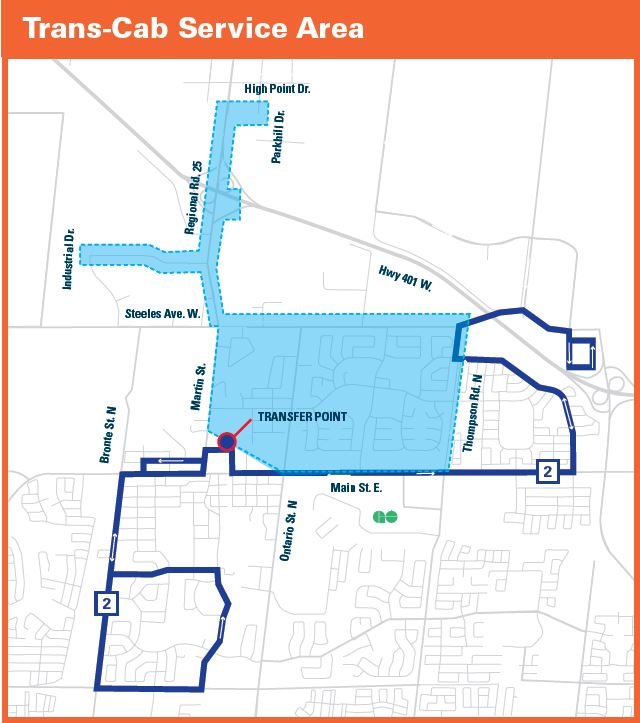
    In Milton, Trans-Cab operates between 8:30 AM to 2:30 PM, and between 5 PM and 6 PM on weekdays, and from 7:10 AM to 7:40 PM on Saturdays,  times when route 1A/1B does not operate. The service requires a 50-cent premium on top of the Milton Transit fare, and the transfer point isn’t at the GO Station, where all eight fixed route buses connect, but at a point in Downtown Milton where only Route 2 connects. Anyone headed elsewhere must then transfer to Route 2 to the GO Station, and transfer yet again. It’s not at all convenient, and the service ends far too early in the evening, especially for commuters and students headed home from Kitchener-Waterloo or Guelph. And unlike connecting between GO and Milton Transits at the station, there’s no co-fare available to any other GO bus service.

    Passengers must also request a ride at least an hour in advance if heading to the transfer point; passengers heading to the Trans-cab service area only have to let the Route 2 operator know they need the service.

    Milton_TransCab
    Map of the Milton Transit Trans-Cab service area, original found here.

    In the Greater Toronto and Hamilton Area, Hamilton Street Railway also provides a Trans-Cab service, serving exurban areas in Stoney Creek (Winona) and Glanbrook. Like Milton, the Trans-Cab service requires a 50 cent premium above the regular fare, and requires a transfer to a regular bus route. In Glanbrook, the service is offered Monday through Saturday from 6 AM to 7 PM, and in rural Stoney Creek from 5AM to 1AM. The HSR system map shows the Trans-Cab service areas. Like Milton, pick-ups have to be arranged at least an hour in advance.

    Peterborough and Greater Sudbury also operate Trans-Cabs; again, in those cities, they serve outlying areas that are difficult to serve with fixed bus routes.

    The Hamilton example illustrates where Trans-Cabs make more sense: in outlying areas where demand is low, the population density sparse, but there’s a need for transit access. In Milton’s case, operating a fixed route serving the urbanized area north of Main Street makes more sense, especially as it links to a major GO Transit connection;. In Milton, a Trans-Cab might be more useful, say, for serving areas outside the Milton urban area, such as Campbellville and Mohawk Racetrack.

    Really, either the Town of Milton/Milton Transit, or GO Transit should work to get the gap between the Highway 401/25 carpool lot and the town transit system fixed properly. An inconvenient Trans-Cab service simply doesn’t cut it.

  • Not so FAST: SmartTrack gets a lobby group, raises many questions (Updated)

    smarttrack_fb
    I find myself feeling frustrated, worn down, and at times angry about this federal election that’s thankfully coming to an end on Monday. As a progressive voter, I’ve been disappointed by Thomas Mulcair and the New Democrats, for reasons that Desmond Cole explains so very well in today’s Toronto Star. (Locally, I ‘ve been supporting the NDP’s Linda McQuaig in Toronto Centre, whose progressive credentials are impeccable.) The bright side is that Stephen Harper’s Conservatives are going down to an almost-certain defeat, hopefully taking their narrow and divisive targeted politics with them. My wish is for a minority government in which the Liberals and New Democrats share power; this may check the Liberals’ record of running left and governing right.

    Happily, Torontonians also have the Blue Jays and municipal politics to watch. Last night, we all got to watch the strangest seventh inning in baseball history; today, we get to snicker at the efforts of an Astroturfing crew of lobbyists pushing SmartTrack – a mayoral campaign slogan masquerading as a transit plan. Municipal politics may be at times just as depressing as provincial or federal politics, but at least it’s a lot more fun.

    The Toronto Star’s fantastic transportation reporter, Tess Kalinowski, reported on a new booster group, known as FAST (Friends & Allies of SmartTrack). Its spokesperson would be Alvin Curling, a former provincial Liberal cabinet minister and Speaker of the Provincial Parliament. Other members of its Public Advisory Board include Kyle Rae, former city councillor who is now a City Hall lobbyist, and three prominent lawyers  – Andrea Geddes Poole, Michael Brooks, and David S. Young. Also involved is one Tom Allison. 

    According to a press release, FAST claims it’s “here to advocate for SmartTrack and to educate the public about how it could make a huge difference in cutting congestion and moving people around the region.” It would raise funds “devoted to creating a variety of awareness campaigns such as town halls and informational videos.” 

    FAST’s website – launched today – is comically full of spelling and syntax errors, misinformation, and complete fabrications of basic facts. Here are just a few. (more…)