Tag: Traffic

  • A year later, progress on Canongate Trail

    IMG_8531-001
    Canongate Trail, February 2019

    In February 2018, Duncan Xu, an 11-year old boy, was struck and killed crossing a residential street in North Scarborough on his way home from school. He was one of forty-two pedestrians unintentionally struck and killed by motorists in Toronto last year.

    Not long after Duncan’s death, I visited the neighbourhood and wrote about the tragedy.  Canongate Trail, where Duncan was struck, is a two-lane residential street. At the time, there were no traffic calming measures in place to slow down motorists, many of whom used Canongate as a shortcut around the busy intersection of Kennedy Road and Steeles Avenue. The local councillor, Jim Karygiannis, decided to unilaterally close a walkway linking the rear schoolyard with Canongate Trail, close to where Duncan was killed. Duncan used the walkway before he tried to cross the street.

    Since then, more permanent fixes were made. At the request of Karygiannis and local residents, city staff studied both reducing speed limit and installing traffic calming measures. While staff recommended reducing the speed limit to 30 kilometres an hour, they concluded that traffic calming measures such as speed humps were unwarranted.

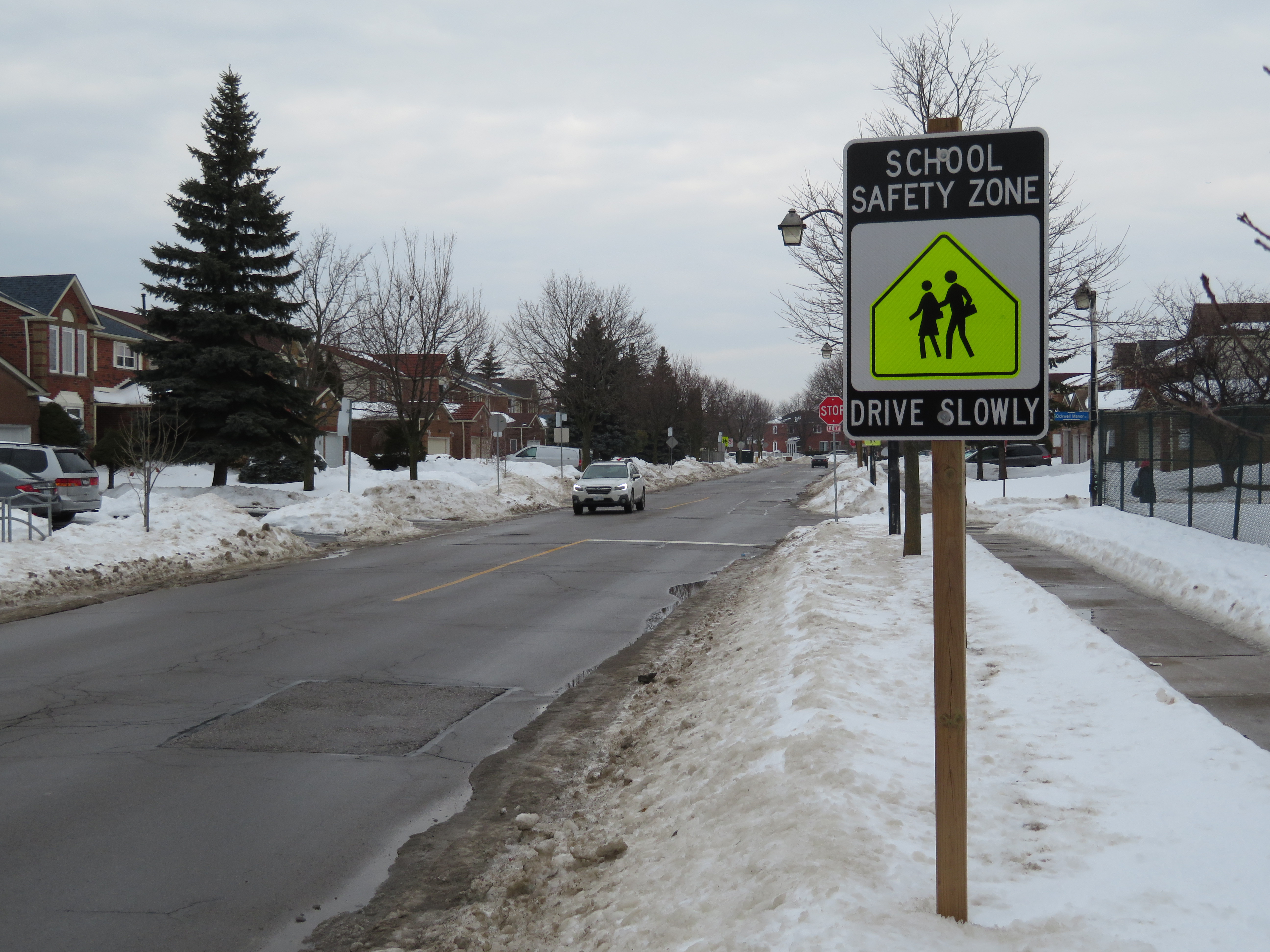
    The speed humps were added anyway, along with other measures. A new all-way stop was added at Ockwell Manor Drive, near where the walkway meets the Canongate Trail sidewalk. Beyond the point where the walkway meets the sidewalk, fencing was installed to discourage children from running into the street. These are significant improvements.
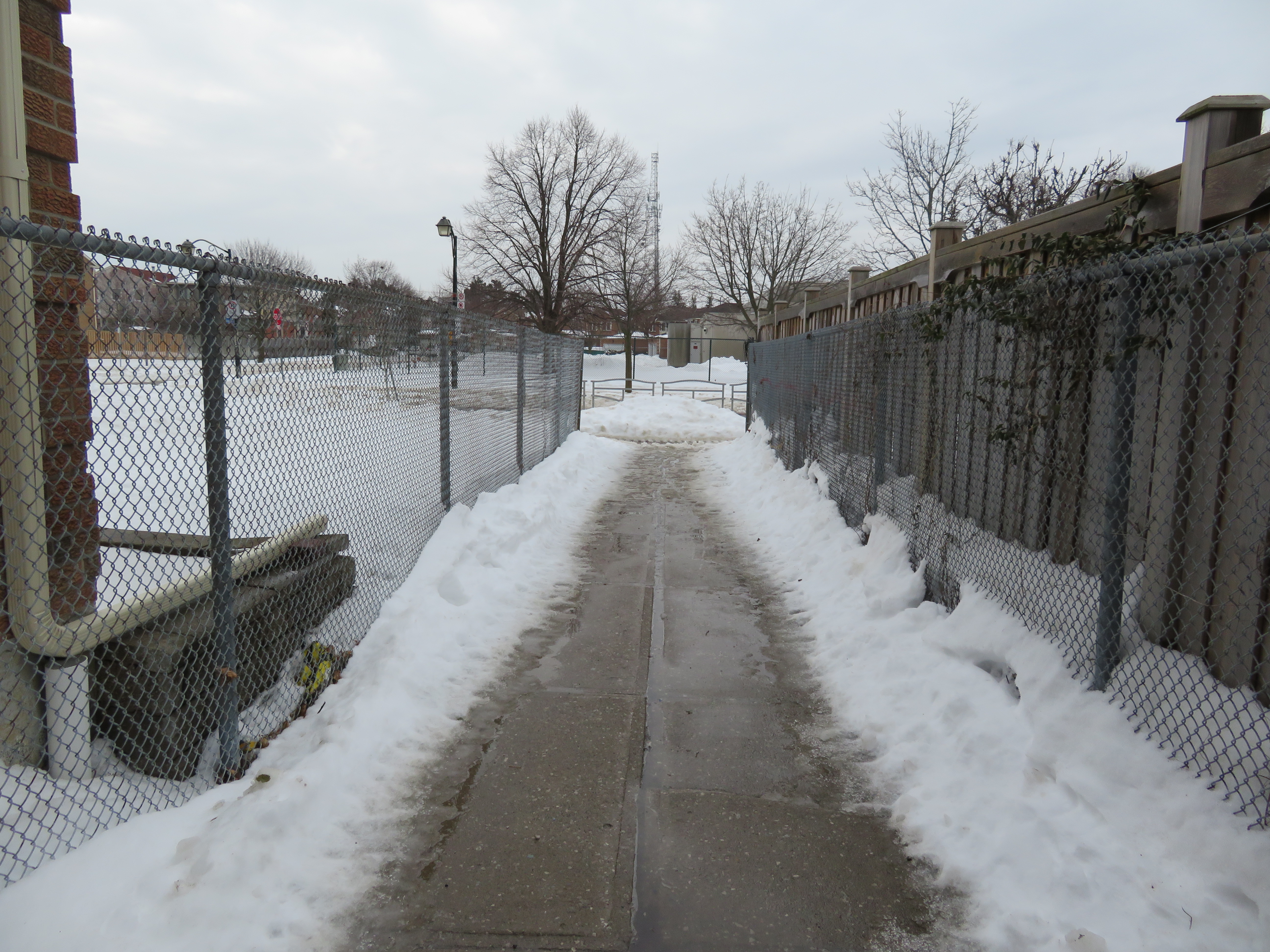
    IMG_8530-001The walkway to the school and a nearby park is reopened, with a metal barrier between the sidewalk and the roadway

    Still, more can always be done. Curb extensions or bulb-outs at intersections would be another effective traffic calming measure, narrowing the roadway, slowing down turning vehicles, and increasing pedestrian visibility while reducing pedestrian crossing distances.

    What’s most disheartening though is that it took a young child’s death for these measures to happen. All residential streets should have a 30 km/h limit and streets designed to slow motorists down, including measures such as curb extensions and speed humps. As with the “Slow Down – Kids at Play” lawn sign campaign, action only comes after a high-profile tragedy. Even then, it’s not enough.

    It’s good to see progress on Canongate Trail. But this should be the standard everywhere. We can and should do better in Toronto if we are all serious about implementing a true Vision Zero policy.
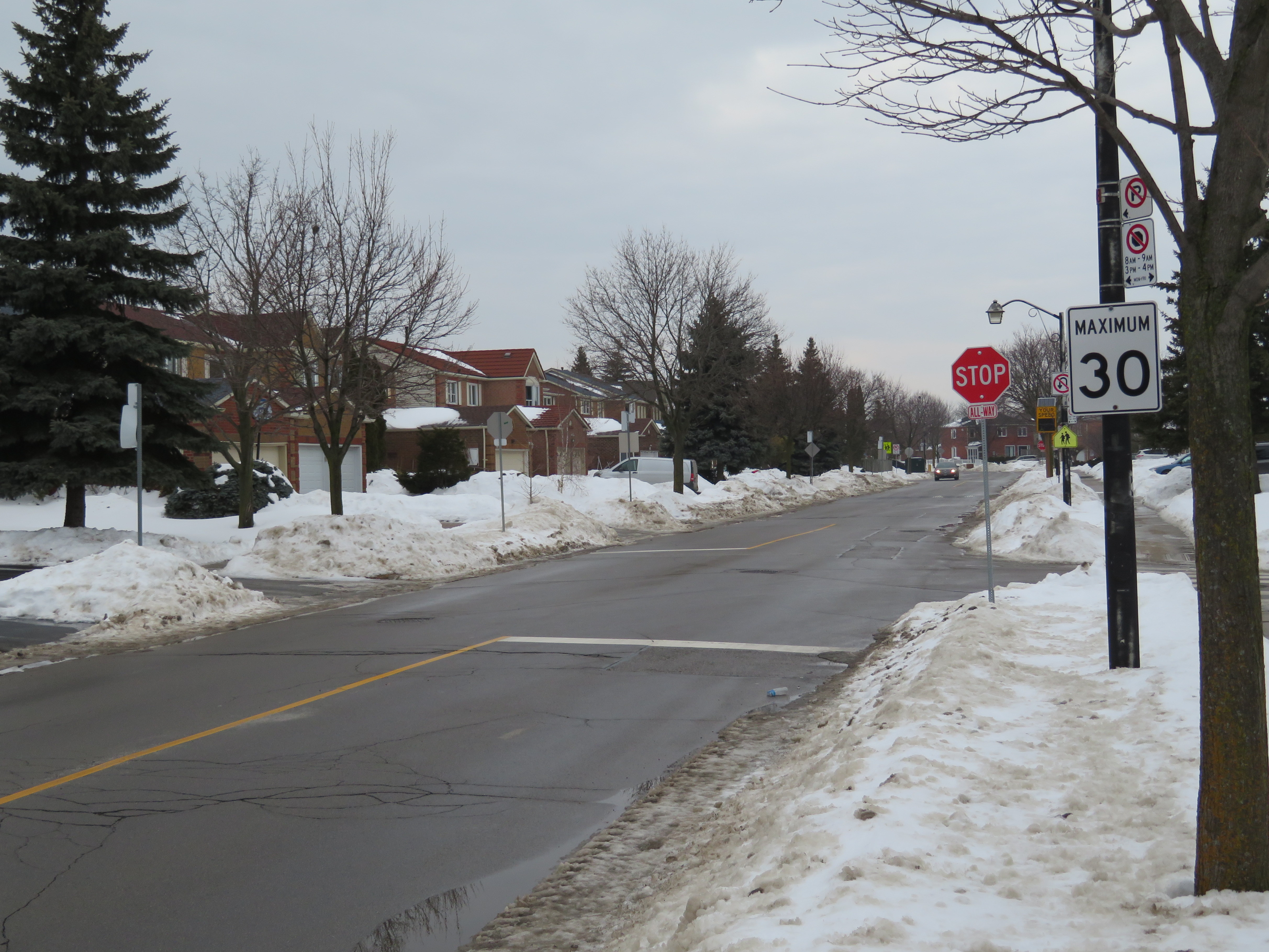
    IMG_8535-001New 30 km/h speed limit and a new stop sign on Canongate Trail, February 2019
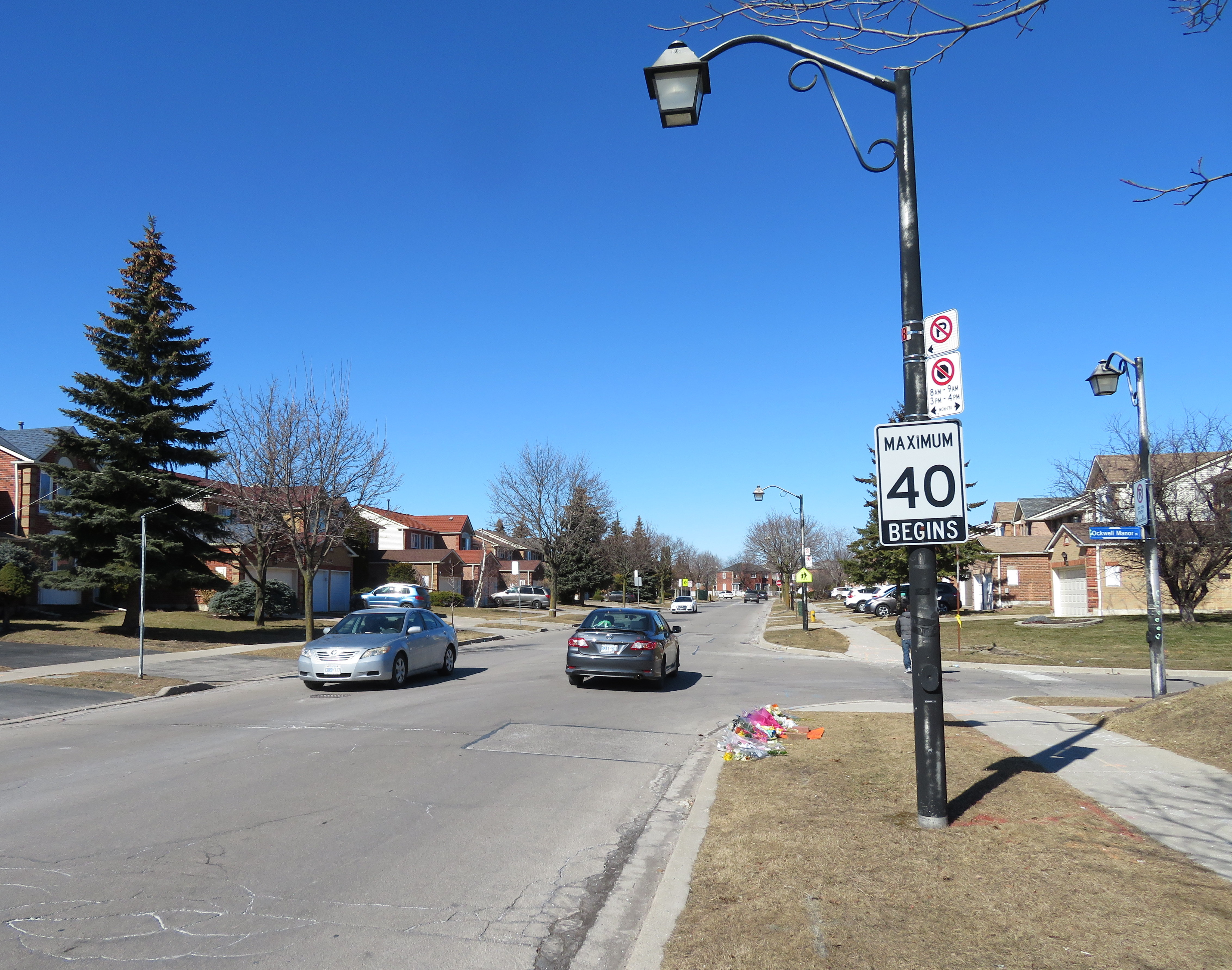
    IMG_6027-001What Canongate Trail looked like in March 2018
  • Pedestrian flags at crosswalks are not a solution

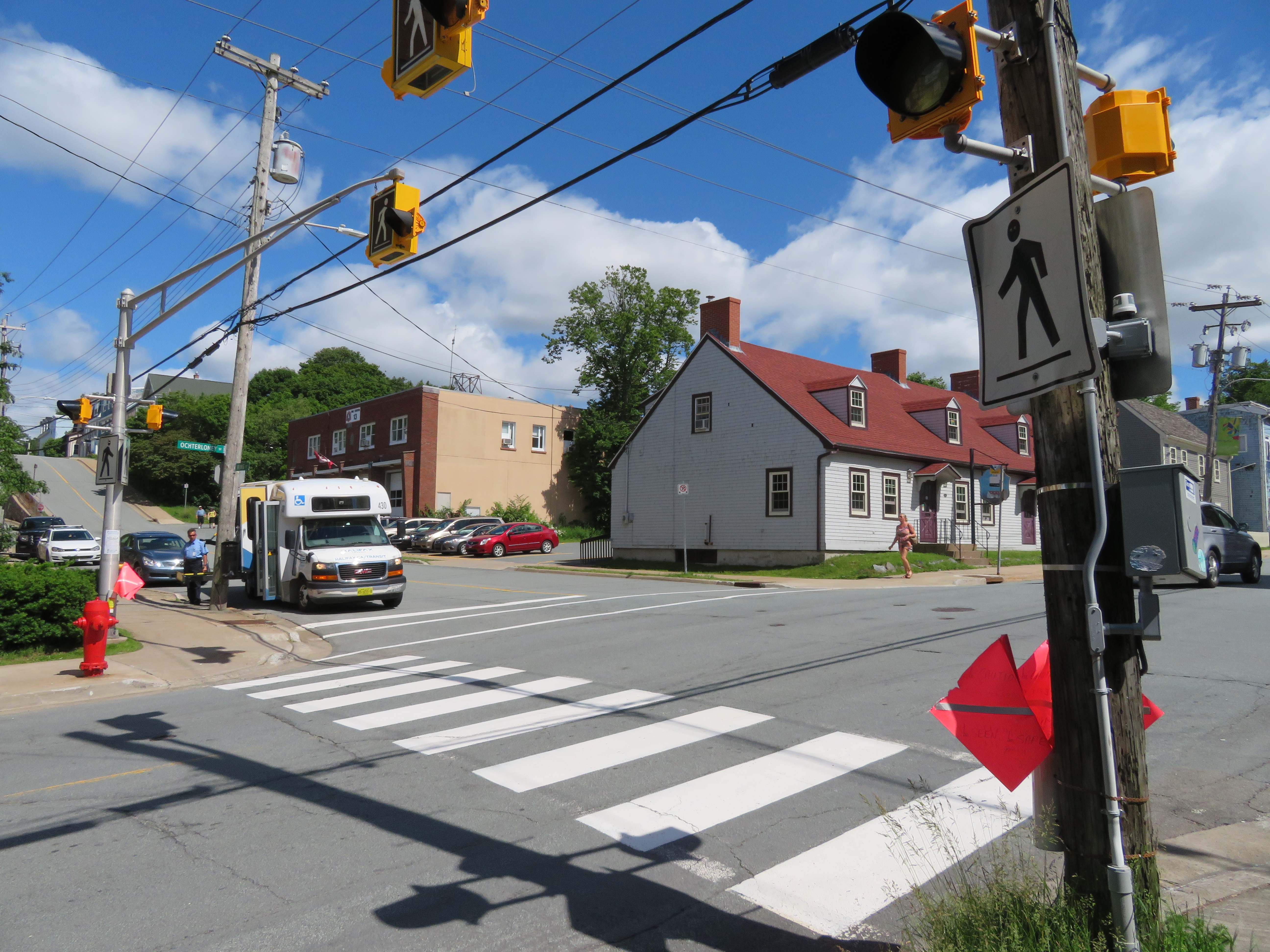
    IMG_0772-001Pedestrian crossing in Dartmouth Nova Scotia equipped with pedestrian flags
    Toronto Star article this weekend profiled three elementary school students installing pedestrian flags at local residential intersections near their school in Leaside. Pedestrian flags are not a new idea; they have been common in Halifax and other communities in Nova Scotia for several years. (I wrote about this before on my blog after visiting Halifax this past summer.)

    On the surface, it sounds like a good idea. Eleven-year old Arnav Shah describes their use in the Star: “what happens is when a pedestrian comes to cross, they look both ways, the regular stuff, maintaining eye contact with the drivers, and then they put the flag up and walk across. Not only does this make them more visible, but makes them (the drivers) more aware of the problem at hand.”

    Residents have complained about additional traffic in the neighbourhood as impatient drivers use residential streets to avoid transit construction on nearby Eglinton Avenue. Photos in the article show the flags being used at the corner of Rumsey Road and Donlea Drive, near the school. The intersection is already controlled by a four-way stop, it is located in a signed school zone, and the local speed limit is 40 km/h.

    The local councillor, Jon Burnside,  rightly praised the children for taking initative. But he added that “…it’s also a sad commentary on the state of our roads and the way people drive.” He’s right. Burnside further adds that adults “can take some cues from the kids’ creativity.”

    If we need bright flags to cross the street at a designated crosswalk because motorists wouldn’t see pedestrians otherwise, then we’ve failed to provide safe infrastructure. The adults — namely Toronto’s mayor and city council — have resisted investing in safe pedestrian and cycling infrastructure.

    The city has put up signs on wide five-lane and seven-lane roads designating them as “Seniors Safety Zones” but has done little to actually make those roads safer for the pedestrians using them. The mayor and the committee responsible for roads and infrastructure rejected making Yonge Street in North York safer and more pleasant to walk and cycle, deferring to motorists instead. And last week, it responded to a child killed while crossing the street in a residential area by closing a walkway to the school yard and not doing anything to slow down motorists speeding in a school zone.

    Simply installing flags at crosswalks for pedestrians to carry would be in line with Toronto’s ineffectual Vision Zero program. While I can admire the children’s action, I would really like to see this taken much farther by the leaders in charge.


    Correction: the local councillor quoted in the Toronto Star is Jon Burnside, not John Campbell. I regret the error

  • The trouble with those “cyclists dismount” signs

    IMG_3940

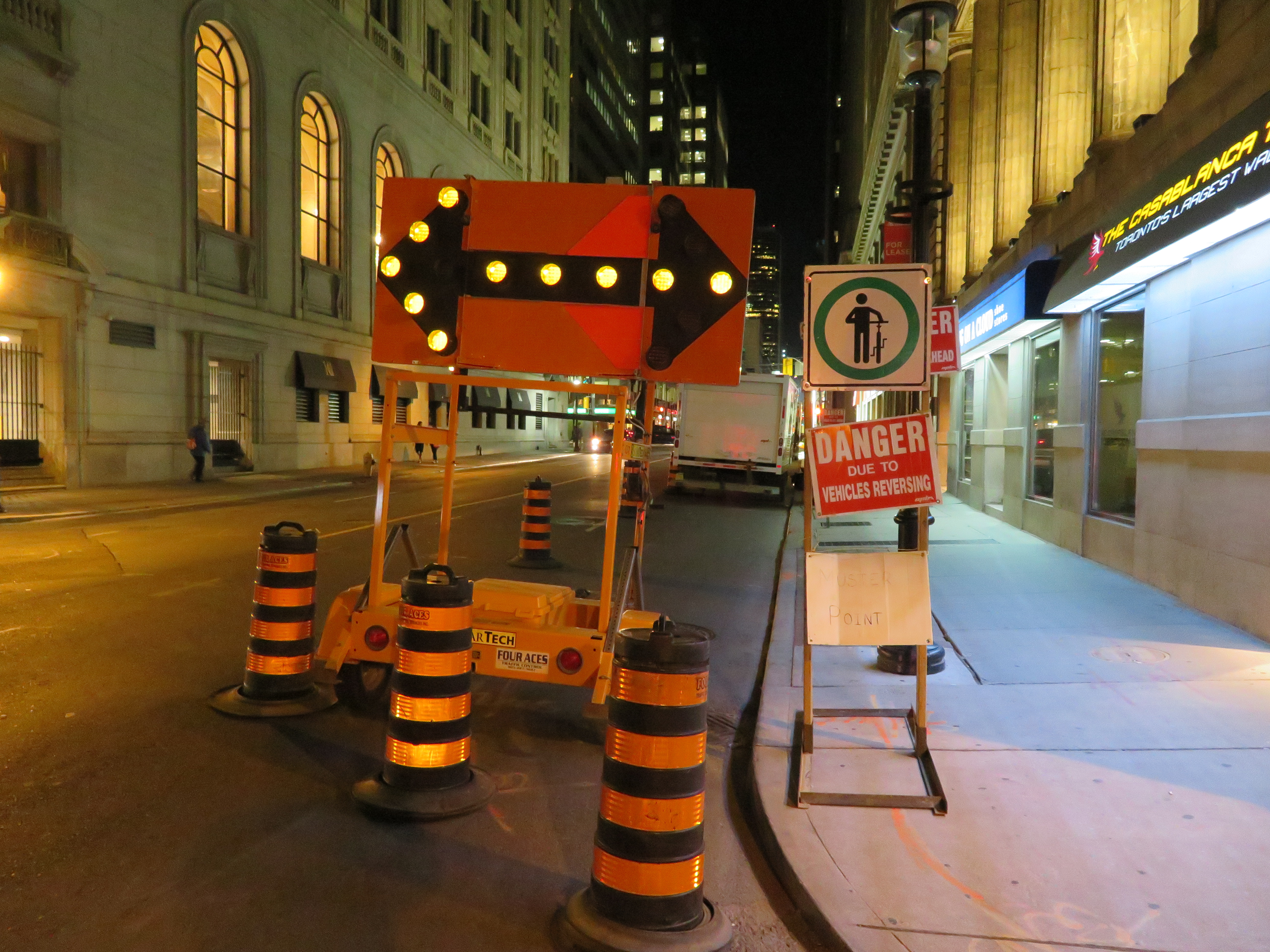
    Recently, I wrote about inconsistent, misleading, and problematic signage at road construction sites. Too often, cyclists are instructed to dismount and walk when a bike lane or general traffic lane is closed for construction.

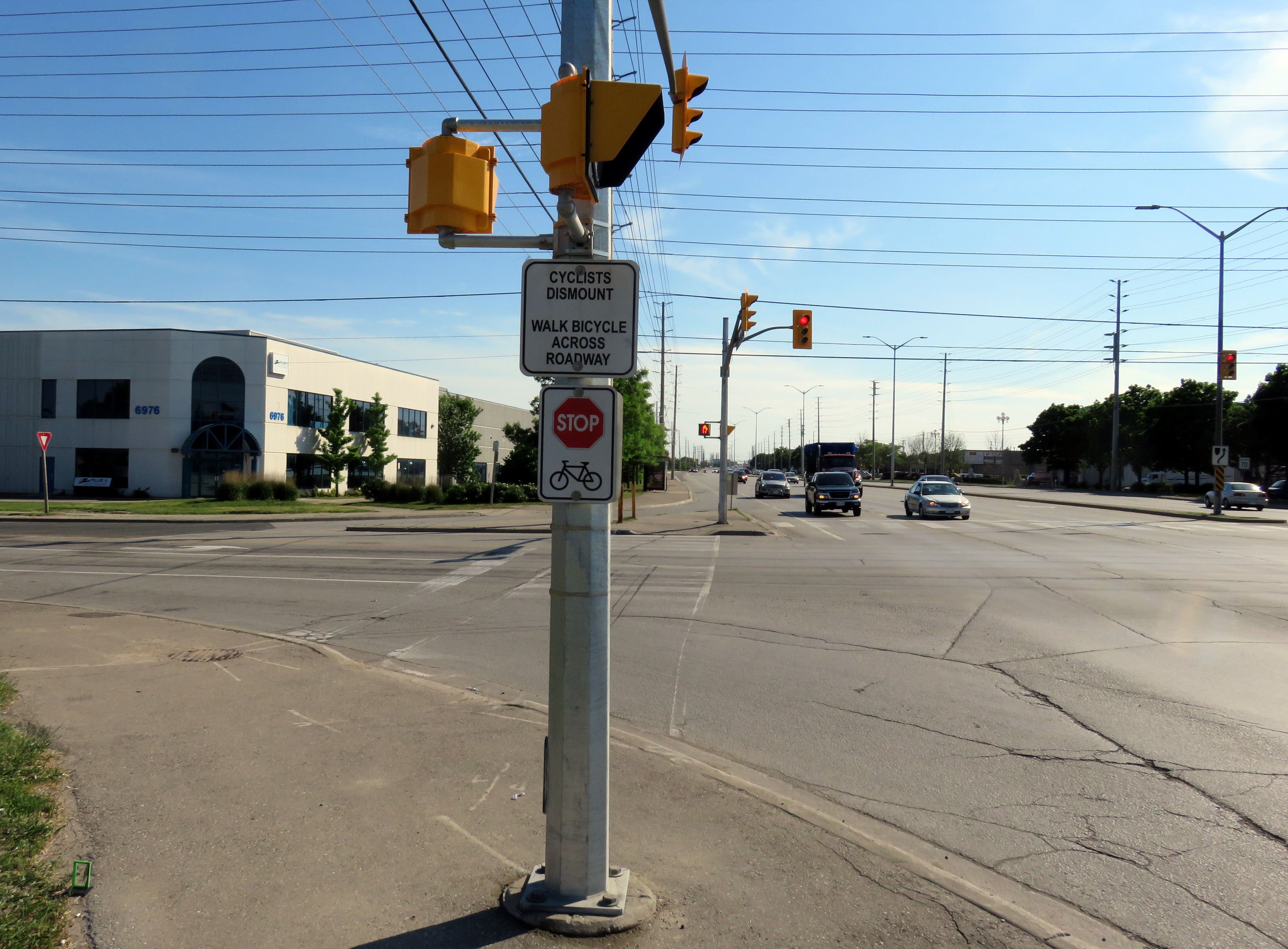
    But these signs also exist where many multi-use trails and paths cross intersections. In suburban municipalities such as Brampton and Mississauga, multi-use paths adjacent to major roadways are preferred over on-street bike lanes (protected or not). But they too, are littered with signs instructing cyclists to stop, get off their bikes, and walk across the intersection, such as the example illustrated below, in Mississauga.

    IMG_2302-001

    The trouble is, the Ontario Traffic Manual (OTM), used by transportation planners and engineers to design roadways and install the appropriate signage, takes a dim view of signage requiring cyclists to dismount when on roadways or on multi-use trails:

    “It is sometimes necessary for cyclists to dismount their bicycle and walk when the terrain or cycling conditions are difficult and no alternatives exist. However, the option of asking cyclists to dismount and walk their bikes should not be relied upon in lieu of adequately accommodating cyclists through appropriate road design.”

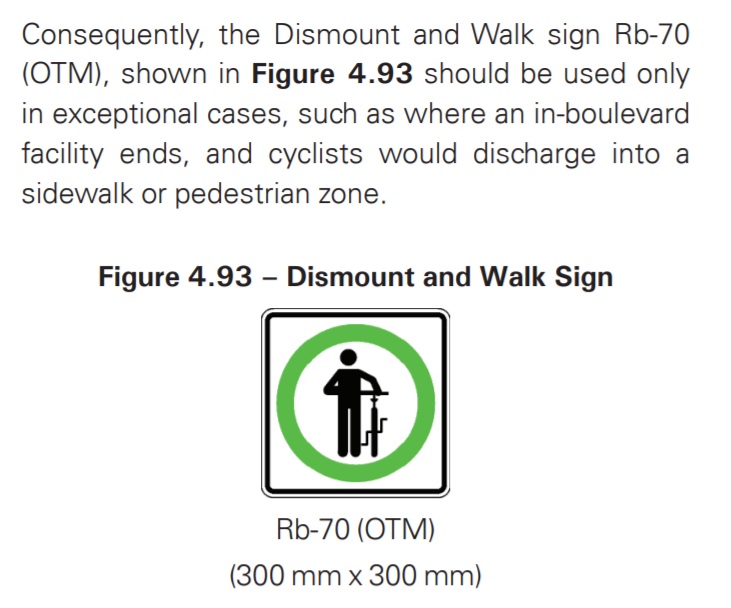
    Book 18 of the OTM (available here as a PDF) states that the “dismount and walk” sign should “be used only in exceptional cases, such as where an in-boulevard facility ends, and cyclists would discharge into a sidewalk or pedestrian zone.” This clearly means that these signs should not exist when a bike route or multi-use trail crosses a driveway or an intersection, but only when the route ends and becomes a sidewalk, or at a pedestrian mall where cycling is not permitted. (Page 118, OTM Book 18, 2013 edition.)

    OTM Book 18 page 118Excerpt from page 118, book 18 of the Ontario Traffic Manual, December 2013 edition
    The OTM also says that “…cyclists usually find it difficult to rationalize why “dismount and walk” restrictions are in place, and conclude that they were a poor, illogical or arbitrary decision. Thus, if facility designs cause cyclists to make what they consider to be unnecessary stops, this will increase the likelihood that they will ignore or disobey traffic controls.”

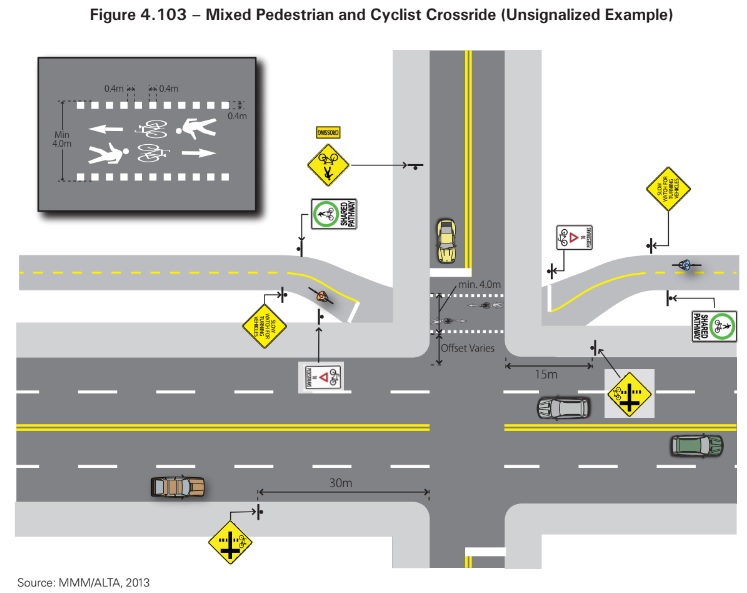
    What the Ontario Traffic Manual does specify, is how signage, road markings, and design should be made to clearly mark crossing locations, warn motorists to watch for cyclists, and to remind cyclists to yield to pedestrians. Figure 4.103 from OTM Book 18, shown below, illustrates how a mixed pedestrian and cyclist route on the side of a road — like those in Brampton and Mississauga — should meet an intersection. While signs warn motorists and cyclists to watch out for each other, and for cyclists to yield to pedestrians, there are no “cyclists dismount” signs to be seen in the diagram.

    OTM Book 18 page 124 .jpg
    Illustration of how a multi-use trail should meet an intersection. Figure 4.103, from page 124, book 18 of the Ontario Traffic Manual, December 2013 edition

    Multi-use trails are an effective way of providing safe cycling infrastructure, especially in the suburbs, where traffic speeds are higher and politics may not make installing bike lanes an easy sell. Traffic engineers have figured out that those ubiquitous “cyclists dismount” signs are not effective and developed designs that instead accommodate cyclists.

    It’s time that municipalities figured this out.