
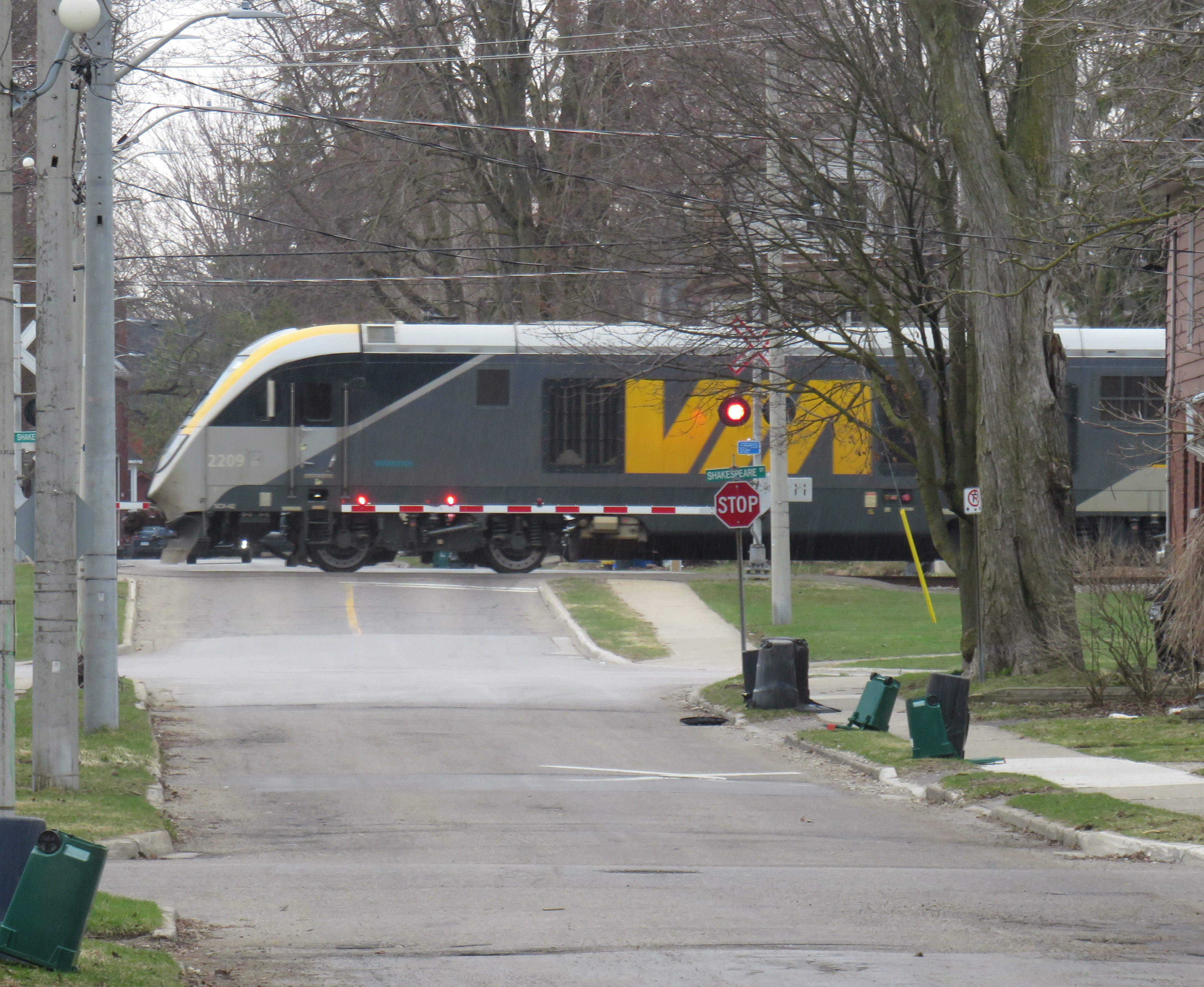
On the way home from a meeting I had in Ottawa on Sunday, May 3, I was aboard VIA Train 647, which left Ottawa Station at 4:51 PM. Our train was held up twice in the first hour: once at Smiths Falls, where we had to wait just under ten minutes for a CPKC freight train to pass, and again at Jasper, where we sat on a siding for about five minutes for an Ottawa-bound train to pass. As a result, our train arrived in Kingston at 7:10 PM, 15 minutes later than scheduled.
VIA Rail owns the track north of Brockville, where Toronto-Ottawa trains verge off the CN mainline between Toronto and Montreal, though it still has to cross the CPKC mainline at Smiths Falls through a freight yard there. Around 2010, after VIA took over the track from Canadian Pacific (once part of a line from Brockville to the Ottawa River near Arnprior), it built new passing sidings and moved the Smiths Falls station stop away from the old CP station to increase passenger train capacity and reduce conflicts. Ideally, the VIA and CPKC tracks would be completely separated, but it would be very expensive to implement.
Despite CN restrictions on VIA’s Venture equipment, with mandated reduced speeds at level crossings, we lost only ten more minutes upon arrival at Oshawa, getting there at 9:01 PM instead of the scheduled time of 8:36. But we had yet to encounter one last obstruction: Metrolinx-owned track between Pickering and Toronto Union Station.
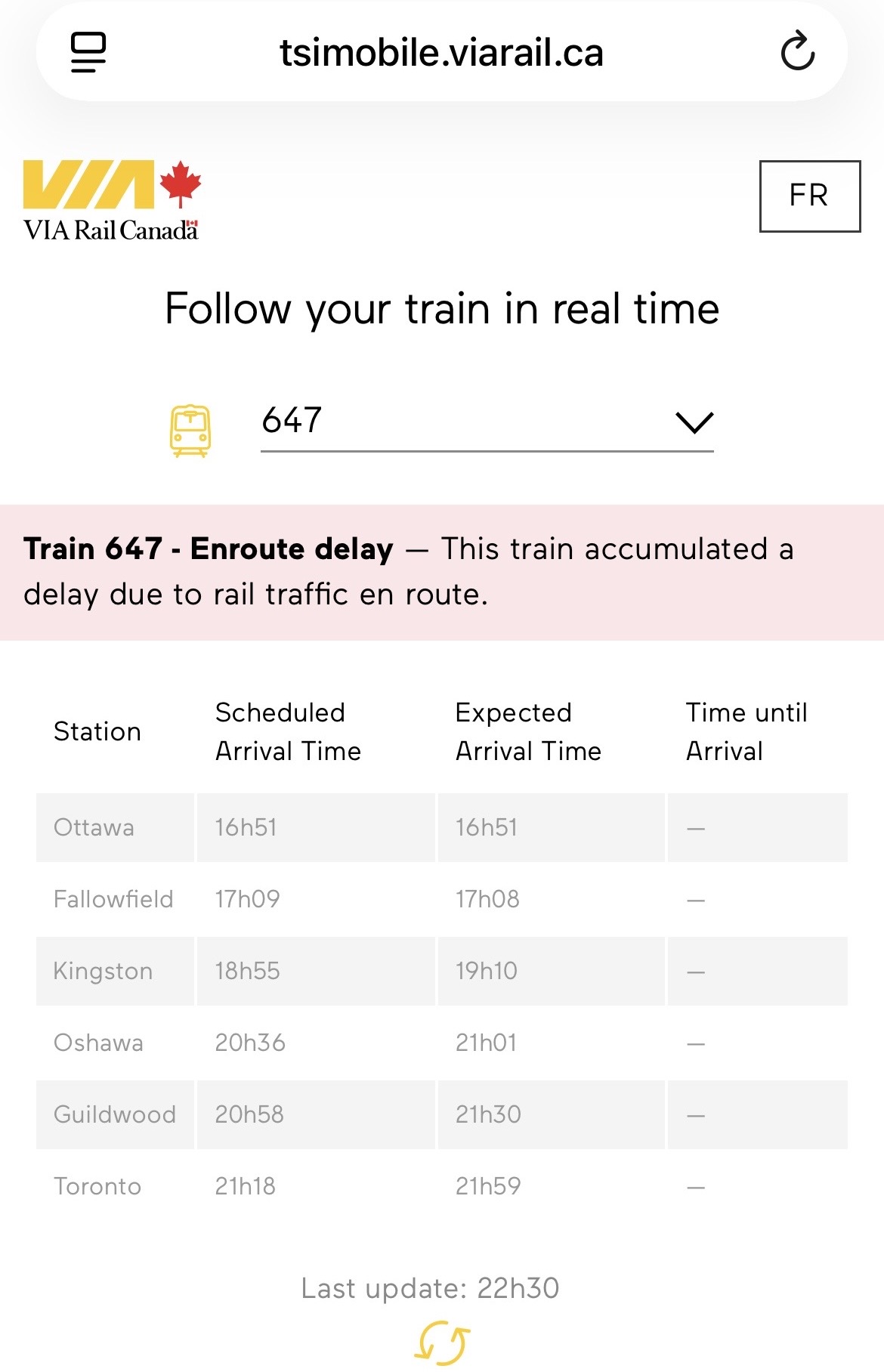
Where the CN Kingston Sub meets the GO corridor west of Pickering Station, our train once again came to a stop for about five minutes. We were held behind a westbound GO Lakeshore East train, slowed down by its regular stop at Rouge Hill. Once we got moving again, our train stopped briefly at Guildwood to allow a few passengers to get off, and now we were 28 minutes late on the VIA train.
From Guildwood westward, the Lakeshore East corridor is triple tracked, so we were able to pass the westbound GO train as it made stops at Eglinton, Scarborough, and Danforth. But under the Main Street bridge, we stopped once again; two minutes later the GO train started moving slowly beside us, taking the lead. With the corridor down to two tracks between Woodbine Avenue and the Don River for Ontario Line work and track expansion, Metrolinx dispatchers decided it was worth holding back a VIA train that would have cleared the section quickly if we were permitted to proceed past Main Street, so that a GO train would have priority and not wait one minute or two despite that train being on time.
We finally arrived at Union at 9:59 PM, 41 minutes late. Sadly, this is a very common occurrence, particularly with inbound trains to Toronto.
Though CN gets plenty of blame for slowing down VIA Rail passenger trains by prioritizing its freight operations and its level crossing spat, Metrolinx must wear some of the blame for VIA’s woes. It is worth pointing out that nearly all VIA passengers affected by poor train dispatching are travelling to or from destinations served by GO Transit: Toronto, Oakville, Oshawa, Aldershot, Brampton, and the majority are travelling within Ontario, including cities such as London, Ottawa, and Kingston. As an agency of the province, Metrolinx should support Ontarians travelling on trains within Ontario, even if they are not aboard Metrolinx-operated GO trains.
 Sean Marshall
One reply on “How Metrolinx gets in the way of passenger rail service”
[With the corridor down to two tracks between Woodbine Avenue and the Don River for Ontario Line work and track expansion, Metrolinx dispatchers decided it was worth holding back a VIA train that would have cleared the section quickly if we were permitted to proceed past Main Street, so that a GO train would have priority and not wait one minute or two despite that train being on time.]
The irony!
GO themselves hold their ‘locals’ quite often along that stretch to allow their ‘express’ trains to run through.