Marshall’s Musings

  • The subway is coming. Let’s improve Scarborough Centre

    As the readers of my blog probably know, I am not a fan of the Scarborough Subway extension. Even though the subway will be expensive and less useful than a fully-funded light rail replacement of the ageing Scarborough RT, politicians from all three major parties have backed the subway, promising “respect” and “fairness” for Scarborough.

    Neethan Shan, the New Democratic Party’s candidate in Thursday’s provincial by-election in Scarborough-Rouge River, has been pushing this messaging hard, though all three candidates — including City Councillor Raymond Cho, running for the Progressive Conservatives — are all in favour of the extension. That conveniently ignores the fact that the subway won’t even stop in Scarborough-Rouge River — though the LRT would have.

    But it’s now time to move on. Scarborough is going to get a six kilometre long, one-stop subway extension, which was confirmed by a vote at city council in July. The focus should now be on getting the best value out of the $3.2 billion project. That must include improving Scarborough Centre.

    The subway extension is currently in the environmental assessment/detailed design stage. I expect that construction will actually begin probably just before the next provincial election is called in 2018. It won’t open for another four to five years after that, in 2022 or 2023. That is plenty of time to make some necessary changes to the street grid, the built form, and the public realm.

    A few weeks ago (during a rare summer rain storm), I explored Scarborough Centre. With too many surface parking lots and a hostile road network, there’s a lot of work that has to be done to make the improve this suburban hub. Employment and residential growth is currently stagnant; that has to be addressed. All that said, there are also a lot of great community assets already in place, and there are some opportunities to make it better.

    (more…)

  • A ride from Peterborough to Uxbridge (Day 2)

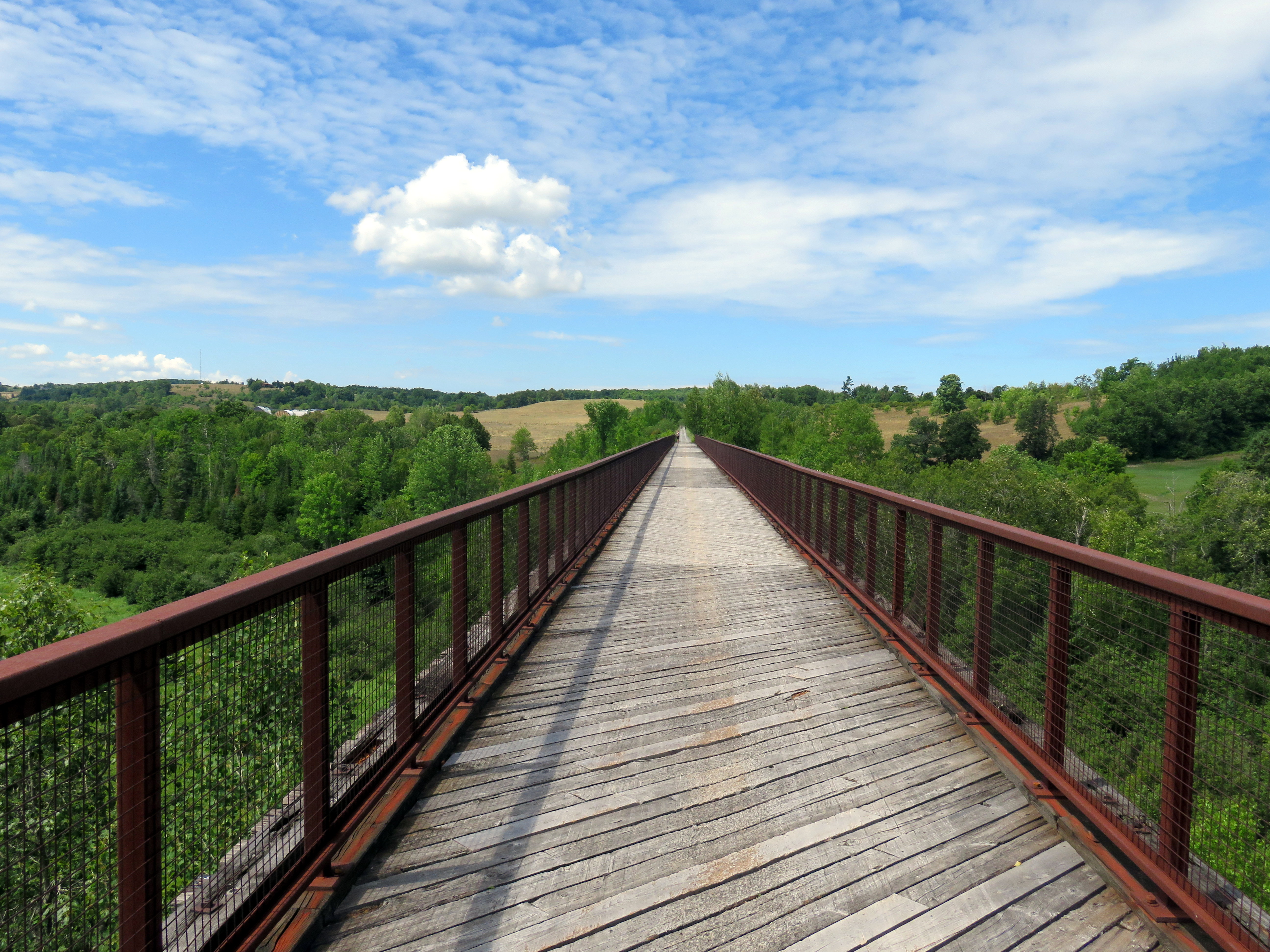
    IMG_4092-001Looking west on Doube’s Trestle, between Peterborough and Omemee

    After riding the Lang-Hastings trail on Sunday July 30, I cycled from Peterborough to Uxbridge on Monday, August 1, stopping at Trent University. This is one of my favourite rides in Ontario, having done this route twice before. But this was the first time I rode west towards Uxbridge, rather than east to Peterborough.

    In total, I rode 99 kilometres that day, and given the heat (and the lack of shade), I ended up ending up a little bit dehydrated — and quite tired — at the end of the trip. There are no places to rest or buy snacks or beverages between Lindsay and Uxbridge, so it’s best to plan ahead. Bring lots of water; Lindsay is an excellent place to take a break and have a light meal. At Uxbridge, I had dinner at a local pub before loading my bike on a GO Transit bus back to Toronto.

    There are a number of great rail trails in Southern Ontario, but except in the Lindsay-Peterborough and  Kitchener-Brantford-Hamilton regions, rail trails in Ontario, where they exist, are usually disconnected from each other and difficult to access from Toronto without a car. It makes me long for Québec s Route Verte network of trails and cyclist-friendly roadways.

    (more…)

  • A ride between Peterborough and Hastings (Day 1)

    IMG_4015-001The Trans-Canada Trail crosses the Otonabee River near downtown Peterborough, next to the Canadian Pacific Railway

    During the Civic Holiday long weekend, I spent two days cycling around Peterborough and two of the rail trails that radiate out of it. Peterborough is one of my favourite places to cycle; it is my third time there on two wheels.

    On Sunday July 31, I started by taking the GO Lakeshore East Train, then transferring to the 88 Peterborough GO bus. Every GO bus is equipped with a rack that can accommodate two bicycles, and all non-peak GO trains can take two or four bicycles per coach (there are special bike coaches as well on the Niagara summer weekend service). After getting off the bus in Downtown Peterborough, and getting coffee at one of that city’s many downtown cafes, I biked out to Hastings, on the Lang-Hastings Trail, returning via (mostly) the same route, a 40 kilometre one-way trip.

    I stayed overnight in Downtown Peterborough and biked to Uxbridge via Lindsay the following day (more on that in a subsequent post), making a diversion via Trent University. That one-way trip was almost 100 kilometres in length. At Uxbridge, I had dinner and took a GO bus back to Toronto.

    (more…)

  • Mapping the Ward 2 by-election

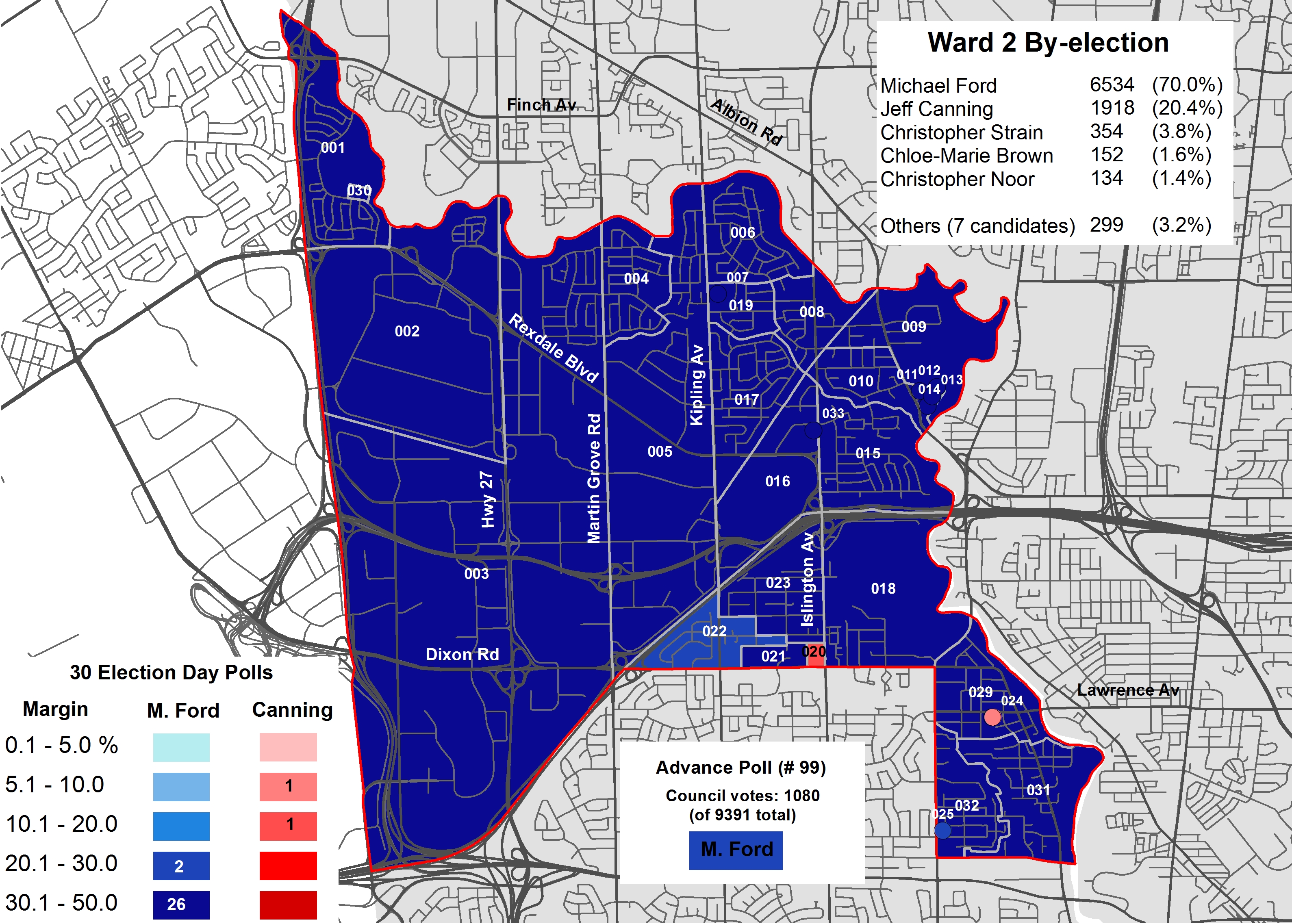
    Ward 2 By-election
    Poll results of the 2016 council race in Ward 2

    On Monday, July 25, residents of Ward 2 (Etobicoke North) went to the polls to elect a new councillor to replace the late Rob Ford, who was elected as councillor in the 2014 general election after a disastrous four years as mayor.

    After Rob Ford’s death in March 2016, it was widely expected that the Ford family would field a candidate; it would either be former Ward 2 councillor Doug Ford or Rob and Doug’s nephew Michael Ford (née Stirpe).

    Michael Ford, then 20 years old, ran for councillor in the 2014 general election. He withdrew in September 2014 to run for the local Toronto District School Board trustee position, so that Rob Ford could run for councillor instead, abandoning his bid for re-election as Mayor of Toronto due to his poor health. Doug Ford, who originally wasn’t going to run again for municipal office, ran for mayor in Rob’s place, coming in a strong second to John Tory. I mapped those results in a previous post. 

    Right away, Michael Ford was the clear favourite to win the by-election. The Ford name is famous in north Etobicoke; Doug Ford Senior was a Progressive Conservative MPP from 1995 to 1999; Rob Ford represented Ward 2 from 2000 through 2010 before running for mayor, and winning against George Smitherman. But Michael Ford, only 22, claimed to be his own person; his brief tenure on the TDSB board has been without the buffoonery or intolerance that Rob and Doug exhibited; Michael attended the 2016 Pride Parade in 2016, something the other Fords made a point of avoiding. But Michael Ford campaigned on a platform of “customer service” — the same philosophy that made Rob Ford popular in his ward.

    There were eleven candidates running against Michael Ford. They included:

    • Entrepreneur Justin Canning, a right-of-centre candidate who made a point of saying that Michael isn’t like Rob and Doug Ford when quoted in the Toronto Star;
    • Christopher Strain, a New Democrat who managed Russ Ford’s campaign for councillor in Ward 6 in the 2014 election;
    • Chloe-Marie Brown, a volunteer and City Hall intern who sought to represent her community and bring attention to the needs of lower income residents of North Etobicoke.

    Voter turnout was low, as they often are for municipal by-elections. Only 9391 residents voted in 2016, less than half the 19,793 votes for councillor that were cast in 2014. And to no one’s surprise, Michael Ford won, with 70.0%of the vote. Justin Canning came in a very distant second, with 20.4%, Chris Strain had only 3.8% of the vote, Chloe-Marie Brown only got 1.6%.

    Michael Ford came in first place in all by two polls by wide margins, as shown in the map above. Only two polls, 020 and 024, chose Justin Canning. Poll 020 represents two condo towers on Islington Avenue at Dixon Road, while Poll 024 represents a seniors’ residence on Lawrence Avenue. Both polls voted for Rob Ford for council in 2014, but for John Tory for mayor over Doug Ford.

    Even though I am willing to give Michael Ford a chance to prove himself as city councillor (and we will see how different he truly is from his uncles), the low voter turnout and the inevitability of Ford’s win still troubles me. Perhaps the low turnout was partly due to the assumption that Ford would win this by-election; holding it in the middle of summer wouldn’t have helped either. But there was a solid choice of alternative, qualified candidates that deserved voters’ consideration. Ward 2 deserved a real contest, not another coronation.

  • That video

    With the charges against Sandro Lisi dropped, the publication ban on his case — including evidence presented at pre-trial court proceedings — was lifted. If you recall, Lisi was a friend and the driver for former mayor Rob Ford. Lisi was charged with alleged extortion, trying to get a infamous — yet almost completely unseen — video captured on a cellphone that showed Ford smoking crack and spewing obscenities at the Basso residence in Etobicoke.

    That video — the subject of an explosive story published in May 2013 by the Toronto Star and Gawker — was finally made public. You can watch it, if you like, on the Star’s website. But I’m not suggesting that you should.

    Yes, I watched it, but I almost wish I didn’t. I ended up feeling nothing but sadness. Sad for Rob Ford’s immediate family, and sad for Rob Ford. I can not stop thinking about all the people Ford hurt over the years, including himself. That sadness then turned to anger and contempt when I started to think about Ford’s enablers. And there were plenty of them.

  • Farewell to to Bathurst Manor Plaza

    IMG_3814-001

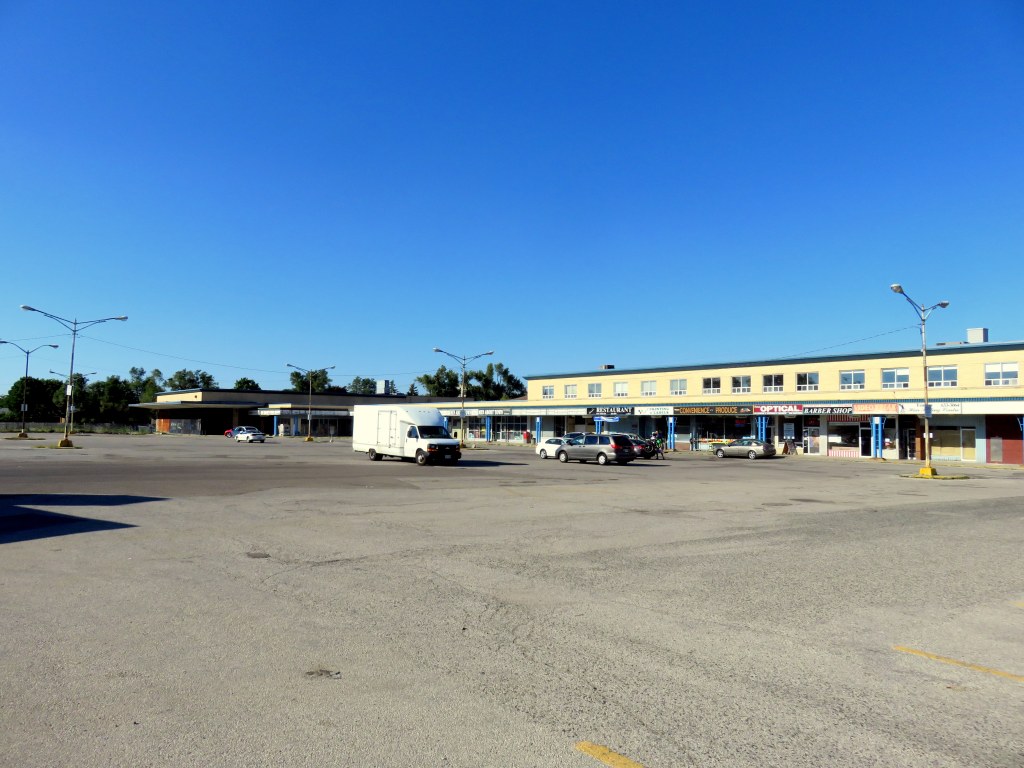
    This Sunday July 31, another suburban shopping plaza in Toronto will close for good. For over 50 years, Bathurst Manor Plaza, at the corner of Wilmington Avenue and Overbrook Place, served the local community. At its peak, it had Sunnybrook Market, a local grocery store, a Shoppers Drug Mart, LCBO, and a CIBC bank branch. It also had several clothing stores, an optician, restaurants, cleaners, an a video store. These may not be the types of businesses that would attract customers from far away, but they were the types of stores essential to the local community. It also had a gas station and service centre, which was later occupied by a kosher pizza restaurant. The plaza’s second floor houses doctors’ and dentists’ offices, lawyers, and other services.

    There was also Goodman’s China and Gifts. Known for wedding registries, it was where my father would go (all the way from Brampton) to get fine crystal gifts, for my mother’s birthday or wedding anniversary, often bring my brothers and I along. I still remember friendly Mr. Goodman behind the counter, who always had a twinkle in his eye and loved seeing us kids with our father in his store. This is why I felt particularly sad visiting this plaza for the last time earlier this week.

    Canadian Jewish News has a very good article that discusses the history and future of Bathurst Manor Plaza.

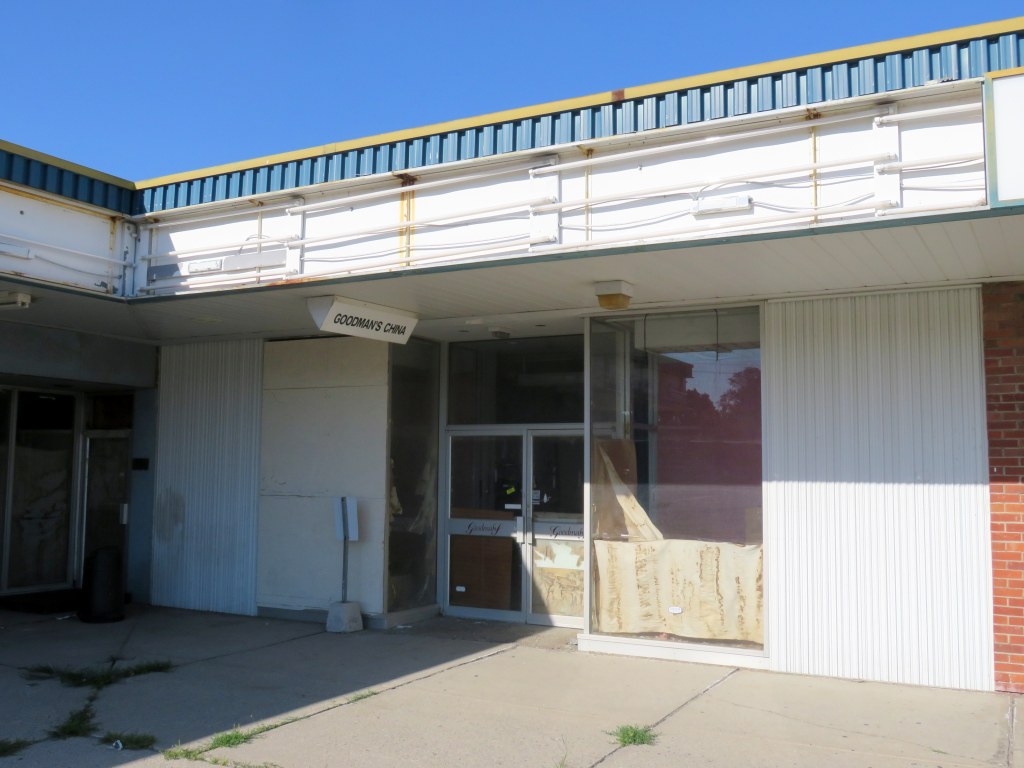
    IMG_3825-001The abandoned Goodman’s China store

    (more…)

  • Suburban cycling infrastructure: the 416 versus the 905

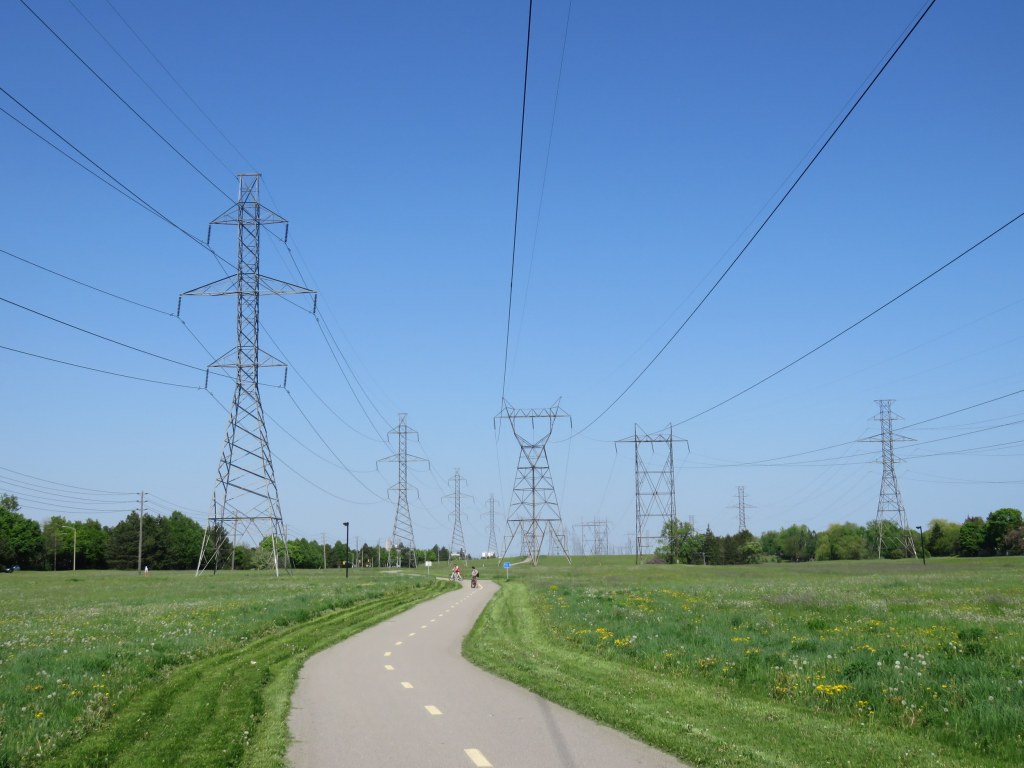
    IMG_2051-001Riding along the McNicoll hydro corridor in northern Scarborough
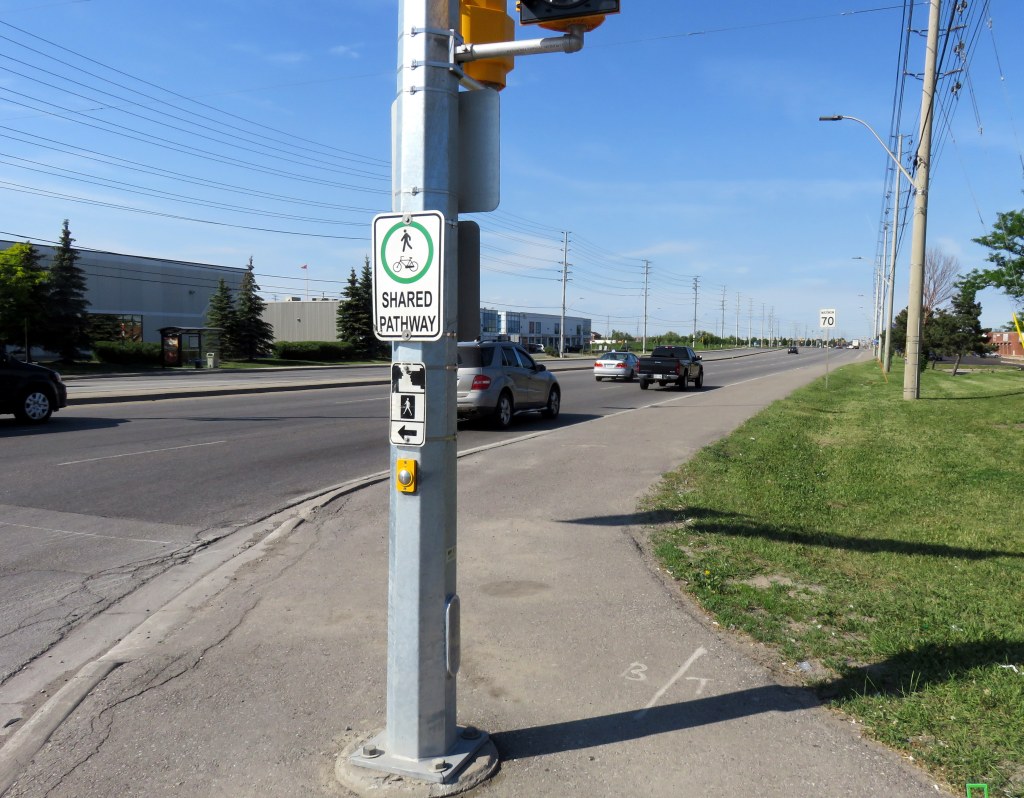
    Earlier this summer, I took two rides from my downtown apartment to suburban locations. On one ride, I biked northeast to Agincourt, on another trip, I biked to Downtown Brampton on a route that took me past the Humber River and Etobicoke Creek. I experienced different standards for on-street and off-road cycling routes. The City of Toronto generally does better, but suburban cycling infrastructure generally depends on off-road trails, rather than on-street bike lanes and cycle tracks.

    In the urban, central part of Toronto, bike lanes and cycle tracks (separated bike lanes located along major streets) are the predominant form of cycling infrastructure. While there are some bike lanes in suburban Toronto and in other municipalities like Mississauga and Brampton, most bike routes, if they exist, are off-road multi-use trails, in ravine or hydro corridors, or alongside major roads, like sidewalks.

    Multi-use paths are pleasant to ride on, but they’re often treated as recreational trails, rather than transportation corridors. Most paths are not cleared of snow in the winter (winter cycling really should be encouraged), and they are often isolated from the adjacent road network and local destinations, and they can meander, rather than follow straight lines. Road crossings can often be awkward.

    Bike lanes, which offer less protection from motorized traffic at least are integrated with the rest of the street grid, and are generally more direct. But on fast-moving suburban arterials, they aren’t ideal without separation. This is where the side-of-road path comes in.

    IMG_2305-001Shared pathway, Derry Road, Mississauga
    (more…)

  • Toronto’s new rapid transit plan

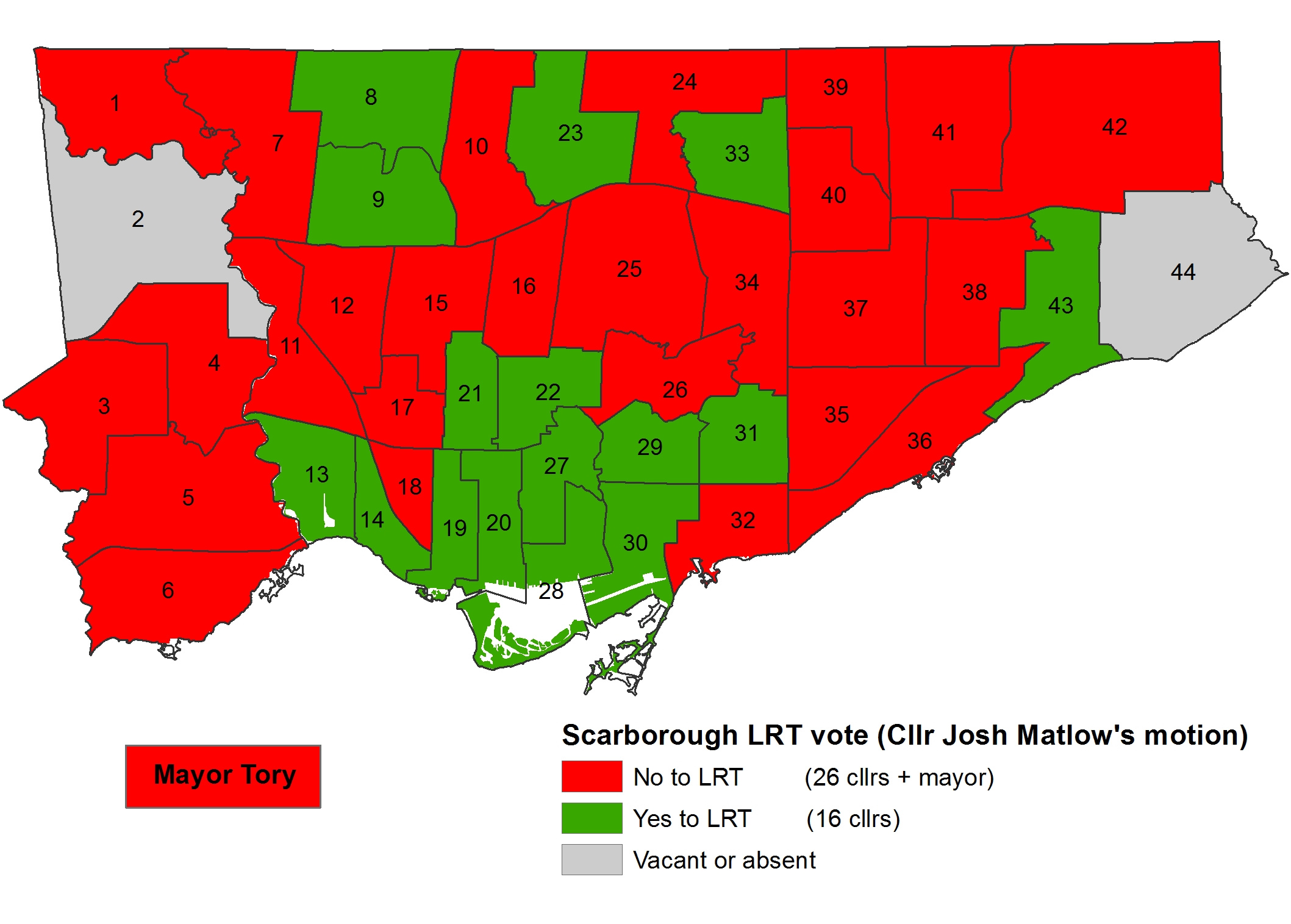
    Yesterday, City Council decided, by a vote of 27-16, to go ahead with the $3.1 billion one-stop extension of the Bloor-Danforth Subway to Scarborough Centre, rejecting Councillor Josh Matlow’s last-ditch attempt to resurrect the LRT replacement and extension of the ageing Scarborough LRT line. Council — Mayor Tory included — also voted to spend resources studying three more suburban subway extensions and a re-alignment of the proposed Relief Line subway backed by the local councillor.

    Unfortunately, the chance of going back to the less-expensive, yet longer seven-stop light rail line is slim-to-nil at this point. In my view, it’s time for transit advocates that backed the LRT to focus their energies elsewhere. Like Metrolinx’s fare integration strategy, and the plans for other LRT lines, such as the eastern and western extensions of the Eglinton-Crosstown.

    TT - Scarborough VoteHow council voted on Councillor Matlow’s motion to resurrect the LRT option for Scarborough
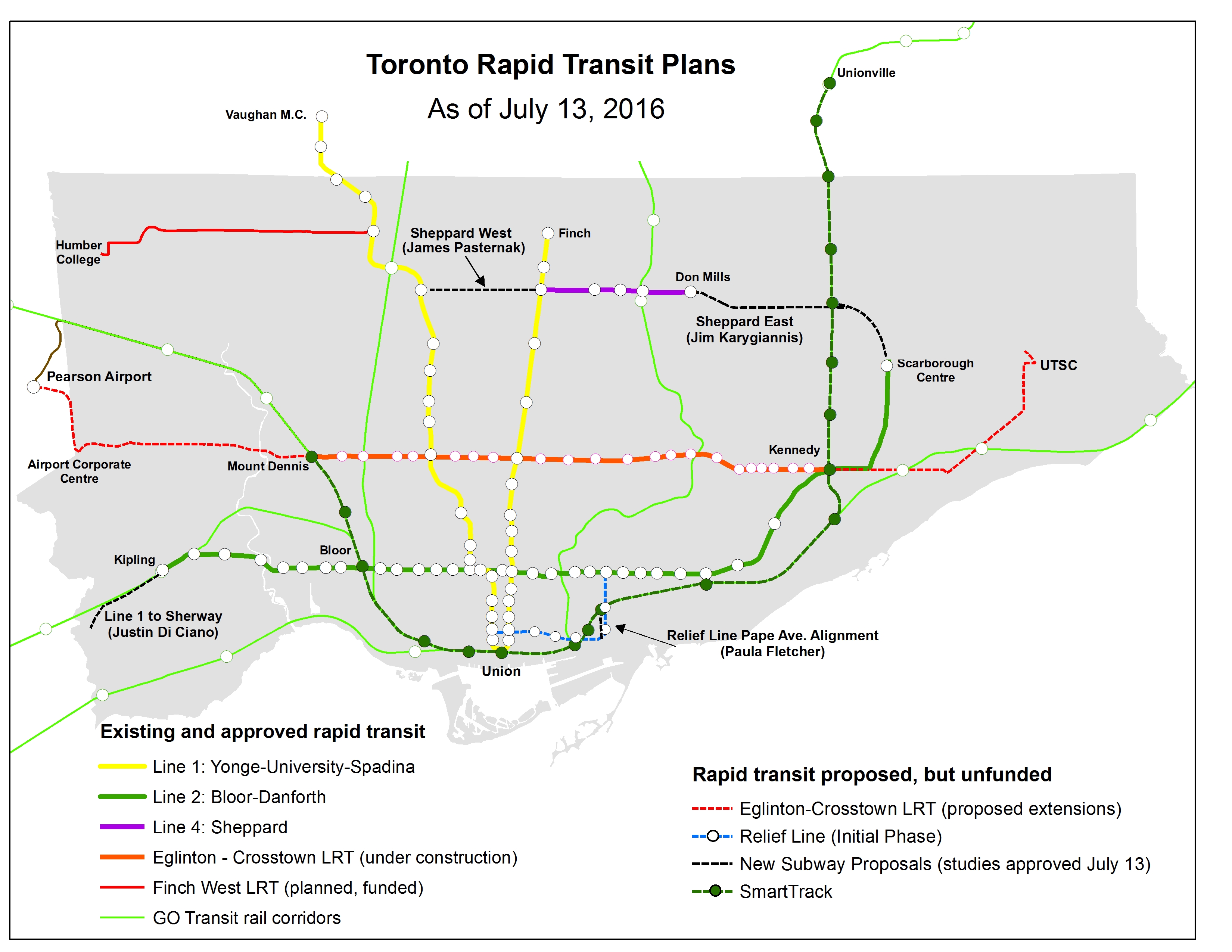
    In order to ensure that he had enough votes, John Tory entertained Ward 39 Councillor Jim Karygiannis’ motion for a study on an extension of the Sheppard Line from Don Mills Station to Scarborough Centre. (There’s a LRT proposed for Sheppard East, but no matter.) Karygiannis’ motion passed, as well as several other councillors’ pet subway projects. Ward 10 Councillor James Pasternak has long pushed for a Sheppard Subway extension west between Sheppard-Yonge and Downsview Stations, and he successfully got that included as well. Finally, Justin Di Ciano (Ward 5) got a study approved for a subway extension in his ward as well, resurrecting a long-dormant proposal for a subway extension from Kipling Station to Sherway Gardens.

    It’s worth noting that all three right-leaning councillors are reliable votes for John Tory.

    Downtown, Paula Fletcher (Ward 30) moved that staff re-examine the Relief Line, moving the recommended alignment from under Pape Avenue to Carlaw Avenue between Gerrard and Queen Streets. This would shift the planned — yet unfunded — subway line two blocks west. The Pape alignment was chosen for ease of construction and operation (the line must curve from north to west just south of Queen Street), and is only two blocks away. That study will cost $520,000 and staff time.

    All these new studies are illustrated below. For clarity’s sake, the Sheppard East LRT, the Scarborough LRT proposal, and the existing Scarborough RT (Line 3) are removed. You can read more about how the votes went down on Steve Munro’s site.

    Transit Plan July 2016The map of planned, approved and existing rapid transit lines, and those extensions and re-alignments approved for study

    The “subways, subways, subways” sentiment is alive and well at City Hall, even if Rob Ford has passed on. And despite the thirst for expensive new subway lines,  Mayor Tory is still backing an austerity agenda at City Hall. Apart from the decorum, not much has changed in the mayor’s office.

  • The difference between the Fords’ Subway Plan and John Tory’s Subway Plan

    201493-rob-ford-subway
    The Rob Ford/Doug Ford Subway Plan, circa 2014

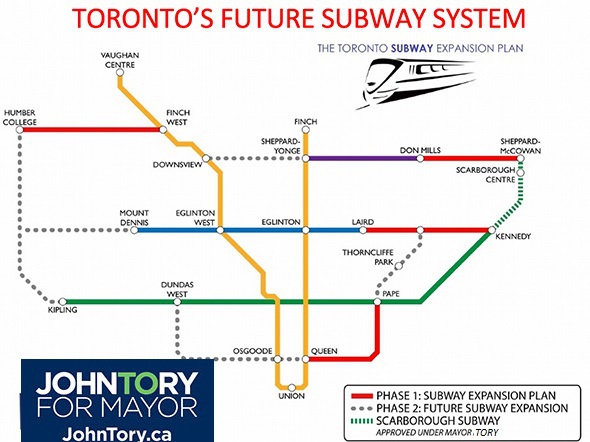
    The above is the subway plan promoted by Rob Ford, and later Doug Ford, in the 2014 municipal election. Thanks to today’s pandering to suburban councillors demanding their own subway lines, below is the John Tory-backed subway plan.

    tory-subway
    The John Tory Subway Plan, circa 2016

  • The Truth About SmartTrack

    smarttrack_fb

    This article originally appeared on June 27, 2016 in Torontoist

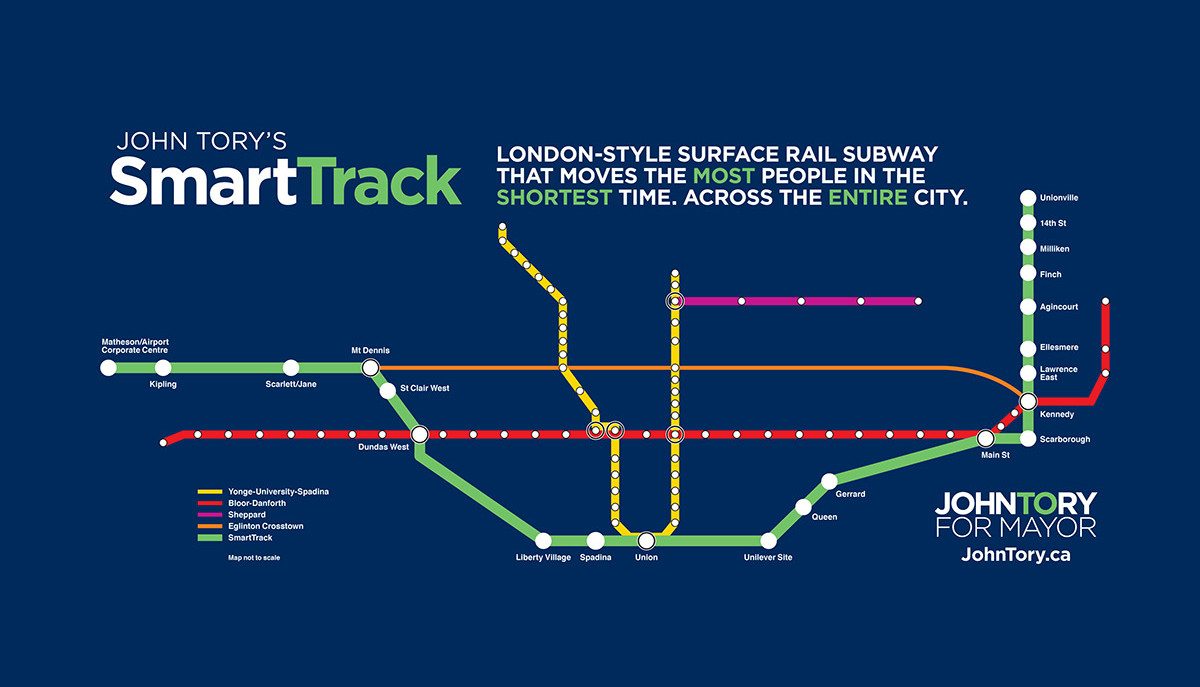
    In 2014, then-mayoral candidate John Tory ran on a campaign of sound fiscal management, returning decorum to City Hall, and a curious new transit plan called SmartTrack, which promised “London-style” rapid transit from Mississauga to Markham. During the election campaign Tory claimed that the new rail service—53 kilometres long, costing $8 billion—would provide needed transit relief in just seven years, all on a TTC fare.

    During campaign speeches, Tory called the plan “bold.” He also promised to build the Rob Ford-backed subway extension to Scarborough Centre, rather than return to the cheaper, funded light rail alternative that candidates Olivia Chow and David Soknacki were backing.

    Of course, Tory won the election, and many Torontonians were looking forward to an era of competent governance, if not visionary leadership. But two years in, the costs of the Scarborough subway keep mounting, even if the number of stations kept shrinking (from three stations to one stop), and the scope of John Tory’s “bold” SmartTrack plan kept getting watered down.

    With the recent provincial and municipal transit announcements on new GO Station locations, it’s now official: SmartTrack is nothing more than a brand name for transit projects that were already in the works. And the City of Toronto is stuck with some of the construction costs that would have been borne by the province.

    Mayor Tory and the provincial government held two separate transit announcements this week: one in Liberty Village, the other at the former Unilever lands that First Gulf is looking to redevelop as a major office and commercial centre. While Tory has been bullish about promoting First Gulf’s development, the East Gardiner replacement, SmartTrack Station, and even a Relief Line subway stop—projects he championed—will all serve this particular property.

    Those announcements coincide with a Metrolinx report [PDF] that recommends 12 new GO Transit stations: Breslau, St. Clair, and Liberty Village on the Kitchener Line; Innisfil, Mulock, Kirby, Davenport-Bloor, and Spadina on the Barrie Line; East Harbour (Unilever), Gerrard, Lawrence East, and Finch East on the Lakeshore East and Stouffville lines. Stations at Mount Dennis, Downsview Park, and Caledonia were already approved and will connect to the subway and Crosstown LRT. Seven of those stations—from Mount Dennis to Unionville—are along the SmartTrack corridor. Spadina Station, part of Tory’s SmartTrack map, will only be served by Barrie corridor trains.

    From the start, SmartTrack was a fantasy built on assumptions; the line was an idea conceived by a little-known organization called Strategic Regional Research Alliance. SRRA authored a report, “The Business Case for the Regional Rail Line,” discussing the potential of a 2009 concept for connecting suburban office parks with Downtown Toronto with rapid transit. That report became the basis for SmartTrack.

    Meanwhile, Metrolinx—the provincial transportation authority for the Greater Toronto and Hamilton Area—was involved in studying plans for converting much of its existing GO Transit rail network from a commuter rail system to an electrified, regional rail network known as Regional Express Rail. RER and SmartTrack (as well as VIA Rail and UP Express trains) would be sharing the same corridors.

    Since the election, the truth about SmartTrack has become clear. Previous plans for SmartTrack were simplistic, with maps created using out-of-date Google Maps imagery that ignored the fact that lands owned by the City of Toronto along Eglinton Avenue in Etobicoke—reserved for an unbuilt freeway—were largely sold off and redeveloped. There were serious engineering and financial complications of building the connection between the existing GO line at Mount Dennis and the Eglinton spur. The plan to use tax increment financing (TIFs) to build SmartTrack remains dubious. The Eglinton spur was removed, replaced by the revival of the approved yet unfunded western section of the Eglinton Crosstown LRT. Tory surrounded himself with experts, including a prominent University of Toronto transportation professor who gave the plan an “A+.” Critics who pointed out these flaws were ignored or insulted. There are few excuses that Tory can make for this failure.

    With the latest announcements, it is clear that SmartTrack has become nothing more than a moniker for an existing GO Transit RER. Rush-hour train frequencies will likely be every eight to 10 minutes; off peak, trains will arrive every 15 minutes (the TTC subway never operates at less than six-minute frequencies). We do not know what fares will be charged on GO RER/SmartTrack as Metrolinx continues to study regional fare integration. And it is very unlikely that we will be seeing frequent, electric trains offering relief by 2021.

    As the Globe and Mail‘s Marcus Gee points out, the City will now be expected to pick up much of the construction tab—similar to how the municipal government is stuck with cost overruns on the Scarborough subway extension after it rejected a provincially funded seven-stop light rail line to replace the ageing RT line.

    At best, SmartTrack represents the City of Toronto’s buy-in to GO RER, a worthwhile project to provide better rail service to suburban Toronto and the 905. There’s room to negotiate at least some fare integration between GO and the TTC. But at worst, SmartTrack is a failure to deliver on a key election promise, as flawed as it is. But in order for the Mayor to save face, the SmartTrack brand will likely never go away.