Tag: Downtown

  • Brantford’s downtown was the “worst in Canada” – but has it bounced back?

    IMG_7684-001
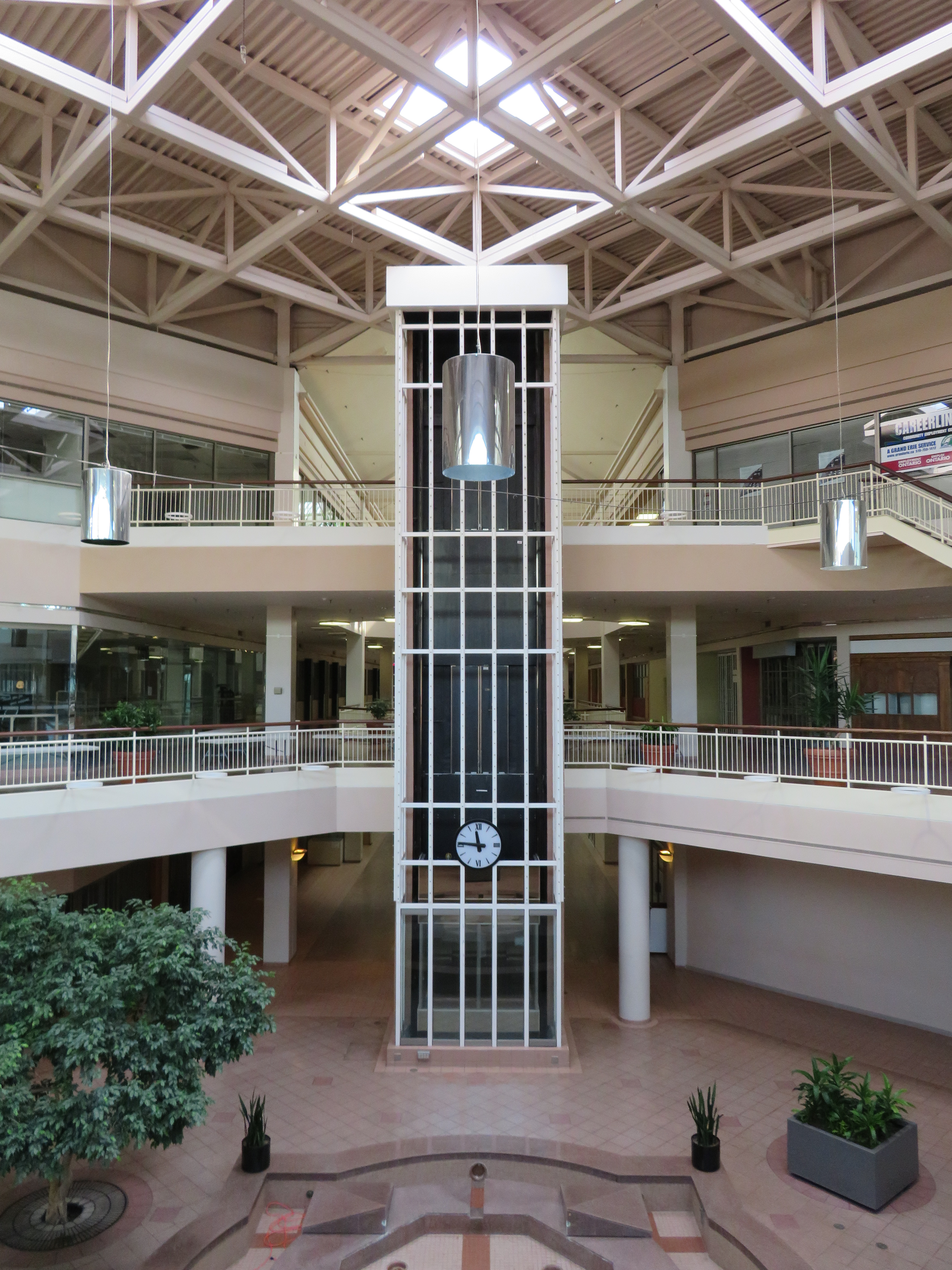
    Interior of former Eaton Market Square, 2018

    On Labour Day weekend, I paid a visit to Brantford. I brought my bike on GO Transit, taking a train to Aldershot and a bus from there to the Telephone City. I then biked from Brantford to Hamilton on one of Ontario’s best rail trails.

    Over a decade ago, Mayor Chris Friel called Brantford “the worst downtown in Canada.” It was not hard to understand why. Colborne Street, Brantford’s main street, was lined with neglected commercial buildings, many with boarded up streetfronts. In the 1990s, many of the plywood hoardings had been decorated with pretend business names and silhouettes of customers, either as an attempt at beautifying the street or recalling the variety of businesses that had once occupied the strip. Only a few stores and restaurants remained open.
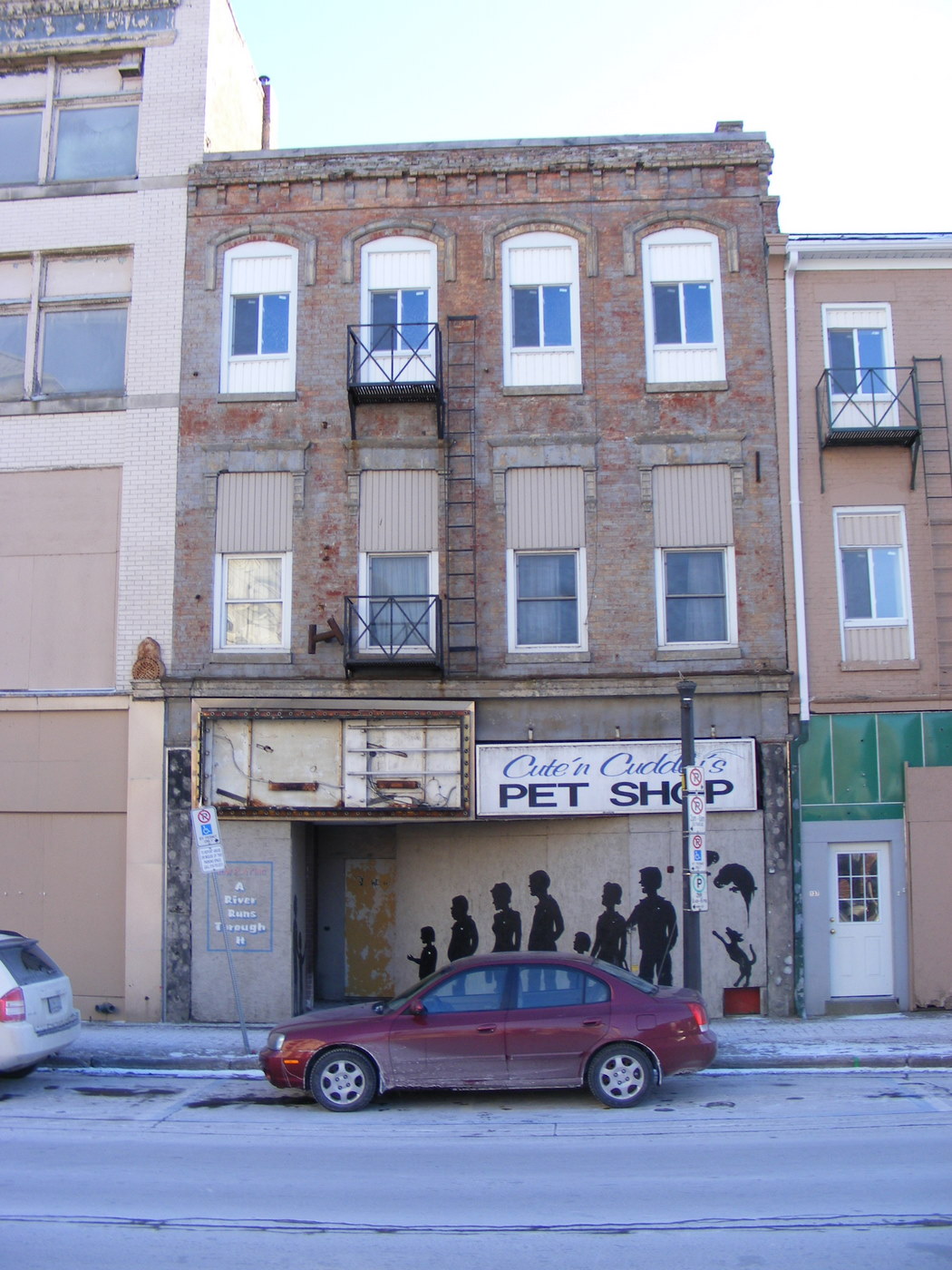
    4360965559_d1aa044078_o.jpgBoarded up storefront, Colborne Street, 2010

    There were several reasons for Downtown Brantford’s decline. In the 1980s, Brantford’s major industries, including the once-mighty Massey-Ferguson, had shut down local operations. Other industries like Cockshutt (later White Farm Equipment) had also departed Brantford. By the early 1990s, the unemployment rate hit 24 per cent.

    Cockshutt plant offices in 2004, and the remains in 2018

    The city also made some questionable urban renewal decisions. The old open-air marketplace at Colborne and Market Street, along with a whole city block was cleared for Eaton Market Square, which opened in 1986. The city also built a new parking structure to the south, as well as a new office building across the street from the new mall. Like most downtown malls built in Ontario, Eaton Market Square was a commercial failure. Brantford already had two suburban malls — Lyndon Park Mall, anchored by Sears, and Brantford Mall, anchored by the Right House, a Hamilton-based department store, Woolco and Loblaws.

    While parking at the suburban malls was free and plentiful, customers had to pay to park downtown, and Eaton’s in the 1980s was too upmarket for a smaller, blue collar city. Brantford’s downtown parking garage, built by the municipality, was to be paid for with parking fees.
    IMG_7686-001
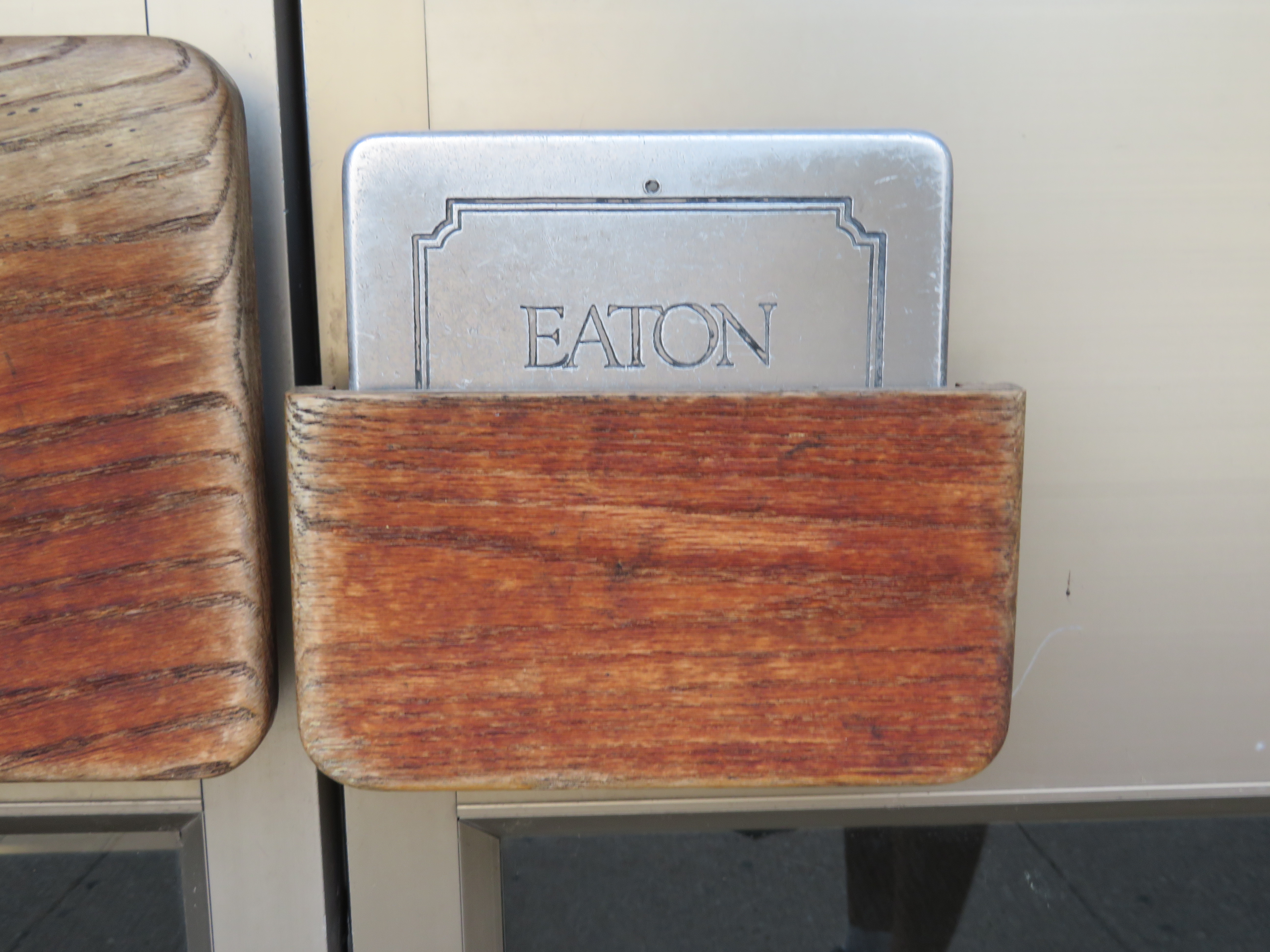
    Eaton Market Place dropped the Eaton name after its anchor closed, but the mall’s past has since revealed itself

    While Eaton Market Square brought in many of the remaining retailers that were left on Colborne Street when the mall opened, as the mall floundered, most major tenants left as soon as their leases were due for renewal. By 1997, when Eaton’s entered bankrupcy and closed the Brantford store, many of the other shops had already closed.

    But the mall wasn’t the only thing Brantford officials did to try to revitalize its city centre.

    Like Flint, Michigan’s efforts to attract tourists and shoppers downtown coincident with the decline of its manufacturing base (described in Michael Moore’s film Roger and Me), Brantford pursued other projects along with the new mall to revitalize its downtown core. The provincial government planned a new electronic processing centre, but was cancelled by the NDP-led government in the early 1990s due to budget pressures.

    Icomm was to be a new telecommunications museum, science centre, and research hub, built on an old industrial site just south of downtown. While the building was completed in the early 1990s, it was left vacant after Bell Canada pulled its funding for the venture. Though city officials hoped for a post secondary educational institution, the Icomm building became a casino. Next to the casino, a commercial plaza, including a supermarket, fast food restaurants and a LCBO store was built, along with free surface parking.
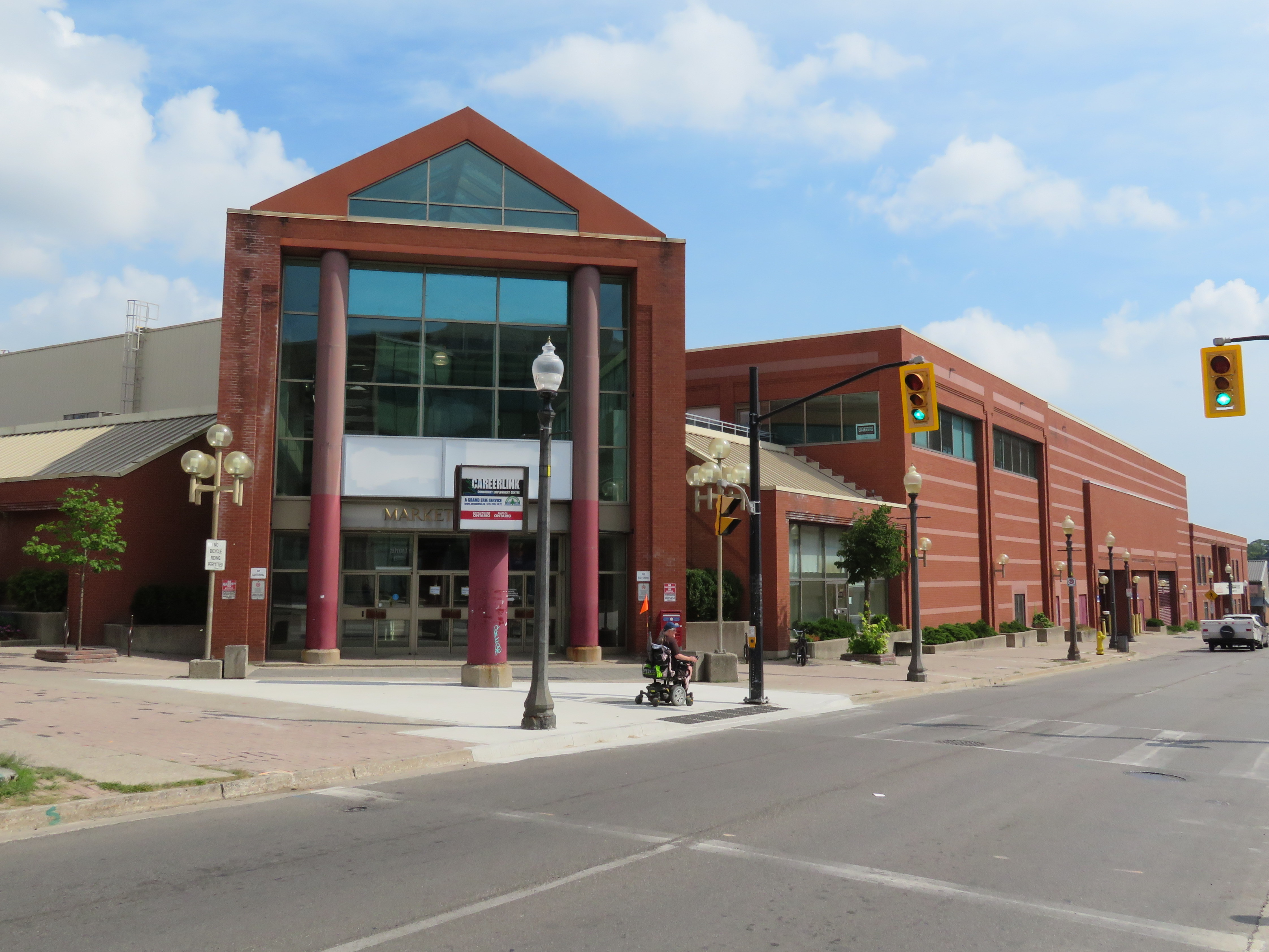
    IMG_7676-001.JPGMarket Square

    Eventually, Brantford found a viable solution for revitalizing its downtown core. In 1999, Wilfrid Laurier University opened a satellite campus, starting out in the old Carnegie Library sold by the city for $1. By 2002, there were 340 students; today, enrollment is  about 3,000. Laurier now owns dozens of building downtown, including a previously abandoned movie theatre, and even the old old Eaton Market Square building. Hundreds of students live in local residences.
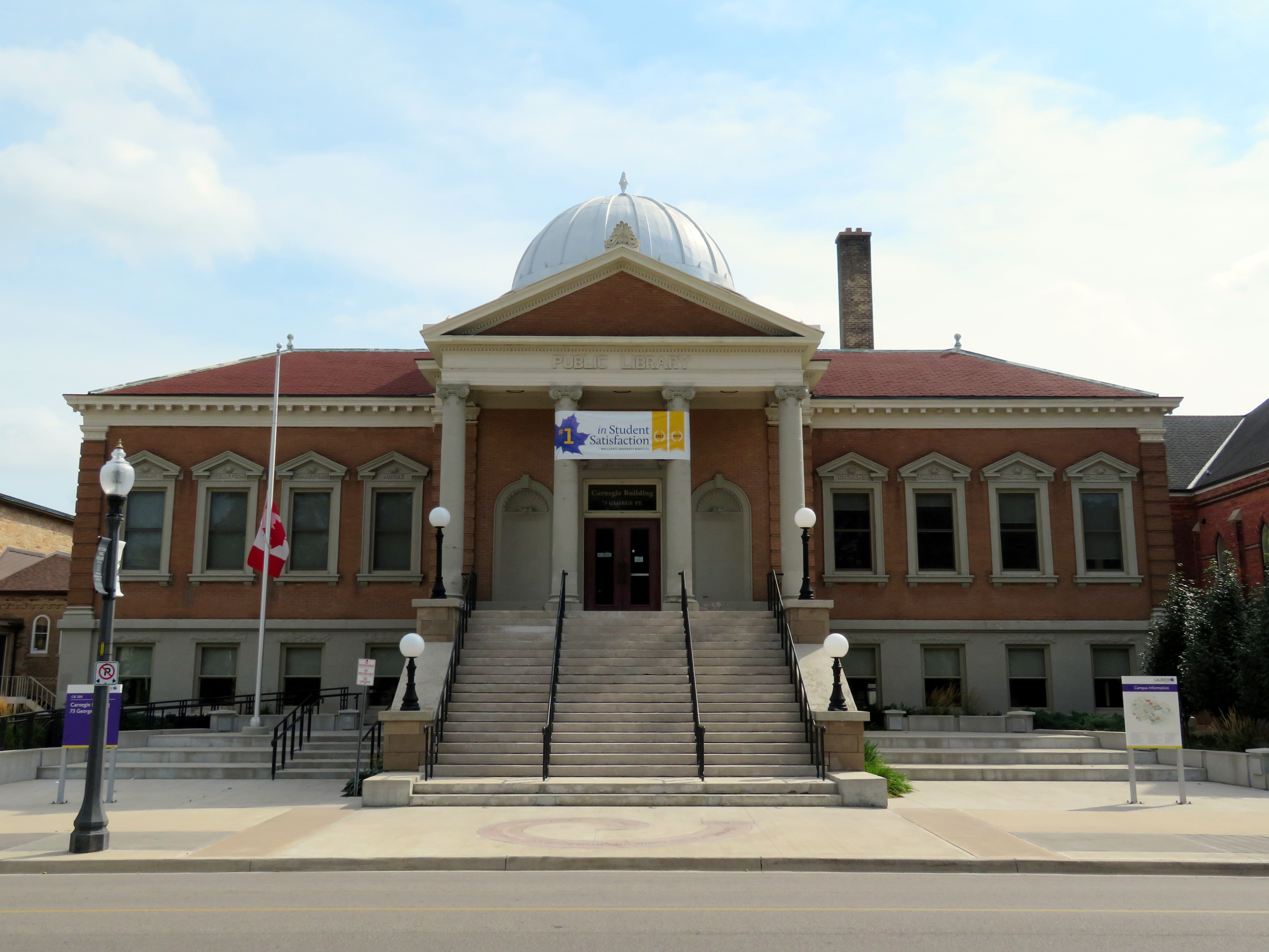
    IMG_7664-001The old Carnegie Library, Brantford

    Yet, there is still little retail downtown, though there are now several newer restaurants, bars, and coffee shops.

    It hasn’t been all good news. Nipissing University, based in North Bay, also established a satellite campus in Brantford. In December 2014 it announced that it would be winding down its presence there, including its joint programs with Laurier. The Ministry of Education had capped the number of funded spaces for Bachelor of Education students and reduced funding for the program. The joint programs were one of Brantford-Laurier’s main draws.
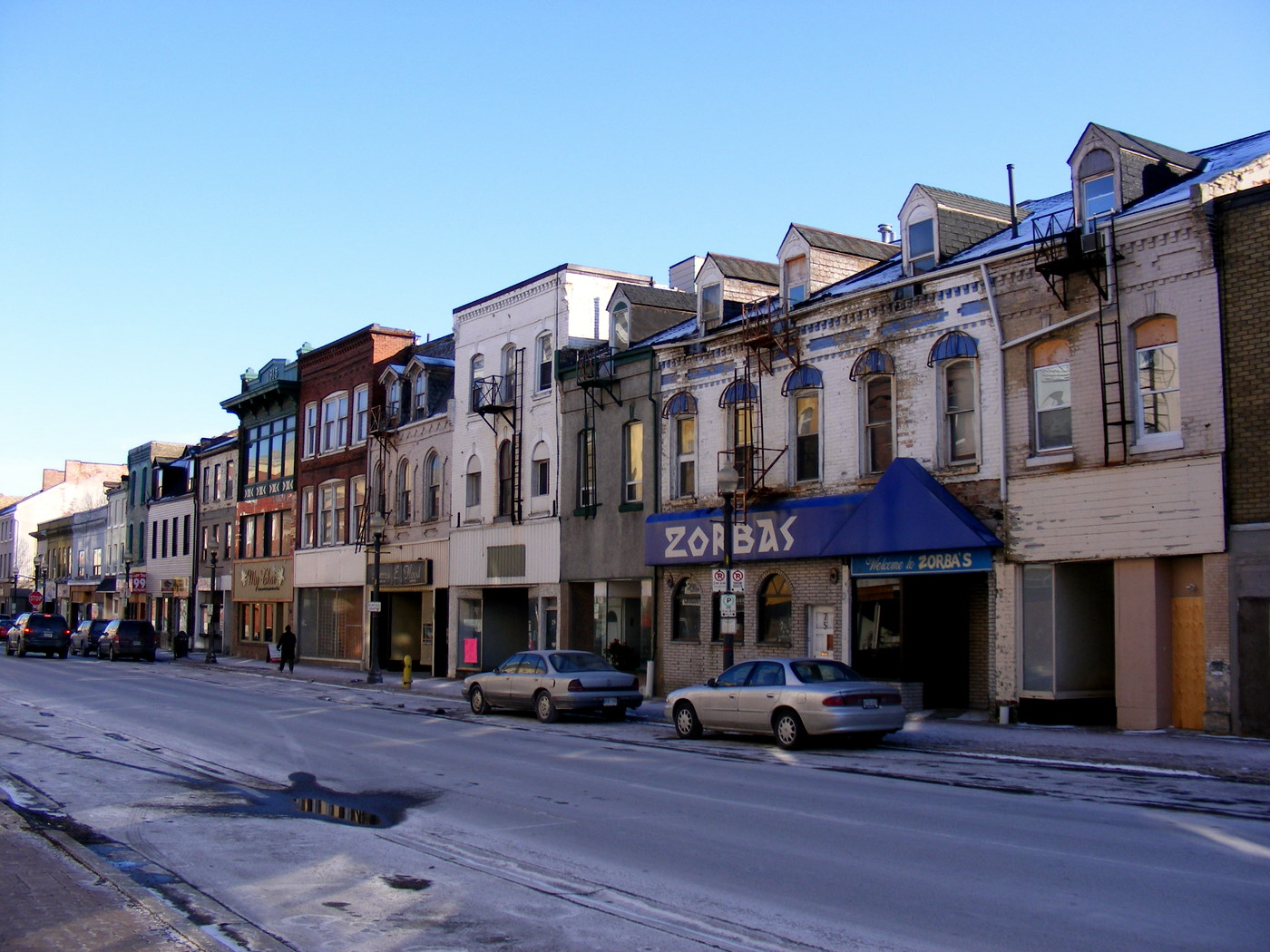
    4360965043_88fea24940_o.jpgColborne Street, January 2010

    Meanwhile Colborne Street continued to languish. In 2010, the city expropriated and demolished the entire south side of the street, including several commercial blocks still occupied. A new joint Laurier-YMCA athletics and recreation facility was built on the site, which will open by the end of the year. Sadly, the new building contributes very little to Brantford’s main street.
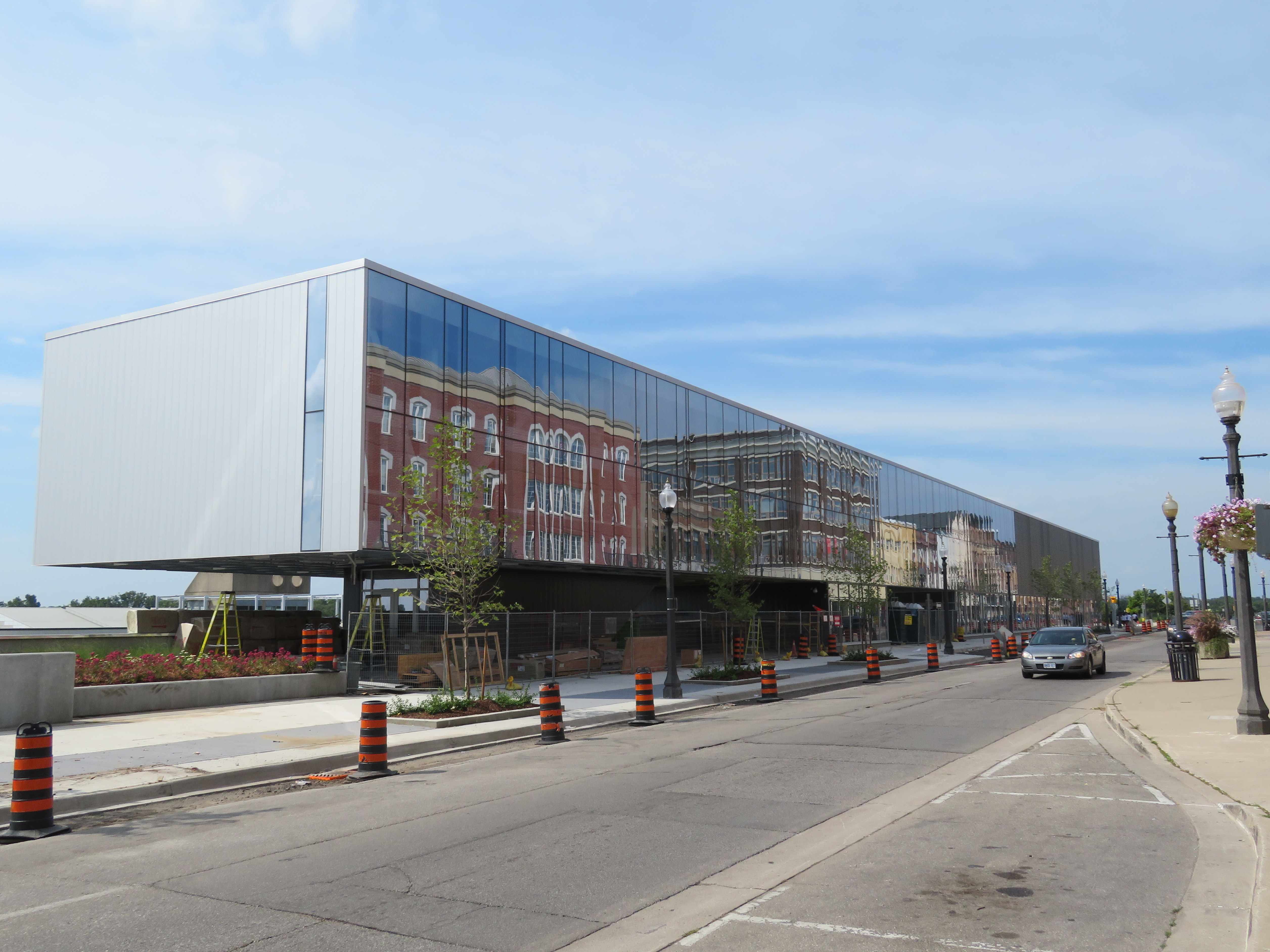
    IMG_7674-001The architecture of the new YMCA-Laurier athletic building is sterile compared to the old Colborne Street storefronts

    At the least, Laurier’s Brantford campus has brought some life back to a moribund downtown core that suffered through misguided urban renewal schemes, a major restructuring of the local economy, competition from suburban retail developments, and urban neglect.

    But a satellite post-secondary institution on its own isn’t necessarily a panacea for other suffering downtowns. As Norma Zminkowska pointed out recently in an article for TVO, satellite campuses aren’t necessarily permanent boosts to the local economy. In Barrie and Bracebridge, small campuses were closed for financial reasons. They weren’t able to attract enough students. Small campuses, especially those with fewer than 3500 students, often struggle to attract students and faculty — and scattering programs can weaken the institution. This is a warning worth considering as Laurier plans another satellite campus in Milton and Ryerson plans its second campus in Downtown Brampton.


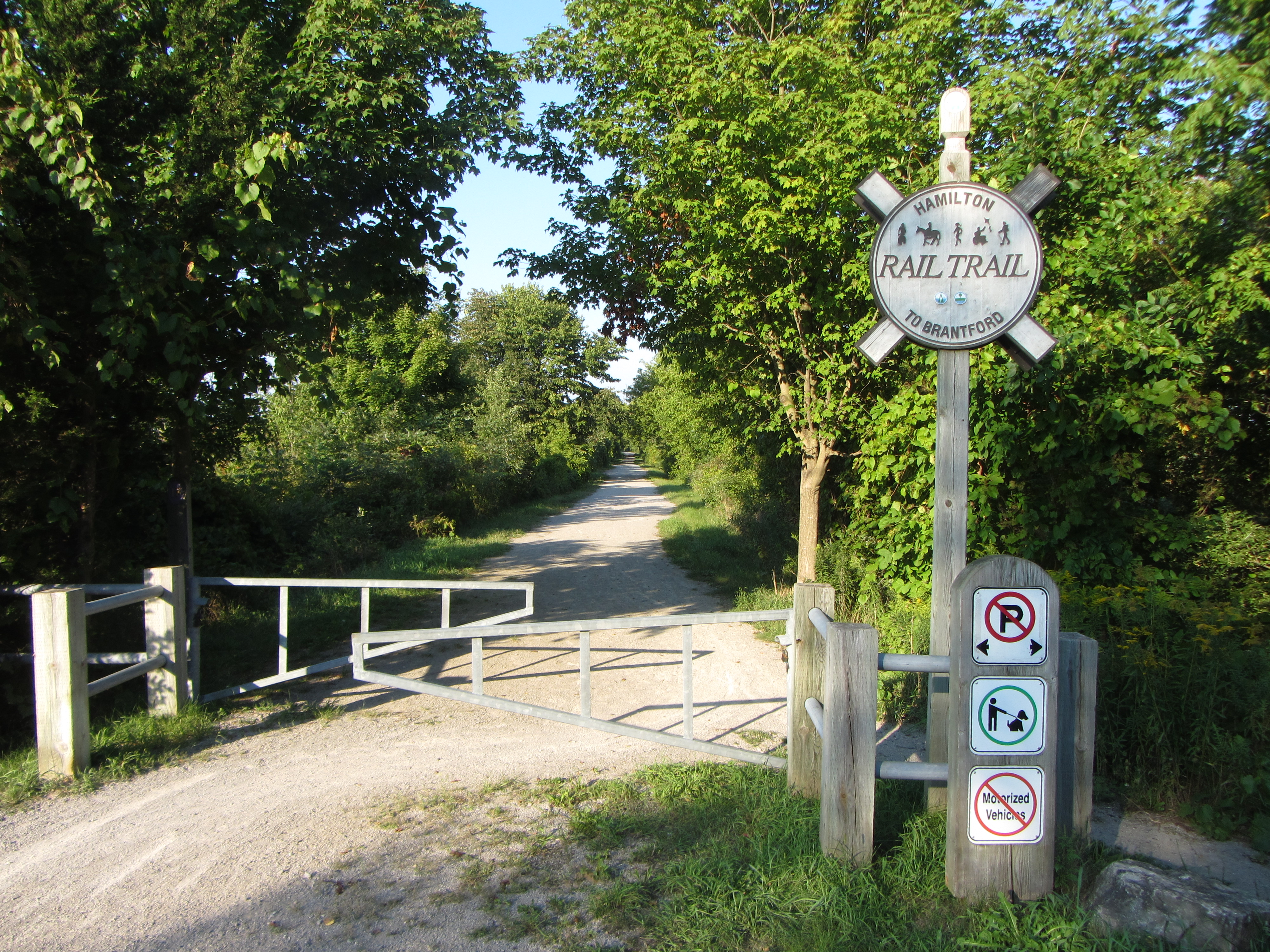
    As an aside, Brantford is an interesting town, and is well-positioned at the junction of three major cycling trails connecting it to Cambridge and Kitchener-Waterloo to the north, Simcoe and Port Dover to the south, and Hamilton to the east. The Hamilton-Brantford Rail Trail is one of Ontario’s best trails, in excellent condition, and a gentle grade climbing the Niagara Escarpment.
    IMG_4333
    Hamilton-Brantford Rail Trail

    Within Brantford itself, there are several interesting sights. The Bell Telephone building features a statue of Alexander Graham Bell, who resided just outside of town for a number of years. The world’s first long-distance telephone call was made between nearby Paris, Ontario and Brantford in 1876. The area surrounding Victoria Square north of Colborne Street and the mall is reminiscent of a New England town square.
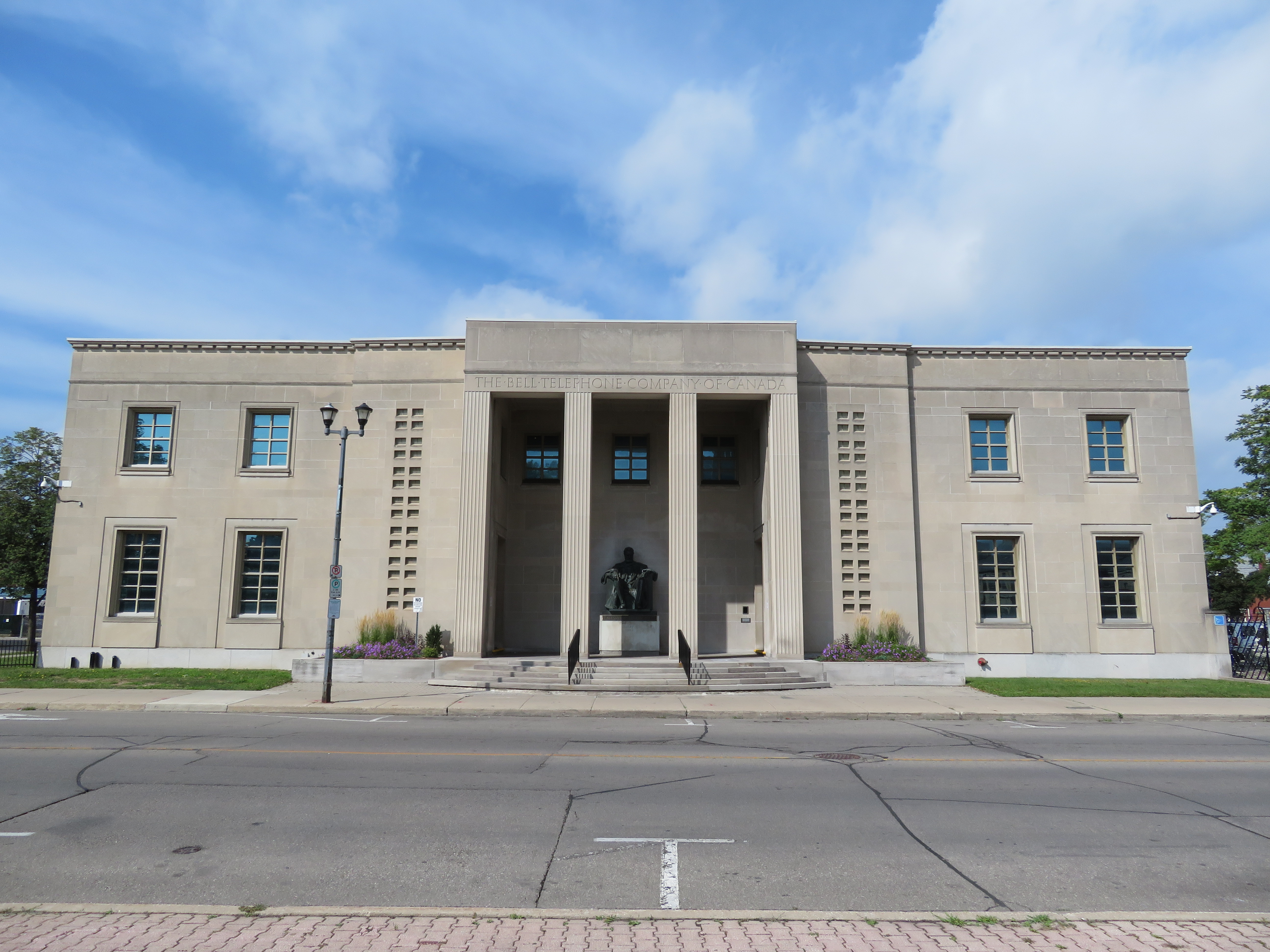
    IMG_7649.JPGBell Telephone Building

    Brantford was named for Joseph Brant, the anglicized name given to Thayendanegea, the Mohawk leader who allied with the British in the American War of Independence. His community, which previously resided in what is now Upstate New York, was given a large land grant on the Grand River. That land grant shrunk to what is now Six Nations. Her Majesty’s Royal Chapel of the Mohawks is one of the oldest buildings in Ontario, built in 1785. It is worth a visit. Nearby, the Woodland Cultural Centre is a museum and art gallery housed in a former residential school. The museum is dedicated to the history and future of the province’s First Nations.
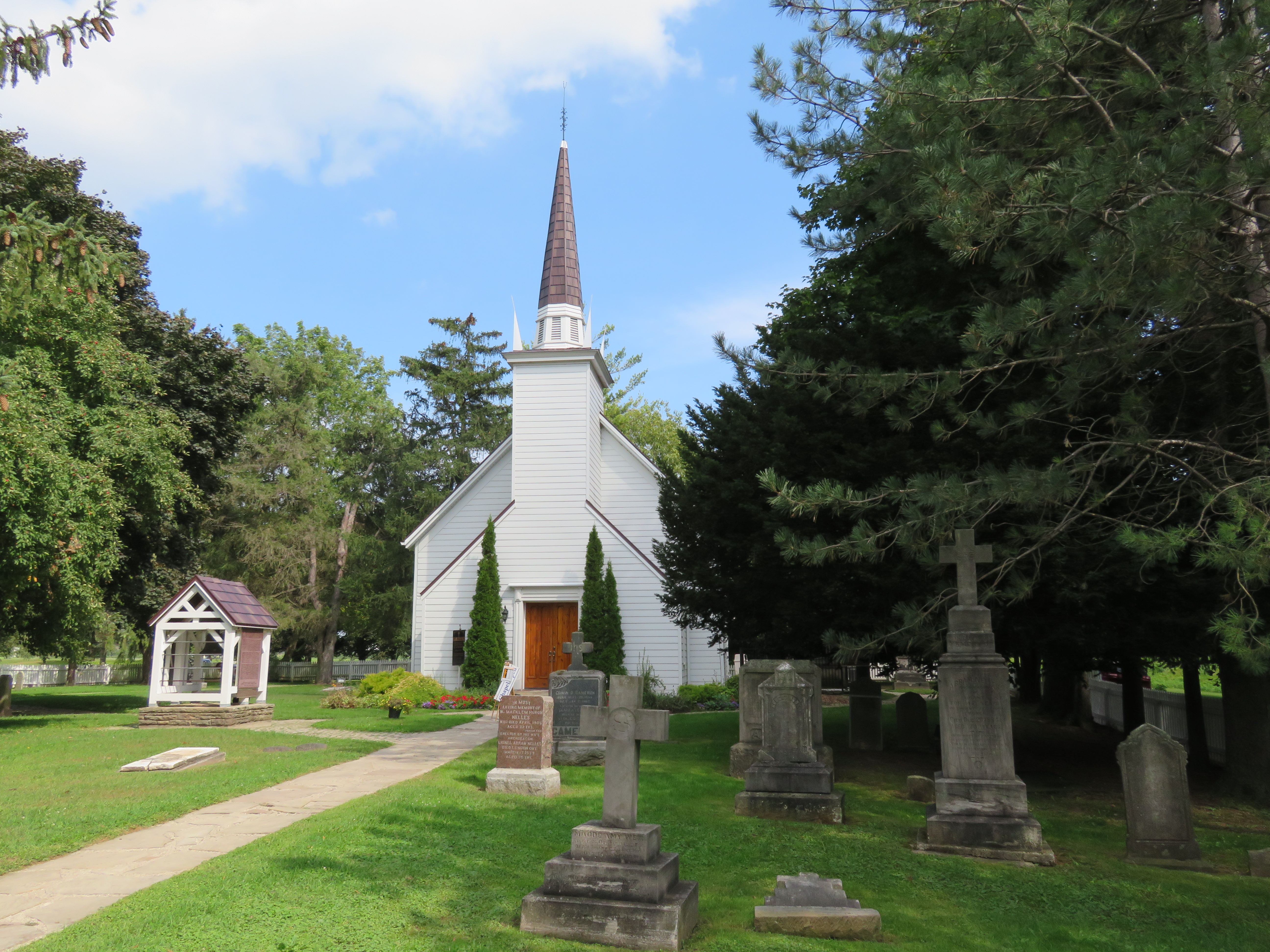
    IMG_7727.JPGHer Majesty’s Royal Chapel of the Mohawks
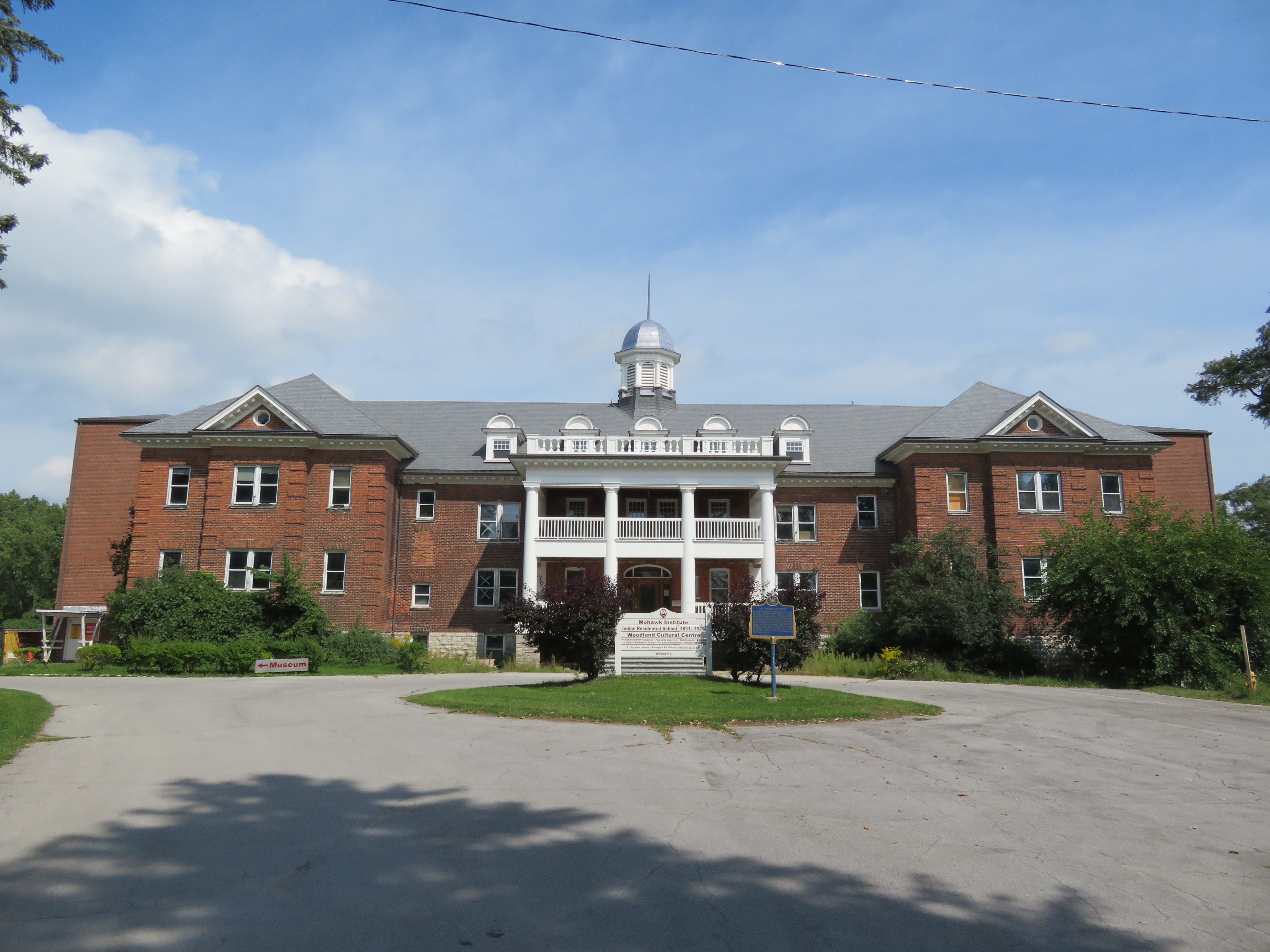
    IMG_7709-001.JPGWoodland Cultural Centre. This building formerly housed the Mohawk Institute, one of many residential schools built as part of Canada’s shameful attempts at eradicating Indigenous heritage. It is now a First Nations museum and art gallery. 
     

  • What’s going on in Downtown Brampton?

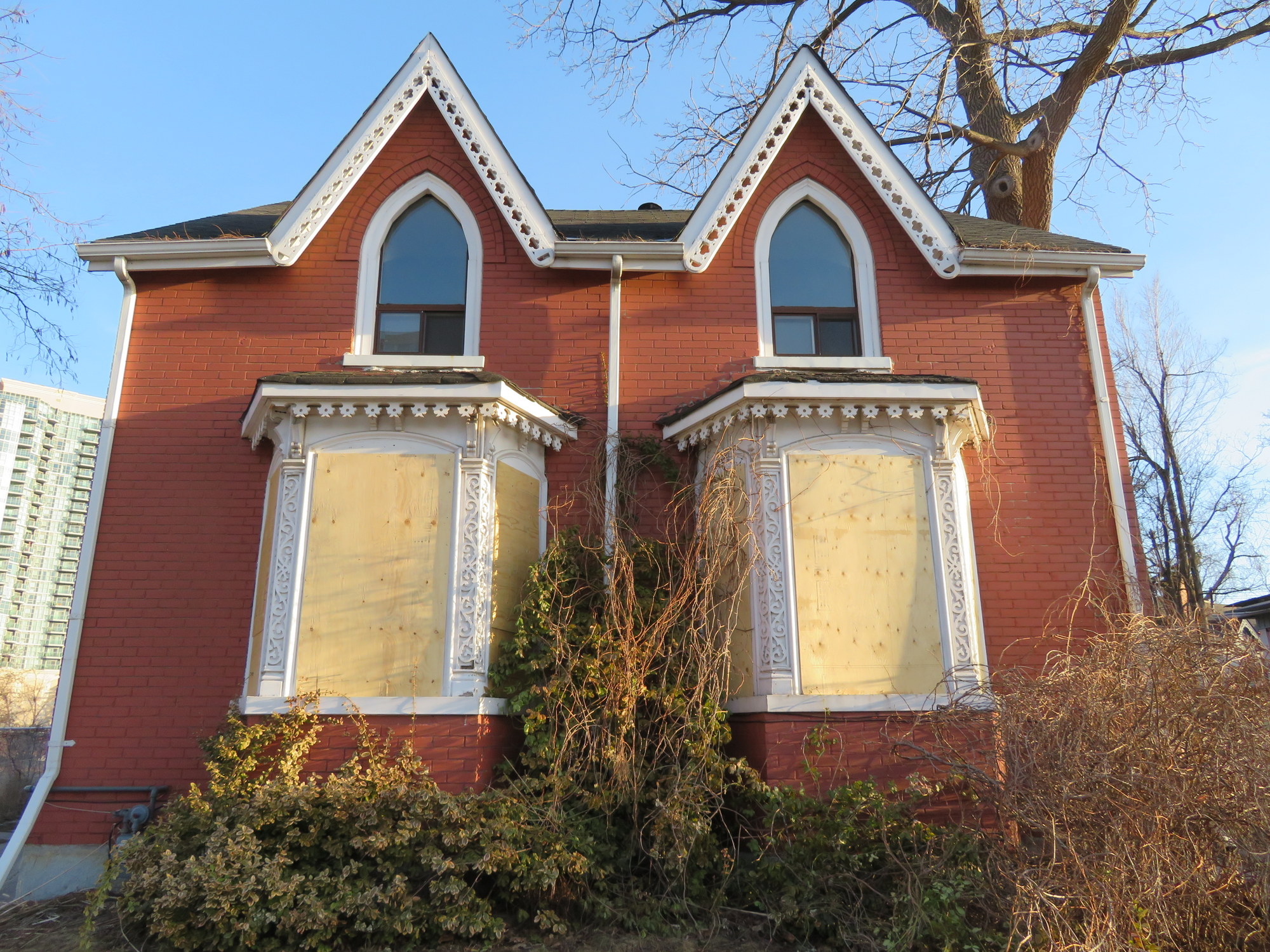
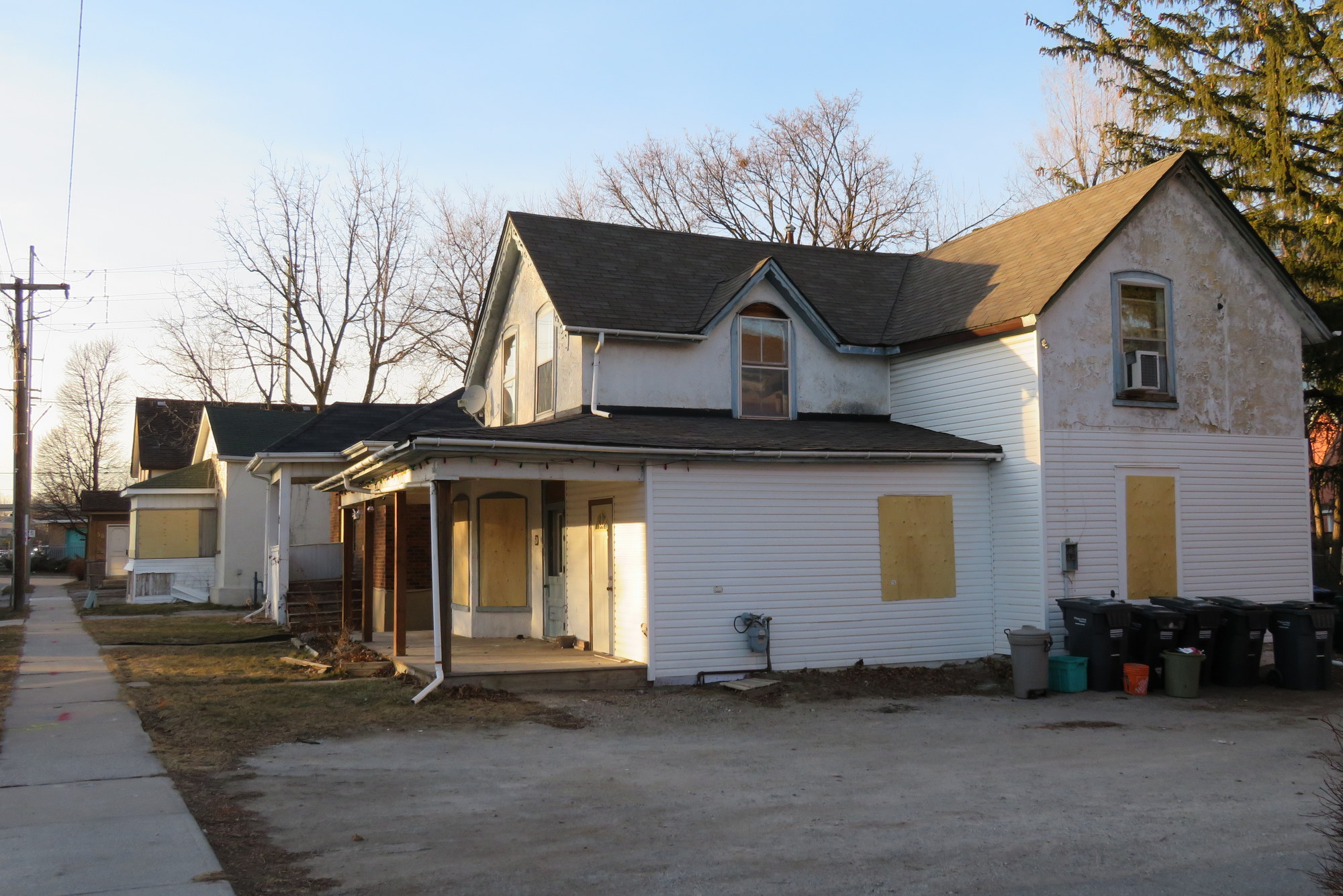
    IMG_6139-0015 Railroad Street, on the City of Brampton’s heritage registrar, is one of several houses recently boarded up in Downtown Brampton
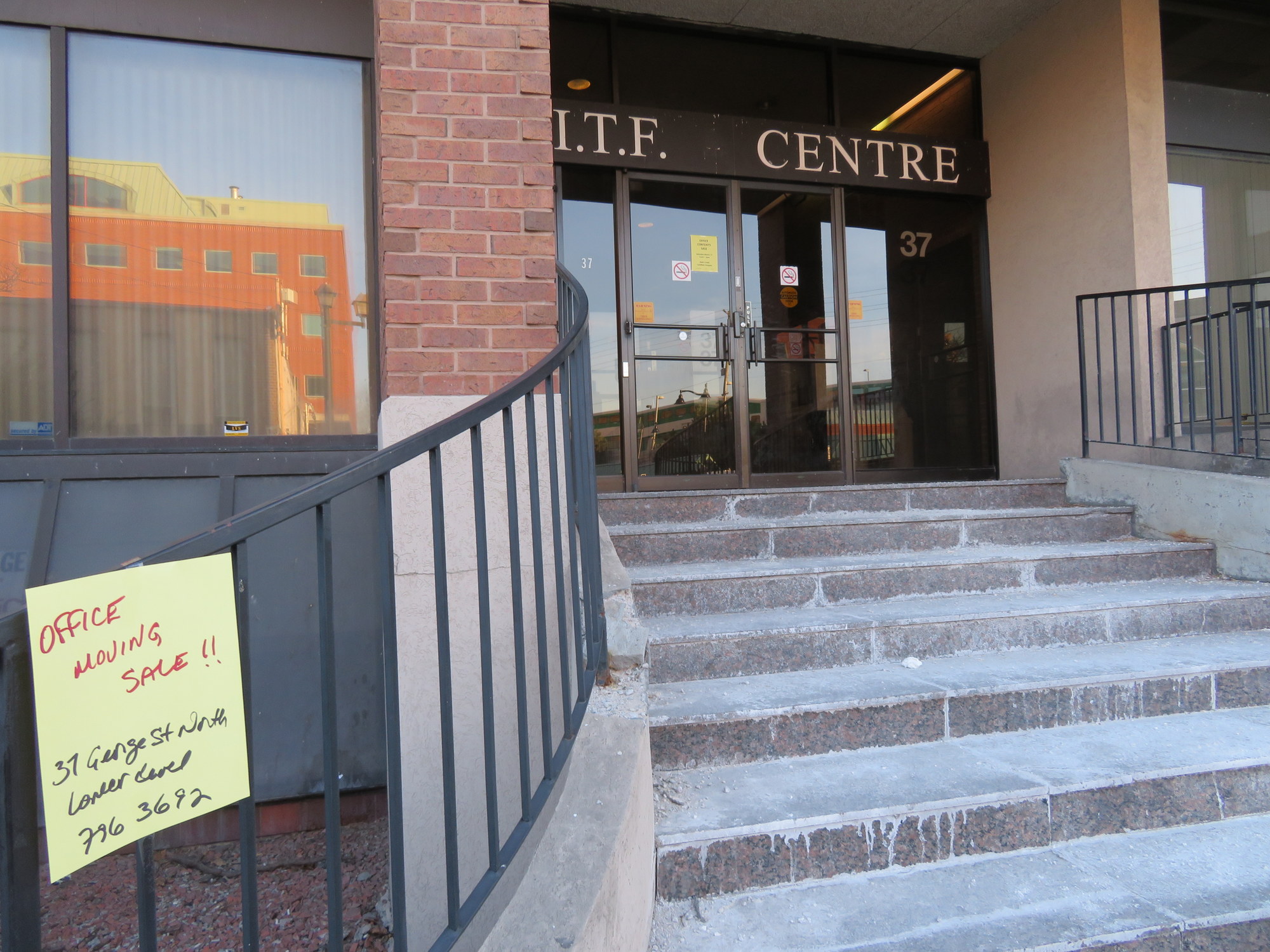
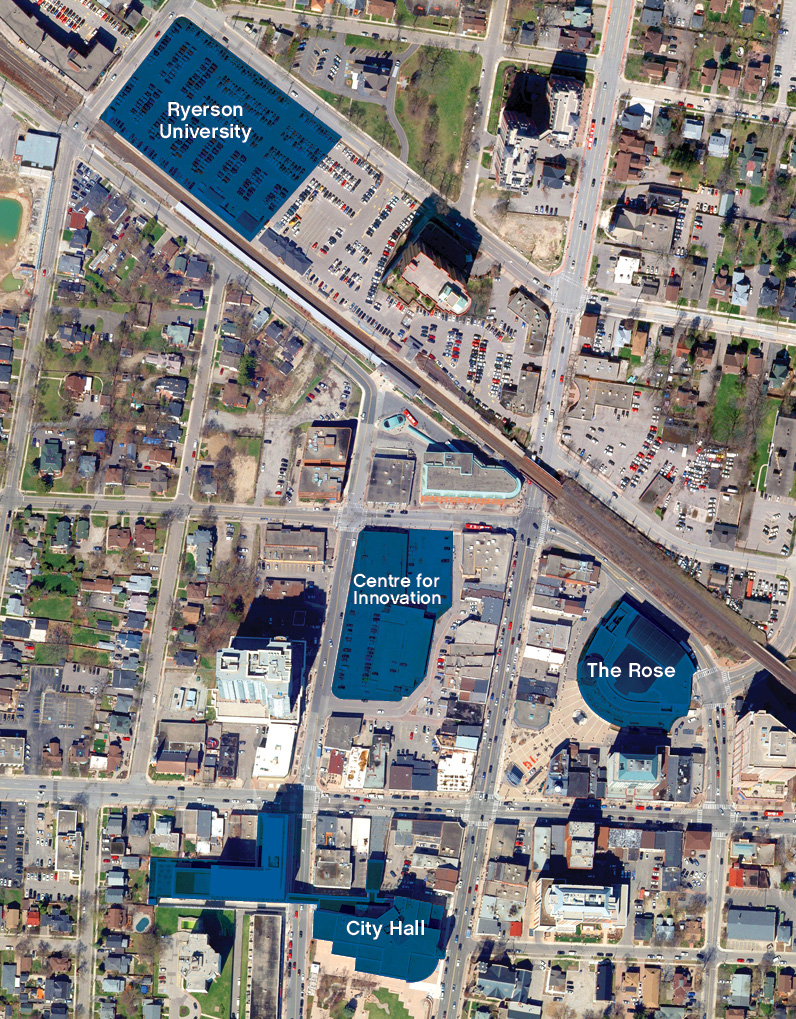
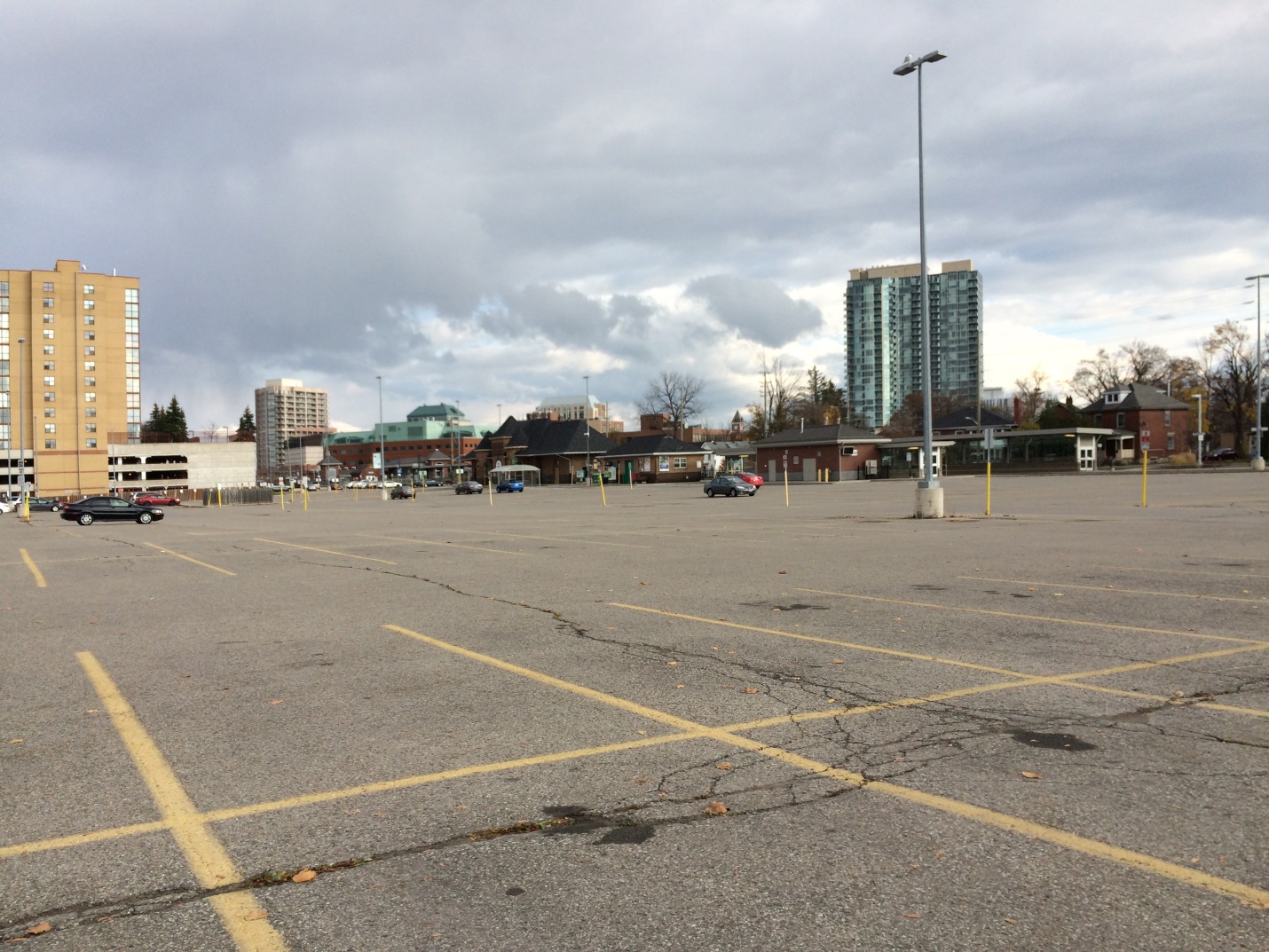
    Update April 19, 2018: the location for Ryerson’s new Brampton campus was announced this morning. The 2000-student campus, which will be a partnership between Ryerson University and Sheridan College, will be built at the corner of Mill and Church Streets, on the GO Transit parking lot. This explains Metrolinx’s (GO Transit’s parent agency) purchase and demolition of properties south of the rail corridor, on Nelson, George, Railroad, and Elizabeth Streets, which I wrote about below.

    While it remains unfortunate that surface parking will replace housing and offices, at least in the short-to-medium term, at least we now know what’s going on in Downtown Brampton. The downtown campus site, with excellent transit links, is the right location.


    Nearly two years ago, I wrote about how Metrolinx, the Province of Ontario’s regional transportation authority, had purchased several houses and two office buildings in Downtown Brampton. The intention at the time was to build a new surface lot to accommodate GO Transit commuters, a symptom of the commuter transit system’s dependence on providing parking.

    Metrolinx is responsible for GO Transit, the UP Express airport rail link, the Presto farecard, and planning and constructing transit infrastructure in the Greater Toronto and Hamilton Area.

    Since my 2016 blog post, three dwellings — 28A and 28B Nelson Street West, a semi-detached house, and 42 Elizabeth Street North — were demolished, but there was little other visible change until this month. Now eight more houses — on Elizabeth Street and Railroad Street have been boarded up and their electricity disconnected, including at least one rooming house that was occupied until very recently. The two office buildings — 29 and 37 George Street — are also emptying out.

    Four of these properties — 30 Nelson Street West, 46 and 50 Elizabeth Street North, and 5 Railroad Street — are listed by the City of Brampton as containing heritage resources.

    IMG_6153-001Offices at 37 George Street are moving out
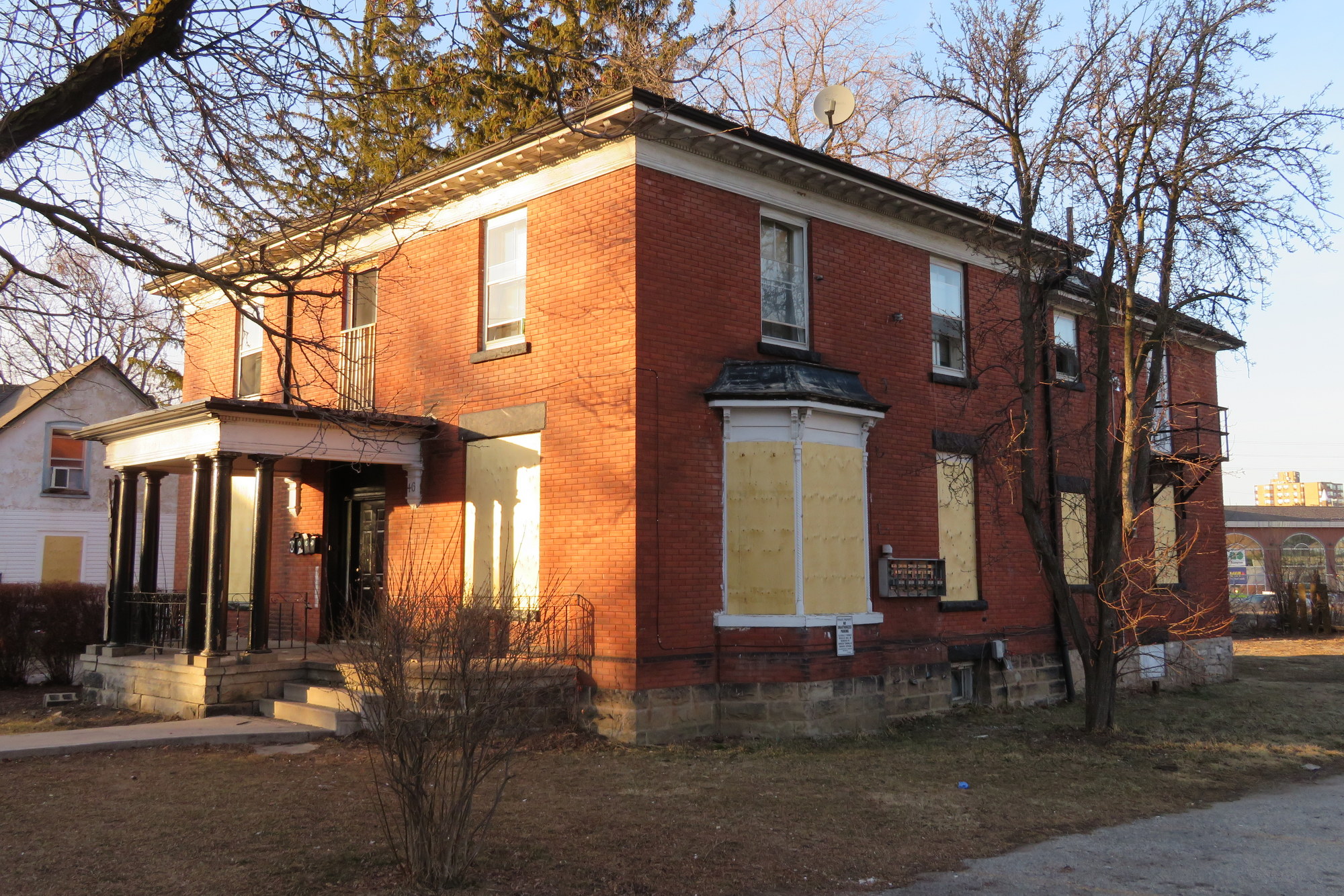
    So what exactly is going on? Why has Metrolinx purchased twelve homes and two offices in Downtown Brampton? Is it for a surface parking lot as previously reported in 2016? Or does this have to do with recent plans for a new Brampton campus of Ryerson University?

    The City of Brampton has been assembling land and buildings nearby, including 8 Nelson Street West, a six-storey office building above the downtown bus terminal. The city also owns the old Loblaws store on the southeast corner of George and Nelson Street. As Bramptonist‘s Divyesh Mistry found, Metrolinx noted “…continued collaboration between Metrolinx staff […] with the City of Brampton and Ryerson University on the Brampton Station redevelopment.”

    IMG_6148-001
    Houses on Elizabeth Street North recently vacated and boarded up. 

    If this land assembly is, in fact, to support a yet unannounced Ryerson University campus site on this block or on the existing Brampton GO Station parking lot, then this is on the whole very good news, though I remain concerned about the loss of downtown housing, particularly rooming houses and affordable apartments that some of older homes in the area have been divided into. A downtown campus with excellent transit links — GO Transit and several Brampton Transit bus routes — makes more sense than Milton’s plans for a greenfield campus for Wilfrid Laurier University distant from GO Transit’s bus and rail lines.

    IMG_6149-00146 Elizabeth Street North, a rooming house with heritage status, is now boarded up, with the electricity disconnected. 

    Unlike a competing university campus site near Etobicoke Creek backed by New Brampton (a politically influential group of local business and landowners who also opposed the Hurontario-Main LRT route), the GO Station and the Nelson/Railroad/Elizabeth Street buildings are outside the historical floodplain and can be built quicker.

    If the existing GO Transit parking lot were to be used for Ryerson’s Brampton campus, then an alternative parking site would be required — hence the recent purchase and the demolition of these homes and offices. The construction of a new surface lot in an designated “anchor hub” — where rapid transit lines meet and urban intensification is encouraged — would be most unfortunate, but I hope that it will not be a long-term solution. On the other hand, a new university campus is exactly the type of land use that should be located at an “anchor hub.”

    So far, local officials have kept very quiet about the land assembly on the block surrounded by George, Nelson, Elizabeth and Railroad Streets, perhaps waiting for approvals from the province and Ryerson University before making a public announcement. But with residents and office tenants displaced and houses boarded up suddenly, confirmation of these plans should come soon.

  • Ontario’s failed downtown malls

    IMG_0392.JPG
    Bayside Mall, formerly the Sarnia Eaton Centre, on a Saturday morning in 2013. Most stores are vacant or occupied by non-profits or independent businesses.

    The Toronto Eaton Centre, large, famous, and vital, is only one of many malls built in the downtown cores of Ontario cities between the 1960s and 1990s. From Thunder Bay to Cornwall, the construction of new enclosed shopping centres were seen as a necessary tool to keep the old city centres vibrant and relevant in the face of competition from new suburban malls. But only in the province’s two largest cities did the concept work. Elsewhere, these urban shopping complexes were left largely vacant within ten years of opening, when leases expired. When the Eaton’s department chain went bankrupt in 1997, huge voids were left behind that developers and municipalities struggled to fill.

    The Toronto Eaton Centre was opened in two phases between 1977 and 1979. It added hundreds of shops and new office space to Downtown Toronto, anchored by a new Eaton’s flagship and was connected to the Simpson’s store across Queen Street. Today, the Eaton Centre is Canada’s second largest mall (including the Hudson’s Bay/Saks Fifth Avenue building) and the Toronto region’s second most productive shopping centre in terms of sales per square metre. In Ottawa, the downtown Rideau Centre, opened in 1983, is the busiest and most productive mall in that region (Retail Council of Canada, 2016).

    But elsewhere in Ontario, downtown malls — mostly built with municipal and/or provincial government support — have been, without exception, commercial and urban development failures. Not only did they suffer from high vacancy rates, they helped to wreck the downtown cores they are located in rather than foster the economic revitalization they once promised.

    (more…)
  • A check-up on Downtown Barrie

    IMG_8357-001
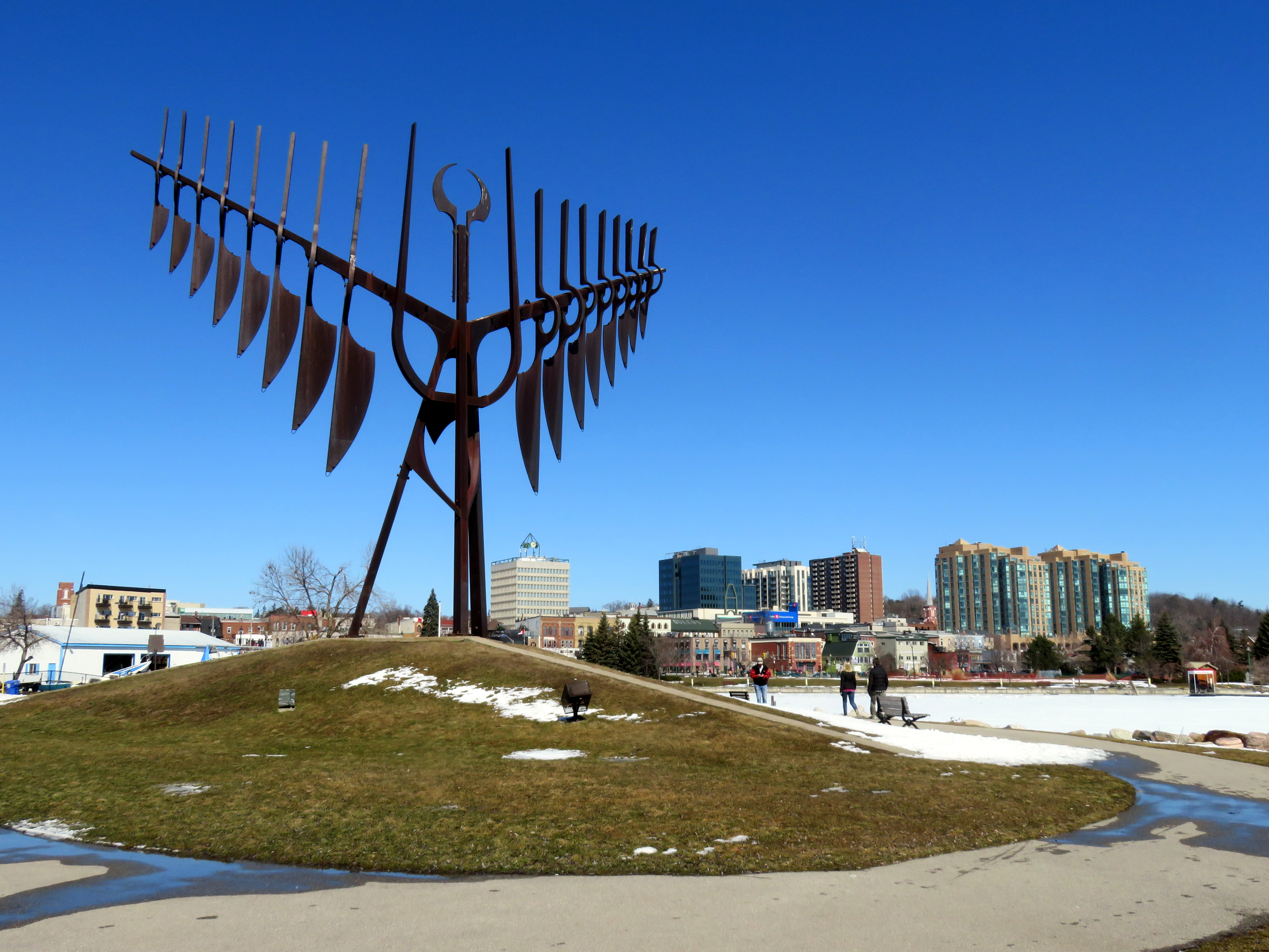
    “Spirit Catcher” by Ron Baird on Downtown Barrie’s Waterfront

    Last weekend, I made a trip up to Barrie on GO Transit. Most people in the Greater Toronto Area know of Barrie as a place you pass on Highway 400 on the way north to Collingwood, Wasaga Beach, or Muskoka, but it has a population of 140,000 people, many of them commuters to the Greater Toronto Area.

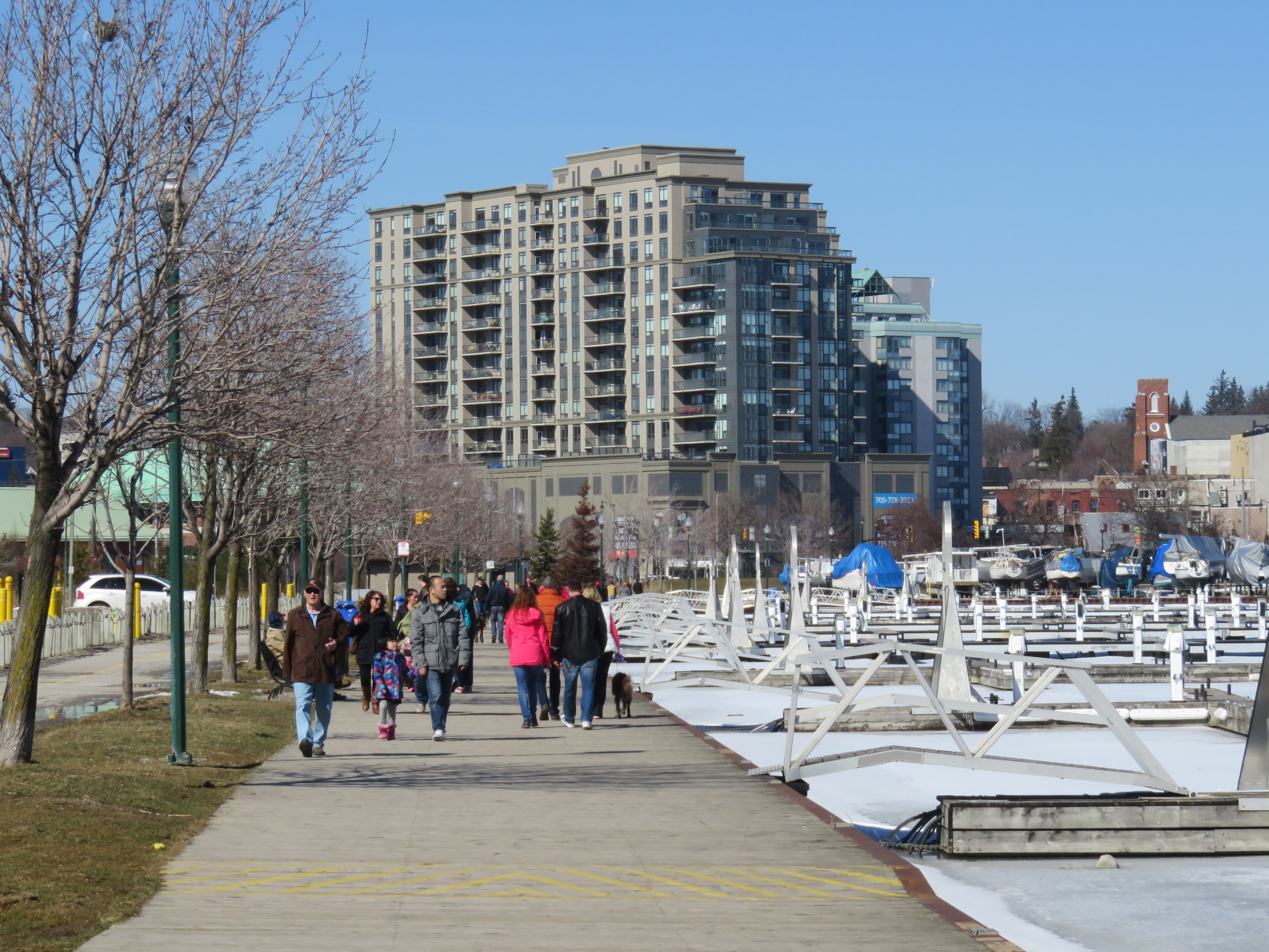
    Barrie features a lovely waterfront, situated at the end of Lake Simcoe’s Kempenfelt Bay. After the abandonment of the Canadian National Railway tracks north of Allandale Station in 1997, a new waterfront trail was created and Lakeshore Drive moved inland to provide more park space. The waterfront trail connects on the north with a rail trail that extends to Orillia. The waterfront has three swimming areas, a marine, food concessions, playgrounds, and gardens. On a warm Sunday in March, the boardwalk and waterfront paths were very well used. Work is being completed on further enhancements to the public realm.

    IMG_8386-001A busy March Sunday on Barrie’s waterfront
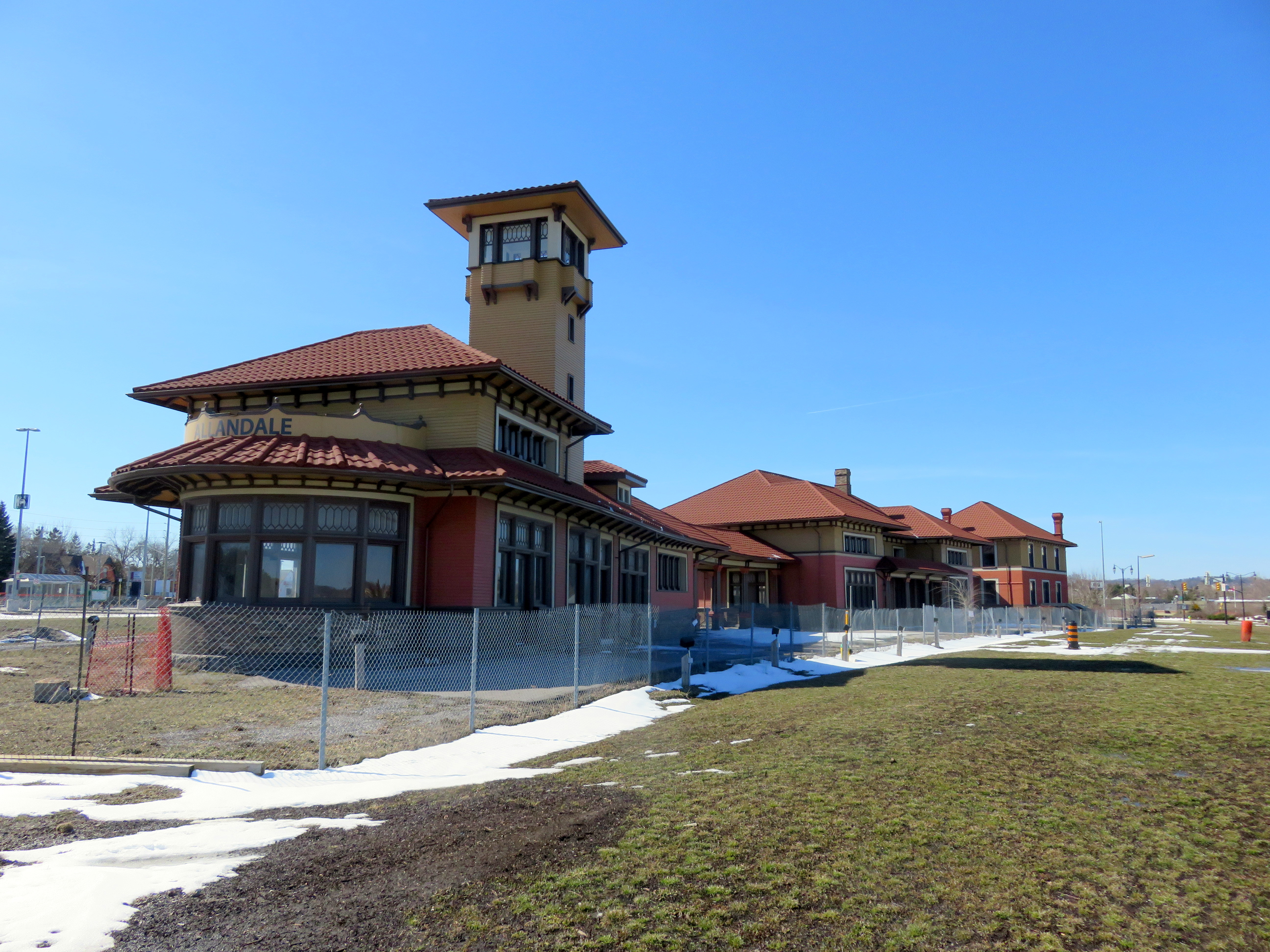
    In 2012, GO Transit extended the Barrie line to Allandale Waterfront Station, at the closest point possible to Downtown Barrie where tracks remained. The old Allandale Station, built by the Grand Trunk Railway in 1905 and abandoned by CN in the 1980s, still stands just north of the GO station, newly restored. Yet the station is fenced off and is awaiting re-use.

    IMG_8372-001.JPGAllandale Station is fully restored on the outside, but remains fenced off. The GO Station is to the far left.
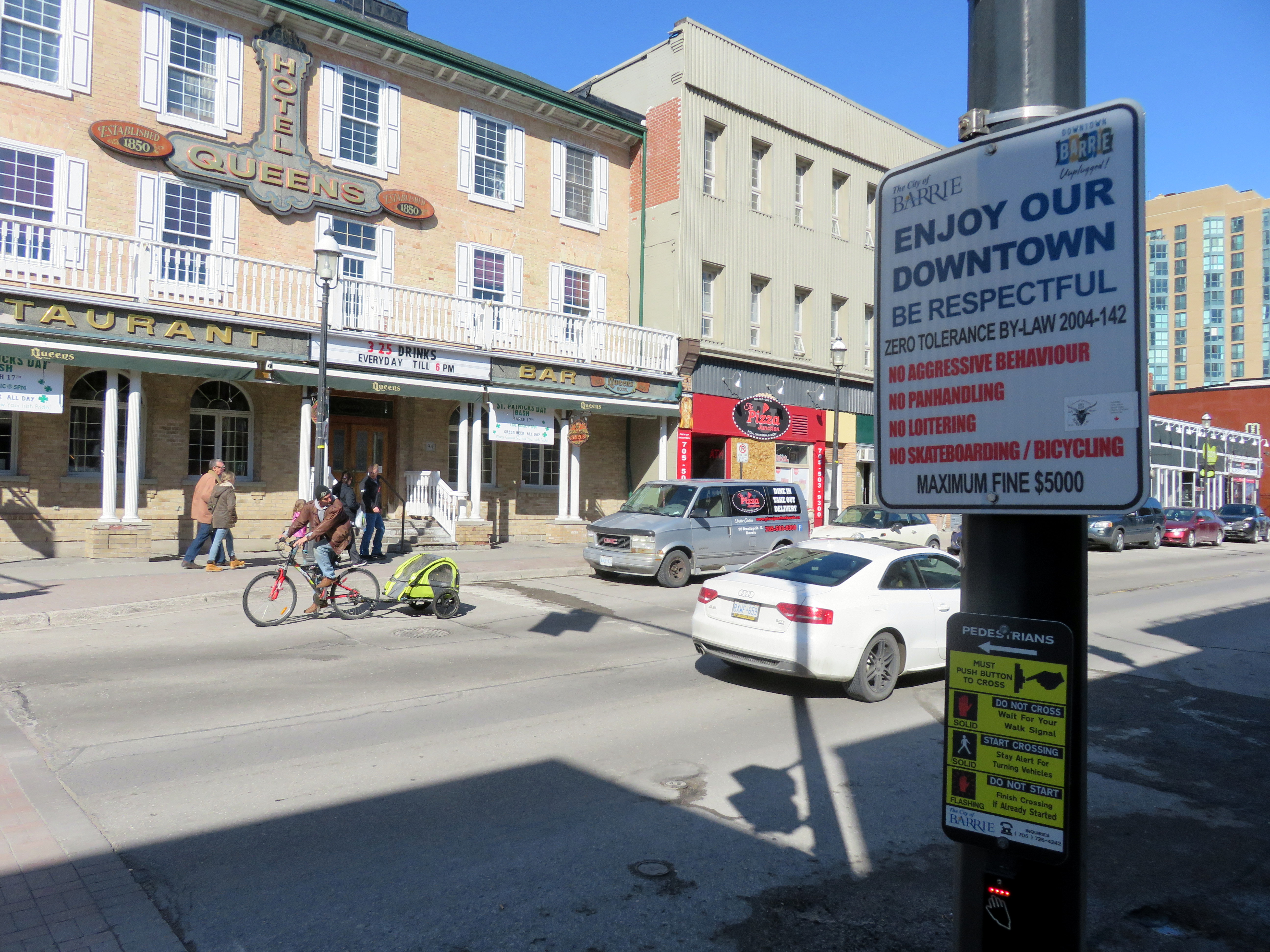
    Downtown Barrie hosts many heritage buildings. Despite a catastrophic fire in 2007, the downtown core boasts a mostly-intact inventory of heritage commercial and institutional buildings. The old Carnegie Library was incorporated into the MacLaren Art Centre (a new central library was built in the 1980s). The Queen’s Hotel on Dunlop Street, established in the 1850s, retains its historical veranda. Brampton and other county towns had similar hotels, but many were lost to fire or development.

    The downtown business improvement area has been active as well. During the summer months, patios are brought out into the streets, and festivals are put on year-round. New condominium towers built along the waterfront and downtown bring new residents that can support the historic city centre.

    Despite my positive impressions, one thing really bothered me: Downtown has many signs posted reminding people of a 2004 by-law prohibiting “aggressive behaviour, panhandling, loitering, and skateboarding/bicycling” with a maximum fine of $5000. Surveillance cameras are positioned at several downtown corners.

    IMG_8396-002Sign reminding of Downtown Barrie’s Zero Tolerance Bylaw. The historic Queen’s Hotel is in the background.
    The intent of the rule against cycling probably refers to bicycles ridden on sidewalks, rather than on roadways (there are some bicycle lock-up locations downtown and along the waterfront). That said, the signage and the by-law have the effect of telling young people and low-income residents that they are not welcome.

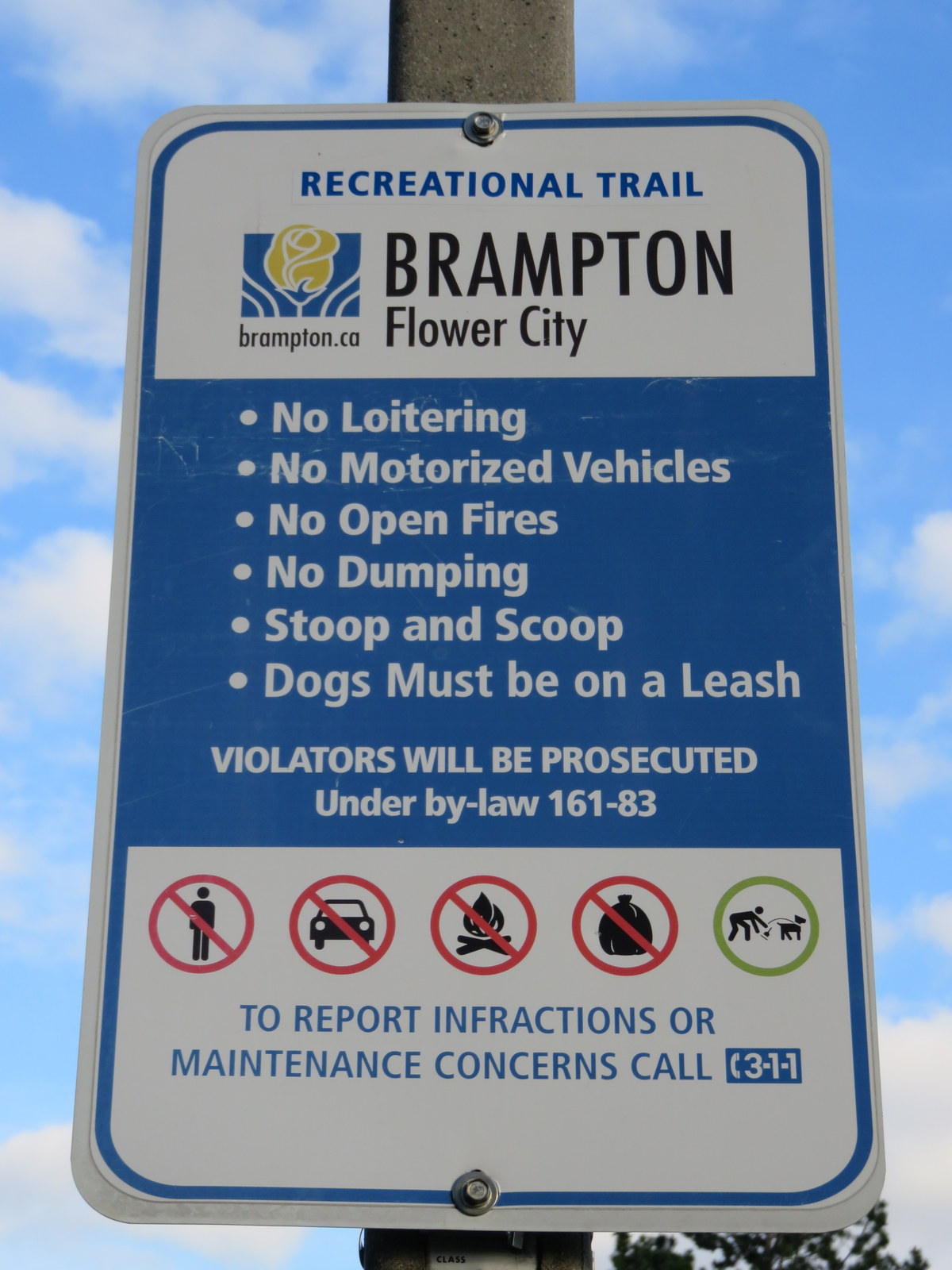
    Signs and specific bylaws such as this are not uncommon in Ontario. In Brampton, signs in public parks and along its pathways prohibit loitering as well. Yet sidewalks and parks are public spaces; parks in particular are places where one might wish to relax, have a picnic, or just sit and enjoy nature or to people-watch.

    IMG_2362-001.JPG“No loitering” in Brampton’s parks

    Downtown Barrie has struggled with poverty, vacant lots, derelict properties on the periphery, as well as crime, such as assaults, and drug trafficking. Downtown Barrie has many of the support services for economically and socially marginalized people; there are affordable rental apartments and rooming houses in the core as well. Downtown has several cafes and restaurants, a few clothing and furniture stores, as well as a craft brewery, but many of the businesses along the main streets are convenience stores, hair salons, vape shops, tattoo parlours, bars, and nightclubs. Especially missing are businesses such as a drug store, and a supermarket.

    To discourage loitering, benches were removed from Dunlop Street, Barrie’s main street. However, seniors in particular benefit from places to sit and rest while going on walks or doing shopping. Payphones downtown were also removed in 2013; the local councillor said that they were “degrading the quality of the neighbourhood.”

    In 2014, the City of Hamilton was looking at adopting a similar by-law to discourage low-income and homeless people congregating and creating a nusiance in Downtown Hamilton. Councillor Jason Farr pointed to Downtown Barrie’s success, but noted the importance of consulting with poverty advocates to “include that social side of the argument.”

    Instead of merely implementing aggressive regulations and ticketing, there’s a need for inclusive urbanism. Are there adequate recreational and social activities for youth and marginalized populations? Barrie has a skateboard/BMX park nearby, at Queen’s Park, but that might not be enough to satisfy local youth. What urban interventions would Barrie’s low income populations like to see? Sadly, I doubt they were consulted.

    Barrie’s waterfront is one of Ontario’s best: accessible by transit, connected to its downtown, hosting many activities and events. As construction concludes, it should help revitalize the neighbourhoods around it. Barrie should not further push away its already marginalized populations; it should find a way to be welcoming to all.

  • Rethinking Downtown Brampton’s streetscape

    IMG_8755-001Main Street looking north at Queen Street, Downtown Brampton
    On Thursday, February 23, I went back to my hometown to check out plans for re-configuring Main and Queen Streets in Downtown Brampton. As the Region of Peel needs to replace water and wastewater infrastructure in the area, the timing is right for re-imagining what the streetscape should look like.

    The same conversations are taking place in Downtown Toronto. There there are proposals for transforming King Street to prioritize transit and pedestrians; on Yonge Street, city planners, Ryerson University, and local businesses are looking to provide more space for pedestrians and cyclists, as well as street furniture (such as benches and trees), patios, and special events. Of course, re-imagining downtown streets where cars are given priority will generate opposition, but it’s necessary in dense, urban cities were people, and not necessarily their cars, are given priority.

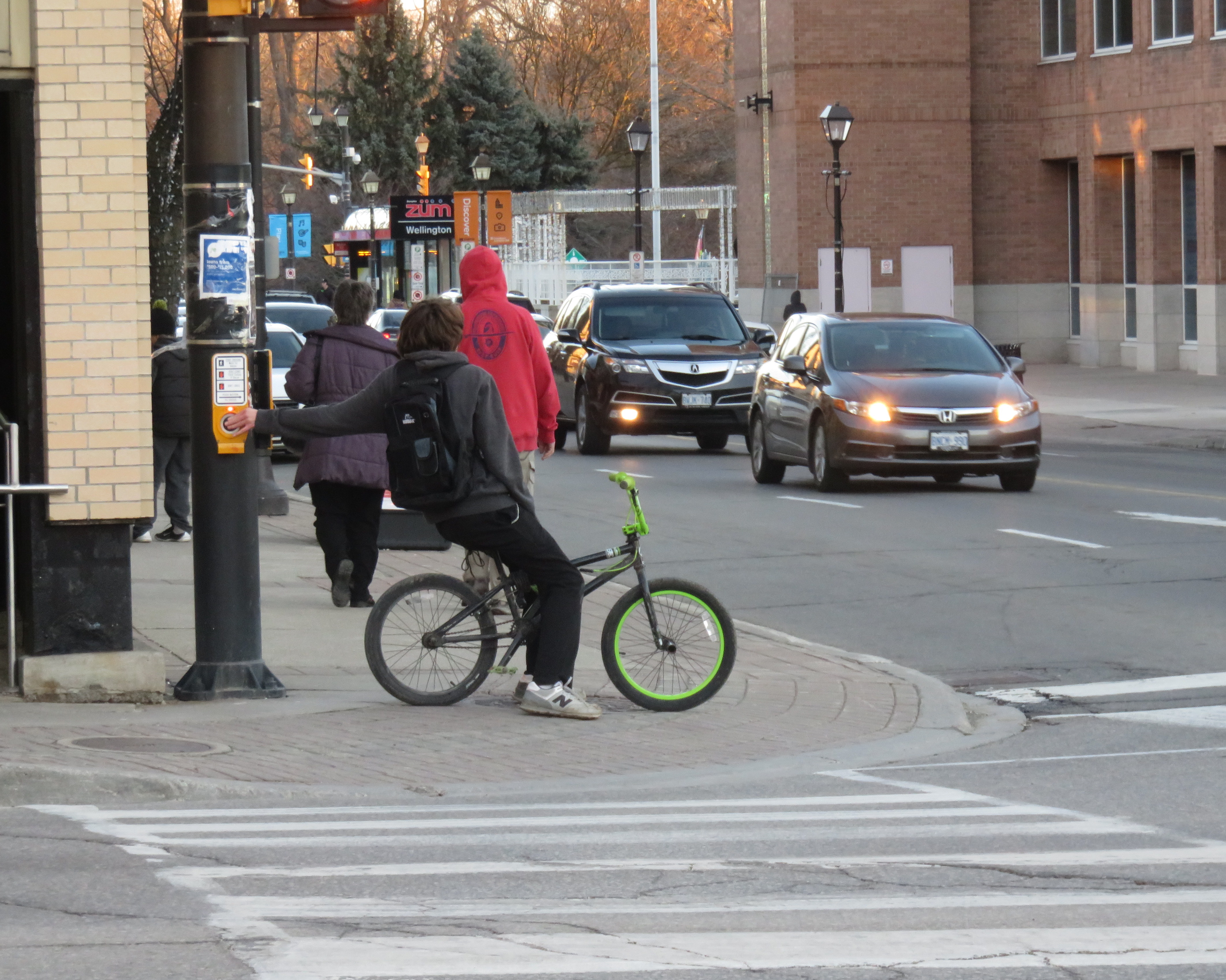
    Downtown Brampton has great bones; it has numerous heritage buildings, several great public spaces, and GO Transit and VIA Rail trains stop right here. The Saturday Farmers’ Market is popular, as is ice skating at Gage Park. But despite some interesting new restaurants and bars, most retail has struggled here, and even new residential development in the area is sluggish. Improving the public realm, especially wider sidewalks and more attractive streetscaping, would be a relatively inexpensive, yet symbolically important, step to making downtown a more desirable place to be.

    img_8159-001Sidewalks are narrow, and cyclists often take the sidewalks in Downtown Brampton. 
    (more…)

  • GO Transit and the high cost of “free” parking, Part II: Brampton Boogaloo

    IMG_0610-001

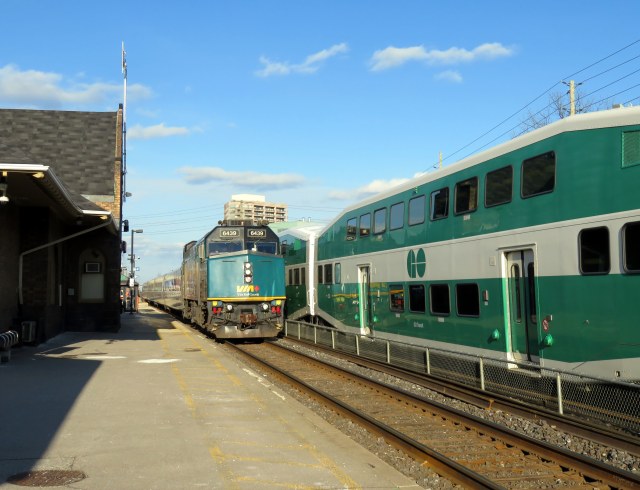
    GO and VIA Trains meet at Brampton Station

    September 20, 2016 update: Metrolinx has begun the process of demolishing its newly-acquired Downtown Brampton properties. It has applied for a demolition permit for 28A and 28B Nelson Street West, two semi-detached dwellings that were built in 2001. In the  City of Brampton, demolition permits for residential properties must be approved by the Planning & Infrastructure Services Committee. The permit will likely be approved at the September 26, 2016 meeting of that committee.


    On April 5, 2016, Peter Criscione at the Brampton Guardian reported on a matter that arose during the regular meeting of the City of Brampton Planning & Infrastructure Services Committee on April 4. Metrolinx, the regional transit authority that operates GO Transit and UP Express, confirmed the purchase of 1.78 acres in Downtown Brampton, land that will be used for surface parking.

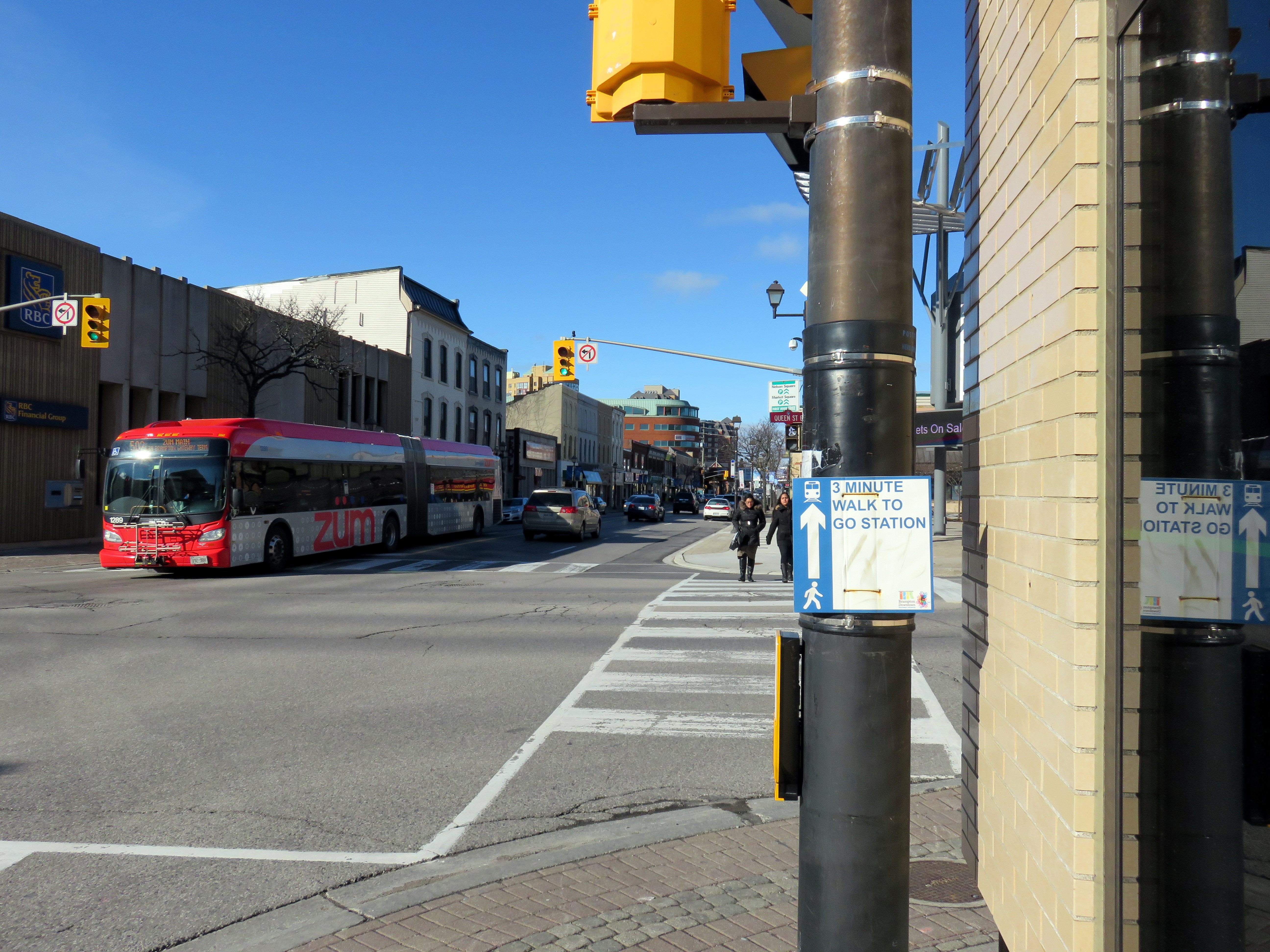
    Brampton Station, served by GO Transit and VIA trains, is located in Downtown Brampton, and is adjacent to Brampton Transit’s downtown transit terminal. With local shopping, restaurants, residential areas and employment, it is one of the most walkable stations in GO Transit’s system; it has a Walk Score of 90. (Bramalea GO Station, in comparison, has a Walk Score of 22.) The options of getting to Brampton Station without a car are quite good, at least as far as most GO stations go.

    But Brampton Station’s two lots are full, and there are planned service improvements to Brampton, including eventual hourly evening and weekend rail service. Not everyone can be expected to take transit, walk, or get a ride to the station. But I find this land assembly troubling.

    According to Criscione, and noted in the minutes of the April 4 meeting [page 25-26], the properties purchased by Metrolinx include:

    • 20 Nelson Street West
    • 37 George Street North
    • 41 George Street North
    • 26 Nelson Street West
    • 3 Railroad Street (includes 3 separate parcels)
    • 28A Nelson Street West
    • 28B Nelson Street West
    • 30 Nelson Street West
    • 42 Elizabeth Street North

    The planning committee asked staff to contact Metrolinx and report on the status of its recent and pending purchases of downtown lands. It also invited Metrolinx to work with city staff and officials, as well as present their plans at a future meeting.

    The purchase of downtown lands for a parking lot is troubling, in my opinion. Downtown Brampton is a designated “anchor hub” — a major mobility hub where two or more rapid transit lines meet where transit-oriented development and intensification is encouraged. At no point do I see new surface parking lots are part of this vision, especially if buildings must be vacated and demolished to do so. And Downtown Brampton, not yet experiencing a building boom, has plenty of parking lots and garages that could be employed instead.

    The embedded Google Map below shows where these properties are located, immediately south of Brampton Station, and west of the Brampton Transit downtown terminal.


    On Friday, April 8, I visited Downtown Brampton to have a look at the properties in question.

    (more…)

  • Armed with facts, the Toronto Relief Line Alliance is launched

    TRLA-Map-01-1

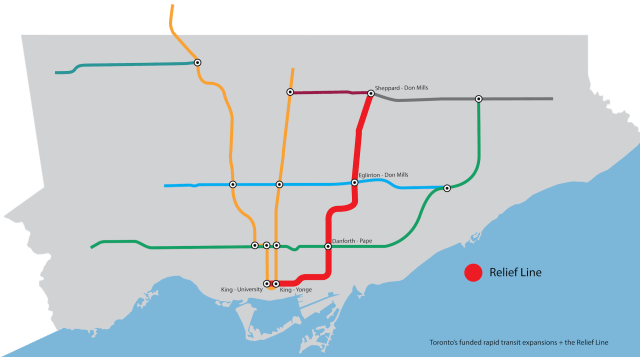
    The Relief Line is a subway route intended to reduce crowding and congestion in Toronto’s existing subway system. Planned for over a century, we may finally see work started in a few years. If Toronto finally puts shovels in the ground on this vital transit project, we will have a new grassroots advocacy group, armed with facts, to thank for that.

    Even though a relief subway line is very old idea, one that goes back over 100 years, the only construction ever done were roughed-in streetcar subway platforms at Queen Station built in the 1950s. A Queen Street subway remained on the TTC’s books until approximately 1980, when attention was focused on building subways in Toronto’s growing suburbs. But a Downtown Relief Line (DRL) was included as part of Network 2011, a plan drafted in 1985. If implemented, Toronto would have also seen new subways below Eglinton and Sheppard Avenues. Changes in the provincial government, opposition from downtown and suburban councillors and declining TTC ridership saw only two sections of subway opened: Downsview Station in 1996, as well as a shortened Sheppard subway, completed in 2002.

    With increasing TTC ridership, the continued employment growth in Downtown Toronto, and no new road capacity, we are again faced with the need for downtown transit relief. During rush hour, commuters often have to wait for two or three trains to pass before boarding. Bloor-Yonge Station is operating beyond its design capacity. While there may be some short-to-medium term opportunities for transit relief with the revised plans for SmartTrack, GO RER, and other capacity improvements, such as Automatic Train Control on Line 1, the Relief Line will need to be built soon.

    Planners and advocates of the DRL have wisely dropped “Downtown” from the name of the proposed subway. Thanks to populists like the Fords, and opinions such as University of Toronto Professor Margaret Kohn’s, “Downtown” has become a dirty word. There’s a false, and frankly dangerous, opinion that wealthy downtown residents benefit from subway projects, while the needs of suburban residents are brushed aside by an “openly contemptuous” “downtown cognoscenti.” In reality, the Relief Line will benefit suburban commuters the most, especially if it continues north of Danforth Avenue along the Don Mills Corridor, serving low-income, high-density neighourhoods such as Thorncliffe Park and Flemingdon Park.

    As Metrolinx and City Planning redraw plans for SmartTrack, the Scarborough Subway, and suburban light rail projects, planning work continues for the Relief Line. But the initial plans are for a short section between the Financial District and Danforth Avenue, to be really effective, the line should continue north.

    Happily, there’s a new advocacy group that just launched, the Toronto Relief Line Alliance. This new group will advocate for the subway, explaining its benefits and countering the myths about the project. Without the business connections or budget of of Friends and Allies of SmartTrack (FAST), a Bay Street group formed to advocate John Tory’s SmartTrack plan, the founders have developed a slick website and started a social media blitz. (Within days of launching, TRLA has more than twice the followers on Twitter as FAST.) All the data that the TRLA presents is sourced from Metrolinx and the City of Toronto. A map, embedded below, shows the estimated travel time reductions made possible by the new subway.


    Map from TRLA’s website showing the travel time savings possible for various trips to downtown via the Relief Line.

    As a long-time proponent of the subway line, I’m excited by TRLA’s launch. The Toronto Relief Line Alliance, made up of independent citizens, including business professionals and aspiring planners, is a genuine grassroots advocacy group. FAST, on the other hand, is a textbook example of an Astroturf organisation.

    (Full disclosure: I know many of TRLA’s founders, and I was involved in some of the pre-launch discussions. But finding myself stretched too thin, I haven’t been active in TRLA.)

  • The Downtown Divide: Wards 19, 20, 27, and 28

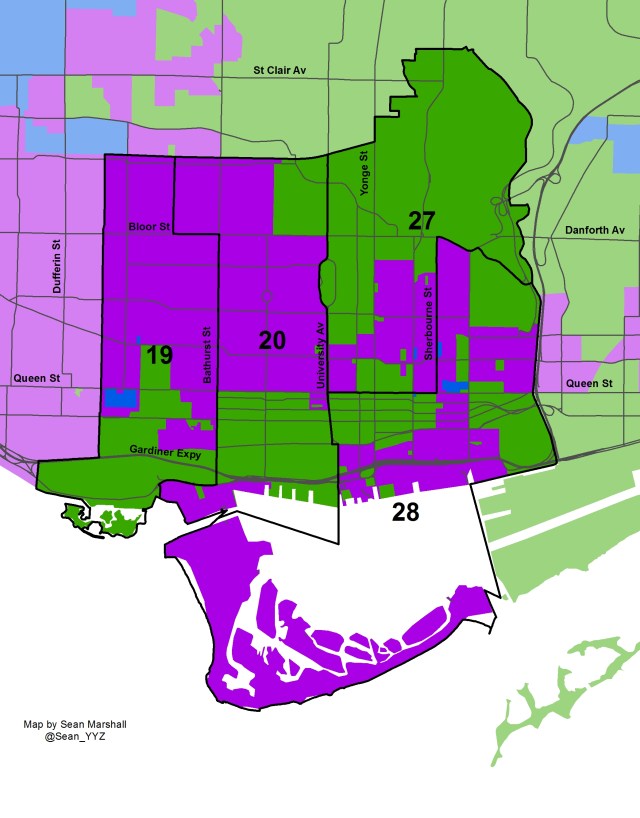
    2014 Election - Downtown Wards Mayor Solid A map of each poll’s first choice for mayor in Wards 19, 20, 27, and 28
    In this post, I examine the results in four downtown wards – Wards 19 and 20, Trinity-Spadina, and Wards 27 and 28, Toronto Centre-Rosedale.

    Olivia Chow, the early favourite to defeat Rob Ford, was a long-time city councillor. Chow represented Ward 20 before she ran and won in Trinity-Spadina for the New Democratic Party in the 2006 federal election. In order to run for mayor, Chow resigned as an MP early in 2014. A by-election was called for June 30. Joe Cressy hoped to keep the seat for the NDP, but Adam Vaughan, Chow’s successor as Ward 20 councillor, won the by-election for the Liberals by a wide margin. In the provincial election held earlier that month, Rosario Marchese, one of a very few NDP MPPs left from the Bob Rae era, lost to Liberal candidate Han Dong. Trinity-Spadina’s demographics were changing, especially with new condominium towers going up in new neighbourhoods like City Place and Liberty Village. And this mattered in the 2014 municipal election.

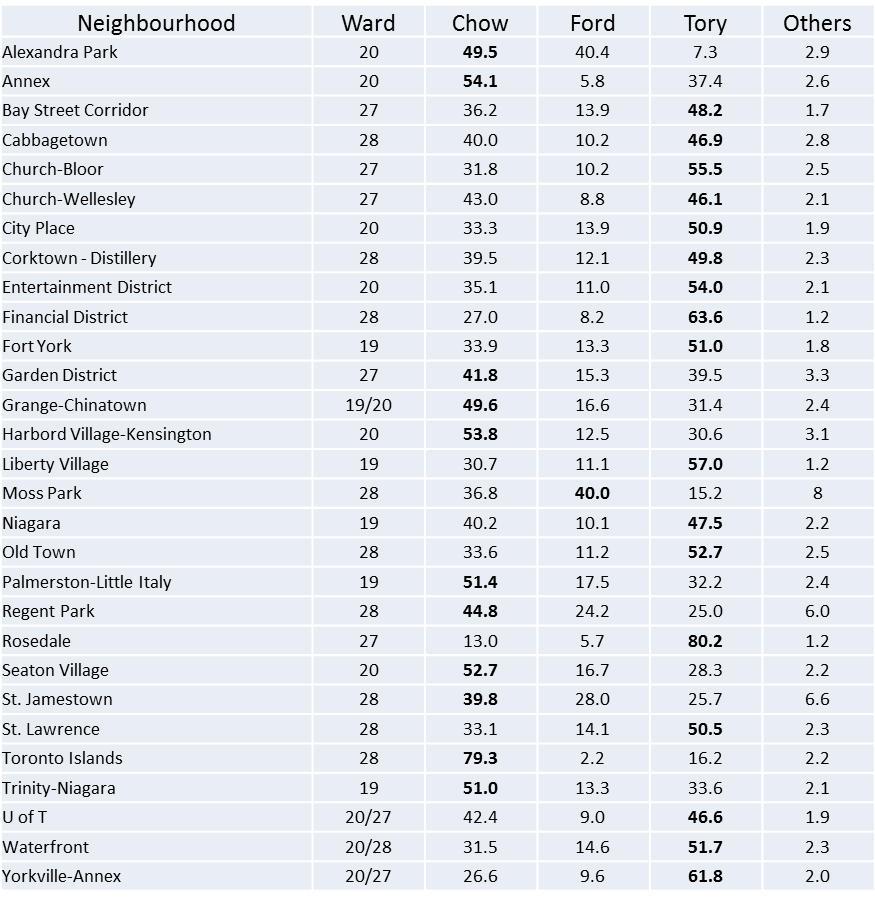
    Of the four downtown wards, John Tory came in first place in three: Wards 20, 27, and 28. Olivia Chow did not win her own ward, even though she represented it in municipal and federal politics for decades. Interestingly, John Tory is also a Ward 20 resident, so he, like Doug Ford, won his own ward. Tory makes his home in a large condominium apartment in Poll 013, Chow lives in a house in Poll 024. At least Chow won her poll.

    The map at the top of this article illustrates each poll’s first choice for mayor, without gradients based on the margin of the win. What can clearly be seen is that the older, more established neighbourhoods (with the exception of Rosedale and Yorkville) voted for Chow. The new condominium neighbourhoods voted for Tory. Doug Ford won a few polls – Moss Park and several other TCHC housing properties, but managed only to get 12.6% of the vote in these four wards.

    But what really strikes me is the north-south divide. Queen Street is a clear dividing line between the new condos to the south (Liberty Village, Fort York, City Place, Entertainment District, the Waterfront and Financial Districts) and the older neighbourhoods to the north. Other areas with many new condo towers, such as around Yonge/Church/Bloor and along Bay Street, also picked Tory.

    2014 Election - Downtown Wards Mayor MarginMap of each poll’s first choice for mayor in Wards 19, 20, 27, and 28, with margin of win

    Chow’s strongest support was in the Annex, Little Italy-Palmerston, and the Harbord Village/Kensington/Chinatown neighbourhoods. She did the best on Toronto Island, winning nearly 80% of the vote there. Chow also did well in Alexandra Park, a rare downtown neighbourhood where Ford came in second place and Tory got less than 10% of the vote. Tory did the best in Rosedale (not surprisingly), which he won with 82% of the vote, and did very well in those new condominium neighbourhoods.

    What really surprised me was that Tory came in first in the Church-Wellesley neighbourhood. Olivia Chow and her late husband Jack Layton were some of the greatest allies of the Toronto’s LGBT community, going back to the 1980s, when gays and lesbians did not enjoy the societal acceptance and support that they increasingly do now. I suspect that the spectre of a Doug Ford victory (the Fords have been rightly accused of being homophobic) convinced many voters to back Tory as Chow’s campaign floundered, and this might have been an important factor here.

    Table_Downtown

    Council races downtown

    Except in Ward 20, where Councillor Adam Vaughan moved on to federal politics (Ceta Ramkhalawansingh filled in as a interim council appointee), each incumbent councillor – Mike Layton in Ward 19, Kristyn Wong-Tam in Ward 27, and Pam McConnell in Ward 28, were easily re-elected.

    In Ward 20, Joe Cressy, after losing the federal by-election, ran for council in a crowded, open race, and won 42% of the vote and 54 of 68 election-day polls. There were other very good candidates, like Terri Chu (who came in second with 12.4%), Albert Koehl, and Anshul Kapoor, but Cressy had the organization and some name recognition from his run for MP. Cressy also had the endorsement of NOW, the Toronto Star, and the Labour Council. Fringe mayoral candidate Sarah Thomson also ran in Ward 20 after withdrawing from the mayoral race, despite her name recognition and nearly winning Trinity-Spadina for the Provincial Liberals in 2011, came in third with 9.5% of the vote.

    (more…)