Author: Sean Marshall

  • Mapping Toronto’s homeless shelters: an interactive mapping exercise

    Earlier this week,  I mapped the locations of Toronto’s homeless shelters for Torontoist. While there are shelters located across the city, the capacity is located almost entirely within the old city of Toronto, especially in the Downtown east side, between Church Street and the Don River. This is despite the fact that the need for shelters, like all social services and affordable housing, is city wide. I obtained the homeless shelter data from the City of Toronto’s Open Data catalog.

    https://seanmarshall1.cartodb.com/viz/418097ea-71f9-11e5-8d00-0e787de82d45/embed_map

    Unlike previous mapping exercises, I used CartoDB to create an interactive map, rather than relying on Quantum GIS (open source GIS software) or ESRI ArcGIS (software developed and maintained by the leading GIS firm) to create static maps. Importing data into CartoDB is quite easy; the selection of simple base maps is also very helpful. Creating legends and classifications had a bit of a learning curve, but on the whole, I was quite pleased with the result.

  • Not so FAST: SmartTrack gets a lobby group, raises many questions (Updated)

    smarttrack_fb
    I find myself feeling frustrated, worn down, and at times angry about this federal election that’s thankfully coming to an end on Monday. As a progressive voter, I’ve been disappointed by Thomas Mulcair and the New Democrats, for reasons that Desmond Cole explains so very well in today’s Toronto Star. (Locally, I ‘ve been supporting the NDP’s Linda McQuaig in Toronto Centre, whose progressive credentials are impeccable.) The bright side is that Stephen Harper’s Conservatives are going down to an almost-certain defeat, hopefully taking their narrow and divisive targeted politics with them. My wish is for a minority government in which the Liberals and New Democrats share power; this may check the Liberals’ record of running left and governing right.

    Happily, Torontonians also have the Blue Jays and municipal politics to watch. Last night, we all got to watch the strangest seventh inning in baseball history; today, we get to snicker at the efforts of an Astroturfing crew of lobbyists pushing SmartTrack – a mayoral campaign slogan masquerading as a transit plan. Municipal politics may be at times just as depressing as provincial or federal politics, but at least it’s a lot more fun.

    The Toronto Star’s fantastic transportation reporter, Tess Kalinowski, reported on a new booster group, known as FAST (Friends & Allies of SmartTrack). Its spokesperson would be Alvin Curling, a former provincial Liberal cabinet minister and Speaker of the Provincial Parliament. Other members of its Public Advisory Board include Kyle Rae, former city councillor who is now a City Hall lobbyist, and three prominent lawyers  – Andrea Geddes Poole, Michael Brooks, and David S. Young. Also involved is one Tom Allison. 

    According to a press release, FAST claims it’s “here to advocate for SmartTrack and to educate the public about how it could make a huge difference in cutting congestion and moving people around the region.” It would raise funds “devoted to creating a variety of awareness campaigns such as town halls and informational videos.” 

    FAST’s website – launched today – is comically full of spelling and syntax errors, misinformation, and complete fabrications of basic facts. Here are just a few. (more…)

  • A ride through Midwestern Ontario, Part I

    IMG_5885-001

    Just prior to Labour Day weekend, I went on a two-day bike excursion west of Toronto, starting in Guelph, staying in Downtown Kitchener, and finishing my ride in Downtown Hamilton. [Part II, Kitchener to Hamilton is here.]

    I find that cycling long distances, especially in the countryside, is valuable “me” time. I go at my own place, which is great, because I do not have the stamina nor the build for keeping up with seasoned road cyclists. In my opinion, well-maintained rail trails are excellent — there are no hills to climb, no traffic to deal with (except where the trail crosses busy country roads), and there is much peace and quiet. Fellow trail users are friendly, a nod, a hello, or a wave are normally exchanged by passing cyclists or pedestrians.

    On the first day of this 160-kilometre ride, I rode from Guelph, through West Montrose, Elmira, and St. Jacobs to Downtown Kitchener. I stopped at a covered bridge, rode through several charming small towns, sampled the beers of a craft brewery celebrating its second anniversary, and checked out some interesting cycling infrastructure shared by a very different form of muscle-powered transport.

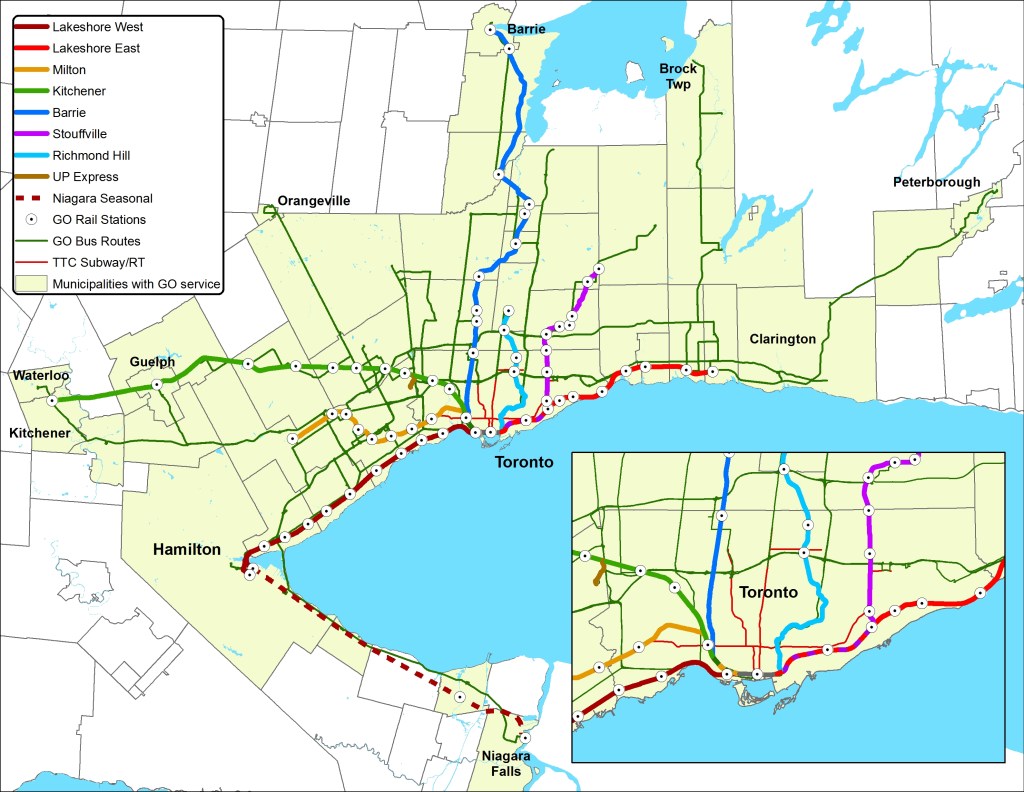
    I don’t have a car, so planning rural rides are little bit more challenging. Happily, for most out-of-town ride I rely on GO Transit’s trains and buses, which provide an opportunity for one-way or “open-jaw” trips without worrying about the logistics of organizing shuttle rides. In the last few years, I’ve used GO Transit to get to/from Uxbridge, Lindsay and Peterborough, Hamilton (and on to Port Dover by bike), Niagara Region, Georgetown and Newmarket, and Barrie (and on to Orillia and Midland), these cities served by GO are all great places to start or finish a ride.

    IMG_4943-002Downtown Guelph. The Basilica Church of Our Lady Immaculate dominates McConnell Street (photo taken earlier this year)

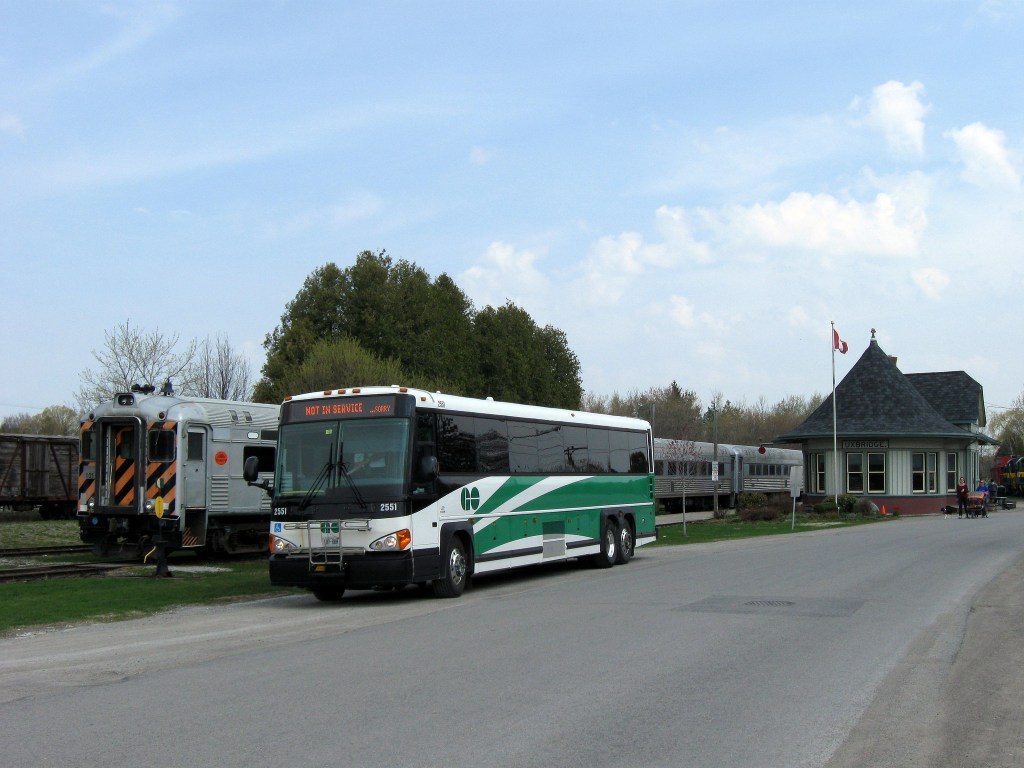
    On a pleasant Saturday, I loaded my bike on the rack took a GO bus from the Union Station Bus Terminal to Guelph, a long bus ride that took nearly two hours. GO Transit’s buses are quite comfortable; if you’re planning to bring a bike along, just be sure to arrive early to make sure you get one of the two bike rack spots.

    (more…)

  • A disappointing step backwards for ranked ballots

    I’ve long been a fan of ranked ballots, a voting system that Dave Meslin and the good people at RaBIT have been promoting for a long time. At the municipal level, ranked ballots —also known as instant run-off voting — is a simple, yet effective way of improving local democracy.

    Ranked ballots ensure that politicians are elected because they can enjoy the support of a majority of electors, so they are fairer than the first-past-the-post system we currently use to elect city councillors. To some degree, it reduces the advantage that incumbent councillors enjoy due to name recognition, and they promote diversity in local politics. I think they’re a better idea than term limits, recalls, or municipal parties.

    The provincial government is currently reviewing the Municipal Elections Act; reforms may allow municipalities to adopt ranked ballots. At first the City of Toronto seemed to be eager to sign on; in 2013, Council adopted a motion to ask the province to allow ranked ballots to replace the current electoral system; more recently Mayor John Tory expressed his support for the idea.

    But during a recent council meeting, newly-elected Councillor Justin Di Ciano (Ward 5) just threw a wrench into the works. Calling ranked ballots “confusing,” he put forward a motion to ask the province not to allow ranked ballots. It passed, 25-18.

    The map below illustrates the result of that vote by ward.

    Ranked ballots vote

    Incumbent councillors might be wary of ranked ballots, especially if they face multiple opponents. Fifteen councillors (and Mayor Tory) were elected with less than 50% of the vote; they would be vulnerable to ranked ballots. Three of those councillors: Ana Bailão (Ward 18), Joe Cressy (Ward 20), and Raymond Cho (Ward 42), were brave enough to vote the right way on Di Ciano’s motion.

    Conversely, councillors such as Norm Kelly (Ward 40, who won with 86% of the vote), Michael Thompson (Ward 37, 84%) and Jaye Robinson (Ward 25, 83%) voted for the motion. Justin Di Ciano himself won with 54% of the vote in Ward 5. The “yes” votes were mostly from Council’s right wing, but left leaning councillors such as Maria Augimeri (Ward 9) and Paula Fletcher (Ward 30) joined in. Augimeri would have almost definitely lost in 2010 had ranked ballots been adopted; it’s possible that Fletcher would have been voted out in 2010 and in 2014 under this voting system.

    2014 Election - Councillor win percentMap of the share of votes each councillor was elected by in 2014.  

    The fight for ranked ballots is far from over; Mayor Tory still has plenty of political capital and sway with the provincial government. I’m hopeful that council will reverse itself yet again.

    In happier news, Council voted 25-18 in favour of asking the province to allow non-citizen permanent residents to vote in municipal elections. As local government is closest to the people, and makes decisions that affect most individuals on a day-to-day basis, I am in favour of such a move. That said, I still believe that electing federal and provincial representatives should remain a privilege afforded to Canadian citizens.

  • Exploring the downtown federal election races: Part II

    Back in April 2015, I looked at the impact of changes to the new federal electoral districts in three key downtown races: Toronto Centre, University-Rosedale, and Spadina-Fort York. The three downtown ridings were created by splitting two larger electoral districts, Trinity-Spadina and a larger Toronto Centre.

    As a downtown resident and political junkie, I was very interested in how previous election results would look with the new electoral districts. Could Toronto Centre, long held by the Liberals, go orange with Rosedale and Yorkville lopped off? Would University-Rosedale and Spadina-Fort York become Liberal bastions with the new boundaries?

    When I wrote the original post, the Liberal Party had nominated candidates in all three ridings — Chrystia Freeland in University-Rosedale, Adam Vaughan in Spadina-Fort York, and first-time candidate Bill Morneau in Toronto Centre. I wrote more about all six candidates (and some of my personal opinions) in the original post.

    Back in April, the New Democrats nominated Jennifer Hollett in University-Rosedale and Linda McQuaig in Toronto Centre, but had yet to choose a candidate in Spadina-Fort York to run against Adam Vaughan. Vaughan, who took Trinity-Spadina in a 2014 by-election, was a popular Toronto city councillor. There were rumours that prominent criminal defense James Lockyer and former MP and mayoral candidate Olivia Chow were both considering running, but in late July, Chow formally sought, and won, the nomination.

    After the 2014 municipal election, in which Chow came in third place in the race for mayor, she accepted a position at Ryerson University. I expected that she was going to sit this election out, but I was proven wrong.

    All three ridings are proving to be interesting races. The Conservative Party of Canada (CPC) and Green Party have also nominated candidates in all three electoral districts, but only the Liberals and NDP are competitive.

    In this post, I added results and maps from the 2008 election, when the Harper Conservatives won a minority government, the Liberals were led by Stéphane Dion and the New Democratic Party, led by Jack Layton, came in fourth place in the seat count (after the Bloc Québécois) with 30 seats. Perhaps the 2011 election, in which the Bloc was nearly eliminated, the NDP became the Official Opposition and the Liberals relegated to third place, was an anomaly.

    Toronto Centre 2008-2013 Toronto Centre election results, 2008-2013

    In Toronto Centre, the NDP kept gaining support since the 2008 election, yet the Liberals held on with comfortable margins in 2011 and 2013. In the 2013 by-election, triggered by Bob Rae’s retirement from electoral politics, the CPC vote share collapsed (as did voter turnout), and Linda McQuaig, the new NDP standard-bearer, more than tripled the NDP’s share of the vote in 2008.

    Trinity-Spadina 2008-2014Trinity-Spadina election results, 2008-2014

    The NDP’s Olivia Chow, elected MP in 2006, was re-elected in 2008 and 2011. But her resignation in 2014 to run for Mayor of Toronto triggered a by-election in which Toronto city councillor Adam Vaughan took the riding for the Liberals in a by-election held on June 30, in the middle of the Canada Day long weekend. Voter turnout was a miserable 31.9%.  (more…)

  • Not seeing the light on pedestrian safety

    IMG_9773

    Earlier this week, I ranted on Twitter about a poster I spotted on the TTC. The poster, showing a pedestrian crossing a downtown street, is one of a series of posters aimed at pedestrians, all with the tag “Stay Focused. Stay Safe.” They are co-produced by the TTC and the City of Toronto.

    The poster, as seen above, shows a blurry image of a pedestrian crossing the street, wearing a backpack and a dark jacket. But it shows that pedestrian crossing legally and safely at one of the safest intersections in Toronto – Yonge and Dundas. We see cars and a streetcar waiting at the light in the background. There’s nothing wrong with this picture. What part of “stay focused” does clothing come in, anyway?

    (Some of the responses to my rant were hilarious, like the woman who compared walking downtown wearing dark clothing with hiking in rural B.C. and not being prepared for cougar attacks.)

    With the new school year and with the shorter days, it isn’t a bad time to be reminding all road users about how to stay safe. Other posters remind TTC passengers to cross at designated crosswalks and to pay attention when crossing the street, rather than focusing on their smartphones. While crossing many streets midblock isn’t itself dangerous – as long as one crosses a quiet street with caution it’s usually quite safe – the advice given in the poster above bothers me. It indirectly blames pedestrians for the clothes they wear.

    Most fall and winter clothes, especially jackets, are dark – black, navy blue, dark grey, etc. Instead of blaming pedestrians, should we be blaming clothing retailers? Should we be requiring all pedestrians to wear high-visibility clothing, and be equipped with bright flashing lights? Or as David Hains pointed out in Torontoist, why aren’t cars required to be brightly coloured as to be seen better by pedestrians?

    In Spacing, fellow Walk Toronto co-founder Dylan Reid wrote about, and debunked some common myths about pedestrian collisions. The vast majority of pedestrians in Toronto – 67% – hit by motorists had the right-of-way, such as with a walk signal at a traffic light or in a marked crosswalk. Only in 19% of collisions did injured pedestrians not have the right of way. And downtown, where there is a higher volume of pedestrians, there’s a safety in numbers; it’s on busy suburban arterials where pedestrians are most at risk; speed kills.

    And as for bright-coloured clothing, it’s a great idea for joggers and runners at night, especially in rural areas. But it doesn’t necessarily prevent collisions. I was hit on Dupont Street by a careless taxi driver two years ago, even though I was riding safely in a bike lane. My bright, reflective jacket, my steady front and rear bike lights and my flashing helmet-mounted lights did not do a thing. I’ve been nearly hit over a dozen times by aggressive drivers racing through red lights or making right turns without looking for pedestrians with the right of way; I was attentive, and avoided injury in every case.

    Some factors that make pedestrians difficult to see at night include poor lighting, inattentive and/or aggressive drivers, and motorists who don’t put their headlights on at night. There’s nothing wrong with reminding all users about how to get around safely; pedestrians should always be attentive when walking in and around traffic. There’s lots that can be done to promote pedestrian safety: better infrastructure, improved lighting, lower speed limits, and so forth. Safety campaigns are a useful tool. But blaming pedestrians for their wardrobe is ridiculous and misses the point.

  • More thoughts on cycling infrastructure

    In Torontoist last week, I mapped the new and improved bike lanes proposed for 2016. There are some great new additions – more contraflow lanes in the east end and through Kensington Market allow cyclists to take direct routes along quieter residential streets. There will finally be a pilot of the long-demanded Bloor Street bikeway; at least between Shaw Street and Avenue Road. And, as I write this post, work is being completed on separated bike lanes along Adelaide and Richmond Streets east to Parliament Street. The popularity of the lanes added last year (University Avenue to Bathurst) pretty much guarantees that these new bike corridors, still officially pilots, are permanent.

    But the map below – created for the Torontoist post – shows many gaps, even with the new 2015 and 2016 additions. Note the long north-south lane in the top centre of the map. That’s Willowdale Avenue, the longest planned addition. It ends at Sheppard, just before Highway 401; there’s no easy and safe way for cyclists to cross North America’s widest and busiest auto route anywhere near where the new Willowdale bike lane ends. Freeways and railways remain nearly impenetrable barriers for pedestrians and cyclists; this prevents the true implementation of a minimum grid.

    Bike Routes - Sept17

    But even bike lanes are only good if they aren’t blocked by ignorant or ill-intended motorists. Simple barriers like knock-down bollards or curbs are helpful, but they aren’t always effective.

    Last Sunday, I cycled from my home in east Downtown Toronto to Downtown Hamilton, following the Martin Goodman Trail, Lakeshore Road, and the Hamilton Beach trail for an 84-kilometre ride. Through Oakville and Burlington, the Waterfront Trail is nearly non-existent, so I ride on Lakeshore Road itself, which has bike lanes in only a few sections. But motorists are, almost without exception, courteous and patient; it’s the one place in the suburbs where I really enjoy cycling.

    In Hamilton, after crossing the Queen Elizabeth Way on a spectacular bridge that also spans the Red Hill Creek, I again take minor streets to make my way west towards downtown, where I usually visit a favourite pub on Augusta Street before loading my bike on a GO Transit bus rack and returning to Toronto.

    6164718675_1ac3950080_o

    Hamilton, like Toronto, has started to add some great new cycling infrastructure. It has a bike share program, called SoBi Hamilton, it has great trails leading out to Brantford and Caledonia (as well as the Waterfront Trail), and some new bike lanes and cycletracks. The most impressive is Cannon Street, where a lane on a one-way arterial was transformed into a two-way separated cycletrack last year.

    14988034160_c541a52410_k

    But even green paint, knock-down bollards, and plenty of signage wasn’t enough on Sunday, when I encountered this:

    IMG_9624

    IMG_9625

    The woman in the red shirt and grey trackpants started screaming at me as I took these photos, claiming she had the right to stop here as she was moving out of the house. She threatened to call the cops on me (!) for taking photos of her stuff, saying I could be looking to steal it. (On my bike, of course.) Cyclists encountering this from the west would be forced into oncoming traffic; in any event it’s dangerous and illegal. (Taking photos of this type, on public property, certainly is not.)

    https://twitter.com/Sean_YYZ/status/645726388310396928


    There’s still a lot of ignorance out there; not by the woman with the U-Haul that I mentioned; but by at least one reaction:

    Sidewalk riding is itself illegal and dangerous (sidewalk riding cyclists are a pet peeve of mine). Happily, there were plenty of others willing to correct that user about the safety of vulnerable road users and the various laws and by-laws applicable in this case.

    But this is all a long and winding way to say that more cycling infrastructure is great. And places like Toronto and Hamilton are doing great work on that front. But the infrastructure is only as strong as its connectivity, and as long as they’re not blocked by ignorant and/or hostile motorists. Education and enforcement need to go along with the buckets of green paint, signage, and barriers now being added in our cities.


  • Mapping Toronto’s Legal Rooming Houses

    unnamed

    Rooming houses are often-overlooked in Toronto, but they provide an essential form of affordable housing in a city that struggles with the issue. In Torontoist, I looked a little more closely at this issue and created a map of all licensed rooming houses located in the City of Toronto. (The list from which the map was created can be found here.)

    There are many, many more illegal rooming houses across Toronto that I didn’t map; currently they only legal in certain parts of the city  – the old City of Toronto and parts of the old cities of York and Etobicoke. These outdated laws predate amalgamation, and ignore the need for this form of affordable housing, as well as the variety of rooming arrangements. Illegal, undocumented rooming houses have the potential to be firetraps, licencing and inspections protect tenants from unsafe and unhealthy living conditions.

    It’s time for updated regulations that cover all of Toronto; landlords should be able to rent out rooms right across the city. Happily, the city is conducting a city-wide review of rooming houses; one of the goals is to modernize the city’s by-laws; another is to improve the conditions in existing rooming houses.

  • A Simcoe Day ride from Georgetown to Newmarket

    A few weekends ago, on Simcoe Day (Civic Holiday), I cycled a new route, taking 90 kilometre ride between Georgetown and Newmarket. Just over half of the roue took me on the Caledon Trailway, a beautifully-maintained rail trail between Terra Cotta and Tottenham. From Georgetown to Terra Cotta and between Tottenham and Newmarket, I mostly used quiet, country roads. It was a very rewarding trip, one that I will likely redo in the future.

    The Caledon Trailway is one of the most-used rail trails in Ontario, and I encountered many fellow cyclists and pedestrians along the path. For those with cars, there are several convenient parking areas along the route.

    I took the GO Transit bus on Monday, August 3 from Union Station to Georgetown, taking advantage of the bike racks installed on all of that regional transit agency’s buses.  From Newmarket, I took a special summer GO Train that operates between Barrie (Allandale Waterfront Station) and Union Station. Like all non-rush hour GO trains, bicycles are welcomed aboard as well.


    My route between Georgetown and Newmarket

    A few photos and observations follow.

    (more…)

  • A quick guide to the Toronto Ward Boundary Review

    2014 Election - 2018 Ward ProjectionsThe variance in ward populations in 2018; new ward boundaries will address the population inequities shown above.

    Back in March, I wrote about the City’s plans for new ward boundaries, outlining the history of Toronto’s post-amalgamation council and the need for fairer representation. While Toronto’s population continues to increase, most of the growth is concentrated in northeast Scarborough, central North York and Etobicoke, and especially Downtown, where new condo towers are going up by the dozen.

    Yesterday, on August 11, the Toronto Ward Boundary Options Report was released, setting the stage for further public consultations. With the report, we now have tangible details of what the new wards might look like, and how many politicians the new council, to be elected in 2018, will be comprised of.

    I wrote more about the report in Torontoist, with a discussion on the process, criteria, and the various options presented.

    While the mayor may disagre (“I think the last thing we need is more politicians,” he was quoted as saying), I personally prefer the options that add a few more councillors than the existing 44. Back in 1997, the newly amalgamated City of Toronto had 57 city councillors, and with a growing population, a small increase in the size of council is more than appropriate. “Option 1 – Minimal Change” adds three new councillors; two downtown and one in North York; it is not a bad option, though I think fifty is a workable number.

    There are plenty of opportunities for feedback, including a survey and a new round of public consultations in the Fall; I recommend taking part and sharing your own views.