Author: Sean Marshall

  • It’s time for two-hour transfers on the TTC

    15102078722_2ee5e4e9e3_k

    As of Monday, December 14, all TTC streetcars will operate under a “proof-of-payment” system; allowing customers to enter through the rear doors, as they currently do on 509 Harbourfront and 510 Spadina, the two routes partially equipped with the new Bombardier low-floor streetcars. All-door loading and proof-of-payment (POP) is supposed to be in effect on streetcars on Queen Street, but in practice, operators inconsistently open the rear doors; sometimes at all stops, often just a few downtown stops, sometimes only at Yonge Street, sometimes not all.

    This new policy requires passengers to have a valid pass, transfer, or Presto card on board every streetcar; fares can continue to be paid at the front door on the older CLRVs and ALRVs; at that point a transfer must be obtained.

    TTC fare inspectors have been handing out brochures about the new policy to streetcar passengers, informing them about the upcoming change:

    The design of the new low-floor streetcars has required POP: they have four doors instead of two doors on CLRVs and three on ALRVs; the operator is in a separated cab, and normally does not interact with passengers, including fare collection and handing out transfers. At this point, at the end of 2015, all streetcars on the 509 and 510, as well as the 505 Dundas and 511 Bathurst routes were supposed to be equipped with low-floor accessible streetcars, but the many delays at Bombardier has resulted in only the twelfth new streetcar, #4413, entering service today.

    By the end of the year, all TTC streetcars (not just the new Bombardier LFLRVs) will be accepting payment by Presto Card, one small step towards the elimination of tickets, tokens and paper transfers, a process already complete at many suburban GTA transit agencies.

    But widespread adoption of Presto at the TTC will result in a few challenges unique to it, thanks to its outdated transfer policy that dates back over 100 years.

    On the TTC, transfers are only valid for continuous one-way trips, no stopovers permitted. But most other major systems in Ontario work on the time-based transfer system, that allows for stopovers, even return trips within a 90 minute period (the policy at Grand River Transit) or 120 minute period (permitted in Mississauga, Brampton, York Region, Hamilton and elsewhere). After boarding the first bus, each additional tap with a Presto card will not result in a new fare deducted until the 90 minute or two hour time limit has passed.

    The TTC will have a different policy. Paper transfers will still be required for Presto card holders if they intend to transfer to a bus (Presto readers will not be coming to the TTC’s buses for another year); but transfers to connecting streetcars and subway stations can be done by tapping the card on the new vehicle or at the subway turnstile. If it’s a valid transfer under the TTC’s rules, it will not deduct another fare. Here’s the TTC’s Brad Ross (the TTC’s amazing Head of Communications) clarifying this:

    https://twitter.com/bradTTC/status/672810002688569344

    But there’s a hiccup:

    https://twitter.com/bradTTC/status/672841401177014272
    https://twitter.com/bradTTC/status/672841244918210560

    If a passenger taps onto another vehicle on the same route, which is quite a common occurrence due to delays, short-turns, and diversions/shuttles, the Presto Card will deduct a second fare.

    There is an easy solution: two-hour transfers. It would eliminate confusion, allow for short stopovers and quick two-way trips, and solve such issues such as customers re-boarding streetcars and buses on the same route. Allowing Presto cardholders the same luxury as that enjoyed in Toronto’s suburbs would provide an incentive to passengers paying by cash and token to switch. After all, the TTC already offers a two-hour transfer on St. Clair Avenue, a pilot project left over from the construction of the streetcar right-of-way.

    The TTC already considered at time-based transfers in 2014 as it planned for the transition to Presto for fare collection. The Commission estimated that it would cost $20 million in annual revenue (thanks to lost fares stopovers and single-fare return trips), but it would by a lot of goodwill. And I doubt that the TTC would lose $20 million a year as it might attract new riders, especially during off-peak periods.

    It’s now time for the TTC to bite the bullet to make it easier to ride the rocket.

  • GO Transit plans to raise fares in 2016. How about a better fare system?

    Note: Updated in February 2016 due to a conflicting chart.

    At Thursday’s Metrolinx Board Meeting, the Board of Directors will be voting on a GO Transit fare increase effective February 1, 2016. As has become common, Greg Percy, the President of GO Transit, will be recommending a tiered fare increase, and we should expect that the Metrolinx Board will rubber stamp this proposed fare hike, as it usually does.

    Recently, I wrote about the many problems with GO Transit’s fare structure. It penalizes short trips, it does not allow for any fare integration with the Toronto Transit Commission, and many trip pairs (particularly the Barrie, Richmond Hill, and Stouffville Corridors) are priced lower than they should be compared to other stations. In another post, I suggested that GO Transit should seriously consider charging for parking at its lots, as constructing and maintaining parking lots is a major expense that all GO Transit users are paying for, whether they use them or not.

    I was somewhat surprised to see that the fare increase will not apply to short trips, those currently costing between $5.30 (the lowest fare possible) and $5.69. This would freeze the one-way ticket price for trips such as between Danforth, Union, and Exhibition Stations. With a slight increase in the “loyalty discount” offered tot Presto Card users when they pay a GO fare,  from 10% to 11.15%, this results in a very slight fare decrease for short trips.

    You can read the GO Transit report recommending a fare increase here.

    (more…)

  • The trouble with Trans-Cabs

    In my last post, in which I discussed the gaps in the Golden Horseshoe’s transit network (and offered unsolicited advice to Metrolinx), I used the example of Milton, in which a carpool lot served by several GO Transit bus routes was largely disconnected from the rest of the local transit system, and located several kilometres from the main GO hub at Milton Station.

    When I pointed out that Milton Carpool lot, at the junction of Highways 401 and 25, was only served by Milton Transit’s route 1A/1B, which runs only during rush hours, Twitter user YIGE corrected me:

    https://twitter.com/yige_t/status/669902364111822848

    YIGE is correct. Milton Transit does offer a Trans-cab service in the residential areas north of Main Street in Milton, as well as some of the institutional and industrial zones north of Steeles Avenue. I did not see it in the “System Map and Routes” section of the website; it has its own page elsewhere.

    Trans-Cabs, are contracted taxi services that are intended to serve suburban or rural areas that would be inefficiently served by fixed bus services, but require a connection to the transit network. Several cities and towns in Ontario offer these services.

    In Milton, Trans-Cab operates between 8:30 AM to 2:30 PM, and between 5 PM and 6 PM on weekdays, and from 7:10 AM to 7:40 PM on Saturdays,  times when route 1A/1B does not operate. The service requires a 50-cent premium on top of the Milton Transit fare, and the transfer point isn’t at the GO Station, where all eight fixed route buses connect, but at a point in Downtown Milton where only Route 2 connects. Anyone headed elsewhere must then transfer to Route 2 to the GO Station, and transfer yet again. It’s not at all convenient, and the service ends far too early in the evening, especially for commuters and students headed home from Kitchener-Waterloo or Guelph. And unlike connecting between GO and Milton Transits at the station, there’s no co-fare available to any other GO bus service.

    Passengers must also request a ride at least an hour in advance if heading to the transfer point; passengers heading to the Trans-cab service area only have to let the Route 2 operator know they need the service.

    Milton_TransCab
    Map of the Milton Transit Trans-Cab service area, original found here.

    In the Greater Toronto and Hamilton Area, Hamilton Street Railway also provides a Trans-Cab service, serving exurban areas in Stoney Creek (Winona) and Glanbrook. Like Milton, the Trans-Cab service requires a 50 cent premium above the regular fare, and requires a transfer to a regular bus route. In Glanbrook, the service is offered Monday through Saturday from 6 AM to 7 PM, and in rural Stoney Creek from 5AM to 1AM. The HSR system map shows the Trans-Cab service areas. Like Milton, pick-ups have to be arranged at least an hour in advance.

    Peterborough and Greater Sudbury also operate Trans-Cabs; again, in those cities, they serve outlying areas that are difficult to serve with fixed bus routes.

    The Hamilton example illustrates where Trans-Cabs make more sense: in outlying areas where demand is low, the population density sparse, but there’s a need for transit access. In Milton’s case, operating a fixed route serving the urbanized area north of Main Street makes more sense, especially as it links to a major GO Transit connection;. In Milton, a Trans-Cab might be more useful, say, for serving areas outside the Milton urban area, such as Campbellville and Mohawk Racetrack.

    Really, either the Town of Milton/Milton Transit, or GO Transit should work to get the gap between the Highway 401/25 carpool lot and the town transit system fixed properly. An inconvenient Trans-Cab service simply doesn’t cut it.

  • The Golden Horseshoe’s missing links

    14182301824_167b4e754a_k
    GO Transit bus at Uxbridge

    Over the last 15 years, GO Transit has done well expanding its bus and rail operations. It opened up new stations, such as Mount Pleasant, Lincolnville, Barrie South, Allandale Waterfront, and West Harbour. It introduced the Highway 407 service, finally making York University accessible to thousands of suburban students. And it extended its reach to Waterloo and Peterborough, not only serving post-secondary institutions and residents in those cities, but also making it easier for cyclists like myself to explore new trails and destinations.

    But as GO Transit expands, there are many gaps, large and small, that should be closed. Coinciding with GO Transit’s expansion, intercity bus operators have been cutting back; dozens of Ontario towns and cities no longer have any coach service, and many more have saw their service cut back. Several municipalities in GO’s service area have resisted operating local transit systems, and GO’s use of park-and-ride lots has made their bus services difficult to reach without a car. In this post, I discuss some of these challenges.


    Related:

    (more…)

  • Not so fair-by-distance: GO Transit’s problematic fare system

    Not so fair-by-distance: GO Transit’s problematic fare system

    GO Network 2015GO’s bus and rail system serves 39 municipalities and reaches points over 130 kilometres from Union Station

    In 1967, GO Transit started out as a simple commuter service from Oakville to Pickering (with two additional trains to and from Hamilton). In 1970, it started its first bus service, connecting Oshawa and Hamilton to the hourly train service at Pickering and Oakville. Eventually, GO expanded to other corridors, inaugurating the Georgetown service in 1974, and taking over former suburban Grey Coach and TTC routes in the 1970s. By 1981, GO was operating trains on all seven of its current corridors, expanding and extending its bus rail services ever since. As a commuter rail and bus system, GO Transit is a great success story, there were over 68 million boardings in 2014, and service continues to expand. Regular bus service goes all the way to Niagara Falls, Peterborough, and Waterloo, serving post-secondary institutions and long-distance commuters. But there are many ways in which it can improve; its fare structure is just one of them.

    Previously, I explained why GO Transit should consider charging for parking at its commuter lots. GO Transit provides over 60,000 free parking spaces, but the cost of servicing those lots is borne by all passengers, whether or not they drive to the train or not. This isn’t terribly fair to those customers who arrive by foot, by bicycle, or are able to get a ride. In the suburbs outside the City of Toronto, most transit agencies offer a co-fare – a discounted fare for taking local buses to connect to and from GO Transit, but no such fare integration exists with the TTC. But the parking subsidy enjoyed by drivers is only part of the unfair pricing scheme levied by GO Transit.

    GO Transit describes its fare scheme as “fare by distance.” And to a degree, this is accurate. Generally, the farther one travels, the more expensive the fare. So far, so good. But fares for short trips cost far more than longer ones per kilometre traveled, and fare increases for short trips have risen at a greater percentage rate than fare hikes for long trips.

    Steve Munro wrote about the myth of GO’s fare-by-distance scheme last year. As Munro put it, “the fare structure is rigged against short distance trips, and this has been getting progressively worse for a decade.”

    If GO Transit wishes to fully become a regional transit service, it needs to address both its unfair fare scheme and its lack of fare integration with the TTC.

    go_rail_and_bus_network,_2015_by_seanmarshall1_11_18_2015_02_29_09

    I created a map of the full GO transit bus and rail system in CartoDB to illustrate GO Transit’s reach; all stations and major bus stops include some fare information (the distance and cash fare to Union Station) and the number of parking spots. 

    (more…)

  • GO Transit and the high cost of “free” parking

    IMG_0878

    This is the first of a series on regional transit in the Greater Toronto and Hamilton Area

    This may or may not come as a surprise to readers of my site, but the largest parking lot provider in Ontario isn’t the Toronto Parking Authority, nor is it a major real estate developer like Oxford (owner of Yorkdale and Square One malls) or Cadillac Fairview (Eaton Centre, Sherway Gardens). That record belongs to a public transit agency.

    Metrolinx, the regional transportation authority for the Greater Toronto and Hamilton Area (GTHA), owns or leases 63,302 spots at 53 of its 64 GO Transit rail stations (not counting two stations served by seasonal Niagara trains), and offers another 4,186 spots at various park-and-ride and carpool lots served by GO buses. (Metrolinx is responsible for approximately 1,000 spots, the Ministry of Transportation Ontario and local municipalities are responsible for the remaining 3,000 spots).

    Pickering GO Station, adjacent to Highway 401, has the most parking spots in the system, with 3,600 spaces in several lots and in a new parking garage. Clarkson comes in second with over 3,000 spaces. Acton, which sees only two trains a day to Toronto, has only 50 spaces. Eleven GO rail stations do not have any on-site parking: Union Station, Hamilton GO Centre, Hamilton West Harbour, Kipling, Exhibition, Bloor, Danforth, Kennedy, York University, Guelph, and Kitchener. With the exception of York University, all are either in urban downtowns (Toronto, Hamilton, Guelph, Kitchener), or are connections to the TTC.

    All GO Transit parking spots are “free,” with the exception of reserved spaces that can be leased for $94/month at most rail stations and the Newmarket bus terminal. Reserved spaces are beneficial for regular passengers to guarantee a preferred spot on weekdays. This is in contrast to the Toronto Transit Commission (TTC), which charges $2 to $7 to park at any of its lots on weekdays, though there are no parking charges on weekends and holidays at most of its lots and garages.

    The Toronto Parking Authority, the largest municipal parking operator in North America, operates 20,000 off-street parking spots in lots and garages across the City of Toronto. (The TPA is also responsible for 17,500 metered on-street spots.) Oxford Properties Group owns approximately 30,000 spots at five GTHA malls (Square One is the largest, with 8,700 spots), while Cadillac Fairview owns 26,671 spots at 7 GTHA malls. The TTC has parking facilities at 13 stations; Finch, with 3,227 spots, is the TTC’s largest, though Finch Station’s parking lots are within a hydro field.

    The table below illustrates this comparison.

    The GTHA’s largest parking operators

    Parking table v2

    I chose to include major shopping centres in this comparison, because as with GO Transit, they provide “free” parking to their customers, both surface lots and multi-level parking garages. The TTC does not charge for parking at most of their lots on weekends and holidays, while the Toronto Parking Authority charges competitive rates while returning a healthy profit to the City of Toronto.

    This model of providing ample “free” parking made sense early in GO Transit’s history, when the provincial government created the agency (“GO” is short for Government of Ontario) to shift auto traffic off the Queen Elizabeth Way and other provincial roads as Toronto was growing rapidly, especially as a major financial centre. In 1967, GO operated only on the Lakeshore Line between Pickering and Oakville, with two trains continuing on to Hamilton. Public transit in the suburbs was almost non-existent; land at these new GO stations was cheap and plentiful. (Here is a fascinating history of GO Transit’s early years.)

    But that model makes less sense nearly 50 years later, especially as GO moves towards becoming a regional rail operator, with more frequent services operating more like a metro than a commuter railway.

    (more…)

  • Some thoughts about the 2015 election and Canada’s new government

    My congratulations to Prime Minister Justin Trudeau and the Liberal Party. The Liberals managed to win a healthy majority government on October 19, 2015, defeating Stephen Harper and the Conservatives. I’m not completely happy with the election day results, but I think there is still plenty to be satisfied about. For now, I’m cautiously optimistic thanks to a clear Conservative defeat and the first few moves on the incoming Liberal government.

    (more…)

  • On Brampton’s short-sighted Hurontario-Main LRT decision

    8742719319_adb77a0b03_k
    LRT mockup at Gage Park, Brampton

    On late Tuesday night (actually, early Wednesday morning) Brampton City Council made disappointing and harmful decision by voting against the Hurontario-Main LRT, a 23.2 kilometre, $1.6-billion light rail line, whose construction costs would be fully covered by the province. This followed another marathon meeting back in July in which a final decision was delayed to allow for further study and a possible compromise.

    The mayor, Linda Jeffrey, and four councillors (Gurpreet Dhillon, Pat Fortini, Marco Medeiros, and Gael Miles) supported the project, but six councillors (Jeff Bowman, Grant Gibson, Elaine Moore, Michael Palleschi, John Sproveiri, and Doug Whillians) voted against. The final vote was 7-4 against the LRT, with Jeffrey mistakenly voting with the majority, but the 6-5 vote against a modified downtown routing in an last-minute attempt to sway opponents should be considered the true decision.

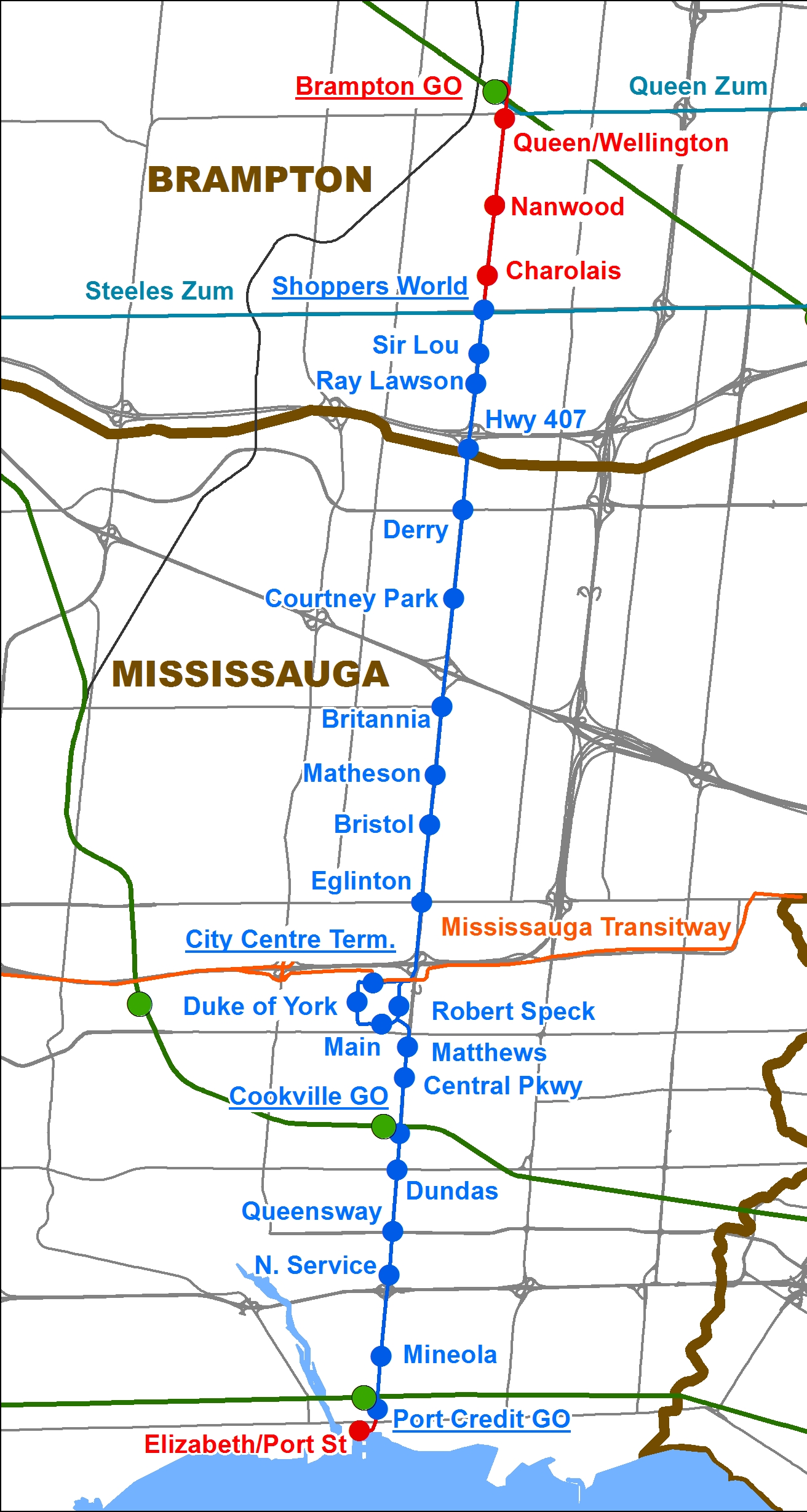
    Light rail transit will still be coming to Brampton – construction will start in 2018 – but it will terminate at Shoppers World at Steeles Avenue, with only three stops completely within Brampton’s borders. Nearly four kilometres and four stops have now disappeared, including the crucial terminal at Brampton GO Station. The map below shows the Hurontario-Main LRT route, with the eliminated sections in red. (A short section of the LRT’s route in Port Credit was eliminated due to community opposition; it would have brought light rail transit closer to Port Credit’s bustling core. The Hurontario LRT will now terminate adjacent to the Port Credit GO Station, north of Lakeshore Road.)

    The Hurontario-Main corridor was selected for LRT simply because it is one of the busiest transit corridors in the Greater Toronto Area outside the City of Toronto; it connects three GO lines and several major bus corridors, it would help urbanize south Brampton and several neighbourhoods in Mississauga. It’s part of a larger regional network, yet six city councillors in Brampton, looking out for narrow, local interests, sunk it.

    Now transit advocates elsewhere are looking to capitalize on Brampton’s loss: at least $200 million of the province’s money won’t be spend. For example, advocates in Hamilton are looking for an opportunity to expand their funded LRT network with Brampton’s cash.

    HMLRT
    The Hurontario-Main LRT, after Tuesday’s vote. 

    The arguments against the LRT included heritage concerns (as if trams aren’t found in the centres of historic cities such as Vienna, Istanbul, Brussels, and Amsterdam), claims of low ridership (which were written about by the Toronto Star’s San Grewal), concerns about operating expenses. Some councillors suggested that Queen Street should get LRT first. Others took exception to the fact that most of the route (17.6 kilometres, 19 stops) would be in Mississauga, while only a quarter of the line would operate within Brampton (5.6 kilometres and eight stops) But one cannot dismiss the NIMBY factor – some of the biggest opponents were wealthy homeowners on Main Street. Even former Premier Bill Davis, long regarded as a friend of cities and public transit, came out publicly against the LRT. Davis will long be remembered for stopping destructive expressways, but won’t support public transit when it runs down his street.

    Opponents suggested other routes, or tunneling under Main Street. But those alternatives were more expensive, more difficult, less convenient for riders, and weren’t going to be funded by the province. These suggestions were studied by city staff and outside consultants and rejected.

    Yes, Queen Street is Brampton Transit’s busiest corridor. Yes, the ridership will be lower north of Steeles Avenue than through central Mississauga. Yes, there will be some traffic impacts on Main Street.

    But there’s no current planning study for a potential Queen Street LRT; a route hasn’t been chosen (would it go to the Spadina Subway extension to Vaughan? York Region would have to be on board), there’s no funding on the table, and the Hurontario corridor in Mississauga is a lot busier than Highway 7 in York Region. And yes, Mississauga benefits more from the LRT. But Mississauga has a larger population, a much larger transit ridership, and more jobs. By connecting to Downtown Brampton, the LRT increases mobility for the entire region, connects to the Kitchener GO line, and allows for direct transfers to the 501 Queen Zum, Brampton’s busiest bus route. It is part of a regional transit network; it would have made it a lot easier for trips, for example, between Downtown Guelph and Mississauga City Centre.

    10671927_oriToday’s news that anti-LRT councillors are now going to seek federal funds for transit expansion makes me want to tear my hair out. This image of Frank Grimes pretty much describes how I’m feeling right now.


    Just adding to my frustration, I read today that Councillor Bowman, who helped sink the Main Street section of the LRT, is now going to look for transit funding from the newly elected Liberal federal government. In the article, Bowman suggests that since Brampton elected five new Liberal MPs, helping to defeat the Conservatives, it was time to “leverage” that support. Payback, if you will. But there are no other plans to hold up, nothing that’s “shovel-ready.” There will be no ribbon-cuttings for Liberal MPs and cabinet ministers to attend anytime soon.

    If looking for money from a new federal government – one that’s so far very friendly with their provincial counterpart – it would have looked a lot better to have approved the transit that the province, and a majority of Bramptonians, wanted, and then ask for additional funds to build on that. Advocating for a potential Queen Street LRT would be a lot when there’s an existing line to connect it, and a strong transit-focused hub to anchor it.

    So, to sum up, Brampton city councillors threw away at least $200 million for a light rail project that they didn’t want, a gift-wrapped transit opportunity from the provincial Liberal government. Now they will be looking for new transit funding for alternative transit routes, which have yet to be planned, from the federal Liberal government. Good luck with that. 
     

  • Happy October 21, 2015

    IMG_0472

    The makers of Back to the Future Part II didn’t predict selfies, did they?

    The joys of living close enough to work to walk there includes passing by the Rogers/CityTV building at Dundas Square. where a DeLorean, fitted out like the one used in the film trilogy, was on display. In the franchise’s “history,” October 21, 2015 was the day Doc Brown and Marty McFly arrived in a time machine from 1985 in an attempt to save Marty’s future children from trouble.

    We have no hoverboards, no flying cars, the Chicago Cubs probably aren’t going to win the World Series, but we also (thankfully) have no double ties. But advances in communication, particularly the smartphone, is just one way in which we are more “futuristic” than the film predicts.

    Happy Back to the Future Day, everyone!

    IMG_0471IMG_0475  IMG_0477

  • A ride through Midwestern Ontario, Part II

    IMG_6019-001The Cambridge to Paris Rail Trail, part of a network of rail trails that join together in the City of Brantford

    Previously in this blog, I described the first day of a two-day ride through Midwestern Ontario, between Guelph and Kitchener via West Montrose and St. Jacobs. I rode through Ontario’s only authentic covered bridge, along infrastructure created for both cyclists and carriages, and through several picturesque towns and villages.

    Midwestern Ontario is a term that I generally use to describe the part of the province west of the Greater Toronto Area, yet outside the flat, prairie landscapes of Southwestern Ontario (Essex, Lambton, and Kent Counties). The rural landscape is marked by gentle rolling hills, livestock and cash crop farms, as well as cities and towns adjusting to a post-industrial economy. Brantford was once the capital of Canada’s once massive farm implement industry, but now not even the factories remain. Kitchener-Waterloo’s diverse heavy manufacturing concerns have mostly left; but there’s now a strong knowledge economy. Galt (now part of Cambridge) and Paris straddle the Grand River, their grand stone churches and commercial blocks make these some of Ontario’s most picturesque.

    Electric and steam railways — the Grand River Railway, the Lake Erie & Northern, the Toronto, Hamilton & Buffalo, the Grand Trunk, the Canada Southern — tied many of these communities together; now highways do. But many those abandoned railways have found new purpose as hiking and cycling trails; Brantford is at the heart of this new network.

    The second day’s ride, on August 30, took me from Downtown Kitchener, where I stayed overnight, through Cambridge, I then followed the Grand River closely to Brantford. After a stop in Brantford, I took the former TH&B railway corridor into Downtown Hamilton, where I enjoyed dinner and refreshments before loading my bike on a GO Transit bus and rode back home to Toronto. I completed a similar trip in 2012; I wrote about that ride in Spacing.

    Photos and commentary follow.

    (more…)