Category: Politics

  • Mapping the 2018 candidates for Toronto City Council, Bill 5 edition (updated)

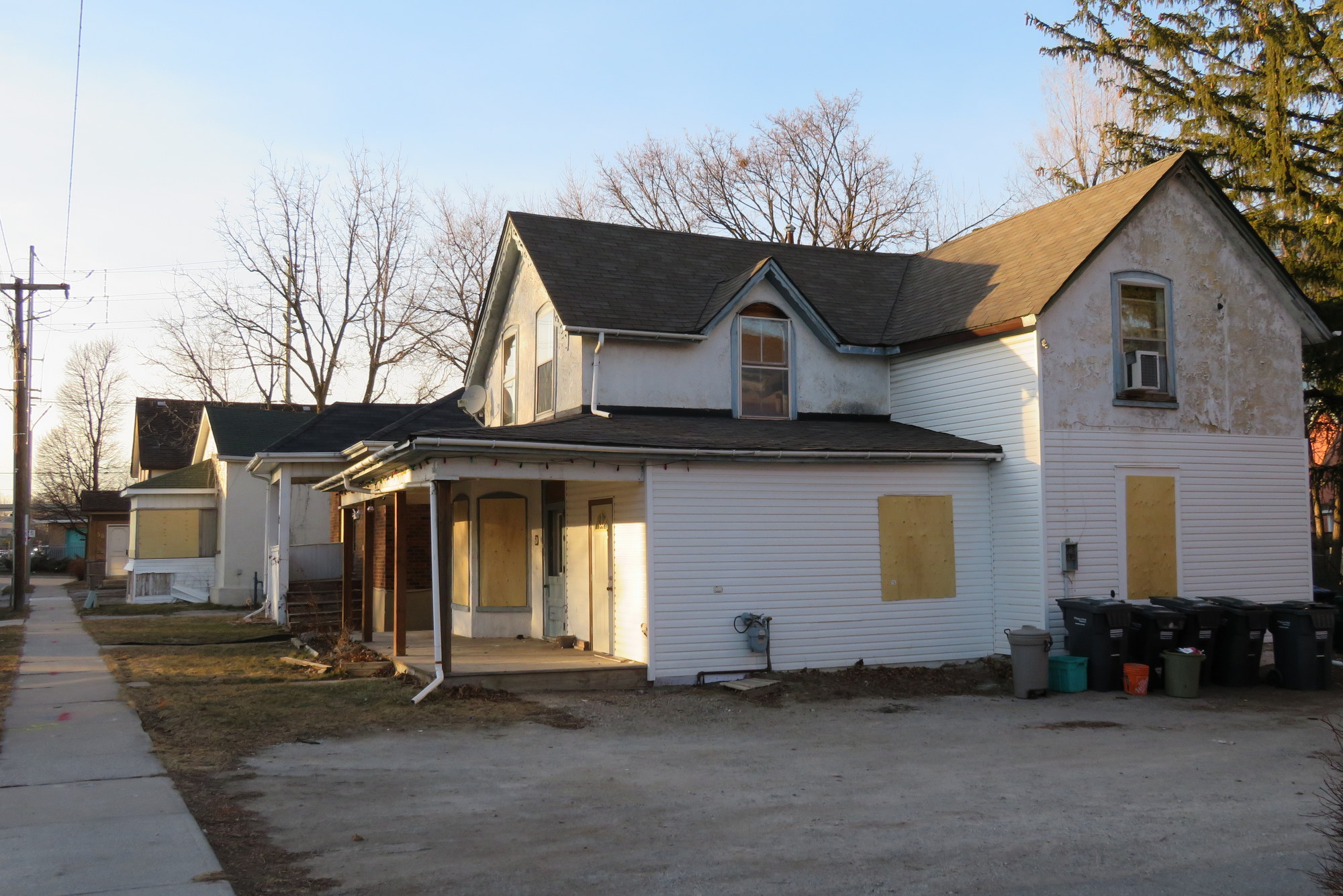
    IMG_8629.jpg
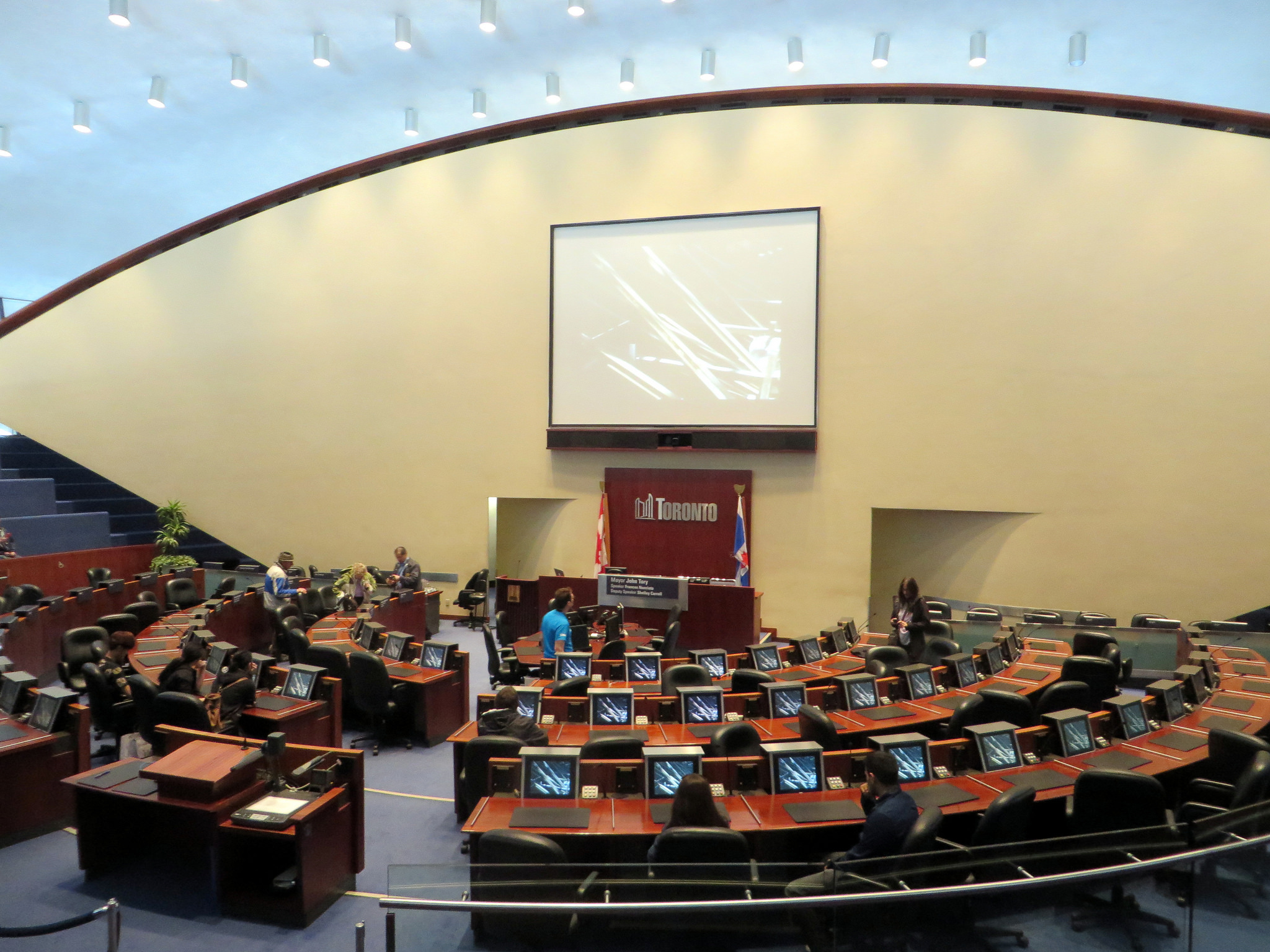
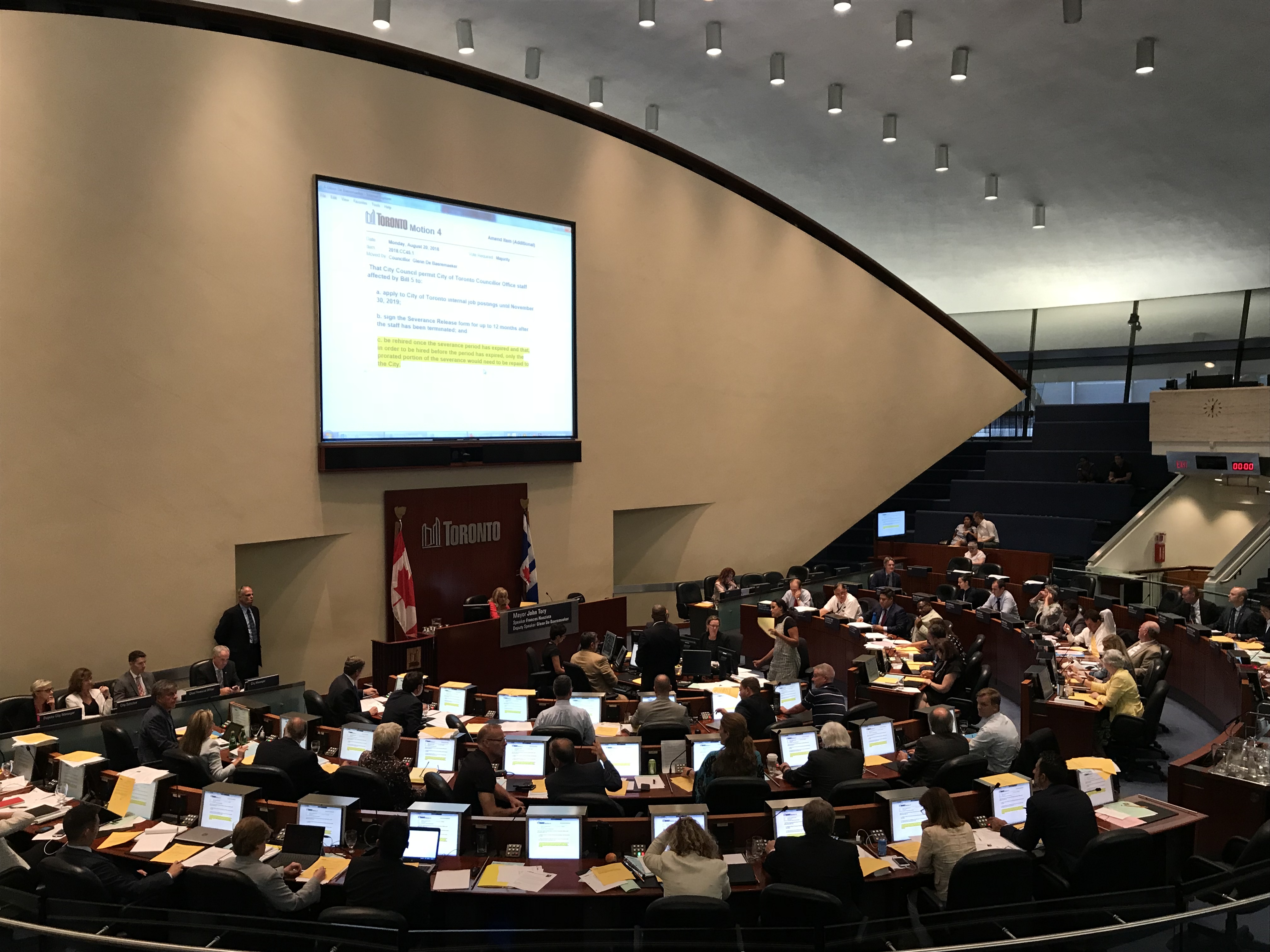
    Toronto City Council voting on a legal challenge to Bill 5, August 20, 2018

    September 21 update: nominations are now closed, and I updated the map. Councillor Cesar Palacio dropped out in Davenport; this practically ensures that fellow incumbent Ana Bailao will be re-elected. There are 19 candidates in Toronto Centre, where popular incumbent Kristyn Wong-Tam is facing former mayoral candidate and provincial minister George Smitherman and appointed councillor Lucy Troisi.

    I’ll add a proper update later this weekend.

    September 19 update: the Ontario Court of Appeal ruled in the province’s favour today, issuing a stay of the September 10 Ontario Superior Court ruling against Bill 5. So with just over a month before election day, October 22, there’s now certainty that the 25 wards imposed by a vindictive Premier Ford will be used.

    That puts out a lot of good candidates looking to run in the 47-ward structure. Candidates Dan Fox in North York, and Chris Moise and Ausma Malik downtown, will not run. This is unfortunate and very disappointing.

    According to city hall reporter Arianne Robinson, incumbent councillors Paula Fletcher and Mary Fragedakis will run against each other in Toronto-Danforth.

    Without the City of Toronto’s online list of candidates live, I haven’t been able to make authoritative updates to the 25-ward map of candidates, but I have been trying to keep up with the news. Once the city’s list is live, I’ll make a definitive update.

    September 6 update: Councillor John Filion, who previously announced his retirement from municipal politics, registered to run in Ward 18 – Willowdale in the new 25 ward election. He felt his registration was necessary to prevent a non-progressive candidate from running (possibly David Shiner) and winning against relatively unknown candidates. It’s a terribly unfortunate result of going to 25 wards from 47 — it shuts out many fresh new faces and favours incumbents and other politicians with strong name recognition.

    Because of rapid population growth in the North Yonge corridor, Filion’s North York ward was essentially being split into two. Filion had endorsed his executive assistant, Markus O’Brien Fehr for the Ward 28 council seat, and Lily Cheng on Ward 29. If the challenge to Bill 5 is successful, and the 47 wards are restored for the 2018 election, Filion will not run.

    In other developments, the first battle between two progressive-leaning incumbents under the 25 ward model has emerged in Ward 12 – Toronto-St. Paul’s. Josh Matlow, an outspoken critic of John Tory’s transit plans, is running against longtime incumbent Joe Mihevc. Matlow is affiliated with the Liberals, while Mihevc is aligned with the NDP.

    There are now nine wards in which two sitting councillors are running against each other.

    I have updated the 25 ward map below.


    Bill 5, the so-called “Better Local Government Act, 2018,” was passed by the Ontario Legislature on August 14. This legislation reduces the number of council seats from the 47 wards approved by City Council to just 25, despite three years of study by independent experts and several rounds of public consultations. Passed in just over two weeks from the Premier Doug Ford’s surprise announcement on July 27 — the same day nominations for city council were scheduled to close — Bill 5 disrupted the municipal election campaign already in progress. Two hundred and ninety-two candidates had registered to run in one of the approved 47 wards.

    Bill 5 is vindictive, grossly unfair, and sets a bad precedent for provincial meddling in municipal affairs. It only targets the City of Toronto, which rejected Doug Ford’s late run for mayor in 2014, and delivers a blow to hundreds of candidates that registered to run in good faith. But legally, the City of Toronto must follow the province’s edict and elect only 25 councillors with wards based on the current provincial riding boundaries.

    Before Bill 5 was announced, there was an excellent chance for renewal at Toronto City Hall. Councillors Janet Davis, John Filion, and Mary-Margaret McMahon announced their retirements, while Shelley Carroll and Chin Lee resigned to run in the June 2018 provincial election. Councillors Ron Moeser and Pam McConnell died in office, replaced by appointees who promised not to stand for election (though Lucy Trosi later broke this promise). Councillor Josh Colle announced that he, too, was not going to run for re-election, but his father, defeated MPP and former councillor Mike Colle, would run instead. Meanwhile, Justin Di Ciano and David Shiner never registered.

    With three new wards, this meant that there were up to thirteen open races without an established incumbent. With only 25 wards, all but two wards are guaranteed to have at least one incumbent running for re-election, and at least ten wards with two incumbents running against each other.

    On Monday, August 19, nominations opened for any candidate wishing to run in one of the 25 wards. Nominations will close at 2:00 PM on September 14, just over five weeks before election day on October 22. Council candidates who registered under the 47 ward system or the 25 ward system may also withdraw by that date.

    There remains a faint hope that a court case, scheduled to be held on Friday August 31 will delay or overturn the provincial legislation, allowing the planned 47-ward election to go ahead.

    I expect that many candidates, especially progressive incumbents and challengers not eager to face off against each other, will wait until then to decide. But sadly, it means that great people like Chris Moise, who registered to run in Ward 25, will withdraw from the race.

    I will be maintaining and updating a Google map of the 25 ward races, similar to my 47-ward map. This new map appears below.

    As of Tuesday, August 28, there are eight wards in which two incumbents are running against each other. For example in Ward 1, Etobicoke North, Ford ally Vincent Crisanti will be running against Michael Ford, nephew of late mayor Rob Ford and Premier Doug Ford.

    But downtown, no incumbent councillors or high-profile candidates have registered under the new boundaries. I suspect they, like many of us, are waiting to find out what will happen on August 31, and that if the 25 wards go ahead, we will lose some promising new choices for city council.

  • How do you solve a problem like Mammoliti?

    Giorgio Mammoliti, long-time Toronto City Council, is a great poster child for what’s wrong with municipal politics. Arrogant and obnoxous, Councillor Mammoliti has made a name for himself by flouting council rules and election laws, by demeaning his constituents, picking fights with other members of council, and pursuing media attention with crass stunts and outrageous comments. Toronto would be a far better place without him at City Hall. His 23 years in municipal office have made him a convincing argument in favour of term limits, but I don’t agree that it’s the best way of getting rid of troublesome politicians.

    Mammoliti has been in municipal office since 1995, when he was elected to North York City Council. Before that, he was elected an MPP for Yorkview as a member of the provincial NDP. He is well-known for his socially conservative views against LGBT rights, social housing, youth recreation, and. In 1994, he voted in opposition to his party in the provincial legislature against allowing same-sex couples spousal insurance benefits.

    At city hall, his attention-grabbing antics have made him well-known. In 1999, he ripped off his shirt in front of news cameras to protest a decision permitting a clothing-optional section of beach on the Toronto Islands. In 2014, Mammoliti offensively called Parkdale, a lower-income neighbourhood, a “pedophile district.”

    Even though the Jane-Finch area, which is partially represented by Mammoliti, has a high proportion of visible minorities, high rates of poverty and underemployment, and poor transit access, Mammoliti has undermined rather than improved things for the community. He strongly opposes the Finch West LRT project that will provide an improved connection to the subway at Keele Street and Humber College. He has called residents of local community housing developments “cockroaches” in interviews for the Toronto Sun and alt-right Rebel Media. In a recent re-election advertisement, he posed in front of a nearby TCHC development with a sledgehammer in hand; the text of the ad read “saving our community begins with knocking down social housing. You deserve better!”

    This week, the Toronto Star reported that Mammoliti missed nearly half of all council votes in 2018, the worst record among all 44 councillors. During the 2014-2018 term, he missed 43.1 percent of all votes.

    The Ontario Provincial Police is investigating a failed Toronto Parking Authority land  deal in Ward 7 that Mammoliti had an involvement in. Allegedly, the councillor threatened a senior city staffer to recommend that the sale go ahead in a report to council. Auditors determined that the five acre site at Finch Avenue and Arrow Road was overvalued by $2.63 million. Mammoliti was previously interested in erecting a giant flagpole on that site.

    It’s not the first time he’s been under police investigation. In 2013, he held a $5000-a-table fundraiser in Vaughan, despite rules forbidding raising funds outside of election campaigns. Several prominent lobbyists were in attendance at the event, which raised $80,000. In 2014, Council docked him three months’ pay, the strictest penalty available.

    The people of northwest Toronto deserve much better than Giorgio Mammoliti. But one solution championed by some political observers — term limits — isn’t the right one, even if it would finally remove such a toxic member of council.

    Last month, Spacing’s John Lorinc argued that term limits would be “…the magic bullet reform that would blow open local government to new voices.” While term limits might be an easy way to get rid of Giorgio Mammoliti, it wouldn’t fully solve the incumbency advantage. Instead term limits would remove some of Council’s brightest and hardest working members, without guaranteeing a more diverse council with fresh new voices.

    Name recognition does not only come from years of incumbency, it may also come from a famous family name and political connections. Many “new voices” elected to city council when an incumbent chooses not to run for re-election are councillors’ constituency assistants, often given access to contact lists and the organization built up over the years. Or they’re politicians previously elected from other levels of government. Or they’re the sons, daughters, spouses, or in one case, the nephew, of a well-known public figure.

    Councillors Josh Colle, Joe Cressy, Stephen Holyday, Mike Layton, and David Shiner are the sons of previous municipal politicians. Councillor Cristin Carmicahel Greb is the daughter of former Conservative MP John Carmichael, Frances Nunziata’s brother John was a Liberal MP in the 1980s and 1990s, and Councillor Michelle Holland is married to former Liberal MPP Lorenzo Berardinetti, and is running for re-election as Michelle Holland-Berardinetti.

    And there’s the Ford family.

    In September 2014, Rob Ford, citing his poor health, announced that he was no longer running for mayor. His brother Doug, who was at that point councillor for Ward 2, but was not running for re-election,would run for mayor in Rob’s place. Rob and Doug’s nephew, Michael Ford, who was running for councilor, stepped aside for Rob and ran for trustee instead. Michael Ford changed his last name from Stirpe (his father’s surname) in February 2014 to take advantage of the famous Ford name.

    After Rob died, Michael Ford ran in the Ward 2 by-election and won by an easy margin. And Doug Ford, taking advantage of the folksy populist image his brother Rob fostered, ran for the leadership of the Ontario PCs and became premier in 2018. Doug Ford’s father, Doug Ford Sr., was an Ontario PC MPP from 1995 to 1999.

    On July 25, the week that nominations were scheduled to close (and two days before Premier Doug Ford announced his rushed and vindictive plan to cut council to 25 seats), Councillor Josh Colle (who was first elected in 2010 and served just two terms) announced that he was not going to run for re-election in his North York ward. But his father, Mike Colle, recently defeated as a Liberal MPP, would run instead. Term limits would not have stopped father and son from swapping places every eight or twelve years.

    While term limits would prevent a Norm Kelly, Frances Nunziata, or Giorgio Mammoliti from spending decades on council, it would also stop popular and well-regarded representatives such as Joe Mihevc from continuing to serve their communities. Institutional memory would also be lost on Council. Councillors Gord Perks, Paula Fletcher, Michael Thompson, Paul Ainslie, and many others would also be required to leave office this year if a three-term limit were imposed. Gord Perks’ knowledge of council procedure and his defense of the Parkdale neighbourhood would be sorely missed.

    Term limits also do not prevent lacklustre candidates from being elected.

    In 2014, Cristin Carmichael Greb was elected in Ward 16 with only 17.4% of the vote, a 1.2% margin over her nearest competitor. This was despite the support of John Tory’s campaign. Carmichael Greb has proven to be an ineffective councillor. In Ward 5, Justin Di Ciano has made a name for himself opposing democratic measures such as ranked ballots, new ward boundaries, and supporting a questionable development proposal backed by a firm with which he has close ties. Like Mammoliti, Councillor Di Ciano has found himself under OPP investigation.

    I continue to prefer other methods of limiting the power of incumbency. Ranked ballots would be a good first step. In 2014, Ward 12 incumbent Frank Di Giorgio, in office since 2000, won with only 29% of the vote in a four-way race. Ranked ballots could have made a difference there.

    I also believe that all adult permanent residents, not just Canadian citizens, should be able to vote in municipal elections. As municipalities have the responsibility for delivering local services, such as police, parks and recreation, roads, transit, libraries, and water and waste services, all residents have a stake in how they are being delivered. Extending the municipal franchise could help community engagement, especially in neighbourhoods poorly represented by indifferent or antagonistic city councillors. In contrast, non-resident property owners are permitted to vote. Council voted to request the province to allow non-citizen voting in 2013, but the province was under no obligation to respond to the city’s request.

    I was hoping that in 2018, Giorgio Mammoliti would finally be defeated. TDSB trustee Tiffany Ford is a promising young candidate that had a good shot of defeating him under the new 47-ward model. However, with the 25 ward boundaries imposed by Premier Doug Ford, Mammoliti will be up against more challengers, including fellow incumbent Anthony Perruzza. Perhaps Perruzza or Tiffany Ford will still be able to defeat him.

    While term limits sound like a great solution for solving a problem like Mammoliti, they aren’t necessarily a great solution for improving local democracy.

  • Why Doug Ford’s plan for 25 Toronto wards is an attack on local democracy

    Ridings and 47 Wards.jpgMap of Doug Ford’s proposed 25 wards and the City Council-approved 47 ward boundaries

    Late last week, the newly elected Ontario Progressive Conservative government announced that they would be imposing a new electoral map on the City of Toronto, a decision that would eliminate the new 47 wards approved by Toronto City Council, replacing them with the same 25 boundaries used by the federal and provincial governments.

    It’s very clear that Premier Doug Ford’s plan, which requires a new piece of legislation, ironically titled the “Better Local Government Act,” is vindictive and mean-spirited because it only affects the City of Toronto, which rejected Doug Ford’s 2014 mayoral bid. It quashes the hopes of many young, racialized, and progressive candidates looking to change the make up of a council that has generally supported Mayor John Tory’s agenda. It is unfair to candidates that ran in good faith, started campaigns, raised funds, and spent money hiring staff, purchasing materials, and renting campaign offices.

    But most of all, Ford’s actions are an attack on local democracy because of the haste with which they are being made, at the end of the nomination period for those approved 47 wards. They ignore the years of study by independent experts and several rounds of public consultations. They also benefit Toronto’s suburban areas, which are growing at a far slower rate than downtown Toronto, North York Centre and Etobicoke’s waterfront area, which will be disproportionately affected by this arbitrary decision.

    Each new ward was designed to have an average population of 61,000, with a population range of between 51,800 and 72,000 (+/- 15%). They were designed to last for four election cycles, to be re-drawn before the 2034 election.

    It is worth noting that the independent experts looked at using the 25 federal/provincial boundaries twice. In the first study, they were rejected early on because they would not “meet the tests of effective representation.” The federal boundaries, which are also adopted by the province of Ontario, are based on population counts from the 2011 Census, and are already seven years out-of-date, while the consultants were tasked with developing new ward boundaries to last 16 years. Even a 50-ward solution (which mimics the old 44 wards based on the 22 federal ridings that were established in 1996 and came into effect with the 1997 federal election) would result in severe variations in population.

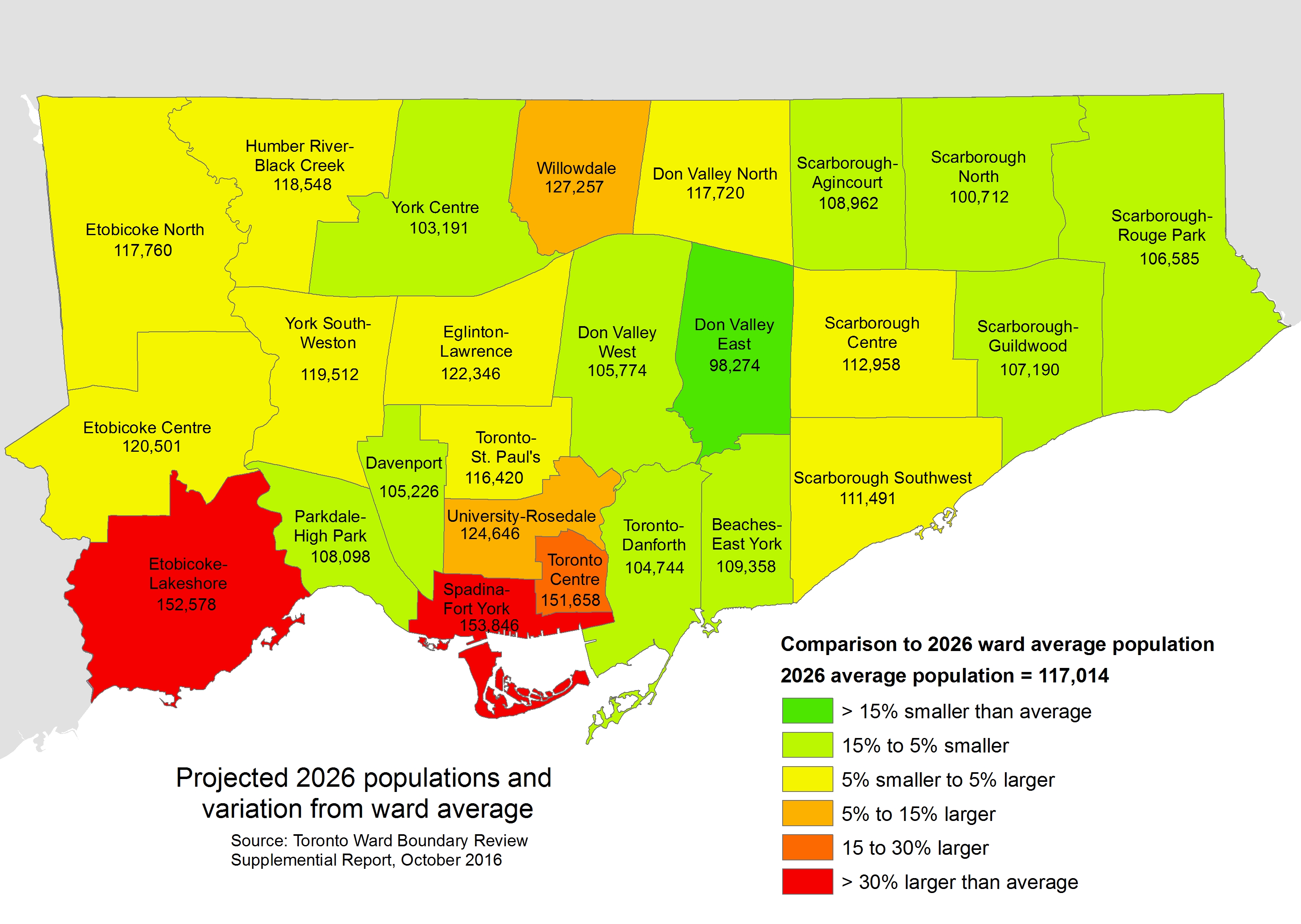
    Ridings and 2026 pop variation.jpgHow the 25 ridings, if used for Toronto’s ward boundaries, will vary in population by 2026

    After Tory’s Executive Committee tasked the Toronto Ward Boundary Review team to re-examine options that would see fewer than 47 councillors elected in 2018, they re-examined using the 25 ward boundaries. They found that in 2026, three of those wards — Toronto Centre, Etobicoke-Lakeshore, and Spadina-Fort York — would have populations over 30% higher than the ward average in 2026. Willowdale and University-Rosedale would also have had much larger populations than the city average.

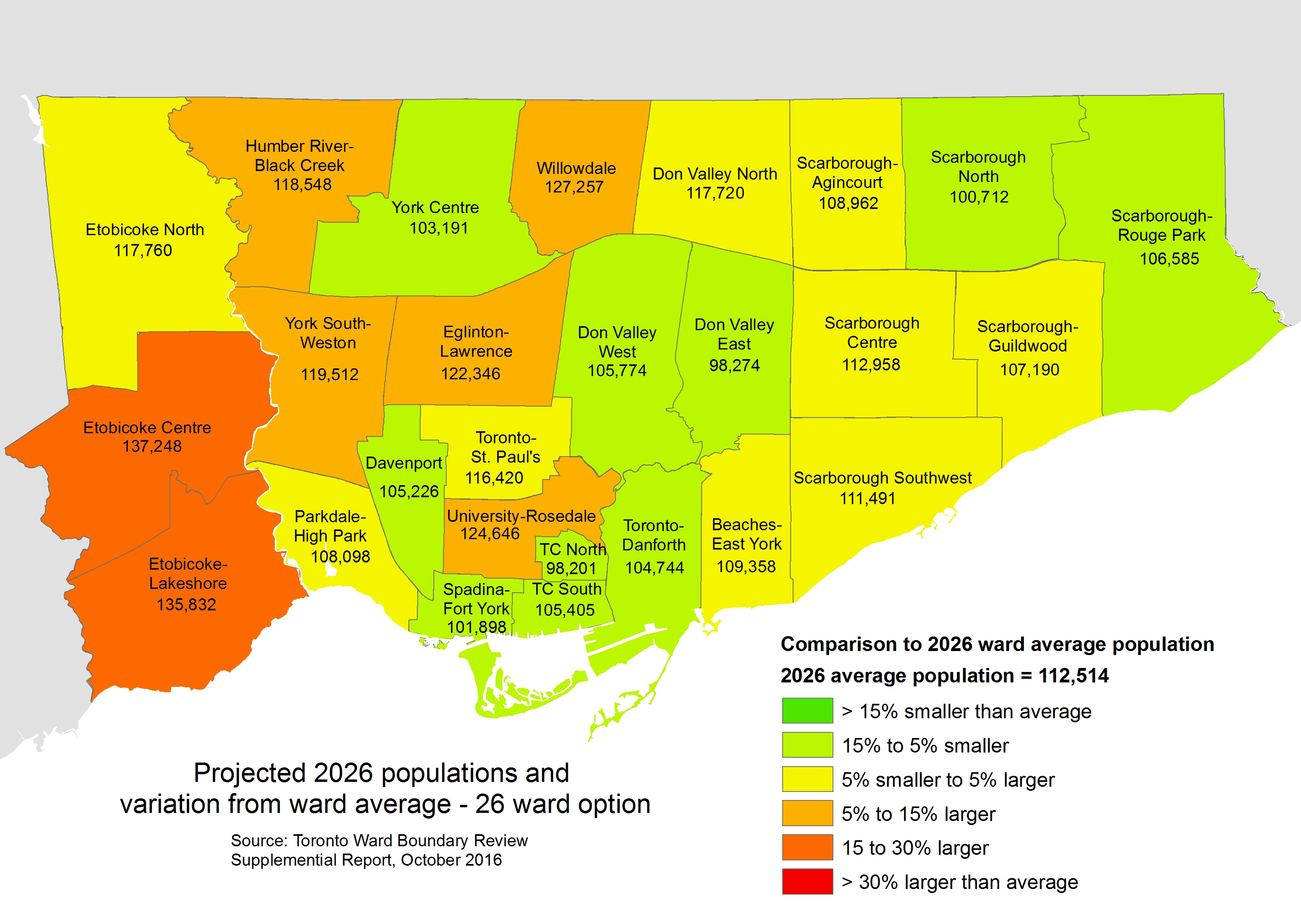
    The review team also looked at a 26-ward option that mostly maintained the riding boundaries but added a new ward downtown out of the Toronto Centre and Spadina-Fort York constituencies and adjusted boundaries in southern Etobicoke. Even then, Etobicoke Centre and Etobicoke-Lakeshore would still have populations over 20% higher than the city-wide average. Despite making some adjustments for population growth, this option would have not have corresponded with some ridings, and was also not recommended.

    26 Wards and 2026 pop variation.jpgHow the modified 26 ridings, if used for Toronto’s ward boundaries, would have varied in population in 2026

    For those reasons, and to support local representation, the 47-ward solution was once again recommended, and was approved by City Council in November 2016. Councillors Justin Di Ciano (Ward 5) and Giorgio Mammoliti (Ward 7) then appealed the new boundaries to the Ontario Municipal Board, but they were dismissed. The 47-ward solution has survived despite it all.

    Mayor Tory may have brought back decorum to the mayor’s office after an embarrassing period under Doug Ford’s brother Rob, but he has pushed an austerity agenda, and has failed to show leadership on police reform, wasteful infrastructure spending, and safe streets for pedestrians and cyclists. His initial reaction, to call for a referendum on Ford’s plan to cut Toronto’s council, was a characteristically weak response; he was later pushed into supporting a legal challenge by an angry public. Meanwhile, some of Tory’s allies, like Di Ciano, David Shiner, and Glenn De Baeremaeker, support Ford’s actions.

    Ford’s attack on local democracy is an insult to candidates who have already put their names forward for election and launched their campaigns. It undermines the City of Toronto’s legislated responsibility to decide its own ward boundaries. And it will only exasperate existing disparities in council representation.

  • Mapping the 2018 candidates for Toronto’s 47 wards (Updated)

    18506683800_6c96dcc66b_k

    September 10, 2018
    This morning, the Ontario Superior Court ruled against Bill 5, finding that the bill  “substantially interfered with the municipal candidate’s freedom of expression that is guaranteed under [Section 2(b) of the Charter of Rights and Freedoms.]”

    Barring a successful provincial appeal (or invoking Section 33 of the Canadian Charter of Rights and Freedoms, also known as the Notwithstanding Clause), this is once again the map of council candidates for the October 22 election.

    September 12, 2018
    Oh, never mind. We’re back to the 25 wards because its not as if Doug Ford has anything better to do than override a judicial finding with the Notwithstanding Clause and re-introducing the vindictive legislation. And we may not even get to vote in advance polls.

    Once the new law is passed, there will be two days for council candidates to sign up to run in the 25 wards.


    August 15, 2018

    Bill 5, the so-called “Better Local Government Act,” passed third reading on August 13, 2018, and was given royal assent on Tuesday August 14, despite vigourous opposition from the New Democratic Party. Bill 5 passed without any public consultation that usually takes place with any government legislation, as the Progressive Conservatives used procedural tactics to push through the bill as quickly as possible.

    (A new map of the 25 wards can be found here.)

    This means that legally, the City of Toronto must follow the province’s edict and elect only twenty-five councillors, with wards based on the current provincial riding boundaries. Scarborough Councillor Glenn De Baremaeker has already announced that he will no longer seek re-election.

    I have no intentions of removing the map below, but I will be creating a new 25-ward map and populating it once nominations re-open. I suspect that many council candidates will not re-register, and that there will be many more incumbents facing off against each other.

    There’s a faint hope that a legal injunction could suspend Bill 5. Council candidate and lawyer Rocco Achampong is seeking one, the courts will hear arguments by the end of the month.

    (more…)

  • Where, exactly, is Northern Ontario?

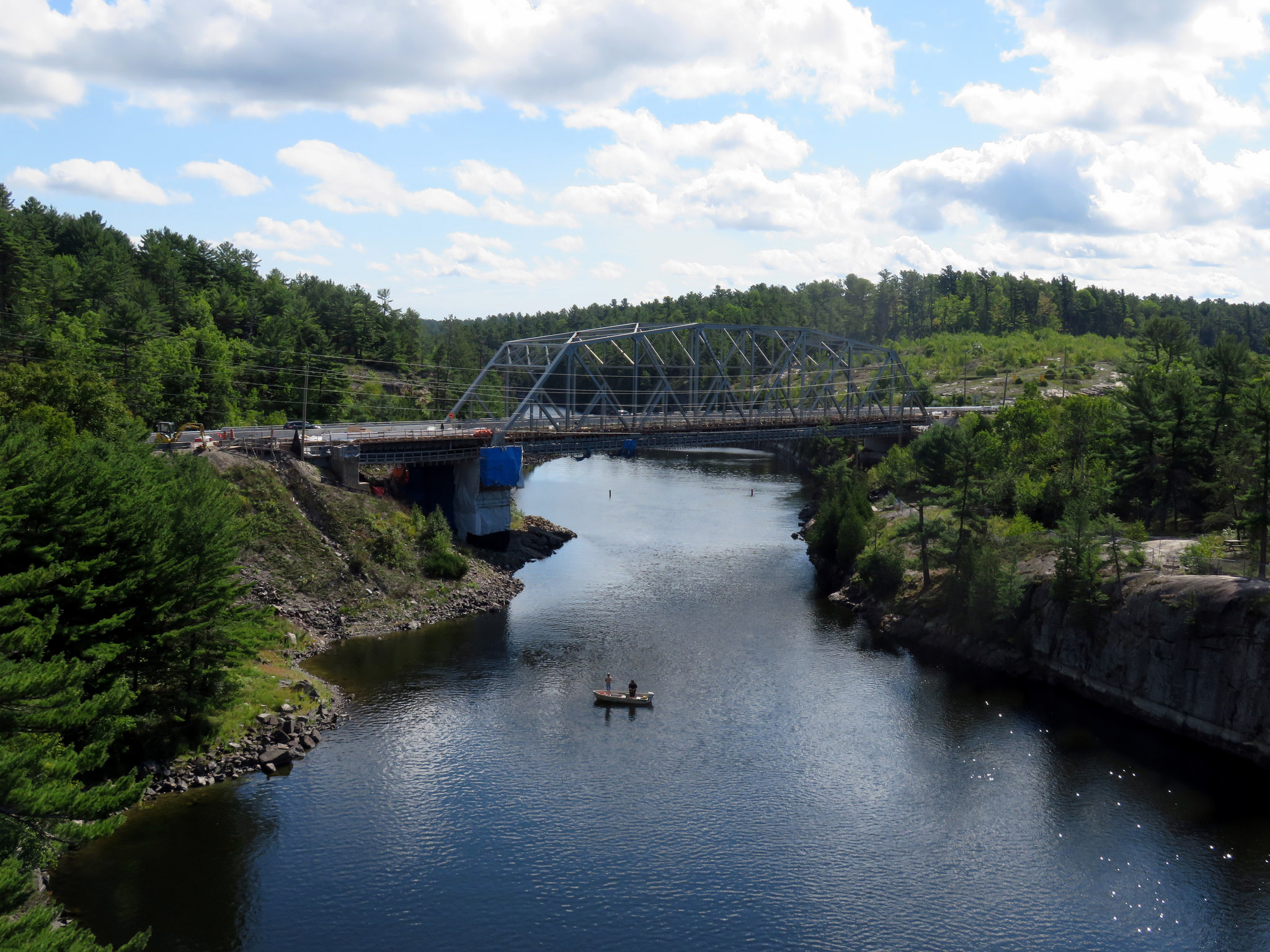
    29496350986_0f43c86857_k.jpgThe French River at Highway 69, where Northern Ontario truly begins
    Last week, the leaders of the three major provincial parties (Liberals, Progressive Conservatives, and the New Democrats) met in Parry Sound, at a debate dedicated to issues specific to Northern Ontario. It was the second of three debates scheduled ahead of the June 7, 2018 general election.

    But is Parry Sound, a town that’s only a two hour’s drive north of Toronto (when free of weekend Cottage Country traffic) really a part of Northern Ontario? That depends on who you ask. Even government agencies disagree. In my opinion, though, Parry Sound isn’t in Northern Ontario, even though the district it’s located in shares some characteristics of this vast part of the province.

    Despite living my entire life in the Greater Toronto Area, I have an affinity for Northern Ontario, particularly the northeastern part of the province. My father’s hometown is Timmins, one of my siblings lives in Sudbury, and I have visited both cities many times. I made a trip up to Sault Ste. Marie to ride the Algoma Central Railway passenger train between Sault Ste. Marie and Hearst and back before it was cancelled, and I still lament the loss of the Northlander, Ontario Northland Railway’s passenger train between Toronto and Cochrane that was terminated in 2012. I even made it all the way to Moosonee, on the James Bay coast.

    The northern part of this province covers a huge area — over 800,000 square kilometres, larger than France, Belgium, and the Netherlands combined — but has a population of just over 750,000. It is even crossed by a time zone boundary. Despite my connection to the region, I had yet to make a proper visit to Thunder Bay and Northwestern Ontario (I finally paid a visit in August 2019).

    The North includes many First Nations communities accessible only by plane or ice road. Other communities, with names like Dryden, Kapuskasing, Iroquois Falls, and Kirkland Lake, were established to serve mines or pulp mills — resulting in a very different economic landscape than the agricultural and industrial south. In recent decades, many of those mines and mills have closed, eliminating many towns’ only major employer.

    In a province dominated by the urban centres in the Greater Golden Horseshoe, Ottawa, and London, it’s too easy to ignore the North.

    So how do people actually define Northern Ontario?

    Traditionally, Northern Ontario begins at the French River, Lake Nipissing, and at the Mattawa River. North Bay, which calls itself the “Gateway to the North” sits right on this line. For administrative purposes, this includes the entirety of Sudbury and Nipissing Districts, which extend south of the French and Mattawa Rivers, and includes most of Algonquin Park. It also includes Manitoulin Island, which can only be reached year-round from the north, through Sudbury District.

    The Canadian Shield, the defining landscape of most of Northern Ontario, starts further south. Driving north from Toronto on Highways 400 or 11, the shield starts about where Simcoe County ends and Muskoka District starts. But the Canadian Shield also encompasses large sections of the City of Kawartha Lakes and Peterborough, Hastings, Frontenac, and Lanark Counties and the entirety of Haliburton County.

    NOntarioThe various definitions of Northern Ontario, including the county, regional and district boundaries. 

    But the provincial and federal governments both have special economic development funding programs whose boundaries take a more liberal definition of Northern Ontario. FedNor, the Government of Canada’s economic development agency, includes Parry Sound and Muskoka Districts. The Northern Ontario Heritage Fund Corporation, a provincial agency, includes Parry Sound District, but not Muskoka District.

    Whether Parry Sound and Muskoka are considered part of Northern Ontario is very much a political question. In 2004, the newly elected Liberal government chose to remove Muskoka from the areas eligible for provincial grants meant for northern communities — Muskoka being a reliable Progressive Conservative seat, and the riding of the previous PC premier, Ernie Eves.

    Parry Sound District, while not, in my view, part of Northern Ontario, at least shares some similar characteristics with neighbouring Sudbury and Nipissing Districts. It includes many isolated communities, and apart from the Town of Parry Sound itself, it has a very sparse population. Muskoka, on the other hand, is more urbanized with three larger towns, and is much more popular for recreation, particularly during the summer. Muskoka also has a regional government — the District Municipality — while much of Parry Sound District’s land is unorganized — meaning lands without any municipal government.

    And if one considers Muskoka to be part of Northern Ontario, why not also include Haliburton County, which also has a sparse population and is relatively isolated from the urbanized south? A line needs to be drawn somewhere, and there is no valid reason why Muskoka should ever be considered a part of Northern Ontario. There might be a case for Parry Sound District, but definitely not cottage country.

  • The John Tory Way

    32267768383_8c2f20d0d5_k
    Yonge Street looking south from Richmond Hill

    There’s an episode of The Simpsons where Homer Simpson changes his name to Max Power, after he’s ridiculed for sharing the name with a buffoonish television character. It’s not a great episode — it came out at the time the show was in transition from its glory years to the “Zombie Simpsons” era — but it has a few good laughs.

    There’s one good memorable quote:

    — “There’s the right way, the wrong way, and the Max Power way!”
    — “Isn’t that the wrong way?”
    — “Yeah, but faster!”

    On important transportation projects, the John Tory way is the wrong way, but costlier. We’ve seen this several times during his mayoralty.

    When it came time to replace the underused eastern section of the Gardiner Expressway, Tory and his suburban allies on council voted in favour of a more expensive “hybrid” option that maintains much of the elevated highway, instead of a cheaper at-grade option that would provide a better pedestrian realm on the Eastern Waterfront and better support new development.

    In Scarborough, Tory stubbornly supports building a one-stop subway extension that was last estimated to cost $3.35 billion dollars, instead of supporting a seven stop LRT route from Kennedy Station that would extend the existing grade-separated Scarborough RT route to Centennial College and Sheppard Avenue. A proposed SmartTrack station at Lawrence East (whose estimated construction cost has risen from $26 million to $155 million) may not be able to be built while the Scarborough RT is still in operation.

    And on February 27, Toronto’s Public Works and Infrastructure Committee (PWIC) voted against plans backed by city staff, the local councillor, John Filion, and many residents and road safety advocates, to transform Yonge Street in North York Centre between Sheppard and Finch Avenues. This section of Yonge Street is due for reconstruction, hence the opportunity to rethink the street to better serve the community.

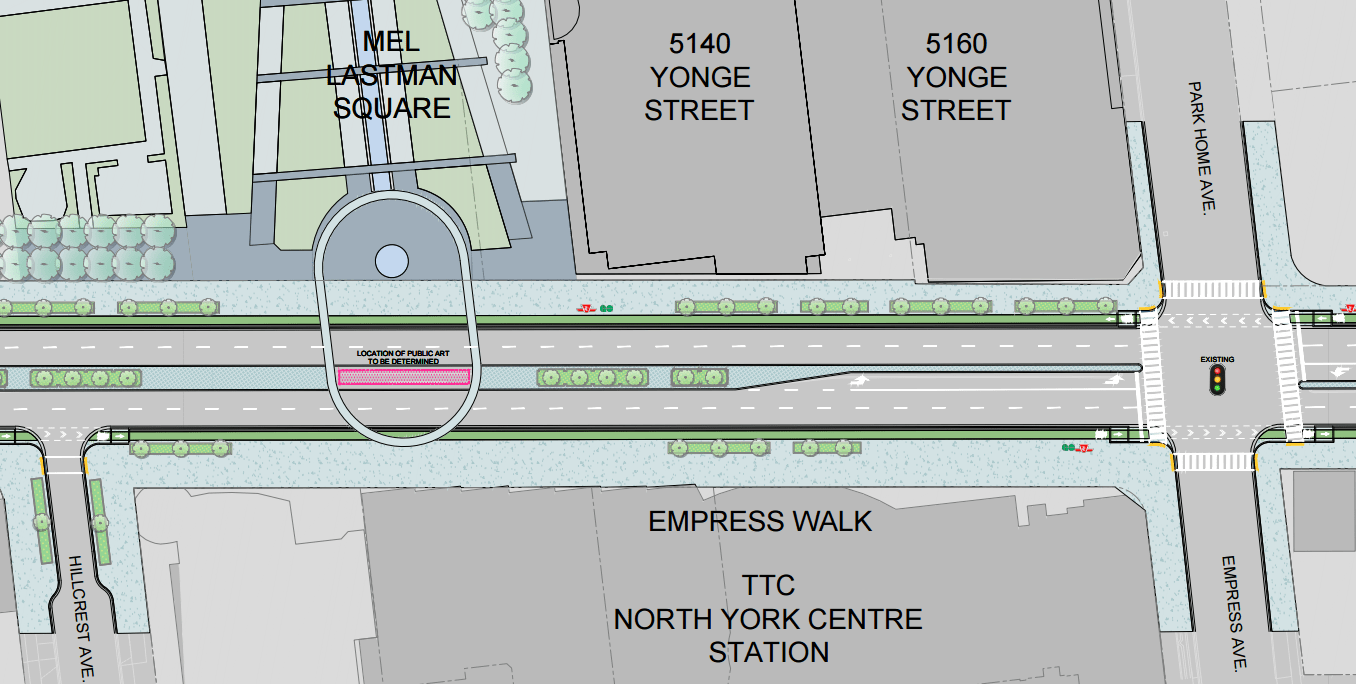
    The REimagining Yonge Street plan seeks to improve the pedestrian realm with widened sidewalks, would add new cycling infrastructure. To make room for these improvements, two traffic lanes — used for street parking outside of weekday rush hours — would be removed. This stretch of Yonge Street has seen many new condominium towers built over the last decade, and there are three subway stations serving this stretch of Yonge Street.

    Mayor Tory, who has the power to select committee chairs and members, stated his preference for the status quo on Yonge Street, suggesting that the bike lanes be moved one block west, to Beecroft Avenue. PWIC moved for this alternative option as well, even though city staff reported that the change would cost an additional $20 million.

    YongeCrossSectionYonge Street between Sheppard and Finch Avenues would have seen new separated bike lanes, wider sidewalks, and new public art. (From the EA materials.)
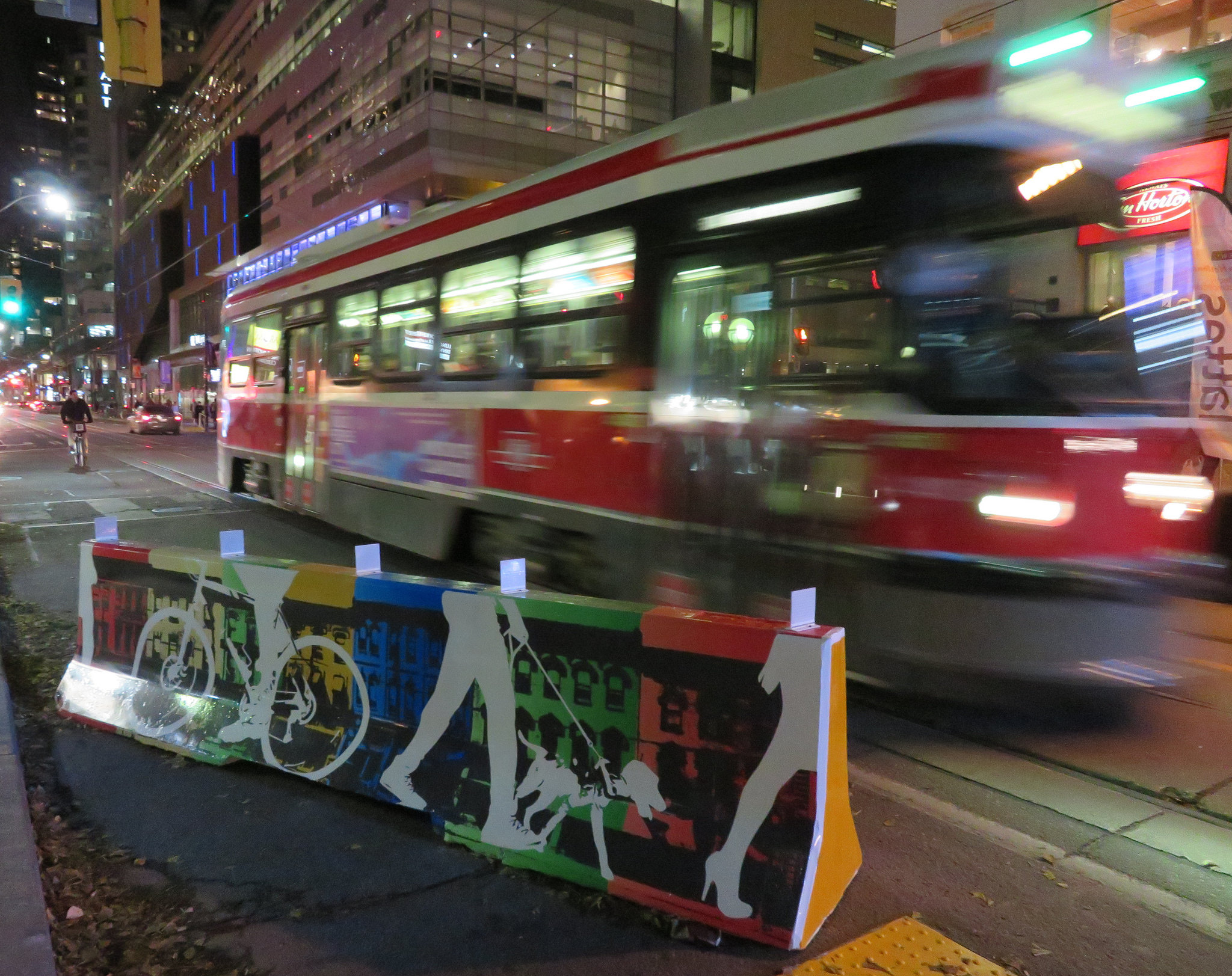
    The decision to maintain the status quo on Yonge Street benefits commuters outside of Toronto more than local residents, so it is puzzling why Mayor Tory has declared his support — once again — for an option that puts drivers first. Nearly three-quarters of rush-hour drivers on Yonge Street through North York come from York Region. A majority of residents take transit, walk, or cycle; they would benefit from a safer, more pleasant street. Moving the bicycle route to Beecroft Avenue serves to move cyclists out of the way of cars, rather than providing a direct route with better access to transit, shops, and homes.

    With Doug Ford focused on the Ontario Progressive Conservative party leadership race, there are — as of yet — no high-profile challengers to Mayor Tory’s re-election bid. There is no need to pander to a voting bloc angered by a so-called “war on the car” unless Tory actually supports suburban commuters over his own constituents. And this decision will only cost more money.

    Once again, Mayor John Tory has chosen the wrong way.

  • Mapping Toronto’s approved new ward boundaries

    18506683800_6c96dcc66b_k

    On Monday, October 22, 2018, Torontonians will be electing a new city council. And for the first time since 2000, Toronto’s ward boundaries will be changing.

    When the new council is formed on December 1, 2018, there will be 47 wards, up from 44. Downtown Toronto will gain three new seats, and North York will gain one, but one seat is lost in Toronto’s west end, in an area currently represented by Wards 14, 17, and 18. Seven wards in Etobicoke, North York, and Scarborough will remain unchanged.

    Earlier this week, the City of Toronto added the new boundaries to its open data catalogue, so I used the data to create an interactive Google map. This map, embedded below, shows both the current 44 wards, and the approved new 47 wards. Each of the two ward boundary layers can be turned on and off.


    Google map showing current and approved new ward boundaries

    These new ward boundaries are the result of a long four-year study and consultation process, and represent a compromise that improves representation in high-growth areas, while minimizing the loss of council representation elsewhere. Several other options were explored, including reducing the number of councillors to 25, but they were rejected by the consultants hired by the city to draw the new wards; they were also unpopular among members of the public who attended the consultations.

    While Toronto City Council approved the new boundaries in November 2016 (despite Mayor John Tory’s opposition), Councillors Justin Di Ciano (Ward 5) and Giorgio Mammoliti (Ward 7) appealed the new boundaries to the Ontario Municipal Board. Happily, the OMB dismissed the two councillors’ complaints last month. Both councillors are likely to run for re-election in modified versions of their existing wards.

    I will update the interactive map, adding candidate names for each of the new wards. Nominations are open from May 1, 2018 through July 27, 2018.

    Thanks to Gil Meslin (@g_meslin), who altered me to the fact that the new ward boundaries were available on the city’s website. 

  • King Street complainers need to remember why they’re on King Street

    26777810469_e87676d219_k

    On Friday, CBC Toronto ran a story on several King Street West businesses that have claimed that the new King Street Pilot have caused them to lose customers in December.  The three business owners mentioned in the article were Laleh Larijani of Forno Cultura, a bakery on King east of Bathurst, and two Restaurant Row restaurateurs: Jesse Warfield, whose family owns the Gabby’s chain of restaurants, and Fred Luk, owner of Fred’s Not Here and The Red Tomato.

    The King Street Pilot was launched by the City of Toronto on November 12, 2017. At many intersections between Bathurst and Jarvis Streets, cars and trucks are required to turn right off of King Street, prioritizing streetcar traffic. Most on-street parking spots were removed from King Street through this section, but designated areas allow for deliveries, passenger pick-ups and drop-offs, and access to local properties, including parking garages. Despite some [predictable] hyperbole from suburban politicians and reactionary journalists, cars are not in fact banned from any section of King Street. And there are many public and privately-owned garages adjacent to the pilot corridor for motorists to park at.

    For transit riders, the King Street Pilot is working. In December, the TTC reported travel time reductions for the busy 504 King and 514 Cherry Streetcars of up to 24 percent. However, it still struggles to keep up with demand. The continuing delays in the new streetcar deliveries from Bombardier have not helped matters; and streetcars still often run overcrowded, leaving some passengers behind at streetcar stops. There are some necessary tweaks to be made: TTC schedules should take advantage of improved travel times, and transit signal priority is also necessary with the new far-side stop locations at intersections. Signal priority will help to ensure streetcars don’t have to stop at a red light at the near side of the intersection and again to load passengers at the far side.

    But since it’s a year-long pilot project, these tweaks can be made.

    Unfortunately the CBC article was weak in that it presented only the business owners’ complaints about the King Street Pilot, without hard data to back up the claims of lost business. Only one Toronto city councillor was quoted, John Campbell, who represents Ward 4, Etobicoke Centre. Ward 4 is an affluent, suburban part of the city that does not have any streetcar lines. Councillor Campbell, who also sits on the Toronto Transit Commission, would like to see street parking permitted during evenings and weekends:

    “I would like to see people able to park here in the evening, park here on the weekends, because listen, when it’s –15 C people don’t want to walk a block-and-a-half to get to a restaurant. They want to park within 100 metres. I think that would bring more vibrancy back,” [Campbell] explained.

    It’s worth pointing out that motorists will walk much further than 100 metres when parking at busy suburban malls like Sherway Gardens or Yorkdale; it’s also the distance from many GO Transit parking spots to the train platform. The walk between the front doors of the Royal Alexandra Theatre and Princess of Wales Theatre on King Street is nearly 200 metres.

    Watering down the King Street Pilot would doom it to failure: as any King Street transit rider knows, traffic congestion didn’t suddenly disappear at 6:30 PM. It’s an unreasonable expectation to find ample parking 100 metres from many downtown businesses and institutions.

    It’s worth noting that a suburban councillor has taken so much interest in watering down a downtown initiative championed by downtown councillors, and that as a member of the TTC board, Campbell wishes to reduce the benefit to many of the transit agency’s customers.

    Fred Luk, profiled in the CBC article, has a long history of complaining to Toronto media, as pointed out by urbanist and writer Shawn Micallef on Twitter. In the last few years, Luk has complained about the increase in the minimum wage, higher energy costs, the effects of the 2003 SARS outbreak and the 2010 G20 Summit, even the 1999 municipal indoor smoking ban. Yet Luk’s King Street restaurants persisted.

    There are many factors that can influence the success of restaurant businesses. Obviously, the quality of food and service should be examined. It’s worth noting that Toronto is bearing with unseasonably cold temperatures, it’s the low season for tourism, and there aren’t any blockbuster musicals currently playing at the Royal Alex or Princess of Wales. Motorists still have to get used to the new arrangements and change their habits; it’s only been seven weeks so far. Once the weather improves, the curb lane in front of Restaurant Row can be used for wider sidewalks, even enlarged front patios.

    The smart thing for a business owner concerned about a decline in patronage would be to use the free publicity to promote the restaurants, rather than complain about a loss of business. Businesses in the Entertainment District are largely driven by walk-up traffic; there’s a reason why menus are posted by the doors and in the summertime, you can’t walk past Restaurant Row without having a representative out front trying to get you to look at their menu.

    Locating a restaurant on King Street West has lots of advantages: the proximity to thousands of residents, many nearby offices, hotels, entertainment and sports venues, and excellent transit access and ever increasing pedestrian activity. It is not realistic to expect ample street parking to be one those advantages.

    If access to parking were the chief concern, it would be wise to set up in a suburban plaza somewhere else, like in John Campbell’s Etobicoke. Complaining about a major improvement to the travel times of thousands of commuters, without offering any incentives for potential customers to visit your restaurants isn’t productive. Instead, doom and gloom messaging may only damage business further, resulting in a self-fulfilling prophecy.

  • A need for high-speed rail reality (Updated)

    IMG_6258-001VIA Rail train at Brampton Station, on the Toronto-Kitchener rail corridor

    Updated Friday May 19, 2017:

    Today, Premier Kathleen Wynne announced the commencement of an Environmental Assessment on bringing high-speed rail to Southwestern Ontario, connecting Toronto and Pearson Airport with Guelph, Kitchener, and London, with Phase II continuing to Windsor, with a potential stop in Chatham.

    Former federal Transport Minister David Collenette was assigned to write a report on building the corridor; it is now public on the Ministry of Transportation’s website. It proposes operating speeds up to 250 km/h, making it a true high speed line (though slower than many lines in Europe and East Asia, which have cruising speeds between 270 and 320 km/h). The estimated cost of the project is estimated to be $21-billion, reducing travel times from Toronto to Windsor to a mere two hours.

    figure-es-2-proposed-future-southwestern-ontario-passenger-rail-network.jpgProposed High Speed Rail system for Southwestern Ontario

    An option for a 300 km/h HSR service was studied, but found to be even more expensive, requiring more dedicated tracks. The 250 km/h option will allow it to use most of the existing Toronto-London and London-Windsor corridors.

    For southwestern Ontario, high speed rail could be a boon. Kitchener-Waterloo is a major educational and technological hub; faster and more frequent rail service will benefit university students, tech workers, and other commuters, perhaps those priced out of the Toronto housing market. London’s economy has taken some hits in recent years, so bringing it within commuting distance to Toronto and K-W gives residents there more options.

    Between Toronto and Kitchener, the report assumes two off-peak HSR trains an hour, and one GO train every hour, making local stops. It also assumes that GO RER service will continue to terminate at Bramalea, a poor location to terminate regional rail services; Downtown Brampton is one stop away. Building the “missing link” along Highway 407 will allow many more trains to pass through Downtown Brampton, which would allow for local RER trains to be extended to west Brampton, at Mount Pleasant GO. It would be a shame if the HSR plans (which, in principle, I support) pushed aside regional and local needs.

    Statford and St. Marys, which are only served by VIA trains (and no intercity coach service) will also have to be considered, as they will be bypassed by HSR. As well, towns and cities elsewhere in southwest Ontario, such as Simcoe, Tillsonburg, Wallaceburg, and St. Thomas, have no bus or rail access. For less than the $15 million pledged for the HSR EA, the province could fund several years’ worth of basic intercity bus service to connect these communities together.

    Unless assumptions change, Brampton residents will see twice as many trains speed by their downtown core than stop, which I think is unfortunate. In the original post below, I was worried that high speed rail dreams would distract from more immediate needs. I’m now afraid that I was right.


    Original post dated April 26, 2017

    When have I heard this one before?

    According to CTV News, the provincial government is looking to build a new high-speed rail line between Toronto, Kitchener, and London. The new plan, to be announced next month, is based on the work of former federal Transport Minister David Collenette.

    During his time as Transport Minister under Prime Minister Jean Chretien, Collenette backed incremental VIA Rail improvements, as well as VIA-FAST, a higher-speed train service between Toronto, Ottawa, and Montreal. Those proposed improvements were cancelled when Paul Martin became prime minister; currently VIA is pushing for a revised version of that previous plan. Collenette also pushed hard for a rail link between Toronto Pearson International Airport and Union Station, a fundamentally flawed proposal known as “Blue 22.” That airport rail link proposal was later relaunched as a provincial project and opened as UP Express in 2015.

    Ontario Transportation Minister Steven Del Duca was not especially clear about the plans for such as high-speed rail service, saying “…there are multiple definitions for high-speed rail depending on what you’re looking at.” Del Duca cited “geographical limitations,” while hoping that the federal government would contribute funds towards the project.

    Interestingly, only a week ago, Deputy Minister Deb Matthews (and London MPP) was downplaying the province’s plans, saying the province only promised to study, but not necessarily build, the high-speed rail corridor.

    I worry that high-speed rail is a distraction. In Canada, we have an abysmal record of proposing high-speed rail projects, but never following through. Even VIA’s less ambitious plan for dedicated tracks and new equipment to provide more frequent and reliable service, with somewhat faster travel times, is not yet secure.

    There is already a Toronto-Kitchener-London service; two VIA trains operate daily in each direction along the entire route, while GO Transit operates more frequent weekday trains to Brampton and four weekday round trips to Kitchener. Before the 1990 Brian Mulroney-era VIA cuts, there were five round trips on this line. In the 1980s, the fastest VIA train between Toronto, Kitchener, and London took 3 hours, 2 minutes; today, the fastest train is 3 hours, 22 minutes.

    This Rick Mercer Report video will never get old

    All that I want for the Toronto-Kitchener-London corridor in the short-to-medium term is the same as what VIA is proposing between Toronto and Montreal:

    • Dedicated tracks. On the Toronto-Kitchener-London corridor, this means building a new rail corridor, known as “The Missing Link” for freight trains between Halwest (near Bramalea GO Station) and Milton. This new route would divert Canadian National (CN) freight trains that currently pass through Brampton and Georgetown on the Toronto-Chicago mainline. Potentially, Canadian Pacific (CP) trains passing through Toronto and Mississauga could also be diverted, freeing up capacity on GO Transit’s Milton Line. CN freight traffic limits the frequency and speed of GO Transit rail service to Brampton and Kitchener; moving the through freight trains would allow for frequent, electrified, GO RER service beyond Bramalea, as currently proposed. CN is interested in partnering with the province to build this link; CP has not expressed interest.Ibi Missing Link map.jpg
      Map of the “Missing Link” from a 2015 IBI Group report
    • Rail improvements. Between Georgetown and Kitchener, the railway is owned by Metrolinx, and hosts four weekday GO Transit trains in each direction, two daily VIA trains in each direction, and several Goderich-Exeter Railway (GEXR) freight trains. Track is in good shape, but has several slow sections, including a two-kilometre section west of Guelph Central Station where trains crawl at 10 miles an hour (16 km/h).

      Improving rail speeds in central Guelph will be expensive, especially where the railway runs in the middle of residential Kent Street, but it will be worth it.
      Beyond Kitchener, the track is leased and maintained by GEXR, which has allowed the rails to deteriorate. Slow speeds are acceptable by a no-frills short line freight operator, determined to minimize maintenance costs, but not so for passenger rail. VIA trains are consistently late because of the condition of track, especially between Stratford and London. Purchasing the track, installing welded rail, and improving grade crossings will substantially improve reliability and speeds on this corridor.Incremental improvements, such as grade separations, improved signalling, and new passing tracks, would permit frequent, reliable, and faster rail service.
    • A new train fleet. Via Rail’s coaches are nearing the end of their useful lives; among the rolling stock used on the Toronto-Kitchener-London service are HEP-I and HEP-II coaches built in the 1950s and refurbished several times since. GO Transit’s commuter coaches are acceptable for shorter trips, but are uncomfortable for long-distance travel. With the completion of the “Missing Link” and the acquisition of the Kitchener-London rails, it would be possible to electrify the entire corridor. Electric trains benefit from faster acceleration times, especially electric multiple units.

    Some of these improvements can be started within the next year, before the 2018 provincial election. If the province wants to show that it’s serious about providing effective rail service to Kitchener and London, there’s no need for another high-speed rail study. Simply continue the work on the “Missing Link,” plan for GO RER to continue west of Bramalea GO, improve the existing rail infrastructure, and acquire the optimal fleet for medium-distance rail services. Once that is complete, planning for even higher speeds, possibly with a new purpose-built alignment, should begin.

    Canadians have been teased with high-speed rail proposals that never get anywhere, meanwhile existing rail infrastructure is neglected and intercity services are cut. It’s time to get moving with a sensible plan that can start right now.

  • A new low for the Scarborough Subway champion

    Note: a version of this article has been cross-posted to Spacing Toronto

    For 2016’s annual Torontoist Heroes and Villains feature, I nominated Toronto Councillor Glenn De Baeremaeker (Ward 38, Scarborough Centre) as villain of the year. (“Pedestrian blaming” won that dubious honour.) But I remain proud of my choice. As I wrote back in December:

    De Baeremaeker’s record of environmentalism has been overshadowed by an increasingly antagonistic tone, pitting supposedly downtrodden Scarborough against the rest of the city in his one-track quest to build a one-stop subway extension to his ward. In his myopic support of the subway, De Baeremaeker is opportunistic and vindictive, takes the low road, insults critics who engage in good faith debates, and in the process does a disservice to the community he represents.

    Councillor De Baeremaeker hasn’t changed his tone.

    Yesterday, May 10, the City of Toronto held a public consultation at Scarborough Civic Centre on the next phase of planning for that one-stop, 6.2-kilometre subway extension, which is estimated to cost $3.35 billion, and open no earlier than 2026.

    I wish I was able to attend last night’s meeting, as disgruntled Scarborough residents questioned the merits of that transit plan. And Councillor De Baeremaeker shamelessly blamed “downtown councillors” for the shortcomings of that one-stop subway. For a councillor who is rightly proud of his past environmental advocacy, it was surely a low point.

    Toronto Star reporter Jennifer Pagliaro, an excellent local journalist, covered the meeting. 

    City Scarborough MapCity of Toronto map from February 2016 illustrating current plans for the Scarborough Subway and connecting transit.

    At the public consultation, TTC and City planning staff answered queries from members of the public, many questioning the utility of the single-stop subway. There are no additional funds to rough in future stations, such as at McCowan Road and Lawrence Avenue, where the line would intersect the busy 54 Lawrence East bus and serve Scarborough General Hospital. As building future stations later would require an extended shut-down of the line, the one-stop subway extension will likely be forever a one-stop subway.

    (The eastern extension of the Eglinton-Crosstown LRT from Kennedy Station to University of Toronto’s Scarborough Campus is also part of the new plan for Scarborough, but the LRT component is unfunded.)

    Shameless as ever, Councillor De Baeremaeker resorted to strawman arguments, talking up a “suburban/urban divide”:

    [De Baeremaeker] blamed “downtown councillors,” who represent the most densely populated wards in the city, for not wanting to fund more frequent transit stops like their residents enjoy.

    Yes, it is true that all councillors representing central Toronto opposed the subway extension, but so did several suburban politicians, most notably Councillor Paul Ainslie (Ward 43 – Scarborough East). Yet not one of those councillors wanted less transit for Scarborough. Instead, they backed a seven-stop LRT replacement for the ageing Scarborough rapid transit line, including an extension to Centennial College and Sheppard Avenue in Malvern. That less-expensive line was fully funded by the provincial government, which would have permitted scarce funds to be spent on other transit projects across Toronto.

    Meanwhile Mayor John Tory was most interested in pushing SmartTrack, a fantasy rail project that got pared down as parts of the line were found to be impossible to build, and costs increased. The eastern end of SmartTrack conflicted with the Scarborough Subway extension. The three-stop subway plan was cut to a single stop at Scarborough Centre, to keep costs down and to not cannibalize SmartTrack.

    Yet Tory and De Baeremaeker are allies on the subway extension; Tory named him one of his Deputy Mayors to champion the line. But Tory’s push for his own project put him at odds with De Baeremaeker’s focus on the subway extension, any subway extension, to his ward.

    It is also worth noting that until 2012, De Baeremaeker supported Transit City, the transit plan championed by David Miller that would have delivered three new light rail lines to Scarborough.

    I am not surprised by De Baeremaeker’s shameless politics. But his performance last night was especially crass and dishonest. Backed into a corner, faced with angry local residents, he lashed out at imaginary villains. But subway backers largely have themselves to blame; despite winning every recent vote on the subway plan, they have only one stop to show for it.