Category: Transit

  • Tunnel Vision: A History of Toronto’s Subway

    IMG_0209-001

    If you haven’t yet had a chance to go, you should be sure to visit the Market Gallery at St. Lawrence Market. The current exhibition, called Tunnel Vision: The Story of Toronto’s Subway, is a fascinating collection of maps, photographs, memorabilia, and drawings illustrating over a century of subway plans and operations in Toronto. Dominating the gallery, which was the City of Toronto Council Chambers in the 19th century, is the front of an H-4 subway car; visitors are encouraged to take selfies with it.

    While Canada’s first subway opened in 1954, there were serious subway proposals that date back to 1910. Interestingly, many of these early subway maps feature a line that looks very similar to the (Downtown) Relief Line.

    I wrote more about this exhibition, which continues until June 11, 2016, in Torontoist

  • Digging a hole on Main Street

    Fullscreen capture 29022016 113646 PM

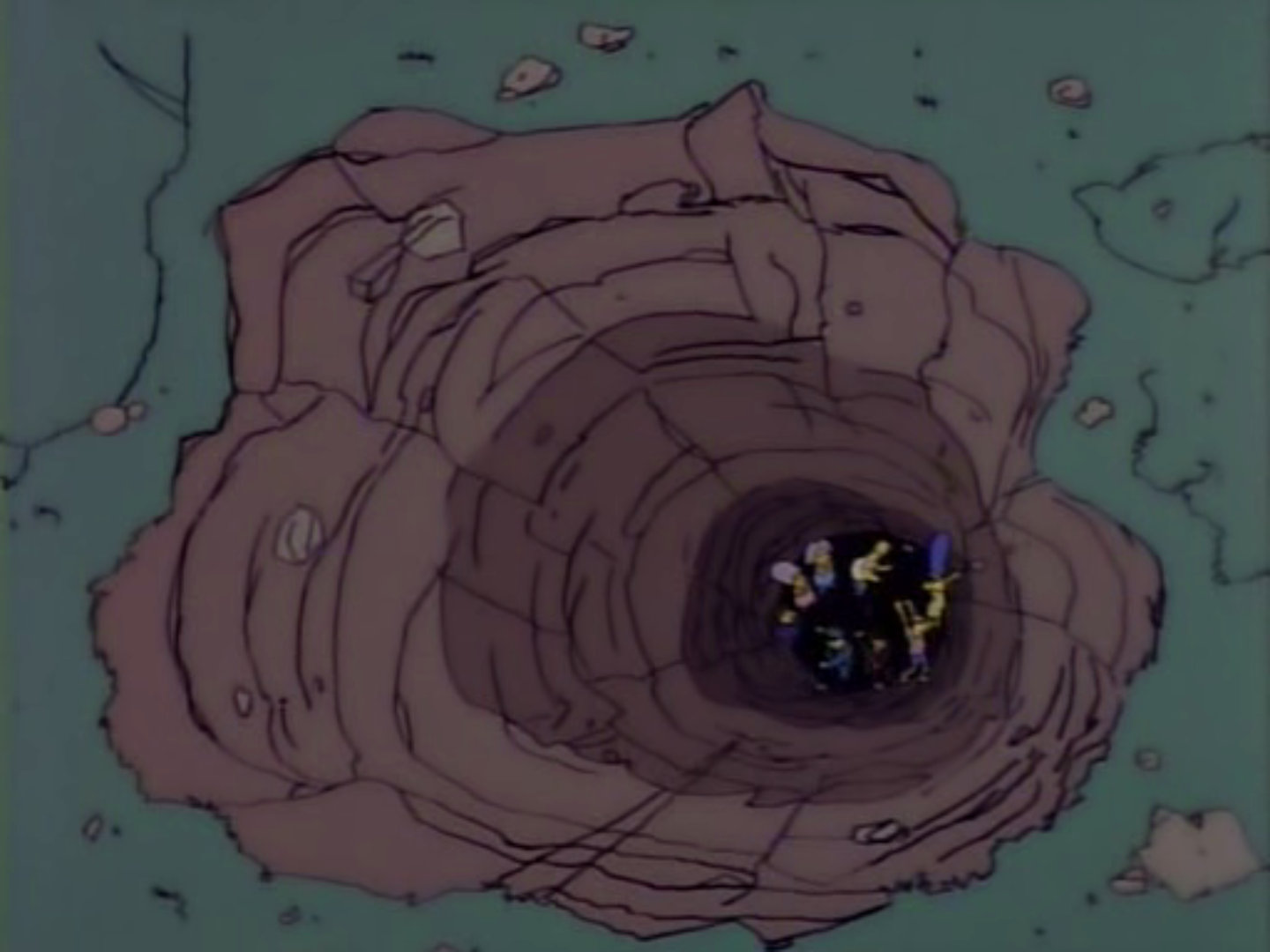
    Most people that know me know that I’m a fan of The Simpsons. There’s a scene at the end of a classic episode, entitled “Homer the Vigilante,” where several characters, including Homer Simpson, Otto Mann, Mayor Quimby, and Police Chief Wiggum are stuck in a hole, looking for a non-existent buried treasure.

    The final few minutes of the episode are a spoof of the 1963 comedy epic It’s a Mad, Mad, Mad, Mad World: a cat burglar tricks the people of Springfield into seeking his buried treasure while he escapes from the police lockup. A briefcase found quickly when digging under a “Big T” says as much, but a few determined souls decide to keep digging in the vain hope of finding that promised treasure. Finally, after digging for hours and finally realizing that there was no fortune to be found, the remaining excavators decide to dig their way out of the deep hole they find themselves in. As the final scene fades into the credits, Wiggum suggests they’re all doing it wrong, providing some nonsensical advice: “No, no. Dig up, stupid.”

    On October 27, 2015, Brampton City Council decided, in a 5-4 decision, to terminate the provincially funded LRT line at Steeles Avenue. Council was pressured by local opposition from wealthy landowners on Main Street South and several downtown businesses. Construction on the shortened transit corridor is scheduled to begin in 2018.

    After rejecting the recommended surface alignment, Council asked staff, which twice recommended the original surface route, to come back with alternative alignments. Late last week, staff released its report on the various options for extending the Hurontario LRT from Steeles Avenue (Shoppers World). That report, buried in a large PDF document, starts at page 238. The report will be brought to the Planning and Infrastructure Committee on Monday, March 7, and will likely presented at a special public meeting on Monday, April 18.

    Yesterday, in Bramptonist, Divyesh Mistry summarized the report’s recommendations. Staff recommended  two tunnel options. Both potential tunnel alignments would extend from a portal between Elgin Drive and Nanwood Drive under Main Street to the GO Station, either with underground stations at Nanwood and Wellington Street (at Brampton City Hall and Gage Park), or running straight through without stops, but a new surface stop at Elgin Drive. The first option, with underground stations at Nanwood and Wellington, would cost $570 million; the second tunnel option would be cheaper, costing $410 million. The tunnel would have to clear the Etobicoke Creek bed, and each underground station would require stairways and elevators to provide access.

    Staff recommended that council authorize $2.5 million for a new transit project assessment process (TPAP), including technical and design work, that would take two years to complete.

    Fullscreen capture 01032016 120953 AM
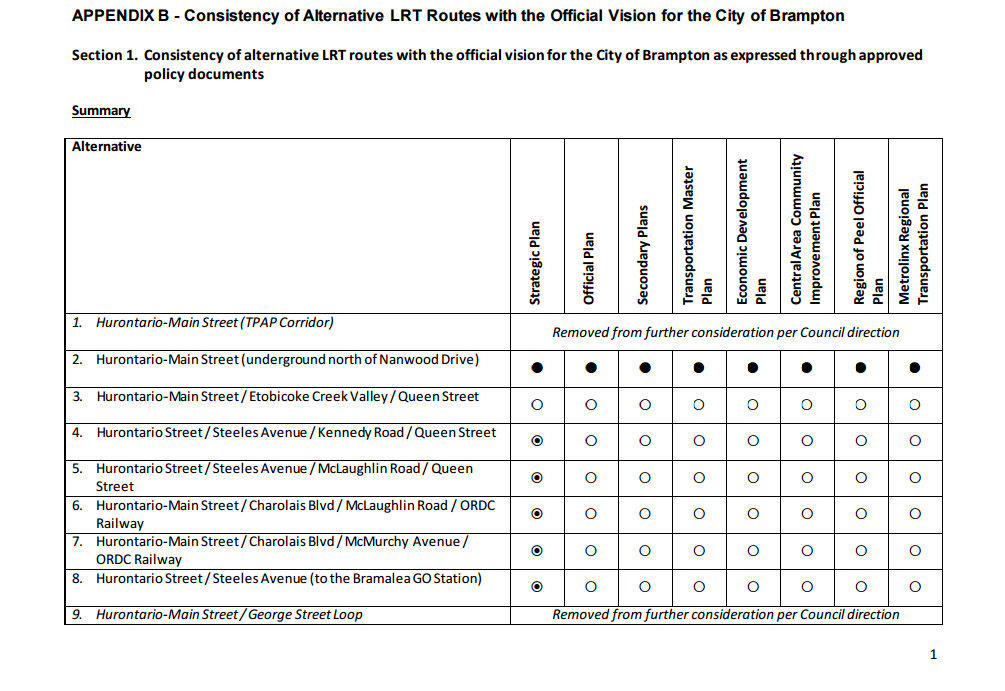
    Appendix B from the City of Brampton staff planning report, which outlines each LRT routing option’s consistency with city, regional, and provincial planning policies

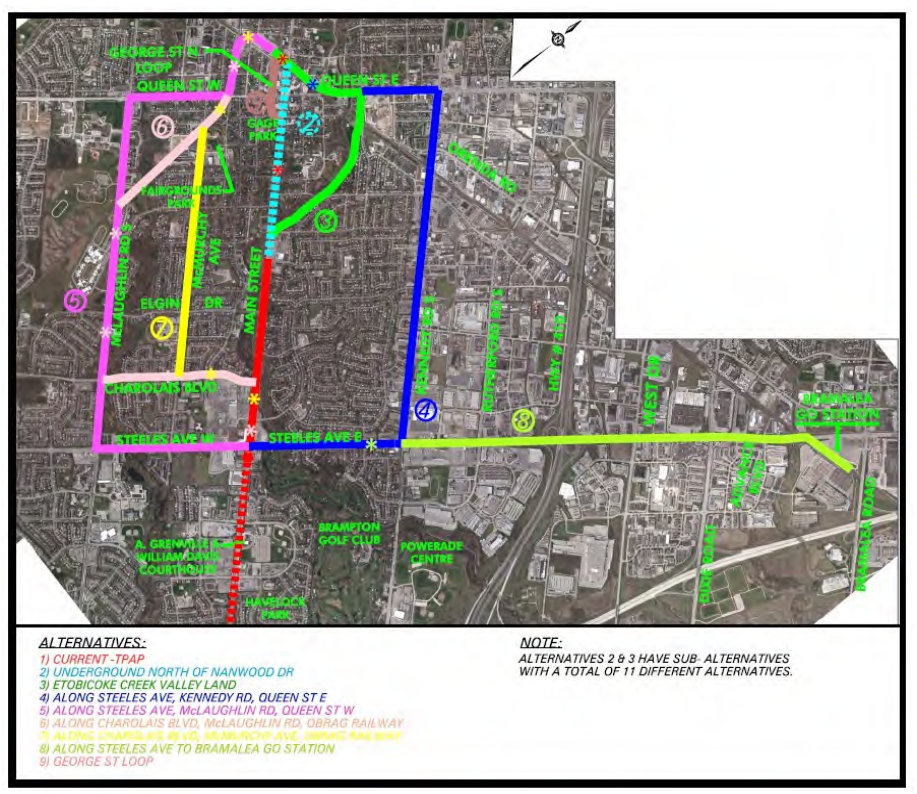
    Of course, cheapest and most obvious option, running the new light rail line on the surface between Nanwood Avenue and the Brampton GO Station, was “removed from further consideration per Council direction.” Various other alignments that would have seen the light rail line follow  McMurchy Avenue, McLaughlin Road, Etobicoke Creek and/or the Orangeville-Brampton Railway were rejected as they were found to be inconsistent with various planning policies, including the city and regional official plans and economic and transportation policies. The various other alignments would be less direct, follow active railways or floodplains, and move the LRT away from Main Street, but in the neighbourhoods of other, less wealthy residents.

    Fullscreen capture 01032016 121050 AM
    Appendix A: from the City of Brampton staff planning report, a map of alternative LRT alignments north of Steeles Avenue

    If money weren’t an object, the first tunnel option, with stops at Nanwood and Wellington, would be a reasonable compromise. It maintains the linear alignment most suited to moving passengers, it gets the LRT to Downtown Brampton, the Queen Street corridor, and the GO/VIA station, and it placates the local NIMBYs worried about light rail trains operating on Main Street.

    But the City of Brampton, when it rejected the alignment north of Steeles Avenue planned during a multi-year TPAP, threw away the $200 million the province was prepared to spend on that segment. If Brampton ends up deciding to extend the LRT, it’s already in a $200 million hole, unless it can convince Queen’s Park to give that money back. If it decides to build a tunnel, it will dig itself even deeper into that hole. The cheaper of the two tunnel options misses useful stops at Wellington and at Nanwood, where the Brampton Mall lands provide an excellent opportunity for urban intensification.

    So I see three options going forward:

    • The status quo. Brampton City Council balks at the costs of each alternative alignment, and the Hurontario-Main LRT terminates at Shoppers World. Maybe in a few years, Brampton will realize its mistake, à la Mesa, Arizona, and approve and build the extension. I see this as the most likely outcome.
    • A return to the surface TPAP LRT alignment. Brampton City Council, once again faced with a staff report advocating the direct Main Street alignment, balks at the cost of the tunnel, and decides to reverse position, even begging Queen’s Park to provide funding. Will a dysfunctional Brampton City Council come to this decision? Possible, but unlikely.
    • A go-ahead for a tunnel. With the recent election of a new Liberal government committed to building infrastructure, there’s a slight chance that Brampton would find enough support from upper levels of government for partial funding for a $410-570 million tunnel into Downtown Brampton. But it will be up against many competing bids for transit funding. London, Ontario has a plan for a rapid transit system. Ottawa is ready to start building Phase II of the Confederation Line LRT. And, of course, Toronto has several plans for new subways and LRT lines. Will Brampton be willing to go it alone?

    As Lisa Stokes points out, Brampton already has a $1.5 billion infrastructure gap, and there are many other projects that the city needs in the short to medium term, such as a second full-service hospital campus, a central library, a permanent market space, or simply repairing the roads, parks, and recreation centres in dire need of attention.

    So because of its rejection of a financially and technically sound surface routing last October, the City of Brampton will likely go through a new round of project assessments. It will also have to go begging for money to build their preferred alternative. Without even starting construction, City Council dug a pretty deep hole for itself. Can it dig itself out?

  • The upshot of the new, lower UP Express fares

    24281427544_ddb67d604d_k

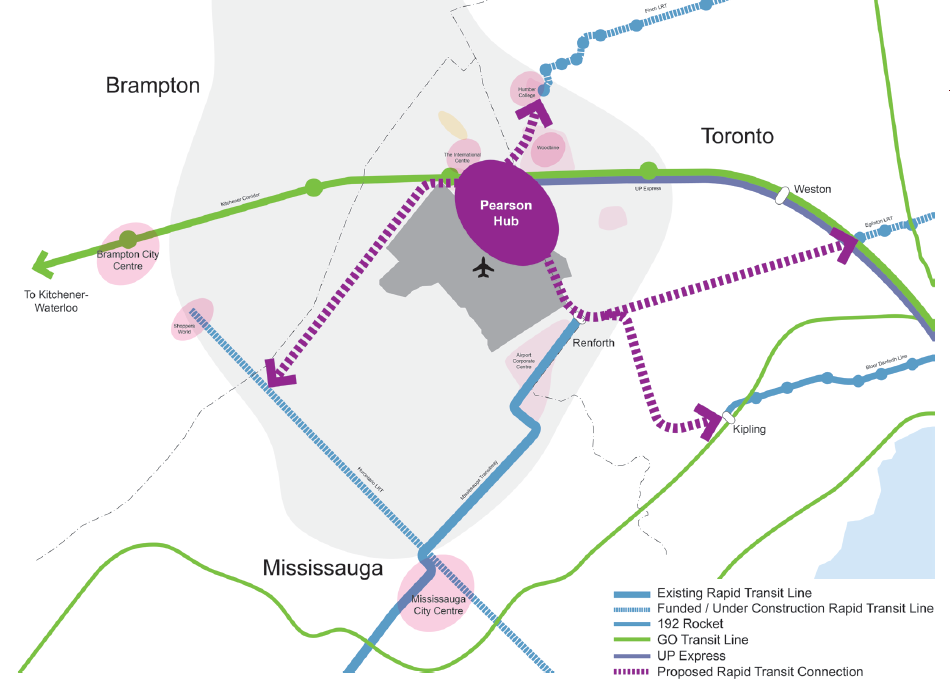
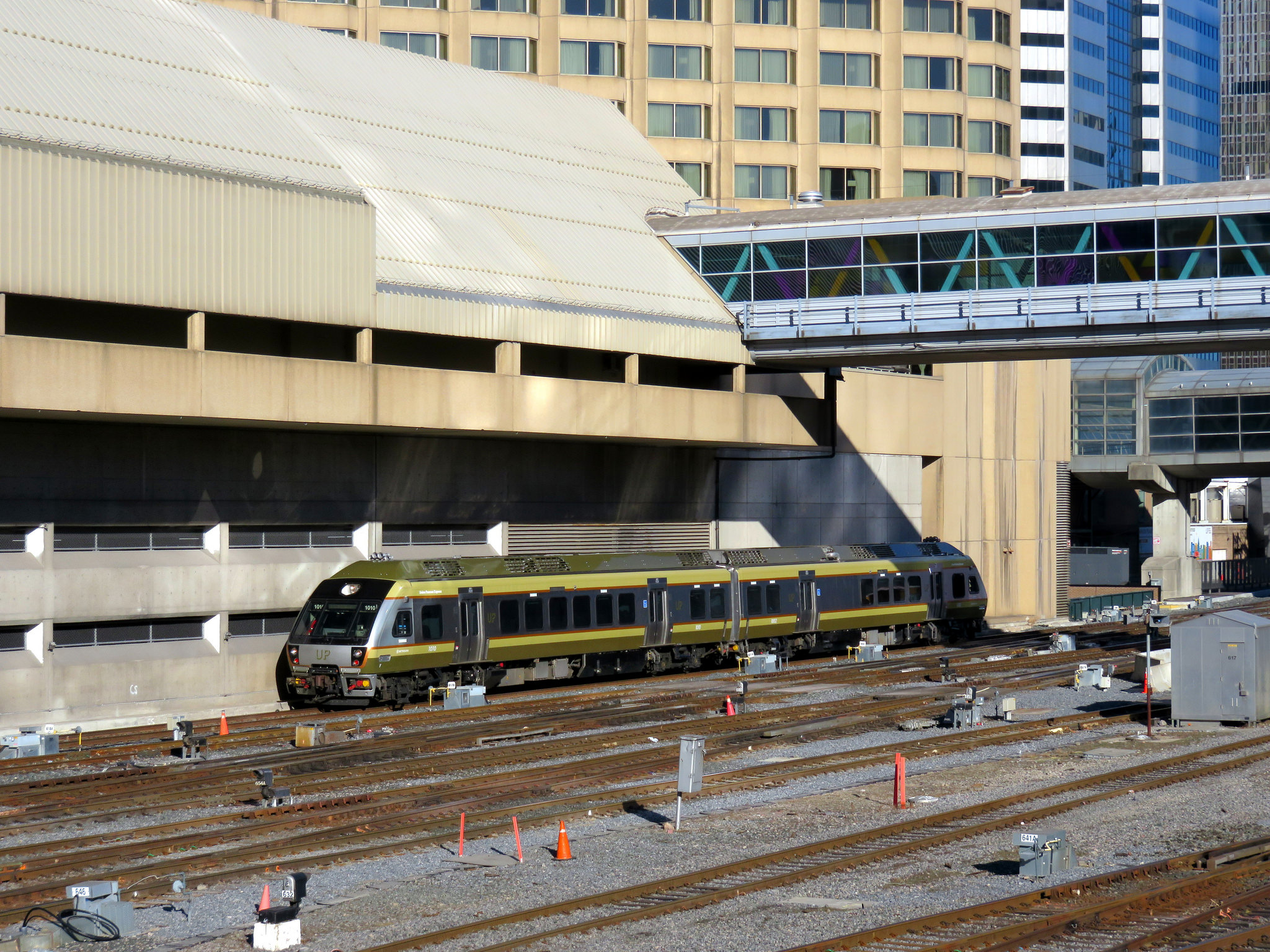
    Earlier this month, I commented on the poor ridership numbers of UP Express, Metrolinx’s airport rail link between Toronto’s Pearson International Airport and Union Station. I suggested that despite the embarrassing ridership figures, UP Express (UPX) was no white elephant. I argued that instead, the rail service could be a useful transit link for residents of North Etobicoke, Weston, Mount Dennis, and West Toronto.

    Later today, Metrolinx’s Board of Directors is expected to approve a major fare reduction for UPX slashing fares by over 50 percent. The Globe and Mail broke the story yesterday; today the Toronto Star has more details.

    The one-way cash fare between Union Station and Pearson Airport will drop from $27.50 to $12.00; the fare charged to Presto cards will drop from $19.00 to $9.00. Fares between Union Station, Bloor and Weston will drop to the equivalent GO fares. (The 2016 GO Transit fare from Bloor to Union Station is $5.30, or $4.71 with Presto; from Weston, it is $5.65, or $5.02 with Presto).

    The UPX fare between Union Station and Pearson will still be priced at a premium compared to the equivalent GO Transit fare — the cash fare from Union to Malton Station is $7.70, or $6.84 with a Presto card.

    Interestingly, before UPX was launched, Metrolinx conducted studies on potential ridership and fares. One study, by Steer Davies Gleave, that some UPX trains might even at capacity by August. You can read Metrolinx’s market research and ridership studies (with some details redacted) here. Obviously, there weren’t enough well-heeled business travellers willing to ride UPX for $27 each, or even enough local residents willing to pay $19 with their Presto card.

    This change in pricing makes UPX much more attractive for commuters in the Junction/Junction Triangle neighbourhood, as well as those living in Weston. The lower fares should help increase ridership between Pearson Airport and Union Station as well. It’s a good start, but it isn’t enough.

    Last year, I commented on GO Transit’s “fare by distance” structure, which charges disproportionately high fares for short distances, and very inexpensive fares for long commutes.  While GO offers co-fares to suburban transit agencies, it offers no such fare integration with the TTC. GO Transit offers free parking at suburban rail stations, burying the cost of building and maintaining its parking lots into the fares of every passenger, whether they need parking or not.

    The charts below show the single ride and Presto fares, per distance travelled in 2016, with the new UPX fares. Per distance travelled, a GO Transit fare to Union Station to Exhibition, Bloor, and Danforth is more expensive than going from Toronto to Pearson Airport via UP Express.
    2016CashFares 2016PrestoFares

    Metrolinx is in the midst of developing a new fare integration strategy, so hopefully these concerns will be addressed. Once the TTC completely rolls out Presto at all subway stations and on all buses, it will be technically simple to adopt a GO-TTC co-fare, and UPX should be part of this as well. There are tens of thousands of jobs at the airport and in the surrounding offices and industrial parks. With proper fare integration with TTC, Miway and Brampton Transit (all of which serve Terminal 1), UPX could become much more useful to many more commuters.

    Lowering UP Express fares is a good start, a welcome acknowledgement that the rosy forecasts of business travellers crowding the airport trains were never reached. But lowering fares isn’t enough: with proper fare integration, UP Express can offer far more utility than simply being an airport rail link.

  • Down is the new UP: Thoughts on dismal UP Express ridership

    19008325386_9c321ac7ab_k

    At February 10th’s Metrolinx board meeting, there was an update on the Union Pearson (UP) Express ridership. The news isn’t good, as ridership dropped in the last few months, instead of growing according to Metrolinx’s rosy projections.

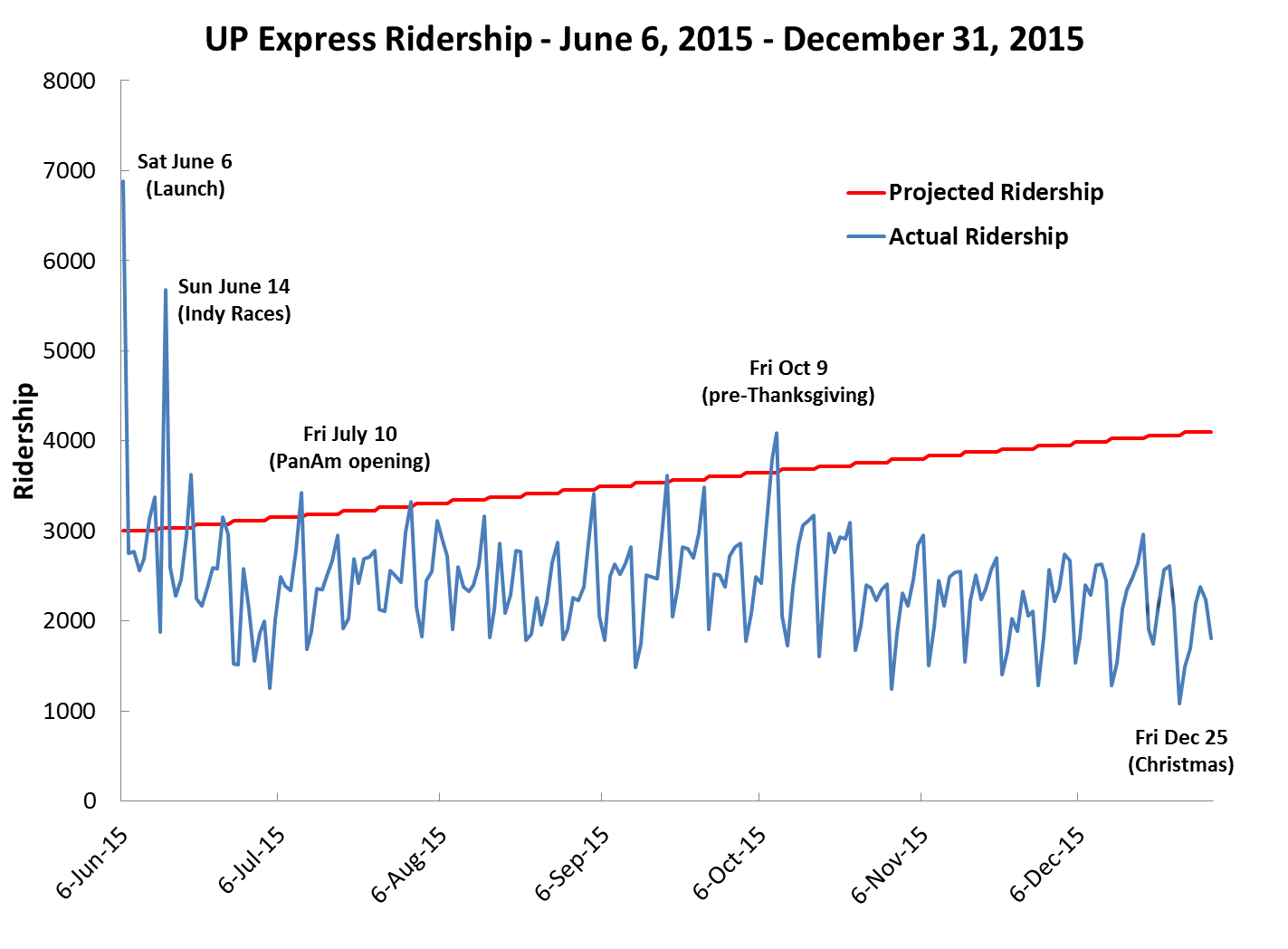
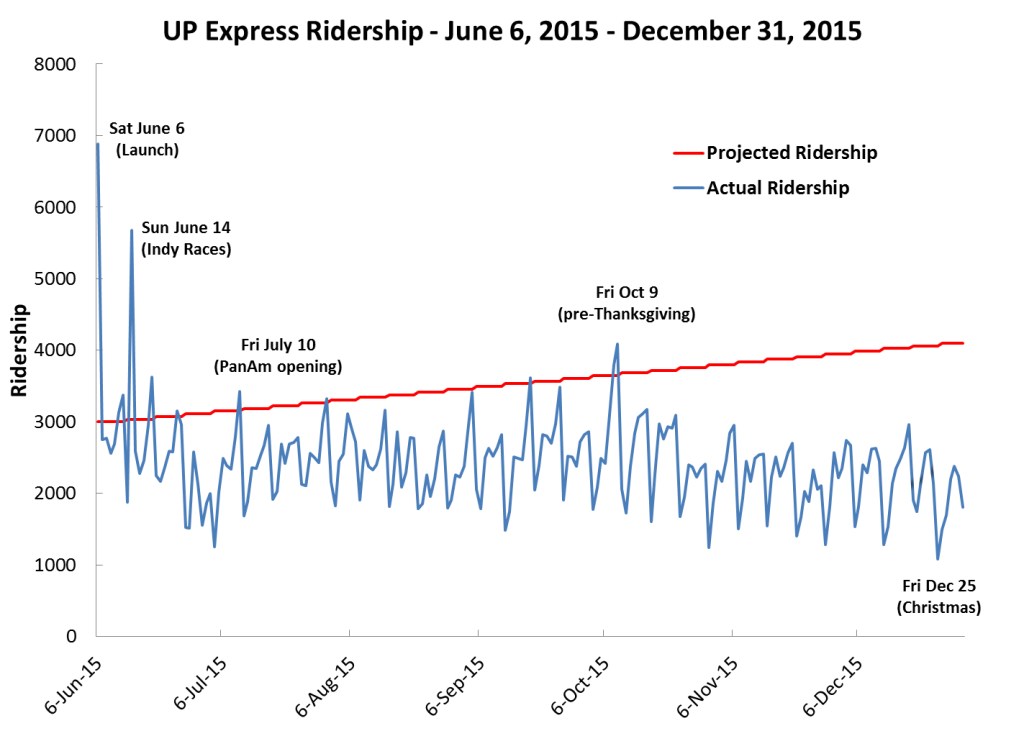
    UP Express launched on Saturday, June 6, 2015, a month prior to the 2015 PanAm/ParapanAm Games. I was one of thousands to ride the train on that inaugural day; thousands of free tickets were given to the public. Nearly 7,000 rides were taken that Saturday, a number that has yet to be surpassed. Metrolinx estimated that UP Express would start off with an average of 3,000 daily riders, and within a year, there would be 5,000 daily riders. While the base one-way fare for UP Express is $27.50, the fare for Presto cardholders is $19.00.

    The line chart below shows the projected ridership (increasing weekly towards 5,000 riders by June 2016) and the actual daily ridership. As one can see, the ridership varies by the day of the week, mirroring trends in air passenger traffic. Fridays are generally the busiest day of the week for UP Express, while Saturdays are the quietest.
    UO

    After the June 6 launch, the busiest day for UP Express were Sunday, June 16, which coincided with the Honda Indy at Exhibition Place, when 5,673 passengers used the train. There were peaks on Friday, June 19 (3,628 customers), Thursday June 25 (3,077 customers), and on Friday, July 10, when 3,424 riders took UP Express, the day of the opening ceremonies for the Toronto 2015 PanAm Games.

    But ridership plateaued after October, which had the highest monthly ridership recorded, at 79,010, which works out to a daily average of 2,548 passengers. The last peak was on Friday, October 19, the day before the Canadian Thanksgiving long weekend. Nearly 5,000 passengers rode UP Express. Ridership dropped in November and December, a busy travelling season. The daily average ridership dropped to 2,169 in December, a new low, and never was above 3,000 after Friday, October 23. Ridership bottomed out on Christmas Day, when a mere 1,086 rode the train.
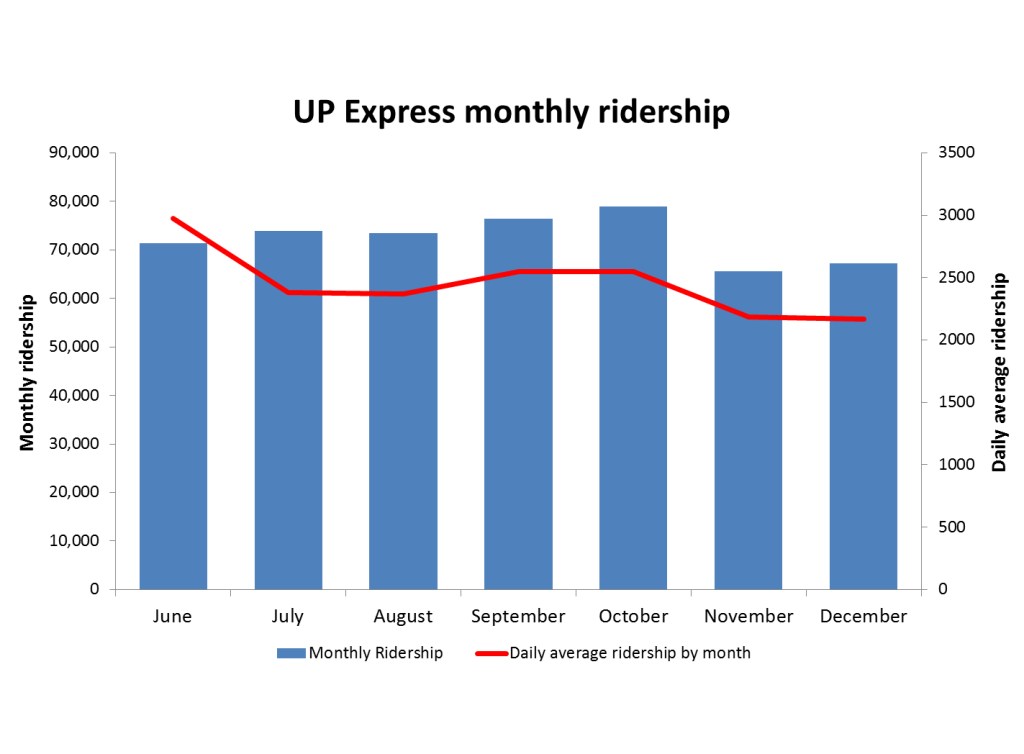
    MonthlyUPXMetrolinx should be embarrassed by these extremely low ridership figures. UP Express is a semi-autonomous operating division of the provincial transportation agency with its own President, Kathy M. Haley. The agency spent $4.5 million on a contract for branding with Winkreativewhich included special uniforms and even an “in-flight” magazine. The TTC’s 192 Airport Rocket, which has its own dedicated bus fleet, carries 4,700 passengers on an average weekday. The TTC doesn’t have a special operating division or President for that route, even though it carries nearly twice the number of passengers.

    For comparison, in 2014 — the last year for which detailed ridership data is available — only twenty-five regular TTC bus routes had a daily weekday ridership that was lower than the UP Express for the months of November and December. The 48 Rathburn Road bus route, a minor feeder route in Etobicoke, carries approximately the same number of people as the airport rail link.

    GO Transit’s Richmond Hill corridor — the lowest ridership of GO’s seven rail lines, with only 11 trains daily — had a daily ridership of 10,587 according to GO Transit’s Spring 2015 cordon counts, an average of nearly 1,000 riders per train. UP Express, with 156 trains a day averages just over 15 passengers per train.

    The narrative in the local media is that UP Express fares are too high; that ridership will improve if the fares are lowered. Metrolinx CEO Bruce McCuaig claims that “a lack of awareness” is the cause for the low ridership. Given the media hype surrounding the launch, and the improved wayfinding signage at Union Station and Pearson Airport, I don’t think that awareness is the problem.

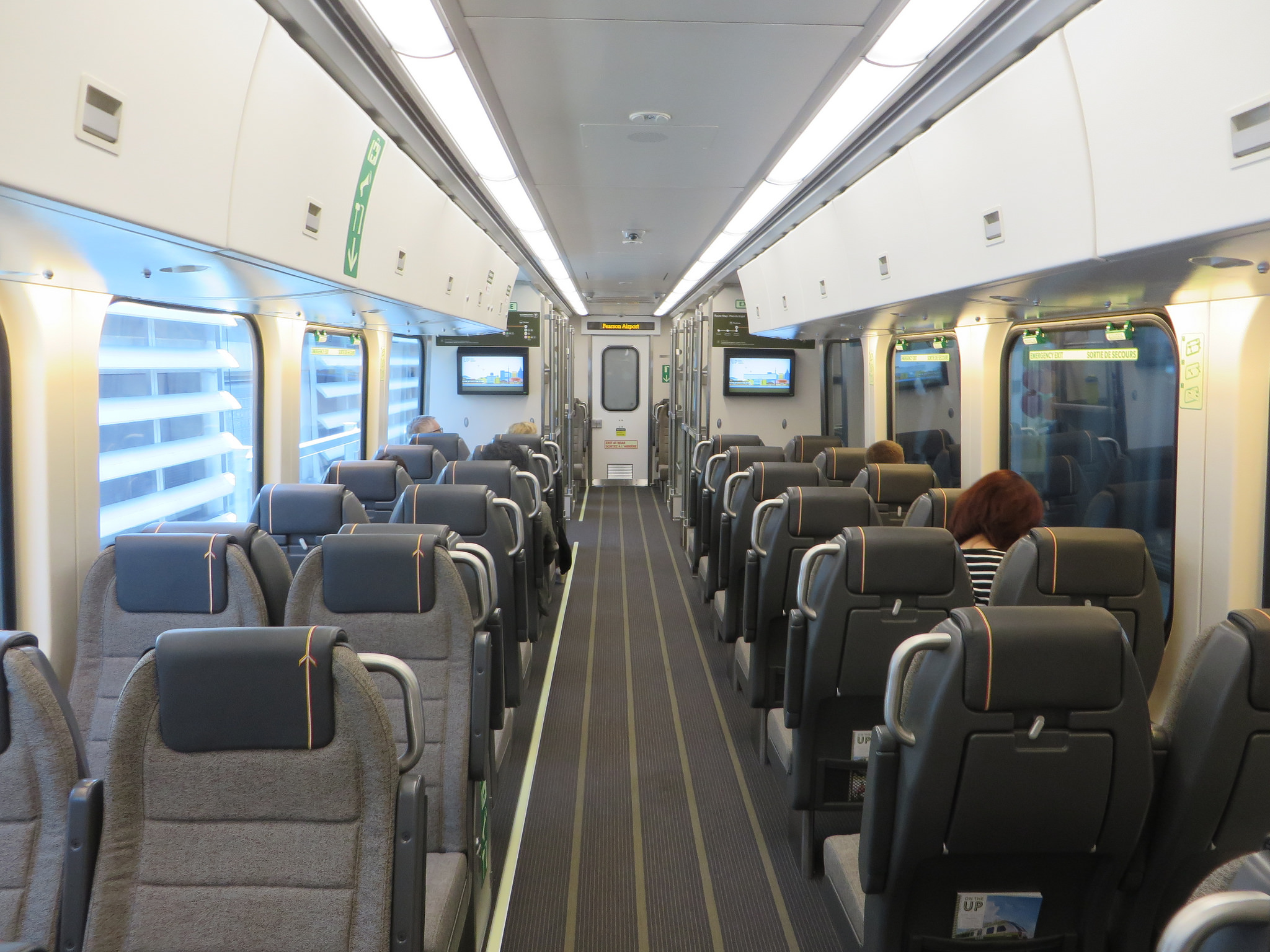
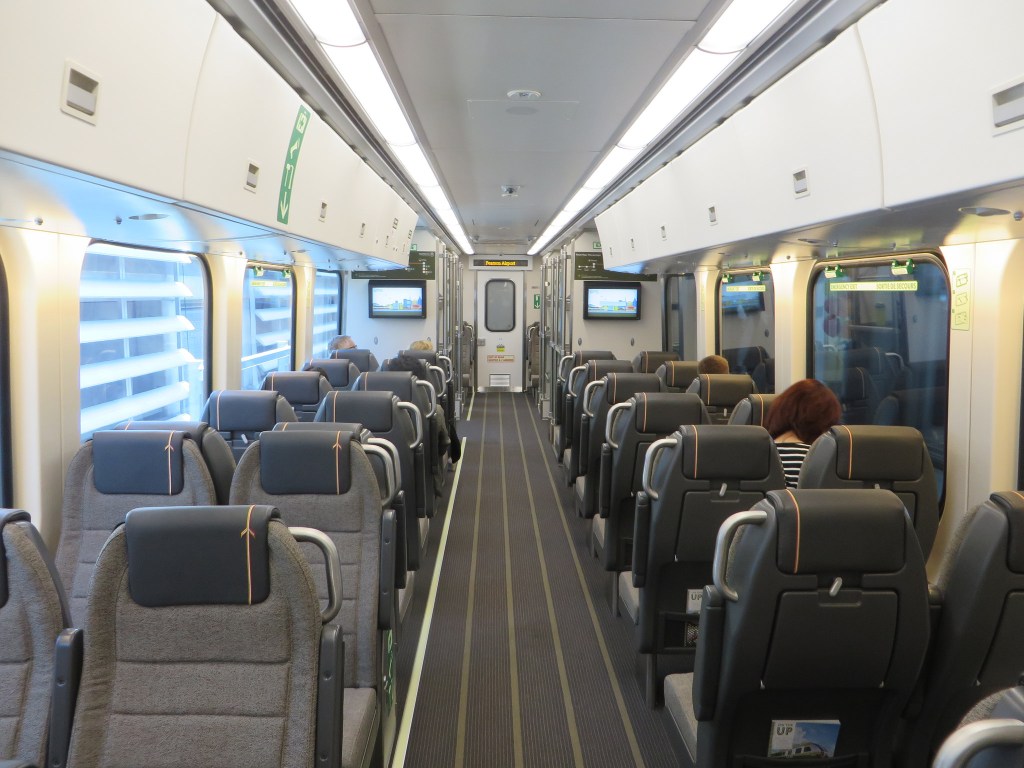
    I also don’t think that lowering UP Express fares, without looking at fare and service integration, is going to be a magic bullet either. Last year, I was pleasantly surprised by the announcement that Presto fares were going to be $19 for Presto cardholders, which was slightly less expensive than I expected. Travelling alone, it’s a bargain compared to riding a taxi or limo, especially if your origin or destination is in Toronto’s financial district. . (Connections at Bloor Station and in Weston are less useful.) I live about 15 minutes away from Union Station by foot, and I’ve taken advantage of UP Express. The cars are comfortable, the wi-fi is a nice perk, and the service is fast, friendly, and reliable.

    Happily, UP Express isn’t a white elephant. Most of the sunk costs — $456-million — are salvageable, and a rail link to Pearson remains an excellent idea.

    I think the answer is making UP Express more of a transit link, useful for residents of North Etobicoke, Weston, Mount Dennis, and West Toronto. The service would be more like Vancouver’s Canada Line; a part of the local transit network, but with a premium on single-ride fares from the airport to recover costs. Metrolinx could start by integrating UP Express with its GO Transit operating division, phasing out the ridiculous branding and separate bureaucracy.

    UP Express could even be part of a re-routed “SmartTrack” corridor, where it would make a few additional stop. But most importantly, it would become part of Toronto’s transit system, rather than a boutique airport shuttle service. The rail infrastructure improvements built for UP Express go a long way towards improving GO train service to Bramalea and points west. Hopefully, we get a revised airport rail link somewhat similar to that of Philadelphia, with fares integrated with the TTC and GO Transit. It’s also worth noting that Pearson Airport offers transit connections to GO Transit buses to Richmond Hill and Hamilton, as well as express and local Mississauga and Brampton Transit routes. There’s a need to recognize Pearson Airport’s role as a regional transit hub, not just a hub for Air Canada and WestJet.

    But the UP Express fiasco raises other questions. How can we expect Metrolinx to come up with a credible fare integration strategy when it can’t even get GO Transit fares right, never mind the UP Express? Yes, there are many fine people working at Metrolinx, but the UP Express hurts the organization’s credibility.

    All that said, I still sometimes feel optimistic about Toronto’s transit progress in recent years. The UP Express, while suffering from poor ridership, is still useful. The Eglinton-Crosstown LRT is underway, and might be extended in both the east and west. The [Downtown] Relief Line subway plan is still a viable project. And despite John Tory’s budget cuts, TTC bus service has been expanded in 2015 and 2016.

    Meanwhile, UP Express will be offering free fares this Family Day weekend. It will be interesting to know whether this promotion will increase ridership on the weekend or not.


    Thanks to Steve Munro for providing me with a copy of Metrolinx’s ridership numbers for UP Express.
     

  • The terminus of the Hurontario LRT: an opportunity for something better

    IMG_8755-001
    Downtown Brampton, the logical terminus of the Hurontario-Main LRT

    I’ve written several times about the Hurontario-Main light rail transit (LRT) project on this blog. Last summer, I led a walk along Main Street, discussing Downtown Brampton’s wonderful built heritage, the potential for Main Street, and explaining why alternative routes, proposed by councillors and private interests, weren’t feasible. Floodplains aren’t great places to build higher-order transit lines.

    Needless to say, I was very disappointed that Brampton City Council voted 6-5 last October against building the LRT between Steeles Avenue and Downtown Brampton. A vocal and wealthy minority, including a former premier of Ontario, opposed the project; it didn’t help that Mayor Linda Jeffrey found herself in constant opposition with several city councillors who backed other candidates for mayor in the 2014 municipal election. A Toronto Star reporter, assigned to the western GTA beat, wasn’t reporting fairly on this issue either.

    Since that unfortunate vote, I resigned myself to a truncated Hurontario-Main LRT corridor that will still serve three or four stops in Brampton, but will stop short of its logical terminus.

    I recently made a trip out to the intersection of Steeles Avenue and Main and Hurontario Streets, the new northern terminus of the planned LRT. Construction of the 20-kilometre line, between Port Credit and Steeles Avenue, is scheduled to begin in 2018.

    HMLRT
    The Hurontario-Main LRT, after Brampton City Council’s vote in October 2015. 

    The corner of Steeles Avenue and Main Street is already a major transit hub. Eleven Brampton Transit bus routes (including two Züm routes), a Miway express bus, and GO Transit buses serve the corner; the Brampton Gateway Terminal is the city’s second-busiest transfer point. The new Gateway Terminal, which opened in 2014, was built to accommodate ridership growth and facilitate transfers with the proposed LRT, which will stop in the median of Main Street.

    As far as Toronto’s suburbs go, this corner of Brampton is relatively dense. There are several rental towers within a short walking distance; there are also three nearby townhouse complexes. Shoppers World, on the northeast corner, is a large regional shopping centre, albeit a mall that has fallen on hard times. On the southwest corner, there is still an old farmfield, surrounded by subdivisions, apartment towers and retail. There are many opportunities for transit-oriented development.

    IMG_8803-001A fallow farm field, south of Shoppers World. The area is zoned for medium and high density housing developments, including townhouses and apartment buildings. 

    If Downtown Brampton, Brampton’s busiest bus route (501 Queen) and a GO Transit and VIA Rail station weren’t just 3 kilometres away, this would actually be an ideal terminus for a suburban light rail transit line.

    IMG_8776-001The corner of Steeles and Hurontario/Main, looking northwest. The Brampton Gateway Terminal is on the opposite corner.

    One of the greatest opportunities for new transit-oriented development is Shoppers World Brampton. First opened in 1969 by Peel Elder Limited (who also developed Shoppers World Danforth), the mall went through several additions over the years; by the 1980s, it boasted over 200 stores, including a Simpson’s, K-Mart, Pascal Hardware, cinemas, and two supermarkets. At one time, Shoppers World even had indoor waterslides. By 2000, Simpsons became The Bay, and K-Mart became Zellers.

    Growing up only a 15-minute walk away, Shoppers World was my local mall. Pizza Hut was a favourite place to meet up with friends, I fondly remember the free popcorn at Jumbo Video, and the bus terminal made it easy to get to better malls, particularly Square One. My first paying gig was returning abandoned shopping carts to K-Mart for $5 each.

    By the 1990s, the mall’s owners neglected the property, while Bramalea City Centre and Square One renovated and expanded. There were persistent rumours that the mall would be closed and re-developed with highrise towers.

    IMG_8782-001A mostly empty Shoppers World parking lot on a Saturday afternoon.

    RioCan REIT took over Shoppers World Brampton in 2000, renovated the property, and added new big-box retailers such as Canadian Tire. But The Bay closed in 2007, and Target, which took over Zellers’ lease, shut down last year. The final indignity came when the shuttered Bay store was torn down and replaced by Lastman’s Bad Boy.

    Shoppers World isn’t yet a dead mall – while many national chains left in the last two decades, small businesses have moved in. However, there are still plenty of vacancies, especially in the north end of the mall, near where The Bay used to be. The new Bad Boy and Beer Store are accessed only from outside the mall, making it harder to draw customers in.

    IMG_2887-001The former mall entrance to Target, showing the floor tiles installed in the 2000-2002 renovations.

    The answer, I think, is to partially redevelop Shoppers World into a mixed-use, transit-oriented development, retaining a majority of the retail space, but including new residential, office and community uses. Shops at Don Mills, at Don Mills Road and Lawrence Avenue in Toronto, isn’t a bad model to follow, but better residential integration and a proper link with the transit hub would be necessary. Humbertown, a smaller, but controversial development proposed for Etobicoke, has the right mix of retail and residential intensification.

    One day, I believe a new Brampton City Council will come to its senses and get the LRT extended to Downtown Brampton as proposed. This is what happened in Mesa, Arizona, a Phoenix suburb that originally opposed a light rail corridor from Downtown Phoenix, Tempe, and Arizona State University, to its downtown. After the first phase of the Valley Metro LRT opened in December 2008, political opposition to a light rail extension along Main Street faded. The LRT through Downtown Mesa opened to great fanfare in August, 2015.

    But until that time comes, there are some opportunities to capitalize on the approved plan. Steeles Avenue isn’t the ideal place to end the Hurontario LRT, but it’s a good place to start planning something better.

  • A new, improved TTC system map

    Last week, the Toronto Transit Commission quietly introduced a new system map on its website. The map, a 3.8 MB PDF file, can be directly accessed here.

    This new system map, which includes all scheduled routes including the limited-service community buses and the Blue Night network, is very different than previous editions of the TTC’s “Ride Guide,” but I think it is the best edition yet. That said, there are a few tweaks that I would like to see.

    Below is a screenshot of the new 2016 map, showing York University, Downsview Station, and North York Centre.

    TTCJan2016

    Unlike previous editions, the new Ride Guide is not to scale; subtle curves and bends in the road network are dispensed with in favour of a diagrammatic style, which shows transfer points very well. (It reminds me of the Los Angeles Metro system map.) Like the 2012 edition, shown below, only the streets served by surface routes are illustrated, but landmarks (such as hospitals, post-secondary education institutions, and major parks) are given more prominence than in previous maps. GO Transit rail lines are more prominent (with the same colours used on GO Transit maps and schedules), and there’s an effort to show connections with other transit systems, such as GO buses, and suburban agencies such as York Region Transit, Miway, and Brampton Transit.

    TTCAug2014
    Screenshot of the 2014-2015 edition of the TTC Ride Guide, showing the same area as the 2016 map.

    From 1994 to 2012, the TTC’s official system map included the routes of adjoining transit systems (see screenshot below). Note the YRT, GO Transit and Brampton Transit Züm routes converging on a very crowded York University. Depicting the connecting networks was certainly useful, but it added to a very cluttered map (which included the entire street network); it also relied on every other agency to provide timely updates. Removing the other transit agencies’ bus routes in 2014 allowed the TTC design team and cartographers to concentrate on their own system.

    In 2014, the system map was stripped of almost all features apart from the TTC’s own routes, a decision I criticized in a previous post. All landmarks were removed, as were all connections, apart from faint lines showing GO Transit rail corridors. It was easier to read, but went too far in removing important and use information. But it had a few improvements, such as highlighting the “frequent service network” – surface routes that operated every ten minutes or better at most times of the day. Express bus routes were better depicted.

    The 2016 edition restores these features lost in 2014. In a few places, the logos of the suburban transit agencies are once again shown, such as York University (where Brampton Transit, GO Transit and York Region Transit connect) and Pearson Airport (where Brampton, Miway and GO also operate). The contact information for the five neighboring systems is also included on the map. The addition of the frequent service category remains.

    TTCNov2012November 2012 Ride Guide

    Overall, I think the new map looks great. Surface routes are clearer, GO Transit rail lines are more prominent, and more points of interest are shown. Not only does downtown Toronto get a new inset, so does a complex section in north Scarborough, where the 102 Markham Road, the 53 Steeles East, and the 42A Cummer routes converge. The TTC design team has done a fine job.

    But I did find a few things about the new 2016 edition that I would like to see improved:

    • Hospitals are labelled inconsistently. Humber River, Sunnybrook, and Scarborough Centenary are, but North York General, Etobicoke General, Scarborough General, St. Joseph’s, East Toronto General, and the downtown hospitals are not.
    • Some suburban connections are shown, most are not. Pearson Airport shows GO, Brampton, and Miway logos, and York U shows GO, Zum, and YRT logos, but they are missing from Humber College, a major terminal for Brampton Transit (511, 11, 50) and Miway (22, 107), it’s a terminus for a YRT route as well. Rouge Hill GO shows a DRT logo, even though this is a very limited service, but there isn’t one for Miway at Long Branch, where two major routes, 5 and 23, terminate.
    • I’m not sure I like how branches are labeled now; I miss the use of the “+” that denoted a section of a route on which all branches operated on.

    Hopefully, we will see these relatively minor issues corrected in the next edition of the Ride Guide, which will likely be issued later in 2016.


    If you’re interested in the history of TTC maps, Transit Toronto has a fine archive of old system and subway maps dating back to the 1930s. It’s worth a look.

  • The challenge of getting to the bus stop

    IMG_8796-001

    It’s time for a rant on suburban transit, and how unnecessarily difficult it can be to get to the nearest bus stop.

    Transit has a harder time in the suburbs. Population densities are lower than in neighbourhoods developed before the Second World War. Suburbs are not only built for the car, but they’re laid out with crescents, cul-de-sacs and winding street systems meant to discourage through traffic in residential areas. Backyard fences line arterial roads, safe pedestrian crossings might be a ten or fifteen minute walk down the road. These factors can make it difficult for people living in subdivisions and near busy streets to easily access a nearby bus stop.

    Last year, Streetsblog USA asked its readers to vote for the sorriest bus stop in America, and some of the submissions are truly awful. But in the Greater Toronto Area, there are many examples of poorly designed or located bus stops. Intersections like the one at Steeles Avenue West and McMurchy/Malta Avenue in Brampton, which, granted isn’t as bad as the StreetsblogUSA submissions, is just one example of how not to get people out of cars and onto public transit. Some thought into placing bus stops and improving access to local transit is necessary.

    I like Brampton Transit and what they’ve been doing over the last decade in my hometown. In 2005, the suburban transit agency began to re-organize its routes into a grid system. There were some hiccups: additional transfers, combined with low frequencies made some trips more difficult, but as ridership improved, so did service levels on key corridors. Schedules were adjusted to improve transfers. Connections to Toronto and Mississauga were improved. My hometown’s bus system was no longer a joke.

    Brampton Transit - December 1980 front

    Here’s what Brampton Transit looked like in 1980, marked with meandering routes and one-way loops. The 2015-2016 system map is here [PDF]. 

    In September 2010, Brampton Transit introduced its first “Züm” route, 501 Queen, which connects Downtown Brampton with York University. Like the first phase of York Reigon’s Viva and Durham Region’s Pulse, Züm was developed as a specially-branded limited-stop bus service. Züm stops have special shelters, with real-time schedule information, winter heating. And on sections of Queen Street and Steeles Avenue, special “queue jump” lanes allow buses to by-pass cars and trucks waiting at intersections.

    Services such as Zum and Viva, which operate mostly in mixed traffic should not be mistaken for “bus rapid transit” such as Ottawa’s Transitway or Bogota’s TransMillenio; “BRT-lite” or “quality bus” are more appropriate terms for these routes. Route 501 Queen operates every 15 minutes or better, seven days a week, into the late evenings. It’s proof that quality transit can be operated in Toronto’s suburbs, and be a success.

    Since Route 501 was introduced, three more Züm routes were added: 502 Main, which follows Main and Hurontario Streets as far as the Mississauga City Centre Terminal at Square One, 511 Steeles, and 505 Bovaird. Each of these routes complements an existing local bus route, though the level of service on these other routes are not as high as on Queen Street; Züm service ends sooner in the evenings (though local bus service operates until after midnight) and frequencies are lower.

    With the introduction of Züm, and combined with other service increases, Brampton Transit ridership increased by nearly 30 percent in the last five years (2011-2015). This increase is significantly higher than the rate of Brampton’s population growth over the same time period.

    In September 2015, the 511 Steeles Züm bus was extended west from Shoppers World to Lisgar GO Station in Mississauga; standard Zum shelters were installed along the corridor, including the intersection of McMurchy/Malta Avenues and Steeles. This intersection is only a few hundred metres from where I grew up. The existing bus stops for local bus routes were relocated to the new shelters, like the one seen below.

    IMG_8800-001

    Both bus stops were installed on the east side of the intersection. The trouble is that pedestrian crossings are prohibited on the east side, due to the priority given to motorists at this suburban intersection. Therefore, transit users may have to cross the intersection three times to get to and from their bus; with several rental apartment towers, townhouses, and compact single-family housing, this is not a low-density neighbourhood.

    IMG_8797-001

    From a traffic engineering rationale, this traffic arrangement, which has existed for about a decade, makes sense. The majority of traffic is on busy, six-lane Steeles Avenue. From the north, most traffic on McMurchy Avenue turns east (left) onto Steeles, while Malta Avenue is a short stub, serving a small townhouse development on the south side of Steeles Avenue. Eventually, Malta Avenue will continue south, hooking up with another section of the same street. For now, a dormant farm field separates the two streets and awaits development.

    To facilitate through traffic on Steeles, the cross streets, McMurchy and Malta, are given only green time equivalent to the minimum pedestrian crossing time. And to facilitate the left turns from McMurchy to Steeles, pedestrians are banned from crossing that side of the street. From the viewpoint of a traffic engineer, this makes sense, but it’s a mindset that ignores the needs of pedestrians and transit customers, and with the re-location of the bus stops, this has become more of a problem. This intersection is owned and maintained by the Region of Peel, not the City of Brampton, as Steeles is a regional road.

    There are two options here, and at other places where people must give way to cars:

    1. Allow pedestrians to cross at all four sides of the intersection, ignoring, for a minute, the desire for cars and trucks to move through with minimal disruption; or
    2. Move the bus stops to the west side of the intersection, minimizing the inconvenience for transit riders.

    Brampton Transit has done a fine job growing its ridership over the last decade, making it a bit easier to get around Toronto’s second-largest suburb without a car. But situations like these, where pedestrian access can be improved, are low-hanging fruit that would demonstrate that transit users are valued, even in the car-dependent suburbs. The current arrangement is unacceptable. Brampton and Peel Region should do better.

    There are plenty of cases elsewhere where there are poorly-located transit stops. One example here in Toronto is the eastbound stop for the TTC’s 42A Cummer bus at McNicoll Avenue at Boxdene Avenue in north Scarborough. There’s no sidewalk on the south side of McNicoll, and Boxdene runs north. Anyone attempting to use this stop is at the mercy of traffic on this busy, four lane road.

    Overall, I would like to see more thought put into locating bus stops in general and making sure they’re easily accessible.

  • Armed with facts, the Toronto Relief Line Alliance is launched

    TRLA-Map-01-1

    The Relief Line is a subway route intended to reduce crowding and congestion in Toronto’s existing subway system. Planned for over a century, we may finally see work started in a few years. If Toronto finally puts shovels in the ground on this vital transit project, we will have a new grassroots advocacy group, armed with facts, to thank for that.

    Even though a relief subway line is very old idea, one that goes back over 100 years, the only construction ever done were roughed-in streetcar subway platforms at Queen Station built in the 1950s. A Queen Street subway remained on the TTC’s books until approximately 1980, when attention was focused on building subways in Toronto’s growing suburbs. But a Downtown Relief Line (DRL) was included as part of Network 2011, a plan drafted in 1985. If implemented, Toronto would have also seen new subways below Eglinton and Sheppard Avenues. Changes in the provincial government, opposition from downtown and suburban councillors and declining TTC ridership saw only two sections of subway opened: Downsview Station in 1996, as well as a shortened Sheppard subway, completed in 2002.

    With increasing TTC ridership, the continued employment growth in Downtown Toronto, and no new road capacity, we are again faced with the need for downtown transit relief. During rush hour, commuters often have to wait for two or three trains to pass before boarding. Bloor-Yonge Station is operating beyond its design capacity. While there may be some short-to-medium term opportunities for transit relief with the revised plans for SmartTrack, GO RER, and other capacity improvements, such as Automatic Train Control on Line 1, the Relief Line will need to be built soon.

    Planners and advocates of the DRL have wisely dropped “Downtown” from the name of the proposed subway. Thanks to populists like the Fords, and opinions such as University of Toronto Professor Margaret Kohn’s, “Downtown” has become a dirty word. There’s a false, and frankly dangerous, opinion that wealthy downtown residents benefit from subway projects, while the needs of suburban residents are brushed aside by an “openly contemptuous” “downtown cognoscenti.” In reality, the Relief Line will benefit suburban commuters the most, especially if it continues north of Danforth Avenue along the Don Mills Corridor, serving low-income, high-density neighourhoods such as Thorncliffe Park and Flemingdon Park.

    As Metrolinx and City Planning redraw plans for SmartTrack, the Scarborough Subway, and suburban light rail projects, planning work continues for the Relief Line. But the initial plans are for a short section between the Financial District and Danforth Avenue, to be really effective, the line should continue north.

    Happily, there’s a new advocacy group that just launched, the Toronto Relief Line Alliance. This new group will advocate for the subway, explaining its benefits and countering the myths about the project. Without the business connections or budget of of Friends and Allies of SmartTrack (FAST), a Bay Street group formed to advocate John Tory’s SmartTrack plan, the founders have developed a slick website and started a social media blitz. (Within days of launching, TRLA has more than twice the followers on Twitter as FAST.) All the data that the TRLA presents is sourced from Metrolinx and the City of Toronto. A map, embedded below, shows the estimated travel time reductions made possible by the new subway.


    Map from TRLA’s website showing the travel time savings possible for various trips to downtown via the Relief Line.

    As a long-time proponent of the subway line, I’m excited by TRLA’s launch. The Toronto Relief Line Alliance, made up of independent citizens, including business professionals and aspiring planners, is a genuine grassroots advocacy group. FAST, on the other hand, is a textbook example of an Astroturf organisation.

    (Full disclosure: I know many of TRLA’s founders, and I was involved in some of the pre-launch discussions. But finding myself stretched too thin, I haven’t been active in TRLA.)

  • Yet another transit plan for Scarborough (Updated)

    Updated with a link and discussion of the Scarborough Transit Planning Update, released earlier today.

    It’s been an eventful few days for transit watchers. Late last week, we found out that John Tory’s SmartTrack plan will be clipped to an initial phase between Mount Dennis and Kennedy Station, and the Eglinton-Crosstown extended in the west to the Airport Corporate Centre and probably Pearson Airport itself. The section north from Kennedy Station to Unionville Station in Markham has been deferred to a later Phase II. And the announcement of a preferred alignment to the Gardiner East “Hybrid” was announced on Tuesday.

    Back in December, 2014, I suggested that there was no need for the Scarborough Subway extension, and that a good transit plan had already been developed in the last ten years. A combination of the Scarborough RT replacement and extension to Malvern, the Transit City light rail plan, and GO Transit Regional Express Rail (RER) would have served the eastern part of Toronto quite well.

    But then, in 2010, Toronto elected Rob Ford as mayor, who ran on a transportation platform of “subways, subways, subways” and ending the so-called “war on the car.” The Scarborough RT replacement was dropped in favour of a subway, planning and construction work on the Finch and Sheppard East LRT routes was suspended, and the TTC surface network was cut back. For a while, it looked like maybe the Scarborough LRT line would be resurrected. But then municipal and provincial politicians, looking for votes, pushed the more expensive and shorter subway option. Candidates in a by-election in Scarborough-Guildwood all claimed to be “subway champions,” even the NDP’s Adam Giambrone, the TTC Chair at the time Mayor David Miller put forward the seven-line Transit City LRT plan. The three-stop Scarborough Subway extension would cost over $3.5 billion.

    John Tory, who won the 2014 mayoral election, ran on a platform that included “SmartTrack,” a single-line regional rail concept that he claimed would provide relief to the Yonge Subway, completed by 2021. Tory’s campaign claimed that SmartTrack would carry  200,000 riders a day, and be fully integrated with the TTC, including fares. Tory also promised not to re-open the Scarborough LRT vs. subway debate, committing himself to the three-stop subway. Tory never showed much commitment to the Finch West and Sheppard East LRTs, which were funded by the province, but left dormant.

    The trouble with committing to SmartTrack and the Scarborough Subway was having two new parallel transit lines three kilometres from each other between Eglinton and Sheppard Avenues, as depicted in the map below. The Eglinton-Crosstown LRT, currently under construction, the Bloor-Danforth Subway and the SmartTrack line would intersect at Kennedy Station.

    Scarborough - 2015Active rail transit proposals in Scarborough, as of 2015

    But on Wednesday, January 20, Oliver Moore and Marcus Gee at the Globe and Mail and Tess Kalinowski at the Toronto Star broke news on a City of Toronto planning report that would re-allocate part of that $3.5 billion from the subway to extending the Eglinton-Crosstown line to the University of Toronto’s Scarborough Campus (UTSC), and reducing the number of stops on the subway from three (excluding Councillor Glenn De Baeremaeker’s proposal for a fourth) to one. The subway, therefore, would run five or six kilometres, non-stop, between Scarborough Centre and Kennedy. The 12-kilometre, 17-stop extension of the Eglinton-Crosstown line resurrects most of the proposed, but unfunded Scarborough-Malvern LRT

    Today, on January 21, the Scarborough Transit Planning Update staff report was released, with more details.

    I created this map below based on a map tweeted by the Star’s Tess Kalinowski on Wednesday afternoon:
    https://twitter.com/TessKalinowski/status/689890493409300484

    Scarborough - 2016The Latest plan for Scarborough, including the one-stop subway extension and the additional 17 stops planned for the Eglinton-Crosstown LRT, as well as SmartTrack Phases I and II, as recommended in a separate study.

    It’s worth noting that the Sheppard East LRT, which won’t start construction until 2021 (essentially leaving it in limbo) is marked on the staff report map as “rapid transit to be determined.” Maybe it will connect to the subway at Scarborough Town Centre. Maybe it will connect to the Eglinton-Crosstown. Maybe it will remain a bus route. In the original Transit City plan, Sheppard East was to be started first; indeed construction did start on the Sheppard Avenue rail underpass at Agincourt GO Station; an empty median is where the LRT tracks are planned to go. The Scarborough-Malvern LRT was supposed to continue north of UTSC to Sheppard Avenue (and potentially further north along Morningside), but this isn’t part of this latest study.

    Transit City planned for a LRT maintenance and storage facility (MSF) on Sheppard East at Conlins Road, near Morningside Avenue. The Conlins MSF would have served three routes: the Sheppard East LRT, the Scarborough RT replacement, and the Scarborough-Malvern LRT. The MSF has been scaled back due to the deferral or cancellation of the other two lines, but will be essential if this latest plan goes through. So the ECLRT is built to UTSC, a rail connection from Sheppard will probably be necessary, and maybe the Sheppard and Crosstown lines were converge here.

    What makes the least sense for me is the long, non-stop section of the subway between Kennedy and Scarborough Centre. There was clearly a problem of having two prioritized high-capacity rail proposals serving similar markets: SmartTrack, and the Scarborough subway extension both championed by the mayor. Cutting out the Sheppard and Lawrence stops delivers passengers to SmartTrack. That is, of course, SmartTrack makes it north of Kennedy Station.

    A separate study by Metrolinx staff, recommending a shorter SmartTrack line between Mount Dennis and Kennedy, along with a western extension of the Eglinton-Crosstown LRT,  was reported in the Globe and Mail last Friday, with the Unionville-Markham section part of a later Phase II. It appears that the City-led Scarborough Transit Planning Study is assuming a full build-out of SmartTrack, at least on the east end.

    I’m happy, though, to see LRT seriously considered as a solution for intermediate transit needs. What I find somewhat ironic, though, is that the Eglinton-Crosstown LRT is becoming what SmartTrack was eighteen months ago: a single line that solves all transit planning problems. Of course, my wish is to go back to building the Scarborough LRT extension, the original Scarborough-Malvern line, and letting Metrolinx and GO Transit do their thing with implementing RER.

    The city planning report notes that “…of the 206,000 transit trips that begin in Scarborough, 99,000 or 48% end in Scarborough. This means that only 14% of all trips that begin and end in Scarborough use transit (99,000 of 692,000).” (Pages 14-15.)

    This is why improving the local transit network – be it streetcars or buses – is so important. We’re often fixated on moving commuters long distances, but we never pay enough attention to short-distance commuters as well. For all the “subways, subways, subways” hot air we’re still hearing from some Scarborough councillors, most of their transit-riding constituents rely on buses. As a friend pointed out, since most of those local trips are by car, we need to ask whether this new plan will make transit more competitive for trips within Scarborough.

    Will we see yet another proposal for Scarborough? I bet we will. Maybe SmartTrack could be routed to a spur to Scarborough Centre (has anyone looked at that?). But at some point, fatigue will set in, and we’ll have to pick something – anything – and build it in order to avoid looking indecisive. But I believe that these planned revisions to SmartTrack, LRT, and the Scarborough subway are steps in the right direction.

  • A vision for King Street

    21207239313_0c5746b3f8_o

    In today’s Toronto Star, city columnist Ed Keenan reports on the “King Street Visioning Study,” a city planning project that will soon be available for public feedback. The study proposes improving streetcar operations along the King Street Corridor between Dufferin and Parliament Streets as well improving the public realm, making it a more pleasant place to walk. The 504 King Streetcar is the busiest surface route in the TTC’s system, and as I, and many others, have said before, the streetcar needs to be able to move more people more efficiently. But now City Planning is leading the study, not the TTC, making this a more holistic vision for King Street.

    Chief City Planner Jennifer Keesmaat says that it’s “reasonable” that the initial pilot projects could be started in early 2017. Work has already been contracted to some of the same firms that were responsible for transforming Queen’s Quay (which despite some construction delays, and conflicts in a few places between pedestrians, cyclists, and motorists, is a fantastic project).

    Keesmaat echoes previous attempts at creating a King Street Transit Mall, suggesting a similar system of alternating one-way sections that would provide for taxis, deliveries and passenger drop-offs and pick-ups, but forcing through traffic onto parallel streets. Extending transit priority all the way from Dufferin to Parliament could do a lot to streetcar improve operations, especially as the TTC is planning a new 514 route on King between Dufferin and Cherry Streets to supplement the overburdened 504 line and better serve the West Donlands, Distillery District, and Liberty Village.

    Yes, King Street improvements would start off as pilot projects, much like the bicycle lanes on nearby Richmond and Adelaide Streets, or the decade-old 2-hour transfer on St. Clair Avenue, or the Toronto Hydro ALAMP street lighting trials that should have concluded years ago. (Toronto seems to like permanent pilot projects.) That said, previous plans for a King Street transit mall never even got to the “pilot project” phase.

    But hearing that pedestrians and transit will be getting priority is music to my ears. Knowing that City Planning, and not just the TTC, is looking at this gives me optimism that this could finally go ahead. There will be opposition from businesses along the corridor, taxi drivers, suburban politicians concerned about a non-existent “war on the car.” And it’s not clear if Mayor John Tory is in favour, or a majority of city councillors.

    An improved public realm is especially appropriate on King Street, especially through historic Old York on the east and the cultural and tourist draws of the Entertainment District on the west. Sidewalks are often crowded, especially as the theatres get out in the evening, but with such diverse uses along the corridor, from bank towers to night clubs, King is one of Toronto’s most vibrant streets. Toronto often has trouble with attractive streetscaping (thanks to ugly wooden poles and overhead wires, cheap, grey street furniture, and ugly traffic signals), but it has recently managed to get Queen’s Quay (mostly) right.

    As for design, I’m hoping for something interesting and something different. I’d do away with the Muskoka chairs mentioned in Keenan’s article. They’re wonderful on Toronto’s waterfront, but I’d like to see some imagination on King Street. What about seating shaped like director’s chairs in front of the TIFF Lightbox? (Oh, and on the subject of TIFF, could we tell film festival organizers to stuff it when they want to wreck the King Streetcar again in 2016?)

    After years of talk about fixing King Street, there’s a very serious proposal to do something about it. Maybe the third time’s the charm.