Category: Urban Planning

  • A vision for King Street

    21207239313_0c5746b3f8_o

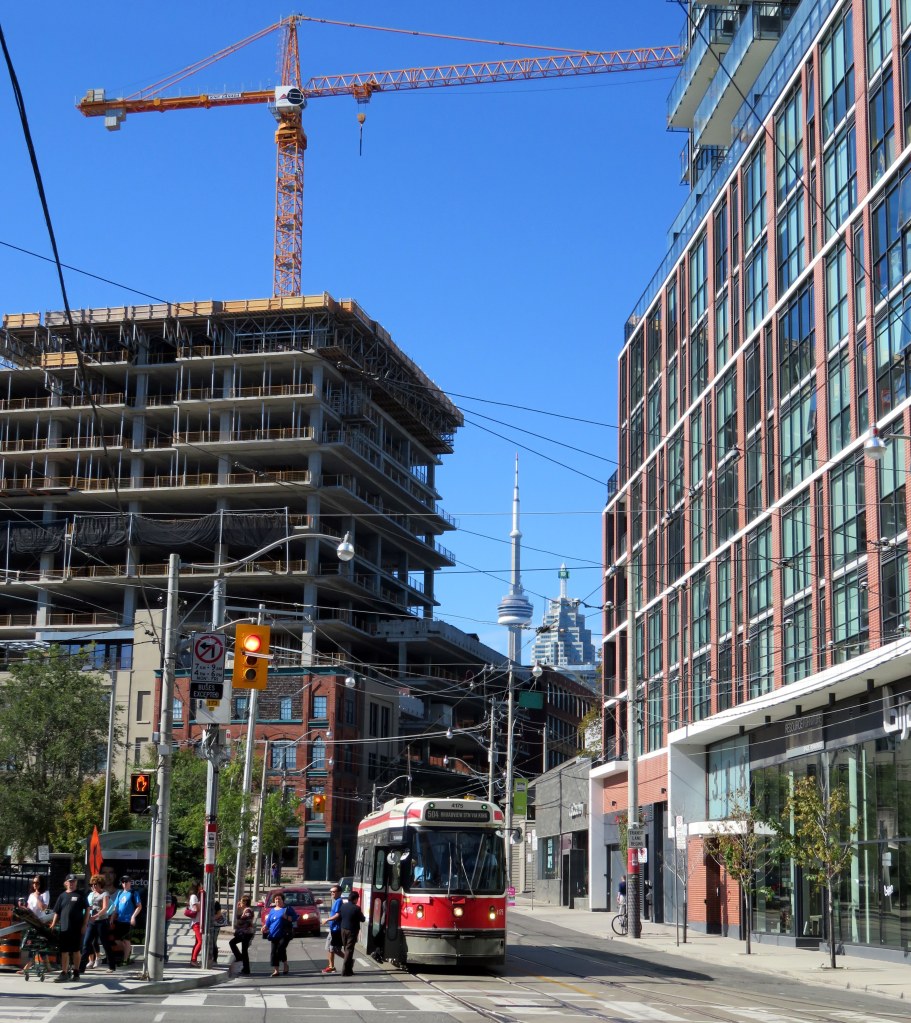
    In today’s Toronto Star, city columnist Ed Keenan reports on the “King Street Visioning Study,” a city planning project that will soon be available for public feedback. The study proposes improving streetcar operations along the King Street Corridor between Dufferin and Parliament Streets as well improving the public realm, making it a more pleasant place to walk. The 504 King Streetcar is the busiest surface route in the TTC’s system, and as I, and many others, have said before, the streetcar needs to be able to move more people more efficiently. But now City Planning is leading the study, not the TTC, making this a more holistic vision for King Street.

    Chief City Planner Jennifer Keesmaat says that it’s “reasonable” that the initial pilot projects could be started in early 2017. Work has already been contracted to some of the same firms that were responsible for transforming Queen’s Quay (which despite some construction delays, and conflicts in a few places between pedestrians, cyclists, and motorists, is a fantastic project).

    Keesmaat echoes previous attempts at creating a King Street Transit Mall, suggesting a similar system of alternating one-way sections that would provide for taxis, deliveries and passenger drop-offs and pick-ups, but forcing through traffic onto parallel streets. Extending transit priority all the way from Dufferin to Parliament could do a lot to streetcar improve operations, especially as the TTC is planning a new 514 route on King between Dufferin and Cherry Streets to supplement the overburdened 504 line and better serve the West Donlands, Distillery District, and Liberty Village.

    Yes, King Street improvements would start off as pilot projects, much like the bicycle lanes on nearby Richmond and Adelaide Streets, or the decade-old 2-hour transfer on St. Clair Avenue, or the Toronto Hydro ALAMP street lighting trials that should have concluded years ago. (Toronto seems to like permanent pilot projects.) That said, previous plans for a King Street transit mall never even got to the “pilot project” phase.

    But hearing that pedestrians and transit will be getting priority is music to my ears. Knowing that City Planning, and not just the TTC, is looking at this gives me optimism that this could finally go ahead. There will be opposition from businesses along the corridor, taxi drivers, suburban politicians concerned about a non-existent “war on the car.” And it’s not clear if Mayor John Tory is in favour, or a majority of city councillors.

    An improved public realm is especially appropriate on King Street, especially through historic Old York on the east and the cultural and tourist draws of the Entertainment District on the west. Sidewalks are often crowded, especially as the theatres get out in the evening, but with such diverse uses along the corridor, from bank towers to night clubs, King is one of Toronto’s most vibrant streets. Toronto often has trouble with attractive streetscaping (thanks to ugly wooden poles and overhead wires, cheap, grey street furniture, and ugly traffic signals), but it has recently managed to get Queen’s Quay (mostly) right.

    As for design, I’m hoping for something interesting and something different. I’d do away with the Muskoka chairs mentioned in Keenan’s article. They’re wonderful on Toronto’s waterfront, but I’d like to see some imagination on King Street. What about seating shaped like director’s chairs in front of the TIFF Lightbox? (Oh, and on the subject of TIFF, could we tell film festival organizers to stuff it when they want to wreck the King Streetcar again in 2016?)

    After years of talk about fixing King Street, there’s a very serious proposal to do something about it. Maybe the third time’s the charm.

  • Milton’s self-inflicted growing pains

    There’s an interesting article in today’s Toronto Star about Milton’s growing pains. The Town of Milton, which has grown tremendously in the last 15 years, complains that the province has neglected to provide the growing municipality with transit and other infrastructure. In 2001, its population was only 31,471. But In 2006, after finally connected to “The Big Pipe” that brought treated lake water to the municipality, the population increased to 53,939, an increase of 71.4%. In 2011, the town’s population went up again to 84,362; by 2016, Milton’s population will be well over 100,000.

    But no one should be surprised by Milton’s growing pains. Milton’s population stagnated for years as its reliance on well water constrained residential and commercial growth. Once all that developer-owned land had access to water and waste water pipes, of course, tract housing, big box stores, and warehouses were going to follow. In recent years, Milton’s housing density has increased in accordance with the province’s Places to Grow Act; with more townhouses and low-rise apartment buildings and houses on smaller lots. But apart from higher densities, land use and planning is still based on automobile ownership and suburban zoning plans.

    Milton is outside the continuous built-up Greater Toronto area. It doesn’t have great transit links, apart from the rush hour GO Trains. Apart from two interchanges off Highway 401, it doesn’t have great highway access. If it’s cheap housing you seek, and nothing else, Milton might be the right place to live. But if you want transit, parks, walkable neighborhoods, access to community services, and short drives, Milton isn’t the right place to buy.

    Many of the concerns are valid. The local hospital hasn’t expanded to accommodate the growing population. Highway 401 hasn’t been expanded through Milton since the 1980s. And while GO Transit has increased the number of trains (from five to nine outbound and inbound trips in the last two decades) and buses, the parking lot has completely filled up.

    But one of the main messages that I read in the article is that there isn’t enough parking. To paraphrase Homer Simpson, parking is the cause of  – and solution to – all of Milton’s problems. Residents and councillors complain about parking at the GO station, such as resident Giles vanderHolt, who says, “there’s a huge need for more GO transit parking and better train service to Milton.”

    GO Transit isn’t going to be adding more train service to Milton any time soon. The Milton Line also serves six stations in Mississauga, and is the busiest route outside the frequent Lakeshore corridor. But the Milton line is almost entirely owned by Canadian Pacific, and it’s a busy freight line. GO simply cannot add any more trains, and if it did, it wouldn’t solve Milton’s parking problem.

    Surrounding the GO Station, there’s a retail plaza anchored by a Loblaws, and surrounding it, there are several industrial parks and single family houses. There is no transit-oriented development located there, nor is any planned.

    Milton GO Station and surrounding areas

    I have plenty to say about GO Transit’s reliance on free parking, and I wouldn’t be surprised if GO is drawing up plans for a parking garage at Milton. But to be fair, people don’t move to Milton that are planning to give up their cars. Milton Transit isn’t very good, but it does use the GO Station as its primary hub. Meanwhile, GO has been trying a new ride-booking system for commuters to use to get to and from Milton GO Station. That’s an interesting idea that could be expanded to other outer-suburban communities as a short-to-medium term solution. If GO ever implemented parking charges, it could prove to be a good alternative for commuters where transit links are spotty or non-existent. But Milton could do far more to encourage people to walk, bike and take transit to its station, and develop an urban core.

    Milton has been lobbying for years for a university campus, at a site called “Milton Education Village.” But it wants to locate the campus in a greenfield site a 15-minute drive away from the GO Station, distant even from Highway 401. Students from outside Milton will either be dependent on cars to reach the site, or had better hope that transit connections from the west aren’t as bad as they are from the Milton Carpool Lot.

    Oshawa made the mistake of building a major campus as far as possible from its downtown core and transit infrastructure. Why does Milton want to do the same thing?

    On one hand, Milton is right to complain about poor infrastructure. People live there, by choice or by necessity, and they deserve a proper hospital and other provincial services. GO Transit is doing the right thing by trying out a ride-sharing service to and from the GO station. On the other hand, Milton is a “leap-frog” suburb, with poor urban planning and an auto-centric mentality that has helped to create a lot of its mess. Building some transit-oriented development around the GO station, and improving transit links would be a good place to start turning the page.

    0FXZYgd.jpgScreenshot from the classic Simpsons episode “Homer vs. the Eighteenth Amendment”