Tag: Toronto

  • The beauty of the expressway and Toronto’s accidental gateway

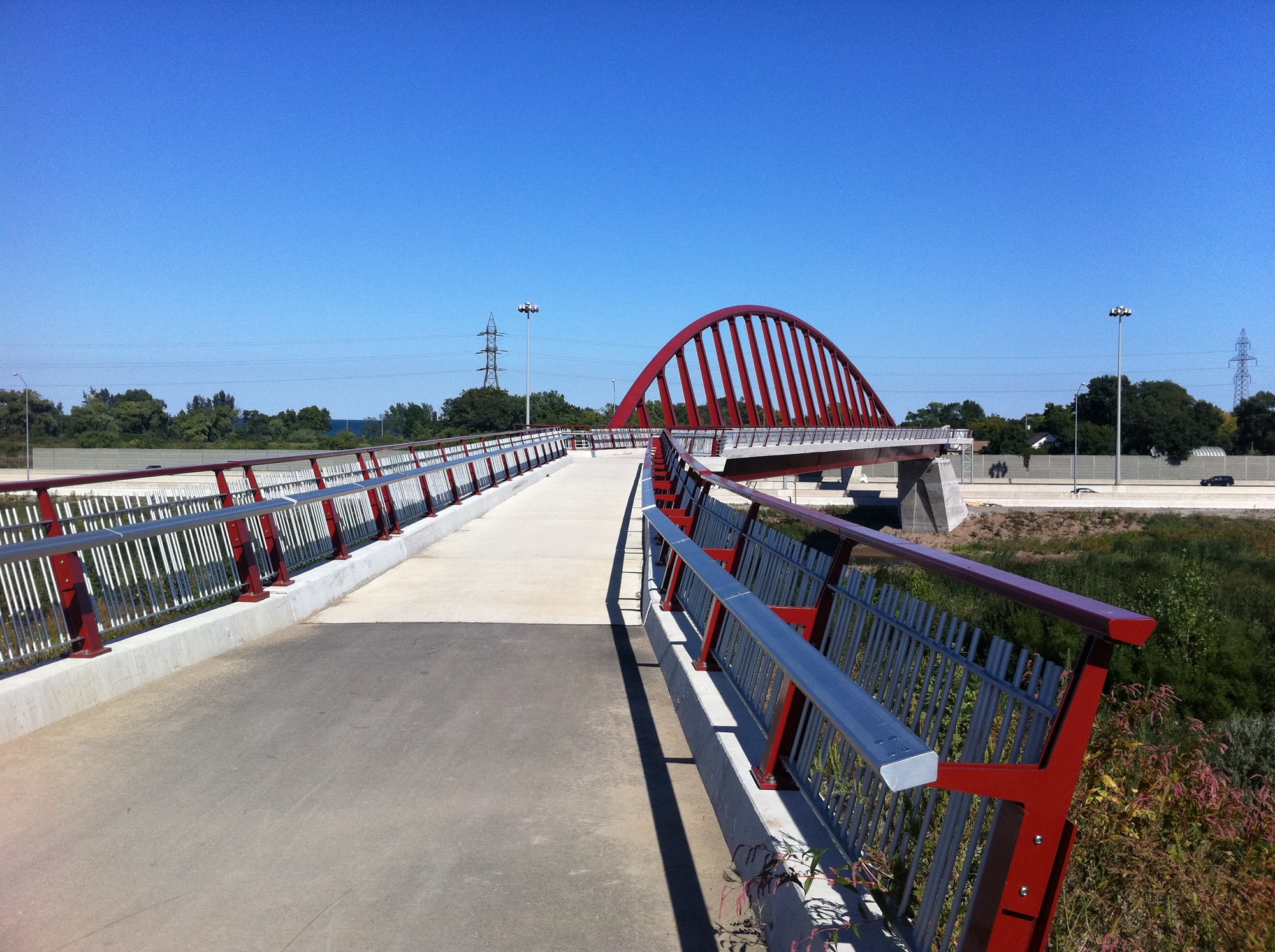
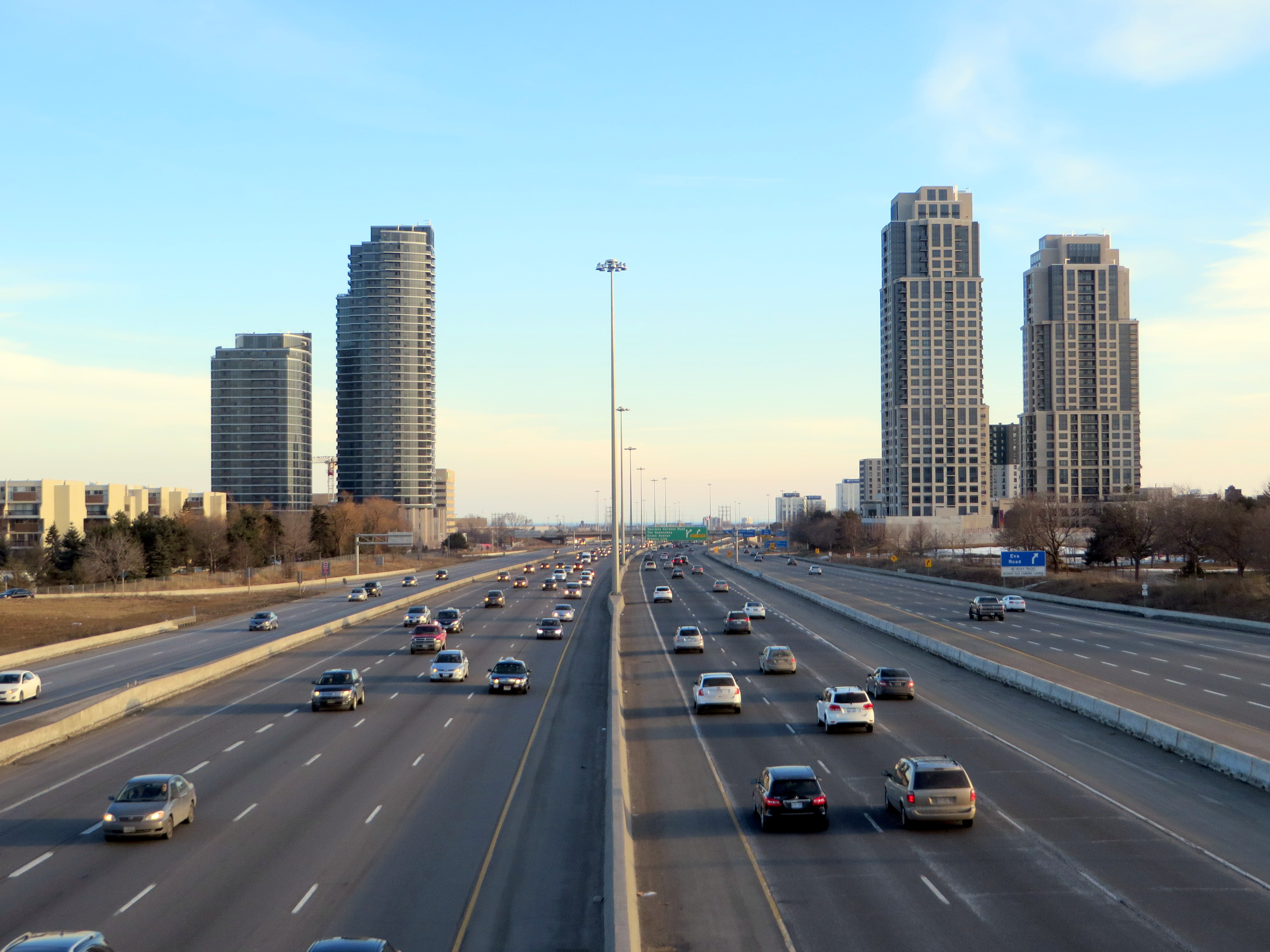
    IMG_8568-001Highway 427 looking south from Burnhamthorpe Road

    On a recent walk with a group of friends and acquaintances, I had the opportunity to explore a bit of Etobicoke. We walked from Kipling Station to a pub near the West Mall and Burnhamthorpe Road, passing by an abandoned dead mall, cutting through another mall, Cloverdale, with its sad, emptying Target that was just a few weeks before closing (along with the rest of Target’s ill-fated Canadian stores).

    Honeydale was built in the early 1970s, a rather small mall anchored by a Woolco and a grocery store. The grocery store became a No Frills, while Woolco was acquired by Wal-Mart in 1994. Most Woolco stores were converted to Wal-Marts, but the US-based giant soon expanded or built replacement stores to its own specifications, leaving behind many vacancies in older malls and plazas. With the loss of Wal-Mart, the mall survived only because the only entrance to the busy No Frills store was within the mall. Once No Frills closed, Honeydale lost its purpose and shut down. Like the Canadian Tire property down the street (the oddly named Kip District development), I expect that the mall, Toronto’s only bona-fide dead mall, will soon be razed and that condos will eventually take its place.

    Unlike Honeydale, Cloverdale, a somewhat larger mall that boasts few vacancies, will most likely survive Target’s retreat from Canada.

    Honeydale Mall
    The vacant Honeydale Mall

    But the most interesting takeaway, in my opinion, is reflected in a photograph I took on the Burnhamthorpe Road bridge over Highway 427, the first photo in this post.

    There is a complicated beauty to freeways; corridors that we usually experience either at speeds of over 100 kilometres an hour, or stuck behind other cars and trucks in frustrating traffic jams. But from a perch over top, such as on an overpass, one can appreciate the landscape. And see the gateway to Toronto, guarded by tall towers on either side.

    Sheraz Khan wrote about this “accidental city gate” in Spacing Toronto in November 2013. He wrote that “…the road to Toronto tells a story about our city. Through the concrete, the wires, the bricks and tangled roads, gleams our new gate. It is a structure that begins to (perhaps accidentally) emphasize Toronto’s wishes of grandeur.”

    Coming from the airport down Highway 427, arriving in Toronto for the first (or the 500th) time, by car or by bus, one can experience this unplanned, and apt, entry to the city. A city of concrete, glass and steel, a city that is continually growing to accommodate its many newcomers. A city as defined by its suburbs as its downtown.

  • Mapping an accessible TTC

    IMG_3898

    Last week in Torontoist
    , I wrote about the challenges of getting around on the TTC for passengers who rely on mobility devices, such as wheelchairs. Most of us never think about this problem unless we’re directly affected by the consequences of an inadequate system, as I was after a cycling injury in 2012.

    But for TTC users with mobility disabilities (or even passengers with strollers, wheeled carts, or luggage), it’s an issue. While the bus system is (mostly) fully-accessible, the backlog in the delivery of new streetcars and the installation of elevators in subway stations leaves the system failing many of its riders. The alternative, Wheel-Trans, is also underfunded, inconvenient and useless for last-minute travel plans.

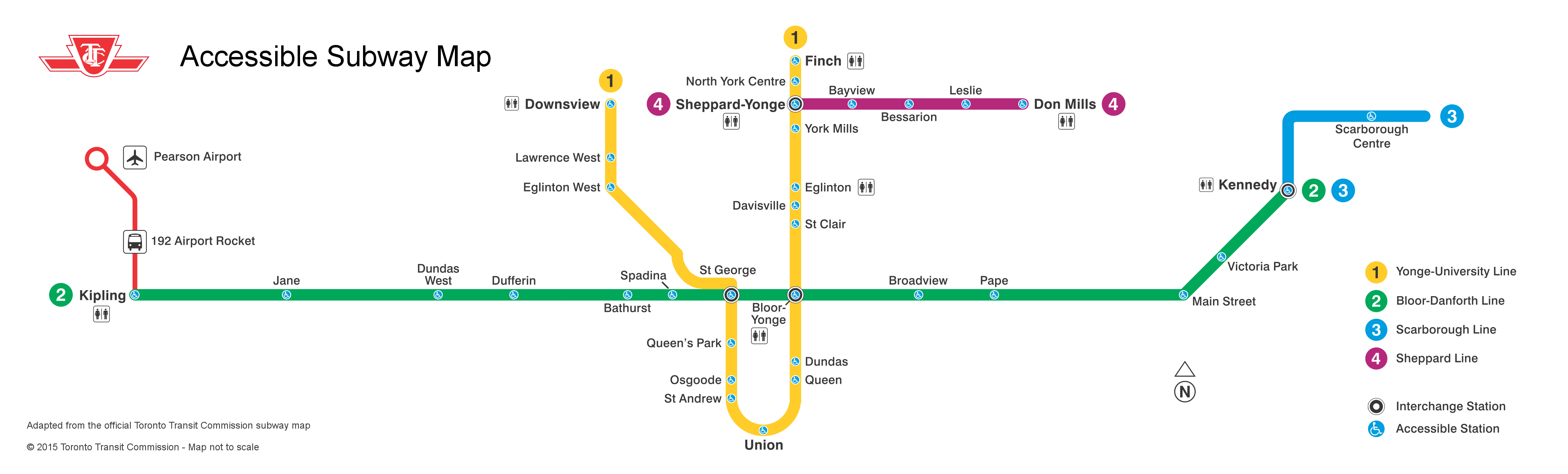
    Here’s what the subway system looks like if you require the use of elevators to navigate the system:

    accessible map - now 2015

    By 2016, only one more station  — St. Clair West  — will be equipped, by 2017, Wilson, Ossington, Coxwell, and Woodbine (and hopefully the Spadina Subway Extension to Vaughan Centre, with its six new fully-accessible stations, will open by then) will follow. But there’s not enough funding to make the entire system accessible by 2025, the deadline set by the Accessibility for Ontarians with Disabilities Act (AODA). Seventeen stations, including Islington and Warden, remain unfunded.

    The entire bus fleet is accessible, though not all bus stops are (the TTC requires a solid, concrete or asphalt place to deploy the ramp or lift, and room for the passenger to board; some suburban stops without a bus pad, or narrow urban sidewalks make loading a passenger in a wheelchair difficult). The first four low-floor streetcars are operating on Spadina Avenue, 200 more are still to be delivered. By now, the Spadina, Bathurst and Harbourfront cars were to have been fully-equipped with the new trams.

    In the meantime, the few bus routes that operate in the central core don’t have many accessible connections; east-west travel is particularly difficult. For example, the 47 Lansdowne bus is inaccessible from either subway station it services (Lansdowne and Yorkdale), and offers no barrier-free transfers south of Dupont Street. The map below shows this problem:

    TTC - Downtown v3 Crop

    Elevators at Ossington would connect the subway with three accessible bus routes, including the 94 Wellesley, a useful east-west alternative. (The 94 serves four subway stations and enters three of them, not one is equipped with elevators.) Meanwhile, both Toronto Western and St. Joseph’s Hospitals are isolated from the accessible transit network.

  • The genesis of Mayor John Tory’s SmartTrack

    I was recently browsing Urban Toronto‘s forums (a great resource if you’re interested in keeping up with construction updates and development proposals here in Toronto), when I came across a post written by “AlvinofDiaspar” in a thread discussing SmartTrack.

    Alvin’s post linked to an interesting report written by the Strategic Regional Research Alliance, a consulting group based in Toronto that I had never heard of until recently. The report, entitled “The Strategic Case for the Regional Relief Line,” was published in October 2013, just before the mayoral race began for the 2014 election.

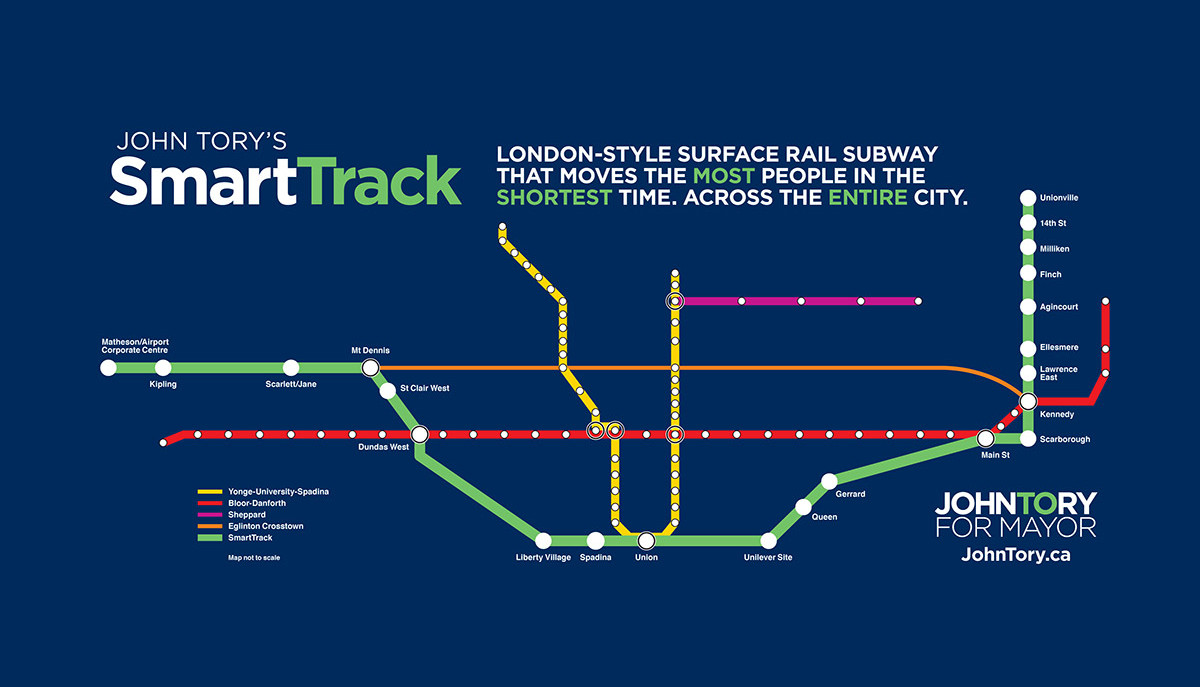
    John Tory unveiled his “SmartTrack” plan, promising a “London-Style surface rail subway” (whatever that meant), on May 26, 2014. The transit service, using frequent, electric multiple unit trains (like those used for commuter/regional transport in many European cities) would mostly follow existing railway corridors from Markham to Mississauga, via Union Station.

    On the east end, the route would follow GO Transit’s Stouffville Line from Union Station as far as Unionville Station, making more frequent stops, serving the Unilever plant (which will be replaced by a massive commercial/office redevelopment by First Gulf, first announced in 2012), as well as additional stops at Queen St East, Gerrard/Carlaw, Lawrence East, Ellesmere, Finch and 14th Avenue, in addition to existing GO Transit stops at Danforth/Main, Scarborough Junction, Kennedy/Eglinton, Agincourt (Sheppard), Milliken (Steeles) and Unionville.

    To the west, the line would follow GO’s Kitchener Line from Union Station as far as Mount Dennis (Eglinton Avenue, near the western terminus of phase one of the Eglinton-Crosstown LRT), with stops at Spadina, Liberty Village, the existing GO/UP Express station at Bloor, and at St. Clair Avenue. At Mount Dennis, the SmartTrack corridor follows a routing via Eglinton Avenue into Mississauga’s Airport Corporate Centre office district, which of course has no existing rail infrastructure to capitalize on.

    Tory promised to have SmartTrack operational in seven years, by 2021, putting other approved and/or proposed transit projects (the Downtown Relief Line, the Sheppard East and Finch West LRTs, among other plans) on the back burner.
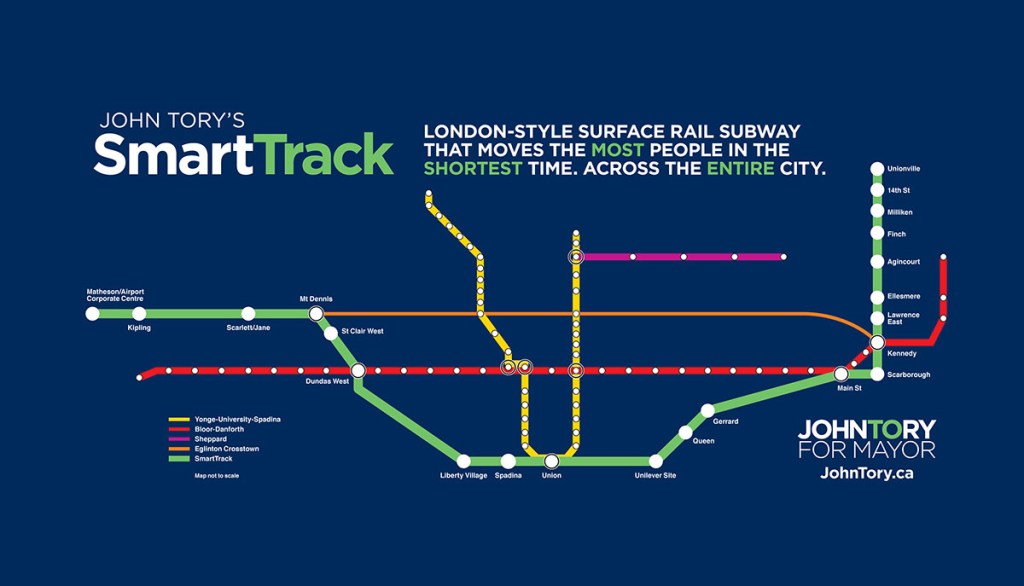
    smarttrack_fbJohn Tory’s “SmartTrack” map

    Back in 2014, transit observers were taken aback by this new “bold” transit idea (John Tory kept using that word to describe SmartTrack), as his campaign had recently taunted Olivia Chow’s hesitancy to prioritize the Downtown Relief Line (DRL) in her transit platform. At the time, Chow, the presumed front runner in the mayoral race in April 2014, promised to increase TTC bus service and build the Scarborough LRT while planning for the DRL continued.

    The DRL is a long-proposed subway line under review by the City of Toronto and by Metrolinx that would connect downtown Toronto to the Bloor-Danforth Line east of the Don River, thus relieving the the Bloor-Yonge subway interchange from overcrowding, while offering improved transit access to east end Toronto, and addressing overcrowding on Yonge subway trains. Further extensions to the north, towards Thorncliffe Park, Flemingdon Park and Don Mills, would re-direct many current and potential transit riders from the Yonge Subway, allowing for an extension of that line from Finch to Richmond Hill.

    But to some degree, Tory’s promise of frequent, regional electric rail on GO’s corridors dovetailed with provincial plans for electrification of part of GO’s services and the Airport Rail Line (now branded as the Union Pearson Express). Improved services on GO’s corridors, if paired with fare integration with local transit (GO’s fares are very expensive for short trips), would provide useful rapid transit to many areas not served by the subway, and could provide some relief to the existing subway network. John Tory was endorsed by many provincial cabinet ministers; it appeared that he had the support of the Liberal government itself, though Premier Kathleen Wynne never endorsed any mayoral candidate directly.

    The only hint of this SRRA report that I could find in the mainstream media was in an interesting article written by Tess Kalinowski, the transportation reporter at the Toronto Star after Tory’s win on October 27, 2014. In an article published on November 17, entitled “The evolution of SmartTrack,” a report entitled “The Business Case for the Regional Relief Line” was mentioned. Also mentioned in the article was John Duffy, a political strategist who worked on the provincial Liberal leadership campaign of former transportation minister (now environmental minister) Glen Murray, and had ties to Wynne’s leadership and election campaigns. Kalinowski wrote that Duffy also was acquainted with Iain Dobson, a property developer and Metrolinx board member. Other people involved in putting SmartTrack together and mentioned in the article were the Canadian Urban Institute’s Glenn Miller (who is listed as a SRRA contact on its website, as is Iain Dobson, a real estate executive and Metrolinx board member), former Toronto chief planner Paul Bedford and businesswoman and urban expert Anne Golden.

    Transit advocate and friend Steve Munro picked up on this report before I had – you can read his posts which are more detailed and far better than my short analysis in this post:

    Munro: The Dubious Planning Behind SmartTrack Part I Part II Part III

    It’s unfortunate that John Tory decided to make this concept the centrepiece of his transit platform. Easily, the biggest flaw, mentioned by others, including Steve Munro and mayoral rival Olivia Chow, is the Eglinton section between Mount Dennis and the Airport Corporate Centre. The corridor already had a proposed rail transit project, the western leg of the Eglinton-Crosstown LRT line, a project first proposed in 2007 as part of a larger city-wide LRT plan known as Transit City, and confirmed in 2009 when the provincial government announced funding for it and three other LRT lines. (In 2010, funding was deferred for the section west of Weston Road). The once-available right-of-way that would have allowed for a surface-running heavy rail transit project was already disappearing.

    But in the SRRA-authored report, we see why Tory went along with the problematic Eglinton routing, rather than having SmartTrack continuing along the GO Kitchener/UP Express corridor towards the transit desert of northwest Toronto. It was part of a larger plan to connect suburban office parks to Downtown Toronto.

    The Regional Relief Line, as envisioned by the SRRA, would have included a third phase, from the Airport Corporate Centre to Meadowvale Business Park, another large, although sprawling, employment centre near Highway 401 and Mississauga Road. The “Phase Three” of this proposed regional rail route would follow Highway 401 on a new alignment.
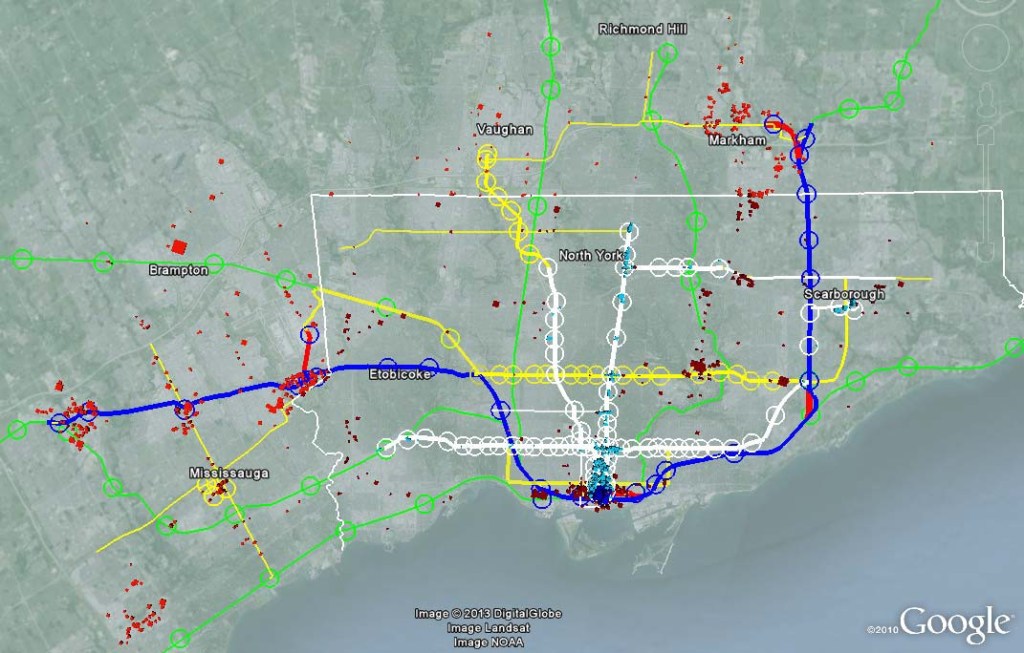
    srra mapThe map from the SRRA report, published on page 4. Note the use of Google Maps to create the map.

    The SRRA planning exercise appears to be one where well-educated planning experts were engaged in a game of “connect the dots.” Sure, the Regional Relief Line connected several major employment nodes in Markham, Toronto, and Mississauga, with the nodes in Mississauga lined up along Highway 401. But this error on page 6 of the report makes me wonder how many of the facts and assumptions the authors simply got wrong or didn’t fact-check:

    This phase will take a little longer to complete than the Markham phase because there are no tracks on the section from Mt Denis to the Airport Corporate Centre. This right of way will take longer to design and obtain approval in an EA process. It is owned by the Province and was intended to be an expressway. There is ample room for the dedicated right of way.

    In fact, the Richview Corridor, the right of way mentioned, was owned by the city, not the province, reserved in the 1960s for an expressway linking Highways 401 and 427 to the proposed Highway 400 extension, part of a much larger highway plan for Metropolitan Toronto. The 400 extension was cancelled and the at-grade Black Creek Drive was built instead; the Richview lands along Eglinton Avenue West in Etobicoke remained dormant for decades. But in 2011, the city started selling off the land for residential development, making the right of way unusable for any transportation corridor. (This did not matter in plans for the Eglinton-Crosstown LRT connection to the airport; there was still room to build a median LRT corridor along this section.) In 2013, pre-eminent local transit and planning experts should have been aware of this development and be able to identify the proper owner of this former right of way.

    It also strikes me as a little backwards looking to link auto-dependent office parks together with a new transit line, especially without a detailed origin-destination study. Shouldn’t urban planners be promoting dense urban employment clusters in areas well-served or potentially well-served by transit? Does it make sense to build expensive transit lines to serve low-density office complexes that come with large parking lots and garages, such as those in Mississauga’s Airport Corporate Centre? Or am I confused?

    In December 2014, mere weeks after Tory’s election, Council voted 42-1 to accelerate the work plan for the rail line, awarding up to $750,000 for early analysis and modelling work. The consultants awarded the funds? A group from the University of Toronto and Strategic Regional Research Associates. In February, council approved an additional $1.65-million towards studying SmartTrack, at least taking a closer look at the Eglinton West section of the corridor.

    To me, it seems just a little bit odd that Tory’s campaign advisers were awarded this contract to study a project, that until Tory’s election, wasn’t even on any transit planning maps. Steve Munro picked up on this as well, questioning whether  Iain Dobson, a member of the Metrolinx Board, has a conflict of interest due to his involvement with the SRRA and a member of the Advisory Board to the University of Toronto Transportation Research Institute. After all, Metrolinx is supposed to be the expert, disinterested provincial agency charged with evaluating and implementing various transit plans. Meanwhile, the need for a Downtown Relief Line hasn’t gone away.

    Tory and his connections in academia and the private sector have managed to change the course of Toronto’s short-term transit planning, and I can’t help but feel a bit suspicious of the behind-the-scenes planning that went into SmartTrack. This is a story very much worth following.
  • Mapping the election: Toronto’s East End (Wards 29, 30, 31, and 32)

    2014 Election - East End Mayor

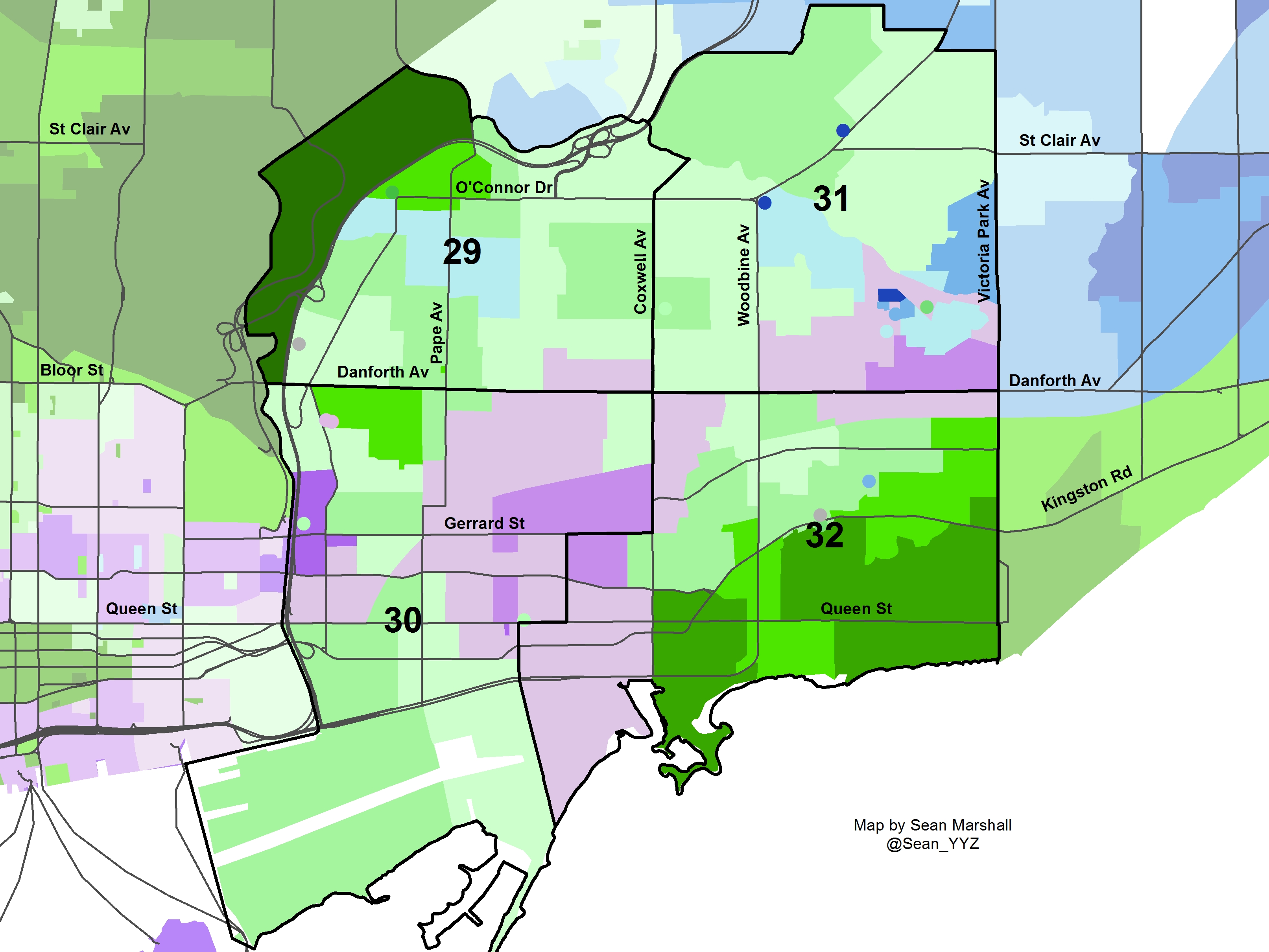
    In this post, I examine the results in four east-end wards, Wards 29 and 30, Toronto-Danforth, and Wards 31 and 32, Beaches-East York. All four wards selected John Tory as their first choice as mayor (though by differing margins), and all four returned their incumbent councillors. Only in Ward 30 was there an interesting council race.

    I’m about to go on a short vacation, so this will be the last of my posts looking at the poll-level results of the last Toronto municipal election for about two weeks. I still have to get to Wards 33 and 34, Don Valley East, and the 10 wards in Scarborough.

    Ward 29

    2014 Election - WARD 29 Mayor
    Poll results of the mayoral race in Ward 29

    Ward 29, the part of Toronto-Danforth north of Danforth Avenue, stuck with first-term left-leaning councillor Mary Fragedakis, who won every poll. Fragedakis won in 2010, beating right-leaning candidate Jane Pitfield with 41.8% of the vote to Pitfield’s 27.9%. Pitfield, previously the councillor for Ward 26, was backed by the retiring councillor Case Ootes. In 2014, Fragedakis won 59.3% of the vote; second-place Dave Andrae took 24.7% of the vote. I did not create a map for the ward race.

    John Tory came in first place in Ward 29, netting 42.1% of the vote and taking 17 of 23 polls. Olivia Chow came in second place, with 32.1% of the vote, but was the second-place candidate in nearly every poll. Doug Ford came in a distant third place, but won in four polls – all near the Pape/Cosburn intersection, where there are many mid-rise rental apartment buildings. Tory did best in Poll 001, which is isolated from the rest of the ward, separated by the Don River, Don Valley Parkway and the GO Richmond Hill corridor railway line, and really part of the Rosedale neighbourhood otherwise covered by Ward 27 (where Tory did exceedingly well).

    Ward 30

    2014 Election - WARD 30 Mayor
    Poll results of the mayoral race in Ward 30

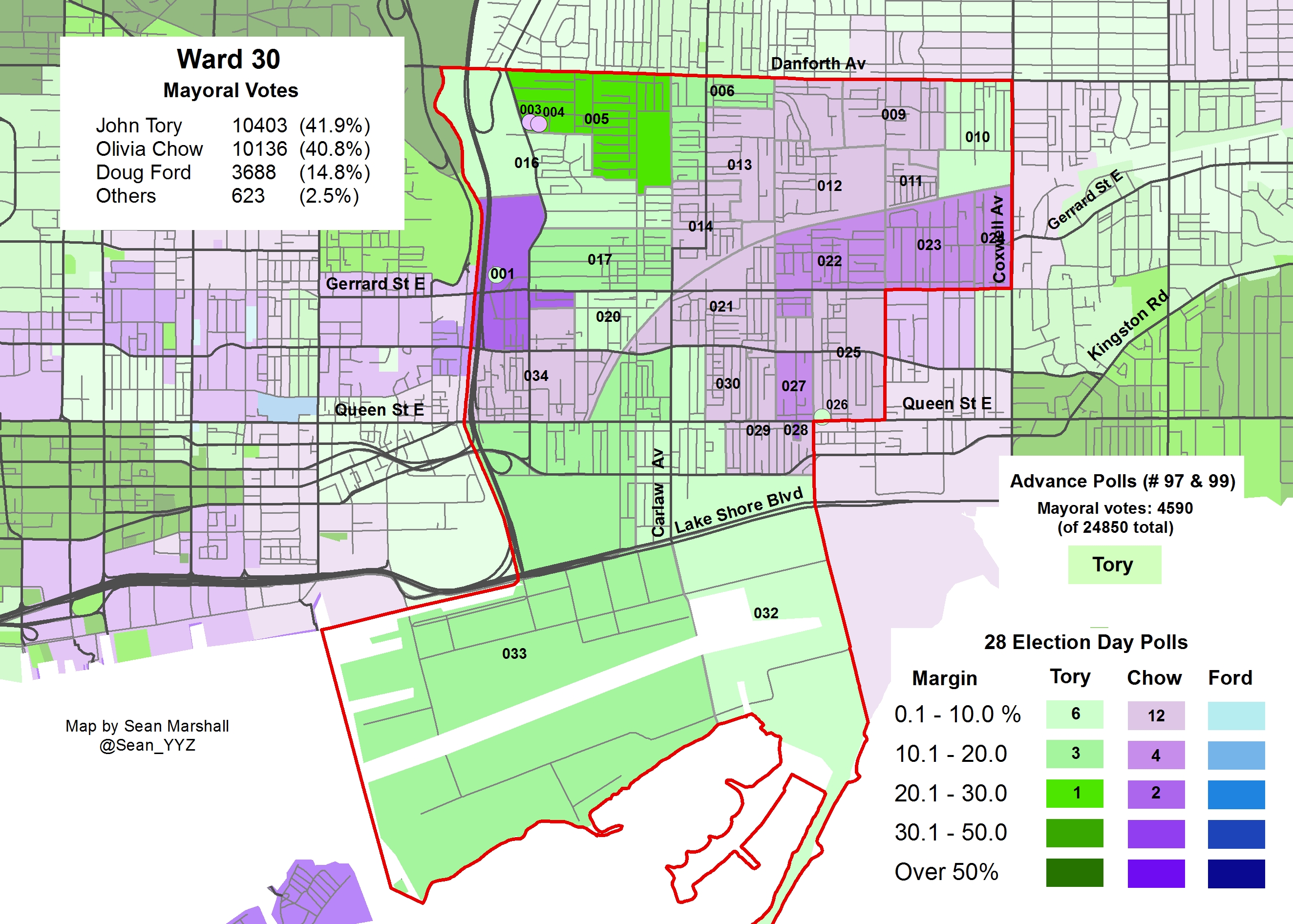
    John Tory came in first place in Ward 30, but Olivia Chow came in a close second place; less than 300 votes separated the two mayoral candidates. Doug Ford came in a very distant third place, taking less than 15% of the vote and no polls. Interestingly, John Tory came in first place in the Withrow Park neighbourhood closest to Danforth Avenue, while Chow came in first place in nearly all polls east of Pape/Carlaw in Leslieville.

    But more interesting was the council race. In 2010, centrist Liz West, a news broadcaster, narrowly lost to long-time incumbent Paula Fletcher. Fletcher won with only 45.4% of the vote, 259 votes ahead of West.

    When author, broadcaster, and community organizer Jane Farrow, a founder of Jane’s Walk and executive assistant to Ward 33 councillor Mary-Margaret McMahon, put her name forward as a candidate, there was some backlash against her bid: why run against a strong progressive councillor? Would the vote be split, allowing the relatively right-leaning Liz West to take the seat? Though Farrow’s candidacy was supported by others on the centre and left; some residents were encouraged by her community advocacy and were looking for a fresh face on city council. (I would have been pleased with either Fletcher or Farrow representing Ward 30.)

    As it turns out, Paula Fletcher, backed by the endorsements of Torontoist, NOW Magazine, the Toronto Star and the Labour Council, increased her vote share in 2014, taking 49.6% of the vote. Liz West lost votes, taking only 27.7% of the vote; Farrow came in third place with 20.0%.

    The feared vote-split did not happen. Fletcher came in first place in all but one poll, where Fletcher and West tied. West came in second place in every other poll, except one, Poll 034, where Farrow came in second place.

    This was the most surprising of the maps that I created so far.

    2014 Election - WARD 30 Cllr
    Poll results of the council race in Ward 30

    (more…)

  • Mapping the election: Toronto’s West End (Wards 13, 14, and 18)

    2014 Election - West End

    In this post, I examine the results in three west-end wards – Wards 13 and 14, Parkdale-High Park, and Ward 18 Davenport. (I previously mapped and commented on Ward 17 Davenport.)

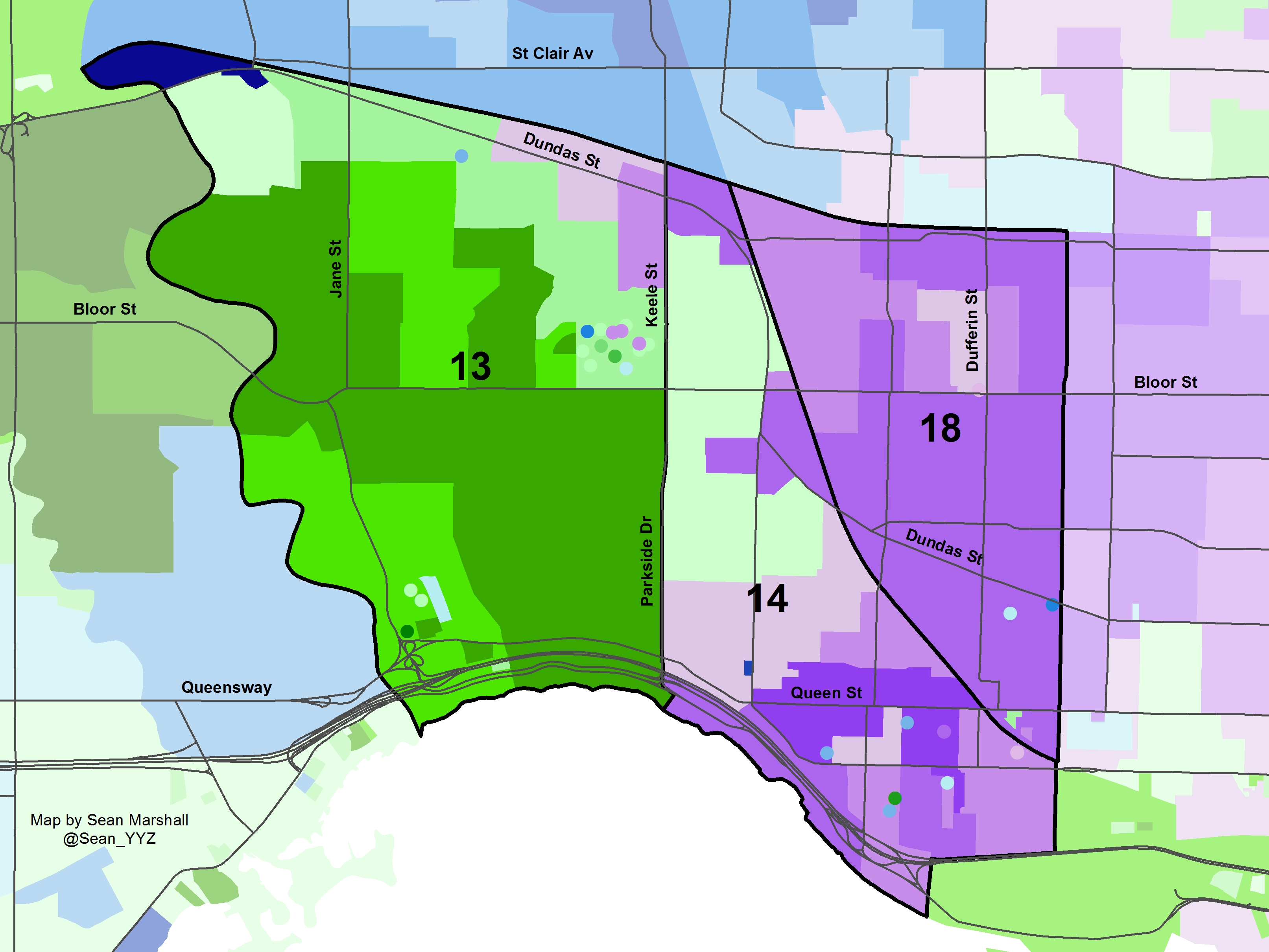
    Ward 13, includes part of the Junction as well as the relatively affluent Baby Point, Swansea, and Bloor West Village neighbourhoods. John Tory won this ward by a comfortable margin. Wards 14 and 18 selected Olivia Chow. Doug Ford came in a very distant third place, winning only a few polls. With a few exceptions, the polls east of Parkside/Keele voted for Chow; west of there, mainly for Tory.

    All three incumbent councillors were re-elected: Sarah Doucette in Ward 13, Gord Perks in Ward 14, and Ana Bailão in Ward 18. Of the three council races, only Ward 18 was competitive. New challenger Alex Mazer ran against Bailão and lost by only 800 votes.

    (more…)

  • The Downtown Divide: Wards 19, 20, 27, and 28

    2014 Election - Downtown Wards Mayor Solid A map of each poll’s first choice for mayor in Wards 19, 20, 27, and 28

    In this post, I examine the results in four downtown wards – Wards 19 and 20, Trinity-Spadina, and Wards 27 and 28, Toronto Centre-Rosedale.

    Olivia Chow, the early favourite to defeat Rob Ford, was a long-time city councillor. Chow represented Ward 20 before she ran and won in Trinity-Spadina for the New Democratic Party in the 2006 federal election. In order to run for mayor, Chow resigned as an MP early in 2014. A by-election was called for June 30. Joe Cressy hoped to keep the seat for the NDP, but Adam Vaughan, Chow’s successor as Ward 20 councillor, won the by-election for the Liberals by a wide margin. In the provincial election held earlier that month, Rosario Marchese, one of a very few NDP MPPs left from the Bob Rae era, lost to Liberal candidate Han Dong. Trinity-Spadina’s demographics were changing, especially with new condominium towers going up in new neighbourhoods like City Place and Liberty Village. And this mattered in the 2014 municipal election.

    Of the four downtown wards, John Tory came in first place in three: Wards 20, 27, and 28. Olivia Chow did not win her own ward, even though she represented it in municipal and federal politics for decades. Interestingly, John Tory is also a Ward 20 resident, so he, like Doug Ford, won his own ward. Tory makes his home in a large condominium apartment in Poll 013, Chow lives in a house in Poll 024. At least Chow won her poll.

    The map at the top of this article illustrates each poll’s first choice for mayor, without gradients based on the margin of the win. What can clearly be seen is that the older, more established neighbourhoods (with the exception of Rosedale and Yorkville) voted for Chow. The new condominium neighbourhoods voted for Tory. Doug Ford won a few polls – Moss Park and several other TCHC housing properties, but managed only to get 12.6% of the vote in these four wards.

    But what really strikes me is the north-south divide. Queen Street is a clear dividing line between the new condos to the south (Liberty Village, Fort York, City Place, Entertainment District, the Waterfront and Financial Districts) and the older neighbourhoods to the north. Other areas with many new condo towers, such as around Yonge/Church/Bloor and along Bay Street, also picked Tory.

    2014 Election - Downtown Wards Mayor MarginMap of each poll’s first choice for mayor in Wards 19, 20, 27, and 28, with margin of win

    Chow’s strongest support was in the Annex, Little Italy-Palmerston, and the Harbord Village/Kensington/Chinatown neighbourhoods. She did the best on Toronto Island, winning nearly 80% of the vote there. Chow also did well in Alexandra Park, a rare downtown neighbourhood where Ford came in second place and Tory got less than 10% of the vote. Tory did the best in Rosedale (not surprisingly), which he won with 82% of the vote, and did very well in those new condominium neighbourhoods.

    What really surprised me was that Tory came in first in the Church-Wellesley neighbourhood. Olivia Chow and her late husband Jack Layton were some of the greatest allies of the Toronto’s LGBT community, going back to the 1980s, when gays and lesbians did not enjoy the societal acceptance and support that they increasingly do now. I suspect that the spectre of a Doug Ford victory (the Fords have been rightly accused of being homophobic) convinced many voters to back Tory as Chow’s campaign floundered, and this might have been an important factor here.

    Table_Downtown

    Council races downtown

    Except in Ward 20, where Councillor Adam Vaughan moved on to federal politics (Ceta Ramkhalawansingh filled in as a interim council appointee), each incumbent councillor – Mike Layton in Ward 19, Kristyn Wong-Tam in Ward 27, and Pam McConnell in Ward 28, were easily re-elected.

    In Ward 20, Joe Cressy, after losing the federal by-election, ran for council in a crowded, open race, and won 42% of the vote and 54 of 68 election-day polls. There were other very good candidates, like Terri Chu (who came in second with 12.4%), Albert Koehl, and Anshul Kapoor, but Cressy had the organization and some name recognition from his run for MP. Cressy also had the endorsement of NOW, the Toronto Star, and the Labour Council. Fringe mayoral candidate Sarah Thomson also ran in Ward 20 after withdrawing from the mayoral race, despite her name recognition and nearly winning Trinity-Spadina for the Provincial Liberals in 2011, came in third with 9.5% of the vote.

    (more…)