Tag: Toronto

  • Suburban stations for urban needs: accessing GO Transit’s proposed new stations

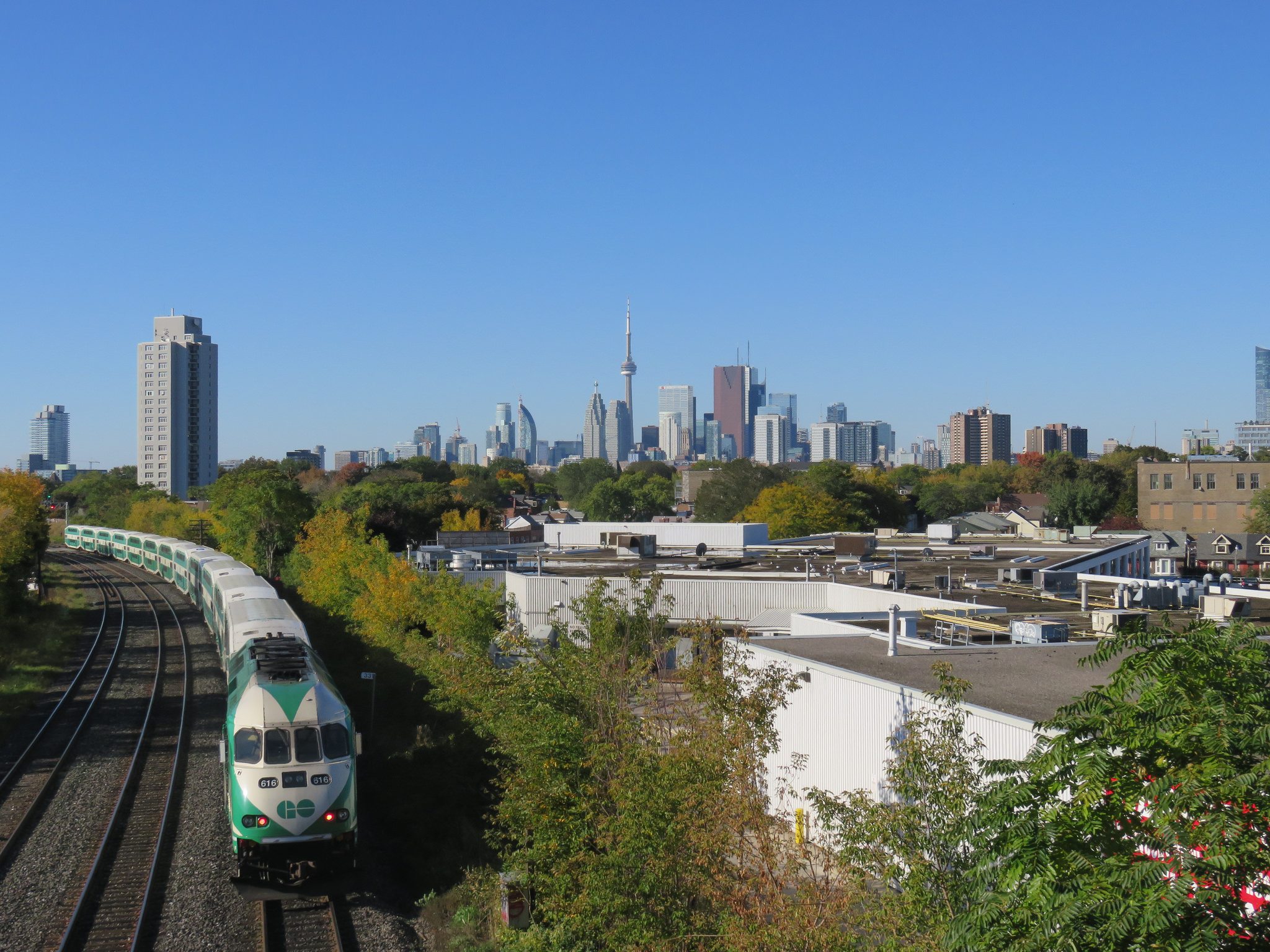
    21505188673_1d34d85175_kGO Transit train from the Pape Avenue footbridge, near the proposed site of Gerrard Station
    At its last board meeting on December 8
    , Metrolinx presented an update on the status of twelve new GO Transit rail stations, all located on existing lines. Eight of these proposed new stations are located in the City of Toronto; and six of those are station locations once promised as part of John Tory’s SmartTrack proposal. Unfortunately, the proposed new station designs (all available in this Metrolinx report) appear to be similar to existing GO stations in the suburbs, with needlessly large bus loops, PPUDOs, and parking lots. Development opportunities are limited.

    Transit connections at some proposed stations, like St. Clair West, are poor or practically non-existent. This is rather unfortunate, as SmartTrack was originally proposed as a frequent, subway-like service between Mississauga and Markham, with full TTC fare integration. Today, it’s merely six additional stations on existing GO Transit rail corridors. Without quick and seamless connections to the subway and surface TTC routes, the ability to provide any transit relief is compromised.

    I have more to say on this at Spacing Toronto.


  • From the vaults: the end of Yonge Street

    5608188561_bf233bac9d_o

    Note: This article was previously published in Spacing Toronto on April 13, 2011.

    One of Toronto’s greatest debates concerns Yonge Street’s controversial claim as “the World’s Longest Street.” Indeed, the Guinness Book of World Records published Yonge Street’s status as the true record until 1999; a bronze art installation in front of the Eaton Centre at Yonge and Dundas has a map of Yonge Street extending to Rainy River.

    This claim rests on the rather tenuous claim that that the 1,896 kilometre length of Yonge Street from Queen’s Quay on Toronto’s Harbourfront to Rainy River via Highway 11, at the Minnesota-Ontario border is in fact, the longest continuous “street.”

    While a popular claim, I’ve been a skeptic of this local legend. Highway 11 and Yonge Street have never been one and the the same, especially after the downloading of Highway 11 south of Barrie by the Harris government in the late 1990s.

    In 1920, Yonge Street was added to the Ontario provincial highway systemas Highway 11, which extended from Downtown Toronto as far as the end of Simcoe County, at the Severn River north of Orillia, where an unnumbered highway continued through the unincorporated Districts of Muskoka, Parry Sound and Nipissing to North Bay. In 1937, Highway 11 assumed the Severn River-North Bay portion and the newly-completed North Bay-Hearst section.

    During the Second World War, the section between Nipigon and Hearst was completed; it finally provided a complete provincial highway link between the Manitoba and Quebec borders and formed a crucial part of the Trans-Canada Highway until the more direct Highway 17 link from Sault Ste. Marie to Wawa was completed in the 1960s. Indeed, Highway 11 could still claim as the longest signed route within a sub-national entity but several national routes, such as US Interstates and US highways, are longer. In fact, the last reference to Yonge Street on Highway 11 north of Holland Landing is a short section of former Highway 11 in south Barrie.

    (more…)

  • Ridership has tripled on UP Express, but we can do even better

    19008325386_9c321ac7ab_k

    When UP Express — Toronto’s rail link to Toronto Pearson International Airport – -launched on June 6, 2015, the one-way fare between Union Station and Pearson Airport was set at $27.50, or $19.00 with a Presto card. At the time, Metrolinx, the provincial agency charged with planning and integrating transportation services in the Greater Toronto and Hamilton Area and the parent agency of GO Transit, expected that ridership would hit 5,000 passengers a day in a year. But after its launch, ridership sunk instead. 

    By January 2016, only an average of 1,967 passengers a day rode UP Express, so Metrolinx cleaned house and lowered the fares. The one-way cash fare was reduced from $27.50 to $12, and from $19 to $9 with a Presto card, and fares between Union and Bloor and Weston stations were reduced to match the GO Transit fares for the same trips. Since the new fare structure was introduced, UP Express ridership has more than tripled. By June 2016, the daily average ridership increased to 7,657.

    Despite the ridership growth, and the utility of the rail service for local residents near Bloor and Weston Stations, there’s still more that can be done to make the most of the $456 million spent to build the line.

    The airport region is a major employment centre, yet is difficult to serve by public transit. Fare integration between UP Express, GO Transit, MiWay and Brampton Transit could be an important a first step in creating a full regional rail network, a concept that Mayor John Tory pitched as “SmartTrack.”

    Airport LinksTransit connections at Pearson Airport. UP Express, if it offered fare integration with the TTC, MiWay and Brampton Transit, would be an invaluable part of the Toronto area’s transit network

    UP Express’s ridership increase is a good news story. But there’s so much more utility that can be leveraged.

    I discuss the UP Express ridership trends further in Torontoist

  • To Stratford by Train

    IMG_6135-001.JPGVIA Train 85 at Stratford Station, October 8, 2016
    On Thanksgiving weekend, my partner and I made the trip out to Stratford to get away from Toronto for two days and see two shows: Macbeth and The Hypochondriac. Both plays were excellent, and we had a lovely time strolling through Stratford’s downtown and parks as well. We took the train to Stratford, unfortunately it’s not a very convenient option for festival goers, nor for anyone visiting Stratford or for those who live there.

    (more…)

  • Why Presto and the TTC don’t mix

    In an earlier post, I explained why the Toronto Transit Commission should ditch its archaic transfer policies and adopt a two-hour unlimited transfer system like those in Mississauga, Brampton, York Region, and elsewhere in the Greater Toronto and Hamilton Area.

    When I made the argument last year, the TTC had just introduced proof-of-payment on all streetcar lines and had just started to adopt the Presto Card for fare payments. Sometime in 2o17, the TTC will eliminate all tickets, tokens, and passes, instead relying on Presto and new limited use media (LUM) paper cards for single-ride payments and day passes. (LUMs are common on some systems that have gone to smart card technology; Montréal, for example, has the L’occasionnelle card, augmenting the plastic Opus Card.)

    About half the buses and over one third of all TTC subway stations now accept Presto as payment (for regular adult and student/senior fares, deducting the same fare as the applicable token or ticket price); according to the TTC, the full roll-out of Presto machines on the bus network is supposed to be complete by the end of the year. But the TTC likes to remind its passengers that they should carry alternative forms of payment in case Presto is not available (for example, when shuttle buses replace subway or streetcar services).

    That said, I’ve been happy with using Presto when it’s available. Presto is all-but-necessary to ride GO Transit, OC Transpo, UP Express and suburban transit agencies; with Presto, transfers and GO Transit/suburban bus co-fares are automatically figured out. I set up the autoload feature on my Presto account, so I never have to worry about not having enough funds on the card. I can always review my account, which accurately keeps track of my transit fare payments and transfers. There are times when Presto is not an option, such as when I travel to Scarborough, so I always keep a few tokens or cash for those instances.

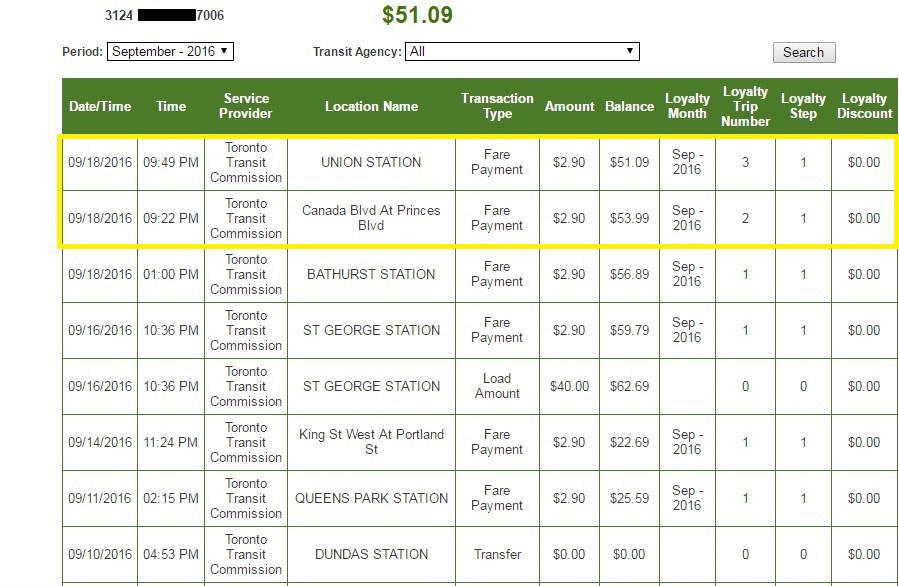
    But on Sunday, September 18, Presto finally didn’t work for me. But I blame this on how the TTC insists on making Presto work with its interpretation of its outdated transfer policies, rather than making its fare policies work for Presto.

    presto-overchargeScreenshot from my Presto transaction history, September 20, 2016
    After a wonderful evening visiting the In/Future arts festival at Ontario Place, I boarded a 509 Harbourfront shuttle bus at the Exhibition Grounds at 9:22 PM. The streetcar that normally operates from the Exhibition to Union Station was not running due to maintenance in the Bay Street tunnel. The shuttle bus was equipped with a Presto machine, and I tapped my card. The bus let off its passengers at the corner of Bay and Front Streets, just outside of Union Station, and I transferred to the subway, a completely valid transfer, at 9:49PM. But that resulted in a second charge of $2.90.

    My mistake was expecting that the transfer from the 509 shuttle bus to the subway would be recognized by Presto as a valid transfer. Normally, the 509 streetcar has a direct connection to the subway platforms, without the need to pass through fare gates. Elsewhere, the transfer between streetcar and subway at downtown stations is not a problem using Presto (like the transfer from the 505 Dundas Streetcar to Dundas Station on September 10).

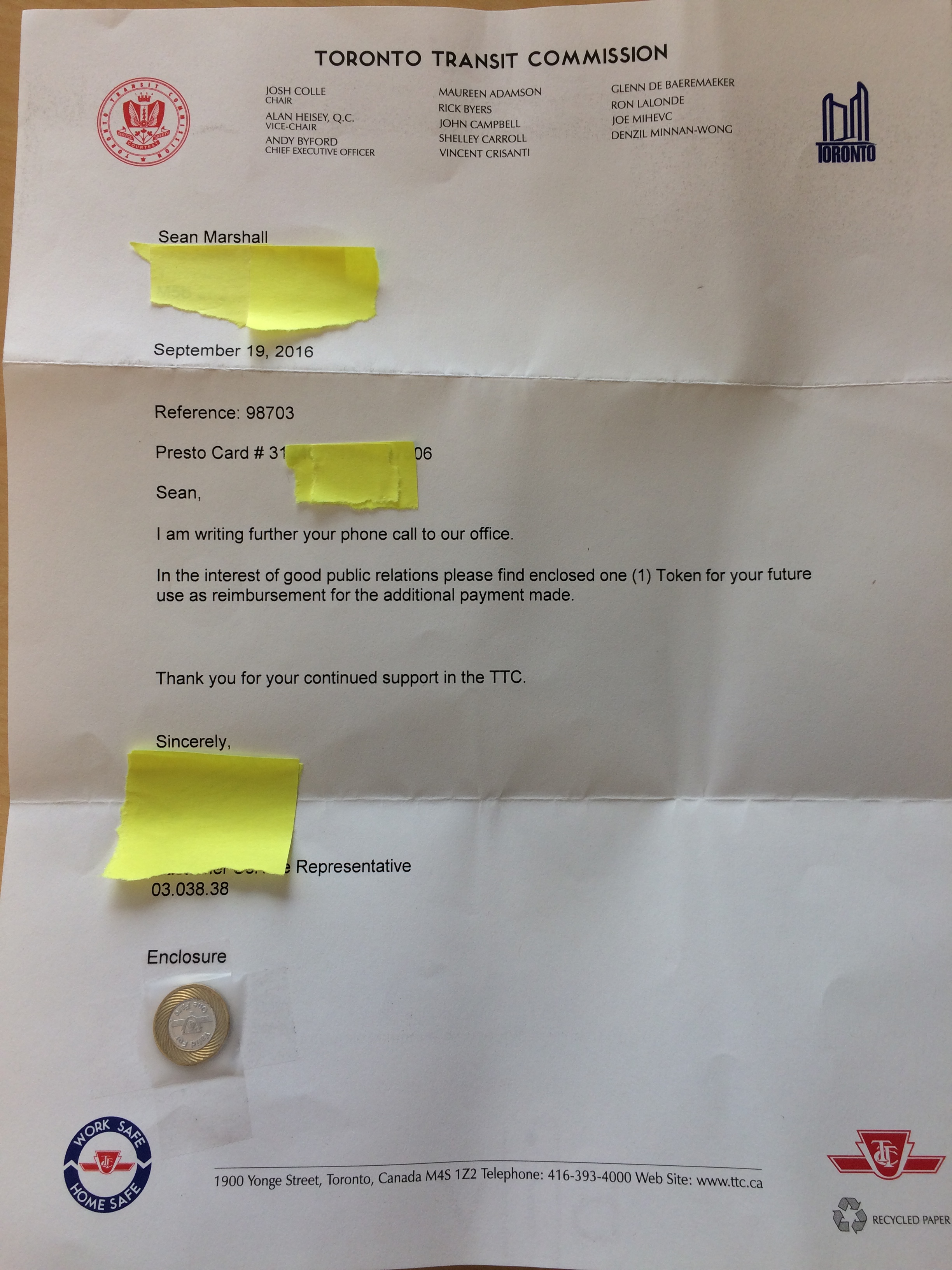
    Luckily, I checked my transaction history on Monday, where I caught the error. I immediately went on Twitter to complain. The TTC Helps account told me me to give TTC customer service a call, and they apologized (though reminding me that I should always get a paper transfer when paying with Presto), and promised to mail me a token to compensate. I got the token in the mail five days later, “in the interest of good public relations.” Mailing a token out is one way to refund an improper charge, but it’s not efficient.

    I will say that the TTC customer service staff are great people who sometimes deal with unreasonable customers. The agent I spoke with was very understanding and agreed with some of the specific issues that frustrated me that day.

    image1-1

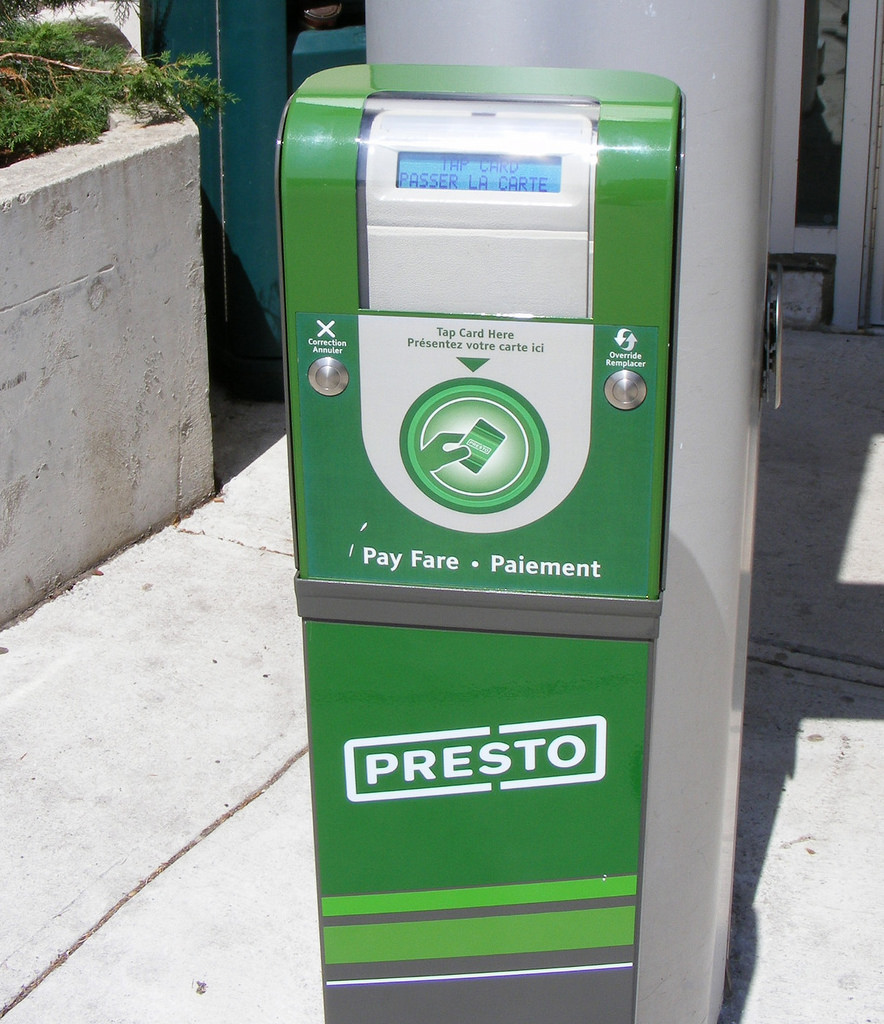
    Had I not checked my balance, and not immediately complained, I would not have received this refund. How many customers, acting in good faith, get double-charged using their Presto Cards and don’t even know it? The TTC’s Presto fare machines don’t provide fare balance or transaction data, unlike those used by GO or suburban transit operators (see photo below).

    4902983182_d89c675230_b.jpgGO Transit Presto fare machine, which displays card balance and time left to complete ride/transfer

    Even when Presto is fully rolled out, the TTC’s transfer rules are unclear and they are prone to unfair double-charges for completely reasonable one-way continuous trips.

    Last year, I warned about the troubles that could result in forcing Presto on top of the TTC’s archaic transfer system: “if a passenger taps onto another vehicle on the same route, which is quite a common occurrence due to delays, short-turns, and diversions/shuttles, the Presto Card will deduct a second fare.”

    As I mentioned before, the TTC already considered time-based transfers in 2014 as it planned for the transition to Presto for fare collection. At the time, the Commission estimated that it would cost $20 million in annual revenue, as some passengers would take advantage of making stopovers en route or quick return trips on one fare. Another excuse I heard is that the TTC is waiting for Metrolinx to finalize its regional fare integration strategy.

    But a modern transfer policy would bring the TTC in line with other transit agencies in the Greater Toronto and Hamilton Area, would make the Presto Card much easier to use, and would buy a lot of goodwill, especially if it was introduced to coincide with a fare increase. It’s also worth noting that when the TTC eliminates transfers, tickets, and passes, its customers will be required to pay $6 for a new Presto Card. It’s only right to incentivize its loyal customers to make the switch.

    I’m happy to get a token refund and acknowledgment of my predicament. But I had to notice the charge and complain, and tokens will soon be phased out. A better solution is needed.

  • Why the Gardiner Expressway remains a barrier to the waterfront

    29295828846_d05ad61318_kThe Gardiner Expressway isn’t so much a barrier to the waterfront because it’s a looming, elevated eyesore: the railway viaduct isn’t pretty to look at either. It’s a barrier to the waterfront because the roadways around the Gardiner: the on ramps, dual left turn lanes, channelized right turns, and the ground-level Lake Shore Boulevard below it, are hostile to pedestrians. Pedestrians are expected to  yield to cars and trucks at many points; there are many missing crosswalks, and where pedestrians can cross, they must wait for long waits to do so as traffic light cycles prioritize through vehicles.

    In the 1950s, when the Gardiner was planned, the waterfront was a mess of railway spur lines, warehouses, and grain silos. Downtown was several blocks north, on the other side of passenger rail yards and Union Station. So it was not the type of place — nor the era — where creating pedrestrian-friendly enviroments was deemed important.  But since then, the rail yards were redeveloped, the waterfront got new parks, cultural spaces, residents, and shops. The Gardiner Expressway hasn’t kept up.

    https://twitter.com/Sean_YYZ/status/769965846903095297

    At Spadina and Lake Shore, it took me 8 1/2 minutes to legally cross at Spadina and Lake Shore (and I’m a healthy, younger, able-bodied adult without parcels or a rolling a stroller). As pedestrians are banned from crossing east-west on the north side of the intersection, and north-south on the west side, I had to return to the corner of Spadina and Bremner/Fort York and walk on the other side. And even that was an unnecessary ordeal.

    The local councillor, Joe Cressy (Ward 20) is on it, and is working on solutions for next year. The Bentway Park will be a good addition as well (even if I haven’t warmed to the name.) But it’s a shame that as a city has grown around this area, the Gardiner remains so difficult to get around on foot.

    Read more in my latest article in Torontoist


  • The controversial Judson Street zoning change

    IMG_3781-001

    Earlier this year, Etobicoke Councillor Justin Di Ciano (Ward 5) pushed for a zoning change to several industrial properties on Judson Street, adjacent to GO Transit’s Willowbrook Yards. Local residents had enough with a concrete batching operation and Dunpar Homes applied to build a townhouse development on the site.

    City staff recommended against the rezoning, which would allow townhouses to go up on land previously zoned as industrial. Metrolinx, GO Transit’s parent organization, also spoke out against the re-zoning, warning that it could impact its expansion plans, including GO RER/SmartTrack. But Councillor Di Ciano, Mayor John Tory, and most of the mayor’s allies voted against those concerns and supported the redevelopment.

    Now Metrolinx is appealing the council decision to the Ontario Municipal Board, and the City will be forced to hire external expert advice, as it went against its staff recommendations.

    You can read the Torontoist post here, where I explain the situation in more detail.


  • Suburban cycling infrastructure: the 416 versus the 905

    IMG_2051-001Riding along the McNicoll hydro corridor in northern Scarborough

    Earlier this summer, I took two rides from my downtown apartment to suburban locations. On one ride, I biked northeast to Agincourt, on another trip, I biked to Downtown Brampton on a route that took me past the Humber River and Etobicoke Creek. I experienced different standards for on-street and off-road cycling routes. The City of Toronto generally does better, but suburban cycling infrastructure generally depends on off-road trails, rather than on-street bike lanes and cycle tracks.

    In the urban, central part of Toronto, bike lanes and cycle tracks (separated bike lanes located along major streets) are the predominant form of cycling infrastructure. While there are some bike lanes in suburban Toronto and in other municipalities like Mississauga and Brampton, most bike routes, if they exist, are off-road multi-use trails, in ravine or hydro corridors, or alongside major roads, like sidewalks.

    Multi-use paths are pleasant to ride on, but they’re often treated as recreational trails, rather than transportation corridors. Most paths are not cleared of snow in the winter (winter cycling really should be encouraged), and they are often isolated from the adjacent road network and local destinations, and they can meander, rather than follow straight lines. Road crossings can often be awkward.

    Bike lanes, which offer less protection from motorized traffic at least are integrated with the rest of the street grid, and are generally more direct. But on fast-moving suburban arterials, they aren’t ideal without separation. This is where the side-of-road path comes in.

    IMG_2305-001Shared pathway, Derry Road, Mississauga

    (more…)

  • Toronto’s new rapid transit plan

    Yesterday, City Council decided, by a vote of 27-16, to go ahead with the $3.1 billion one-stop extension of the Bloor-Danforth Subway to Scarborough Centre, rejecting Councillor Josh Matlow’s last-ditch attempt to resurrect the LRT replacement and extension of the ageing Scarborough LRT line. Council — Mayor Tory included — also voted to spend resources studying three more suburban subway extensions and a re-alignment of the proposed Relief Line subway backed by the local councillor.

    Unfortunately, the chance of going back to the less-expensive, yet longer seven-stop light rail line is slim-to-nil at this point. In my view, it’s time for transit advocates that backed the LRT to focus their energies elsewhere. Like Metrolinx’s fare integration strategy, and the plans for other LRT lines, such as the eastern and western extensions of the Eglinton-Crosstown.

    TT - Scarborough VoteHow council voted on Councillor Matlow’s motion to resurrect the LRT option for Scarborough

    In order to ensure that he had enough votes, John Tory entertained Ward 39 Councillor Jim Karygiannis’ motion for a study on an extension of the Sheppard Line from Don Mills Station to Scarborough Centre. (There’s a LRT proposed for Sheppard East, but no matter.) Karygiannis’ motion passed, as well as several other councillors’ pet subway projects. Ward 10 Councillor James Pasternak has long pushed for a Sheppard Subway extension west between Sheppard-Yonge and Downsview Stations, and he successfully got that included as well. Finally, Justin Di Ciano (Ward 5) got a study approved for a subway extension in his ward as well, resurrecting a long-dormant proposal for a subway extension from Kipling Station to Sherway Gardens.

    It’s worth noting that all three right-leaning councillors are reliable votes for John Tory.

    Downtown, Paula Fletcher (Ward 30) moved that staff re-examine the Relief Line, moving the recommended alignment from under Pape Avenue to Carlaw Avenue between Gerrard and Queen Streets. This would shift the planned — yet unfunded — subway line two blocks west. The Pape alignment was chosen for ease of construction and operation (the line must curve from north to west just south of Queen Street), and is only two blocks away. That study will cost $520,000 and staff time.

    All these new studies are illustrated below. For clarity’s sake, the Sheppard East LRT, the Scarborough LRT proposal, and the existing Scarborough RT (Line 3) are removed. You can read more about how the votes went down on Steve Munro’s site.

    Transit Plan July 2016The map of planned, approved and existing rapid transit lines, and those extensions and re-alignments approved for study

    The “subways, subways, subways” sentiment is alive and well at City Hall, even if Rob Ford has passed on. And despite the thirst for expensive new subway lines,  Mayor Tory is still backing an austerity agenda at City Hall. Apart from the decorum, not much has changed in the mayor’s office.

  • What do I know? I’m just a downtown elitist

    23211094949_cd3f8fc6a1_k

    I once described Councillor Denzil Minnan-Wong as the city official that “knew the cost of everything and the value of nothing.” In 2014, Minnan-Wong complained about the costs of building new washrooms at the soccer fields at Cherry Beach, holding up a sign that simply said “$600,000.” That photo of Minnan-Wong, scowling for the cameras, trying to generate some outrage in an election year, was meme gold and so was parodied in the #TOpoli Twittersphere.

    At $600,000, yes the washrooms were expensive. But as they were built in an isolated part of the Portlands, they required a new connection to the nearest watermain; a sewage tank had to be constructed as well, being so far from existing lines. The city has a mandate to provide quality parks and recreational facilities. Minnan-Wong, along with the Fords, also complained about the costs of umbrellas at Sugar Beach, a popular new waterfront park.

    In 2016, under Mayor John Tory’s administration, we have a City that doesn’t know the cost of some things (like the Scarborough Subway) nor does it know the value of other, smaller things, like the Toronto sign.

    The Toronto sign, placed on Nathan Phillips Square ahead of last year’s Pan Am Games proved to be incredibly popular with residents and tourists alike. The LED backlighting allows the sign to be coloured at night to mark any holiday or any important current or special event. The $100,000 climbable sign (reminiscent of the successful “I amsterdam” signs) was supposed to be temporary, and will have to be replaced within three years. A staff report estimate the cost of major repairs to the existing sign, and a new mobile sign, would cost $421,700 over two years. This would be money well spent.

    But some councillors, including Etobicoke’s Stephen Holyday and Scarborough’s Raymond Cho, would rather privatize the sign, perhaps selling it off. At least Councillor David Shiner, a fiscal conservative, called it “a potent symbol of Toronto pride and unity” after amalgamation, but even he questioned the need for paying for city staff to maintain the sign. A strong argument could be made that the costs to maintain the sign should come from Tourism Toronto and the local tourism industry, but calls from some quarters to sell it off are ridiculous.

    Last Friday, we learned that the estimated cost of building the one-stop, six kilometre subway extension to Scarborough Centre jumped from $2.0 billion to $2.9 billion. But unlike cycling infrastructure or fully funding an effective Vision Zero program to protect vulnerable road users, the mayor, key council allies, and provincial MPPs remain hell-bent on building it.

    Scarborough Centre MPP Brad Duguid, a powerful cabinet minister in the provincial Liberal government, quoted in the Toronto Sun, said that critics of the subway plan “…have been yapping away on this project from Day 1 and the vast majority of those critics come from fairly elitist downtown views of the city. People in Scarborough and the suburbs of Toronto count as well.” Duguid claimed that “the area surrounding the new [Scarborough Centre] station is growing fast.” Never mind that population and employment densities are not very high along the subway route, even in Scarborough Centre, and no major commercial development has come to central Scarborough since the 1990s.

    On Metro Morning, Duguid, a former city councillor who endorsed John Tory’s mayoral bids in 2003 and 2014, doubled down on his previous rhetoric. He repeated false claims about Scarborough Centre’s growth, claimed Scarborough residents have paid for downtown subway expansions, he even stated that the Scarborough Subway “transcends politics” (which earned a guffaw from host Matt Galloway).

    I live downtown, and I don’t use the subway; like many who live here, I walk to work. Many others cycle, or take overcrowded streetcars on King and Queen Streets. The Yonge Subway is overcrowded from commuters from outside the downtown core. Most downtowners wouldn’t directly benefit from a Relief Line either, but it’s an essential part of the network. The last subway built in Downtown Toronto was in 1966. I’m hardly an “elitist” either; I rent my apartment. I don’t enjoy many luxuries, and I certainly don’t hold a position of power or influence. I simply want the best transit for the best price; the Scarborough LRT, along with GO Transit RER and the Eglinton-Crosstown and Scarborough-Malvern light rail corridors represent the right investment for the eastern half of Toronto.

    We’re content to keep up an underused section of the Gardiner at greater expense than an urban boulevard, at the cost of lost development opportunities on the eastern waterfront. We’re committed to a $2.9 billion, 6 kilometre one-stop extension when a 10 kilometre, 6-stop LRT would cost $1.8 billion, funded entirely by the province. But we’ll complain about umbrellas and washrooms, budget too little for road safety plans, and question the costs of maintaining a popular sign at City Hall. I love this city, but sometimes Toronto still gets me down.