Tag: Toronto

  • Mapping the council race in Ward 14 — Toronto-Danforth

    Ward 14, Toronto-Danforth, was another ward where two progressive incumbent councillors were forced to run against each other when Toronto City Council was reduced due to Bill 5. Mary Fragedakis represented old Ward 29, the part of the ward north of Danforth Avenue, while Paula Fletcher represented old Ward 30, south of the Danforth. Both are affiliated with the New Democratic Party.

    Fragedakis was first elected in 2010, replacing retiring councillor Case Ootes, a conservative. In that election, she got 41.8 percent of the vote, well ahead of her closest challenger, Jane Pitfield. In 2014, she won every poll in Ward 29 and got almost 60 percent of the vote. Fragedakis would have very likely been re-elected in Ward 34 under the 47-ward model, despite the new ward boundary encompassing Rosedale. There were three challengers: Marisol D’Andrea, Ryan Lindsay, and Alexander Pena.

    Paula Fletcher was first elected in 2003, taking Jack Layton’s former seat on council. She nearly lost in 2010 to Liz West, a more conservative candidate, but increased her vote share in 2014, taking 49.6 percent of the vote against West and new challenger Jane Farrow. Fletcher intended to run again in the new Ward 36, which had similar boundaries to her old Ward 30. There were also three challengers: Lanrick Bennett, Chris Budo, and Dixon Chan.

    Under the new 25 ward model, the old Wards 29 and 30 were combined, along with a small section of old Ward 32. Only Alexander Pena withdrew from the race.

    Fletcher was endorsed by the Toronto Star and by the Toronto and York District Labour Council. The Labour Council endorsement was controversial, as its president, John Cartwright, is married to Fletcher. Fragedakis was also previously endorsed by the Labour Council, so it would have been only right for it to withhold its endorsement in Ward 14.

    2018 Election - W14.jpg

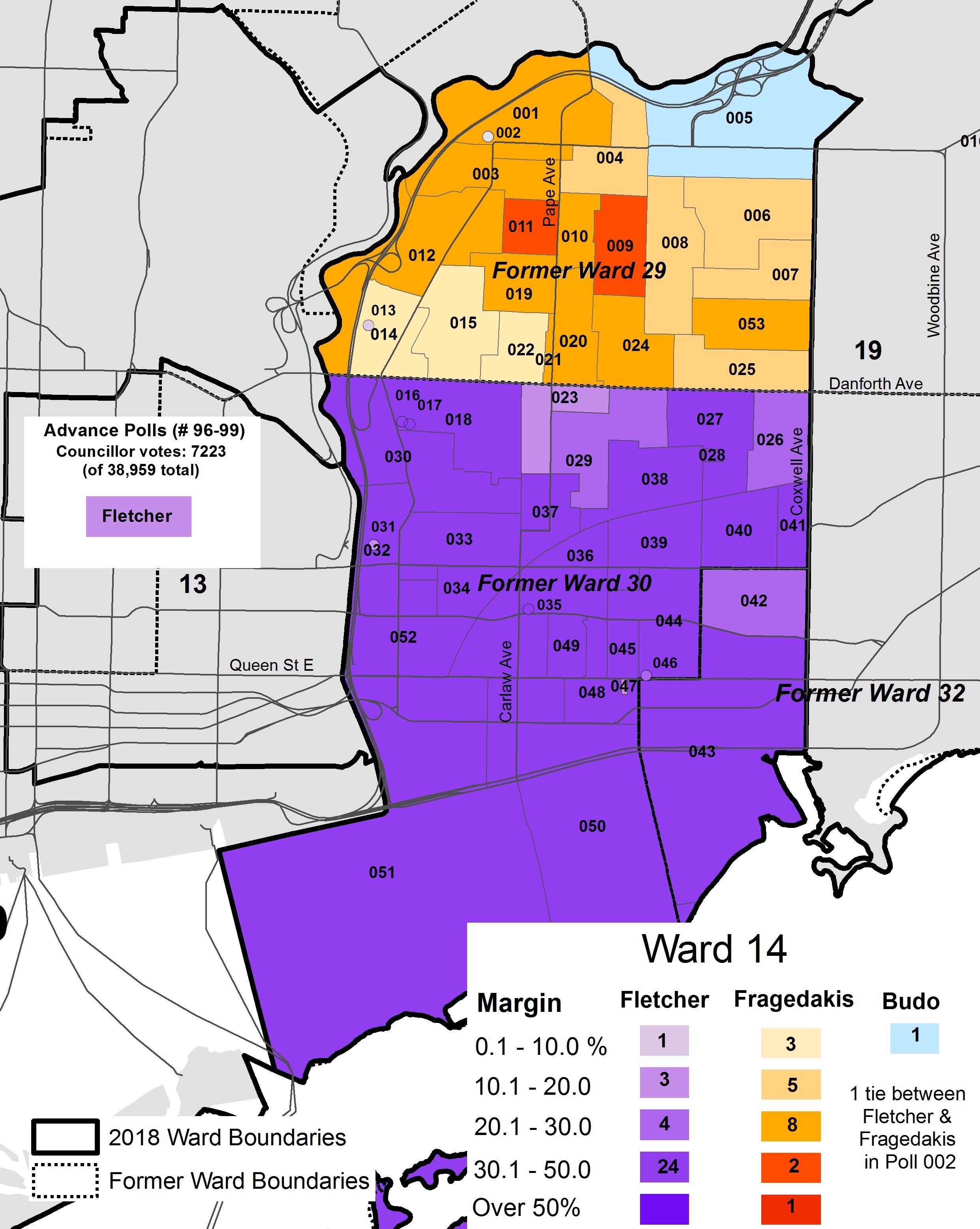
    In any case, the Labour Council’s endorsement wouldn’t have mattered. Fletcher won by a wide margin, netting 42.3 percent of the vote, compared to Fragedakis, who came in second place with 26.2 percent. In third place with 19.0 percent of the vote was 22-year old Chris Budo, a financial analyst who recently graduated from Ryerson University. Budo came in second place in 32 polls, and placed first in Poll 005.

    Fletcher was able to count on the support of polls in her home turf. She got 55.7 percent of the vote in former Ward 30, while Fragedakis was only able to get 44 percent of the vote in old Ward 29. There were also over 3500 more voters south of Danforth Avenue than to the north. As we have seen previously in Wards 6, 8, 22, and 25, when two incumbents ran against each other, the advantage was given to the candidate whose former turf has the larger population in the new ward.

    Paula Fletcher is a hardworking and effective member of Toronto City Council, pushing for affordable housing, social justice and environmental issues, and is very attentive to her community. I am glad that she is back on council. But I remain disappointed and disillusioned by the province’s meddling in local affairs that shut out both good incumbents and promising young voices.

    Ward 14 Toronto-Danforth
    Candidate Votes Percent of vote
    Lanrick Bennett 1,935 5.0
    Chris Budo 7,394 19.0
    Dixon Chan 1,100 2.8
    Marisol D’Andrea 429 1.1
    Paula Fletcher 16,468 42.3
    Mary Fragedakis 10,201 26.2
    Ryan Lindsay 413 1.1
    Lawrence Lychowyd 188 0.5
    Chris Marinakis 700 1.8
  • Mapping the council race in Ward 12 – Toronto-St. Paul’s

    As mentioned in my last post, Bill 5, introduced by Premier Doug Ford in the middle of Toronto’s municipal election campaign, had a silver lining: it finally rid Toronto City Council of its greatest embarrassment, Giorgio Mammoliti. Otherwise, though, it had terrible effects. It removed the opportunity for many new voices to get elected to City Council by reducing the number of seats from 47 to just 25. In Ward 12, voters had a very difficult decision to make, as Josh Matlow and Joe Mihevc found themselves running against each other. Previously, both councillors expected to cruise to victory; neither were facing any prominent challengers under the 47-ward model.

    Joe Mihevc, allied with the New Democratic Party, is one of the best arguments against council term limits. Representing old Ward 21, Mihevc has been a very popular and effective community representative. Ward 21 includes wealthy neighbourhoods such as Cedarvale, Wychwood Park, and the west half of Forest Hill. It also includes more modest neighbourhoods north of St. Clair Avenue and west of Bathurst Street. Two of Mihevc’s signature accomplishments were championing the St. Clair Avenue streetcar right-of-way and the Wychwood Barns project, where a former TTC streetcar yard was transformed into a wonderful park, art space, and community hub.

    Josh Matlow, a Liberal, was elected to City Council in 2010 in old Ward 22. Matlow’s ward includes much of Toronto’s midtown area, affluent neighbourhoods such as Deer Park, Rathnally, and the eastern half of Forest Hill, as well as highrise apartments near Yonge and Eglinton and along Davisville Avenue. Matlow started his first term as an idealistic centrist, but made his mark as a sharp and informed critic of Rob Ford and John Tory, especially the Scarborough Subway.

    Both Mihevc and Matlow became well-known for their involvement in local and city-wide issues. Mihevc has been very active in public health and anti-poverty matters. While Matlow is well-known for pushing for smarter transit infrastructure, he was also busy managing growth in his ward, especially in the Yonge-Eglinton area. Both have been very active in their wards, working on community improvements which make it so unfortunate that only one of the two could be re-elected.

    Though Joe Mihevc is well to the political left of John Tory, the mayor backed Mihevc. This wasn’t surprising given the amount of bad blood between Tory and Josh Matlow. The mayor robocalled for Mihevc, like he did for Brad Bradford in Ward 19, and Mark Grimes in Ward 3.

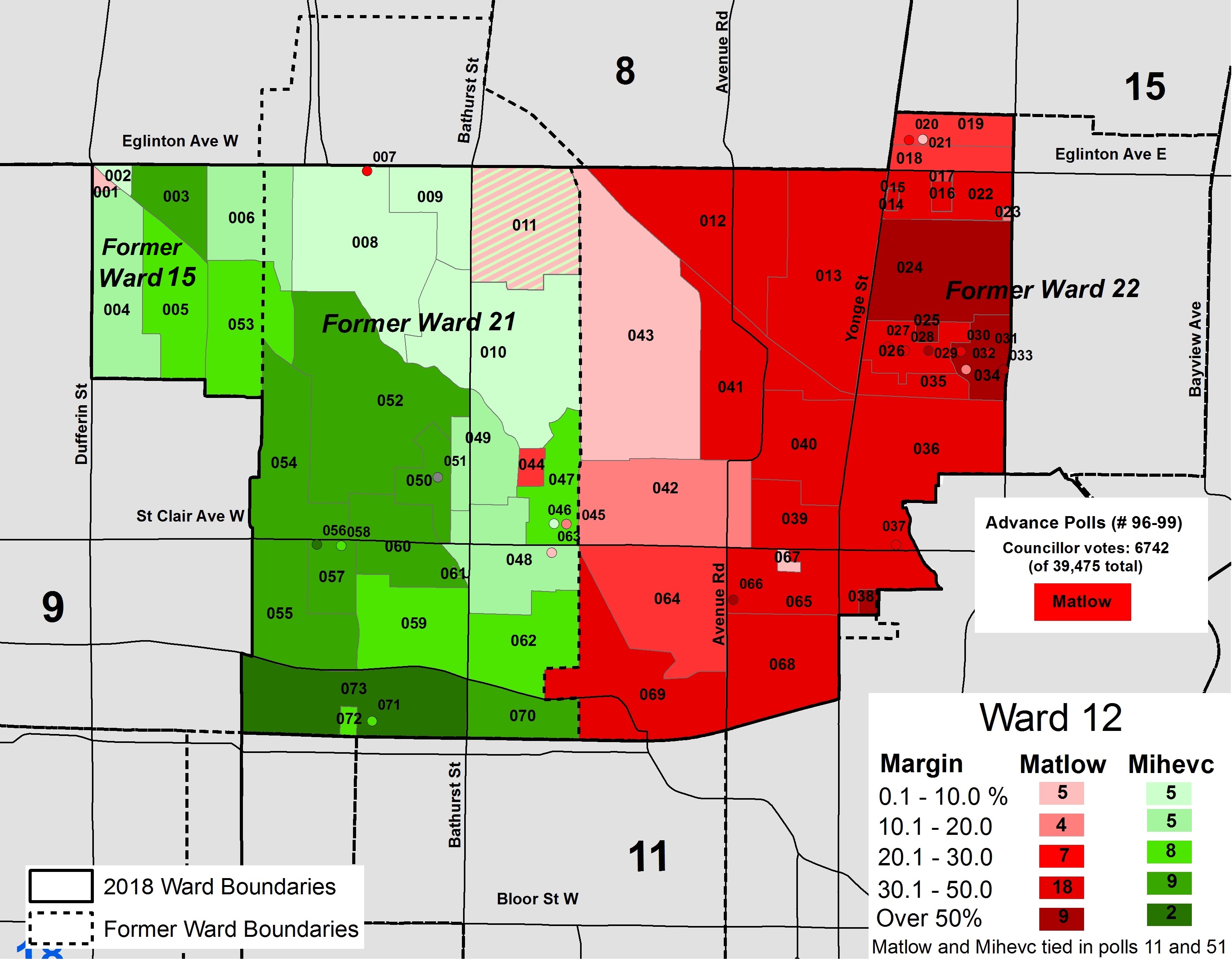
    But the voters in new Ward 8 chose Josh Matlow by a comfortable margin. Matlow got 51.6 percent of the vote to Mihevc’s 42.1 percent. The other four candidates shared the remaining 6.3 percent of the vote. This was one council race the mayor couldn’t influence.

    2018-election-w12

    This result had more to do with geography than anything else. Both Mihevc and Matlow lost parts of their old wards due to the new boundaries — the part of Ward 22 east of Mount Pleasant Road moved to Ward 15, while the part of old Ward 21 north of Eglinton Avenue went to Ward 8. Mihevc was able to count on the support of 61 percent of the voters in former Ward 21, made up of 27 polls. Mihevc also came first in five of the six polls located in former Ward 15, west of Oakwood Avenue. Matlow placed first in only five of the 33 polls west of Oakwood Avenue, and tied with Mihevc in two.

    But there were 39 polls in former Ward 22, Matlow’s turf, where he remained especially popular, getting 66.4 percent of the vote there, and placing first in every poll. The advance poll heavily favoured Matlow as well.

    Doug Ford’s late-stage meddling made the 2018 election incredibly unfair, especially as candidates scrambled late to run in much larger wards. Matlow won because the new Ward 8 had a larger electorate from his old ward, rather than Mihevc’s. This wasn’t fair. But Bill 5 wasn’t meant to be fair.

    But by sending Josh Matlow back to City Council, instead of a more conciliatory Joe Mihevc, John Tory won’t have such an easy time getting his agenda through.

    Ward 12 Toronto-St. Paul’s
    Candidate Total votes Percentage
    Elizabeth Cook 908 2.3
    Artur Langu 290 0.7
    Ian Lipton 930 2.4
    Josh Matlow 20371 51.6
    Joe Mihevc 16634 42.1
    Bob Murphy 342 0.9

    Note: This post is revised from a previous version to better describe some of the community work done by city councillors. 

  • Toronto election 2018: no surprises

    Last night, there were some disappointments and one or two bright spots in the results of Toronto’s municipal election, but there were no big surprises.

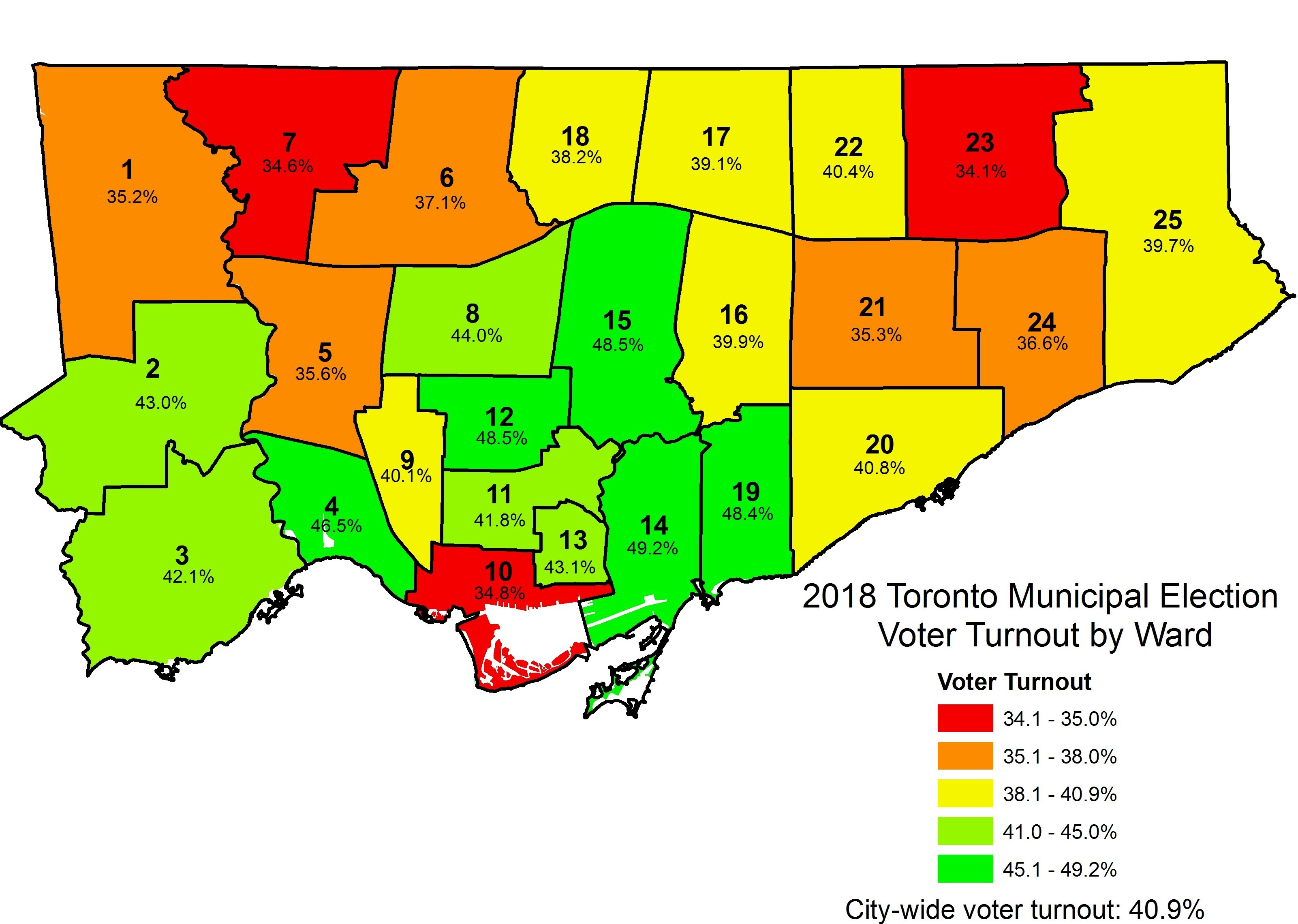
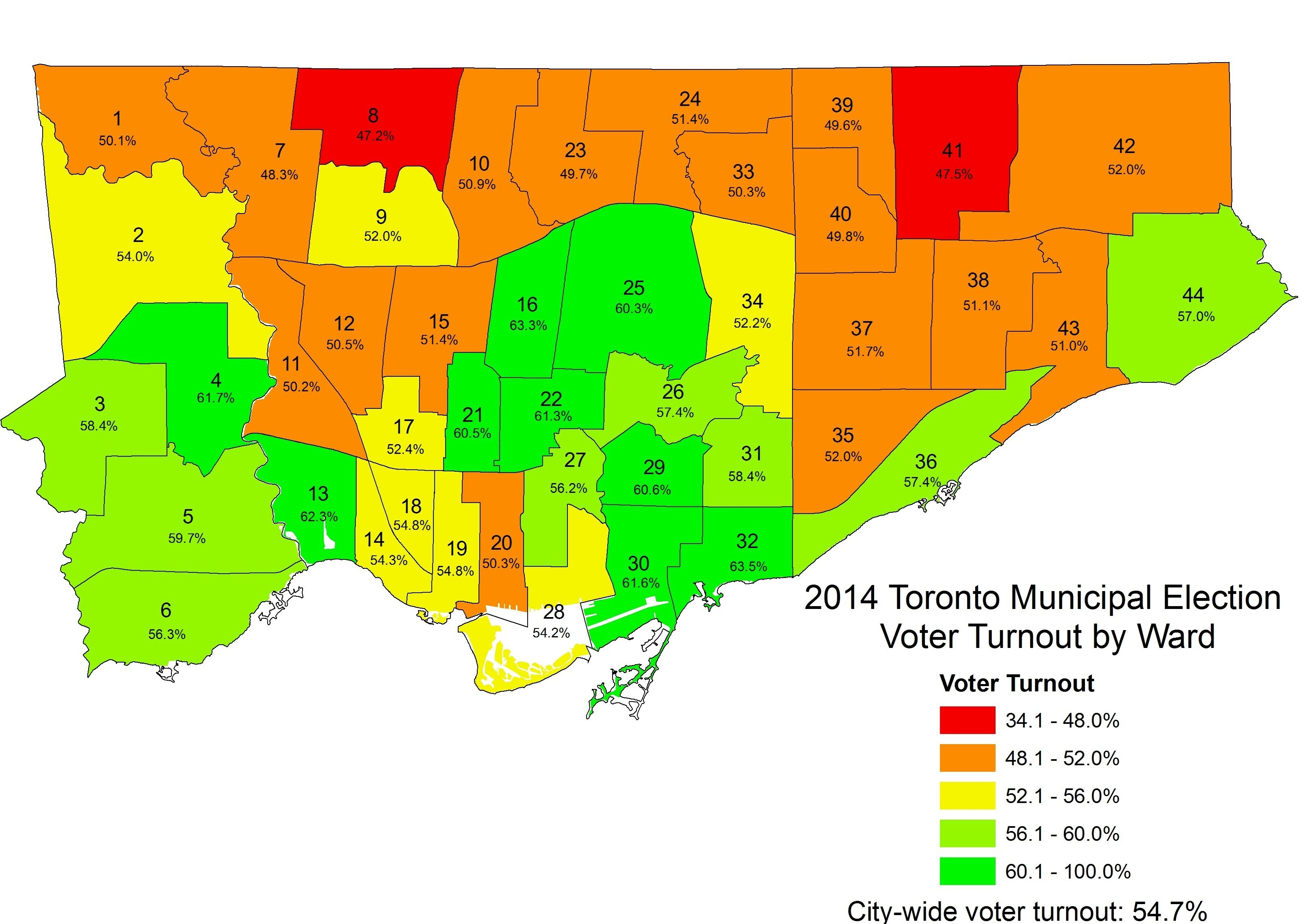
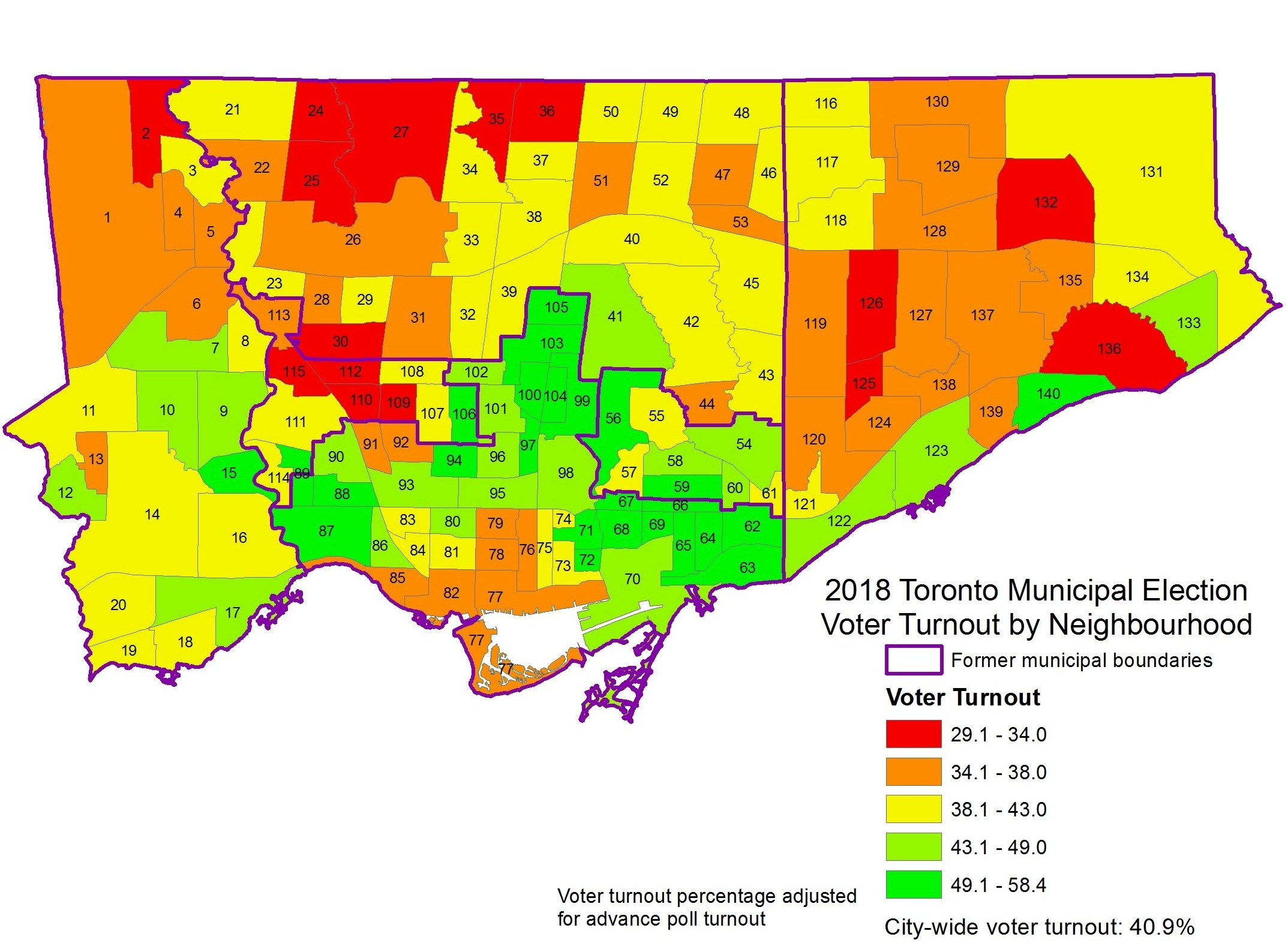
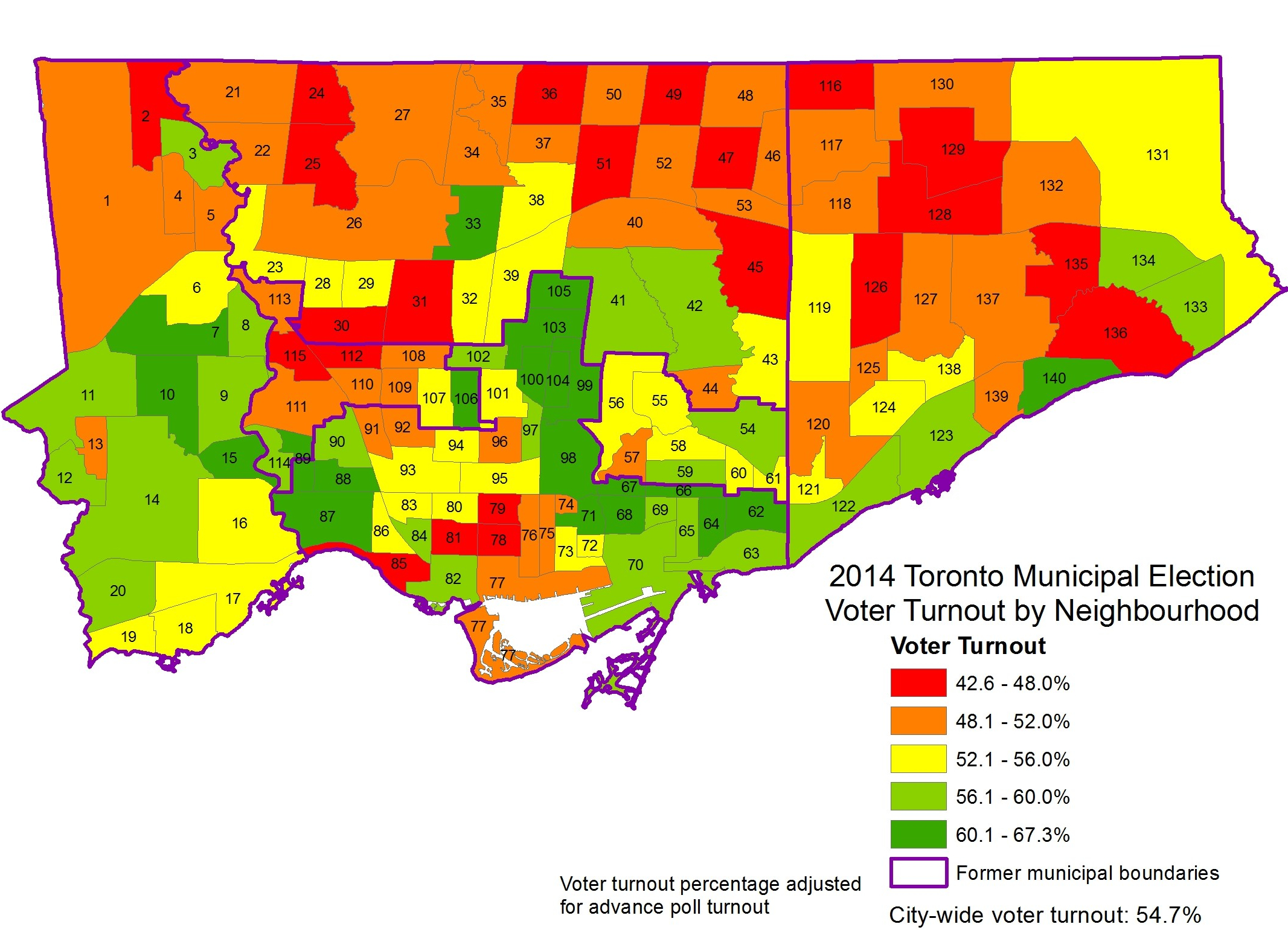
    It was disappointing to see voter turnout drop. In 2014, 54.7% of eligible voters turned out. There was a three-way mayoral race between John Tory, Doug Ford, and Olivia Chow. This year, only 41% of eligible voters came out. This was no surprise: the election was tarnished by Premier Ford’s vindictive Bill 5, which cut the number of wards from 47 to 25, in the middle of the campaign.

    While I was very happy to see former chief planner Jennifer Keesmaat declare her candidacy in response to Tory’s inadequate response to Bill 5, Keesmaat didn’t have the time or the organization to compete against Tory. She took less than 25% of the vote and Tory came in first place in all 25 wards.

    It was also hard to see many good local politicians defeated by fellow councillors in the new larger boundaries. It was difficult to see Josh Matlow and Joe Mihevc run against each other (Matlow won in the end). I would have also liked to see new voices, including Tiffany Ford and Amber Morley, do better. There are only four persons of colour on the new council. As Toronto Star columnist Ed Keenan points out, this is the same as the number of Michaels elected.

    But at least Giorgio Mammoliti is gone.

    The balance of power on the smaller 25-ward Toronto City Council is similar to the old 44-ward council. By my count, there are eight left-leaning councillors, five swing votes, and eleven conservatives. John Tory leans conservative, and he will need the support of 14 councillors to get items passed.

    Progressives (8):

    • Shelley Carroll (Ward 17)
    • Joe Cressy (Ward 10)
    • John Filion (Ward 18)
    • Paula Fletcher (Ward 14)
    • Mike Layton (Ward 11)
    • Josh Matlow (Ward 12)
    • Gord Perks (Ward 4)
    • Anthony Perruzza (Ward 7)
    • Kristyn Wong-Tam (Ward 13)

    Swing votes (5):

    • Paul Ainslie (Ward 24)
    • Ana Bailão (Ward 9)
    • Brad Bradford (Ward 19)
    • Mike Colle (Ward 8)
    • Jennifer McKelvie (Ward 25)

    Conservatives (11):

    • Gary Crawford (Ward 20)
    • Michael Ford (Ward 1)
    • Mark Grimes (Ward 3)
    • Stephen Holyday (Ward 2)
    • Jim Karygiannis (Ward 22)
    • Cynthia Lai (Ward 25)
    • Denzil Minnan-Wong (Ward 16)
    • Frances Nunziata (Ward 5)
    • James Pasternak (Ward 6)
    • Jaye Robinson (Ward 15)
    • Michael Thompson (Ward 21)

    Despite these three simplistic labels, it’s impossible to predict how each vote may go, and how Mayor Tory will tackle new challenges brought on by the Ford government and the fiscal iceberg.

    In the next few weeks, after the official election results are released, I’ll delve into the numbers and map the more interesting ward races, if not all 25 wards.

  • The final days of a brutal municipal election

    IMG_8629Toronto’s municipal election will take place in a few days, on Monday, October 22. A few months ago, I was energized by the possibilities a 47 ward council would bring, with several open races where new voices could be elected. I was looking forward to seeing Dan Fox win on his second try in North York, after an impressive run in 2014 against long-time incumbent David Shiner. I was excited to see Tiffany Ford’s campaign take on Giorgio Mammoliti. Downtown, three new wards would make room for new faces like Chris Moise. Meanwhile, several incumbents, including Janet Davis, Mary-Margaret McMahon, and John Filion were planning to retire.
    The mayoral race was going to be a snooze, with John Tory sleepwalking his way to a second term but at least the council races would be interesting.

    So much for that.

    This municipal election is a sham. When Premier Doug Ford suddenly announced that he was going to introduce legislation to reduce Toronto’s council size from 47 to 25 — in the middle of the election campaign — it threw everything into chaos. Candidates who signed up to run in wards with a population of 50,000 to 60,000 were now forced to decide whether to run in a ward with nearly twice the population and against new opponents. Incumbents were now running against each other. Candidates had run in good faith, raised money, appealed to volunteers, and printed materials. It was no way to run a fair election.

    Though a court ruling overturning the result briefly provided relief and elation, Ford’s threat of using the Notwithstanding Clause to re-introduce legislation, and an appeal court’s ruling ensured that Toronto would run a compromised election with only 25 wards. Good people like Fox, Moise, Kyle Ashley, and Ausma Malik understandably dropped out of the council race. Others, like Tiffany Ford, Lanrick Bennett, Kevin Vuong, and Lekan Olawoye decided to continue what they started, even if it meant running in a tougher race. Meanwhile, John Filion jumped back into the race, while Josh Colle dropped out. His father, former MPP Mike Colle, jumped in.

    Doug Ford’s vindictive meddling sucked the energy out of the election; turnout at advance polls is down significantly from the last election despite the same number of days. About 124,000 voters cast a ballot in the advance polls held between Wednesday, October 10 and Sunday October 14, down from 161,000 who voted in advance in 2014.

    It’s depressing, but it’s still important to vote. There are lots of good people worth supporting even though it sometimes means picking one of several worthy candidates in a single ward. There is also the opportunity to remove some of Toronto’s worst councillors. And at least there’s a higher profile mayoral race, now with former chief planner Jennifer Keesmaat challenging Tory.

    Here are several candidates worth supporting:

    Kristyn Wong-Tam: In her first two terms, Wong-Tam has proven to be one of council’s hardest workers, balancing constituency work with social activism. She represents the east side of Toronto’s downtown core, including the financial district, Moss Park, Yorkville, and Church-Wellesley Village, all fast-growing areas with lots of new development planned or underway.

    Under the old 47-ward model, Wong-Tam’s re-election would have been guaranteed, but now she is running against former provincial cabinet minister and mayoral candidate George Smitherman and appointed councillor Lucy Troisi. There are 19 candidates in total running in Ward 13, Toronto Centre.

    Troisi, who replaced the late Pam McConnell in 2017, was backed by council’s right wing and has proven to be a reliable Tory ally on council. Last summer, when Premier Doug Ford moved to cut Toronto Council to 25 wards, Troisi wasn’t willing to fight. Like all council appointees, Troisi promised not to run for election if appointed, but has since reneged on that promise. Meanwhile, George Smitherman, who lost to Rob Ford in 2010, has drawn controversy for running a negative campaign, including targeting an affordable housing complex on Sherbourne.

    Lekan Olawoye: Running in Ward 5, York South-Weston, Olawoye has proven to be a great community leader. In 2014, he ran in the old Ward 12 against Frank Di Giorgio, getting over 20% of the vote. I met Olawoye and his team after a mayoral debate in 2014, and I came away impressed. This time, Olawoye, an executive at MaRS, will be running against incumbents Di Giorgio and Frances Nunziata. Di Giorgio and Nunziata are both long-time conservative councillors and allies of Mayors Doug Ford and John Tory. Neither have represented the lower-income area effectively over their many years in office.

    Shelley Carroll: I was hoping that Shelley Carroll would be elected MPP in the new riding of Don Valley North. She resigned her council seat to run in the June election, leaving a vacancy on council. She is a progressive Liberal with lots of municipal experience, including a stint as former mayor David Miller’s budget chief. Carroll would have been a valuable member of the Liberal caucus, especially if the party needed to rebuild after the 2018 election. Happily, she will be running for council again in Ward 17, Don Valley North.

    There are also several awful councillors who might be turfed this year.

    Giorgio Mammoliti: First elected to municipal politics in 1995 after serving one term as MPP, Mammoliti has been best known for his attention-grabbing stunts, his outrageous statements, and his disregard for many of his constituents. He barely even shows up to work. Earlier this year, The Toronto Star reported that Mammoliti missed nearly half of all council votes in 2018, the worst record among all 44 councillors. During the 2014-2018 term, he missed 43.1 percent of all votes.

    Mammoliti has been in trouble several times for campaign finance violations, and has been under police investigation twice. Once for olding an illegal $80,000 fundraiser last year attended by lobbyists, developers and other businesspeople, the other for his involvement in a dubious land deal.

    Under the 47 ward model, there was a promising challenger who looked like she could beat City Council’s resident troll: Tiffany Ford. Ford, elected in 2014 as a TDSB trustee, is a local resident, entrepreneur, and community activist. She is still running in the 25 ward election, but is also now against left-leaning incumbent Anthony Perruzza, and Deanna Sgro, the daughter of Liberal MP Judy Sgro. Deanna ran into trouble with the Law Society of Upper Canada in 2013 for questionable debt collection practices. While Perruzza would certainly be an improvement to Mammoliti, I prefer Tiffany Ford.

    Mark Grimes: First elected to council in 2003, Grimes has been known for improperly backing developers in his ward, getting in trouble with the city’s integrity commissioner. Grimes has voted in favour of cuts to transit, the library system, and road safety improvements. Infrastructure has not kept up with massive growth in the Humber Bay Shores neighbourhood. In 2014, John Tory’s campaign supported Grimes’ re-election bid, despite the councillor’s poor record. But he’s been a reliable vote for the mayor on council. Grimes’ friend and ally Justin Di Ciano decided against running in 2018; the two would have otherwise faced off against each other.

    Luckily, Amber Morley, who has been very active in the community, working at a community health centre and at city hall, is running to beat Grimes. Pamela Gough, currently a TDSB trustee, would be another solid choice to replace Grimes.

    With Mammoliti and Grimes defeated, Toronto will be better off.

    Unfortunately, without ranked ballots, it is more difficult to defeat long time incumbents or even underperforming rookies such as Christin Carmichael Greb. In 2018, Carmichael Greb will be running in Ward 8, Eglinton Lawrence against Mike Colle, Dyanoosh Youssefi (who came in second third place to Carmichael Greb in 2014), and Beth Levy. In Ward 7, the anti-Mammoliti vote could be split between several candidates, which could allow him to win with less than 30% of ballots cast.

    The reduced wards has resulted in some very difficult and unfortunate choices as well. In Ward 12, Toronto-St. Paul’s, long-time progressive councillor Joe Mihevc is facing off against centrist Josh Matlow, both great councillors despite their differences. Mayor Tory endorsed Mihevc, probably because Matlow has been Tory’s harshest critic on council, largely because of the Scarborough subway extension. Either councillor, each very hard working and attentive to their constituents, will be missed. Another difficult decision is in Ward 14, Toronto-Danforth, where incumbents Paula Fletcher and Mary Fragedakis are running against each other, with worthy challengers such as Lanrick Bennett having to compete for attention and votes.

    This election has felt anti-climatic thanks to Doug Ford’s meddling. Many good people were shut out of the election, or have a much greater challenge running in a 25 ward election. But I remain inspired by some of the people who decided to continue to run, and at least there are worthy people — veterans and fresh faces — worth voting for on Monday October 22.


    Correction: Dyanoosh Youssefi came in third, not second place in Ward 16 in 2014. 

  • Why closing Toronto’s public golf courses is a boon to the public

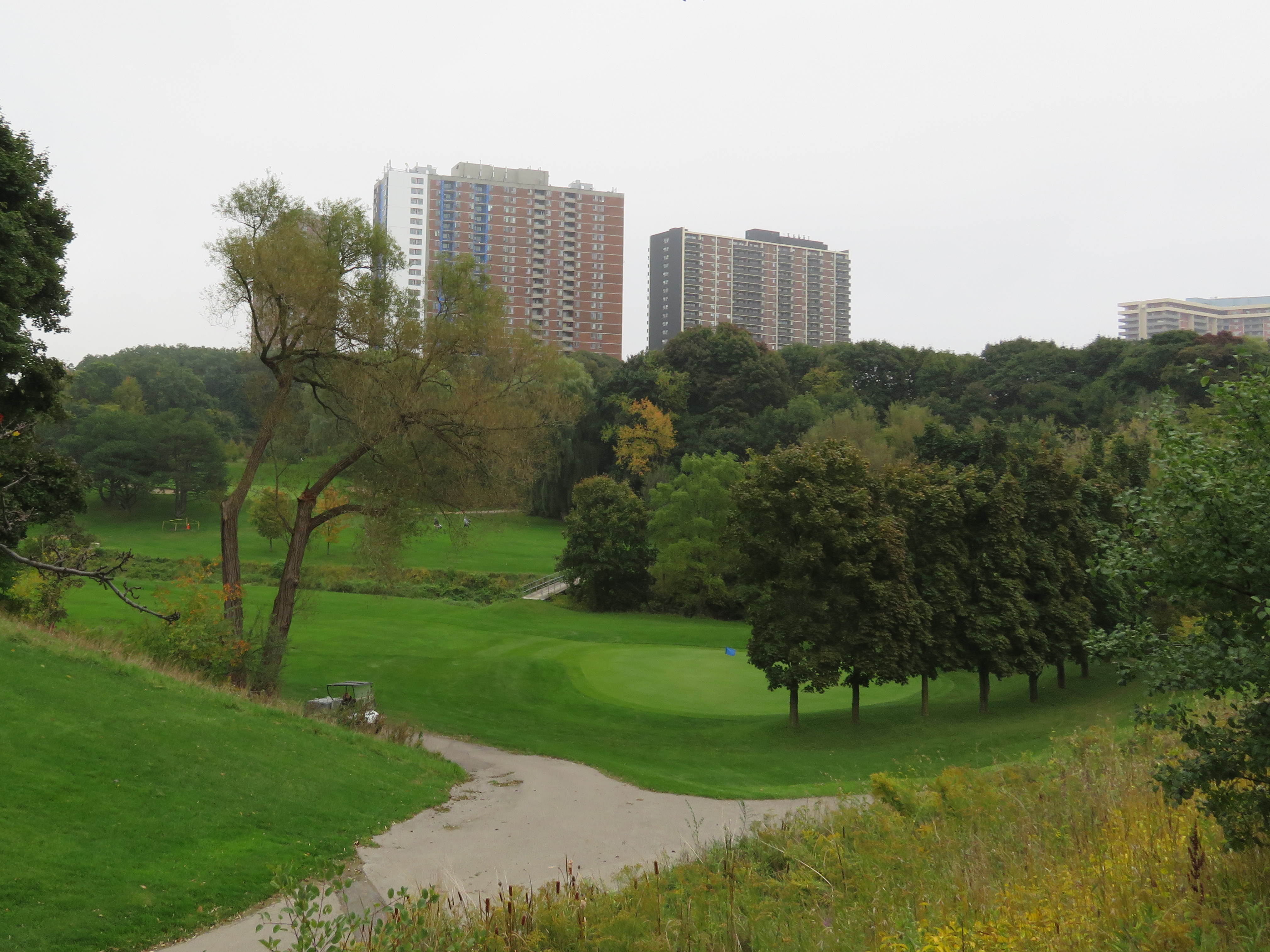
    IMG_8013-001.JPGDentonia Park Golf Course

    Yesterday, Thanksgiving Monday, mayoral candidate Jennifer Keesmaat proposed closing three of Toronto’s five municipally-owned golf courses. Keesmaat, Toronto’s previous chief planner, pointed out that the municipal golf courses operate at a loss, and that $10 million is allocated for improvements to those three courses. Furthermore, she intends to consult the local communities to best re-program the sites to address local wants and needs for the opened-up greenspace.

    The three courses are:

    • Dentonia Park Golf Course, located on Victoria Park Avenue north of Danforth Avenue, next to Victoria Park subway station, in the Massey Creek ravine.
    • Don Valley Golf Course, located in the West Don Valley near Yonge Street and Wilson Avenue, near York Mills Station. It extends under Highway 401.
    • Scarlett Woods Golf Course, located near Eglinton Avenue and Scarlett Road on the Humber River.

    Tam O’Shanter Golf Course, near Sheppard Avenue and Kennedy Road in Scarborough, and the Humber Valley Golf Course in north Etobicoke, are not mentioned in Keesmaat’s proposal.

    I’m very happy that Keesmaat has put forward this bold idea. Despite the municipal ownership of these lands, they are fenced off from residents. For example, Dentonia Park is located in a lower income neighbourhood made of many high-rise rental buildings. As Toronto continues to grow in population, greenspace reserved for golfers could be put to better uses such as sports fields (soccer and cricket, especially), playgrounds, natural wetlands and woodlands, and public paths.

    Golf is an expensive leisure activity with a large environmental footprint: the tending of golf courses require lots of water and pesticides. (Golf courses are exempted from a provincial ban on certain types of pesticides.) They may not adequately address the local community’s needs either, especially in lower income areas. Interest in playing golf is waning in North America as well. It makes sense to open up these publicly owned lands.

    Golf courses get in the way of potential linear parks. As I mentioned before, the Don Valley Golf Course blocks access to Earl Bales Park from the south. Opening up the grounds to the general public would provide a continuous path from York Mills Station to Bathurst and Sheppard and beyond. This would provide a safe and pleasant walking and cycling route across Highway 401, compared to the unpleasant and dangerous crossings at the interchanges with Yonge Street and Avenue Road.

    Dentonia Park Golf Course sits in between the path through Warden Woods and the Taylor Creek Ravine. If opened to the public, there could be a car-free path for pedestrians and cyclists all the way from Warden and St. Clair Avenues all the way downtown via the Don Valley trail system.

    Keesmaat’s plan to close money-losing, poorly-used golf courses is a great idea, much like her promise not to go ahead with the costly replacement of the eastern section of the Gardiner Expressway, instead going with the locally preferred boulevard option. Both of these ideas may not be popular with some, but they are both fiscally and environmentally sound.

  • How do you solve a problem like Mammoliti?

    Giorgio Mammoliti, long-time Toronto City Council, is a great poster child for what’s wrong with municipal politics. Arrogant and obnoxous, Councillor Mammoliti has made a name for himself by flouting council rules and election laws, by demeaning his constituents, picking fights with other members of council, and pursuing media attention with crass stunts and outrageous comments. Toronto would be a far better place without him at City Hall. His 23 years in municipal office have made him a convincing argument in favour of term limits, but I don’t agree that it’s the best way of getting rid of troublesome politicians.

    Mammoliti has been in municipal office since 1995, when he was elected to North York City Council. Before that, he was elected an MPP for Yorkview as a member of the provincial NDP. He is well-known for his socially conservative views against LGBT rights, social housing, youth recreation, and. In 1994, he voted in opposition to his party in the provincial legislature against allowing same-sex couples spousal insurance benefits.

    At city hall, his attention-grabbing antics have made him well-known. In 1999, he ripped off his shirt in front of news cameras to protest a decision permitting a clothing-optional section of beach on the Toronto Islands. In 2014, Mammoliti offensively called Parkdale, a lower-income neighbourhood, a “pedophile district.”

    Even though the Jane-Finch area, which is partially represented by Mammoliti, has a high proportion of visible minorities, high rates of poverty and underemployment, and poor transit access, Mammoliti has undermined rather than improved things for the community. He strongly opposes the Finch West LRT project that will provide an improved connection to the subway at Keele Street and Humber College. He has called residents of local community housing developments “cockroaches” in interviews for the Toronto Sun and alt-right Rebel Media. In a recent re-election advertisement, he posed in front of a nearby TCHC development with a sledgehammer in hand; the text of the ad read “saving our community begins with knocking down social housing. You deserve better!”

    This week, the Toronto Star reported that Mammoliti missed nearly half of all council votes in 2018, the worst record among all 44 councillors. During the 2014-2018 term, he missed 43.1 percent of all votes.

    The Ontario Provincial Police is investigating a failed Toronto Parking Authority land  deal in Ward 7 that Mammoliti had an involvement in. Allegedly, the councillor threatened a senior city staffer to recommend that the sale go ahead in a report to council. Auditors determined that the five acre site at Finch Avenue and Arrow Road was overvalued by $2.63 million. Mammoliti was previously interested in erecting a giant flagpole on that site.

    It’s not the first time he’s been under police investigation. In 2013, he held a $5000-a-table fundraiser in Vaughan, despite rules forbidding raising funds outside of election campaigns. Several prominent lobbyists were in attendance at the event, which raised $80,000. In 2014, Council docked him three months’ pay, the strictest penalty available.

    The people of northwest Toronto deserve much better than Giorgio Mammoliti. But one solution championed by some political observers — term limits — isn’t the right one, even if it would finally remove such a toxic member of council.

    Last month, Spacing’s John Lorinc argued that term limits would be “…the magic bullet reform that would blow open local government to new voices.” While term limits might be an easy way to get rid of Giorgio Mammoliti, it wouldn’t fully solve the incumbency advantage. Instead term limits would remove some of Council’s brightest and hardest working members, without guaranteeing a more diverse council with fresh new voices.

    Name recognition does not only come from years of incumbency, it may also come from a famous family name and political connections. Many “new voices” elected to city council when an incumbent chooses not to run for re-election are councillors’ constituency assistants, often given access to contact lists and the organization built up over the years. Or they’re politicians previously elected from other levels of government. Or they’re the sons, daughters, spouses, or in one case, the nephew, of a well-known public figure.

    Councillors Josh Colle, Joe Cressy, Stephen Holyday, Mike Layton, and David Shiner are the sons of previous municipal politicians. Councillor Cristin Carmicahel Greb is the daughter of former Conservative MP John Carmichael, Frances Nunziata’s brother John was a Liberal MP in the 1980s and 1990s, and Councillor Michelle Holland is married to former Liberal MPP Lorenzo Berardinetti, and is running for re-election as Michelle Holland-Berardinetti.

    And there’s the Ford family.

    In September 2014, Rob Ford, citing his poor health, announced that he was no longer running for mayor. His brother Doug, who was at that point councillor for Ward 2, but was not running for re-election,would run for mayor in Rob’s place. Rob and Doug’s nephew, Michael Ford, who was running for councilor, stepped aside for Rob and ran for trustee instead. Michael Ford changed his last name from Stirpe (his father’s surname) in February 2014 to take advantage of the famous Ford name.

    After Rob died, Michael Ford ran in the Ward 2 by-election and won by an easy margin. And Doug Ford, taking advantage of the folksy populist image his brother Rob fostered, ran for the leadership of the Ontario PCs and became premier in 2018. Doug Ford’s father, Doug Ford Sr., was an Ontario PC MPP from 1995 to 1999.

    On July 25, the week that nominations were scheduled to close (and two days before Premier Doug Ford announced his rushed and vindictive plan to cut council to 25 seats), Councillor Josh Colle (who was first elected in 2010 and served just two terms) announced that he was not going to run for re-election in his North York ward. But his father, Mike Colle, recently defeated as a Liberal MPP, would run instead. Term limits would not have stopped father and son from swapping places every eight or twelve years.

    While term limits would prevent a Norm Kelly, Frances Nunziata, or Giorgio Mammoliti from spending decades on council, it would also stop popular and well-regarded representatives such as Joe Mihevc from continuing to serve their communities. Institutional memory would also be lost on Council. Councillors Gord Perks, Paula Fletcher, Michael Thompson, Paul Ainslie, and many others would also be required to leave office this year if a three-term limit were imposed. Gord Perks’ knowledge of council procedure and his defense of the Parkdale neighbourhood would be sorely missed.

    Term limits also do not prevent lacklustre candidates from being elected.

    In 2014, Cristin Carmichael Greb was elected in Ward 16 with only 17.4% of the vote, a 1.2% margin over her nearest competitor. This was despite the support of John Tory’s campaign. Carmichael Greb has proven to be an ineffective councillor. In Ward 5, Justin Di Ciano has made a name for himself opposing democratic measures such as ranked ballots, new ward boundaries, and supporting a questionable development proposal backed by a firm with which he has close ties. Like Mammoliti, Councillor Di Ciano has found himself under OPP investigation.

    I continue to prefer other methods of limiting the power of incumbency. Ranked ballots would be a good first step. In 2014, Ward 12 incumbent Frank Di Giorgio, in office since 2000, won with only 29% of the vote in a four-way race. Ranked ballots could have made a difference there.

    I also believe that all adult permanent residents, not just Canadian citizens, should be able to vote in municipal elections. As municipalities have the responsibility for delivering local services, such as police, parks and recreation, roads, transit, libraries, and water and waste services, all residents have a stake in how they are being delivered. Extending the municipal franchise could help community engagement, especially in neighbourhoods poorly represented by indifferent or antagonistic city councillors. In contrast, non-resident property owners are permitted to vote. Council voted to request the province to allow non-citizen voting in 2013, but the province was under no obligation to respond to the city’s request.

    I was hoping that in 2018, Giorgio Mammoliti would finally be defeated. TDSB trustee Tiffany Ford is a promising young candidate that had a good shot of defeating him under the new 47-ward model. However, with the 25 ward boundaries imposed by Premier Doug Ford, Mammoliti will be up against more challengers, including fellow incumbent Anthony Perruzza. Perhaps Perruzza or Tiffany Ford will still be able to defeat him.

    While term limits sound like a great solution for solving a problem like Mammoliti, they aren’t necessarily a great solution for improving local democracy.

  • Why Doug Ford’s plan for 25 Toronto wards is an attack on local democracy

    Ridings and 47 Wards.jpgMap of Doug Ford’s proposed 25 wards and the City Council-approved 47 ward boundaries

    Late last week, the newly elected Ontario Progressive Conservative government announced that they would be imposing a new electoral map on the City of Toronto, a decision that would eliminate the new 47 wards approved by Toronto City Council, replacing them with the same 25 boundaries used by the federal and provincial governments.

    It’s very clear that Premier Doug Ford’s plan, which requires a new piece of legislation, ironically titled the “Better Local Government Act,” is vindictive and mean-spirited because it only affects the City of Toronto, which rejected Doug Ford’s 2014 mayoral bid. It quashes the hopes of many young, racialized, and progressive candidates looking to change the make up of a council that has generally supported Mayor John Tory’s agenda. It is unfair to candidates that ran in good faith, started campaigns, raised funds, and spent money hiring staff, purchasing materials, and renting campaign offices.

    But most of all, Ford’s actions are an attack on local democracy because of the haste with which they are being made, at the end of the nomination period for those approved 47 wards. They ignore the years of study by independent experts and several rounds of public consultations. They also benefit Toronto’s suburban areas, which are growing at a far slower rate than downtown Toronto, North York Centre and Etobicoke’s waterfront area, which will be disproportionately affected by this arbitrary decision.

    Each new ward was designed to have an average population of 61,000, with a population range of between 51,800 and 72,000 (+/- 15%). They were designed to last for four election cycles, to be re-drawn before the 2034 election.

    It is worth noting that the independent experts looked at using the 25 federal/provincial boundaries twice. In the first study, they were rejected early on because they would not “meet the tests of effective representation.” The federal boundaries, which are also adopted by the province of Ontario, are based on population counts from the 2011 Census, and are already seven years out-of-date, while the consultants were tasked with developing new ward boundaries to last 16 years. Even a 50-ward solution (which mimics the old 44 wards based on the 22 federal ridings that were established in 1996 and came into effect with the 1997 federal election) would result in severe variations in population.

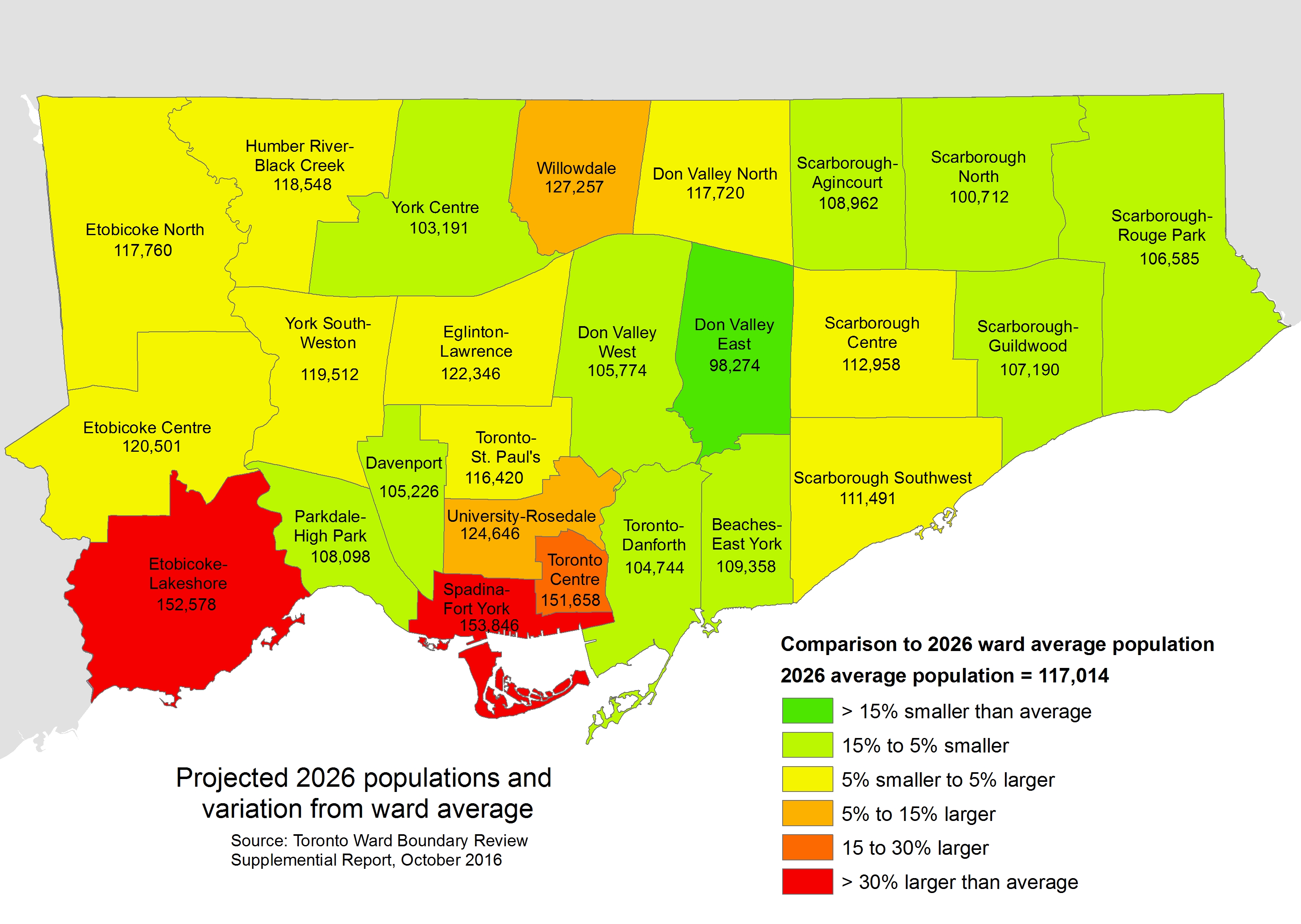
    Ridings and 2026 pop variation.jpgHow the 25 ridings, if used for Toronto’s ward boundaries, will vary in population by 2026

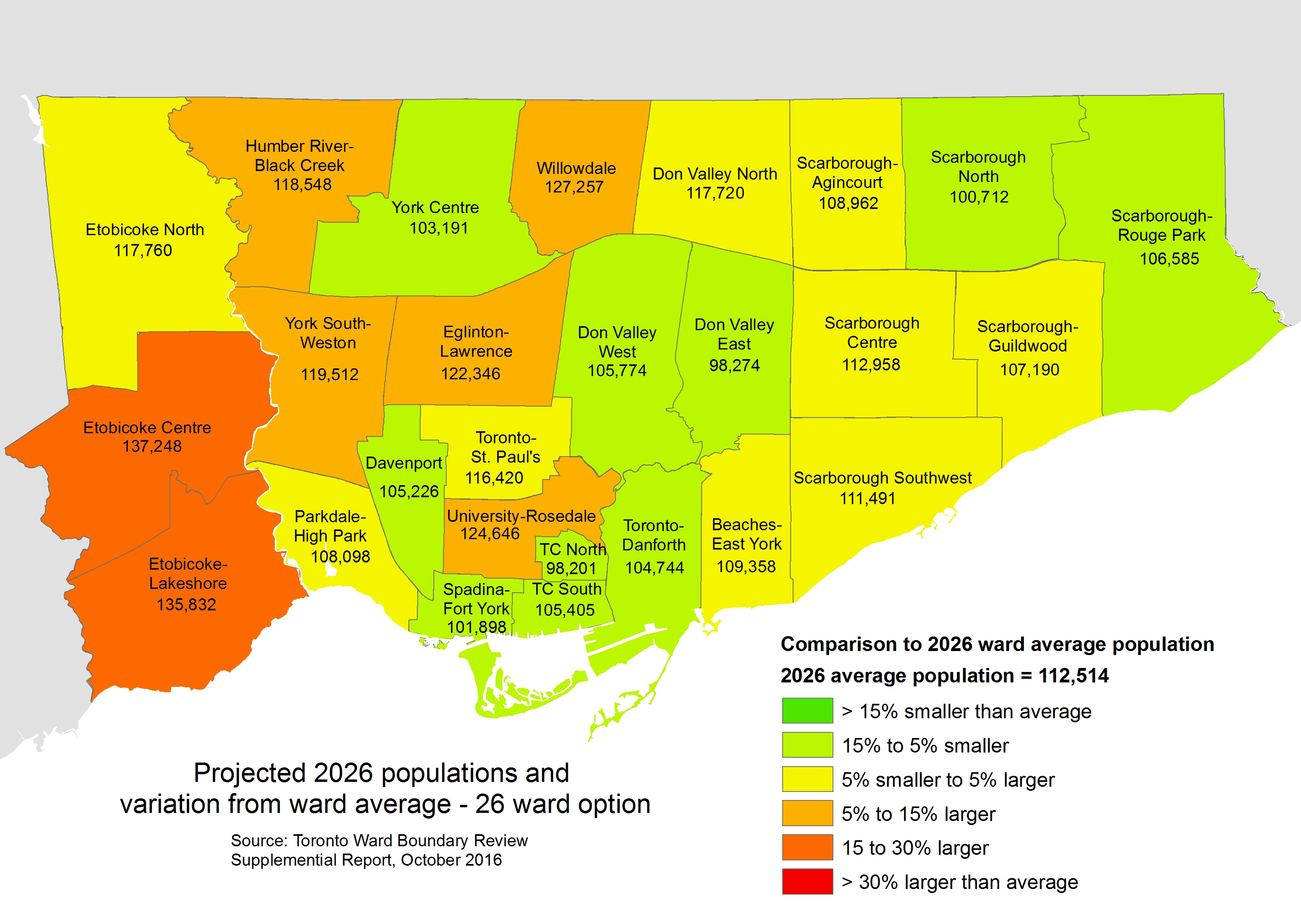
    After Tory’s Executive Committee tasked the Toronto Ward Boundary Review team to re-examine options that would see fewer than 47 councillors elected in 2018, they re-examined using the 25 ward boundaries. They found that in 2026, three of those wards — Toronto Centre, Etobicoke-Lakeshore, and Spadina-Fort York — would have populations over 30% higher than the ward average in 2026. Willowdale and University-Rosedale would also have had much larger populations than the city average.

    The review team also looked at a 26-ward option that mostly maintained the riding boundaries but added a new ward downtown out of the Toronto Centre and Spadina-Fort York constituencies and adjusted boundaries in southern Etobicoke. Even then, Etobicoke Centre and Etobicoke-Lakeshore would still have populations over 20% higher than the city-wide average. Despite making some adjustments for population growth, this option would have not have corresponded with some ridings, and was also not recommended.

    26 Wards and 2026 pop variation.jpgHow the modified 26 ridings, if used for Toronto’s ward boundaries, would have varied in population in 2026

    For those reasons, and to support local representation, the 47-ward solution was once again recommended, and was approved by City Council in November 2016. Councillors Justin Di Ciano (Ward 5) and Giorgio Mammoliti (Ward 7) then appealed the new boundaries to the Ontario Municipal Board, but they were dismissed. The 47-ward solution has survived despite it all.

    Mayor Tory may have brought back decorum to the mayor’s office after an embarrassing period under Doug Ford’s brother Rob, but he has pushed an austerity agenda, and has failed to show leadership on police reform, wasteful infrastructure spending, and safe streets for pedestrians and cyclists. His initial reaction, to call for a referendum on Ford’s plan to cut Toronto’s council, was a characteristically weak response; he was later pushed into supporting a legal challenge by an angry public. Meanwhile, some of Tory’s allies, like Di Ciano, David Shiner, and Glenn De Baeremaeker, support Ford’s actions.

    Ford’s attack on local democracy is an insult to candidates who have already put their names forward for election and launched their campaigns. It undermines the City of Toronto’s legislated responsibility to decide its own ward boundaries. And it will only exasperate existing disparities in council representation.

  • Two-hour transfers are finally coming to the TTC

    IMG_3898

    At its board meeting on July 10, the Toronto Transit Commission finally approved two hour transfers for passengers paying by Presto. This is great news that has been a long time coming.

    The TTC expects that the new policy will cost $21 million a year by 2020, but it will also boost ridership by 5 million passengers. The new two-hour transfer policy will allow a passenger using a Presto card to board any vehicle or enter any subway station within two hours of the first tap without paying a second fare. This will allow anyone to make a short return trip on one fare, or make a stopover before transferring to another route. Customers of most suburban transit systems such as MiWay, Brampton Transit, and YRT have enjoyed the same privileges for over a decade.

    The policy takes effect Sunday, August 26.

    I’ve argued here before why two-hour transfers are necessary. If a passenger taps onto another vehicle on the same route, a common occurrence due to delays, short-turns, and diversions/shuttles, the Presto Card will deduct a second fare. That has happened to me several times, even when making a valid transfer between a bus and Union subway station. It’s often confusing when the TTC tells its passengers to take a paper transfer when a diversion takes place, or tells its customers not to tap again on a bus or streetcar when they’re short-turned. The new policy finally fixes those errors for good.

    However, the transfer policy does not apply to customers paying by cash, tickets, or tokens, so the old archaic paper transfer rules will still apply to many TTC customers.

    The TTC is slowly phasing out paper media and passes, but still has yet to implement daily, weekly or monthly caps that will effectively replace day, weekly and Metropasses. There will also need to be a paper Presto card equivalent developed for occasional and one-time customers, such as tourists or anyone who doesn’t want to pay the $6 fee for a plastic card. Hopefully the details of how these will be implemented will be decided and communicated in the near future.

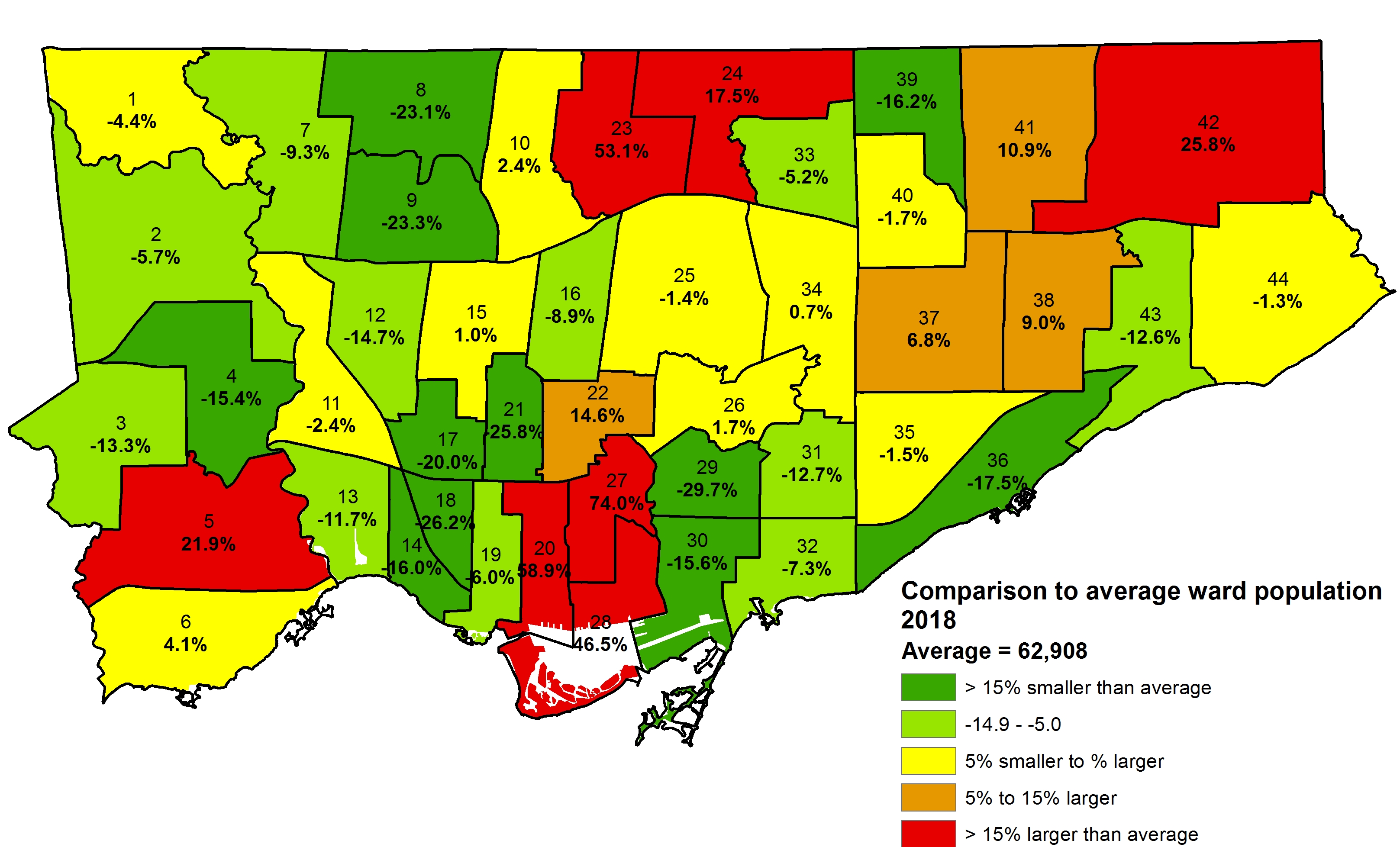
  • Mapping the 2018 candidates for Toronto’s 47 wards (Updated)

    18506683800_6c96dcc66b_k

    September 10, 2018
    This morning, the Ontario Superior Court ruled against Bill 5, finding that the bill  “substantially interfered with the municipal candidate’s freedom of expression that is guaranteed under [Section 2(b) of the Charter of Rights and Freedoms.]”

    Barring a successful provincial appeal (or invoking Section 33 of the Canadian Charter of Rights and Freedoms, also known as the Notwithstanding Clause), this is once again the map of council candidates for the October 22 election.

    September 12, 2018
    Oh, never mind. We’re back to the 25 wards because its not as if Doug Ford has anything better to do than override a judicial finding with the Notwithstanding Clause and re-introducing the vindictive legislation. And we may not even get to vote in advance polls.

    Once the new law is passed, there will be two days for council candidates to sign up to run in the 25 wards.


    August 15, 2018

    Bill 5, the so-called “Better Local Government Act,” passed third reading on August 13, 2018, and was given royal assent on Tuesday August 14, despite vigourous opposition from the New Democratic Party. Bill 5 passed without any public consultation that usually takes place with any government legislation, as the Progressive Conservatives used procedural tactics to push through the bill as quickly as possible.

    (A new map of the 25 wards can be found here.)

    This means that legally, the City of Toronto must follow the province’s edict and elect only twenty-five councillors, with wards based on the current provincial riding boundaries. Scarborough Councillor Glenn De Baremaeker has already announced that he will no longer seek re-election.

    I have no intentions of removing the map below, but I will be creating a new 25-ward map and populating it once nominations re-open. I suspect that many council candidates will not re-register, and that there will be many more incumbents facing off against each other.

    There’s a faint hope that a legal injunction could suspend Bill 5. Council candidate and lawyer Rocco Achampong is seeking one, the courts will hear arguments by the end of the month.

    (more…)

  • Pedestrian flags at crosswalks are not a solution

    IMG_0772-001Pedestrian crossing in Dartmouth Nova Scotia equipped with pedestrian flags

    Toronto Star article this weekend profiled three elementary school students installing pedestrian flags at local residential intersections near their school in Leaside. Pedestrian flags are not a new idea; they have been common in Halifax and other communities in Nova Scotia for several years. (I wrote about this before on my blog after visiting Halifax this past summer.)

    On the surface, it sounds like a good idea. Eleven-year old Arnav Shah describes their use in the Star: “what happens is when a pedestrian comes to cross, they look both ways, the regular stuff, maintaining eye contact with the drivers, and then they put the flag up and walk across. Not only does this make them more visible, but makes them (the drivers) more aware of the problem at hand.”

    Residents have complained about additional traffic in the neighbourhood as impatient drivers use residential streets to avoid transit construction on nearby Eglinton Avenue. Photos in the article show the flags being used at the corner of Rumsey Road and Donlea Drive, near the school. The intersection is already controlled by a four-way stop, it is located in a signed school zone, and the local speed limit is 40 km/h.

    The local councillor, Jon Burnside,  rightly praised the children for taking initative. But he added that “…it’s also a sad commentary on the state of our roads and the way people drive.” He’s right. Burnside further adds that adults “can take some cues from the kids’ creativity.”

    If we need bright flags to cross the street at a designated crosswalk because motorists wouldn’t see pedestrians otherwise, then we’ve failed to provide safe infrastructure. The adults — namely Toronto’s mayor and city council — have resisted investing in safe pedestrian and cycling infrastructure.

    The city has put up signs on wide five-lane and seven-lane roads designating them as “Seniors Safety Zones” but has done little to actually make those roads safer for the pedestrians using them. The mayor and the committee responsible for roads and infrastructure rejected making Yonge Street in North York safer and more pleasant to walk and cycle, deferring to motorists instead. And last week, it responded to a child killed while crossing the street in a residential area by closing a walkway to the school yard and not doing anything to slow down motorists speeding in a school zone.

    Simply installing flags at crosswalks for pedestrians to carry would be in line with Toronto’s ineffectual Vision Zero program. While I can admire the children’s action, I would really like to see this taken much farther by the leaders in charge.


    Correction: the local councillor quoted in the Toronto Star is Jon Burnside, not John Campbell. I regret the error