After five pedestrians were killed on Toronto’s streets during the two weeks of 2018, Toronto Police have announced another pedestrian safety campaign promising increased enforcement and education efforts. Sadly, I do not have faith that the local police service will properly address the safety of vulnerable road users.
Police are once again advising pedestrians to avoid crossing mid-block, to make eye contact with motorists before crossing the street, remove earphones and hoods when crossing, put away mobile devices, and be visible. These are all generally good ideas, but they ignore the larger issue — aggressive and inattentive motorists are most at fault. Most collisions in which pedestrians are seriously injured and killed are in the suburbs, and not in the downtown core, where most pedestrian safety blitzes take place. And some of the advice the police gives pedestrians is not that helpful.
Previous pedestrian safety campaigns have targeted downtown pedestrians crossing with a flashing hand countdown signal or distracted by their phones. The message is usually the same: in 2012, Toronto police were also saying to “cross the street as if your life depends upon it,” the same as this year’s message. Targeting downtown walkers is an easy way to get a message across, but it is not a very effective one, yet we see it every year.
Statistics collected by the City of Toronto show that most pedestrians hit by motorists were crossing legally in a crosswalk, with the right of way. This latest campaign ignores that very fact.
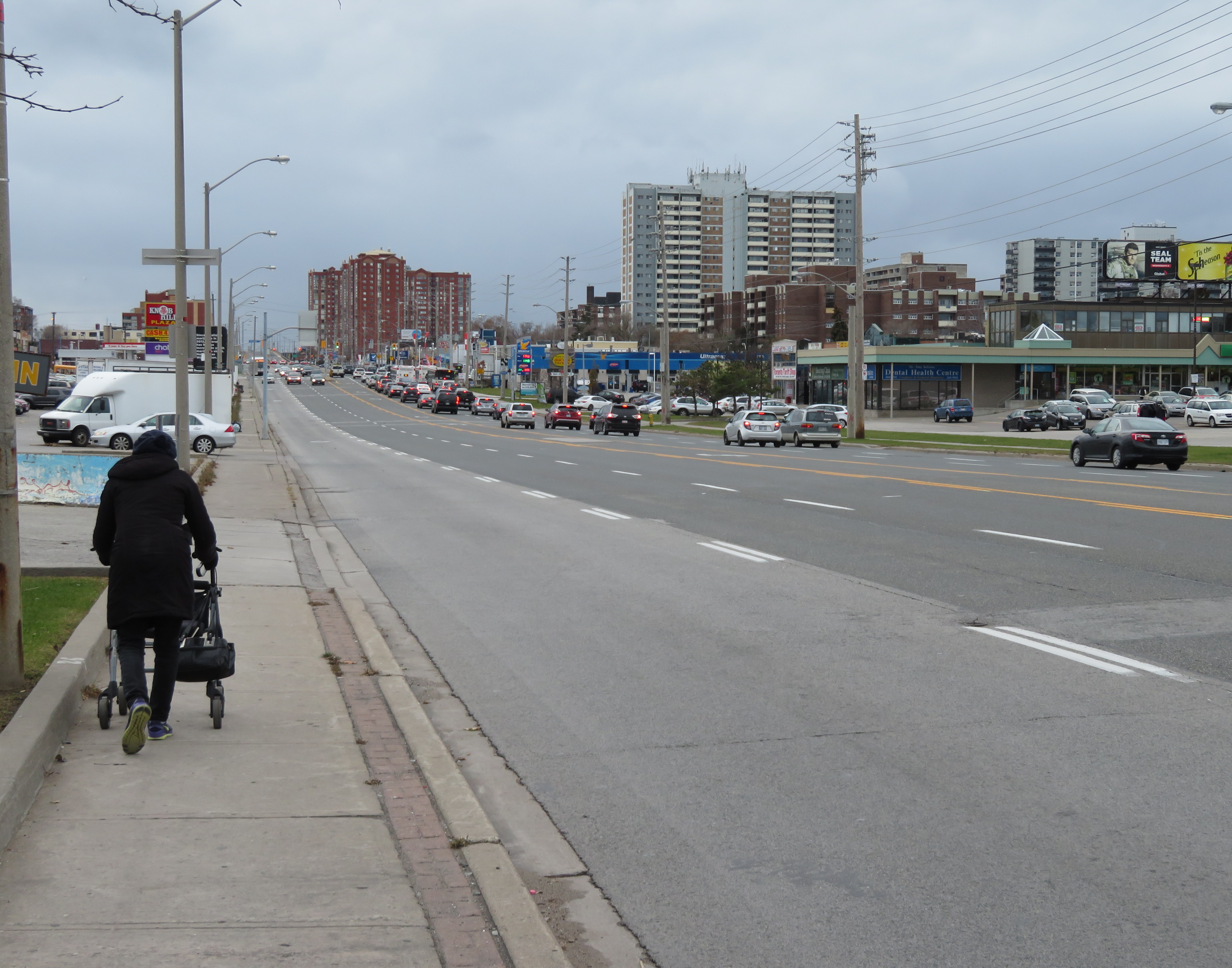
On January 7, Jessica Renee Salickram was killed trying to cross the street after getting off a TTC bus at Steeles Avenue East and Eastvale Drive, on Toronto’s border with Markham. The intersection does not yet have a traffic signal, and it is nearly 300 metres from the nearest signalized crossing, at Tapscott Road. The eastbound TTC bus stop does not even have a sidewalk, one of many inaccessible bus stops in suburban Scarborough. This was not a mid-block crossing, as it was at an intersection. The TTC has since suspended service at this stop, but that is not an acceptable solution.
Pedestrian fatalities in Toronto in 2018
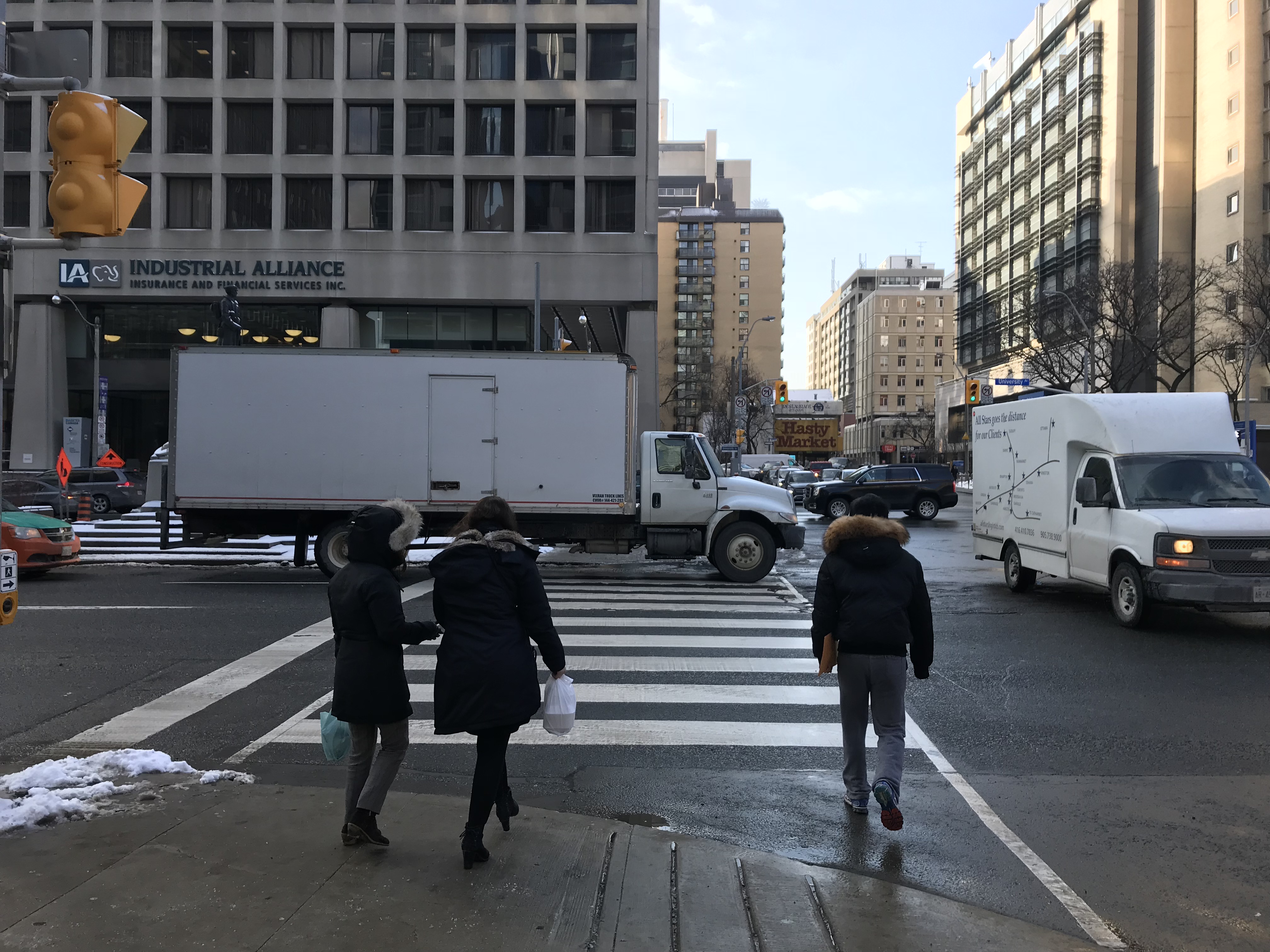
The Toronto Police’s advice to make eye contact with motorists is often difficult — persons with visual impairments have as much right to cross as anyone else. It is also very difficult to make eye contact with distracted motorists, and drivers in cars and trucks with deep-tint windows. Police are advising pedestrians to cross at crosswalks, yet they are often blocked by vehicles.
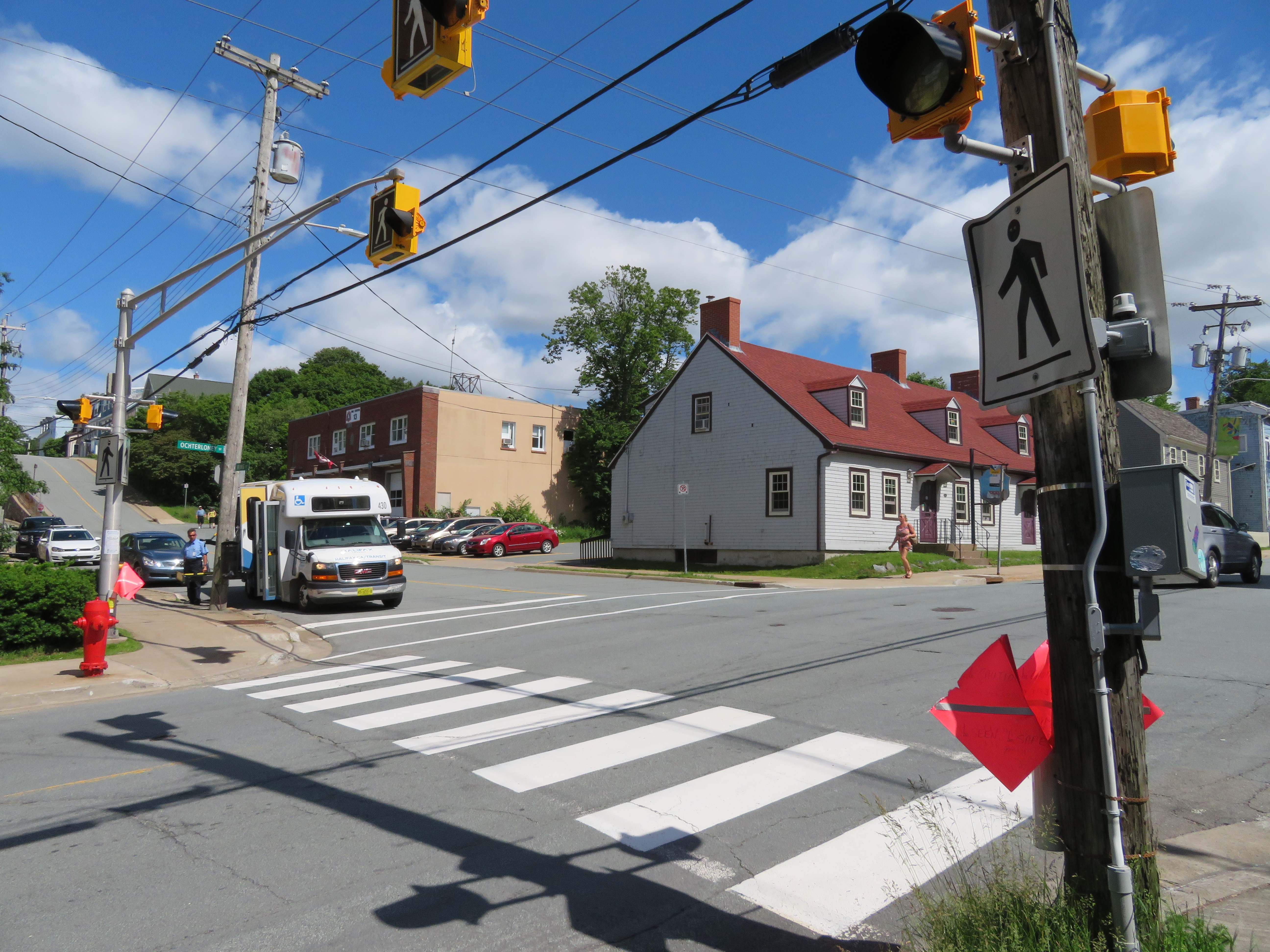
It’s pretty much impossible to cross the street safely when the crosswalk is blocked.
Global News has found that the Toronto Police Service has been issuing far fewer traffic tickets in recent years. Last November, Global reported that Toronto police issued half the number of Highway Traffic Act infractions — fines for speeding, running red lights and stop signs and other unsafe driving — were down by half between 2011 and 2016, as well as a significant drop in impaired driving charges during the same time. It seems wrong that pedestrians are once again being targeted while bad drivers are let off the hook.
As I have written here before, civic leaders have not taken pedestrian and cyclist safety seriously enough. There are a few token gestures to Vision Zero, but “Senior Safety Zones” and reduced speed limits on a few streets are not enough to send the message that we truly value the lives of all vulnerable road users — particularly children and seniors, who are disproportionately at risk. One more quick and easy police blitz on pedestrians at busy downtown intersections does not address the problem.
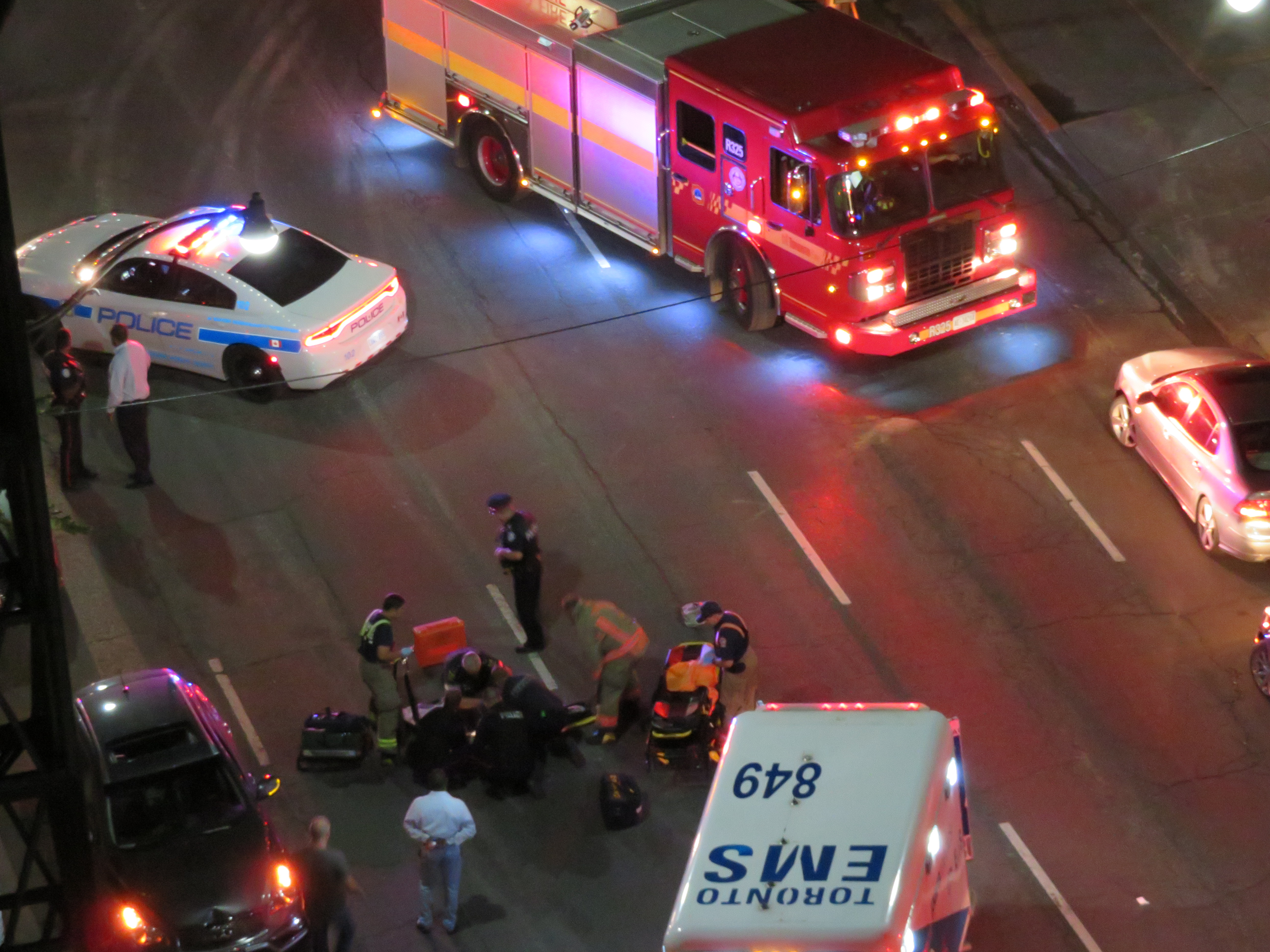
A collision involving a pedestrian on Jarvis Street, 2017
If there’s a “war on the car” in Toronto, the car is still winning.
On Tuesday, Gideon Fekre was acquitted of dangerous driving causing death, after he sped on Dundas Street East, crossing a bike lane, mounting a sidewalk, and struck a pedestrian, Kristy Hodgson, killing her and one of the two dogs she was walking at the time. Both the prosecution and the defense agreed that Fekre was distracted at the time, reaching for a water bottle that fell. But Fekre was acquitted because his driving was not deemed dangerous enough to be worthy of a “dangerous operation of a motor vehicle” conviction. As Ed Keenan — an excellent Toronto Star journalist who covered the trial — pointed out, the Supreme Court ruled the same way in a similar case.
Surveillance video showing Kristy Hodgson walking her dogs, before Gideon Fekre’s car crosses the bike lane and mounts sidewalk before hitting and killing her. (Toronto Star/YouTube)
In the second case, Deriba Wakene was acquitted of leaving the scene of a collision after a 2015 hit-and-run that killed Nelisa DaMota as she was crossing Bloor Street mid-block. The judge in that case explained that he believed Wakene when he said he did not hear, see or feel any impact, even though Wakene’s neighbours could see the damage to his car after he parked it in his driveway.
Both these judgments have made me angry. I hit a raccoon once while driving on a dark, rural highway, and heard and felt that impact, and I was shook up by that, even though there was no damage to the car, and there was’t much that I could do. If you hit a pedestrian, and don’t even know it, you shouldn’t be behind a wheel. If you’re distracted enough that you mount a curb and hit a pedestrian, there should be consequences to that.
These two trials were the result of criminal charges, rather than lesser Highway Traffic Act (HTA) charges more commonly laid by police. For most HTA offences, the accused does not need to appear in court, even after a pedestrian or cyclist is injured or killed, and penalties are light — often a small fine. A proper vulnerable road users law, like that proposed by NDP MPP Cheri DiNovo, is necessary. Her bill sets out mandatory probation orders and community service for careless drivers that cause death or serious injury to a pedestrian or cyclist. DiNovo’s Bill 158 passed first reading at Queen’s Park, but may not be passed in time before the legislature breaks for the June 2018 general election.
Sadly, there’s not enough action on pedestrian and cyclists’ safety here in Toronto. The city’s Vision Zero plan is modest as best, as I recently discussed. Drivers are too often unaccountable for their careless dangerous operation of their potentially deadly machinery. Sidewalks and bike lanes are debated at length, while opportunist politicians and reactionary pundits complain about a “war on the car.” If there is such a war, the cars are still winning.
Eglinton Avenue East near Brimley Road, one of twelve Seniors Safety Zones in the City of Toronto
Despite its status as a global city, a city that’s often ranked as one of the world’s safest, a city that likes to think of itself as both progressive and a top place to do business, Toronto does a lousy job of protecting its residents from injury and death on its roads.
Although there have been a few positive steps — the new King Street Pilot, launched last week, or the Bloor Street bike lanes, made permanent between Avenue Road and Shaw Street in October — Toronto does far too little to protect pedestrians and cyclists in this city. The installation of sidewalks in residential neighbourhoods are often opposed by local residents resistant to losing driveway space on which to park their cars, or unhappy about having to clear sidewalks of snow and ice. Affluent neighbourhoods might be dotted with “drive slow – kids at play” lawn signs, but their residents and elected representatives will oppose new bike lanes and lower speed limits on the arterial roads they use to commute downtown.
The general idea of reducing road violence is a popular one. But specific actions are often opposed. The city’s own Vision Zero strategy — weak as it is — is a good indication of the ambivalence to road safety we have in this city.
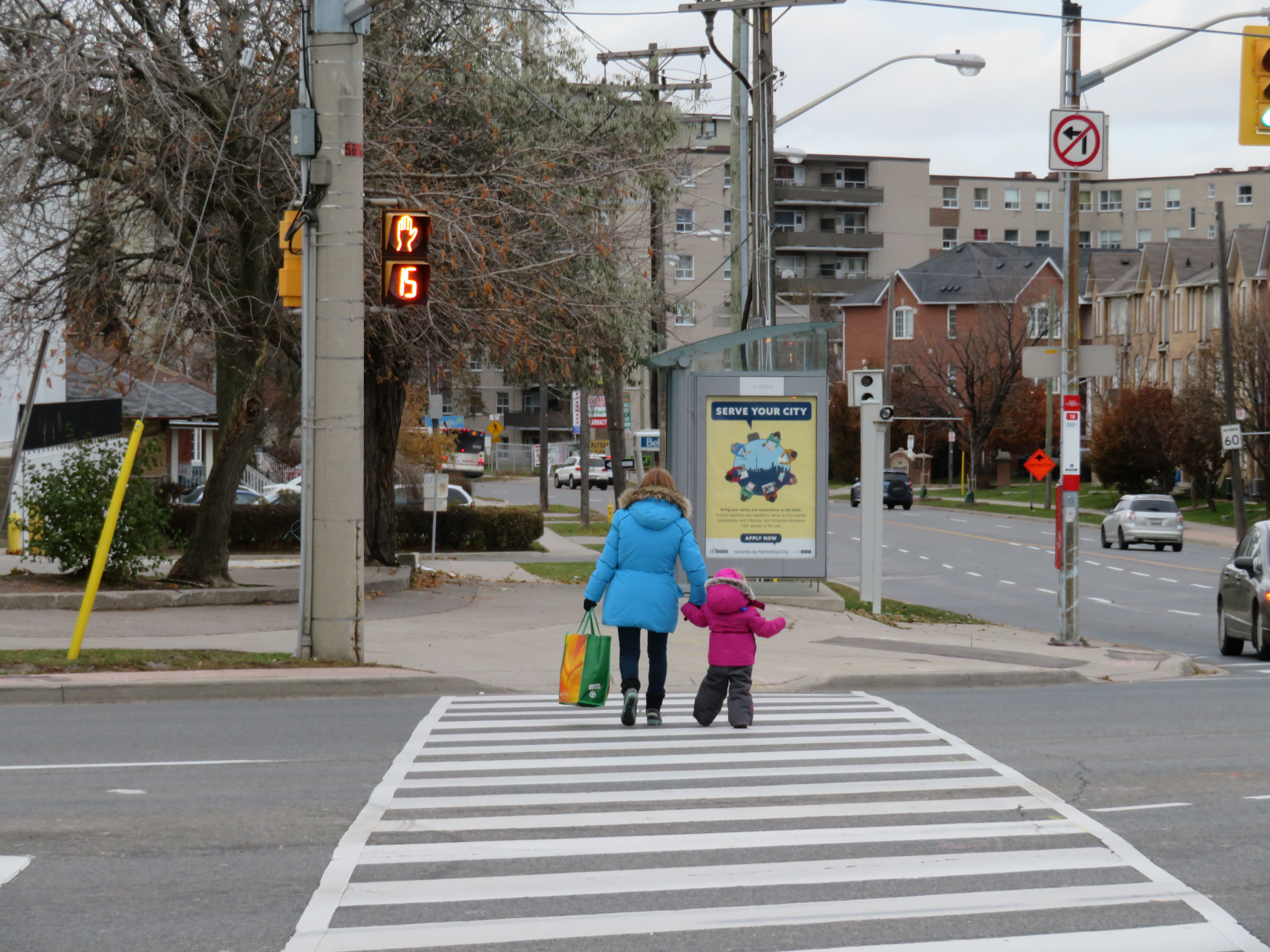
Woman and young child cross seven lanes of traffic at a crosswalk at Eglinton Avenue East and Danforth Road
Vision Zero, which originated in Sweden, is the road safety philosophy that no loss of life is acceptable, and that all road users are human, that humans make mistakes, and road design must minimize the impacts of those mistakes. Complete streets that accommodate all road users (pedestrians, cyclists, motorists, and transit users), and road engineering measures to protect pedestrians and cyclists and reduce traffic speeds are in the spirit of Vision Zero.
But when Mayor John Tory and Public Works and Infrastructure Committee Chair Jaye Robinson (Councillor, Ward 25) originally announced the city’s Vision Zero plan in June 2016, it merely aimed to reduce serious collisions involving pedestrians and cyclists by 20 per cent over a ten year period, allocating $68.1 million over five years. The plan itself was modest. After a social media backlash and criticisms from active transportation activists (including Walk Toronto, of which I am a co-founder and a steering Committee member), the plan was revised, with an additional $10 million allocated and the goal to eliminate serious collisions, rather than simply reduce that number.
One of the specific measures in the city’s Vision Zero plan is the creation of seniors safety zones, areas with high volumes of older adult pedestrians and higher risk of collision. Older adults make up a majority of pedestrian deaths in Toronto; 37 of the 43 pedestrians killed in 2016 were over the age of 55. According to the City of Toronto’s Vision Zero Road Safety Plan, seniors safety zones will feature changes intended to improve pedestrian safety, such as lower speed limits, improved street lighting, advanced and extended walk signals at signalized intersections, red light cameras and radar speed signs, improved sidewalks and additional crosswalks, and increased enforcement.
Twelve seniors safety zones were designated across the entire city of Toronto. Five are in the old City of Toronto, including Dundas Street at Bloor, Dundas at College/Lansdowne, and Dundas at Spadina. Six are in Scarborough, and one is in North York.
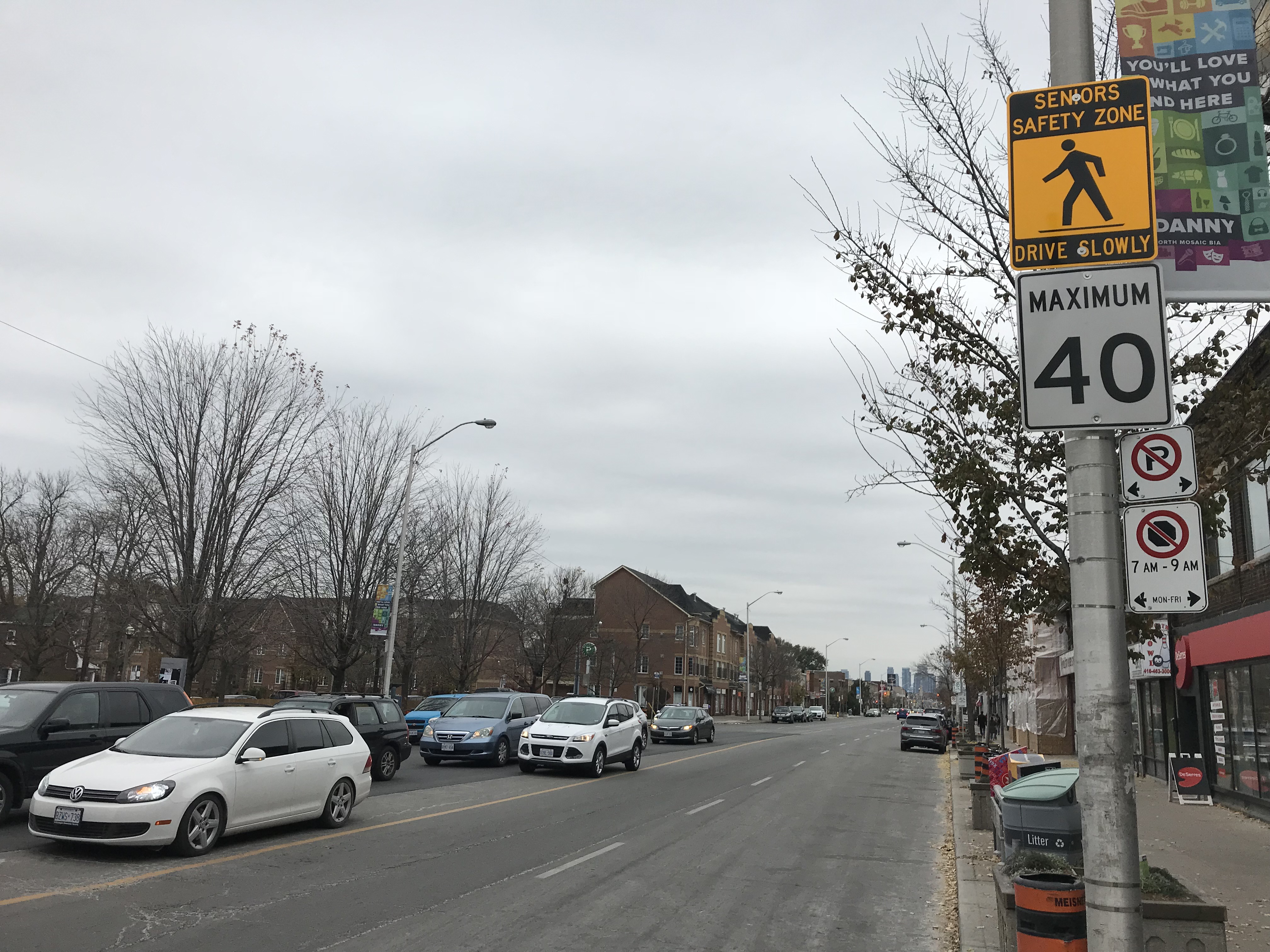
Senior Safety Zone sign and 40 km/h speed limit, Danforth Avenue at Coxwell
On Danforth Avenue, two senior safety zones were identified: near Coxwell Avenue and near Main Street. The speed limit on Danforth Avenue was reduced from 50 km/h to 40 km/h in 2016, but few other visible changes are apparent. Danforth Avenue is a five lane street, including a centre lane for left turns, and is paralleled by a subway line. The curb lanes on Danforth are unusually wide, and are used for parking outside of weekday rush hours. There are no bike lanes on Danforth either.
Despite the 40 km/h speed limit, the wide lanes, dedicated turning lanes, and the absence of daytime local transit promote high speeds. The design speed of Danforth is simply too high; simply reducing the speed limit and putting up “senior safety zone” signs will do far too little.
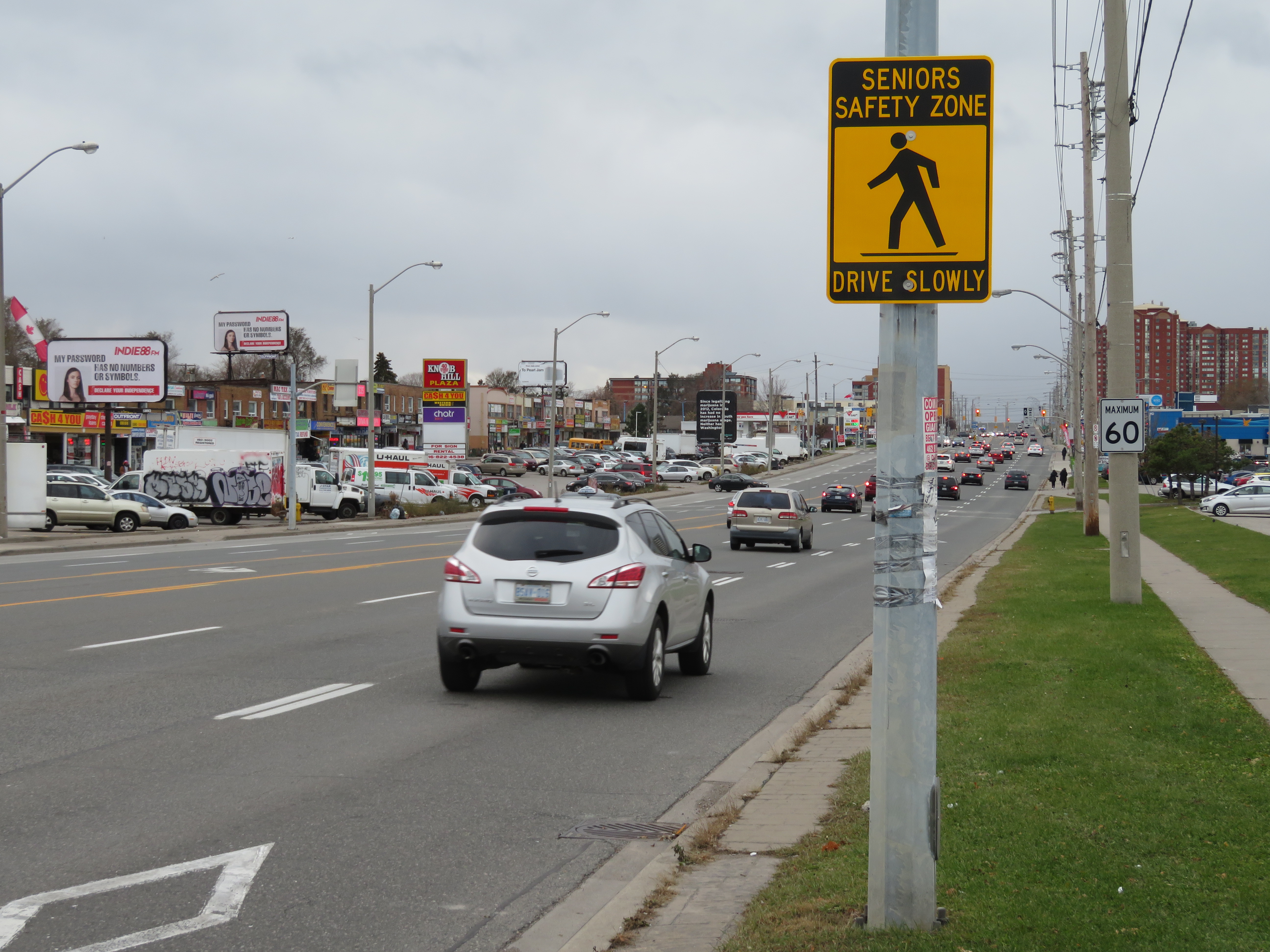
Seniors Safety Zone sign on Eglinton Avenue East, at Brimley Road. Note the 60 km/h speed limit sign
Eglinton Avenue East, between Midland Avenue and Danforth Road in Scarborough, is another senior safety zone. Two pedestrians were killed on this stretch of road in 2016.
Eglinton Avenue through Scarborough is seven lanes wide, including a centre left-turn lane to cross streets and commercial properties that line the wide street. Traffic signals are typically 500 metres apart; many TTC bus stops on Eglinton Avenue East are located far from a designated crosswalk. Buses are frequent between Midland and Brimley; four frequent routes feed into the Kennedy subway station to the west. Again, there is no cycling infrastructure to be found.
The senior safety zone here is a joke. Not one safety intervention was made here. The yellow-and-black safety zone signs that read “drive slowly” are merely advisory, and do not stand out among other traffic and commercial signage. The 60 km/h speed limit was not changed, and intersections were not altered at all to improve pedestrian safety.
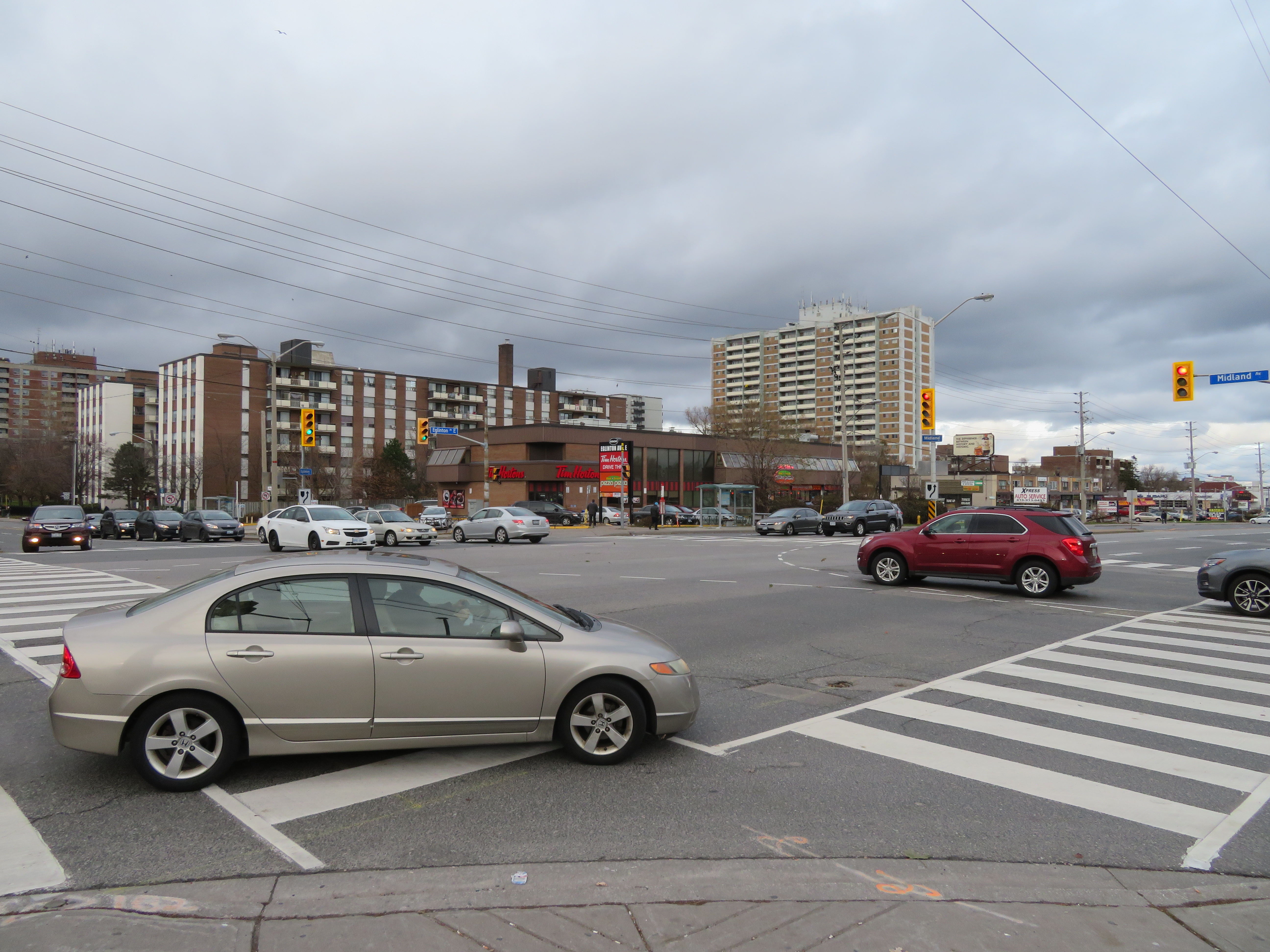
At Eglinton and Midland Avenues, wide curb radii encourage speedy right turns into crosswalks; many drivers do not stop at the red light before making a right turn
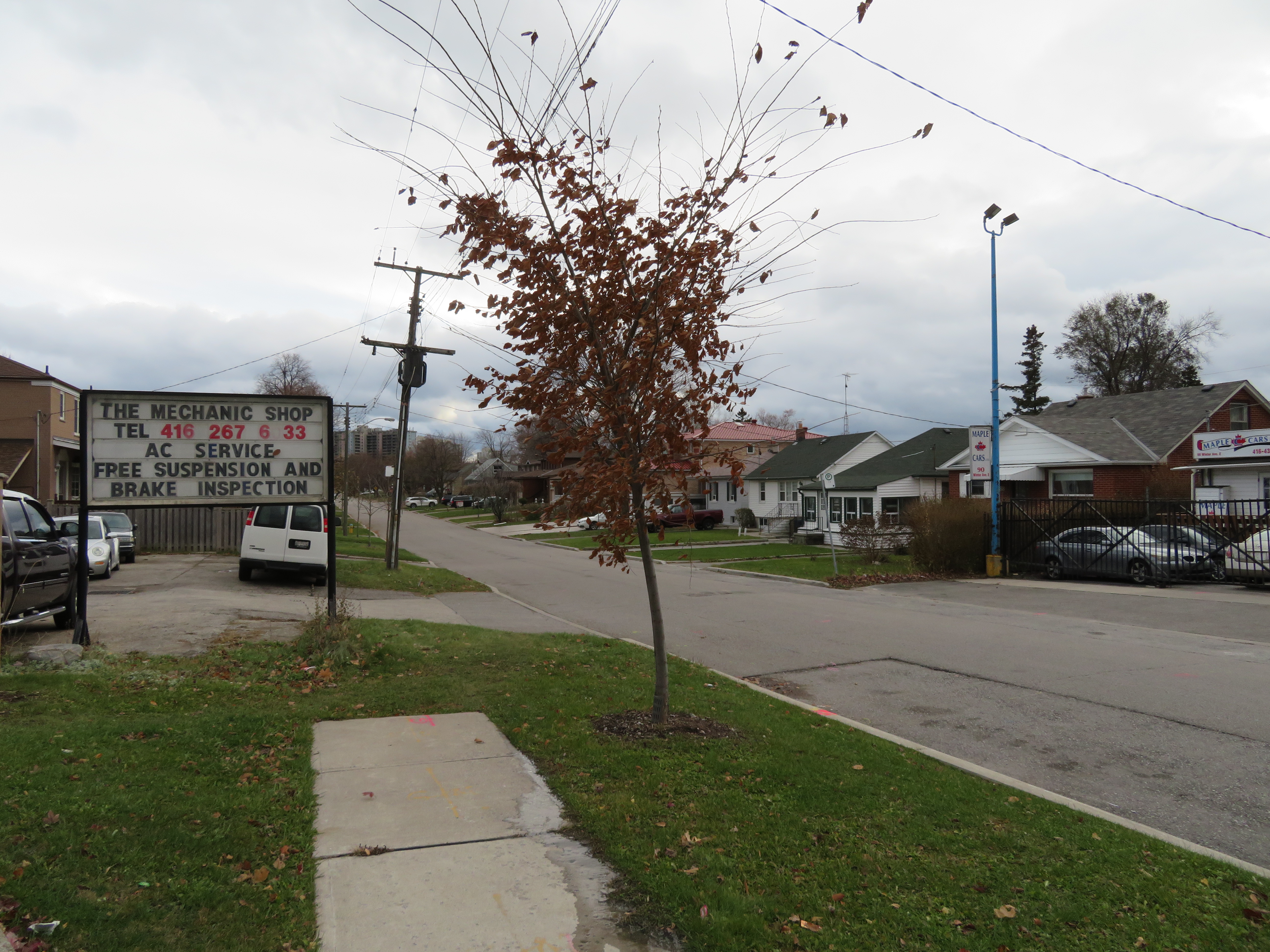
Several residential side streets off of Eglinton, such as Winter Avenue, do not even feature sidewalks. The signs might say “seniors safety zone” but there is no evidence that pedestrian safety is taken seriously at all here.
Winter Avenue’s sidewalks disappear a mere 50 metres south of Eglinton Avenue
Physical interventions, such as narrower lanes (which could make room for cycling infrastructure and/or wider sidewalks), bump-outs at crosswalks to improve pedestrian visibility and slow down right-turning vehicles, would be more effective. Police enforcement, or speed radar cameras, would be an additional deterrent against dangerous driving.
At least the city has taken notice of the unacceptable numbers of pedestrians and cyclists killed in Toronto, but simply putting up new speed limit and safety zone signs are not enough. Without road engineering works to slow traffic down, and without effective police enforcement against speeding and drivers’ failures to obey traffic signs and yield the right of way to pedestrians, we only get feel-good measures and ineffective signs. A real commitment to Vision Zero requires political will, which so far is lacking at City Hall. Instead, we get zero vision.
There have been some positive news, however. The new Bloor Street bike lanes — officially a pilot project — between Avenue Road and Shaw Street were recommended for retention by the Public Works and Infrastructure Committee this month. New bike lanes were added on Woodbine Avenue this year. And the Toronto Police Services’ parking enforcement officers have been targeting cars and trucks stopped in bike lanes.
But one problem that still needs to be addressed is proper messaging at construction sites where bike lanes or general-traffic curb lanes are closed for construction. Too often, cyclists are told to dismount and walk their bikes, despite their status as vehicles, entitled to use the road as any other vehicle. (There are, of course, exceptions such as freeways and some high-speed roads where pedestrians and cyclists are expressly not permitted.)
For example, cyclists heading west from Danforth Avenue over the Prince Edward Viaduct were greeted with a sign reading “bicycle lane closed – cyclists dismount and use sidewalk.” Next to that sign was a “sidewalk closed” sign, directing pedestrians to the south side of the viaduct.
The Ontario Highway Traffic Act says that cyclists are to ride as close to the right of the roadway as practicable. But this does not necessarily mean cyclists must ride right next to the curb either, especially if there are blockages, debris, or other hazards. Motorists must also pass cyclists at a distance of at least one metre, and must wait for a safe opportunity to pass.
147 (1) Any vehicle travelling upon a roadway at less than the normal speed of traffic at that time and place shall, where practicable, be driven in the right-hand lane then available for traffic or as close as practicable to the right hand curb or edge of the roadway. R.S.O. 1990, c. H.8, s. 147 (1).
…
4) Every person in charge of a vehicle on a highway meeting a person travelling on a bicycle shall allow the cyclist sufficient room on the roadway to pass. R.S.O. 1990, c. H.8, s. 148 (4).
…
(6.1) Every person in charge of a motor vehicle on a highway who is overtaking a person travelling on a bicycle shall, as nearly as may be practicable, leave a distance of not less than one metre between the bicycle and the motor vehicle and shall maintain that distance until safely past the bicycle. 2015, c. 14, s. 42.
After several complaints, new signage directing cyclists and motorists to yield and share the lane was installed on Danforth Avenue approaching the viaduct.
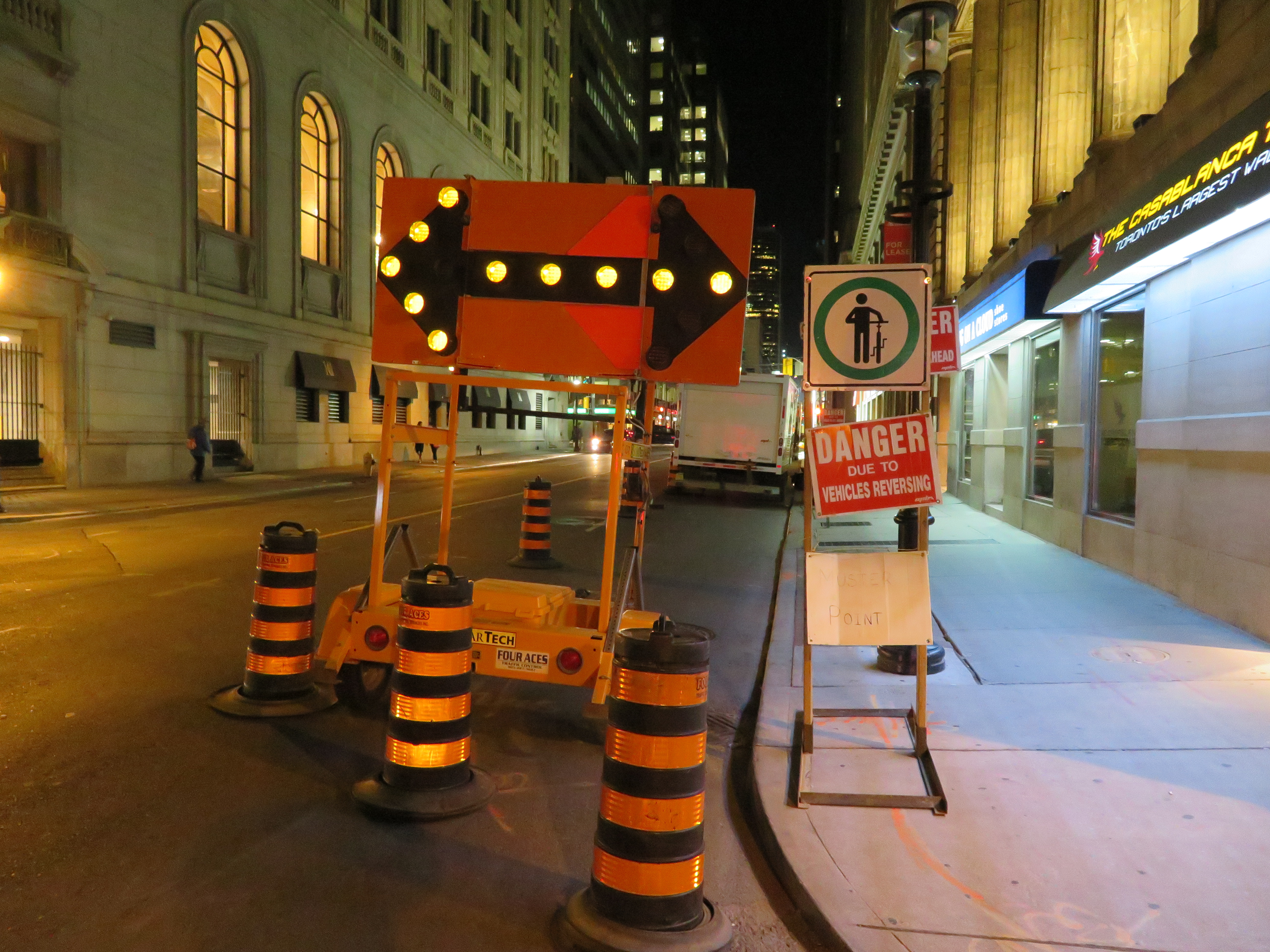
On Yonge Street, where construction between Wellington and Richmond Streets has reduced the road to two lanes, “cyclists dismount” signs have appeared as well. While this part of Yonge does not have bike lanes, the signage is still wrong. Cyclists have the same right to take the lane. I complained to a construction worker nearby after spotting these signs, who complained about cyclists riding through anyway, not getting my point.
Construction signage on Yonge Street, south of King Street
Signs telling cyclists to dismount are generally ignored, like those on multi-use paths in suburban Toronto. They’re placed at intersections and at narrow pinch-points for safety (drivers not expecting cyclists to cross; conflicts with pedestrians on sidewalks), but they are poor substitutes for solutions such as traffic calming, painted cross-rides at road crossings, and gentler, more effective measures to slow fast-moving cyclists, such as speed humps and barriers where necessary. At construction sites, it is far better to remind motorists to yield to cyclists and share the road, than expect cyclists to get off their bikes and walk around the construction zone. That said, “cyclists dismount” signs and enforcement is necessary and useful in pedestrianized zones, such as street festivals and pedestrian malls.
Signage telling cyclists to dismount at construction areas is lazy, de-legitimatizes cycling, and sends the wrong message to motorists. I hear enough complaints about “cyclists who break all the rules.”
Of course, it’s best to provide a safe passage for cyclists at construction zones, such as detouring a bike lane around the construction. On Richmond and Adelaide Streets, some building construction sites have shifted the separated bike lane around the site, an encouraging development. Where it’s not possible or feasible to maintain a bike lane through the construction zone, the signage still can be improved.
At a construction site on Simcoe Street, confusing signage and a poorly marked diversion endangered northbound cyclists, forced out of the separated northbound lane and into oncoming traffic. This resulted in at least one close call.
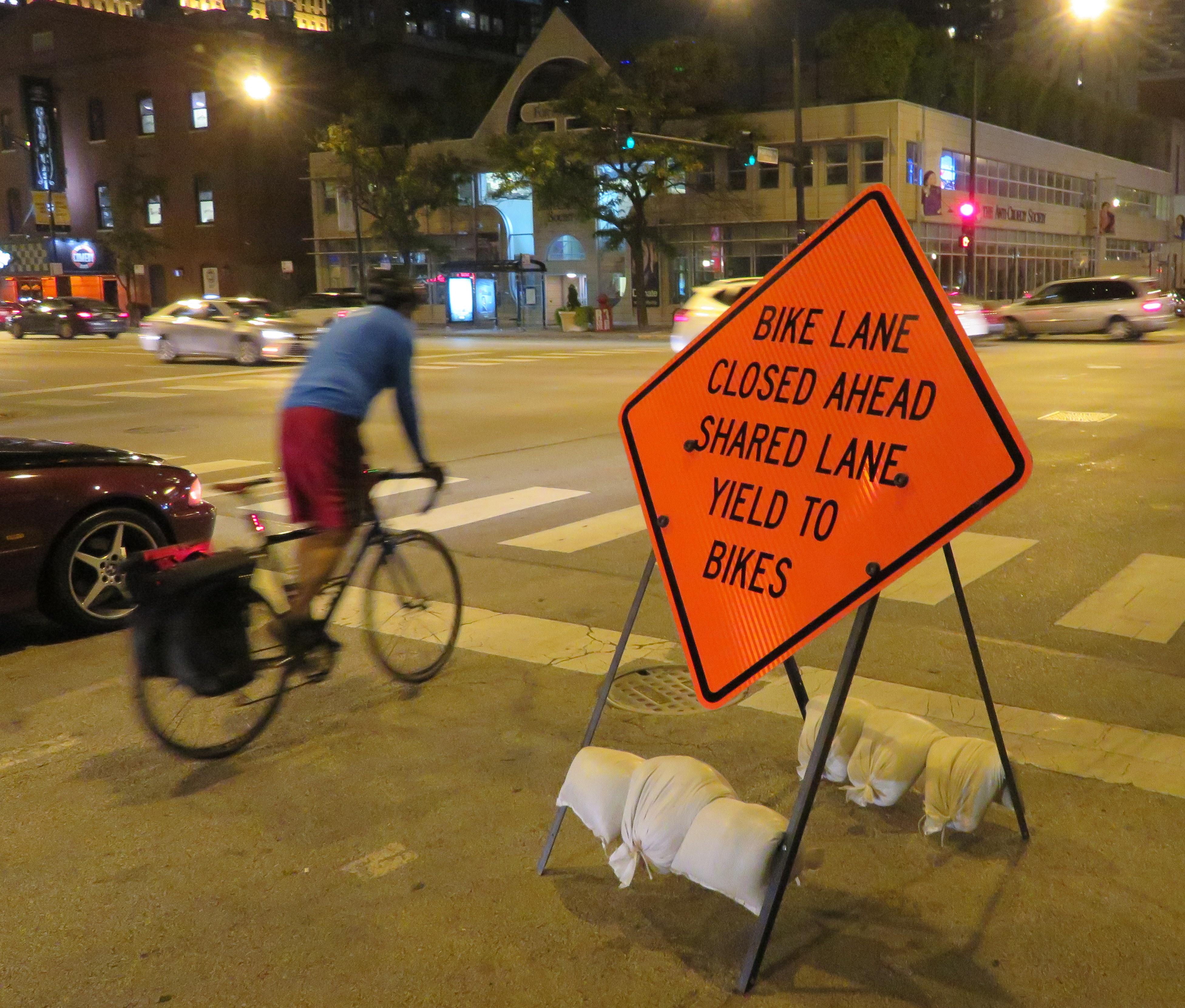
On a recent visit to Chicago, I came across a sign that delivers the right message. It read: “bike lane closed ahead — shared lane — yield to bikes.” The large orange sign was mounted in the road, in a way that it would be seen by motorists. It also makes it very clear that cyclists not only have the right to use the general traffic lane, it also makes it clear that motorists must give way to cyclists detouring around the closed bike lane. Toronto would do well to follow this example.
The City needs to develop mandatory standards for bike lane and curb lane blockages, in order to reduce confusion, as well as promote the safety and legitimacy of cycling in this city. It must also enforce those standards vigorously.
At the bottom of the Scarborough Bluffs, west of Bluffer’s Park
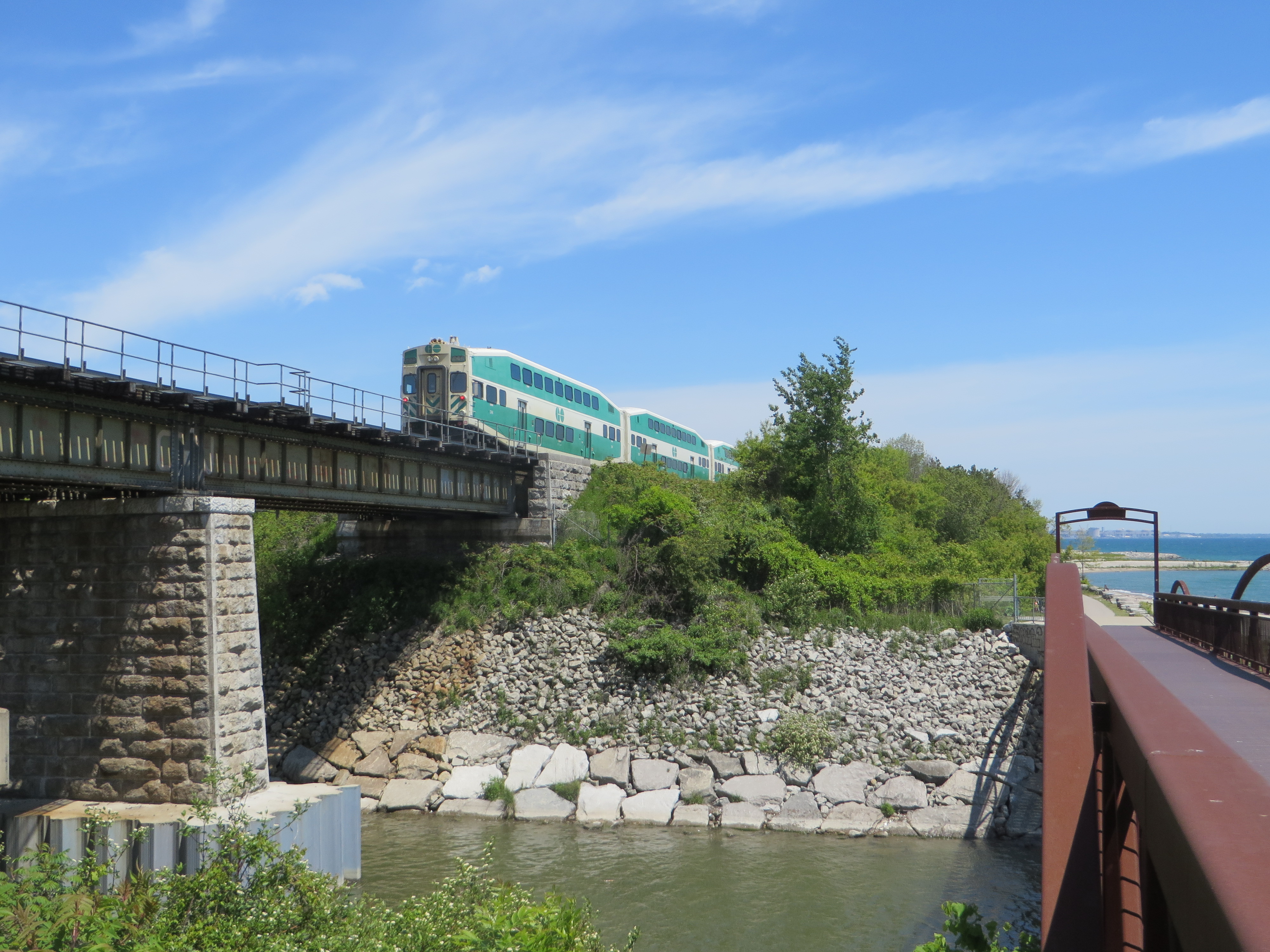
Lake Ontario, like all five of the Great Lakes, is more a freshwater sea than merely a lake. It’s over three hundred kilometres long, from Hamilton to Kingston, bordering two countries, with several inhabited islands, and features a varied and fascinating landscape. Lake Ontario’s vastness is best appreciated from its shore, whether it be the Toronto Islands, on the east side, on the beaches at Presqu’ile or Sandbanks Provincial Parks, or from the top of the Scarborough Bluffs.
The Waterfront Trail, at least in theory, is a wonderful way to explore these varied shorelines of Ontario’s vast Great Lakes on foot or by bicycle. Founded in 1995, the trail now extends from the Quebec border, west along the St. Lawrence River, through Niagara, along the north shore of Lake Erie, and up the Detroit and St. Clair Rivers to Lake Huron. I cycle the Waterfront Trail between Toronto and Hamilton several times a year, an 85-kilometre trip. GO Transit’s trains and buses follow the Waterfront Trail from Durham Region to the Niagara River, making it easy to walk or cycle one-way, returning by train and/or bus.
The Waterfront Trail crosses Highland Creek in eastern Scarborough. (2015 photo)
But the Waterfront Trail is dependent on municipal infrastructure, or the lack of it. Most of the trail’s route winds through rural areas, following country roads and highways where segregated multi-use trails aren’t built: in many places, the Waterfront Trail is neither close to the water, nor is it a ‘trail’ of any kind. At least in Northumberland County and Niagara Region, paved shoulders and bike lanes are found along the busier country roads. But this is not always the case.
In urban areas, though, like the City of Toronto, there is both the demand and the resources for safe pedestrian and cycling infrastructure along the waterfront. In the old city of Toronto, the Waterfront Trail follows the Martin Goodman Trail, and is nearly completely segregated from motor traffic.
But in Etobicoke and in Scarborough, much of the trail is routed via on-street sections; in sections, pedestrians must follow sidewalks next to busy sections of Lake Shore Boulevard and Kingston Road; for cyclists, there aren’t even any bike lanes — they have the choice of either riding with traffic, or illegally riding on the sidewalks.
Route of the Waterfront Trail within the City of Toronto
VIA Rail train at Brampton Station, on the Toronto-Kitchener rail corridor
Updated Friday May 19, 2017:
Today, Premier Kathleen Wynne announced the commencement of an Environmental Assessment on bringing high-speed rail to Southwestern Ontario, connecting Toronto and Pearson Airport with Guelph, Kitchener, and London, with Phase II continuing to Windsor, with a potential stop in Chatham.
Former federal Transport Minister David Collenette was assigned to write a report on building the corridor; it is now public on the Ministry of Transportation’s website. It proposes operating speeds up to 250 km/h, making it a true high speed line (though slower than many lines in Europe and East Asia, which have cruising speeds between 270 and 320 km/h). The estimated cost of the project is estimated to be $21-billion, reducing travel times from Toronto to Windsor to a mere two hours.
Proposed High Speed Rail system for Southwestern Ontario
An option for a 300 km/h HSR service was studied, but found to be even more expensive, requiring more dedicated tracks. The 250 km/h option will allow it to use most of the existing Toronto-London and London-Windsor corridors.
For southwestern Ontario, high speed rail could be a boon. Kitchener-Waterloo is a major educational and technological hub; faster and more frequent rail service will benefit university students, tech workers, and other commuters, perhaps those priced out of the Toronto housing market. London’s economy has taken some hits in recent years, so bringing it within commuting distance to Toronto and K-W gives residents there more options.
Between Toronto and Kitchener, the report assumes two off-peak HSR trains an hour, and one GO train every hour, making local stops. It also assumes that GO RER service will continue to terminate at Bramalea, a poor location to terminate regional rail services; Downtown Brampton is one stop away. Building the “missing link” along Highway 407 will allow many more trains to pass through Downtown Brampton, which would allow for local RER trains to be extended to west Brampton, at Mount Pleasant GO. It would be a shame if the HSR plans (which, in principle, I support) pushed aside regional and local needs.
Statford and St. Marys, which are only served by VIA trains (and no intercity coach service) will also have to be considered, as they will be bypassed by HSR. As well, towns and cities elsewhere in southwest Ontario, such as Simcoe, Tillsonburg, Wallaceburg, and St. Thomas, have no bus or rail access. For less than the $15 million pledged for the HSR EA, the province could fund several years’ worth of basic intercity bus service to connect these communities together.
Unless assumptions change, Brampton residents will see twice as many trains speed by their downtown core than stop, which I think is unfortunate. In the original post below, I was worried that high speed rail dreams would distract from more immediate needs. I’m now afraid that I was right.
Original post dated April 26, 2017
When have I heard this one before?
According to CTV News, the provincial government is looking to build a new high-speed rail line between Toronto, Kitchener, and London. The new plan, to be announced next month, is based on the work of former federal Transport Minister David Collenette.
During his time as Transport Minister under Prime Minister Jean Chretien, Collenette backed incremental VIA Rail improvements, as well as VIA-FAST, a higher-speed train service between Toronto, Ottawa, and Montreal. Those proposed improvements were cancelled when Paul Martin became prime minister; currently VIA is pushing for a revised version of that previous plan. Collenette also pushed hard for a rail link between Toronto Pearson International Airport and Union Station, a fundamentally flawed proposal known as “Blue 22.” That airport rail link proposal was later relaunched as a provincial project and opened as UP Express in 2015.
Ontario Transportation Minister Steven Del Duca was not especially clear about the plans for such as high-speed rail service, saying “…there are multiple definitions for high-speed rail depending on what you’re looking at.” Del Duca cited “geographical limitations,” while hoping that the federal government would contribute funds towards the project.
Interestingly, only a week ago, Deputy Minister Deb Matthews (and London MPP) was downplaying the province’s plans, saying the province only promised to study, but not necessarily build, the high-speed rail corridor.
I worry that high-speed rail is a distraction. In Canada, we have an abysmal record of proposing high-speed rail projects, but never following through. Even VIA’s less ambitious plan for dedicated tracks and new equipment to provide more frequent and reliable service, with somewhat faster travel times, is not yet secure.
There is already a Toronto-Kitchener-London service; two VIA trains operate daily in each direction along the entire route, while GO Transit operates more frequent weekday trains to Brampton and four weekday round trips to Kitchener. Before the 1990 Brian Mulroney-era VIA cuts, there were five round trips on this line. In the 1980s, the fastest VIA train between Toronto, Kitchener, and London took 3 hours, 2 minutes; today, the fastest train is 3 hours, 22 minutes.
This Rick Mercer Report video will never get old
All that I want for the Toronto-Kitchener-London corridor in the short-to-medium term is the same as what VIA is proposing between Toronto and Montreal:
Dedicated tracks. On the Toronto-Kitchener-London corridor, this means building a new rail corridor, known as “The Missing Link” for freight trains between Halwest (near Bramalea GO Station) and Milton. This new route would divert Canadian National (CN) freight trains that currently pass through Brampton and Georgetown on the Toronto-Chicago mainline. Potentially, Canadian Pacific (CP) trains passing through Toronto and Mississauga could also be diverted, freeing up capacity on GO Transit’s Milton Line. CN freight traffic limits the frequency and speed of GO Transit rail service to Brampton and Kitchener; moving the through freight trains would allow for frequent, electrified, GO RER service beyond Bramalea, as currently proposed. CN is interested in partnering with the province to build this link; CP has not expressed interest. Map of the “Missing Link” from a 2015 IBI Group report
Rail improvements. Between Georgetown and Kitchener, the railway is owned by Metrolinx, and hosts four weekday GO Transit trains in each direction, two daily VIA trains in each direction, and several Goderich-Exeter Railway (GEXR) freight trains. Track is in good shape, but has several slow sections, including a two-kilometre section west of Guelph Central Station where trains crawl at 10 miles an hour (16 km/h).
Improving rail speeds in central Guelph will be expensive, especially where the railway runs in the middle of residential Kent Street, but it will be worth it. Beyond Kitchener, the track is leased and maintained by GEXR, which has allowed the rails to deteriorate. Slow speeds are acceptable by a no-frills short line freight operator, determined to minimize maintenance costs, but not so for passenger rail. VIA trains are consistently late because of the condition of track, especially between Stratford and London. Purchasing the track, installing welded rail, and improving grade crossings will substantially improve reliability and speeds on this corridor.Incremental improvements, such as grade separations, improved signalling, and new passing tracks, would permit frequent, reliable, and faster rail service.
A new train fleet. Via Rail’s coaches are nearing the end of their useful lives; among the rolling stock used on the Toronto-Kitchener-London service are HEP-I and HEP-II coaches built in the 1950s and refurbished several times since. GO Transit’s commuter coaches are acceptable for shorter trips, but are uncomfortable for long-distance travel. With the completion of the “Missing Link” and the acquisition of the Kitchener-London rails, it would be possible to electrify the entire corridor. Electric trains benefit from faster acceleration times, especially electric multiple units.
Some of these improvements can be started within the next year, before the 2018 provincial election. If the province wants to show that it’s serious about providing effective rail service to Kitchener and London, there’s no need for another high-speed rail study. Simply continue the work on the “Missing Link,” plan for GO RER to continue west of Bramalea GO, improve the existing rail infrastructure, and acquire the optimal fleet for medium-distance rail services. Once that is complete, planning for even higher speeds, possibly with a new purpose-built alignment, should begin.
Canadians have been teased with high-speed rail proposals that never get anywhere, meanwhile existing rail infrastructure is neglected and intercity services are cut. It’s time to get moving with a sensible plan that can start right now.
View from the top of the ski hill at Earl Bales Park
Last Sunday afternoon, I went for a walk around Earl Bales Park. The large, multiuse green space is located near the corner of Bathurst Street and Sheppard Avenue in North York; it also descends into the West Don Ravine. It was a delight to explore this park, but as I discuss below, it could be much better connected to the city on the south end.
Earl Bales Park originally was a farm established in 1824 by English settler John Bales and his family; their house still stands in situ. The land later became a private golf course, and was purchased by the Borough of North York in 1975, named for one of the Baleses’ great-grandsons.
A lot is packed into this popular green space: walking trails, playgrounds, picnic areas, a community centre, an amphitheatre, an off-leash dog park, a memorial, a seniors’ woodworking shop, and even a ski hill. Even on the first weekend of April, the park was full of picnicking families and groups; families represented a diverse cross-section of suburban Toronto.
After English, the most commonly spoken languages I heard were Russian and Tagalog — the Bathurst Street corridor north of Highway 401 is popular among immigrants from the Philippines and Eastern Europe; many businesses and community organizations in the area cater to these communities.
Picnicking at Earl Bales Park, April 2, 2017 (more…)
Data geeks across Canada were eagerly awaiting this day — February 8, 2017 — the first release of the 2016 Canadian Census of the Population. Today’s release only covers population and dwelling counts, further information on age, sex, household characteristics, as well as language, immigration status, employment, income, and other variables will be released later in 2017. The 2016 Census included the mandatory long-form census, which will provide a robust snapshot on the socioeconomic status of all 36 million Canadians.
I created three quick maps showing the population growth in the City of Toronto by census tract. The City of Toronto grew by 116,511 people over five years to 2,731,571 in 2016, a 4.45% increase. Some suburban municipalities grew much faster, like Brampton (13.3%, with a 2016 population of 593,638), but Toronto has been able to absorb one-third of the Toronto Census Metropolitan Area’s growth.
Toronto’s population makes up 46.1 % of the Toronto CMA (population 5,928,040). The rest of that growth was found in mature suburbs such as Brampton, Mississauga, and Markham, but also in quickly-growing towns such as Milton (population 110,128, up 30.5% from 2011). While some suburbs — Mississauga and Markham in particular — have been establishing higher-density urban centres with mid and high rise condominiums, most of the suburban growth has come from single-family homes and townhouses on formerly agricultural lands. If the Greenbelt is to continue being successful in containing sprawl and preserving productive farms and natural areas, Toronto needs to absorb even more growth in the next few decades. Land developers, speculators and the real-estate industry, however, are pushing back.
The first of the three maps shows the percentage increase or decrease in population by census tract. Areas with higher growth are concentrated in Downtown (particularly along Yonge Street and in the Entertainment District, City Place, Liberty Village-Fort York and St. Lawrence-Distillery-Corktown), as well as Etobicoke Centre, on Humber Bay, Midtown, and along the Sheppard Subway corridor in North York. Not surprisingly, these are areas in which new housing developments, particularly condo towers, are being built. Other neighbourhoods, for the most part, are seeing minor increases or decreases in population, likely related to changes in household/family size.
But more interesting is the map showing absolute population increases or decreases between 2011 and 2016. It better illustrates areas of high population growth and neighbourhoods with population decline. The inner suburbs, especially parts of Scarborough and North York, clearly show slight a population decline compared to the high-growth areas described above.
The final map shows the 63 census tracts (out of a total of 1,426 CTs) with growth of at least 2,000 persons. It very clearly shows where high population growth has taken place.
Census tracts that grew by at least 2,000 persons between 2011 and 2016
Yonge Street at St. Clair Avenue, 1922. The TTC was busy in its first few years joining together the various street railway systems together and expanding services. Here, work is underway to extend city streetcar service to Glen Echo Loop and connect with the former Toronto Civic Railway’s St. Clair line. City of Toronto Archives Fonds 16, Series 71, Item 1571
In 1921, the Toronto Transportation Commission was established to provide all transit services within the City of Toronto, on a complete cost-recovery basis. Within the City, there would be a single fare for all regular services, including free transfers, with additional fares for services outside the city limits.
The TTC immediately took over the operations of the Toronto Railway Company and the city-owned Toronto Civic Railways and began to unify the two systems. It bought new equipment, and replaced worn-out rail, carhouses, and other facilities. It introduced the first transit buses to Torontonians, and three decades later, Canada’s first subway.
Toronto’s streetcar system expanded through the 1920s, but stagnated through the 1930s, including the loss of almost all of Toronto’s radial railways. But it wasn’t until 1947-1948 that Toronto’s street railway network entered an era of decline, as trolley coaches, diesel buses, and subways chipped away at the streetcar’s dominance.
By the late 1960s, the TTC was looking to eliminate streetcars entirely by 1980, once the Queen Street Subway opened. Of course, that subway line never opened, and the streetcars remained. It wasn’t until the 1990s, though, that the network entered a renaissance.
1923
Within two years, the TTC quickly modernized the streetcar system. New streetcars — known as Peter Witts — were ordered and the oldest of the Toronto Railway Company’s cars were immediately scrapped. The TTC unified the TRC and Civic systems, replaced the radial railways within city limits with city services, and added new routes such as Coxwell and Bay. The City took over the Toronto & York radials as well, but handed their operation over to Ontario Hydro. The TTC also replaced much of the worn out rails, and built new turning loops at the end of streetcar lines replaced crossovers and wyes. This improved operations and allowed for larger, single-ended streetcars to operate on more routes.
The TTC also introduced buses. In the early 1920s, buses were were slow, small and less comfortable than streetcars, but they had their advantages. The TTC’s first bus route, 1 Humberside, provided a direct, single-fare ride through the South Junction neighbourhood to TTC streetcars at Dundas Street; the Toronto Suburban’s Crescent streetcar line couldn’t compete and was soon abandoned. The TTC also experimented with a trolley bus route on Merton Street and Mount Pleasant Road between 1922 and 1925; it was replaced by an extension of the St. Clair streetcar.
Trolley bus on Merton Street, June 20, 1922. City of Toronto Archives, Series 648, Fonds 227, Item 1
TRC streetcars on Queen Street, c. 1910. Note the old TSR horsecars used as trailers behind the electric cars. City of Toronto Archives, Series 1465, File 722, Item 18
In 1891, after obtaining a new 30-year franchise, the Toronto Railway Company went to work electrifying Toronto’s streetcar system. The TRC was a private company, led by William Mackenzie and James Ross. Mackenzie made his fortune in railway construction; together with Donald Mann, he would go on to build a railway empire before it collapsed by the end of the First World War. Mackenzie would also control other street railway and interurban lines in Ontario, including the Toronto and York, the Toronto Suburban, and the Niagara, St. Catharines, and Toronto.
By 1894, the TRC became fully electrified, providing quicker and more reliable service. In the twenty-five years that followed, new electric railways radiated out of Toronto to points such as West Hill in Scarborough, Port Credit, Woodbridge, and even as far away as Lake Simcoe and Guelph. But after a short sprint of service expansion within the City of Toronto, the TRC refused to extend its services beyond Toronto’s city borders of 1891. The City of Toronto was forced to form its own public streetcar company in 1911, and became determined to take complete control over urban transportation services once the TRC’s franchise came to an end.
Maps presented only show revenue routes, including peak period variations and some seasonal routes, such as Exhibition services. I omit some minor service and route changes. I welcome constructive feedback as I plan to re-publish these maps elsewhere.
1894
Electrification of the Toronto Railway Company began when the Church Street line was converted on August 16, 1892. The last horsecar made its trip on McCaul Street on July 18, 1894. The TRC extended several routes in Toronto’s west end, including King, Dovercourt, Bloor, Dundas and Carlton.
The Davenport Street Railway Company began operations on September 6, 1892 between Toronto Junction at Keele and Dundas Streets, and Bathurst Street at the CPR tracks, a short walk to TRC Bathurst Cars. The Weston, High Park & Toronto Street Railway Company began operating the same year within the Junction, from Evelyn Crescent to Keele Street, later extending east to the Toronto City Limits at Humberside Avenue. These two companies merged in 1894 to create the Toronto Suburban Railway.
The Toronto and Mimico Railway was the city’s second radial. After a troubled start in 1892, it extended west to New Toronto by 1894. The Toronto and York built east from Queen Street and Kingston Road to Blantyre Avenue in Scarborough Township. Two short spurs served the town of East Toronto (near today’s Main/Gerrard intersection) and down to the Beach.