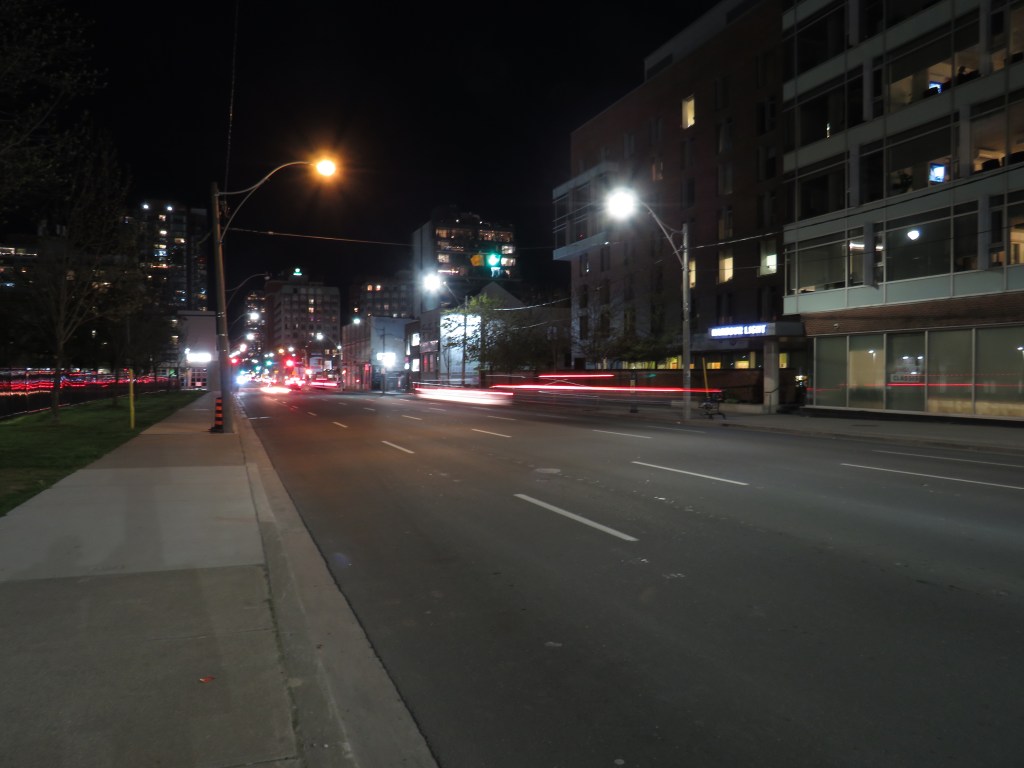
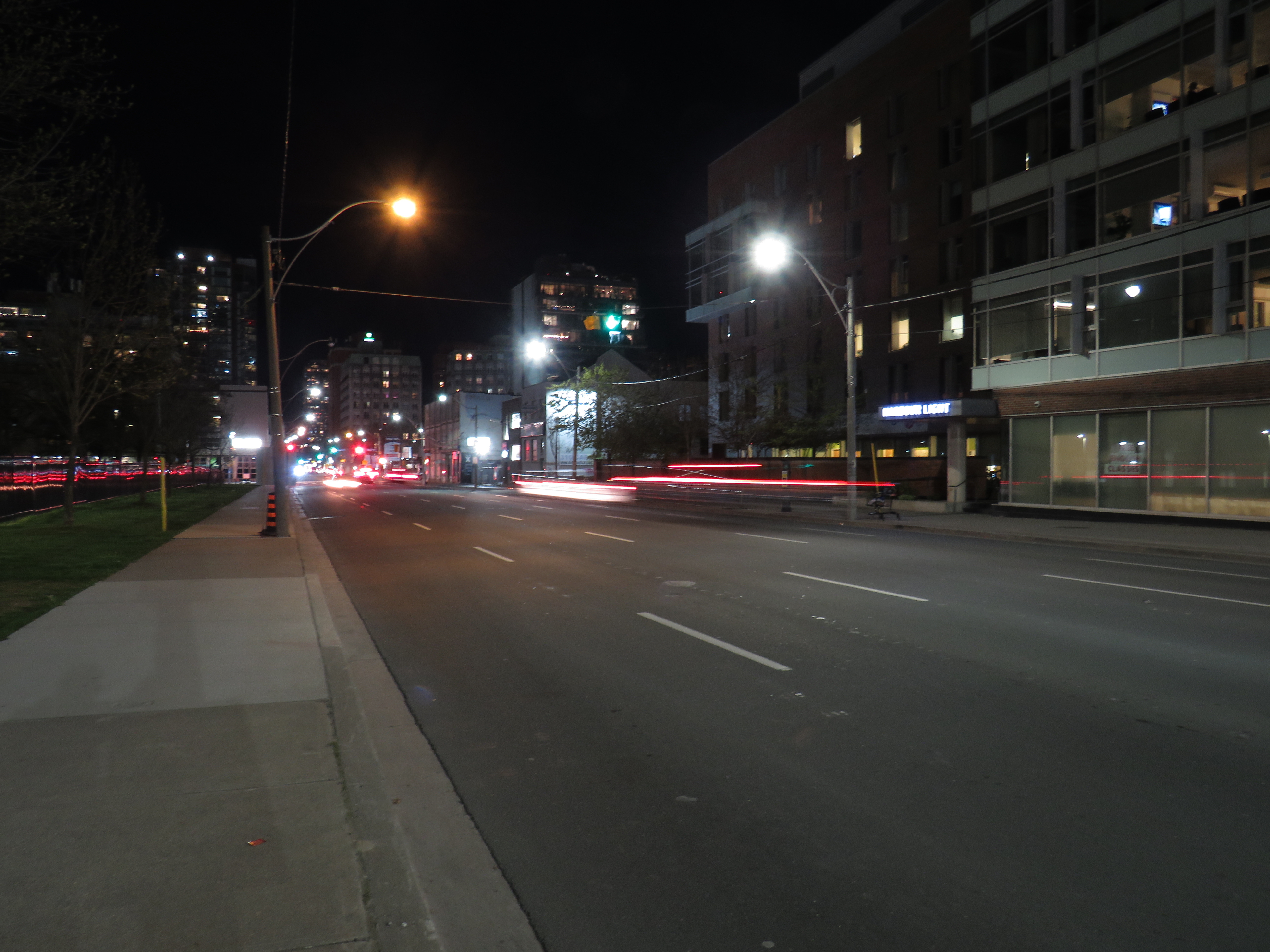
Replacement high pressure sodium lamp on left, the white glow of Toronto’s classic “acorn” lamp on right.
Street lighting is an important, yet overlooked, part of any city’s standard infrastructure. For over seventy years, Toronto’s streets were lit with an elegant and increasingly unique streetlamp design. But modern standards and a desire for standardization will see this change, just as Toronto’s streetcars and street signs have.
Toronto Hydro, which is responsible for Toronto’s street lighting, is replacing the older “acorn” lamps with high pressure sodium (HPS) cobra head lamps (so-called due to their shape when seen from the top or bottom). While surrounding municipalities are switching to white-burning LED lights, Toronto Hydro is installing the older beige-orange glowing lamps.
I asked Toronto Hydro what their long-term plans were for the city’s street lighting infrastructure. Read more on Spacing’s website.
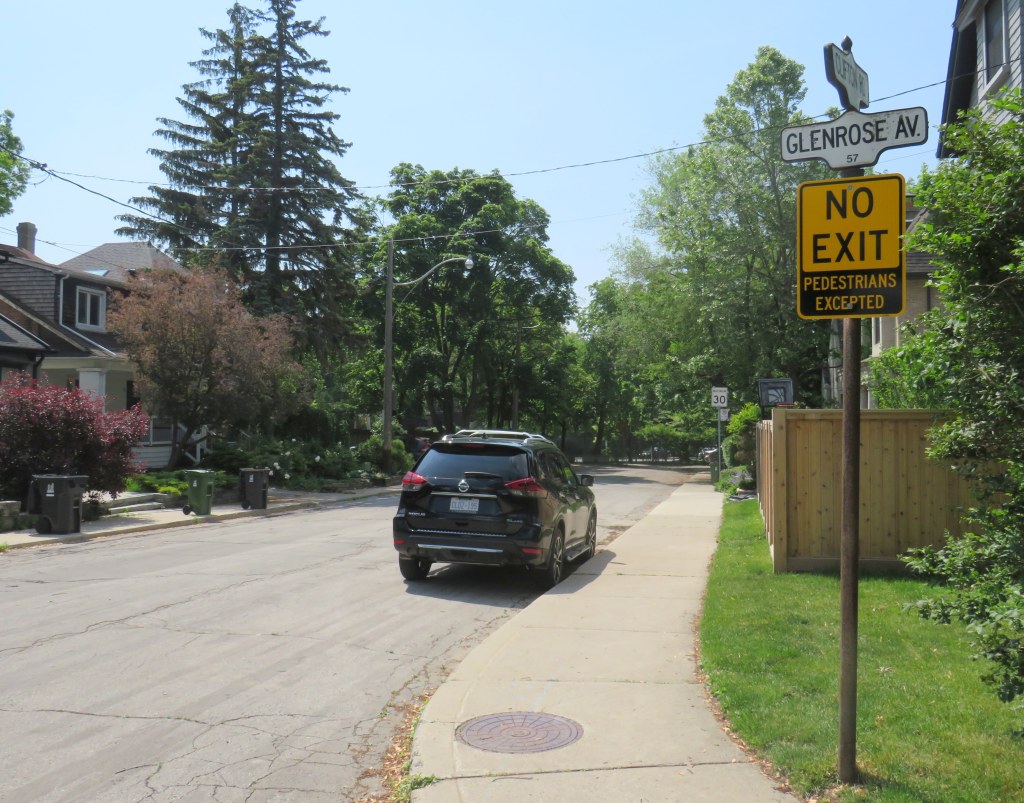
On April 8, Toronto City Council approved a motion brought forward by Councillor Paula Fletcher to change that. Councillor Fletcher’s motion was titled “I’m Walking Here.” Only two months later, new signs are already appearing across Toronto — in Scarborough, Monarch Park, and Swansea. For a city that often takes years to adopt what may seem like simple, easy solutions, this was implemented impressively quickly. The new signs look like standard yellow “no exit” signs, but with a “pedestrians excepted” note at the bottom.
My hope is that these signs will entice Torontonians to get outside, go for a walk, and check out some new streets and parks, enticed by these signs inviting through passage.
In related news, this week Toronto Council approved the expansion of sidewalk slow clearance to all of Toronto’s streets, a service that was previously provided only to suburban areas, where unobstructed sidewalks made municipal slow clearance easy to do. With new snow equipment able to navigate narrow urban sidewalks, Toronto is now finally able to provide universal snow clearance services, a boon for full accessibility.
As public health restrictions ease and stores and restaurant patios reopen this Friday (supported by the city’s willingness to reallocate road space on streets like Yonge and Danforth), there’s never been a better time to for a walk.
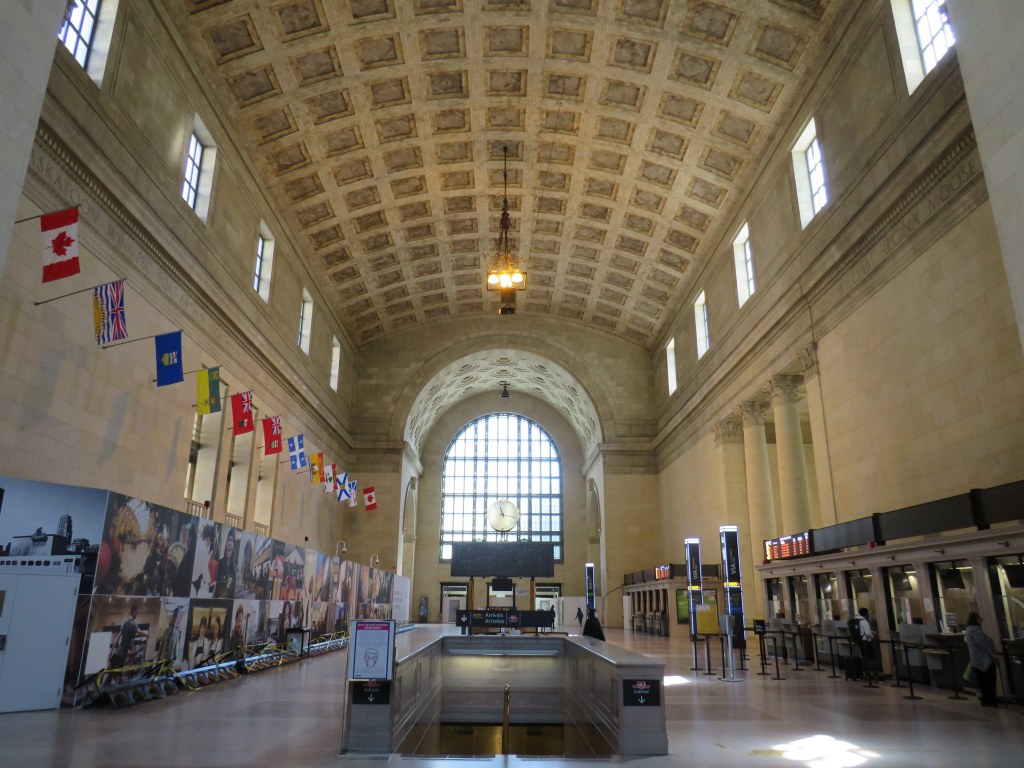
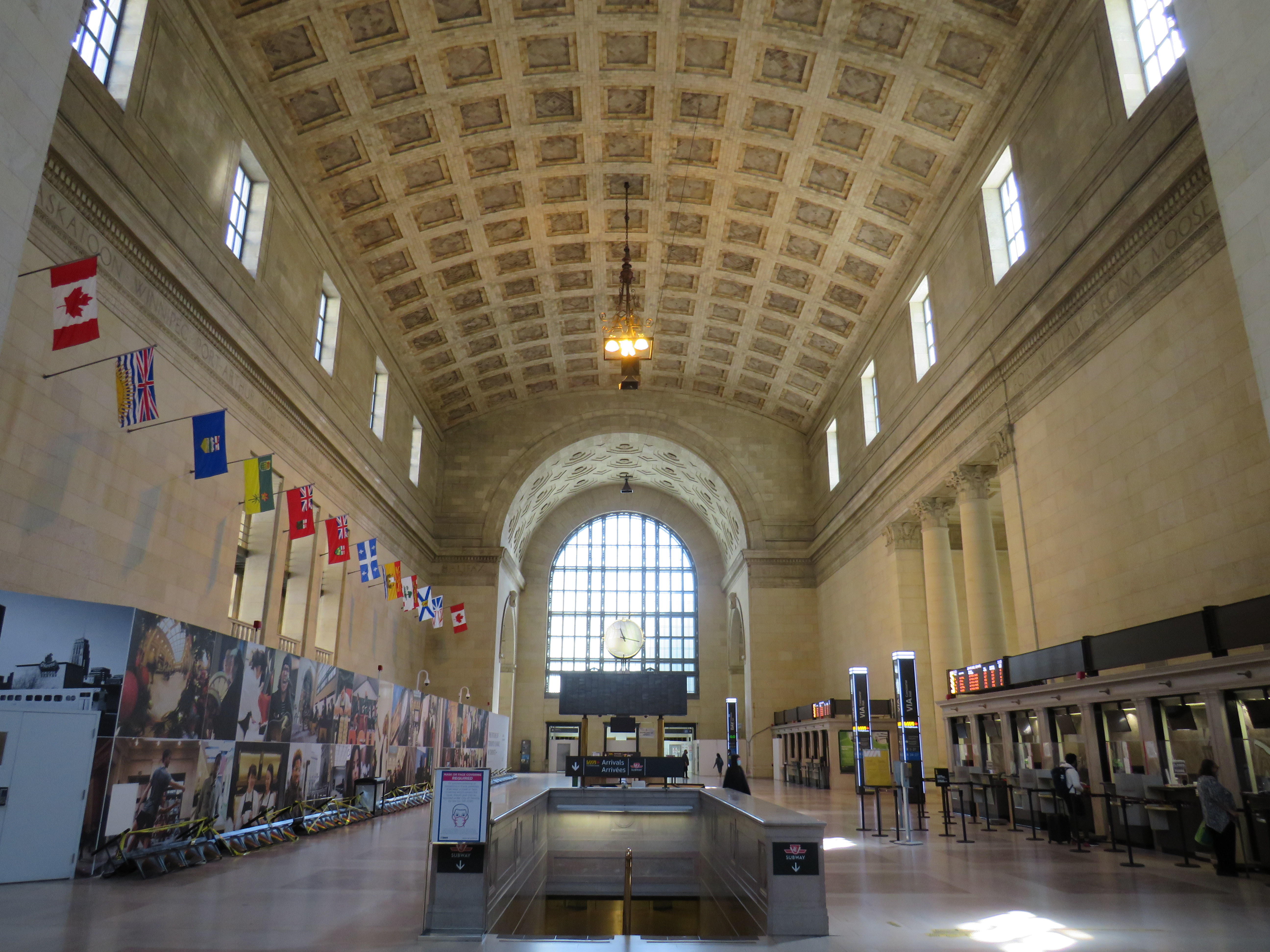
Union Station’s Great Hall is one of Toronto’s great indoor spaces. The station was constructed during Toronto’s first great building boom, in an era that began with E.J. Lennox’s Old City Hall (completed in 1899), and concluded with the completion of the Bank of Commerce Building, opened in 1931.
Work on Union Station, built for the Grand Trunk Railway and Canadian Pacific Railway, began in 1914, with the grand headhouse completed in 1920, construction delayed by the First World War.
Foreshadowing the long-delayed station renovations that are still ongoing, work on the elevated tracks and platforms connecting to the new station took nine more years, though a lavish official opening took place on August 6, 1927. By then, the Grand Trunk Railway was fully absorbed by Canadian National Railways (now CN).
Toronto’s Union Station became Canada’s busiest and most important railway hub, with direct trains to cities throughout six provinces and six American states, with through sleeper cars to even more US destinations via Buffalo. Though Montreal was Canada’s largest city until the early 1970s, CN and CP operated out of separate terminals.
Up high, the names of 27 Canadian cities are carved into the walls. On the north side are the names of cities that were served primarily by the Canadian National Railway (the former Grand Trunk, Grand Trunk Pacific, National Transcontinental, Canadian Northern, and Intercolonial Railways, as existed in 1914-1918); on the south, were the names of cities served primarily by the Canadian Pacific Railway.
On the north side, from west to east, the cities read:
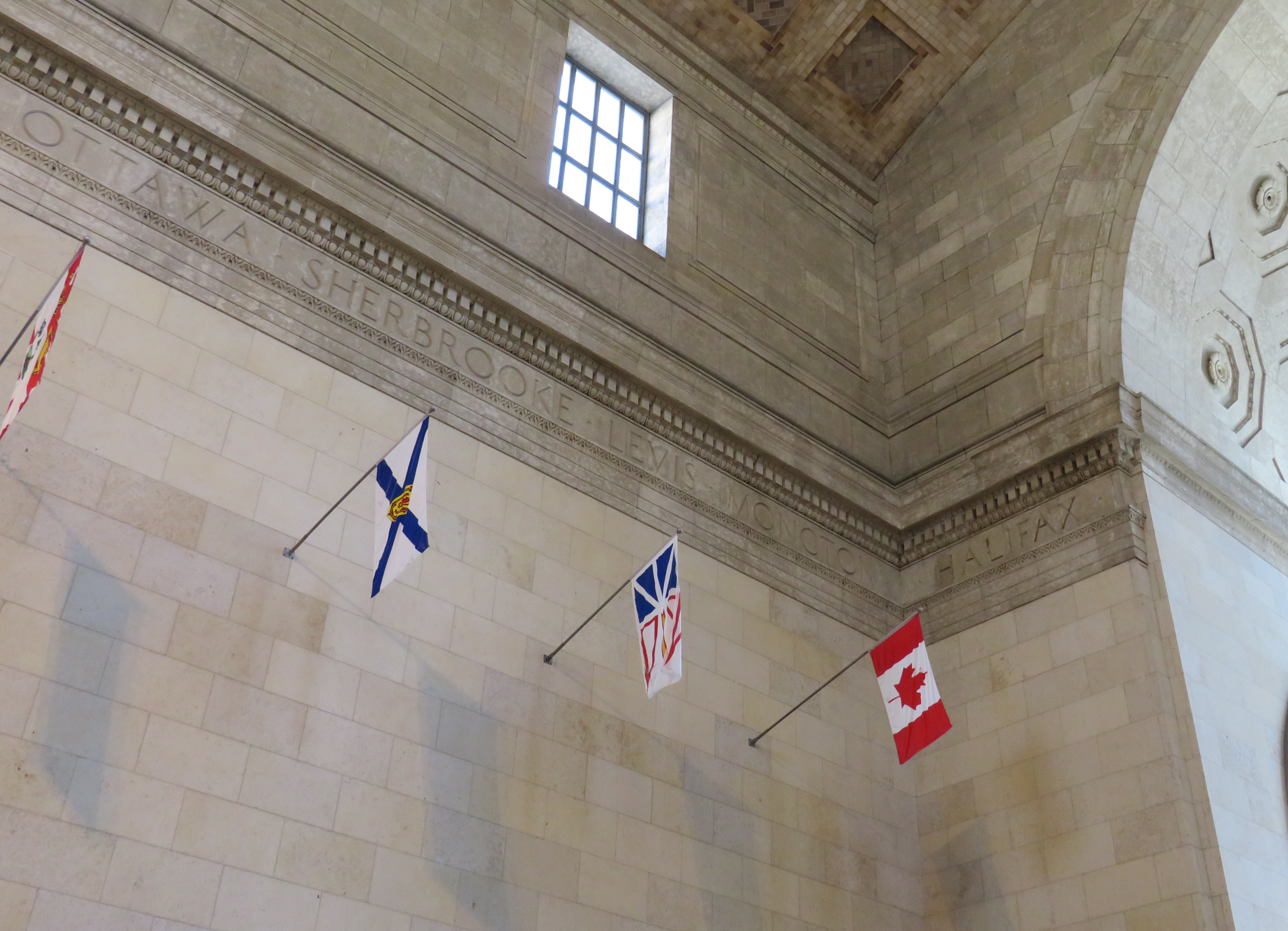
Prince Rupert – Edmonton – Saskatoon – Winnipeg – Port Arthur – North Bay – Sarnia – London – Toronto – Ottawa – Sherbrooke – Levis – Moncton – Halifax
Ottawa – Sherbrooke – Levis – Moncton – Halifax, on the northeast corner of Union Station’s Great Hall
On the south side, from east to west, the city names read:
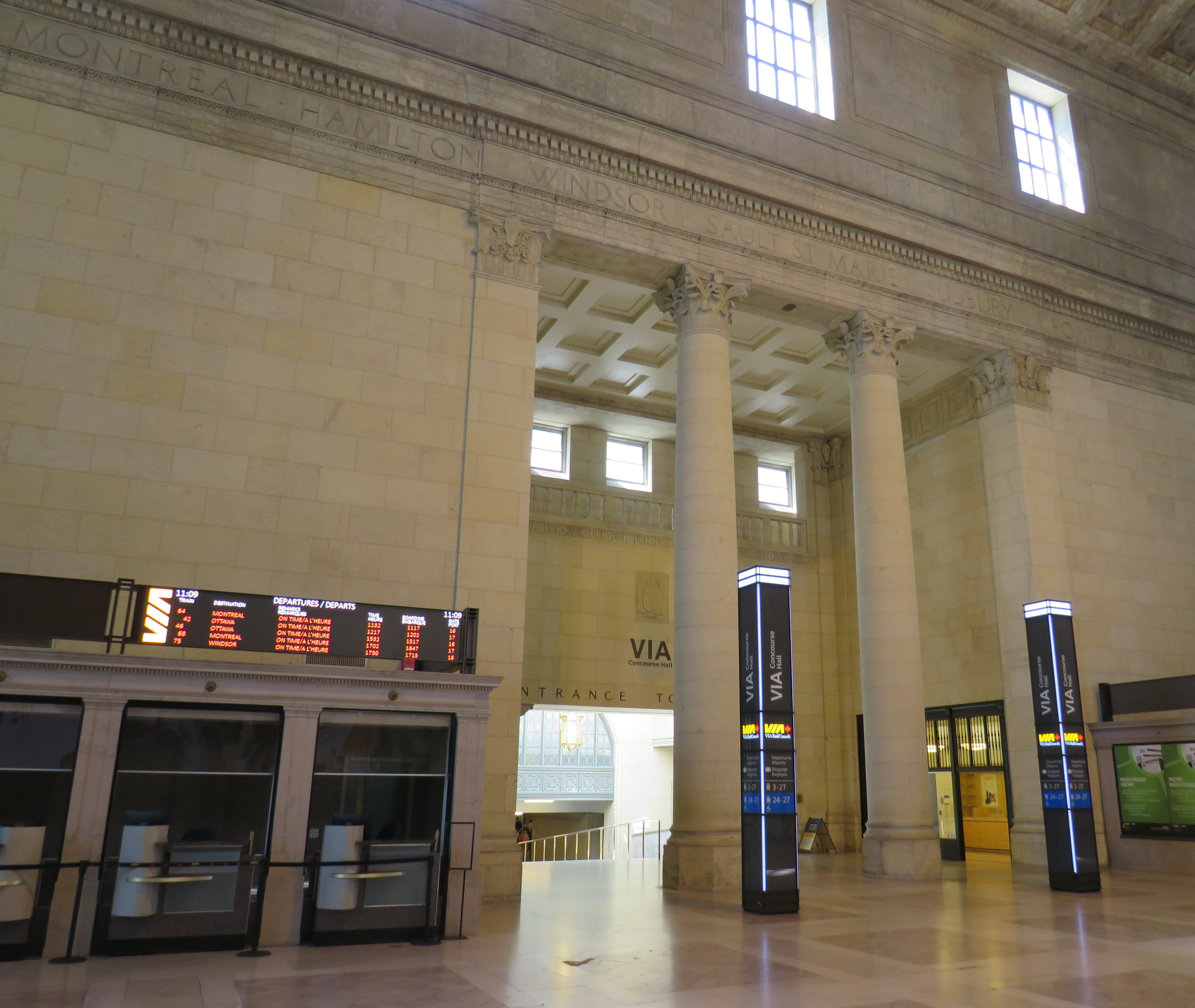
St. John [NB] – Fredericton – Quebec – Montreal – Hamilton – Windsor – Sault St. Marie [sic] – Sudbury – Fort William – Regina – Moose Jaw – Calgary – Vancouver
Montreal – Hamilton – Windsor – Sault St.-Marie – Sudbury – Fort William — names of cities over the entrance to the train concourse
Many, but not all, cities had direct train service from Union Station; the rest required a change of train at Montreal for points east, Sudbury for Sault Ste. Marie, or Jasper, Alberta, for Prince Rupert.
As rail passenger services declined after the Second World War, the number of destinations reachable from Union Station declined. Fredericton lost its rail service in the 1960s, with buses connecting it with the CPR Montreal-Saint John train. (A VIA-operated RDC restored service between Fredericton and Saint John for a few years in the 1980s.) Sault Ste. Marie lost its RDC service to Sudbury in early 1977, though an intrepid traveler could technically still get to Sault Ste. Marie by rail until 2014, by taking a VIA train to Franz or Oba, and then waiting for many hours in remote Northern Ontario for a southbound Algoma Central Train.
But it wasn’t until 1990, due to severe cuts made by Brian Mulroney’s PC government, that daily passenger service across the country came to an end. No longer could a rail passenger reach Calgary, Moose Jaw, Regina, or Thunder Bay (Fort William) by train. In 1994, with the rerouting of all Montreal-Halifax trains to the CN route though Lévis and Campbellton, stations in Sherbrooke and Saint John lost their remaining service. In 1998, CN abandoned its tracks through central Lévis, requiring the Ocean to be rerouted away from the ferry connection to Québec City. And in 2012, the Ontario government ordered the end to the Northlander, which ran through North Bay to Cochrane.
Today, just 14 of the 26 destinations proclaimed on the walls of Toronto’s Union Station can be reached by train. In Fredericton, there are not even any rails remaining.
Despite the decline in medium and long-distance passenger rail services in North America, Toronto’s Union Station is more relevant than ever. GO Transit began operating in 1967, and expanded throughout the 1970s and 1980s. Now, thanks to its role as hub for commuter and regional rail, regional and intercity buses, local transit, and the rail link to Canada’s busiest airport, Union Station became busier than ever. Today, most passengers are headed to places like Aurora, Mississauga, Pickering, or Burlington, despite the promises of far-flung destinations etched on the Great Hall’s walls.
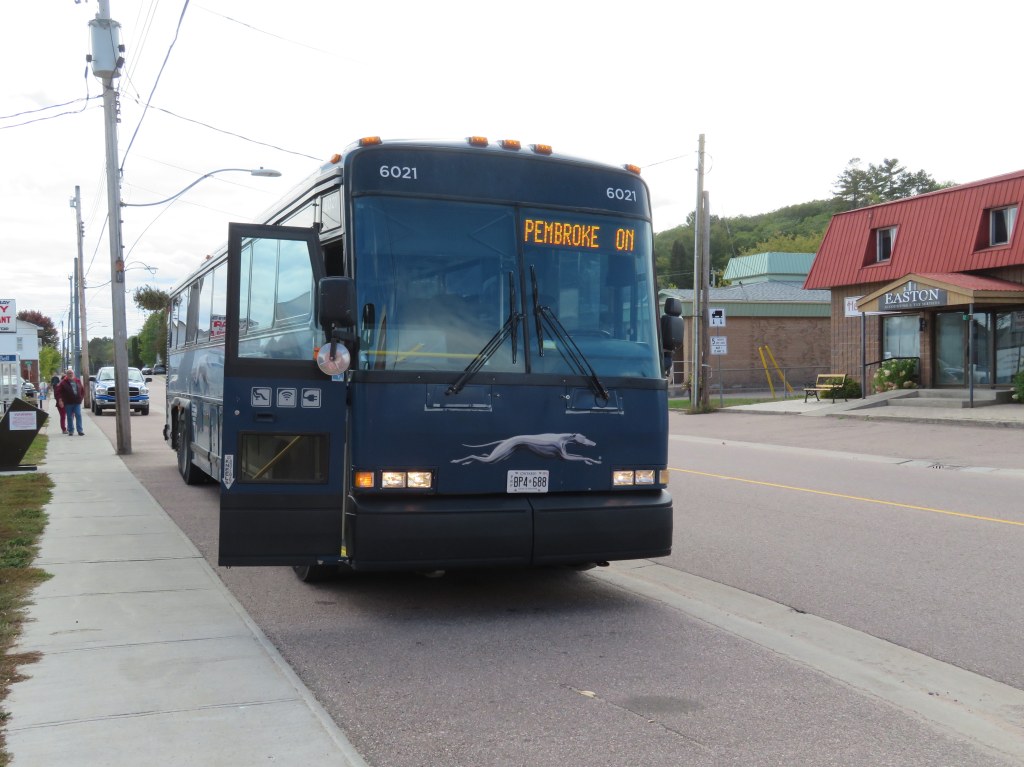
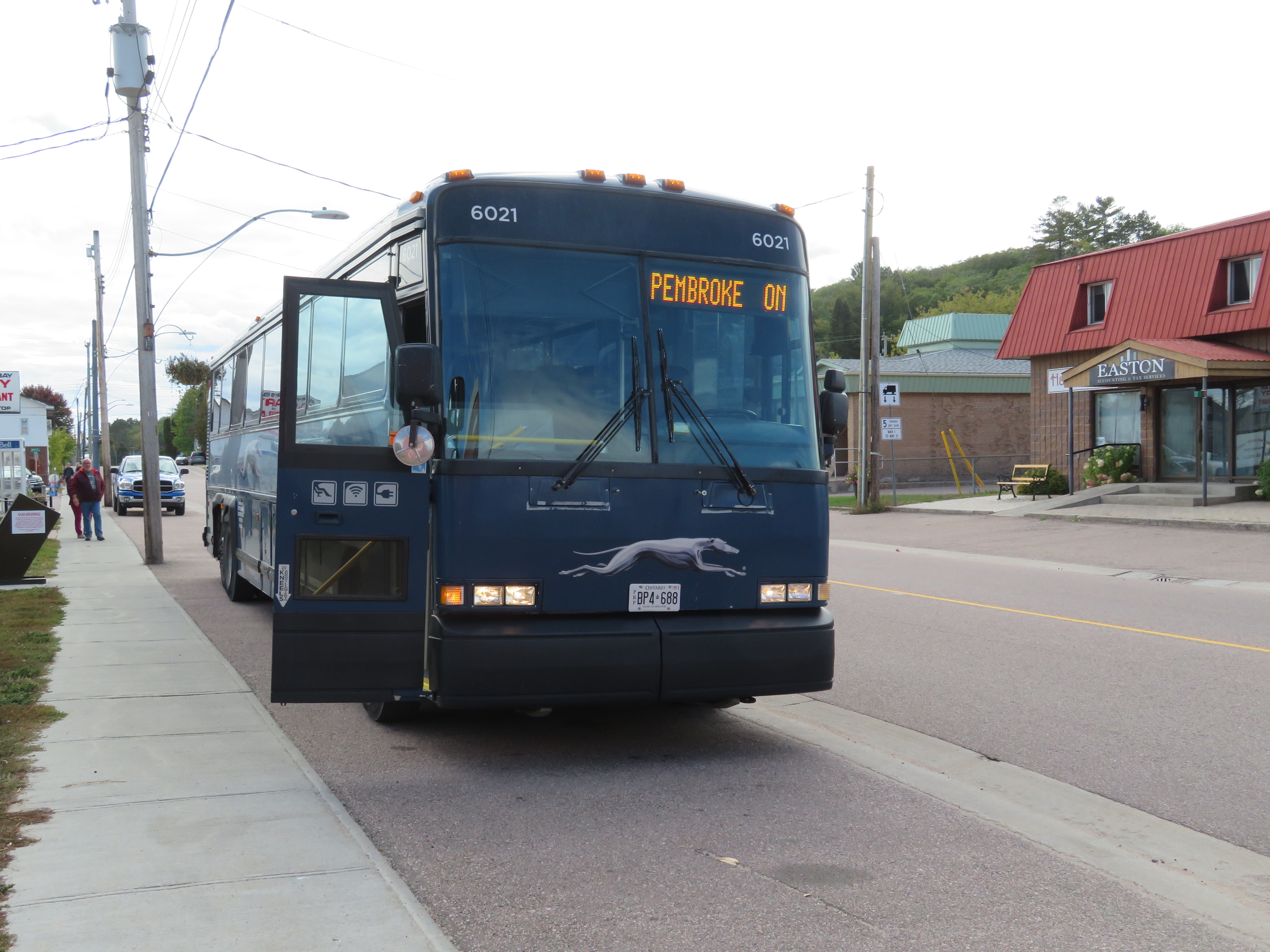
Barry’s Bay, on Greyhound’s Peterborough-Pembroke route, is one of many smaller towns and villages that permanently lost all intercity bus connections since the COVID-19 pandemic
On Thursday, May 13, Greyhound Canada announced that it was permanently ceasing operations. This should not have come as a shock to anyone following the intercity transport industry: for over three decades, intercity bus carriers in this country were privatized (Gray Coach and Canada Coach Lines in Ontario, shut down (Saskatchewan Transportation Corporation), or strangled by continued cutbacks and poor customer service (Greyhound). In 2018, Greyhound Canada ended all its remaining services between Vancouver and Sudbury. The loss of commuter and student traffic — Greyhound’s bread-and-butter in Ontario and Quebec — due to the pandemic led to a temporary, then permanent shutdown.
The next day, on Friday, May 14, Megabus — operated by Coach Canada, a subsidiary of UK-based Stagecoach — announced that it would begin service on the Toronto-Ottawa and Toronto-Kingston routes abandoned by Greyhound. Two buses a day will soon operate between Toronto, Scarborough Town Centre, Kingston, and Ottawa, daily except Tuesdays and Wednesdays, terminating at St-Laurent Shopping Centre, a stop on Ottawa’s new LRT. Though this provides a new option for travelers between the big three cities (VIA Rail continues to serve this route), it does not fill the gaps left by years of decline by private intercity bus operators.
Before Greyhound’s website disappeared, I downloaded the PDF schedules for Ontario and Quebec. In 2019, Greyhound operated three routes between Toronto and Ottawa: an express bus, with stops only in Scarborough, Belleville, Peterborough, Madoc, and/or Kanata, a local bus, making stops in cities and towns along Highway 7 between Peterborough and Carleton Place, and a Kingston-Ottawa bus via Smiths Falls. You can view and download the schedules below:
Peterborough loses two buses a day to and from Ottawa and express bus service to Downtown Toronto (which made the trip in less than two hours off-peak.) Though Peterborough is still connected to Toronto via GO Transit bus Route 88, it can take nearly three hours to go between Union Station and Downtown Peterborough, including a train connection at Oshawa, and many local stops in Clarington and along Highway 115. Other towns, such as Norwood, Marmora, Madoc, Perth, and Carleton Place, lose all bus services, except for a commuter-oriented weekday run between Ottawa and Carleton Place.
Greyhound has chosen to become irrelevant to most Canadians long before the final shutdown announcement. Northern Ontario, at least, still has Ontario Northland (which has expanded its reach), and the Greater Toronto and Hamilton Area has GO Transit (though gaps continue to exist in that network). If your rural community is lucky, your local or regional municipality launched a new, subsidized bus or microtransit service. There is also VIA Rail, which serves most larger communities that lost Greyhound services in 2020-2021 (Windsor, Chatham, Belleville, Ottawa, etc.), though it is typically more expensive.
Despite these continued and emerging services, there remains a need for government support of those crucial links left behind by Megabus, VIA, and GO Transit.
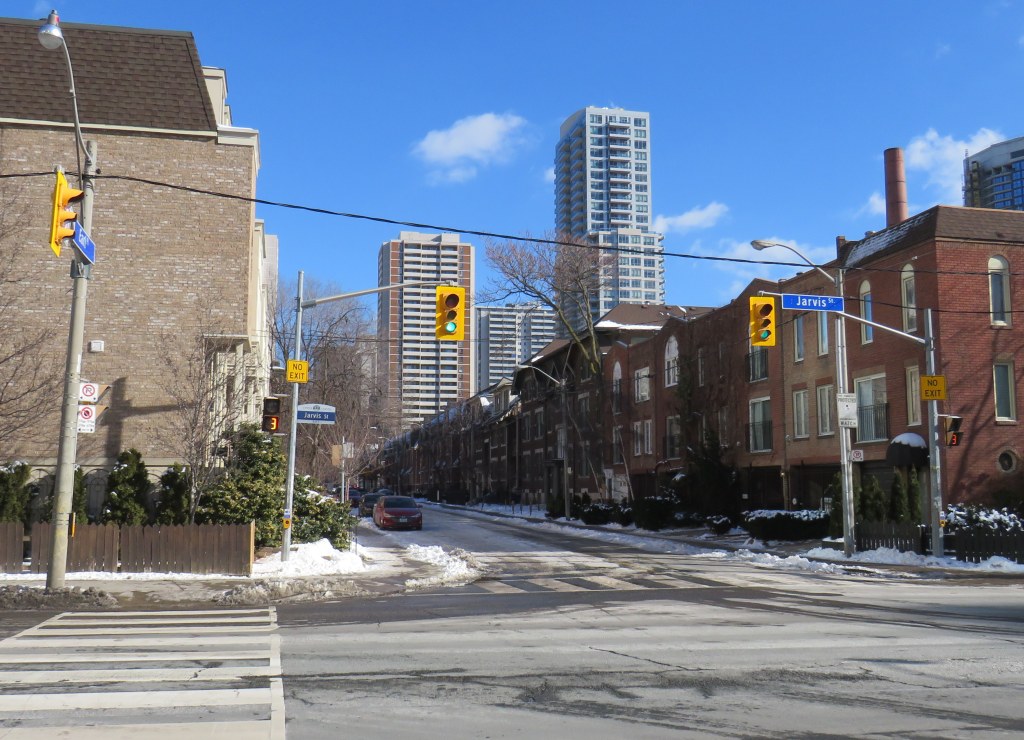
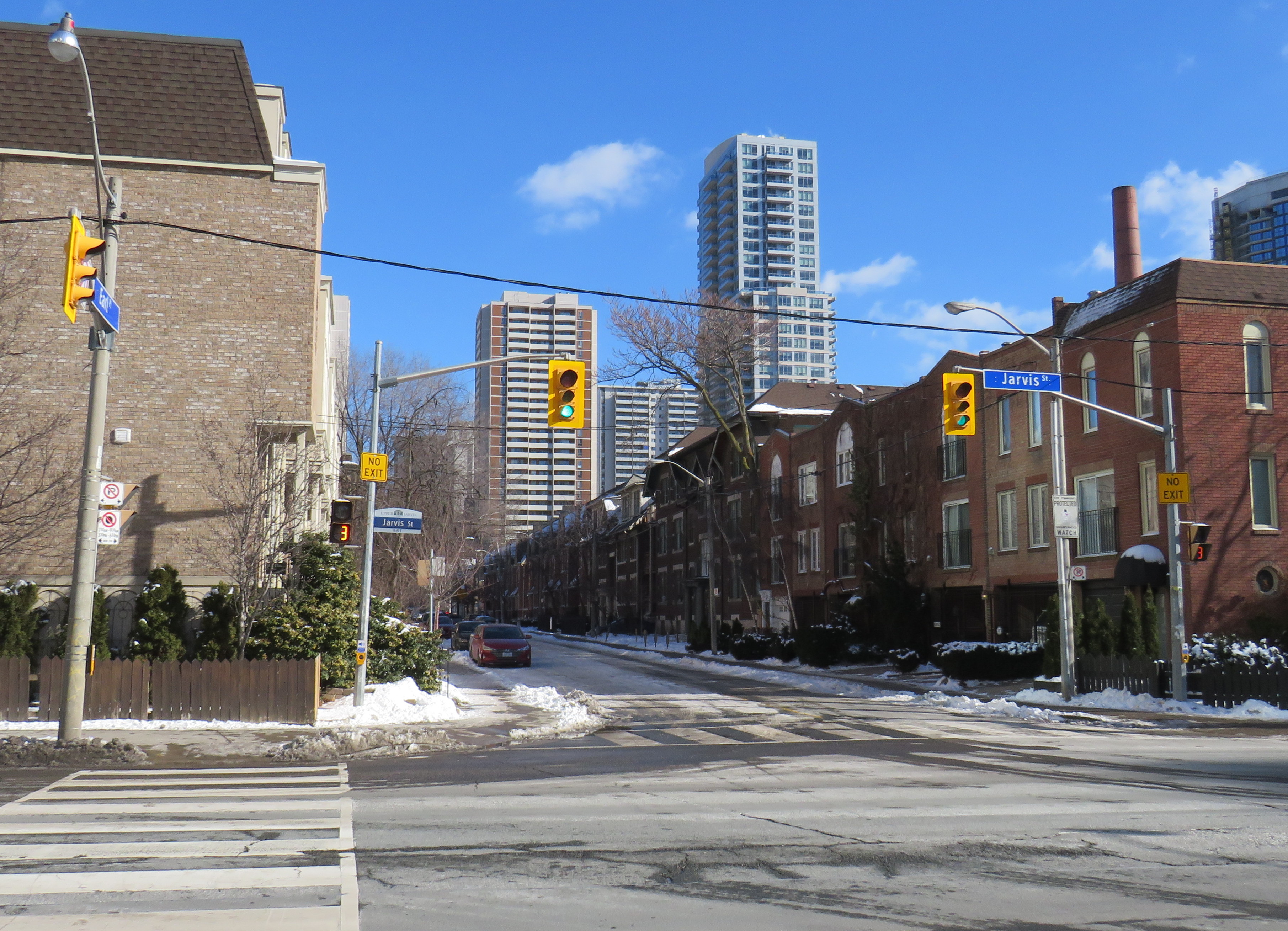
Misleading “no exit” signs, like these on Maitland Place at Jarvis Street, will soon be changed by the City of Toronto to indicate that indeed, pedestrians can continue through
Though these signs are required under traffic codes and regulations, they do not reflect that in many cases, there is an exit for pedestrians.
I quickly created a Google map of all locations in the City of Toronto marking such locations. Through a social media campaign led by Walk Toronto, we were quickly able to map over 450 locations where a pathway, sidewalk, or staircase allows a pedestrian to continue their way where motor vehicles are forced to turn around.
The motion, which was amended to strengthen the wording, requests city staff to develop a new signage standard to indicate where “no exit” signage betrays a pedestrian passage, and to begin installing these new signs this year.
Councillor Paula Fletcher’s motion (inspired by @Walk_TO) to have staff modify “No Exit” signage in places where there are, in fact, exits for pedestrians carries via show of hands, with some amended wording. https://t.co/owNfqtPgNUpic.twitter.com/eevn2bMwkN
The map that I created based on Dylan’s initial suggestion will be used to help identify these locations.
Given the ongoing pandemic, where we are all subjected to yet another lockdown, walking is one of the few permitted ways for each of us to get outside, enjoy the fresh spring air, and get much needed exercise. Knowing where one can walk, especially away from heavy traffic or busy sidewalks and paths, will only help unlock the city for more Torontonians.
I want to thank everyone who submitted locations for the map to Walk Toronto or to myself via Twitter or directly to me on this website. This couldn’t have happened without the help of fellow Torontonians.
The starting wage for an Amazon fulfillment centre employee is $17.00 an hour, despite notoriously tough working conditions. With most professional and office workers at home, and with ongoing pandemic restrictions, Amazon has enjoyed significant sales increases. But those workers picking and packing orders are not able to work from home – and workplace spread has been a significant factor in COVID-19 transmission in Ontario.
Brampton, home to two of the GTA’s fulfilment centres, and close to Amazon’s Mississauga, Milton and Bolton warehouses, has been a COVID-19 hotspot. Like Toronto, Peel Region has been under lockdown and stay-at-home orders since November.
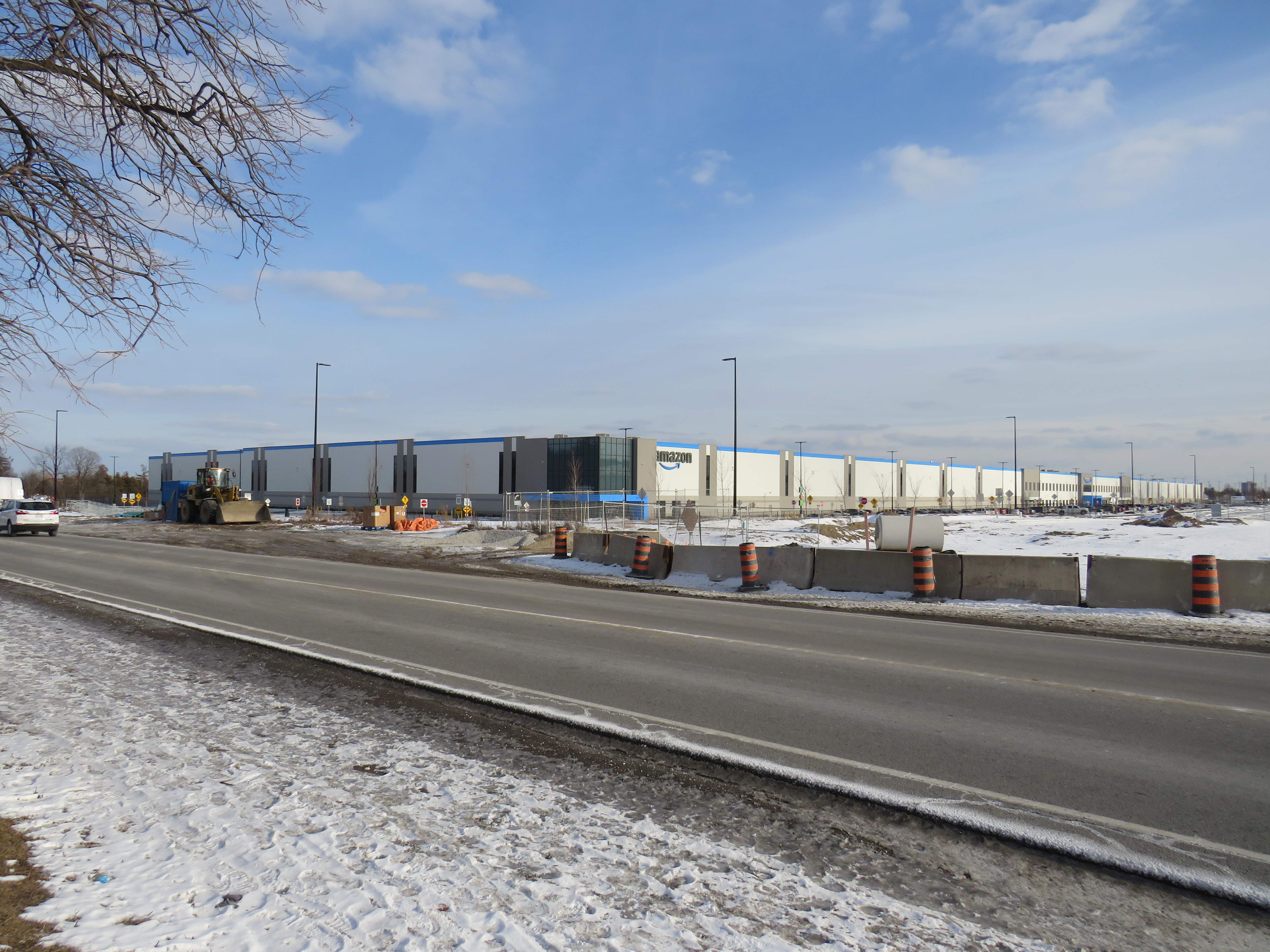
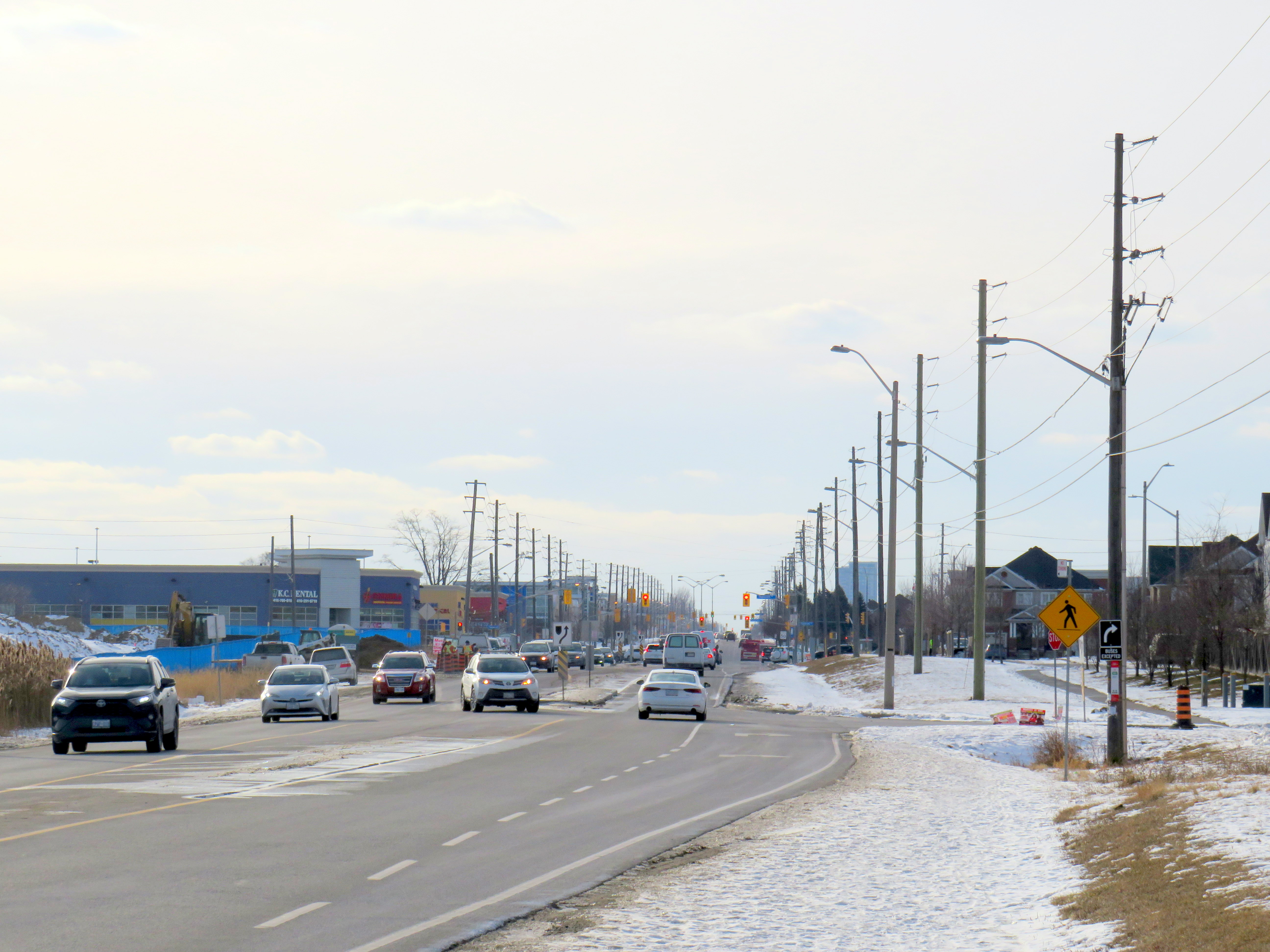
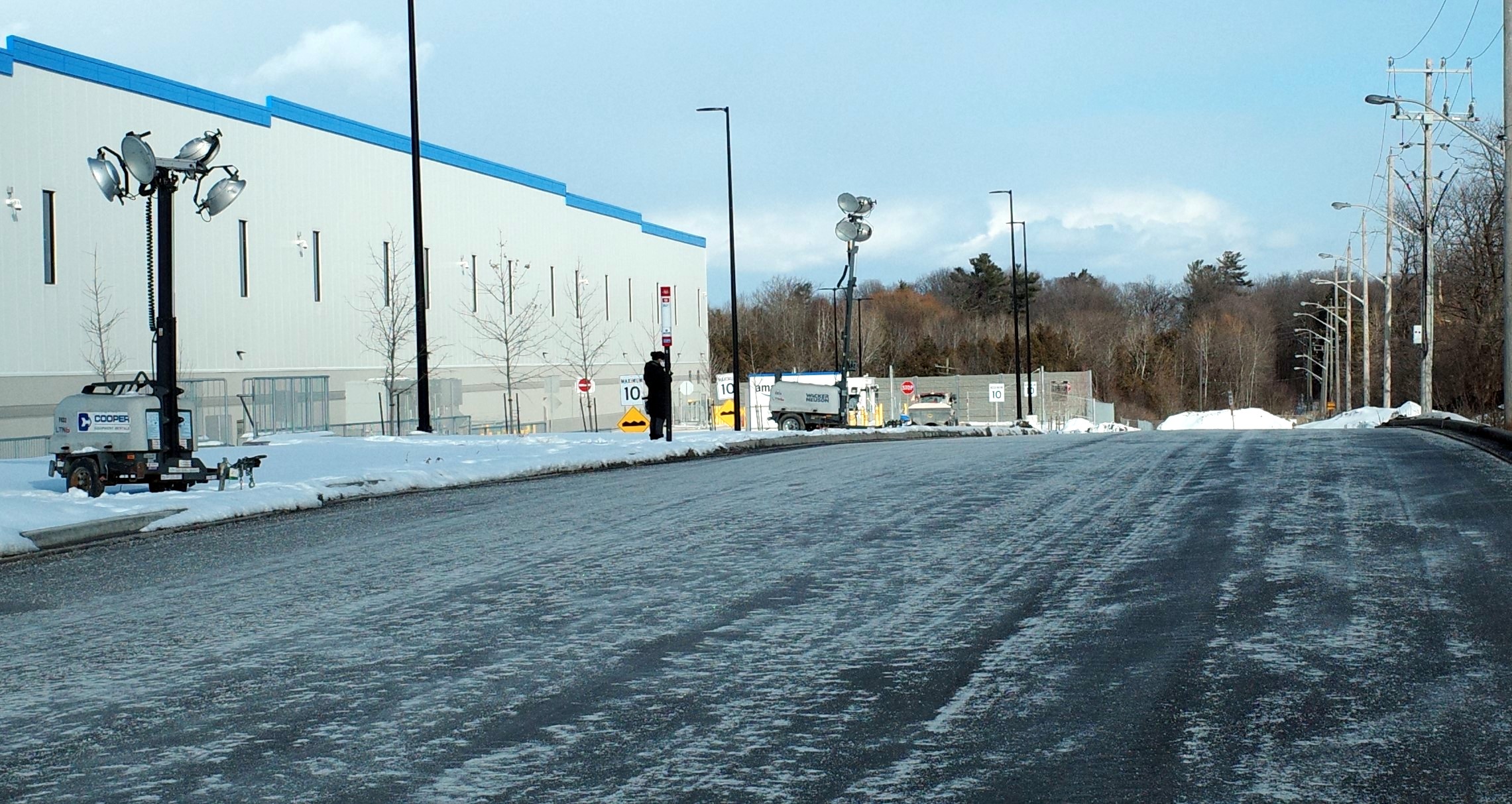
Like most new logistics facilities, the new Scarborough warehouse, like the other five GTA Amazon fulfillment centres, is in an industrial area on the city’s outskirts, where land is plentiful, but transit and pedestrian access is lacking. East of Tapscott Road, Steeles Avenue narrows from four lanes to two, and there are no designated pedestrian crossings at the intersection with Eastvale Drive. The eastbound TTC stop at Eastvale Avenue was removed in 2018 after a passenger was struck and killed trying to cross the street after disembarking from a 53 Steeles East bus. The next nearest stop, at Tapscott Road, is 300 metres west.
Steeles Avenue, looking west towards Eastvale Drive and the signalized intersection beyond, at Tapscott Road
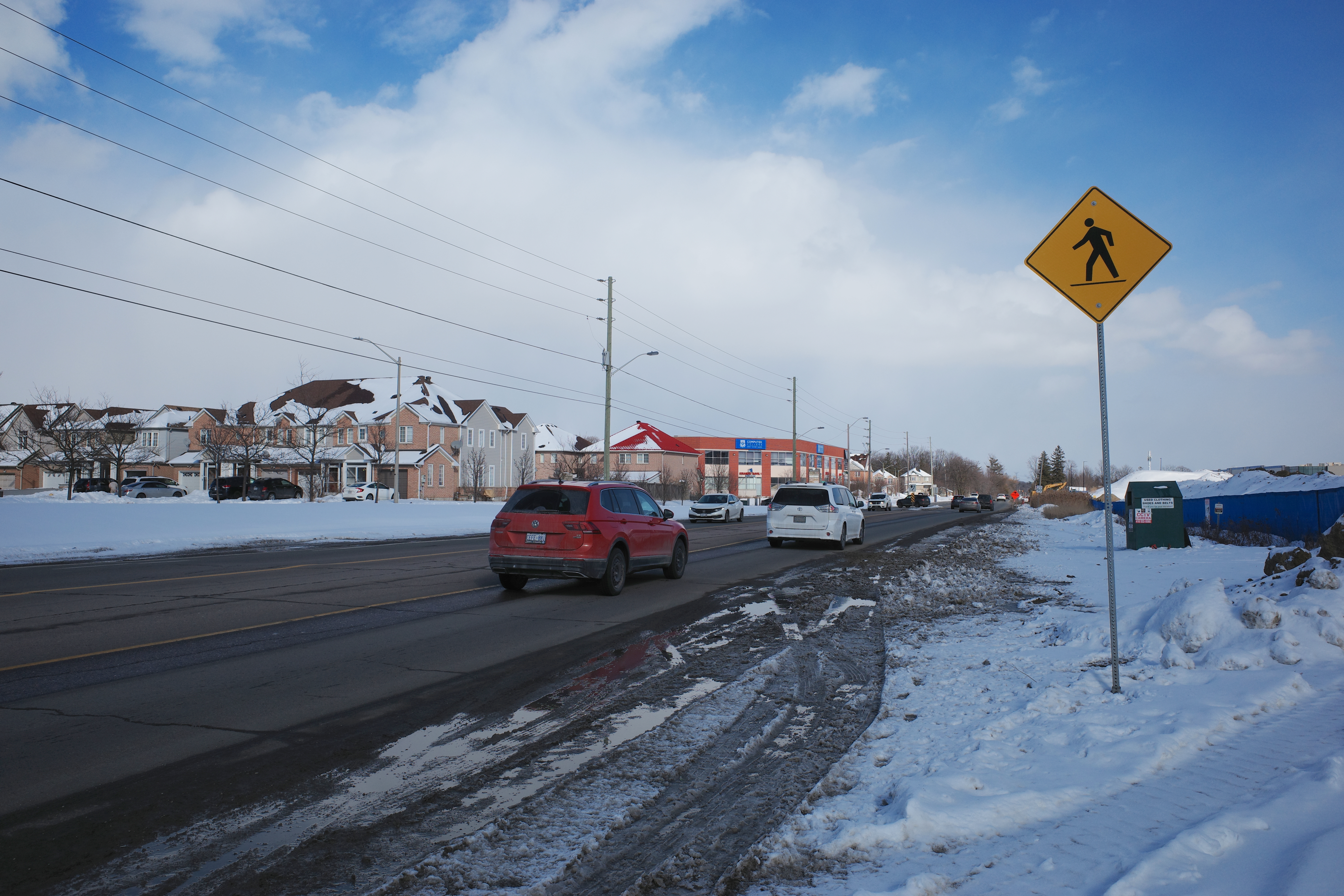
The sidewalk on the south side of Steeles Avenue ends at Tapscott, a few hundred metres west of the Amazon fulfilment centre. On the north side, the sidewalk ends at Ferncliffe Crescent in Markham. Despite a new residential area in Morningside Heights, to the east, there is no sidewalk along Steeles to connect to it. Pedestrians heading to Amazon or towards Staines Road must choose whether to walk in the mud, or on the busy roadway. Though the posted speed limit is 50 km/h, motorists regularly travel at 60 km/h or faster.
Looking east on Steeles from Tapscott Road – despite the sign advising motorists of pedestrian activity, there are no sidewalks leading east towards the new Amazon fulfillment centre (Sonali Praharaj)
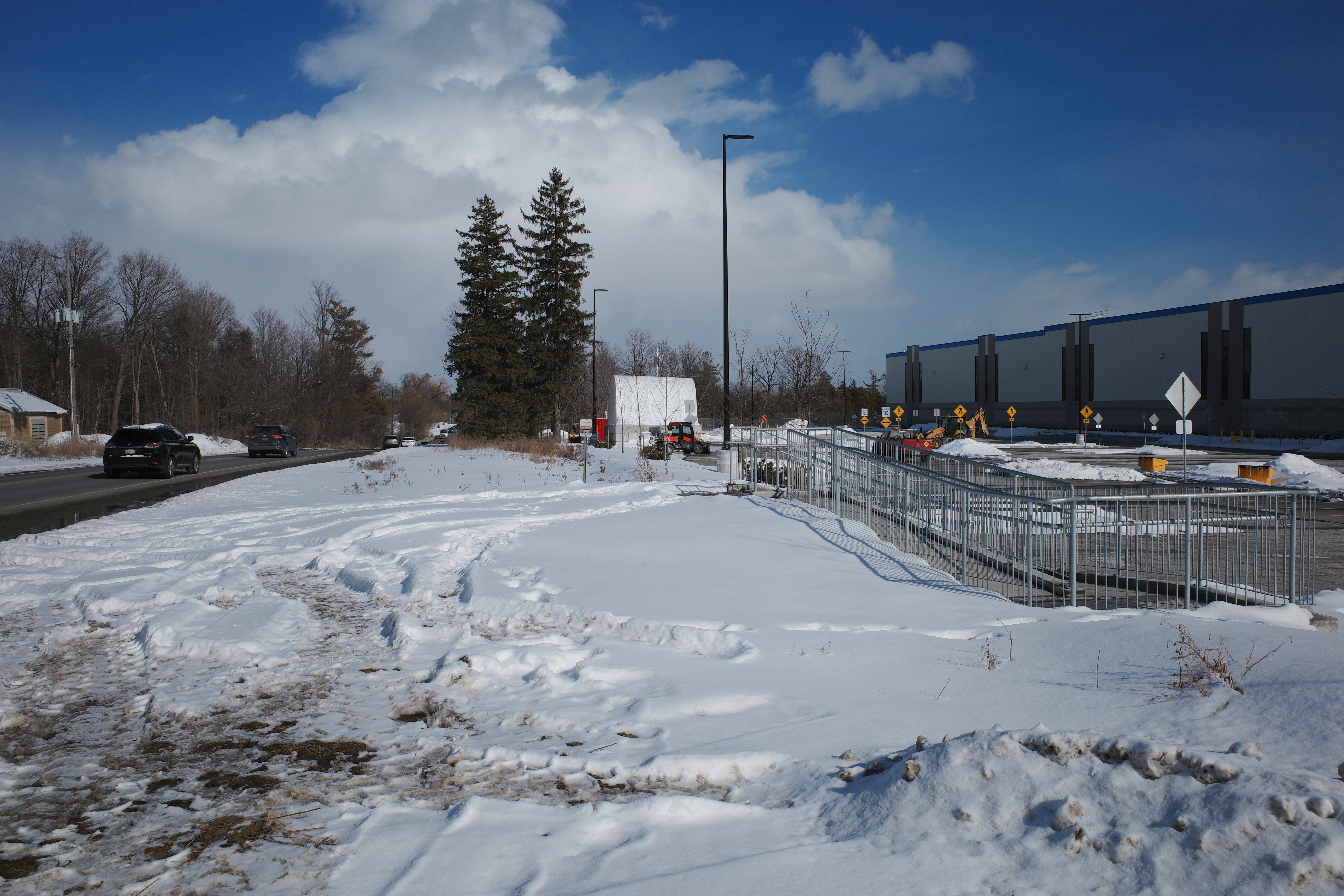
A stairway and ramp were built on the north end of the Amazon property, likely with the expectation that a sidewalk on the south side of Streeles Avenue would soon be installed. This would provide improved pedestrian access to the fulfillment centre. But without a safe and logical way to get to it from the street, it remains largely unused.
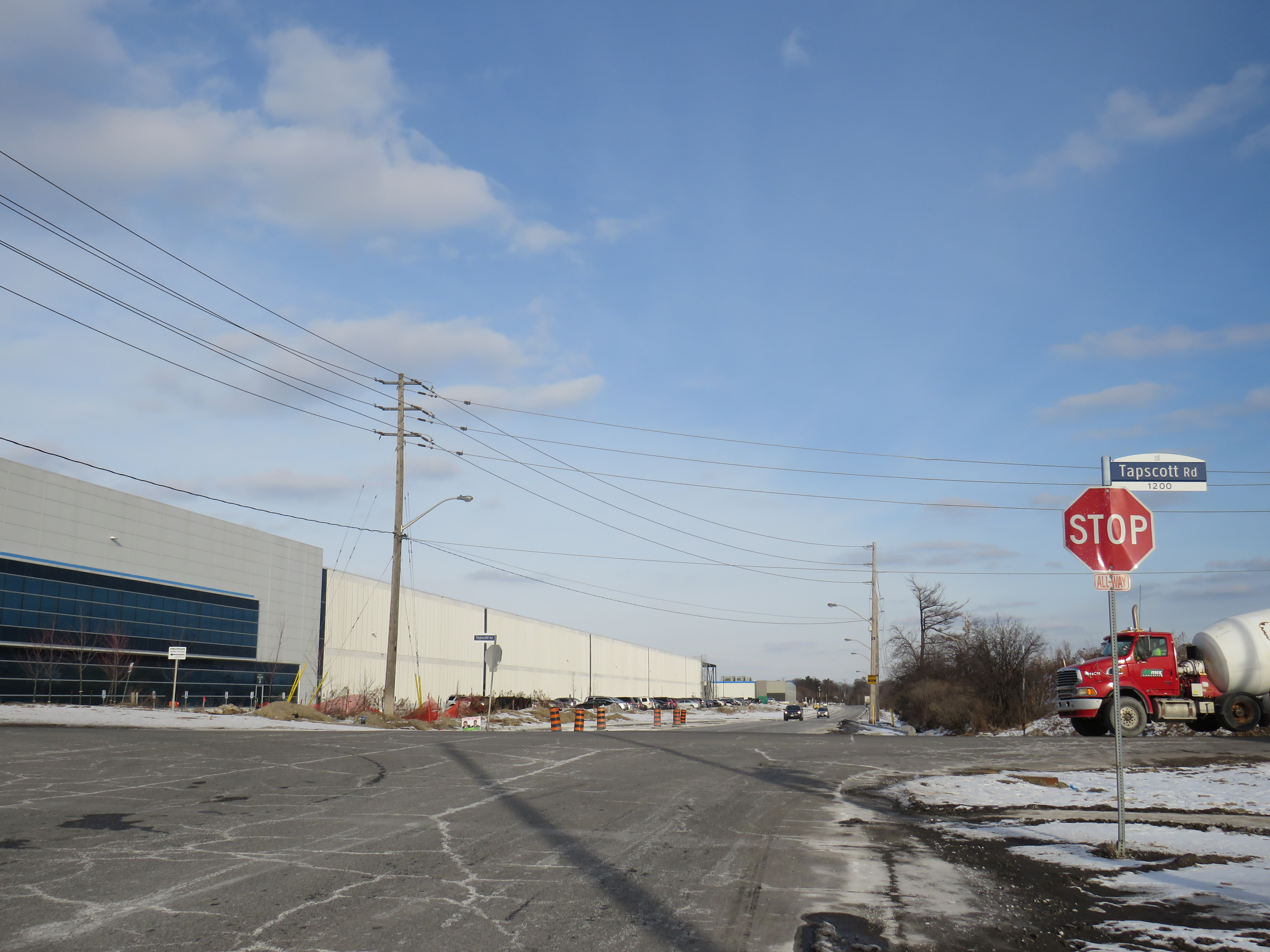
Passmore Avenue, on the south side of the fulfillment centre, was rebuilt with a sidewalk in the late fall of 2020, months after Amazon opened. However, it requires a lengthy walk north to Steeles Avenue up Tapscott, and there are no sidewalks on Tapscott from Passmore south, towards McNicoll Avenue. The intersection of Passmore and Tapscott itself – controlled by an all-way stop – still does not feature proper crosswalks.
Looking east on Steeles from Tapscott Road – despite the sign advising motorists of pedestrian activity, there are no sidewalks leading east towards the new Amazon fulfillment centre (Sonali Praharaj)
Though there are two TTC bus routes that operate to the corner of Tapscott Road and Passmore Avenue – 53B/953B Steeles East and 102B/C Markham Road – for months, workers had to walk on the roadway, through a construction site to access those buses. Anyone looking to go east, towards Morningside Heights, or southeast, towards Malvern, still face a long, dangerous walk or a lengthy bus commute.
The corner of Tapscott Road and Passmore Avenue
The TTC, starting January 11, 2021, began diverting the 53B Steeles East bus to directly serve the Amazon fulfillment centre, finally serving a major industrial trip generator and reducing essential workers’ travel times. Even still, the new sidewalk on Passmore ends at the warehouse entrance – anyone waiting for a bus must still walk and wait in the snow or mud.
Eventually, Steeles Avenue will be widened, with new sidewalks and bike lanes, and Morningside Avenue will be extended north to Steeles Avenue. However, these improvements have been planned for years and completion is still several years away. Though new warehouses have opened here, civic infrastructure has not caught up.
New TTC bus stop serving the Amazon Fulfillment Centre on Passmore Road (Sonali Praharaj)
The TTC’s service change, adding a new bus stop on Passmore Avenue, was a welcome – yet overdue – acknowledgement that essential workers, especially racialized and lower-paid workers, deserve better. It is inexcusable that new employment uses are planned, approved, and constructed before the appropriate pedestrian infrastructure and transit services are in place. It is also inexcusable that after a TTC customer was killed that a nearby bus stop was removed, rather than safety improvements added instead. This is not just a matter of ensuring a basic level of safety for pedestrians – this is a matter of justice for those we consider essential workers.
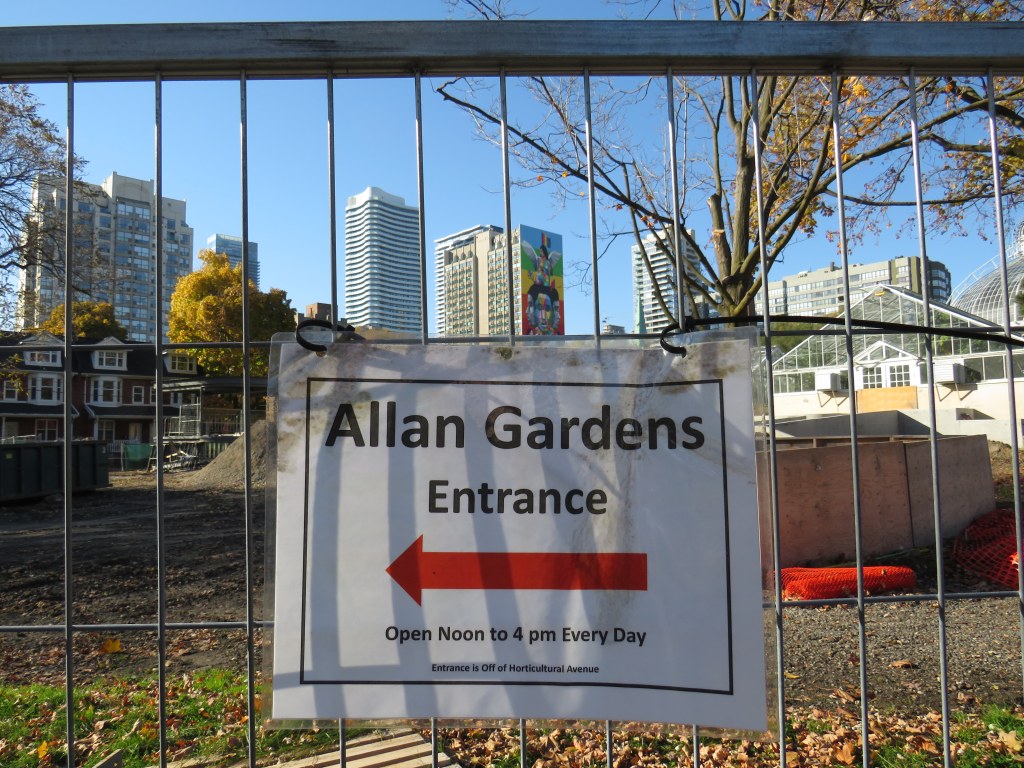
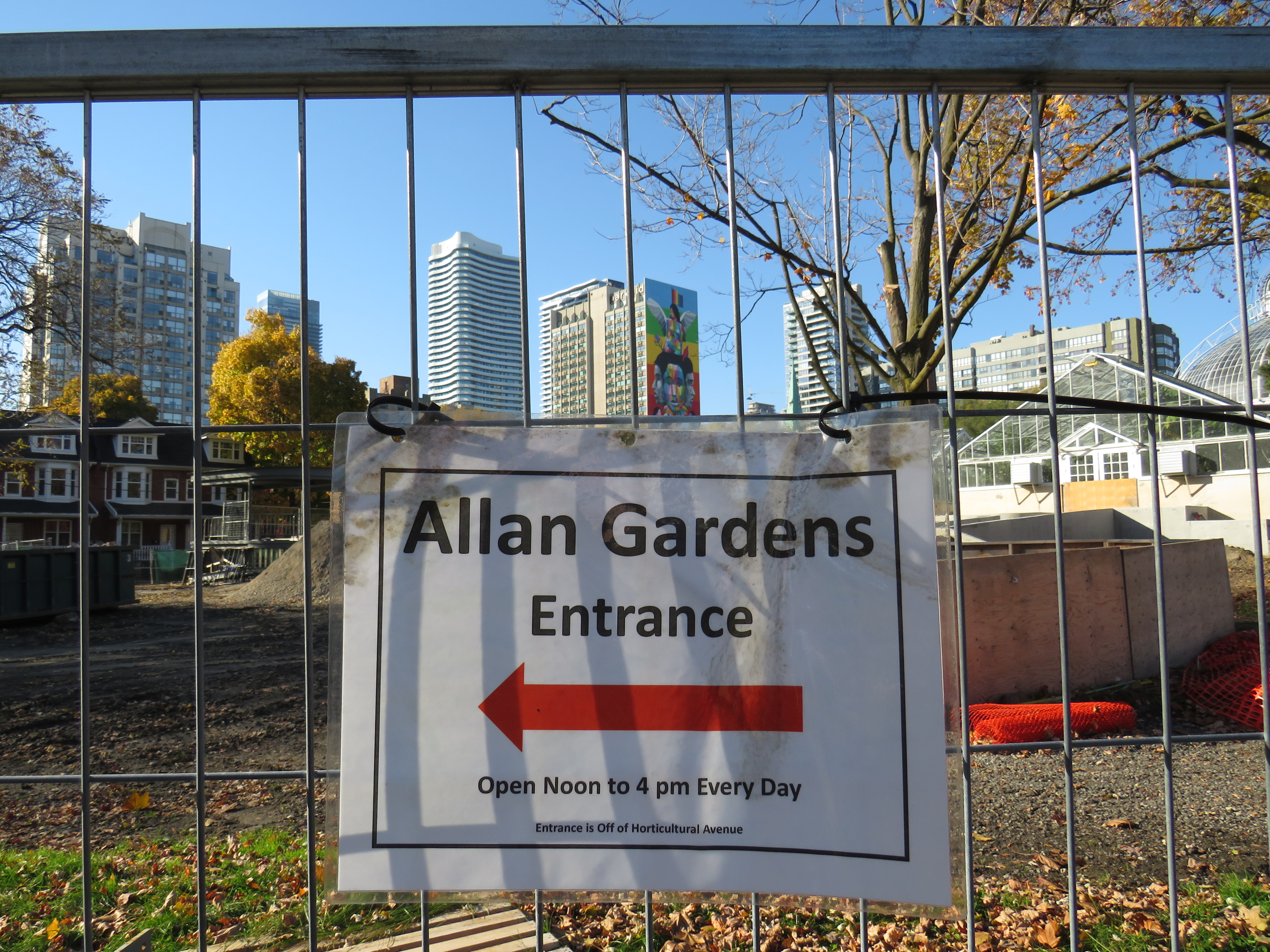
On November 4, signage scattered around Allan Gardens leads visitors to locked doors
The ongoing pandemic, to quote the prime minister, “really sucks.” Ontario has been subjected to various levels of lockdowns and restrictions for nearly eight months now as COVID-19 case counts continue to be high. Restaurants, bars, cinemas, and gyms are currently closed in Toronto, as are most other indoor venues. Many of us are — if we’re lucky — working from home, but shut off from meaningful socializing from family, friends, colleagues, and allies. Many are left unemployed with few job openings out there. Those still working in factories, warehouses, public institutions, kitchens, and stores face increased pressures without many of their supports.
That leaves only a few outlets for selfcare: the support of immediate family, outdoor exercise, and passive entertainment such as streaming shows and movies online. Though I am working on several interesting projects here at home, I can attest that Zoom calls, Facebook chats, and occasional phone-calls are no substitute for in-person social interaction. Regular walks have been essential to my mental health, which has suffered during the pandemic. With so much construction in my neighbourhood, there has been one nearby oasis: the conservatory at Allan Gardens.
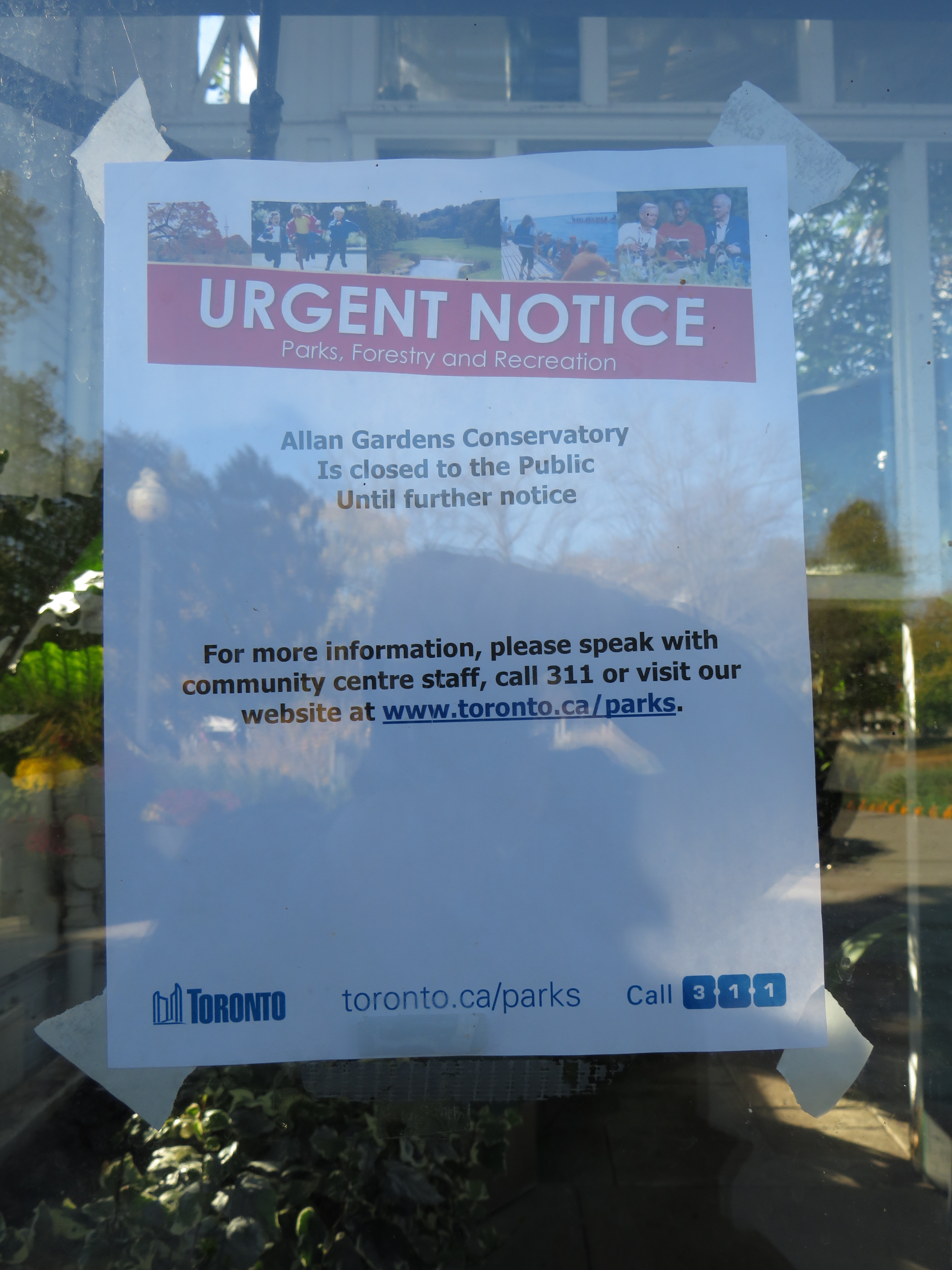
Sadly, that’s no longer an option, and I found that out the hard way. Though it is a minor complaint given the much larger failure to control the virus here in Ontario and properly communicate important public health information and advice, it’s just a microcosm of the mixed messaging from all levels of government that we have been enduring since February.
“Urgent notice” – anyone who continues past the signs directing visitors to the designated entrance to the Allan Gardens Conservatory is greeted with this notice indicating that the building is closed until further notice(more…)
Over the past few years, I have been involved with the YongeTOmorrow project on behalf of Walk Toronto. It has been a very interesting and worthwhile experience being part of a stakeholder advisory group. Allied organizations working towards a more exciting and sustainable Yonge Street include Cycle Toronto, 8 80 Cities, and the David Suzuki Foundation.
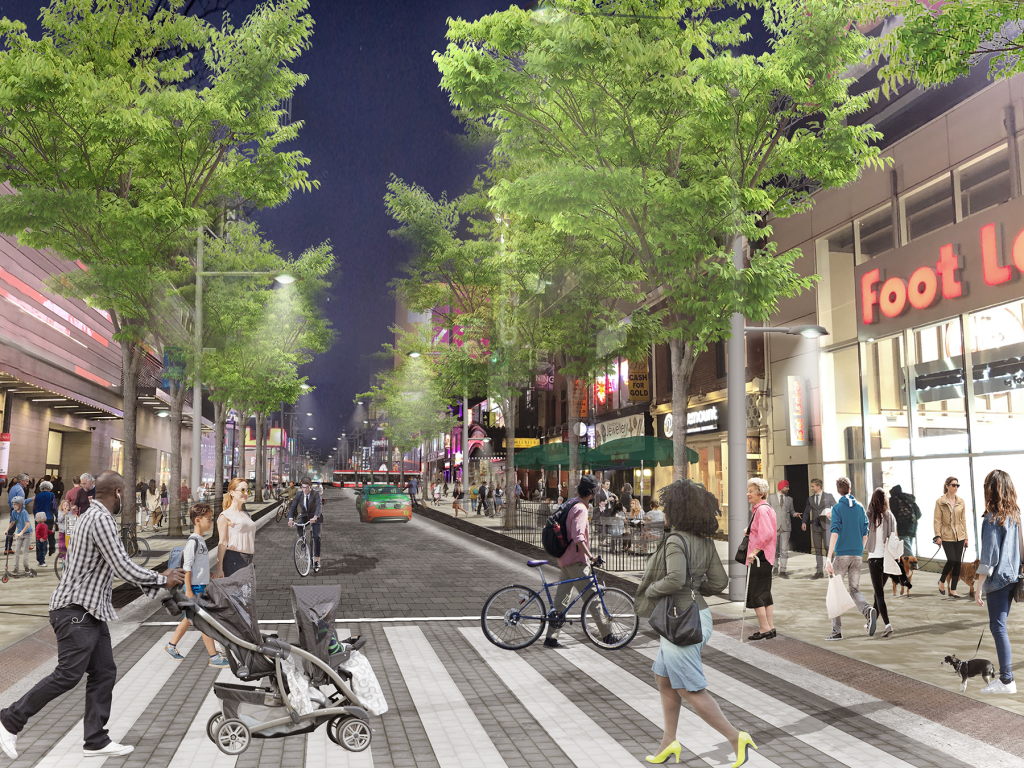
Rendering of proposed changes to Yonge Street , looking north towards Dundas Square. In this section, northbound traffic is permitted, with two-way cycling, and much wider sidewalks, along with new trees and improved street furniture.
Though the selected concept is not perfect, the proposed changes will provide significant improvements to Yonge Street between Queen and College Streets. These include wider sidewalks, patio space, bike facilities, and a pedestrianized zone between Dundas Square and Edward Street, allowing for better circulation, more flexibility for special events, and a more pleasant street.
With more high-rise development on the way (including the redevelopment of the Chelsea Hotel on Gerrard Street), it is only right that more space be given to residents, students, employees, and visitors. Compromises in the plan allow for access to parking garages, permit taxi and other vehicle drop-offs and pick-ups, as well as business deliveries.
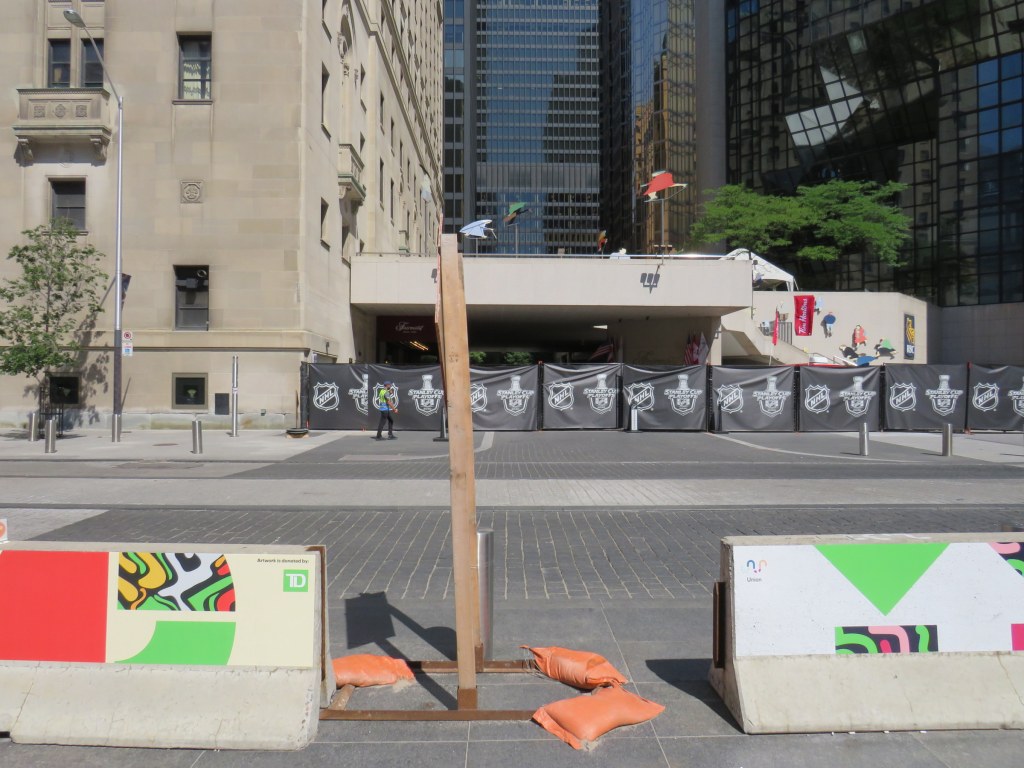
Over two years later, concrete Jersey barriers continue to disrupt pedestrians in front of Union Station
A year ago, I wrote about the unsightly Jersey barriers that were plopped down in front of Toronto’s Union Station in April 2018, creating bottlenecks at two of Toronto’s busiest pedestrian intersections. Though the city promised improvements in 2018and in 2019, the only changes were the application of decals to the existing Jersey barriers.
Though the front of Union Station looks slightly better, and the bottlenecks have been lessened by the ongoing COVID-19 pandemic, this is not a satisfactory solution, especially for Toronto’s busiest and most important transportation hub.
The Jersey barriers were hastily plopped down on Front Street after the April 23, 2018 van attack, where one man steered a rented cargo van onto busy sidewalks in North York, killing 10 and injuring 16 more before he was apprehended by police. As an iconic and crowded pedestrian area, it was felt that special protection was necessary. At the time, the assumption was that the van attack was an act of terrorism, requiring such drastic measures. (It was soon found the motives were not terrorist related.)
In 2018, city councillor John Campbell likened the front of Union Station to “a war zone” while a city spokesperson said that a broader security plan was “in the works,” including for protecting the station has been in the works for some time, including interim measures that would fit into the streetscape.
In March 2019, nearly a year after Jersey barriers were added, the Toronto Star’s Jack Lakey dismissed complaints about their awkwardness and appearance, calling them “effective in stopping a driver bent on another deadly attack.” However, Lakey noted that another city spokesperson said that “city is finalizing the design of permanent vehicle barriers around Union Station”, that would “be smaller, more aesthetically pleasing and easier to navigate for pedestrians.” Those barriers would be installed later in 2019.
Afternoon rush hour crowds navigate around the Jersey barriers at Front and Bay Streets, August 2019
It is now August 2020, and the concrete barriers are still there, creating a mess for anyone using a wheeled mobility device, or for anyone in a hurry.
Bay and Front Streets, August 2020
The only thing that has changed are new artistic vinyl stickers covering the bare concrete, with messages saying that “artwork is donated by TD [Bank].”
TD is the “premier sponsor and exclusive financial services partner” of Union Station, most of which is owned and operated by the City of Toronto. (Some sections used by GO Transit are owned by Metrolinx.) TD enjoys exclusive branding rights, ATM locations, and sponsors Union Station’s wifi and charging stations.
“Artwork is donated by TD”
Perhaps TD was embarrassed by the Jersey barriers (after all, it has its headquarters just up Bay Street). Or perhaps the city decided that something needed to happen here., after two years of unfilled promises.
While examining the barriers, I noticed construction signage wedged within the gaps, creating a trip hazard. I also saw the original metal bollards installed when Front Street was rebuilt for a more pedestrian-friendly streetscape in 2014-2015.
Construction signage creates a trip hazard in the gaps between Jersey barriers. Note the original metal bollard behind.
Though the inconvenience caused by the lingering “temporary” concrete barriers has been lessened as there are fewer pedestrians entering and leaving Union Station right now, it also makes it a good time to finally make the necessary renovations by installing permanent sturdy bollards.
Kingston Road is one of Toronto’s oldest and most important thoroughfares. Sections of the road were first laid out by Asa Danforth in 1799, though a straighter, more direct route was established by the early 1800s. By the 1830s, it was a busy stagecoach route, connecting Toronto with Cobourg, Belleville, and Kingston.
As Toronto grew into a major city, Kingston Road was an obvious route for a radial railway line serving Scarborough Township; by 1906, radial cars extended as far east as West Hill, near Morningside Avenue. The radial line’s stops were numbered from the beginning of the line, first at Queen Street and Kingston Road, then at Kingston and Victoria Park Avenue after the TTC took over city operations.
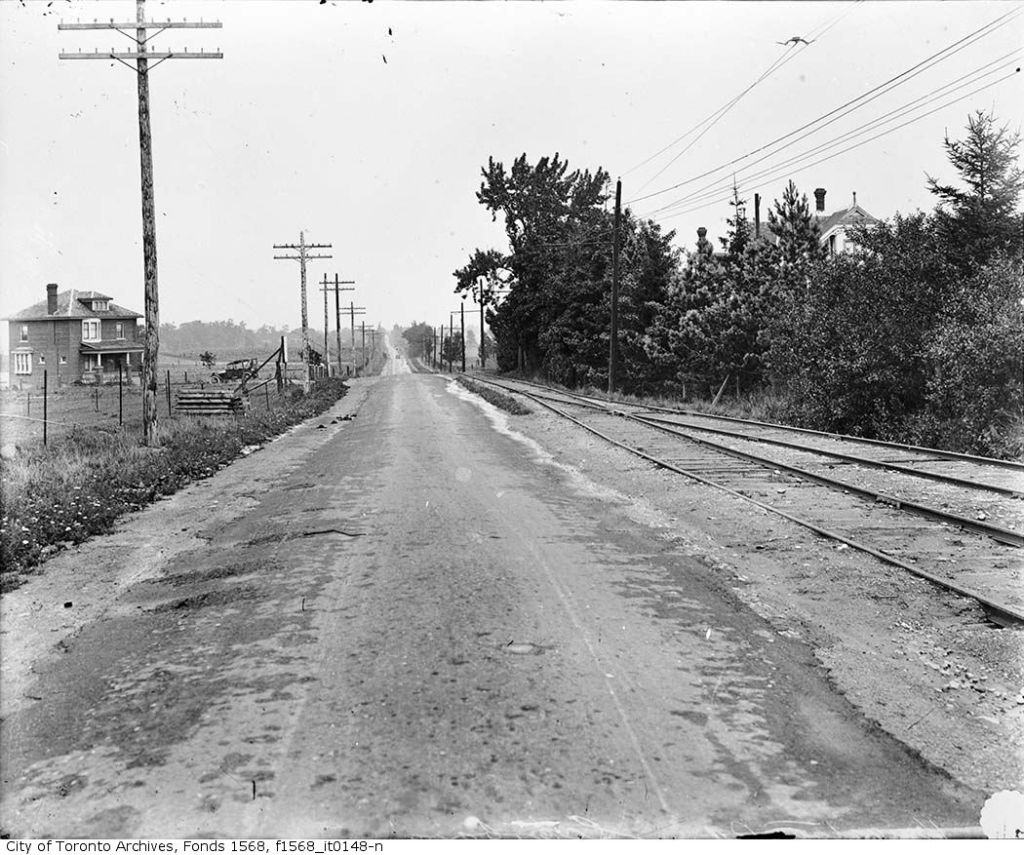
Kingston Road, east of Bellamy Road, 1918: a rural scene. This siding, Mason’s Switch, was Stop 22. The house on the far left of the photograph still stands at the corner of Kingston and Mason Roads. From Toronto Archives, Fonds 1568, Item 148.
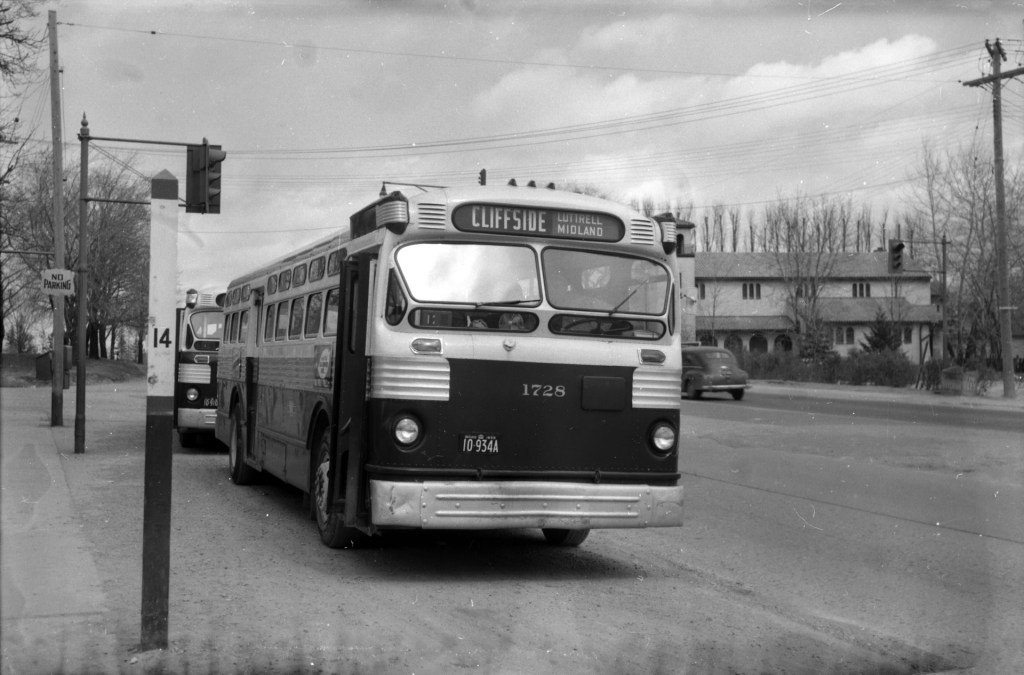
Stop 0 was at the city limits at Victoria Park (with connections to TTC streetcars). Stop 14 was Halfway House at Midland Avenue. Stop 26 was the Scarborough Post Office, near today’s Scarborough Golf Club Road, and Stop 35 was the end of the line, at West Hill.
With increasing automobile ownership and new intercity bus lines in the 1920s, Kingston Road was busier than ever, becoming part of the new provincial highway system, but ridership on the radials declined, especially after the TTC extended city streetcars east to Birchmount Avenue in 1928, leaving behind a mostly-rural service. Radial service was cut back to Stop 26 in 1931, and completely replaced by buses in 1936 (the 86 Scarborough bus route is the modern legacy).
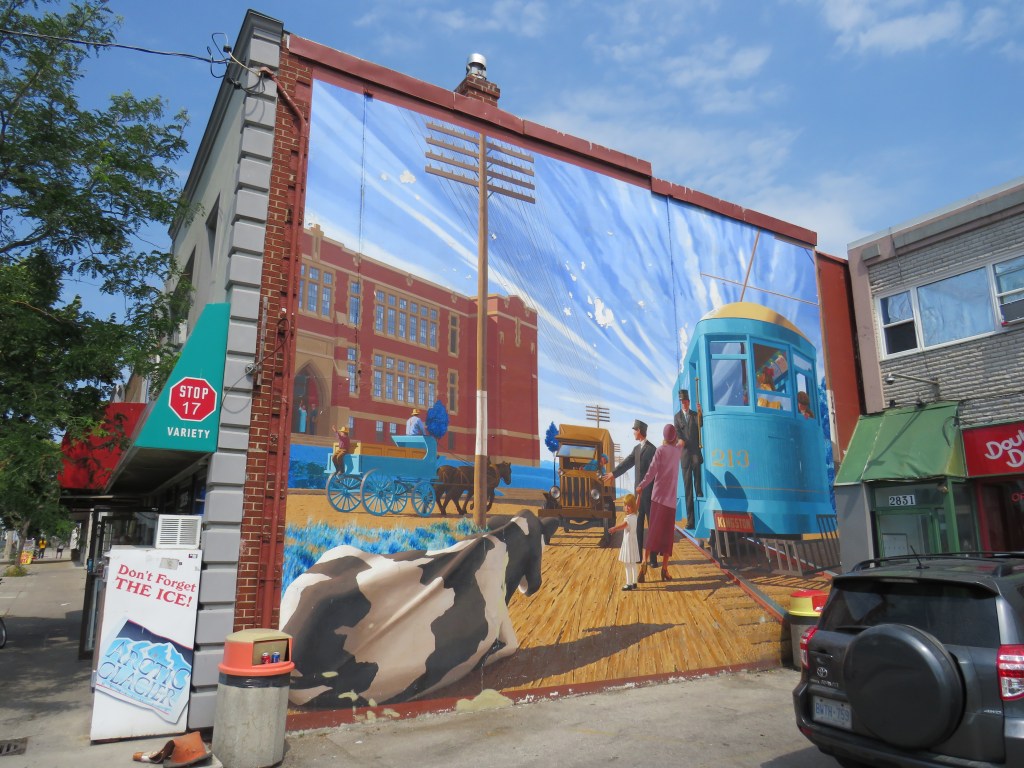
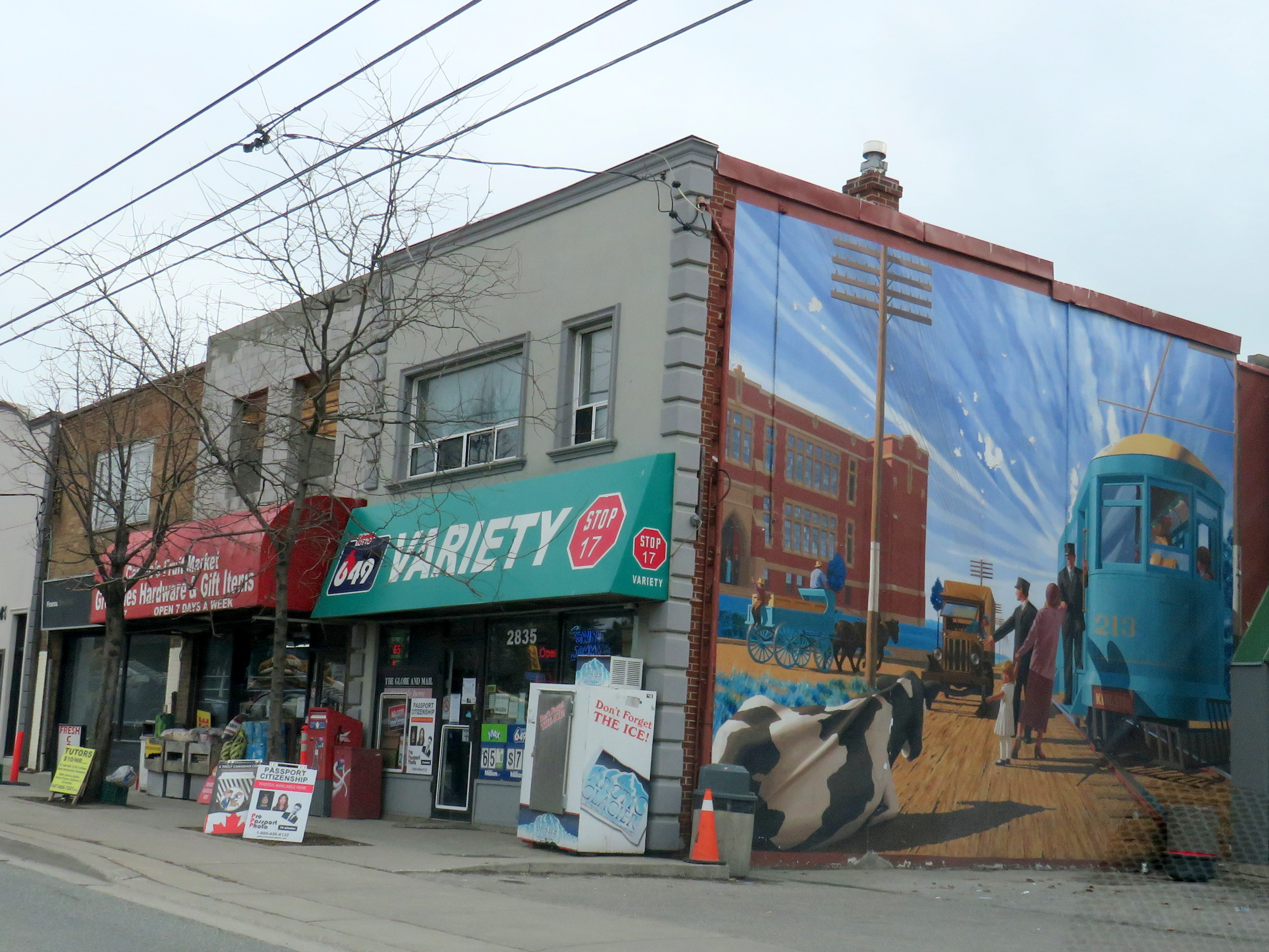
Despite the switch to buses, the stop numbers carried on for many years, listed in TTC timetables through the 1950s. Locals would often refer to stop numbers instead of street intersections. Stop 17, at Kingston Road and St. Clair Avenue East, is one example that has lingered on. A mural on the side of Stop 17 variety depicts a green radial car in front of the Scarborough High School), with a cow blocking the way of a truck looking to pass.
Mural at Stop 17 Variety
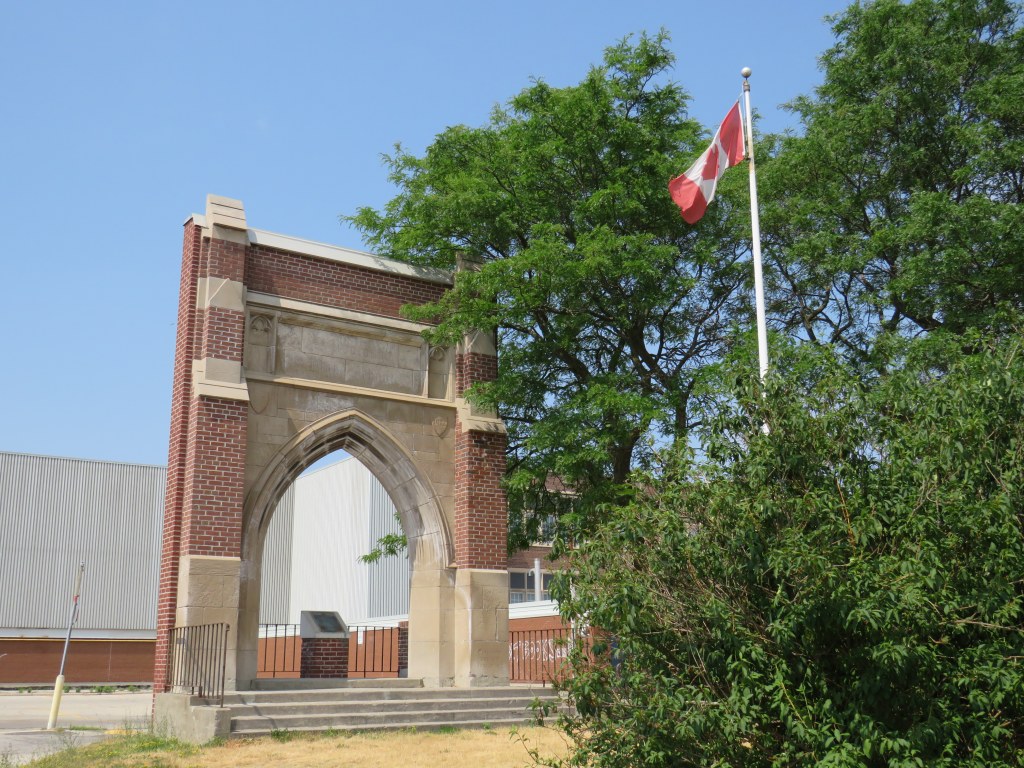
Scarborough High School, on the opposite corner of the variety store, was built in 1922, expanded several times, and later renamed R. H. King Academy. The original building was torn down in 1976, but the entrance way, depicted in the mural, was retained.
Arched entrance way to the demolished original section of Scarborough High School
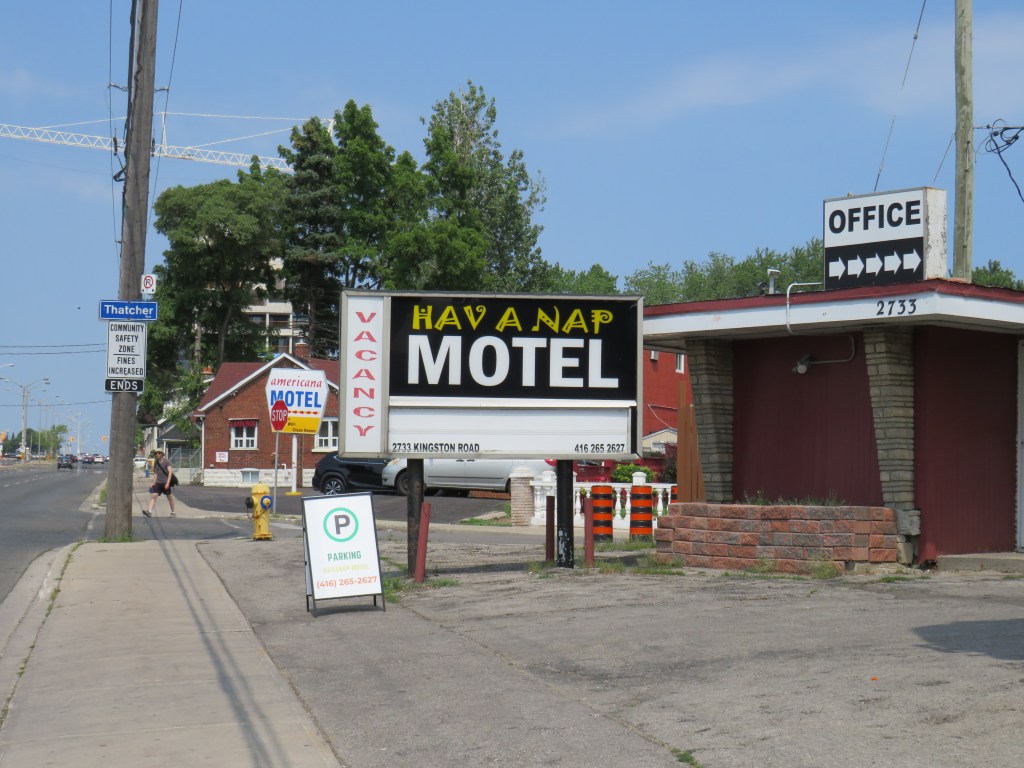
Nearby, towards Brimley Road, several older motels date from the motoring era, when Highway 2 was the main route into the city. Though Highway 401 drew some of the traffic away in the 1950s, it wasn’t until the completion of the Don Valley Parkway (which provided a direct route downtown) and the rise of chain hotels saw a decline in independent motels along Kingston Road and Lake Shore Boulevard. Some have been repurposed as shelters, while others, like the Hav-A-Nap, diversified by offering paid parking for nearby Bluffers Park.
Hav-a-Nap Motel, with the Americana Hotel just behind