Tag: Transit

  • Dispatches from Durham Region, and Kingston Road tokenism

    Two weeks ago, I was out exploring Durham Region, the eastern end of the Greater Toronto Area. While south Durham Region is mostly made up of generic suburban sprawl, there are some interesting historic villages and new urbanist neighbourhoods. North of Highway 7, Durham Region is still mostly rural, though plans for a new airport in North Pickering may change that.

    Sadly, Durham Region remains auto-centric in its outlook, even more so than other suburbs to the north and west of Toronto. The provincial government is constructing an eastern extension of Highway 407, with two new connecting highways to Highway 401 either nearly complete, or proposed. Oshawa, the largest city in Durham, is the birthplace of General Motors Canada, but while the auto industry declines, the city has been continuing to make many civic planning mistakes. And in Ajax, a small symbol of change – new bus and bicycle lanes – is still merely a token effort.

    (more…)

  • GO Transit plans to raise fares in 2016. How about a better fare system?

    Note: Updated in February 2016 due to a conflicting chart.

    At Thursday’s Metrolinx Board Meeting, the Board of Directors will be voting on a GO Transit fare increase effective February 1, 2016. As has become common, Greg Percy, the President of GO Transit, will be recommending a tiered fare increase, and we should expect that the Metrolinx Board will rubber stamp this proposed fare hike, as it usually does.

    Recently, I wrote about the many problems with GO Transit’s fare structure. It penalizes short trips, it does not allow for any fare integration with the Toronto Transit Commission, and many trip pairs (particularly the Barrie, Richmond Hill, and Stouffville Corridors) are priced lower than they should be compared to other stations. In another post, I suggested that GO Transit should seriously consider charging for parking at its lots, as constructing and maintaining parking lots is a major expense that all GO Transit users are paying for, whether they use them or not.

    I was somewhat surprised to see that the fare increase will not apply to short trips, those currently costing between $5.30 (the lowest fare possible) and $5.69. This would freeze the one-way ticket price for trips such as between Danforth, Union, and Exhibition Stations. With a slight increase in the “loyalty discount” offered tot Presto Card users when they pay a GO fare,  from 10% to 11.15%, this results in a very slight fare decrease for short trips.

    You can read the GO Transit report recommending a fare increase here.

    (more…)

  • Not so fair-by-distance: GO Transit’s problematic fare system

    Not so fair-by-distance: GO Transit’s problematic fare system

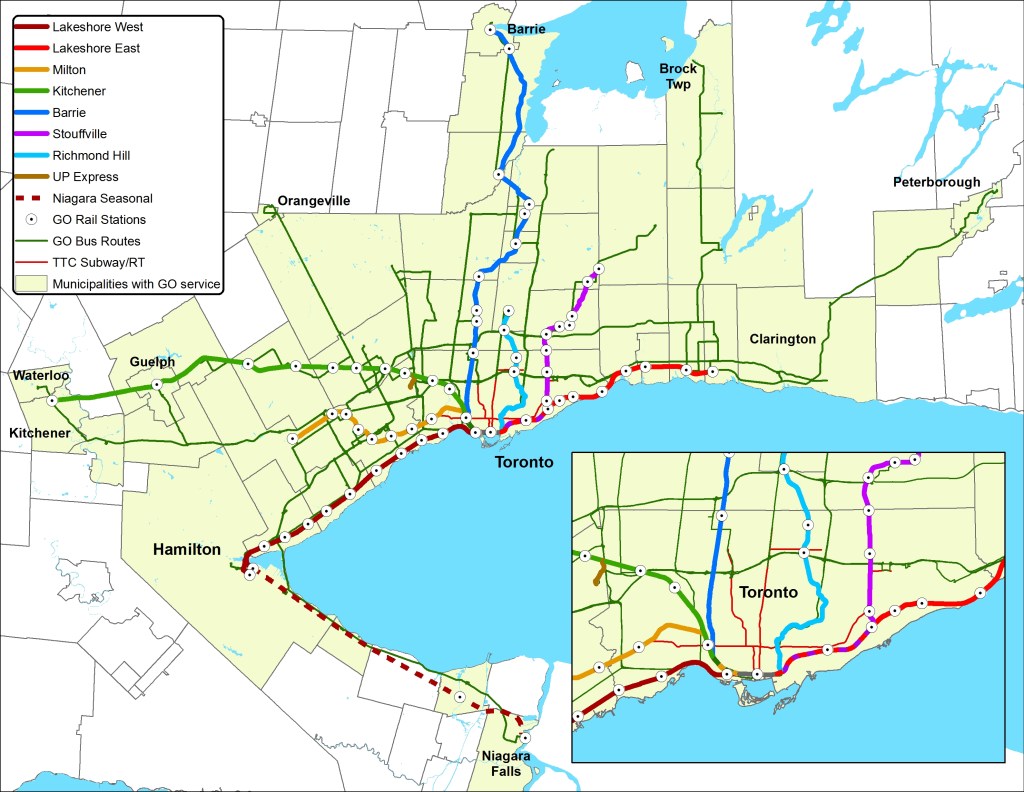
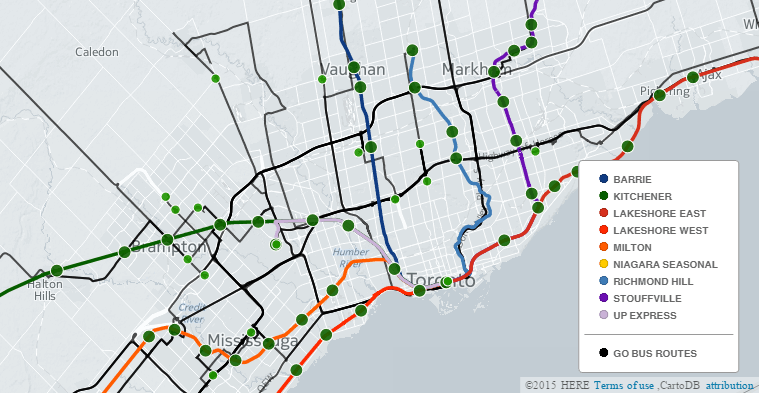
    GO Network 2015GO’s bus and rail system serves 39 municipalities and reaches points over 130 kilometres from Union Station

    In 1967, GO Transit started out as a simple commuter service from Oakville to Pickering (with two additional trains to and from Hamilton). In 1970, it started its first bus service, connecting Oshawa and Hamilton to the hourly train service at Pickering and Oakville. Eventually, GO expanded to other corridors, inaugurating the Georgetown service in 1974, and taking over former suburban Grey Coach and TTC routes in the 1970s. By 1981, GO was operating trains on all seven of its current corridors, expanding and extending its bus rail services ever since. As a commuter rail and bus system, GO Transit is a great success story, there were over 68 million boardings in 2014, and service continues to expand. Regular bus service goes all the way to Niagara Falls, Peterborough, and Waterloo, serving post-secondary institutions and long-distance commuters. But there are many ways in which it can improve; its fare structure is just one of them.

    Previously, I explained why GO Transit should consider charging for parking at its commuter lots. GO Transit provides over 60,000 free parking spaces, but the cost of servicing those lots is borne by all passengers, whether or not they drive to the train or not. This isn’t terribly fair to those customers who arrive by foot, by bicycle, or are able to get a ride. In the suburbs outside the City of Toronto, most transit agencies offer a co-fare – a discounted fare for taking local buses to connect to and from GO Transit, but no such fare integration exists with the TTC. But the parking subsidy enjoyed by drivers is only part of the unfair pricing scheme levied by GO Transit.

    GO Transit describes its fare scheme as “fare by distance.” And to a degree, this is accurate. Generally, the farther one travels, the more expensive the fare. So far, so good. But fares for short trips cost far more than longer ones per kilometre traveled, and fare increases for short trips have risen at a greater percentage rate than fare hikes for long trips.

    Steve Munro wrote about the myth of GO’s fare-by-distance scheme last year. As Munro put it, “the fare structure is rigged against short distance trips, and this has been getting progressively worse for a decade.”

    If GO Transit wishes to fully become a regional transit service, it needs to address both its unfair fare scheme and its lack of fare integration with the TTC.

    go_rail_and_bus_network,_2015_by_seanmarshall1_11_18_2015_02_29_09

    I created a map of the full GO transit bus and rail system in CartoDB to illustrate GO Transit’s reach; all stations and major bus stops include some fare information (the distance and cash fare to Union Station) and the number of parking spots. 

    (more…)

  • GO Transit and the high cost of “free” parking

    IMG_0878

    This is the first of a series on regional transit in the Greater Toronto and Hamilton Area

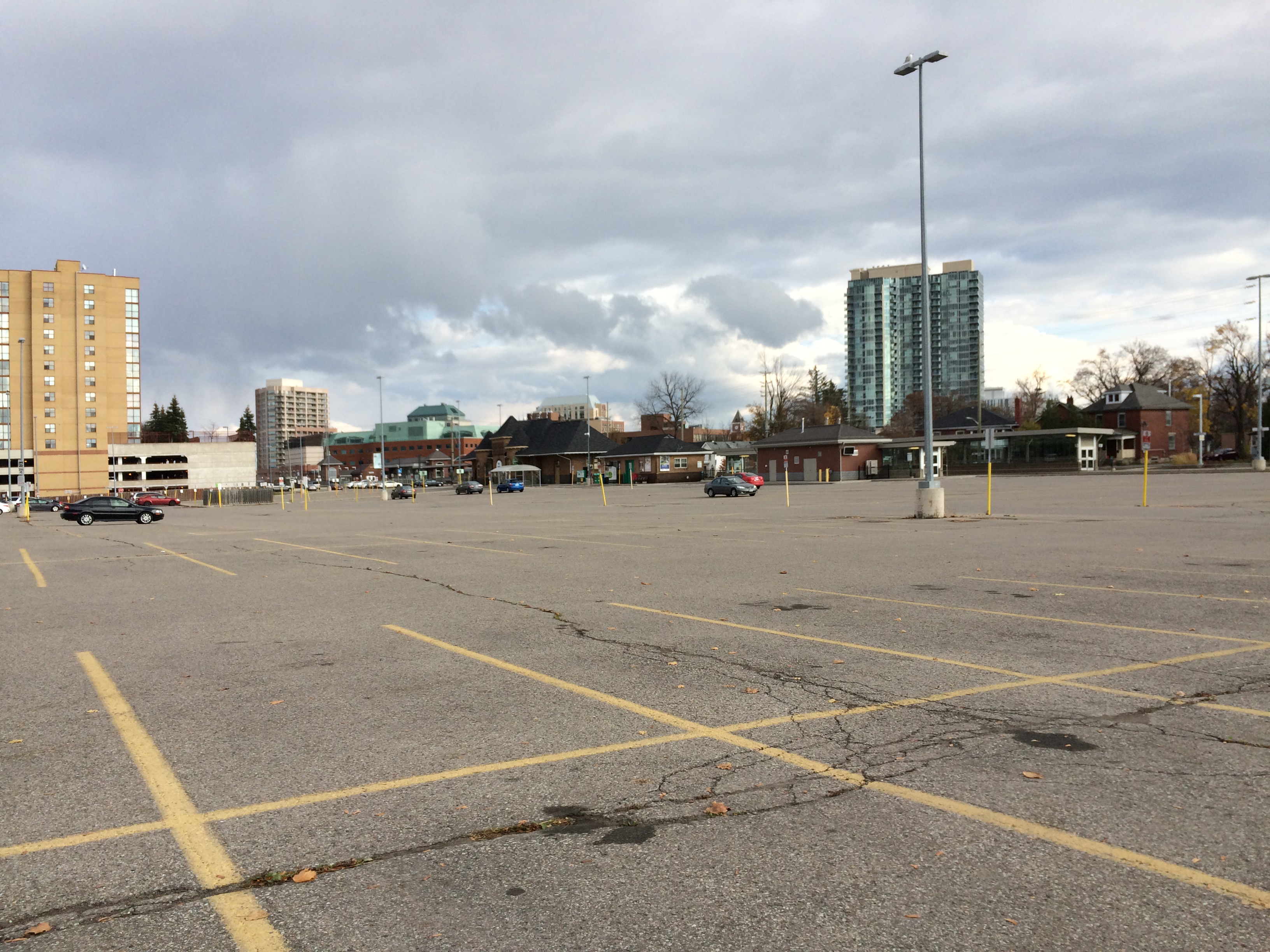
    This may or may not come as a surprise to readers of my site, but the largest parking lot provider in Ontario isn’t the Toronto Parking Authority, nor is it a major real estate developer like Oxford (owner of Yorkdale and Square One malls) or Cadillac Fairview (Eaton Centre, Sherway Gardens). That record belongs to a public transit agency.

    Metrolinx, the regional transportation authority for the Greater Toronto and Hamilton Area (GTHA), owns or leases 63,302 spots at 53 of its 64 GO Transit rail stations (not counting two stations served by seasonal Niagara trains), and offers another 4,186 spots at various park-and-ride and carpool lots served by GO buses. (Metrolinx is responsible for approximately 1,000 spots, the Ministry of Transportation Ontario and local municipalities are responsible for the remaining 3,000 spots).

    Pickering GO Station, adjacent to Highway 401, has the most parking spots in the system, with 3,600 spaces in several lots and in a new parking garage. Clarkson comes in second with over 3,000 spaces. Acton, which sees only two trains a day to Toronto, has only 50 spaces. Eleven GO rail stations do not have any on-site parking: Union Station, Hamilton GO Centre, Hamilton West Harbour, Kipling, Exhibition, Bloor, Danforth, Kennedy, York University, Guelph, and Kitchener. With the exception of York University, all are either in urban downtowns (Toronto, Hamilton, Guelph, Kitchener), or are connections to the TTC.

    All GO Transit parking spots are “free,” with the exception of reserved spaces that can be leased for $94/month at most rail stations and the Newmarket bus terminal. Reserved spaces are beneficial for regular passengers to guarantee a preferred spot on weekdays. This is in contrast to the Toronto Transit Commission (TTC), which charges $2 to $7 to park at any of its lots on weekdays, though there are no parking charges on weekends and holidays at most of its lots and garages.

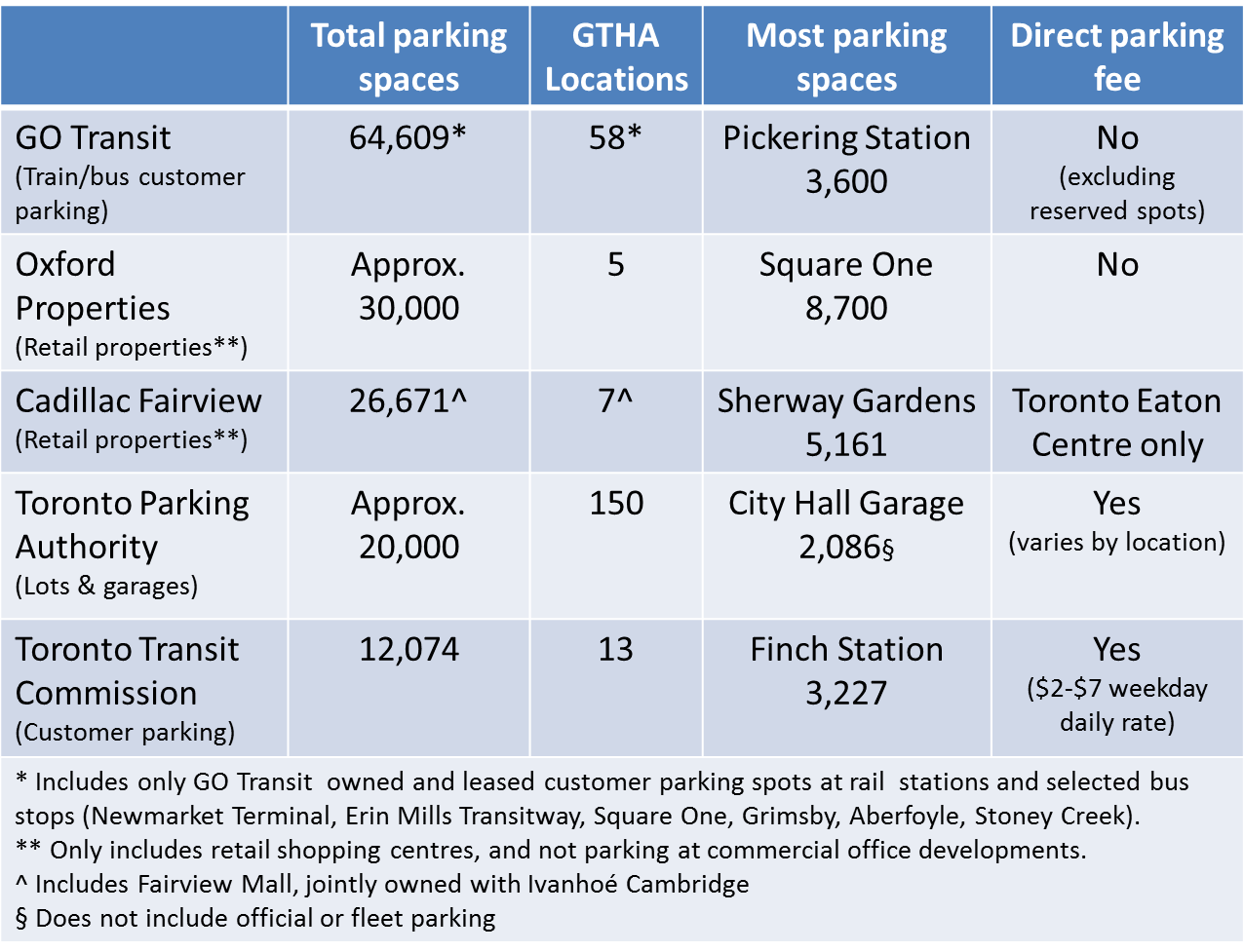
    The Toronto Parking Authority, the largest municipal parking operator in North America, operates 20,000 off-street parking spots in lots and garages across the City of Toronto. (The TPA is also responsible for 17,500 metered on-street spots.) Oxford Properties Group owns approximately 30,000 spots at five GTHA malls (Square One is the largest, with 8,700 spots), while Cadillac Fairview owns 26,671 spots at 7 GTHA malls. The TTC has parking facilities at 13 stations; Finch, with 3,227 spots, is the TTC’s largest, though Finch Station’s parking lots are within a hydro field.

    The table below illustrates this comparison.

    The GTHA’s largest parking operators

    Parking table v2

    I chose to include major shopping centres in this comparison, because as with GO Transit, they provide “free” parking to their customers, both surface lots and multi-level parking garages. The TTC does not charge for parking at most of their lots on weekends and holidays, while the Toronto Parking Authority charges competitive rates while returning a healthy profit to the City of Toronto.

    This model of providing ample “free” parking made sense early in GO Transit’s history, when the provincial government created the agency (“GO” is short for Government of Ontario) to shift auto traffic off the Queen Elizabeth Way and other provincial roads as Toronto was growing rapidly, especially as a major financial centre. In 1967, GO operated only on the Lakeshore Line between Pickering and Oakville, with two trains continuing on to Hamilton. Public transit in the suburbs was almost non-existent; land at these new GO stations was cheap and plentiful. (Here is a fascinating history of GO Transit’s early years.)

    But that model makes less sense nearly 50 years later, especially as GO moves towards becoming a regional rail operator, with more frequent services operating more like a metro than a commuter railway.

    (more…)

  • Not so FAST: SmartTrack gets a lobby group, raises many questions (Updated)

    smarttrack_fb
    I find myself feeling frustrated, worn down, and at times angry about this federal election that’s thankfully coming to an end on Monday. As a progressive voter, I’ve been disappointed by Thomas Mulcair and the New Democrats, for reasons that Desmond Cole explains so very well in today’s Toronto Star. (Locally, I ‘ve been supporting the NDP’s Linda McQuaig in Toronto Centre, whose progressive credentials are impeccable.) The bright side is that Stephen Harper’s Conservatives are going down to an almost-certain defeat, hopefully taking their narrow and divisive targeted politics with them. My wish is for a minority government in which the Liberals and New Democrats share power; this may check the Liberals’ record of running left and governing right.

    Happily, Torontonians also have the Blue Jays and municipal politics to watch. Last night, we all got to watch the strangest seventh inning in baseball history; today, we get to snicker at the efforts of an Astroturfing crew of lobbyists pushing SmartTrack – a mayoral campaign slogan masquerading as a transit plan. Municipal politics may be at times just as depressing as provincial or federal politics, but at least it’s a lot more fun.

    The Toronto Star’s fantastic transportation reporter, Tess Kalinowski, reported on a new booster group, known as FAST (Friends & Allies of SmartTrack). Its spokesperson would be Alvin Curling, a former provincial Liberal cabinet minister and Speaker of the Provincial Parliament. Other members of its Public Advisory Board include Kyle Rae, former city councillor who is now a City Hall lobbyist, and three prominent lawyers  – Andrea Geddes Poole, Michael Brooks, and David S. Young. Also involved is one Tom Allison. 

    According to a press release, FAST claims it’s “here to advocate for SmartTrack and to educate the public about how it could make a huge difference in cutting congestion and moving people around the region.” It would raise funds “devoted to creating a variety of awareness campaigns such as town halls and informational videos.” 

    FAST’s website – launched today – is comically full of spelling and syntax errors, misinformation, and complete fabrications of basic facts. Here are just a few. (more…)

  • Why Brampton’s Main Street needs the LRT

    IMG_6655

    For the first twenty-five years of my life, I lived in Brampton. I still have family and friends who live there, and while I was happy to move to a place of my own in Toronto (first in North York, later to the old City of Toronto), I still have a soft spot for my hometown, even if it is a gigantic, sprawling auto-centric suburb.  Tonight, it has the opportunity to vote for a transit project that will help to transform its long-neglected downtown core into a thriving urban centre.

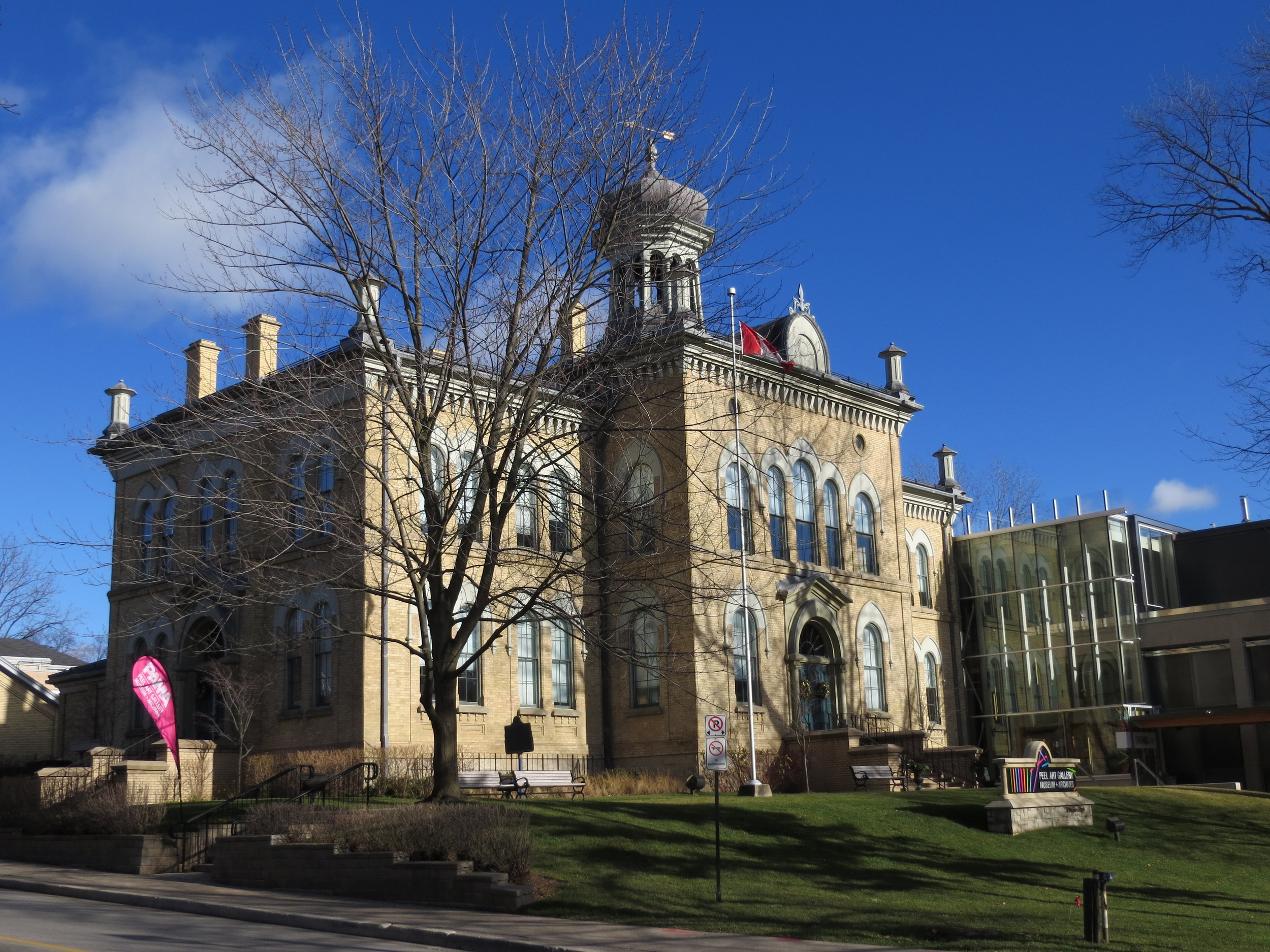
    Nearly a century ago, Brampton was a small town of about 5,000 people; the junction of two railways: the Grand Trunk mainline between Toronto and Chicago, and the Canadian Pacific branch line to Orangeville, Owen Sound, and other points in Midwestern Ontario. It was the seat of Peel County, with a beautiful 1867 Italianate courthouse, with a registry office and jail behind. Brampton had all the trappings of a prosperous rural service centre, including a hospital, a Romanesque federal building, a Carnegie Library, six historic brick or stone churches, a movie and vaudeville theatre, an armoury, and a fire hall. While there were manufacturing concerns by the railway junction  – both the Hewetson Shoe Company and Dominion Skate manufactured footwear – the leading industry was horicultural. The massive Dale and Calvert greenhouse complexes exported flowers and bulbs across Canada; as a result Brampton’s nickname was “Flower Town.” Grand houses lined Main Street, showing off the town’s booming economy.

    It wasn’t until the 1950s that Brampton began the transition from a small industrial and civic centre into a suburb of Toronto. In 1960, a new mall, anchored by Steinberg’s and Woolworth’s, opened south of downtown, new schools and factories, including a large American Motors assembly plant, opened here as well. In 1974, the same year that the first GO Train departed from Brampton for Toronto, the town was amalgamated with sections of several surrounding rural townships, becoming a city of nearly 100,000. Today, Brampton has a population of nearly 600,000.

    Apart from the greenhouses, which disappeared by 1980, and the hospital, which moved across town in 2008, all of the buildings I described are still standing (or in the case of Dominion Skate, partially standing). Downtown Brampton is blessed by its collection of historic buildings; many of these structures are lovingly preserved. The old Thomas Fuller designed Dominion Building on Main Street, which later became a police station and then a pub, was renovated and now has a Starbucks. GO Transit and VIA Rail still use the 1907 Grand Trunk Station. The Hewetson Shoe Factory is now a loft commercial space, and the old county buildings were preserved and now house the innovative Peel Art Gallery, Museum and Archives.

    While there’s lots of great built heritage in Downtown Brampton, but downtown struggles with retail vacancies; condominium towers built in the last decade have had difficulty with sales. A new condo tower planned for the Dominion Skate building, right across the tracks from the GO/VIA station, did not get built; it sits in a half-demolished state, awaiting a new use. Also awaiting a reuse is the old Capitol Theatre, which closed as Brampton’s civic performing arts centre when the new Rose Theatre opened at Brampton’s historic “Four Corners” in 2006. There’s the popular Gage Park, with its 25-year old skating path (which has since been copied in Etobicoke and elsewhere), but most attempts at urban renewal have been, at best, only partially successful.

    IMG_6642Thomas Fuller’s 1889 Dominion Building, Brampton
    Tonight, Brampton City Council will hold a special meeting to decide the fate of its section a fully funded $1.6 billion light rail project proposed for the Hurontario-Main Street corridor from Port Credit to Downtown Brampton. The LRT, which will be funded entirely by the Province of Ontario, will connect three GO corridors, the urban centres of Port Credit and Brampton, several major employment clusters, and Mississauga’s modern city centre, which includes Ontario’s largest mall.

    While most of the LRT route would operate in a reserved median in the centre of the street, in Downtown Brampton, it would operate in mixed traffic on the surface. It would require no private property, though it would require eliminating some surface parking on Main Street and turn restrictions at some intersections and driveways.

    The newly-elected mayor of Brampton, Linda Jeffrey, is in favour of the project, including the planned Main Street alignment, but at least five of ten councillors are against it. Tonight’s vote will be a nail-biter, a meeting for which a record 130-plus residents are registered to depute on this item; the city is clearly divided on this project.

    Opponents claim that the project mostly benefits Mississauga, and that light rail running along Main Street would ruin its heritage character, and would threaten the Saturday farmers market, which is set up on a closed Main Street. They also argue that the removal of street parking would hurt downtown businesses. These arguments are, of course, bunk; the heavy traffic, including light trucks and frequent buses do plenty to mar Main Street’s heritage; trams and light rail trains run through historic European cities like Brussels, Amsterdam, Prague, and Istanbul; the farmers market could simply re-locate to the new Garden Square or onto Queen Street. There are four large city-owned off-street parking garages with room to spare. These arguments are convenient strawmen hiding true NIMBY attitudes.

    8228039505_d6d424f22d_oThe Peel County Courthouse, now the Peel Art Gallery, Museum and Archives (PAMA)

    It is true that most of the route passes through Mississauga; it’s also true that the larger city to the south enjoys more benefits from residential and employment growth on its portion of the corridor. Main Street follows Etobicoke Creek north of Steeles Avenue; this limits new development. However, lands between Shoppers World (which has been losing major retail tenants like The Bay and Target) and Highway 407 are prime opportunities for intensification, as is the largely-vacant Brampton Mall at Nanwood Avenue. But the intermodal connections at Downtown Brampton and the opportunity to revitalize the downtown core make up for these drawbacks.

    Last year, at a 10-1 decisive vote, City Council voted against the proposed route, ordering staff and consultants to evaluate alternative alignments.

    These alternatives, nine of which were studied, included one that follows Etobicoke Creek through a floodplain and residential backyards. Other routes would have taken passengers far out of the way on McLaughlin or Kennedy Roads to reach the downtown core. A tunnel under Main Street, which would cost the City of Brampton $380 million, was looked at as well. Staff came back to Council in June with a report that evaluated all these possible alternatives and re-recommended the original surface alignment as being the most fiscally and technically responsible option and the best for transit users and for city-building.

    IMG_6675The Etobicoke Creek LRT alignment, proposed as a by-pass of Main Street

    The Hurontario-Main LRT is the boost Downtown Brampton needs. While expanded GO rail service will come, most Brampton commuters aren’t headed to Toronto’s financial core; they’re commuting to jobs elsewhere in Brampton, in Mississauga, and in other suburbs, and inter-suburb transport is lacking. Creating a higher-order transit network requires nodes, and Downtown Brampton, one of only a few historic and walkable neighbourhoods in Toronto’s suburban belt, is an ideal place for such a node. Not only is there the connection to GO and VIA trains (which would also benefit commuters to and from Mississauga, Guelph, Kitchener-Waterloo and elsewhere), but there are many opportunities for residential and employment intensification downtown, and along the Main Street corridor. Vacant storefronts that pockmark Main and Queen Streets say to me that more foot traffic is needed to revitalize these buildings. The LRT will help, not hinder, this goal.

    If Brampton votes a second time against the Hurontario-Main LRT, it will still be built, but will terminate at Steeles Avenue, four kilometres south of the downtown core. It will require a transfer to northbound buses at a third-rate shopping mall rather than at an urban transit hub with intercity rail connections. It would be a decision that Brampton will come to regret; offers of provincially funded transit don’t come around very often.

    Voting no will be, to put it mildly, a lost opportunity. Hopefully, Brampton City Council will see the sense of going with the province’s offer of a fully-funded LRT corridor.

  • The Sheppard Scarborough Subway Shitshow

    5279614296_c4bdaac003_b
    Building the Sheppard East LRT in December, 2010

    Nearly five years ago, in October 2010, work began on the Sheppard East light rail transit project, the first of three Transit City lines funded by the provincial government. This initial work was to build a grade separation between Sheppard Avenue East and Canadian National Railway’s Uxbridge Subdivision (better known as the GO Transit Stouffville Line), adjacent to the Agincourt GO Station. Metrolinx was still undertaking detailed design work for the connection to the Sheppard Subway at Don Mills Station, as well as the carhouse at Sheppard and Conlins Road, which would have also served the planned Scarborough RT replacement and extension and potentially the Scarborough-Malvern LRT, one of several Transit City lines that weren’t funded.

    Originally, the 13-kilometre Sheppard East line was to be the first to open, originally by the end of 2013. Finch West between Yonge Street and Humber College was to have opened by the end of 2015. But thanks to austerity measures enacted by the province in Spring 2010, the timelines were pushed back: the Sheppard Line would have opened in 2014; a shortened Finch line (only between the Spadina Subway extension at Keele Street and Humber College) in 2019.

    The completed Sheppard Avenue underpass at Agincourt GO Station, 2013. Note the median for light rail. Image via Google Street View.

    Construction was completed on the Agincourt underpass in May 2013, yet all other enabling work for Sheppard was halted after Mayor Rob Ford’s election. The incoming mayor declared Transit City dead; the province, up for re-election in 2011, was eager to oblige. Ford mused about extending the Sheppard Subway line west to Downsview and east to Scarborough Town Centre, and extend the Bloor-Danforth subway line instead of go with the fully funded, fully approved LRT replacement and extension. Ford was aided and abetted by councillors on both the right and the left, with Councillor Glenn De Baeremaeker the most prominent of Ford’s subway enablers.

    It’s almost a miracle that the Eglinton-Crosstown LRT project survived Ford’s bull-in-a-china-shop act. After some uncertainty, major work on that line continued, with the first boring machines launched in June 2013. That didn’t stop Ford from promising to bury the surface section of the route, at a cost of $1 billion, a plan that City Council defeated in February 2012.

    In March 2012, Council again voted to construct the Sheppard East LRT, in a 24-19 vote against Mayor Ford. Yet work never re-started. In October, 2013, Council voted to proceed with the extension of the Bloor-Danforth subway, even as Ford was losing control of the agenda overall. The provincial Liberal government again went along, hoping to retain power, perhaps even win back a majority government, in the next election. Even Adam Giambrone, an architect of the Transit City LRT plan, backed the expensive subway option as a NDP candidate in a Scarborough provincial by-election.

    That decision pretty much sealed the fate for the Sheppard East LRT. Why go back to building a light rail line on Sheppard if council couldn’t commit to building the Scarborough RT replacement? Why bother building an expensive maintenance facility to serve only one line? Why put any political capital in a project that had only tepid political support? After all, Scarborough was getting the subway extension most of its politicians demanded (even if its residents preferred an LRT), and there would be SmartTrack. Sheppard East was all but dead.

    A few weeks ago, the provincial government re-confirmed that it was funding the construction of the $1.2-billion Finch West LRT between Finch on the Spadina Subway extension, and Humber College, but that work would only start in 2016, and open five years later, in 2021. It also announced 2021 as the start date for construction on the Sheppard East LRT. That puts that project into never-never land. And not a word of protest from City Hall.

    Of course, this latest delay has emboldened subway boosters, hoping the city will push for the subway extension instead. This is despite the fact that the existing five-stop Stubway doesn’t have the ridership to fill four-car subway trains; transit experts are pretty much unanimous in their opinion that the ridership will never materialize to justify a subway extension; even the City of Toronto’s official plans only include subways for the Downtown Relief Line and on Yonge north from Finch Station into York Region. (The one amusing part of Tess Kalinowski’s article is that the pro-subway coalition member she spoke with didn’t want his name published.)

    IMG_2875A private car on the Sheppard Subway, mid-afternoon, May 19, 2015

    Why do we let politicians plan and then then destroy Toronto’s transit plans? Toronto is committed to spending billions on a subway extension we don’t need, while the subway we do need, the Downtown Relief Line, loses momentum as attention is focused elsewhere; on Sheppard and on John Tory’s dubious SmartTrack proposal, a plan that appeared almost out of nowhere in the middle of an election campaign, a half-baked plan that doesn’t provide the subway connectivity nor the redundancy required to function as an adequate relief line. Tory backed the Bloor-Danforth subway extension, even though the cheaper LRT plan was still open.

    Furthermore, Tory committed himself to the Gardiner East “hybrid” solution, which pretty much is a reconstruction of the existing elevated expressway east of Jarvis Street despite it being the more expensive short and long term option for a segment of road that is currently underutilized. It’s a plan that most urban experts and advocates dismiss, even warning that Toronto would be “a laughingstock” if it were implemented. Matt Elliott writes about this absurdity in more detail.

    To me, it appears that Tory surrounded himself with a small group of advisers like campaign chair and lobbyist John Duffy (who will be leading a public relations campaign for SmartTrack) and transportation adviser Eric Miller (who co-authored the pre-SmartTrack reports and whose University of Toronto Transportation Research Institute developed the case for the “hybrid” option backed by “The Gardiner Coalition”). Maybe council will overrule Tory’s preference for the “hybrid.” Maybe not.

    And because of that, John Tory is proving to be on the wrong side again and again on important issues; from carding, a racist police practice he seems to have no problem continuing, despite increasing public opposition; to limiting necessary tax increases; backing the Sheppard Subway; maintaining the East Gardiner Expressway;  his stubborn support for SmartTrack. I’m reminded of his myopic and stubborn support for religious school funding as Ontario Progressive Conservative leader back in 2007; a platform that might have cost him the election. I hope to be proven wrong, but I can’t say I have much faith in John Tory’s leadership.

    Of course, politicians of all stripes can be blamed for the Scarborough Subway Shitshow. But I feel we blew the last, best chance to get things right.

  • Mapping an accessible TTC

    IMG_3898

    Last week in Torontoist
    , I wrote about the challenges of getting around on the TTC for passengers who rely on mobility devices, such as wheelchairs. Most of us never think about this problem unless we’re directly affected by the consequences of an inadequate system, as I was after a cycling injury in 2012.

    But for TTC users with mobility disabilities (or even passengers with strollers, wheeled carts, or luggage), it’s an issue. While the bus system is (mostly) fully-accessible, the backlog in the delivery of new streetcars and the installation of elevators in subway stations leaves the system failing many of its riders. The alternative, Wheel-Trans, is also underfunded, inconvenient and useless for last-minute travel plans.

    Here’s what the subway system looks like if you require the use of elevators to navigate the system:

    accessible map - now 2015

    By 2016, only one more station  — St. Clair West  — will be equipped, by 2017, Wilson, Ossington, Coxwell, and Woodbine (and hopefully the Spadina Subway Extension to Vaughan Centre, with its six new fully-accessible stations, will open by then) will follow. But there’s not enough funding to make the entire system accessible by 2025, the deadline set by the Accessibility for Ontarians with Disabilities Act (AODA). Seventeen stations, including Islington and Warden, remain unfunded.

    The entire bus fleet is accessible, though not all bus stops are (the TTC requires a solid, concrete or asphalt place to deploy the ramp or lift, and room for the passenger to board; some suburban stops without a bus pad, or narrow urban sidewalks make loading a passenger in a wheelchair difficult). The first four low-floor streetcars are operating on Spadina Avenue, 200 more are still to be delivered. By now, the Spadina, Bathurst and Harbourfront cars were to have been fully-equipped with the new trams.

    In the meantime, the few bus routes that operate in the central core don’t have many accessible connections; east-west travel is particularly difficult. For example, the 47 Lansdowne bus is inaccessible from either subway station it services (Lansdowne and Yorkdale), and offers no barrier-free transfers south of Dupont Street. The map below shows this problem:

    TTC - Downtown v3 Crop

    Elevators at Ossington would connect the subway with three accessible bus routes, including the 94 Wellesley, a useful east-west alternative. (The 94 serves four subway stations and enters three of them, not one is equipped with elevators.) Meanwhile, both Toronto Western and St. Joseph’s Hospitals are isolated from the accessible transit network.

  • The genesis of Mayor John Tory’s SmartTrack

    I was recently browsing Urban Toronto‘s forums (a great resource if you’re interested in keeping up with construction updates and development proposals here in Toronto), when I came across a post written by “AlvinofDiaspar” in a thread discussing SmartTrack.

    Alvin’s post linked to an interesting report written by the Strategic Regional Research Alliance, a consulting group based in Toronto that I had never heard of until recently. The report, entitled “The Strategic Case for the Regional Relief Line,” was published in October 2013, just before the mayoral race began for the 2014 election.

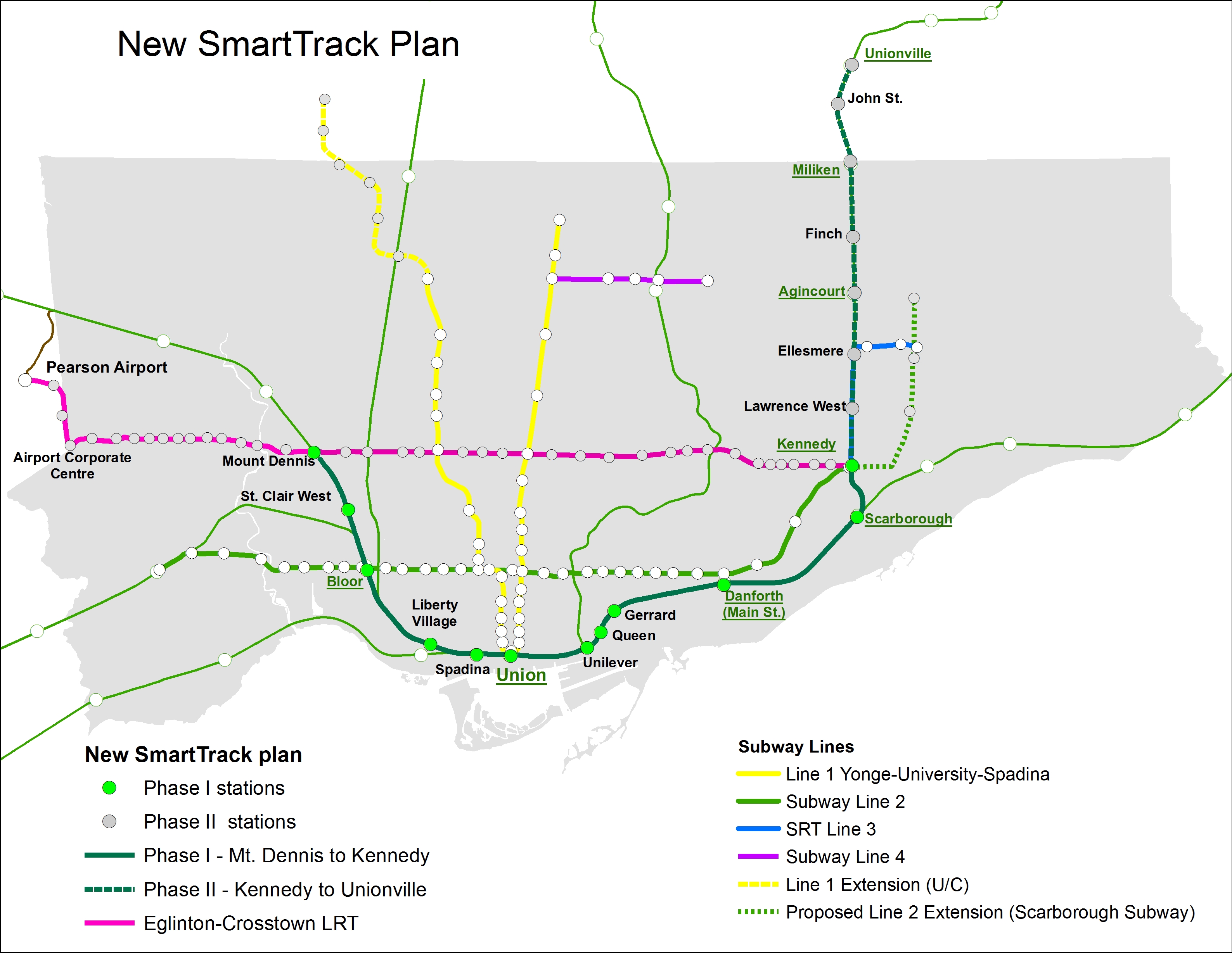
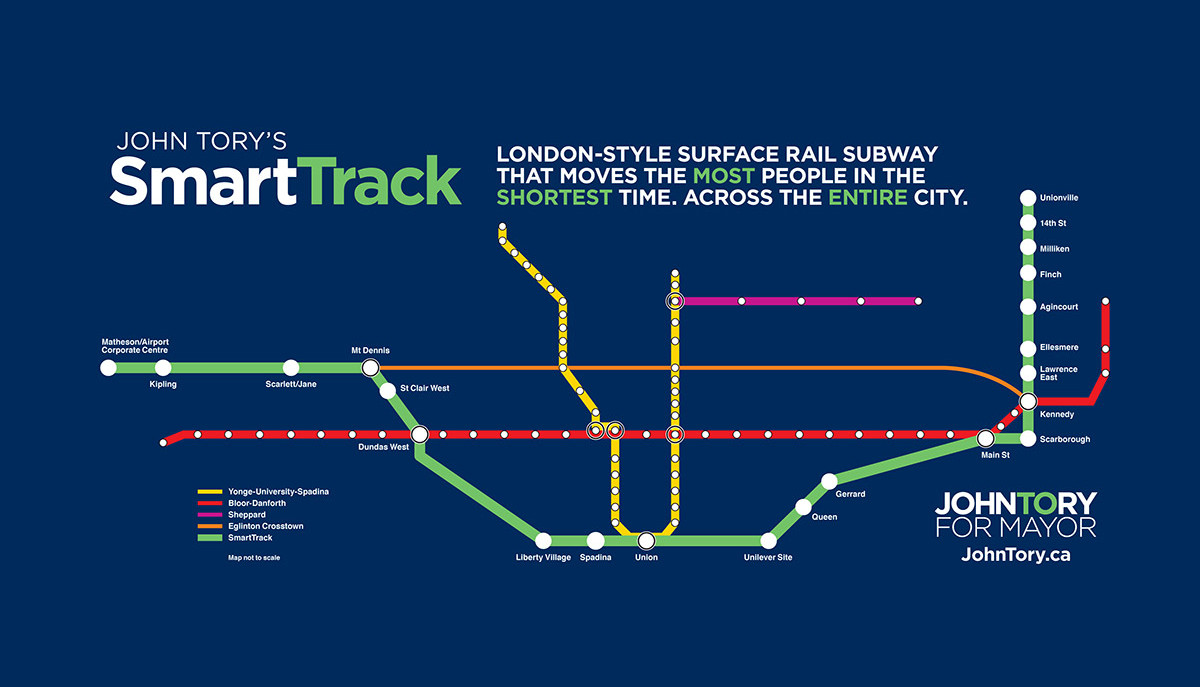
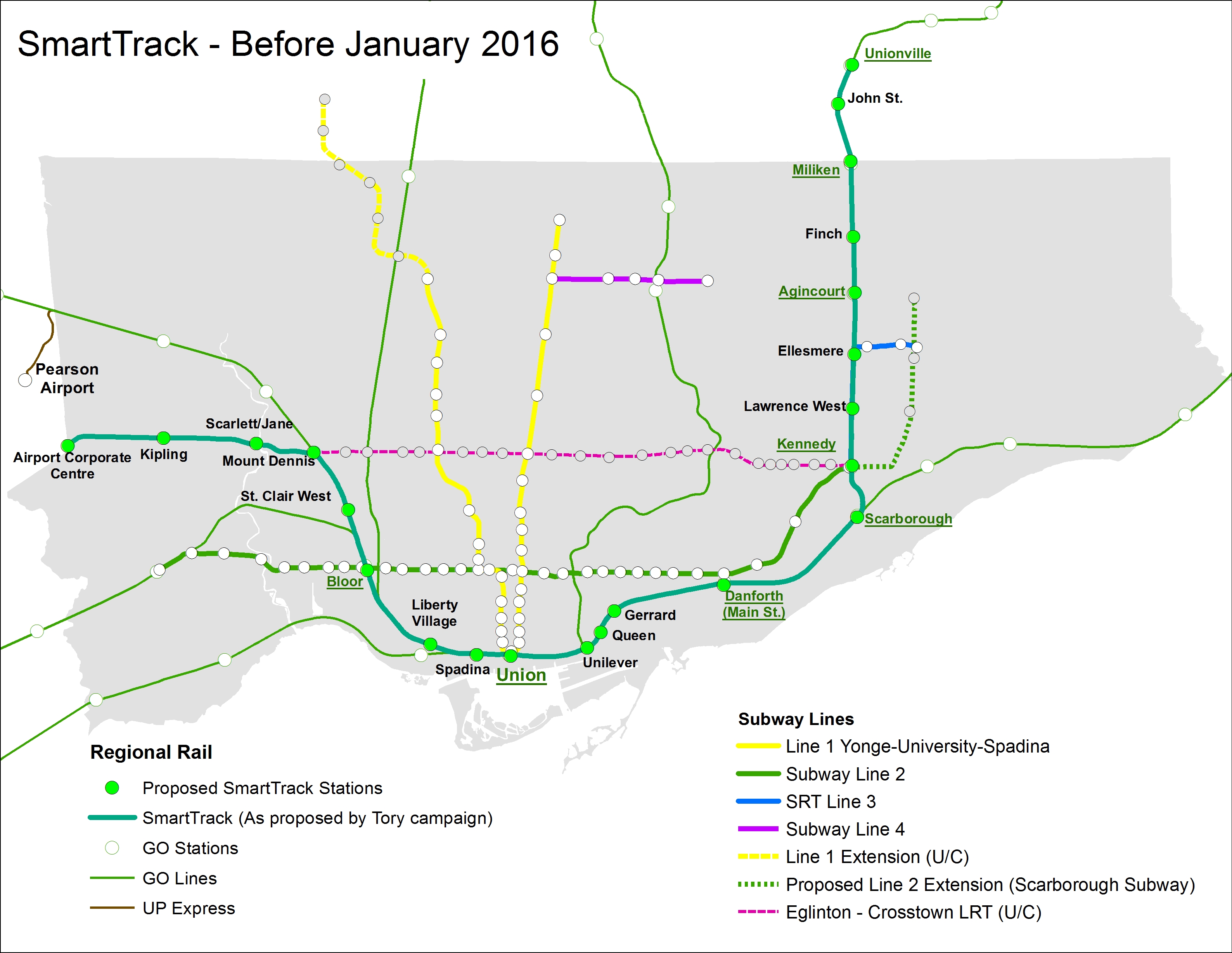
    John Tory unveiled his “SmartTrack” plan, promising a “London-Style surface rail subway” (whatever that meant), on May 26, 2014. The transit service, using frequent, electric multiple unit trains (like those used for commuter/regional transport in many European cities) would mostly follow existing railway corridors from Markham to Mississauga, via Union Station.

    On the east end, the route would follow GO Transit’s Stouffville Line from Union Station as far as Unionville Station, making more frequent stops, serving the Unilever plant (which will be replaced by a massive commercial/office redevelopment by First Gulf, first announced in 2012), as well as additional stops at Queen St East, Gerrard/Carlaw, Lawrence East, Ellesmere, Finch and 14th Avenue, in addition to existing GO Transit stops at Danforth/Main, Scarborough Junction, Kennedy/Eglinton, Agincourt (Sheppard), Milliken (Steeles) and Unionville.

    To the west, the line would follow GO’s Kitchener Line from Union Station as far as Mount Dennis (Eglinton Avenue, near the western terminus of phase one of the Eglinton-Crosstown LRT), with stops at Spadina, Liberty Village, the existing GO/UP Express station at Bloor, and at St. Clair Avenue. At Mount Dennis, the SmartTrack corridor follows a routing via Eglinton Avenue into Mississauga’s Airport Corporate Centre office district, which of course has no existing rail infrastructure to capitalize on.

    Tory promised to have SmartTrack operational in seven years, by 2021, putting other approved and/or proposed transit projects (the Downtown Relief Line, the Sheppard East and Finch West LRTs, among other plans) on the back burner.

    smarttrack_fbJohn Tory’s “SmartTrack” map

    Back in 2014, transit observers were taken aback by this new “bold” transit idea (John Tory kept using that word to describe SmartTrack), as his campaign had recently taunted Olivia Chow’s hesitancy to prioritize the Downtown Relief Line (DRL) in her transit platform. At the time, Chow, the presumed front runner in the mayoral race in April 2014, promised to increase TTC bus service and build the Scarborough LRT while planning for the DRL continued.

    The DRL is a long-proposed subway line under review by the City of Toronto and by Metrolinx that would connect downtown Toronto to the Bloor-Danforth Line east of the Don River, thus relieving the the Bloor-Yonge subway interchange from overcrowding, while offering improved transit access to east end Toronto, and addressing overcrowding on Yonge subway trains. Further extensions to the north, towards Thorncliffe Park, Flemingdon Park and Don Mills, would re-direct many current and potential transit riders from the Yonge Subway, allowing for an extension of that line from Finch to Richmond Hill.

    But to some degree, Tory’s promise of frequent, regional electric rail on GO’s corridors dovetailed with provincial plans for electrification of part of GO’s services and the Airport Rail Line (now branded as the Union Pearson Express). Improved services on GO’s corridors, if paired with fare integration with local transit (GO’s fares are very expensive for short trips), would provide useful rapid transit to many areas not served by the subway, and could provide some relief to the existing subway network. John Tory was endorsed by many provincial cabinet ministers; it appeared that he had the support of the Liberal government itself, though Premier Kathleen Wynne never endorsed any mayoral candidate directly.

    The only hint of this SRRA report that I could find in the mainstream media was in an interesting article written by Tess Kalinowski, the transportation reporter at the Toronto Star after Tory’s win on October 27, 2014. In an article published on November 17, entitled “The evolution of SmartTrack,” a report entitled “The Business Case for the Regional Relief Line” was mentioned. Also mentioned in the article was John Duffy, a political strategist who worked on the provincial Liberal leadership campaign of former transportation minister (now environmental minister) Glen Murray, and had ties to Wynne’s leadership and election campaigns. Kalinowski wrote that Duffy also was acquainted with Iain Dobson, a property developer and Metrolinx board member. Other people involved in putting SmartTrack together and mentioned in the article were the Canadian Urban Institute’s Glenn Miller (who is listed as a SRRA contact on its website, as is Iain Dobson, a real estate executive and Metrolinx board member), former Toronto chief planner Paul Bedford and businesswoman and urban expert Anne Golden.

    Transit advocate and friend Steve Munro picked up on this report before I had – you can read his posts which are more detailed and far better than my short analysis in this post:

    Munro: The Dubious Planning Behind SmartTrack Part I Part II Part III

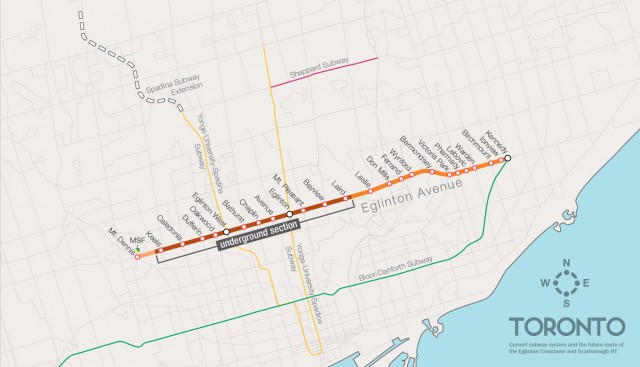
    It’s unfortunate that John Tory decided to make this concept the centrepiece of his transit platform. Easily, the biggest flaw, mentioned by others, including Steve Munro and mayoral rival Olivia Chow, is the Eglinton section between Mount Dennis and the Airport Corporate Centre. The corridor already had a proposed rail transit project, the western leg of the Eglinton-Crosstown LRT line, a project first proposed in 2007 as part of a larger city-wide LRT plan known as Transit City, and confirmed in 2009 when the provincial government announced funding for it and three other LRT lines. (In 2010, funding was deferred for the section west of Weston Road). The once-available right-of-way that would have allowed for a surface-running heavy rail transit project was already disappearing.

    But in the SRRA-authored report, we see why Tory went along with the problematic Eglinton routing, rather than having SmartTrack continuing along the GO Kitchener/UP Express corridor towards the transit desert of northwest Toronto. It was part of a larger plan to connect suburban office parks to Downtown Toronto.

    The Regional Relief Line, as envisioned by the SRRA, would have included a third phase, from the Airport Corporate Centre to Meadowvale Business Park, another large, although sprawling, employment centre near Highway 401 and Mississauga Road. The “Phase Three” of this proposed regional rail route would follow Highway 401 on a new alignment.

    srra mapThe map from the SRRA report, published on page 4. Note the use of Google Maps to create the map.

    The SRRA planning exercise appears to be one where well-educated planning experts were engaged in a game of “connect the dots.” Sure, the Regional Relief Line connected several major employment nodes in Markham, Toronto, and Mississauga, with the nodes in Mississauga lined up along Highway 401. But this error on page 6 of the report makes me wonder how many of the facts and assumptions the authors simply got wrong or didn’t fact-check:

    This phase will take a little longer to complete than the Markham phase because there are no tracks on the section from Mt Denis to the Airport Corporate Centre. This right of way will take longer to design and obtain approval in an EA process. It is owned by the Province and was intended to be an expressway. There is ample room for the dedicated right of way.

    In fact, the Richview Corridor, the right of way mentioned, was owned by the city, not the province, reserved in the 1960s for an expressway linking Highways 401 and 427 to the proposed Highway 400 extension, part of a much larger highway plan for Metropolitan Toronto. The 400 extension was cancelled and the at-grade Black Creek Drive was built instead; the Richview lands along Eglinton Avenue West in Etobicoke remained dormant for decades. But in 2011, the city started selling off the land for residential development, making the right of way unusable for any transportation corridor. (This did not matter in plans for the Eglinton-Crosstown LRT connection to the airport; there was still room to build a median LRT corridor along this section.) In 2013, pre-eminent local transit and planning experts should have been aware of this development and be able to identify the proper owner of this former right of way.

    It also strikes me as a little backwards looking to link auto-dependent office parks together with a new transit line, especially without a detailed origin-destination study. Shouldn’t urban planners be promoting dense urban employment clusters in areas well-served or potentially well-served by transit? Does it make sense to build expensive transit lines to serve low-density office complexes that come with large parking lots and garages, such as those in Mississauga’s Airport Corporate Centre? Or am I confused?

    In December 2014, mere weeks after Tory’s election, Council voted 42-1 to accelerate the work plan for the rail line, awarding up to $750,000 for early analysis and modelling work. The consultants awarded the funds? A group from the University of Toronto and Strategic Regional Research Associates. In February, council approved an additional $1.65-million towards studying SmartTrack, at least taking a closer look at the Eglinton West section of the corridor.

    To me, it seems just a little bit odd that Tory’s campaign advisers were awarded this contract to study a project, that until Tory’s election, wasn’t even on any transit planning maps. Steve Munro picked up on this as well, questioning whether  Iain Dobson, a member of the Metrolinx Board, has a conflict of interest due to his involvement with the SRRA and a member of the Advisory Board to the University of Toronto Transportation Research Institute. After all, Metrolinx is supposed to be the expert, disinterested provincial agency charged with evaluating and implementing various transit plans. Meanwhile, the need for a Downtown Relief Line hasn’t gone away.

    Tory and his connections in academia and the private sector have managed to change the course of Toronto’s short-term transit planning, and I can’t help but feel a bit suspicious of the behind-the-scenes planning that went into SmartTrack. This is a story very much worth following.

  • Streetcars of desire: why are American cities obsessed with building trams?

    IMG_5868-001

    Back in January, I posted my thoughts on some of the new streetcar systems being built in the United States after visiting Detroit, Cincinnati, Atlanta and Tampa on a Florida road trip. I soon cross-posted the article to Spacing, where it got more interest.

    Not long after the Spacing cross-post was published, I got a message from Guardian Cities. The editor, Mike Herd, asked me if I was interested in writing a similar piece, expanding on my post and discussing the difference between the streetcars in my hometown of Toronto, and the new systems being built in the US.

    It was an interesting experience, and one where I came to appreciate the role that content editors have. The article went through several major changes until we were all happy with the final product.

    You can read my Guardian Cities article, which was published on Friday, here:

    Streetcars of desire: why are American cities obsessed with building trams?