Tag: Transit

  • Suburban stations for urban needs: accessing GO Transit’s proposed new stations

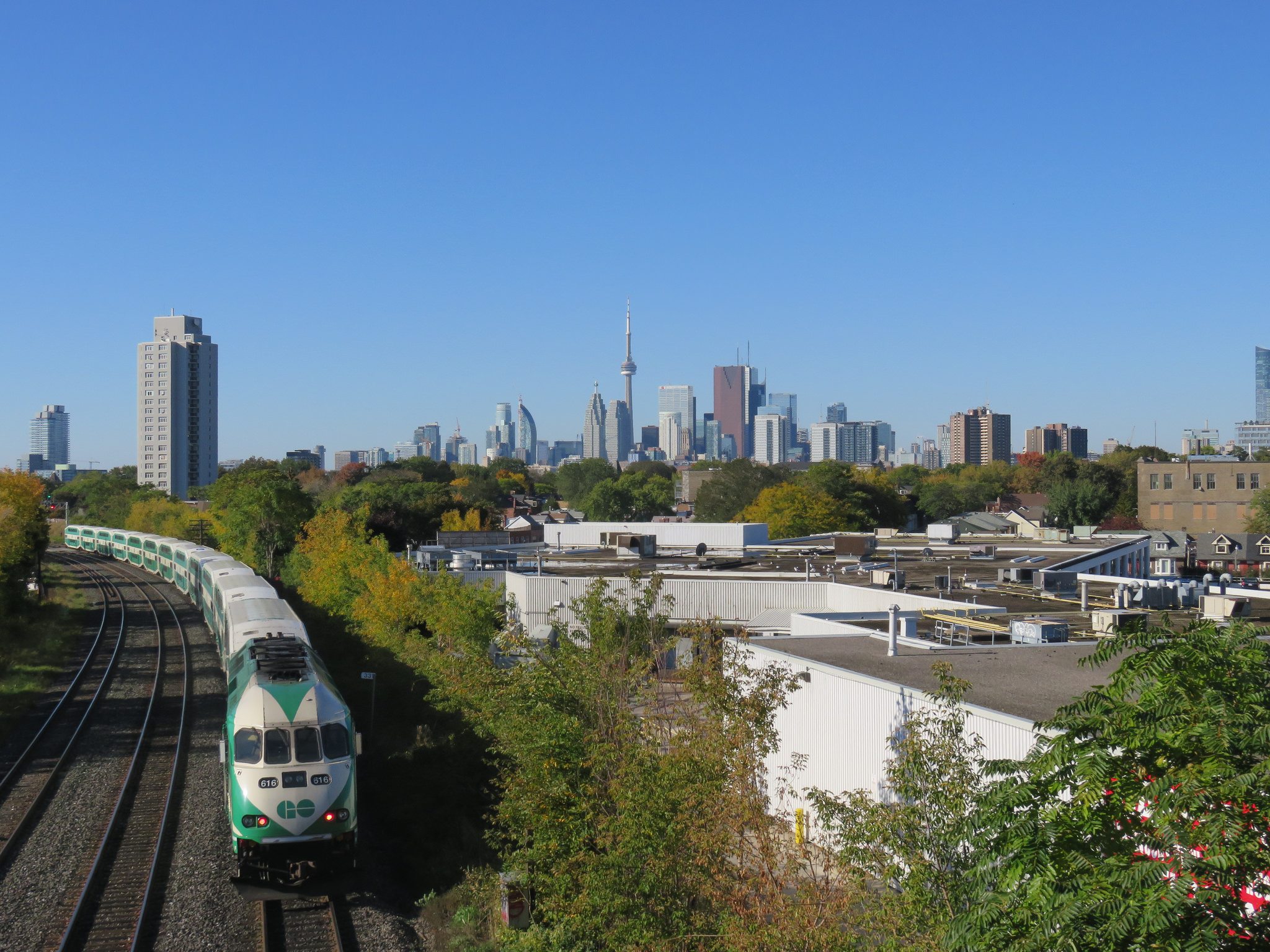
    21505188673_1d34d85175_kGO Transit train from the Pape Avenue footbridge, near the proposed site of Gerrard Station
    At its last board meeting on December 8
    , Metrolinx presented an update on the status of twelve new GO Transit rail stations, all located on existing lines. Eight of these proposed new stations are located in the City of Toronto; and six of those are station locations once promised as part of John Tory’s SmartTrack proposal. Unfortunately, the proposed new station designs (all available in this Metrolinx report) appear to be similar to existing GO stations in the suburbs, with needlessly large bus loops, PPUDOs, and parking lots. Development opportunities are limited.

    Transit connections at some proposed stations, like St. Clair West, are poor or practically non-existent. This is rather unfortunate, as SmartTrack was originally proposed as a frequent, subway-like service between Mississauga and Markham, with full TTC fare integration. Today, it’s merely six additional stations on existing GO Transit rail corridors. Without quick and seamless connections to the subway and surface TTC routes, the ability to provide any transit relief is compromised.

    I have more to say on this at Spacing Toronto.


  • Leadership, John Tory style (part 2)

    We’ve seen it before: when cornered on an issue, Mayor John Tory will get defensive, flustered, and counter with disingenuous remarks. Police carding was one such issue, so was the Gardiner East. Today, as Mayor Tory defends his SmartTrack proposal, he’s doing the same thing.

    After a staff report on SmartTrack — originally planned for a week ago at the scheduled Executive Committee — became public, we learned more details about the watered-down transit plan that was Tory’s signature campaign promise. (Read Steve Munro’s article in Torontoist for more details.)

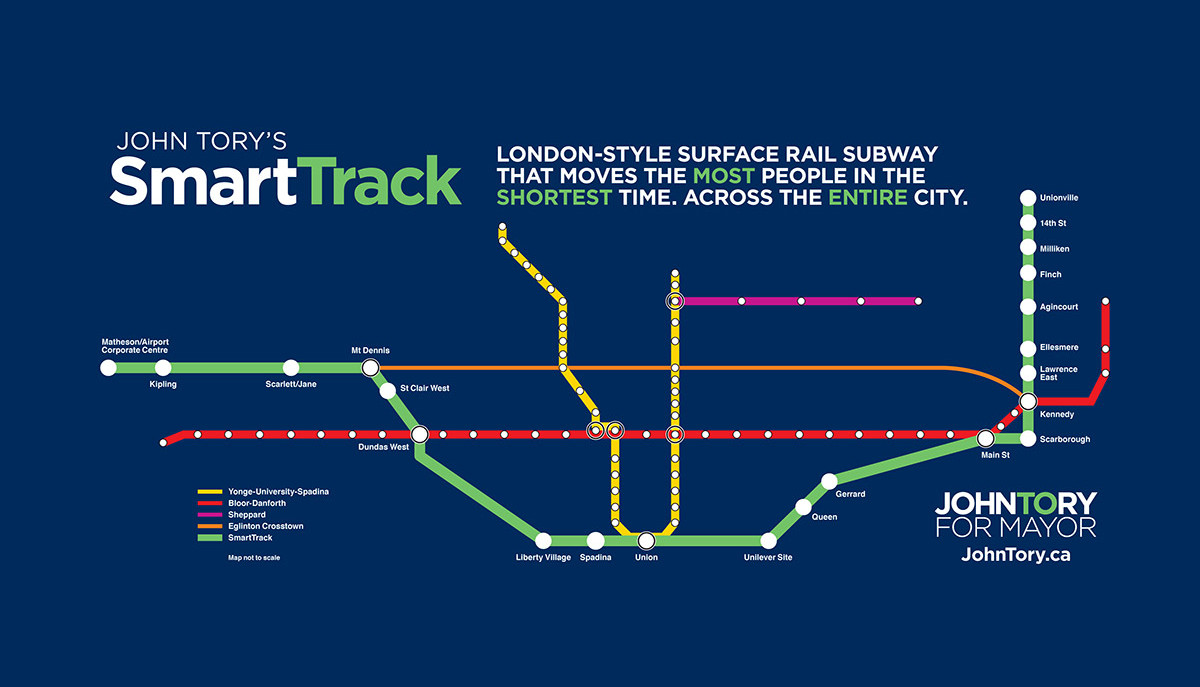
    • In 2014, John Tory promised that his “London Style” surface rail subway would open in just seven years. Now, we find out that it won’t be completed until 2025-2026.
    • Only six new stations will be added to GO Transit’s existing stops on the Kitchener and Stouffville corridors; the GO RER system planned by Metrolinx will stop at the same stations as SmartTrack, blurring the lines further between the province’s plans and Tory’s promises.
    • The City of Toronto will be on the hook for all LRT operating expenses, while the Province/ Metrolinx will continue to own the infrastructure.
    • The City of Toronto would be on the hook for some of the GO RER expenses, such as 15 percent of required grade separations, such as at Steeles and Finch Avenues in Scarborough.
    • The Eglinton-Crosstown LRT west extension to Pearson International Airport, which replaced part of the original SmartTrack alignment planned using outdated Google Maps satellite imagery, may not be built beyond the planned Renforth Gateway Hub, the eastern end of the Mississauga Transitway.
    • Tax Increment Financing (TIF) will not be enough to fund the construction of SmartTrack and the LRT extension; development charges and a property tax hike would be required to fund SmartTrack’s construction.

    smarttrack_fbThe original SmartTrack plan that John Tory campaigned on in 2014
    These are serious concerns, and it is worth asking whether Toronto should remain committed to this plan. After all, the Relief Line Subway remains unfunded, even though it is a top priority for city planning staff. And there’s that $3.2 billion one-stop subway extension to Scarborough Centre, which might become even more expensive if so-called “Subway Champions” Councillor Glenn De Baeremaeker and Liberal MPP Brad Duguid get their way with a proposed realignment.

    (Interestingly, a SmartTrack/RER stop at Lawrence East may not be able to be built before the one-stop subway extension is opened — a Scarborough RT station is in the way. This isn’t good news for transit riders on the 54 Lawrence East bus, which will lack a rapid transit connection in Scarborough.)

    Mayor John Tory’s response is to ask “what’s their plan?” instead of listening and responding to critics. It’s certainly not a productive or mature reaction to very valid concerns.

    There were several alternative plans made by rival candidates in 2014 — Olivia Chow and David Soknacki backed returning to the cheaper and longer Scarborough LRT replacement, and building the Downtown Relief Line subway. Chow also proposed additional bus services, which was mocked by Tory’s campaign as no real plan for transit. Once Tory was elected, the TTC ended up implementing much of Chow’s bus plan, including restoring most of Rob Ford-mandated service cuts and adding new express and night routes.

    Last week, John Tory also rejected — yet again — the new ward boundaries recommended by the Ward Boundary Review Team, independent consultants who came up –twice — with a 47-ward solution meant to reflect population growth (especially downtown and in central North York) and imbalances in ward populations and councillors’ workloads. The Executive Committee voted against the mayor, backing the 47-ward option, but staff warn it might be too late now for the 2018 election. That might suit Tory’s political agenda, but it’s a blow against local democracy.

    Bottom line: Olivia Chow has no plan for transit. She is not a leader.
    – John Tory, 2014

    So no, John Tory, you’re not a leader. You have failed to acknowledge your errors, you haven’t listened to critics, you’re stubborn, and you lash out when things don’t go your way. And you won’t listen to experts because you don’t like what they have to say. At one point, you claim your critics don’t have any alternative plans to SmartTrack, at other times, you mock the very plans that critics suggest.

    So far, John Tory’s critics have been correct about his transit plan. Maybe it’s time to listen.

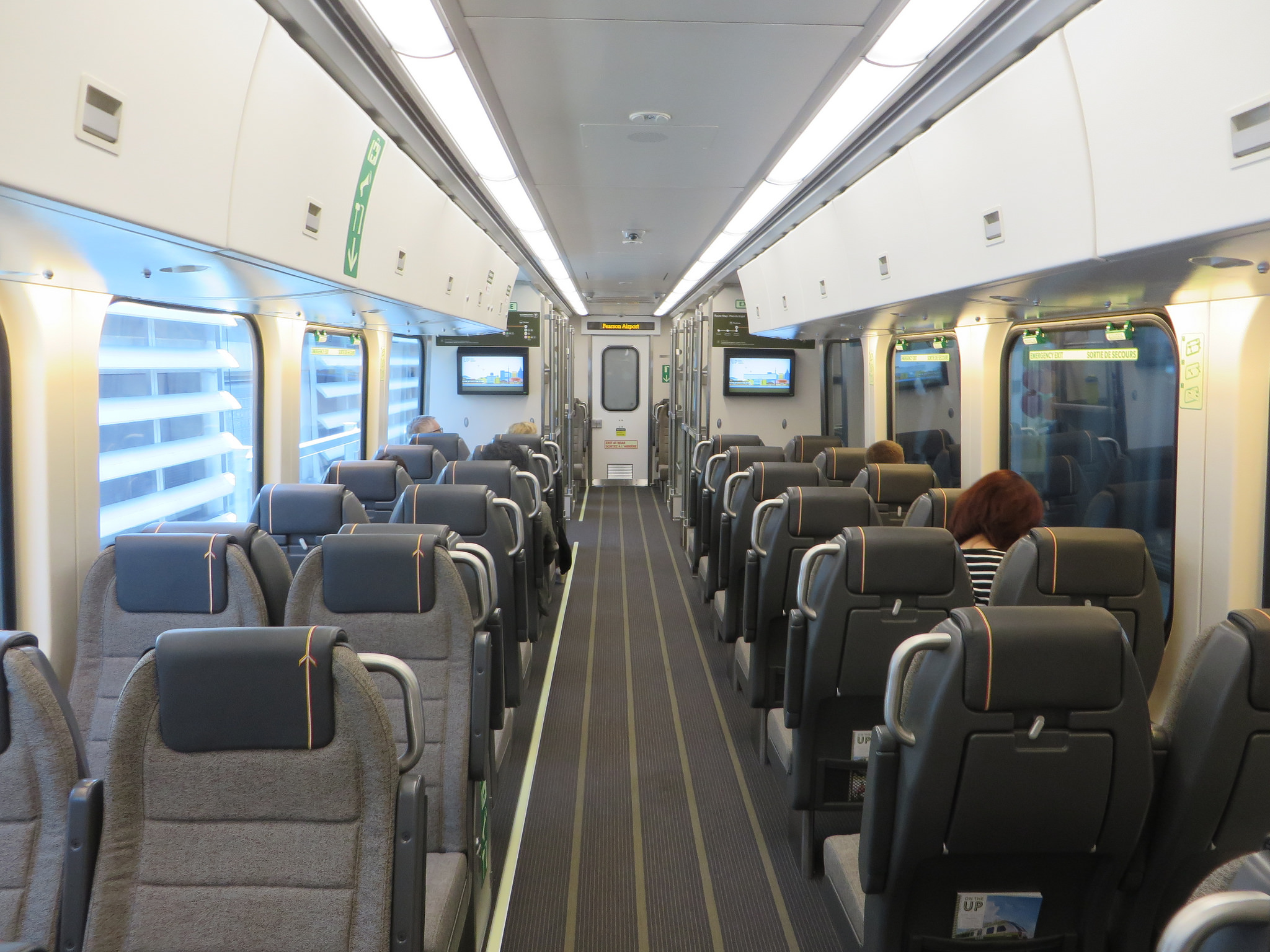
  • Ridership has tripled on UP Express, but we can do even better

    19008325386_9c321ac7ab_k

    When UP Express — Toronto’s rail link to Toronto Pearson International Airport – -launched on June 6, 2015, the one-way fare between Union Station and Pearson Airport was set at $27.50, or $19.00 with a Presto card. At the time, Metrolinx, the provincial agency charged with planning and integrating transportation services in the Greater Toronto and Hamilton Area and the parent agency of GO Transit, expected that ridership would hit 5,000 passengers a day in a year. But after its launch, ridership sunk instead. 

    By January 2016, only an average of 1,967 passengers a day rode UP Express, so Metrolinx cleaned house and lowered the fares. The one-way cash fare was reduced from $27.50 to $12, and from $19 to $9 with a Presto card, and fares between Union and Bloor and Weston stations were reduced to match the GO Transit fares for the same trips. Since the new fare structure was introduced, UP Express ridership has more than tripled. By June 2016, the daily average ridership increased to 7,657.

    Despite the ridership growth, and the utility of the rail service for local residents near Bloor and Weston Stations, there’s still more that can be done to make the most of the $456 million spent to build the line.

    The airport region is a major employment centre, yet is difficult to serve by public transit. Fare integration between UP Express, GO Transit, MiWay and Brampton Transit could be an important a first step in creating a full regional rail network, a concept that Mayor John Tory pitched as “SmartTrack.”

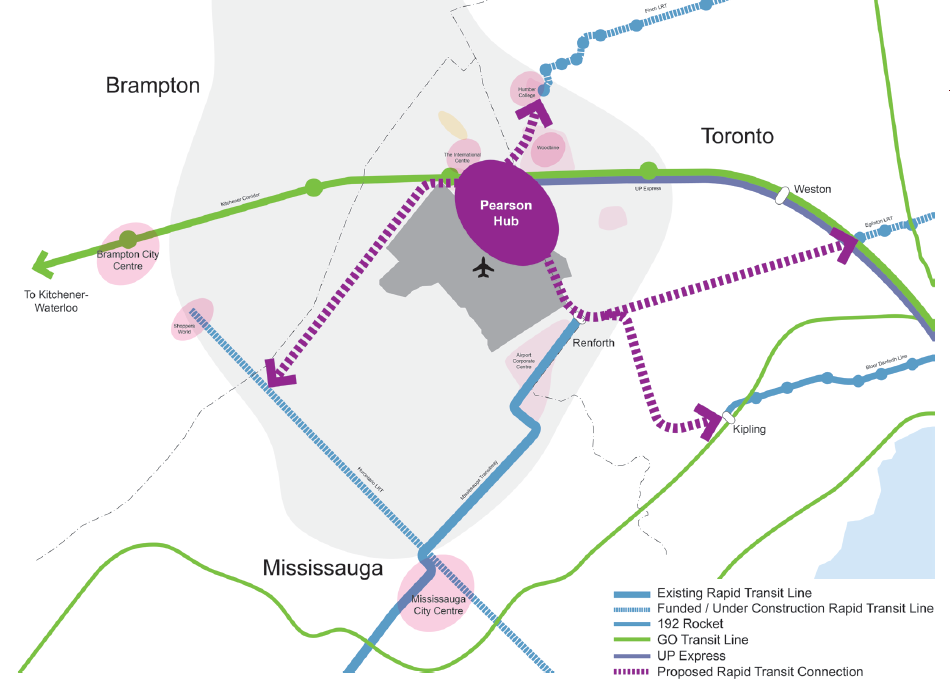
    Airport LinksTransit connections at Pearson Airport. UP Express, if it offered fare integration with the TTC, MiWay and Brampton Transit, would be an invaluable part of the Toronto area’s transit network

    UP Express’s ridership increase is a good news story. But there’s so much more utility that can be leveraged.

    I discuss the UP Express ridership trends further in Torontoist

  • Toronto’s new rapid transit plan

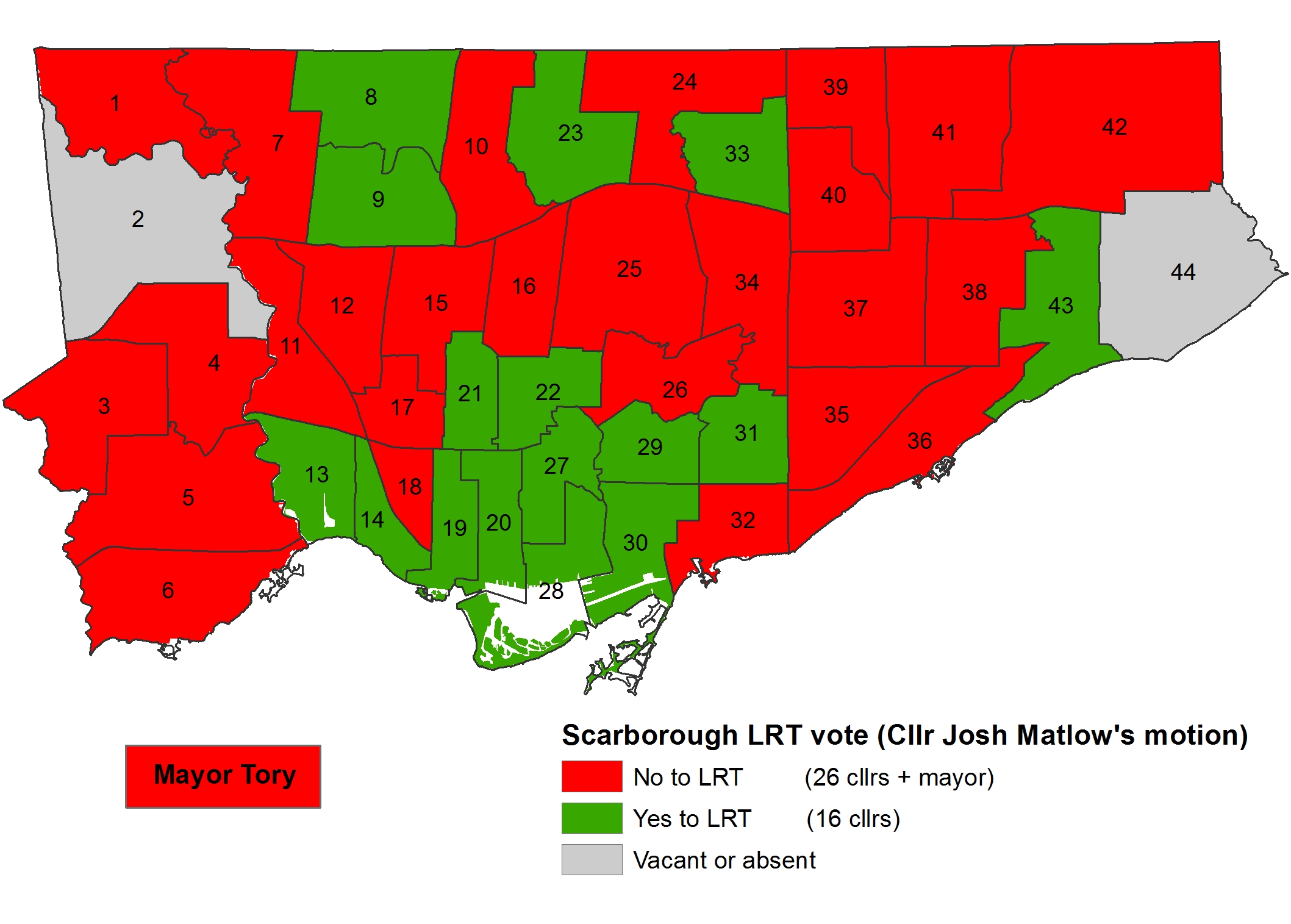
    Yesterday, City Council decided, by a vote of 27-16, to go ahead with the $3.1 billion one-stop extension of the Bloor-Danforth Subway to Scarborough Centre, rejecting Councillor Josh Matlow’s last-ditch attempt to resurrect the LRT replacement and extension of the ageing Scarborough LRT line. Council — Mayor Tory included — also voted to spend resources studying three more suburban subway extensions and a re-alignment of the proposed Relief Line subway backed by the local councillor.

    Unfortunately, the chance of going back to the less-expensive, yet longer seven-stop light rail line is slim-to-nil at this point. In my view, it’s time for transit advocates that backed the LRT to focus their energies elsewhere. Like Metrolinx’s fare integration strategy, and the plans for other LRT lines, such as the eastern and western extensions of the Eglinton-Crosstown.

    TT - Scarborough VoteHow council voted on Councillor Matlow’s motion to resurrect the LRT option for Scarborough
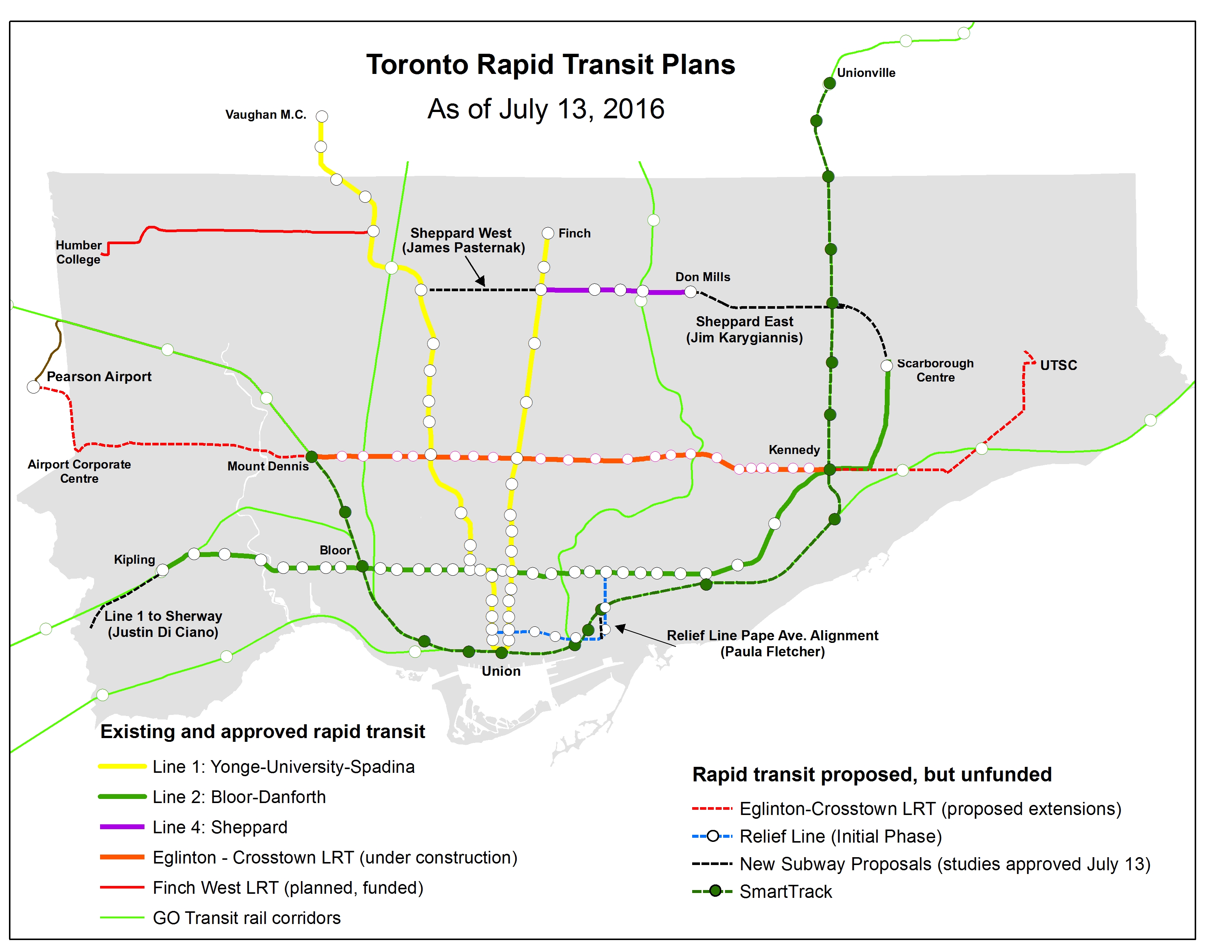
    In order to ensure that he had enough votes, John Tory entertained Ward 39 Councillor Jim Karygiannis’ motion for a study on an extension of the Sheppard Line from Don Mills Station to Scarborough Centre. (There’s a LRT proposed for Sheppard East, but no matter.) Karygiannis’ motion passed, as well as several other councillors’ pet subway projects. Ward 10 Councillor James Pasternak has long pushed for a Sheppard Subway extension west between Sheppard-Yonge and Downsview Stations, and he successfully got that included as well. Finally, Justin Di Ciano (Ward 5) got a study approved for a subway extension in his ward as well, resurrecting a long-dormant proposal for a subway extension from Kipling Station to Sherway Gardens.

    It’s worth noting that all three right-leaning councillors are reliable votes for John Tory.

    Downtown, Paula Fletcher (Ward 30) moved that staff re-examine the Relief Line, moving the recommended alignment from under Pape Avenue to Carlaw Avenue between Gerrard and Queen Streets. This would shift the planned — yet unfunded — subway line two blocks west. The Pape alignment was chosen for ease of construction and operation (the line must curve from north to west just south of Queen Street), and is only two blocks away. That study will cost $520,000 and staff time.

    All these new studies are illustrated below. For clarity’s sake, the Sheppard East LRT, the Scarborough LRT proposal, and the existing Scarborough RT (Line 3) are removed. You can read more about how the votes went down on Steve Munro’s site.

    Transit Plan July 2016The map of planned, approved and existing rapid transit lines, and those extensions and re-alignments approved for study
    The “subways, subways, subways” sentiment is alive and well at City Hall, even if Rob Ford has passed on. And despite the thirst for expensive new subway lines,  Mayor Tory is still backing an austerity agenda at City Hall. Apart from the decorum, not much has changed in the mayor’s office.

  • What do I know? I’m just a downtown elitist

    23211094949_cd3f8fc6a1_k

    I once described Councillor Denzil Minnan-Wong as the city official that “knew the cost of everything and the value of nothing.” In 2014, Minnan-Wong complained about the costs of building new washrooms at the soccer fields at Cherry Beach, holding up a sign that simply said “$600,000.” That photo of Minnan-Wong, scowling for the cameras, trying to generate some outrage in an election year, was meme gold and so was parodied in the #TOpoli Twittersphere.

    At $600,000, yes the washrooms were expensive. But as they were built in an isolated part of the Portlands, they required a new connection to the nearest watermain; a sewage tank had to be constructed as well, being so far from existing lines. The city has a mandate to provide quality parks and recreational facilities. Minnan-Wong, along with the Fords, also complained about the costs of umbrellas at Sugar Beach, a popular new waterfront park.

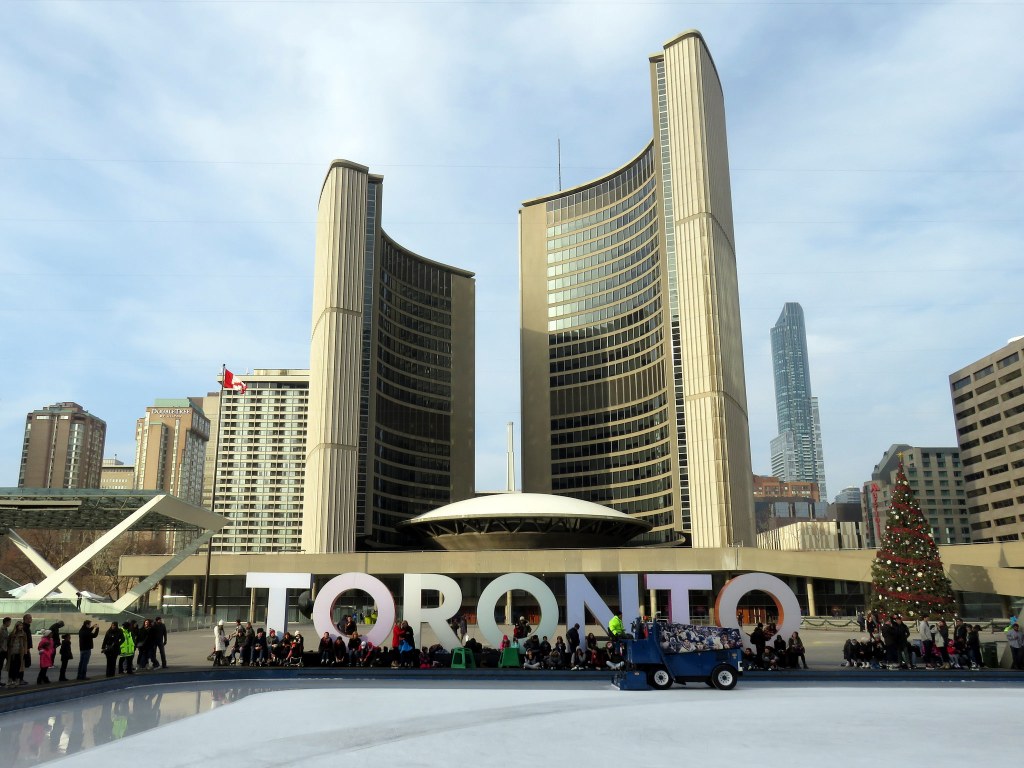
    In 2016, under Mayor John Tory’s administration, we have a City that doesn’t know the cost of some things (like the Scarborough Subway) nor does it know the value of other, smaller things, like the Toronto sign.

    The Toronto sign, placed on Nathan Phillips Square ahead of last year’s Pan Am Games proved to be incredibly popular with residents and tourists alike. The LED backlighting allows the sign to be coloured at night to mark any holiday or any important current or special event. The $100,000 climbable sign (reminiscent of the successful “I amsterdam” signs) was supposed to be temporary, and will have to be replaced within three years. A staff report estimate the cost of major repairs to the existing sign, and a new mobile sign, would cost $421,700 over two years. This would be money well spent.

    But some councillors, including Etobicoke’s Stephen Holyday and Scarborough’s Raymond Cho, would rather privatize the sign, perhaps selling it off. At least Councillor David Shiner, a fiscal conservative, called it “a potent symbol of Toronto pride and unity” after amalgamation, but even he questioned the need for paying for city staff to maintain the sign. A strong argument could be made that the costs to maintain the sign should come from Tourism Toronto and the local tourism industry, but calls from some quarters to sell it off are ridiculous.

    Last Friday, we learned that the estimated cost of building the one-stop, six kilometre subway extension to Scarborough Centre jumped from $2.0 billion to $2.9 billion. But unlike cycling infrastructure or fully funding an effective Vision Zero program to protect vulnerable road users, the mayor, key council allies, and provincial MPPs remain hell-bent on building it.

    Scarborough Centre MPP Brad Duguid, a powerful cabinet minister in the provincial Liberal government, quoted in the Toronto Sun, said that critics of the subway plan “…have been yapping away on this project from Day 1 and the vast majority of those critics come from fairly elitist downtown views of the city. People in Scarborough and the suburbs of Toronto count as well.” Duguid claimed that “the area surrounding the new [Scarborough Centre] station is growing fast.” Never mind that population and employment densities are not very high along the subway route, even in Scarborough Centre, and no major commercial development has come to central Scarborough since the 1990s.

    On Metro Morning, Duguid, a former city councillor who endorsed John Tory’s mayoral bids in 2003 and 2014, doubled down on his previous rhetoric. He repeated false claims about Scarborough Centre’s growth, claimed Scarborough residents have paid for downtown subway expansions, he even stated that the Scarborough Subway “transcends politics” (which earned a guffaw from host Matt Galloway).

    I live downtown, and I don’t use the subway; like many who live here, I walk to work. Many others cycle, or take overcrowded streetcars on King and Queen Streets. The Yonge Subway is overcrowded from commuters from outside the downtown core. Most downtowners wouldn’t directly benefit from a Relief Line either, but it’s an essential part of the network. The last subway built in Downtown Toronto was in 1966. I’m hardly an “elitist” either; I rent my apartment. I don’t enjoy many luxuries, and I certainly don’t hold a position of power or influence. I simply want the best transit for the best price; the Scarborough LRT, along with GO Transit RER and the Eglinton-Crosstown and Scarborough-Malvern light rail corridors represent the right investment for the eastern half of Toronto.

    We’re content to keep up an underused section of the Gardiner at greater expense than an urban boulevard, at the cost of lost development opportunities on the eastern waterfront. We’re committed to a $2.9 billion, 6 kilometre one-stop extension when a 10 kilometre, 6-stop LRT would cost $1.8 billion, funded entirely by the province. But we’ll complain about umbrellas and washrooms, budget too little for road safety plans, and question the costs of maintaining a popular sign at City Hall. I love this city, but sometimes Toronto still gets me down.

  • Missed opportunities on the Mississauga Transitway

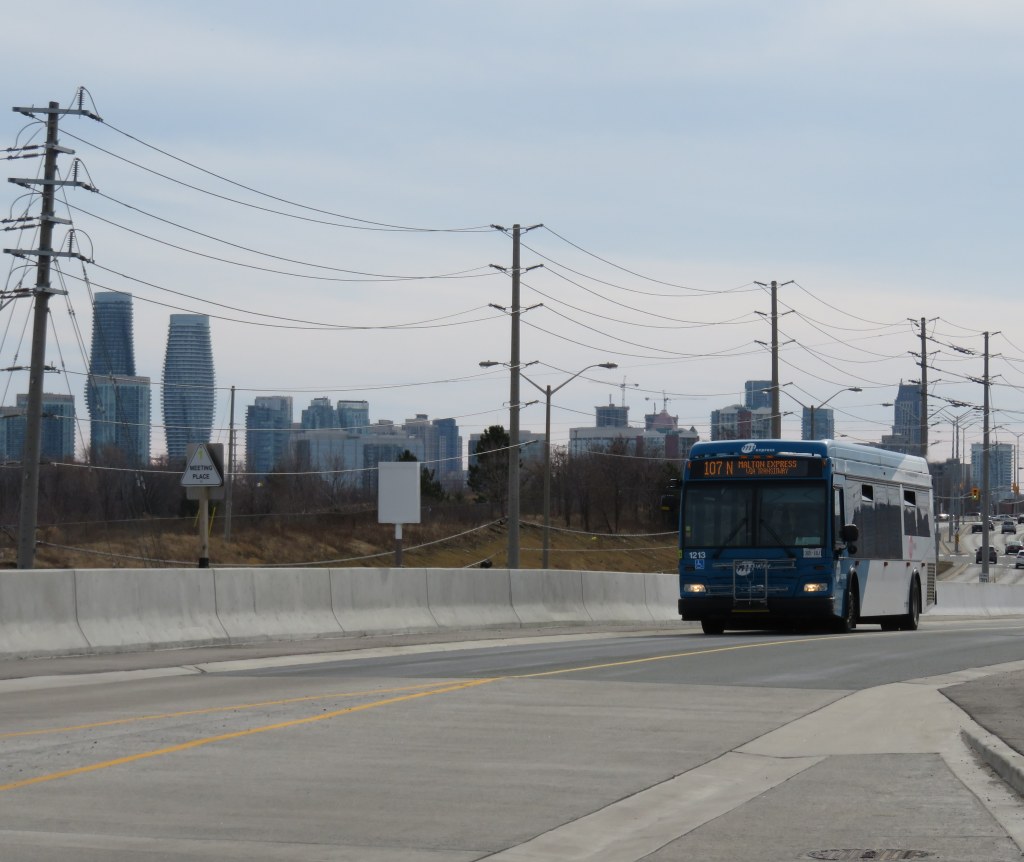
    IMG_0343-001Route 107 Malton Express bus on the Mississauga Transitway at Tomken Station
    After riding the UP Express back in March, the inspiration for a post on a proposed transit hub at Toronto Pearson International Airport, I went for a ride on the Mississauga Transitway.

    I first rode the Mississauga Transitway on a snowy Monday, November 17, 2014, the day it opened. At the time, only four stations were opened — Central Parkway, Cawthra, Tomken, and Dixie. On my first visit, I was unimpressed. But I decided to give it another try after the two new stations opened, on a Saturday, when I had plenty of time to check out the service, the new stations, and the environs.

    I have many thoughts and criticisms about this new piece of transit infrastructure, which will cost the City of Mississauga and Metrolinx a combined $528 million.

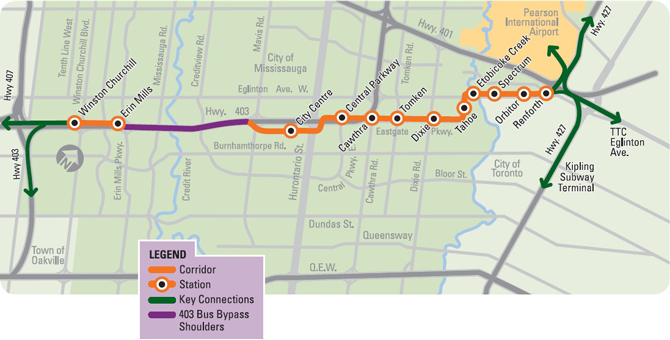
    mississauga_transitway_map_en-670x340Map of Mississauga Transitway, taken from the GO Transit website

    What is the Mississauga Transitway?

    The Mississauga Transitway is a bus rapid transit (BRT) project. BRT is a term used in the transit industry to describe everything from limited-stop conventional buses, perhaps with some perks like all-door boarding and queue-jump lanes sometimes called BRT-lite (Brampton Zum is a good example), to fully grade-separated, high speed bus corridors that operate like metro lines (the Ottawa Transitway and Bogota’s TransMillenio system are good examples). Other busways in Canada include the Ottawa Transitway, to be partially replaced by light rail transit, the Gatineau Rapibus corridor, York Region’s Viva Rapidways, and Winnipeg’s RT corridor.

    The Mississauga Transitway is a true BRT system, but it has several major weaknesses.

    (more…)

  • The many challenges of creating a transit hub at Pearson Airport

    7afe7e75-d368-4472-b208-ab02c57457aa-001
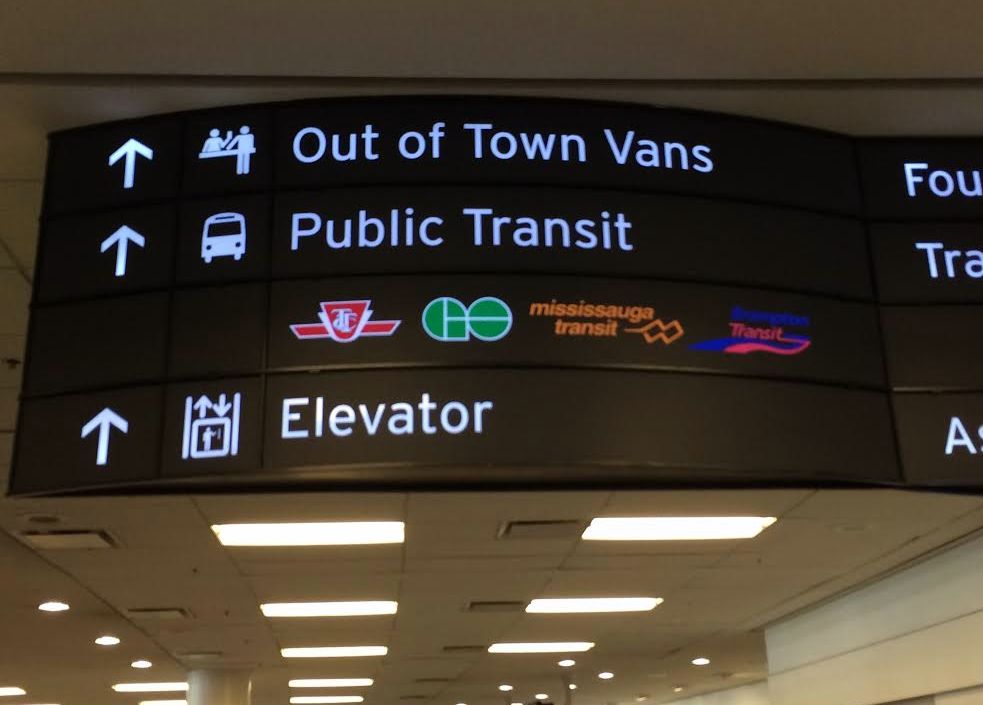
    Sign in Terminal 1 at Pearson Airport. Whether we realize it or not, Pearson Airport is already a transit hub. 

    Updated April 7, 2016

    Lester B. Pearson International Airport is Canada’s busiest airport, handling 41 million passengers a year. It is not the busiest transportation hub in the Greater Toronto Area, though; Union Station is considerably busier (GO Transit alone handles 64.4 million passengers a year at Canada’s busiest station).

    Pearson Airport is located almost entirely within the City of Mississauga, but the terminals are less than a kilometre away fromthe City of Toronto’s western boundary; due to the location of the airport terminals, most passengers reaching the airport by road, or transit pass through the City of Toronto to get to it.

    The Greater Toronto Airports Authority (GTAA), the not-for-profit agency that operates Canada’s busiest airport, has expressed interest in creating a transit hub and guiding transit-oriented development around it. It’s an interesting idea, and some of the facts are compelling.

    There are approximately 300,000 jobs located at and near Pearson Airport. The airport itself hosts 40,000 employees that work for the airport authority and its contractors and tenants, including retailers, airlines, and allied services. The remaining 250,000 jobs are located in office parks and industrial areas that surround the airport, in the cities of Toronto, Mississauga, and Brampton, a very large area that extends north into Bramalea, west of Hurontario Street and south to Highway 403.

    You can read the GTAA’s report, written by the prestigious planning firm Urban Strategies Inc., and named Pearson Connects: A Multi-Modal Platform for Prosperity online as a PDF. The report claims that Pearson Airport and environs has more jobs, and more economic clout than any Canadian downtown, with the exception of Downtown Toronto. To a degree, this is true. But the size of the Airport Employment Zone, as the GTAA defines it, is much larger in size than any downtown, even Toronto’s; the jobs are mostly dispersed in warehouses, factories, and suburban office buildings difficult to reach by transit.

    In fact, Pearson Airport and its surrounding area — all 25,600 hectares  (256 square kilometres) — has fewer than 25 employees per hectare, while Downtown Toronto, one-tenth the size, has nearly 200 employees per hectare (and a growing residential population as well). Igor Dragovic calculated these figures from a recent Neptis report. The low employment densities found in business parks and warehouse districts are only partly to blame; the airport itself, with five active runways and a large land buffer, contributes to this.


    The GTAA wants to build an “airport-related multi-modal hub” that would tie together existing and planned rapid transit services, including the Kitchener RER Service, LRTs on Eglinton and Finch Avenues, the Mississauga Transitway BRT and a proposed Derry Road transit corridor.  It cites airports in Amsterdam, Frankfurt, London, and Hong Kong as examples to emulate.

    GTAA ProposedThe GTAA’s proposal for a transit hub, taken from Page 7 of the report

    The report also neglects to recognize that Pearson Airport is already a major transit hub; the problems lie in integrating the existing and proposed transit services together. And for an area the size of the GTAA’s Airport Employment Zone, that’s a very tall order.

    (more…)

  • A smarter SmartTrack

    ST - Before 2016
    John Tory’s original SmartTrack plan, shown with the existing TTC Subway and GO Rail networks. 

    In Friday’s Globe and Mail, we were treated to a scoop by Oliver Moore, that newspaper’s excellent transportation reporter, on behind-the-scenes revisions to Mayor John Tory’s SmartTrack rail transit platform, a topic that I discussed several times in this blog.

    Tory’s SmartTrack plan, dreamed up by a private-sector planning firm, was intended to connect office parks in Mississauga and Markham to Downtown Toronto, as well as serve the proposed First Gulf development at the Unilever site near the mouth of the Don River. Tory promised that it would provide relief to Toronto’s overburdened subway system, but that was never the main objective.

    I have been aware of rumours that Tory’s SmartTrack plan was going to be walked back due to mounting costs and technical issues of implementing the mayor’s campaign promise. The team that came up with the idea of a U-shaped rail network intended to connect several suburban employment centres with Downtown Toronto overlooked some important details, such as the availability of land along the former Richview Expressway corridor along Eglinton Avenue West. SRRA, the private-sector planning organization that came up with SmartTrack, assumed that the Richview lands were available and owned by the province, but the city owned the land, and sold much of it off for development in 2011 and 2012.

    The cost of building the western spur between Mount Dennis and the Airport Corporate Centre was, in all likelihood, found to be prohibitive, though we have yet to find out what the estimated costs for a tunnel along that section. The eastern section, north of Kennedy Station, would have closely paralleled both the Scarborough RT and the proposed extension of the Bloor-Danforth Subway to McCowan Road, a project that Tory also backed.

    The Globe and Mail’s Oliver Moore reports that SmartTrack will cover a much shorter section than the map on John Tory’s 2014 campaign brochures. Frequent rail service will complement existing GO Transit Regional Express Rail (RER) services on the Kitchener and Stouffville Corridors, terminating at Mount Dennis and Kennedy Stations. The Eglinton West section will be covered by the “shovel-ready” Phase II of the Eglinton-Crosstown light rail transit line (ECLRT), which is already under construction east of Mount Dennis. (The provincial government deferred funding for this section of the ECLRT in 2010 for budgetary reasons.) The north-eastern section of SmartTrack, between Kennedy Station and Unionville Station in Markham, will be deferred.

    This new plan, which is being finalized and will likely be officially announced later this year, will cost an additional $2-billion to $3.5-billion to the existing plans for RER, in order to facilitate more frequent, subway-like frequencies, as well as complete the western section of the ECLRT.

    If Moore’s reporting is accurate (and I have seen maps and other materials that collaborate his report), then Tory will have to eat some crow. Spin doctors will have to figure out how to polish this turd as Tory seeks a second mandate in 2018. It’s also inevitable that the new additional service on this corridor will continue to be branded as “SmartTrack.” But this is the best solution, and maybe this is a sign that Tory is learning on the job.

    At the end of the day, what Toronto gets is what Metrolinx’s “Big Move” plan envisioned: upgrades of most GO Transit corridors to RER, as well as Phase II of the Eglinton-Crosstown LRT line to Pearson Airport. (The Finch West and Sheppard East LRTs are also approved, but have yet to start construction.) The paired-down SmartTrack plan, if trains are frequent enough, and with attractive transfers with the subway and TTC surface routes, will draw some riders. It could help provide medium-term relief as the [Downtown] Relief Line Subway is studied and built.

    New SmartTrack PlanThe new SmartTrack plan, including Phase II of the Eglinton-Crosstown LRT

    But where I find myself annoyed is when I realize that we wasted over a year on Tory’s campaign slogan without any progress on the Relief Line (which will offer real, long-term relief to the Yonge Subway), the Waterfront West LRT, or other transit priorities such as accessibility at all existing subway stations. I remember during the 2014 election campaign, critics of Tory’s simplistic and flawed SmartTrack plan were dismissed without acknowledging their objections. It’s also worth noting that Tory also adopted rival Olivia Chow’s bus plan, after belittling it during the campaign.

    In order to provide fast and reliable transit to the Airport Corporate Centre and Pearson Airport itself, there are opportunities to refine the western section of the Eglinton-Crosstown LRT. The environmental assessment called for 15 stops between Mount Dennis and Pearson Airport, while SmartTrack would have had as few as three stops along the same section. If the ECLRT can be sped up at all, it would be worth considering. I would also be interested in whether the SmartTrack corridor could be integrated with the UP Express rail link, whose ridership started off quite low.

    And maybe, just maybe, the high costs of constructing the Scarborough Subway extension will also prompt a rethink, going back to the original LRT replacement and extension plan. As the Spadina Subway extension to York University and Vaughan is now two years late (and yet another $400 million over-budget), maybe there’s an opportunity to get it right there as well. It’s also imperative that proponents of the Relief Line Subway strike now.

    I could be giddy with the revelation that Mayor Tory’s signature campaign platform is coming undone, having foreseen the problems with his plan. But I’m not. However, I do take pleasure in knowing that we have a smarter plan in the works.


  • Metrolinx’s strange priorities

    crosstownroutemaplarge-640x367Map of the Eglinton Crosstown LRT showing the original working station names along the corridor

    It’s too often that we hear from business leaders, planning experts, and pundits that politicians should be kept out of transit planning. To some degree, this makes sense. We saw what happened when politicians, pandering for votes from Scarborough, derailed a viable, ready-to-go transit plan in favour of a shiny, unfunded, subway line.

    Metrolinx’s appointed board is made up of developers, business people, advisers, administrators, and two retired politicians. It seems like the kind of place where smart, level-headed, apolitical decisions could be made. That is, until board members start bickering about station names.

    In December, Metrolinx rubber-stamped, with little debate, a problematic GO Transit fare increase. But it then spent four times as long debating the names of three stops on the Eglinton-Crosstown LRT corridor. And today, there will be a special teleconference meeting to decide – hopefully once and for all, these three names. Maybe then they can get on to serious business.

    I discuss this further in Torontoist this morning.

  • King Street: a mess of Uber proportions

    21207239313_0c5746b3f8_o

    One of the most frustrating things about living and working in central Toronto is having to rely on streetcars for east-west travel. This isn’t the fault of the streetcars; when free of traffic, they’re a smooth, fast and comfortable way to get around. But trapped in the quagmire that is downtown traffic, streetcars are painfully slow. They’re stuck behind left-turning cars and trucks. Cars plugging the curb lane, legally or not, force all traffic into the streetcars’ path. Replacing streetcars with buses isn’t a solution either; not only would more buses (and drivers) be required to match the each streetcar’s superior capacity, but buses would be forced to weave in and out of the curb lane around taxis, parked cars, delivery vans and other obstructions.

    Rapid residential growth, both east and west of the downtown core, have overloaded the 504 King Streetcar. With 64,600 daily riders, it’s the busiest surface route in the system. The city has done little to facilitate this highrise boom in neighbbourhoods such as Corktown and the Distillery District in the east, and CityPlace, Liberty Village, Niagara, and Queen/Gladstone in the west. Further west, the highrise condos built at Humber Bay Shores must either rely on a painfully slow and unreliable ride on the 501 Queen Streetcar, take an infrequent double-fare express bus, or ride a bus up to the Bloor Subway.

    No wonder then, Uber, the controversial firm that has delighted passengers with cheap transportation, but put the livelihoods of taxi drivers in jeopardy, launched UberHop, a variation of its “ride sharing” service that offers flat $5 rides between neighbourhoods along the King Streetcar and the downtown core. From a purely capitalist viewpoint, Uber is filling a need that’s been left unfulfilled.

    (more…)