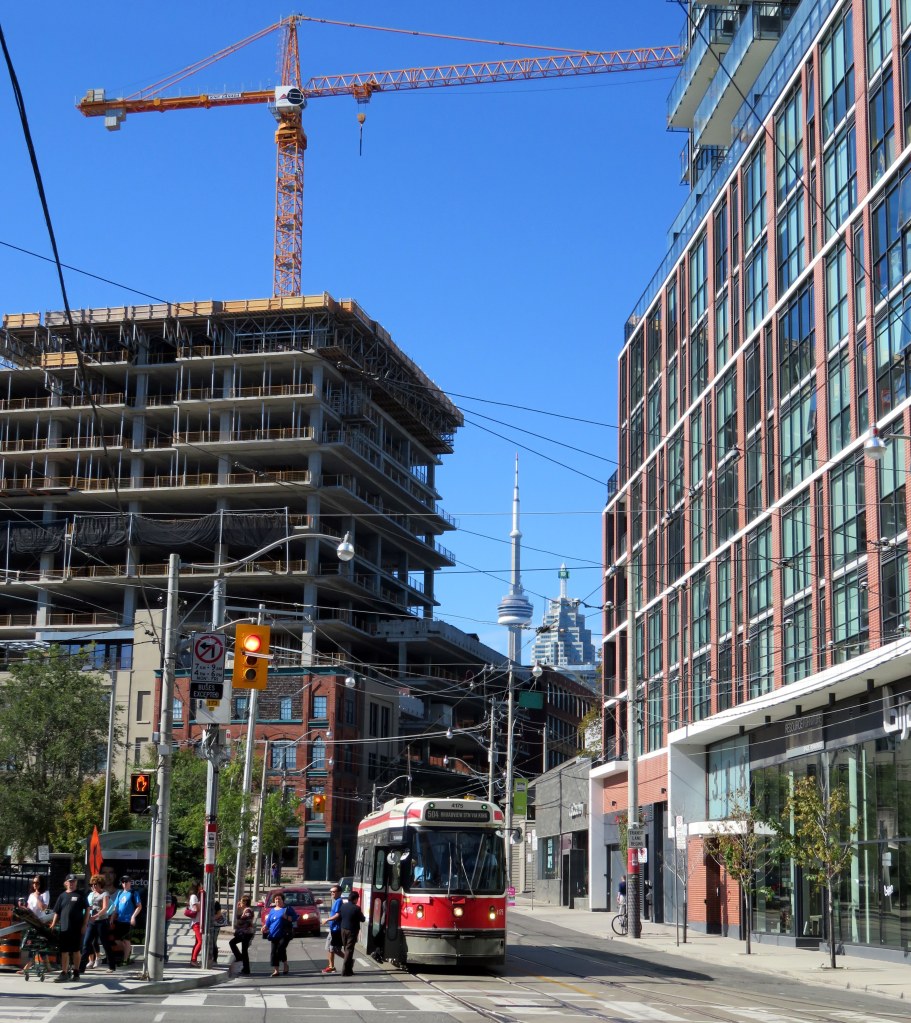
One of the most frustrating things about living and working in central Toronto is having to rely on streetcars for east-west travel. This isn’t the fault of the streetcars; when free of traffic, they’re a smooth, fast and comfortable way to get around. But trapped in the quagmire that is downtown traffic, streetcars are painfully slow. They’re stuck behind left-turning cars and trucks. Cars plugging the curb lane, legally or not, force all traffic into the streetcars’ path. Replacing streetcars with buses isn’t a solution either; not only would more buses (and drivers) be required to match the each streetcar’s superior capacity, but buses would be forced to weave in and out of the curb lane around taxis, parked cars, delivery vans and other obstructions.
Rapid residential growth, both east and west of the downtown core, have overloaded the 504 King Streetcar. With 64,600 daily riders, it’s the busiest surface route in the system. The city has done little to facilitate this highrise boom in neighbbourhoods such as Corktown and the Distillery District in the east, and CityPlace, Liberty Village, Niagara, and Queen/Gladstone in the west. Further west, the highrise condos built at Humber Bay Shores must either rely on a painfully slow and unreliable ride on the 501 Queen Streetcar, take an infrequent double-fare express bus, or ride a bus up to the Bloor Subway.
No wonder then, Uber, the controversial firm that has delighted passengers with cheap transportation, but put the livelihoods of taxi drivers in jeopardy, launched UberHop, a variation of its “ride sharing” service that offers flat $5 rides between neighbourhoods along the King Streetcar and the downtown core. From a purely capitalist viewpoint, Uber is filling a need that’s been left unfulfilled.
Uber has been taking advantage of a city unwilling to regulate Uber’s “ride sharing” [I hate that term] service, a situation that’s unfair to taxi drivers, especially those with ambassador plates, who must be licensed, insured, and regulated by the city. Yes, it can be hard to be sympathetic to taxi drivers: they often refuse short rides, they pretend that their credit/debit machines don’t work, they are known for not picking up persons of colour. Customers love the convenience of hailing a cab from their phone and paying without hassle through an app.
Now, with UberHop, Uber is probably in violation of the TTC’s monopoly on public transportation within the City of Toronto. This is a law that’s been on the books since 1921, meant to protect the TTC from illegal jitneys and competition from private bus operators. It allows the system to cross-subsidize unprofitable routes that are necessary to form a complete network; private companies, without subsidies, would just cherry-pick profitable routes.
The TTC has not been able to fill a need. But like the failure to regulate Uber, and offer some fairness to taxi drivers, the City of Toronto is largely to blame. Underfunding the TTC, prioritising suburban projects, chasing pipe dreams like SmartTrack, has helped to create this mess on King Street. Yes, the TTC often suffers from poor management of surface routes, but it has been trying to come up with short-term solutions to King Street. Yet the city has stood in the way.
The Waterfront East streetcar, planned to facilitate development of Queen’s Quay East (and serving Corktown South and the Distillery District), is still unfunded, as is a plan to build a new Waterfront West LRT. But an unnecessary and pricey three-stop Scarborough Subway? Why not!
On King Street, the TTC now runs a supplementary 504 bus service, and will likely be introducing a new supplementary streetcar line, Route 514, between Dufferin Street and the new Cherry Street loop. This won’t solve any traffic problems; it might just add a few hundred more seats during the busiest times of the day.
A subway, like the oft-proposed and oft-ignored Downtown Relief Line would be a fine solution to east-west transit congestion in Downtown Toronto, especially if the route extended west of Downtown, serving neighbourhoods such as Niagara-Fort York, Liberty Village, Parkdale and Brockton. GO Regional Express Rail (RER), or John Tory’s “SmartTrack” could provide some relief to streetcars on King and Queen Streets, but trains would have to be frequent enough, stop in convenient locations, and have fares that are comparable with local transit. The cost to ride the half-hourly GO Train from Exhibition Station (adjacent to Liberty Village) to Union Station is, by far, the most expensive ride per distance traveled in Greater Toronto’s bus and rail network. Any regional rail-based solution has to account for this.
But there are short-term fixes that could help improve east-west transit. Back in 2001, the Toronto Transit Commission (TTC) proposed major changes to King Street. Reserved lanes, painted in 1993, didn’t work, and the police weren’t interested in enforcing the transit lanes, or ticketing cars and trucks illegally stopping or parking during rush hours, so the TTC wanted to try something more effective and permanent: it would ban all through traffic on King Street between Dufferin and Parliament Streets, while allowing deliveries, passenger drop-offs and other services in alternating curb lanes. Pedestrians would benefit from wider sidewalks, there would even be room for patios, greenery and programmed spaces. The result would be a reliable, efficient King Street for the majority of the street’s users – streetcar riders, and pedestrians. You can read more about it at Transit-Toronto, here.
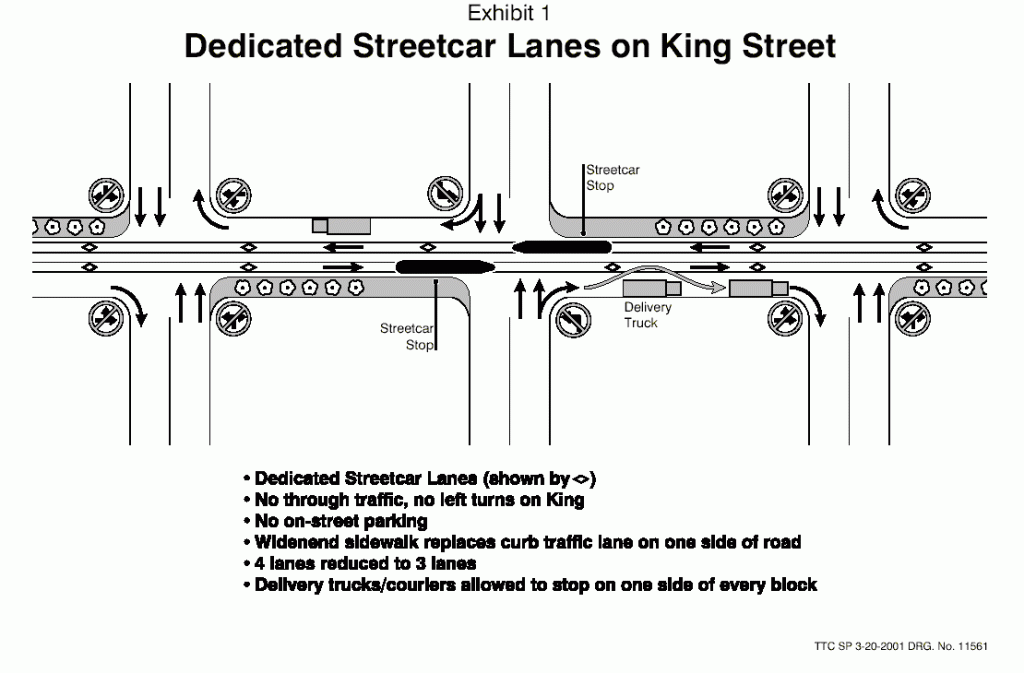
TTC image illustrating the 2001 King Street streetcar right-of-way proposal. Image via Transit-Toronto.
The TTC’s ambitious, yet affordable, plan to improve King Street service was deep-sixed by Mel Lastman’s City Hall. Merchants complained about the loss of parking, about the difficulties of deliveries and garbage collection. They feared a loss of customers. (Never mind many, if not most of the restaurants’ clientele arrived by foot or transit.) It never had a chance.
Again, in 2007, the TTC proposed a pilot project to improve operations on the King Streetcar during the summer months of 2008. It was a less ambitious proposal than the one pitched in 2001, which would only last during July and August, between Simcoe Street and Spadina Avenue. Again, local business owners and a car-friendly city council successfully opposed it.
But for a week in September, the city closes King Street entirely for the benefit of the Toronto International Film Festival. TIFF hijacks the whole street for its own benefit, while the TTC and its customers are left inconvenienced. While TTC staff were against the closure, it was Scarborough’s Glenn De Baeremaeker, who championed the subway, who whines about how Scarborough “deserves” a subway in the absence of facts, and whose motion sunk a fully-funded LRT expansion, moved the TIFF-friendly motion. In his mind, I guess, King streetcar riders weren’t deserving enough.
I’m not a fan of Uber, though I grudgingly acknowledge that it has done exceedingly well identifying a problem in the marketplace and coming up with a solution, whether taxi drivers, plate owners, and municipal governments like it or not. Meanwhile, the city planned and approved residential development along the King and Queen Street corridors, and new office space downtown, yet has done almost nothing to help move the new residents and employees. UberHop is the symptom; an ineffective municipal government is the problem.


Leave a Reply