
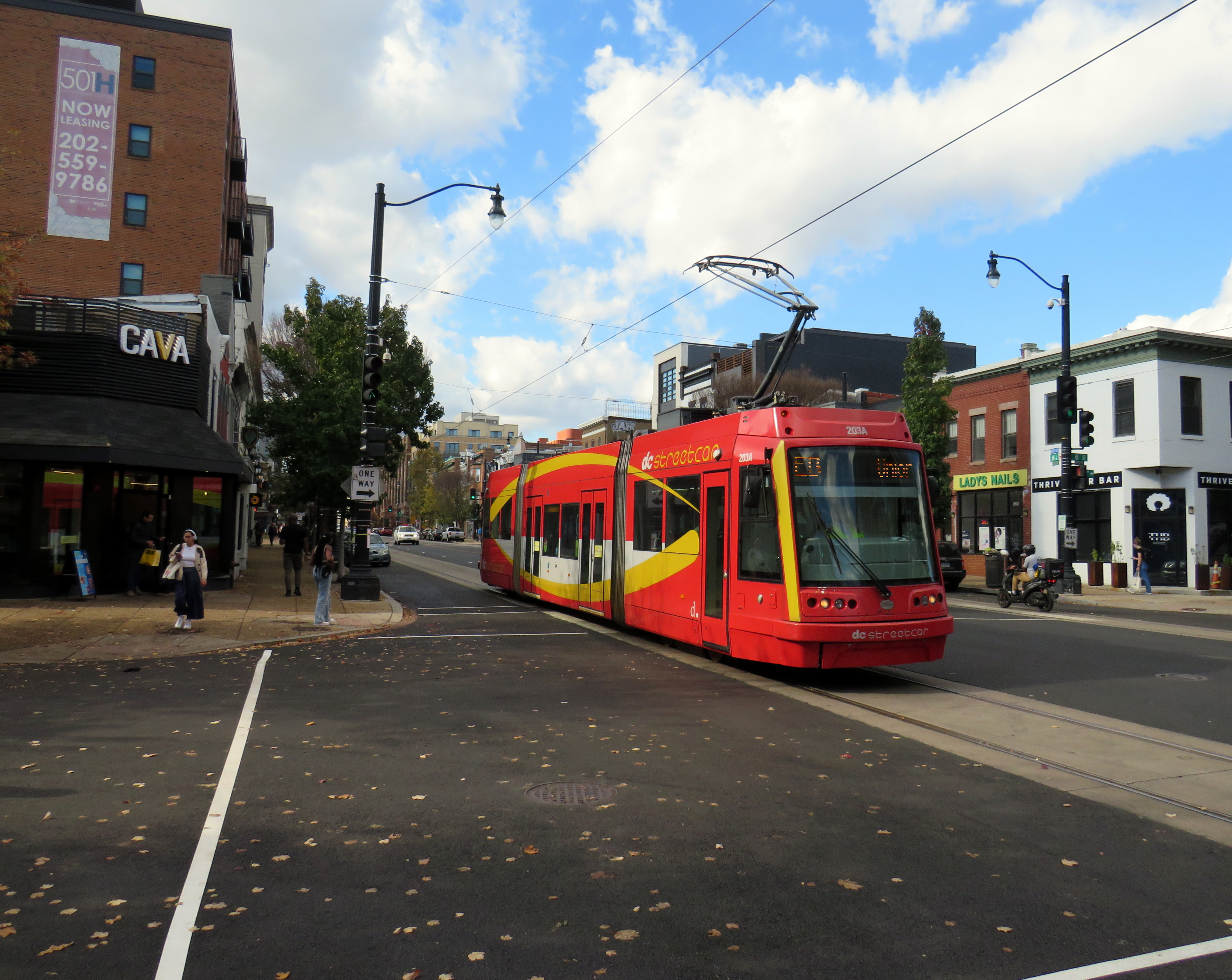
In mid-November, I found myself in Washington DC, accompanying my spouse as she had multiple days of work-related meetings. While I spent part of my time visiting cities in Delaware, Maryland, and Virginia, I also visited several neighbourhoods in Washington itself. Among the things I wanted to see for the first time was the D.C. Streetcar, one of nearly a dozen systems built across the United States in the last two decades. I had already taken rides on modern streetcars in Atlanta, Detroit, Kansas City, Cincinnati, as well as Portland and Seattle, coming away mostly unimpressed — though Portland, Detroit, and Kansas City show some promise. Washington’s small implementation didn’t win me over either.
I grew up in Brampton, a suburb of a city that maintained a large legacy streetcar fleet. Growing up, I thought streetcars were the greatest thing: big, smooth, quiet, gliding through some of Toronto’s most interesting neighbourhoods. I watched as the city expanded its street railway network along the waterfront and up Spadina Avenue before I had the opportunity to move to the big city.
Living in Toronto, and reliant on the streetcars, I got to experience the highs and the lows of street railway operation: traffic congestion, bunching, diversions, bustitutions, but also the sweet late-night rides when the streetcar really felt like the king of the road. The new low-floor Flexity streetcars brought even larger vehicles, but they were subject to the same constraints as the smaller CLRVs.
The TTC’s indifference to line management and the insistence on slow operation in the name of safety (without actually addressing problems like obsolete switches) made streetcar travel less magical with every passing year. But in Toronto, streetcars are still a workhorse, and there is still no easy way for buses to permanently substitute for the demand on routes like King Street.
Visiting cities elsewhere in the world, like Vienna or Hiroshima, makes me realize that trams can and should work, something that Toronto has largely forgotten. Or something that American cities rediscovering the streetcar haven’t even figured out.

Like all large American cities, Washington once had a robust streetcar network, with several private operators that consolidated into Capital Transit in 1933. Streetcars extended throughout the District and into Maryland suburbs, with separate companies providing service into Virginia’s sprawling suburbs until 1941.
Within central Washington, streetcars were required by law to draw electric power from an underground conduit for aesthetic reasons, though outlying areas did not have this this obligation. Therefore, many streetcars in DC, including the modern PCC streetcars acquired in the 1930s and 1940s, had both overhead trolley poles and underbody current collectors.
The last streetcar line in DC was abandoned in January 1962. Fourteen years later, the first section of the Washington Metro opened for service. Unlike the streetcars, the new Metro system was more of a regional service, reaching far out into the Maryland and Virginia suburbs. (Famously, the affluent and congested Georgetown area of Washington is not served by Metro, which was designed mainly as a commuter service.) Though bus service was consolidated throughout the region, there were parts of Washington left underserved by Metro and local bus. The District government began operating its own bus service, DC Connector, and began planning new streetcar services to serve traditionally underserved and rejuvenating neighbourhoods.
Map of the proposed Phase I streetcar network. Only the thick red line was completed.
The first planned route would have connected Anacostia, a historic neighbourhood with a majority Black population, with the Metro and with the gentrifying Navy Yards district on the north side of the Anacostia River. At first, the new light rail would have followed a disused CSX freight spur line, but disagreements with the railroad and land title issues changed the route to a shorter, on-street alignment. After several false starts, work started in 2009 on a “demonstration line” between Anacostia Metro Station and Joint Base Anacostia–Bolling, a major military installation, with an extension to Minnesota Metro Station to follow.

Work was suspended indefinitely in 2010. Today, less than a mile of track remains abandoned in place.
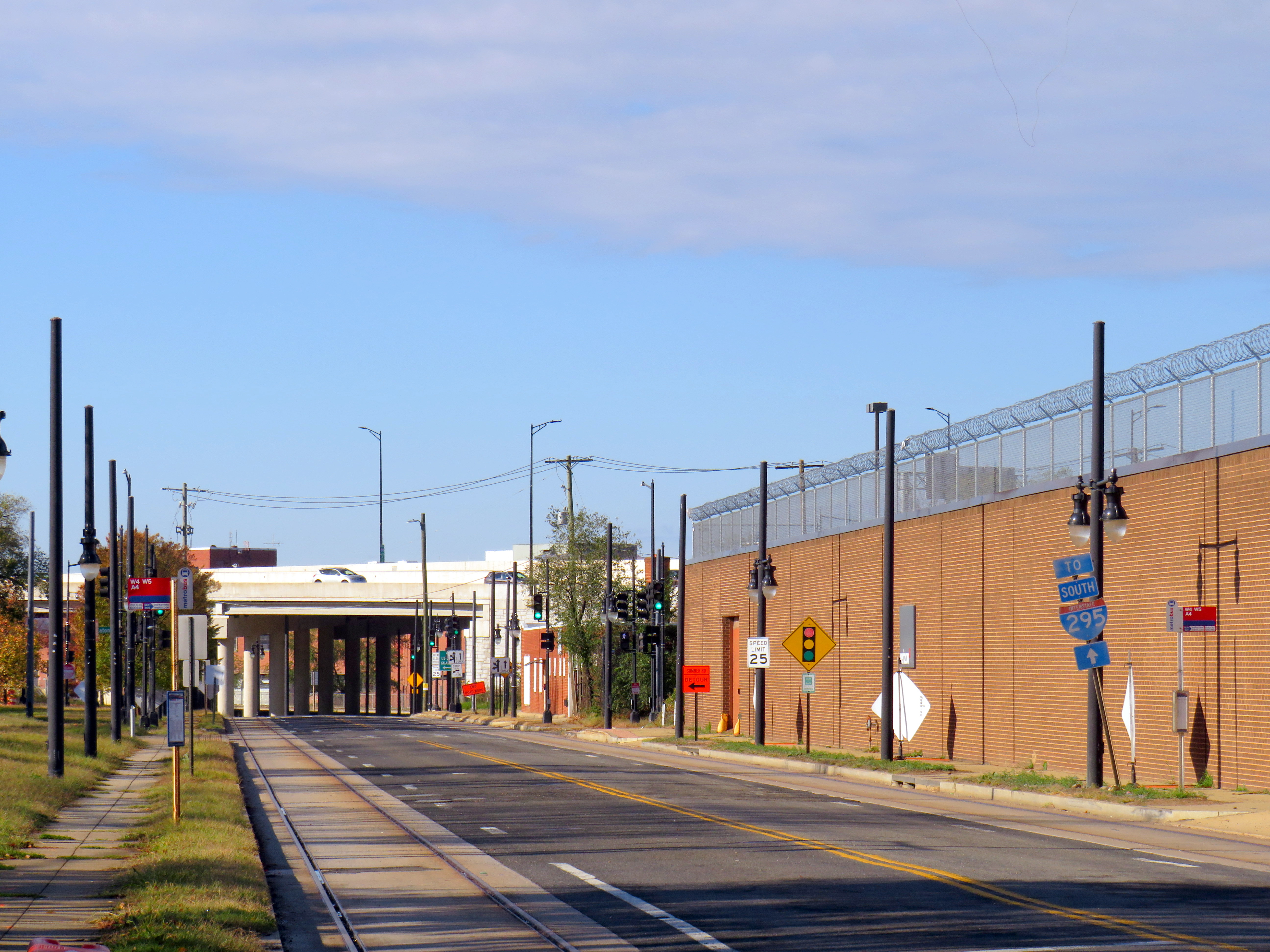
An abbreviated 2.4 mile (3.9 km) H Street-Benning Road Line did open, however, in 2016, several years late. The route, which begins on the H Street overpass north of Union Station, extends east to Oklahoma Avenue, at a public park and sports complex north of the abandoned RFK Stadium. Service, which is currently fare-free, operates every 12 minutes during daytime hours. A parallel bus route, the X2 Benning Road–H Street Line, operates as frequently, but has a much longer route and is considerably faster.
H Street, in the city’s east side, has long been a lower-income, majority Black neighbourhood, hit hard by disinvestment, civil unrest (especially after the assassination of Dr. Martin Luther King Jr. in 1968), crime, and depressed property values. But its proximity to the governmental, cultural, and commercial centres of the city made it an attractive corridor for redevelopment.

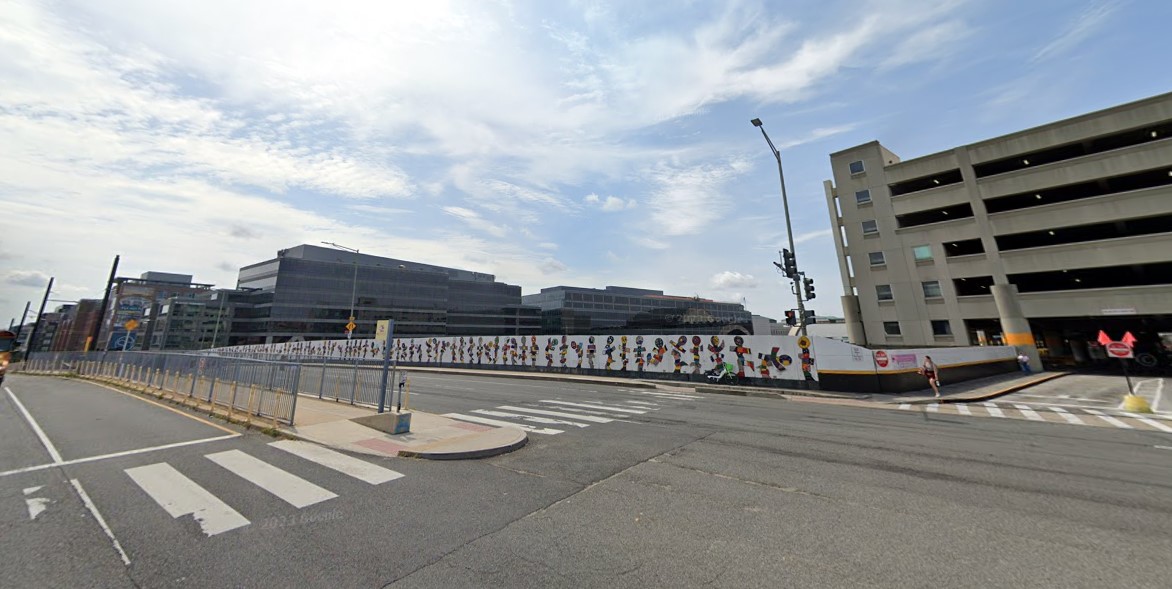
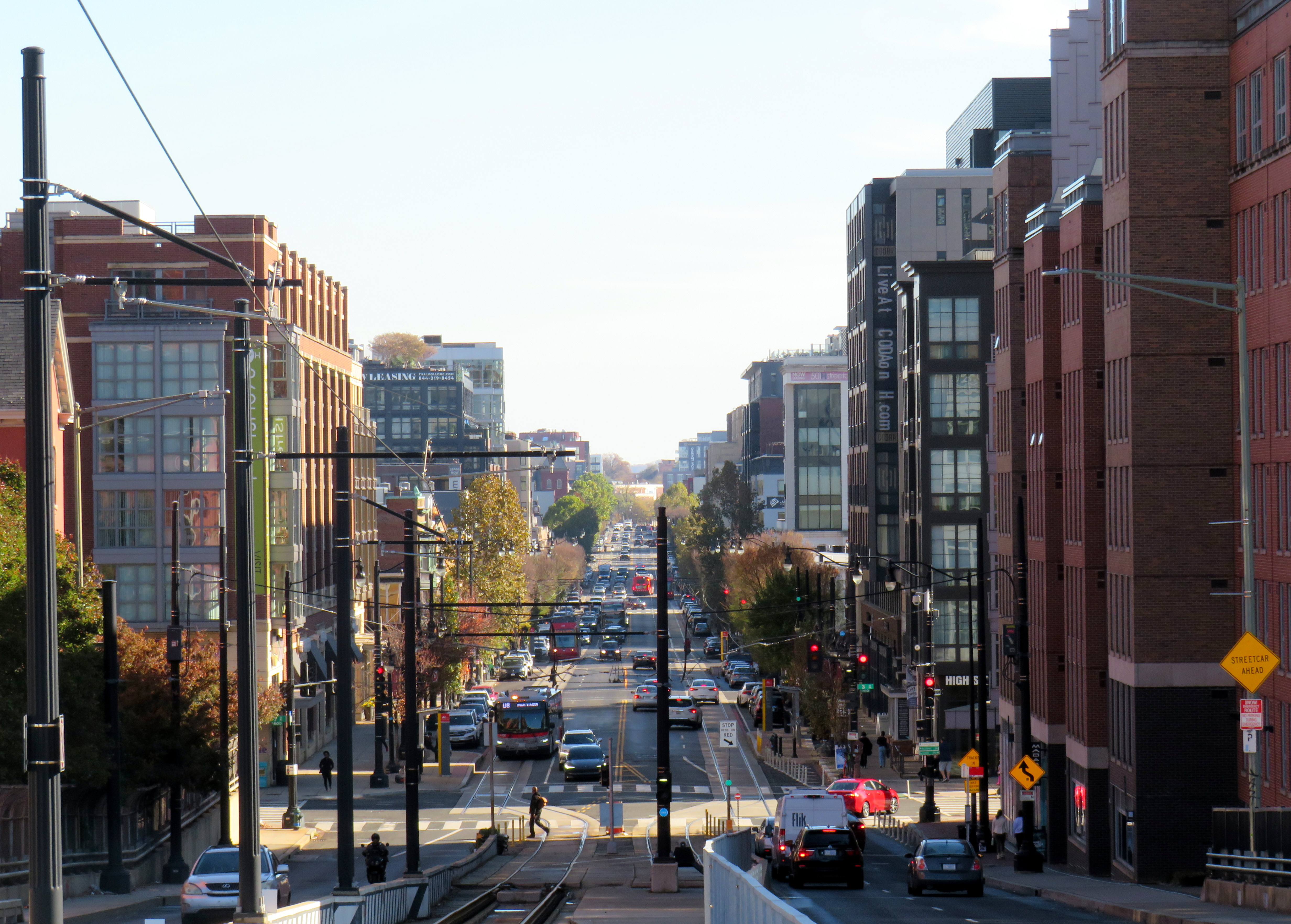
Though Union Station is the western terminus of the short streetcar line, the connection to the Metro Red Line, Amtrak, MARC, and VRE trains is awkward. H Street is to the north of Union Station, crossing over the multitude of tracks leading into the station platforms on a long overpass. The streetcar stops halfway across, in the median. Passengers getting off the streetcar must walk further west on the median, then cross the eastbound lanes of H Street at a traffic signal controlling a driveway exit from the Union Station parking garage. A poorly marked sidewalk provides the connection into the parking garage (which also houses the Union Station intercity bus terminal) and down towards the main station building.
Like most modern streetcar lines in the United States, the DC Streetcar runs in mixed traffic, in the outer driving lane. This allows for platform level boarding from the sidewalk at each stop, but it also leaves the streetcar susceptible to traffic delays due to congestion and from stopped cars and trucks. Though there are parking and layby spaces to the right of the streetcar track, a wide or improperly stopped vehicle can easily disrupt service. Streetcars regularly squeeze past properly parked delivery vans, as in the photo below.

But new streetcar lines in North America are typically less about moving people than it is about sparking new urban development. On H Street, this has definitely happened. New mid-rise rental and condominium residential buildings line the western end, towards Union Station. A Whole Foods grocery store is at the base of one of those buildings, where previously, there was a parking lot and local grocery store.

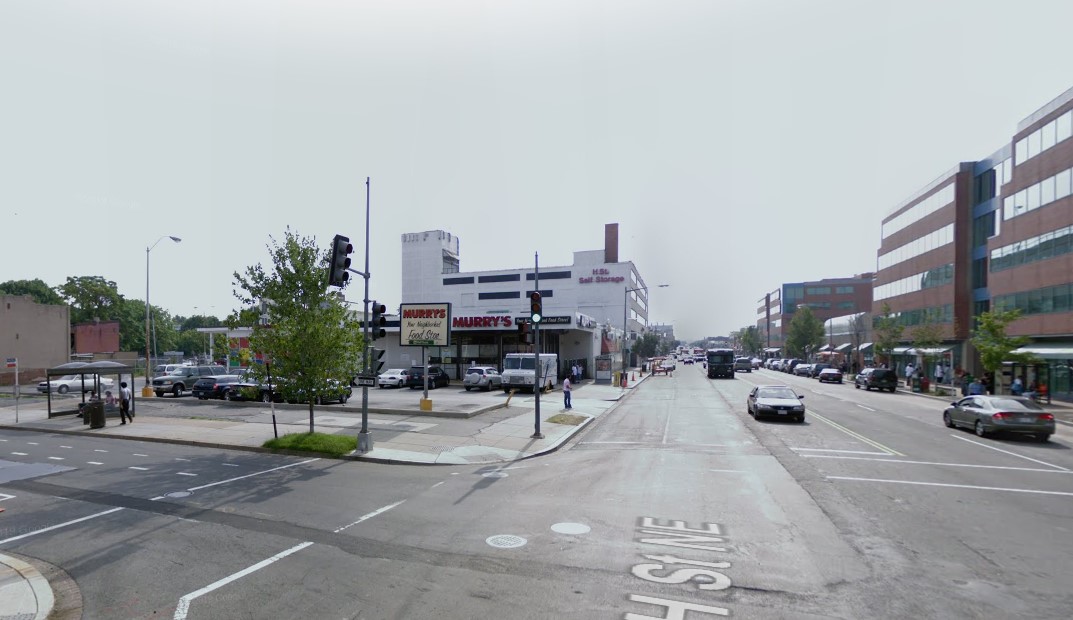
Still, I wonder how much the streetcar itself contributed to the gentrification of H Street. The streetscape is greatly improved, but streetcar ridership is low, despite the free fare. The close proximity to Union Station, government offices, and commercial areas, along with rezoning of vacant lots would have made a bigger impact. However, government investment on the corridor made it attractive for speculators and developers to assemble land and build.
In the meantime, as rents skyrocket, crime remains a concern. New stores such as Whole Foods do not serve long-term residents and local businesses have been displaced. Like Whole Foods, the streetcar was designed to support the new community, while others continue to take the bus and shop at the Safeway on Benning Road.

If the H Street-Benning Road Streetcar was extended in both directions based on the original plans, it could prove to be a useful, albeit slow, transit service filling in one of the gaps left by the Washington Metro system. But as Washington struggles with its city budget, this is very unlikely. By the end of the year, the DC Circulator bus system will disappear for good, further orphaning the single short streetcar line operated by the District.
 Sean Marshall
4 replies on “Another American streetcar, another disappointment”
[Or something that American cities rediscovering the streetcar haven’t even figured out.]
[But new streetcar lines in North America are typically less about moving people than it is about sparking new urban development. ]
Thoroughly agreed on both points, the critical phrase being “rediscovering the streetcar”.
I spent some time in San Diego years ago, and was very impressed at how SD has implemented their system. Sections of it, especially the run on the acquired former Southern Pacific heavy rail down to San Ysidro, is done at high-speed for LRTs.
The San Diego Trolley is considered the spark for ‘second generation’ US LRTs. Unfortunately, almost all have missed the essential lessons that makes the SD Trolley such a success.
To bring the analogy back to Ontario, as much as Kitchener-Waterloo’s ION is a success in many ways (Metrolinx take note!), it just ambles along the heavy rail sections.
Something is being lost in the implementation of LRTs in North Am (with a few exceptions), and that’s speed.
Nice writeup, Sean. I think the “American streetcar rennaisance” are a good case study in the poor vetting of infrastructure investments chosen by the Obama administration right after the Great Financial Crisis of 2008.
The original Portland streetcar was the only modern streetcar that was running at the time. It was mediocre in execution, being a one-way circulator with lousy frequencies, but it probably is still the best of all the modern American streetcars. This was used as a template and cash was thrown willy nilly at any city that wanted to build a streetcar. On a larger scale, the Obama administration also did the same with “high speed rail” funding, some of which went to useful projects like removing at-grade rail junctions in Chicago, but a lot of it was wasted, like the CAHSR money pit or funding for a proposed HSR line in Florida that the Republican state government iced (ironically, Florida became the first state to actually build high frequency rail when the privately-run Brightline went online years later).
in hindsight, I think Obama’s approach to infrastructure investment right after the GFC was very flawed. It threw money at vanity projects in places that were not strategic for Democratic victory (like DC) when, in reality, there was a huge backlog of critical repair projects that would have bought them a lot of goodwill across the country. Goodwill that they lost in the 2010 midterms. Some of those backlogged projects turned out to have tragic consequences – like Flint’s lead pipes, which was a human rights scandal in a swing state.
I’m not saying that Obama’s infrastructure priorities led to Trump, but it was symptomatic of how his administration was swept in by the working class like a latter day Robin Hood and then begun to undermine that from day one.
Buffalo had a small lrt ,way before 2008.
In Europe, streetcars are enjoying a renaissance. You would think that our US capital should receive the same support.