
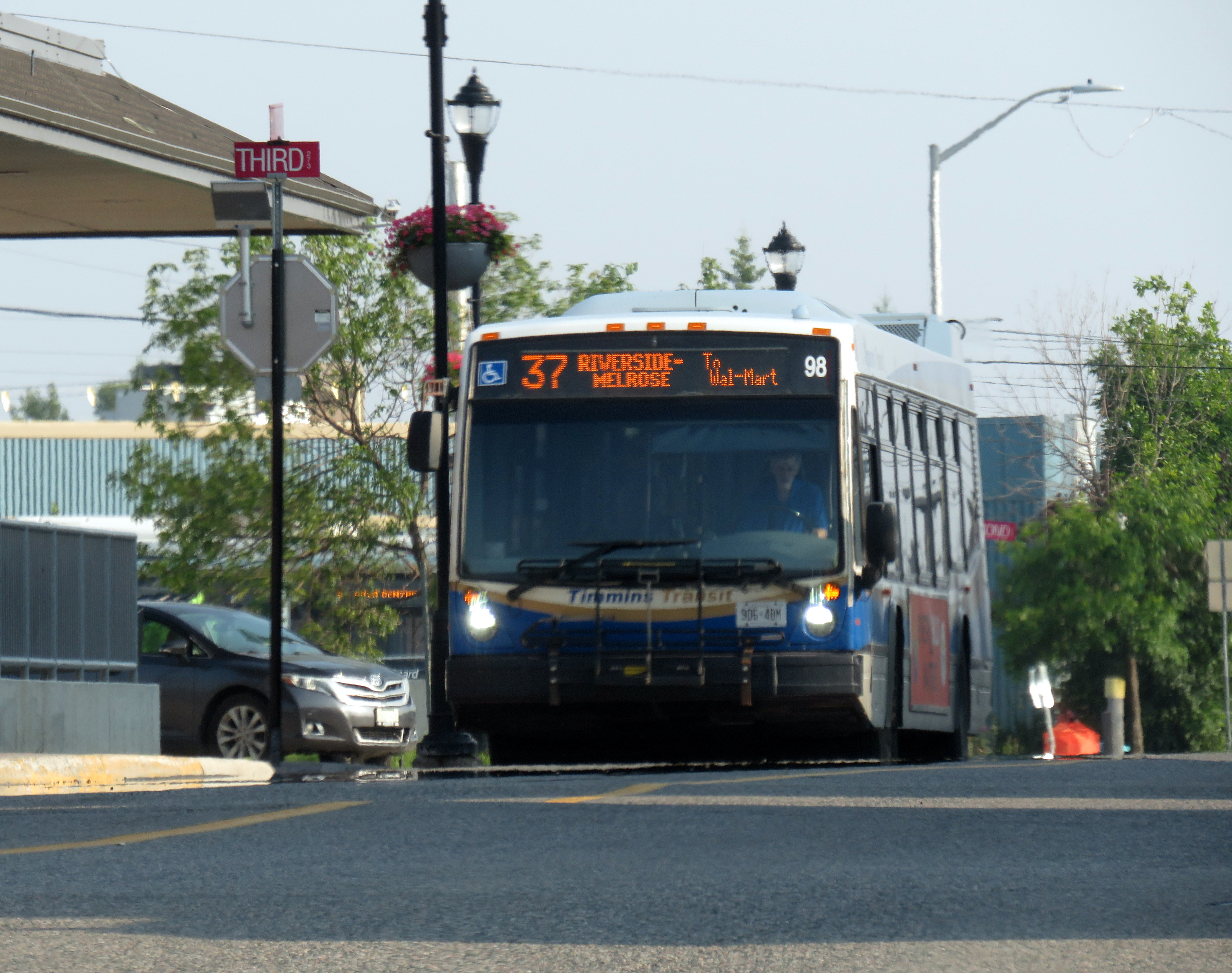
Last month, I found myself intrigued by American transit consultant Jarrett Walker’s observations about the difficulties of getting to Walmart stores by public transit in US cities. On Bluesky, Walker examined the long walks through hostile environments between Walmart stores and the nearest bus stops, and it is an interesting thread.
In response, I noted the more typical experience in midsized Ontario cities. Though American and Canadian land use policies are similar in many ways, complete with the post-1990s proliferation of “big box” retail developments, there are some significant differences. For example, local transit systems will often make an effort to serve big box retail clusters, particularly Walmart stores.
Walmart stores are important to transit riders, especially in smaller urban centres that have few or no other major shopping centres. Most Walmart stores now have an in-store pharmacy, carry a full selection of groceries, and have ancillary services, such as medical clinics, haircutters, and opticians. Walmart itself will typically anchor a larger commercial development with other big-box retailers such as Home Depot or Canadian Tire. These commercial developments and surrounding areas will have up to have several hundred employees, some of which may also rely on transit.
From the 1960s to the early 2000s, regional shopping malls were often major transit hubs in mid-sized cities and suburban municipalities in Canada, typically located in space set aside in the mall parking lot. For the most part, Canadian commercial landlords were willing to provide the space; in some cases, the terminal was even right outside one of the main entrances.
In my hometown of Brampton, for example, two of the three major transit terminals were Bramalea City Centre and Shoppers World. Mississauga’s main transit hub is at Square One mall; Hamilton has large bus loops at Limeridge and Eastgate malls, and London has transit hubs at Masonville Place and White Oaks Mall. Smaller cities and towns such as Belleville, Orillia, and Peterborough would also be sure to serve the local shopping mall with at least one route stopping on the mall property, typically in a space set aside on a mall driveway.
Sometimes, these mall terminals become too small or too difficult for buses to get in and out of. Brampton Transit grew, the Shoppers World and Bramalea City Centre terminals were moved to larger facilities off-site with better road access, but still close to the malls. In smaller cities, where the importance of enclosed shopping malls (anchored by traditional retailers such as Sears Canada, Zellers, and Hudson Bay) declined in favour of big-box retail, often located on the urban outskirts, the buses followed where their passengers needed to go.
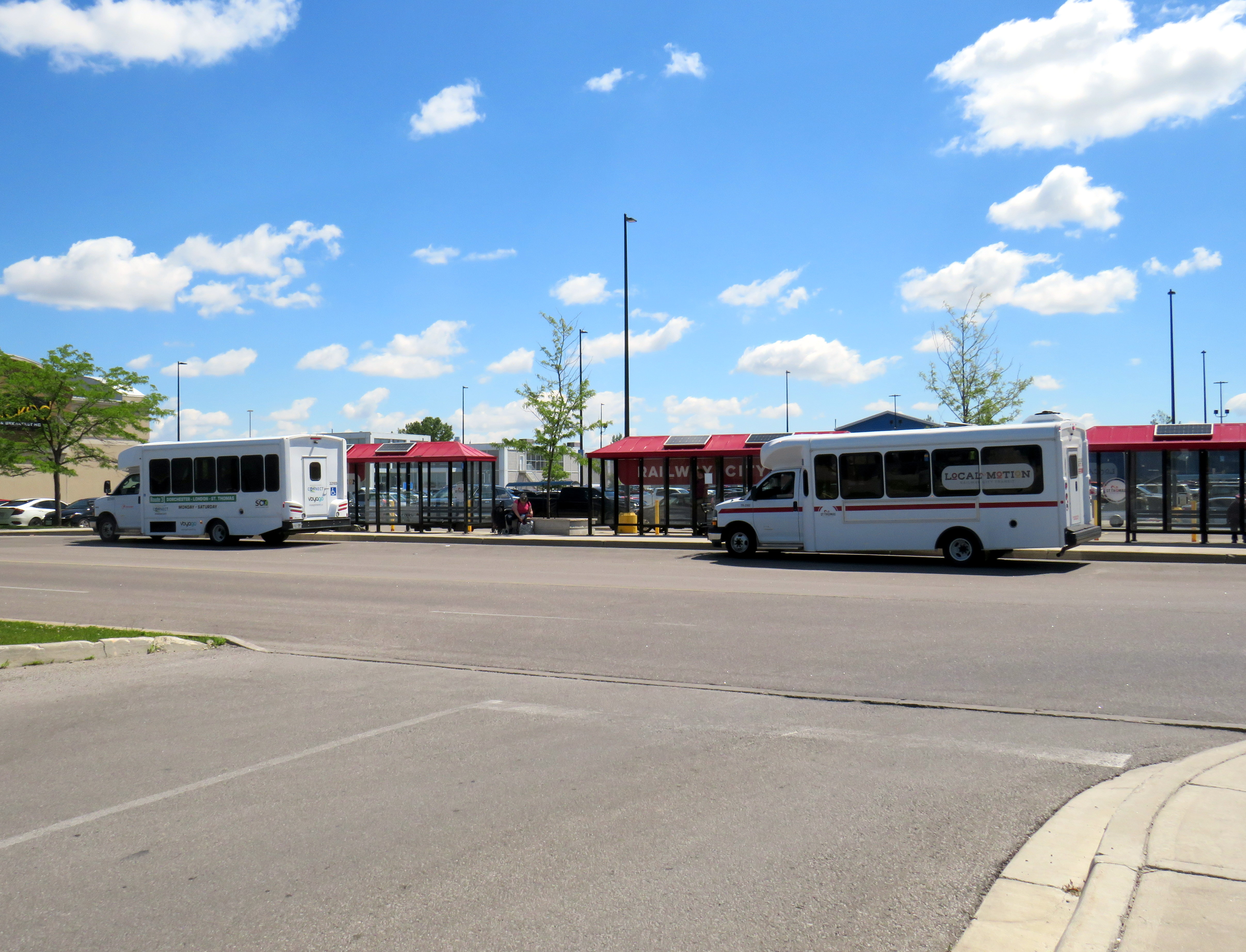
In St. Thomas, a small city of about 45,000 people, the main transfer point is in front of the Walmart store parking lot, meaning that every bus rider gets a one-seat ride to the SmartCentres-managed property, which also includes a Loblaws grocery store, Canadian Tire, and over a dozen smaller stores, restaurants, and banks. The recent relocation of the transit hub from a struggling downtown to the big box centre to the west — which is actually closer to the city’s geographic centre — makes sense. It now also serves as the transfer point to the regional bus service to London.
In Brockville, another small city in Eastern Ontario, the two transfer points are in the downtown and at “Box Stores Transfer” in the northeastern corner of the municipality. The latter is also the transfer point to the inter-municipal River Route to Prescott and Cardinal. In other smaller Ontario cities, including Belleville, Chatham, Orillia, Sarnia, and Timmins, there is at least one bus route extending to the end of the urbanized area to serve the Walmart and/or other large big box retailers. Often the stop will simply be called “Walmart” or “SmartCentres.”
Sometimes, larger cities will have transit terminals in the middle of big box parking lots. On the south end of Sudbury, GOVA’s Route 1 Mainline terminates in front of a Walmart parking lot, with connections to three local feeder routes. A similar set up can be found in the north end of Guelph. In Waterloo, a large big box complex on the edge of the region’s urban boundary, Boardwalk, was designed with a central transit hub.
Though the examples here are all Ontario examples, the pattern generally holds across Canada, from St. John’s, Newfoundland to Nanaimo, British Columbia, though there are many exceptions. It also helps that many Canadian Walmart stores are located in shopping malls as they are in renovated and/or expanded former Woolco or Zellers stores.
Despite these attempts to provide transit services to retailers like Walmart, these are not ideal set ups. Shopping malls were designed as pedestrian environments within large parking lots. As long as there is a convenient, safe, and short walkway to the mall entrance, transit riders could be well-served. This is much harder with contemporary big box retail, as they are designed completely different. With malls, parking lots surround a cluster of stores. Most big box developments have the stores surround gigantic parking lots. Even if walkways and bus facilities were included in the site plan, there are still long, unsheltered walks between the bus stops and store entrances.
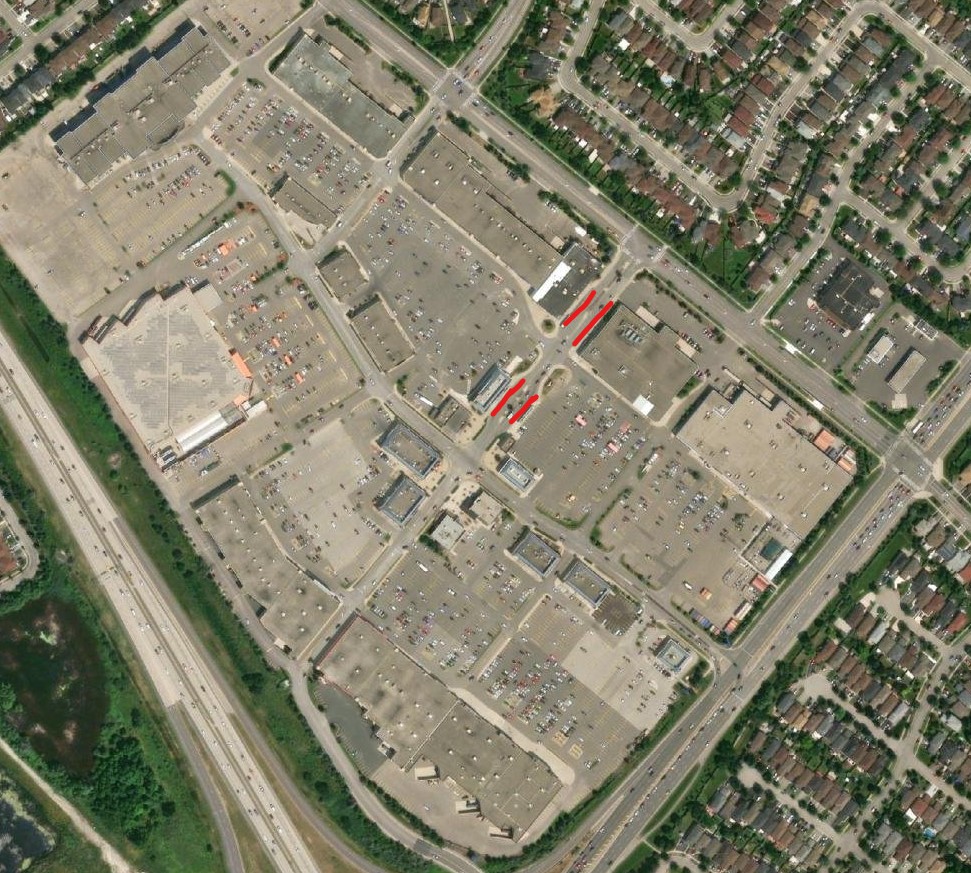
An early attempt to create a more transit and pedestrian site plan in a big box centre was Trinity Common in Brampton, which opened in stages in the early 2000s. There were distinct roadways, complete with sidewalks and street lighting; in the centre, surrounded by restaurant pads, were several bus bays and a transit terminal office. Several busy Brampton Transit bus routes converge here rather than simply stop on the adjoining multi-use roadways. Even so, the distances between retailers — which include Canadian Tire, a Metro supermarket, Home Depot and Brampton’s only multiplex cinema — make walking unpleasant.
But at least, unlike the American examples Jarrett Walker highlighted, there’s an attempt at doing better. Hopefully, the next generation of retail centres — mixed use developments with residential uses on upper levels — do better with incorporating the needs of pedestrians, cyclists, and transit users.
 Sean Marshall
One reply on “Buses to the big box”
Hi Sean
Here in Uxbridge, the DRT 905 route ends in downtown. It does not pass through “suburbia”. A dialup bus existed to pickup and deliver patrons around town. This didn’t work as planned so DRT created the 605 which follows a fixed route to suburbia, passing the Walmart and stopping between the Zehrs (grocery store) and Canadian Tire before passing through some residential areas. After looping through town a few times, the bus leaves Uxbridge as the 905, going first to Port Perry where it’s routing looks like spaghetti. It visits all the commercial areas, including Walmart on the edge of town before continuing its trip to Whitby via Oshawa.
Regards
Grant Baines
Uxbridge