Category: Infrastructure

  • Pylons are not enough: how to make a quiet street

    Pylons are not enough: how to make a quiet street

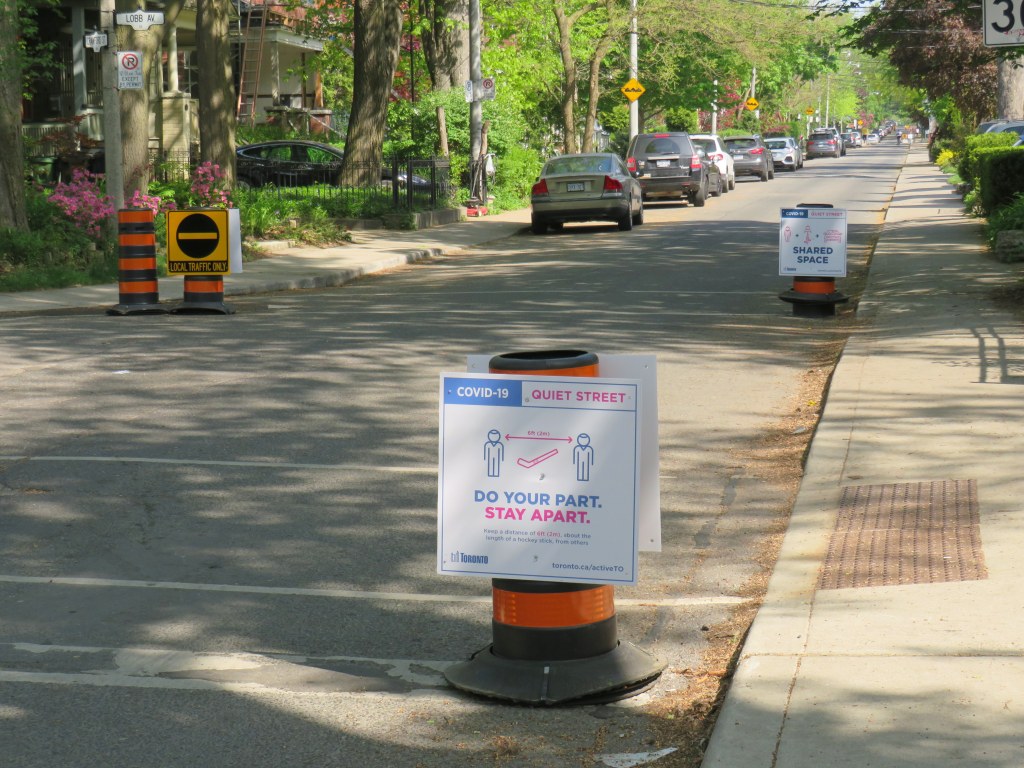
    Pylons and Quiet Street signage left in the gutter, Crawford Street, Toronto

    Toronto took its time recognizing the need for pedestrian space during the ongoing COVID-19 pandemic. It wasn’t until late April that the mayor and the medical officer of health considered limited curb lane closures to accommodate crowded sidewalks in front of supermarkets, drug stores, and other essential businesses.

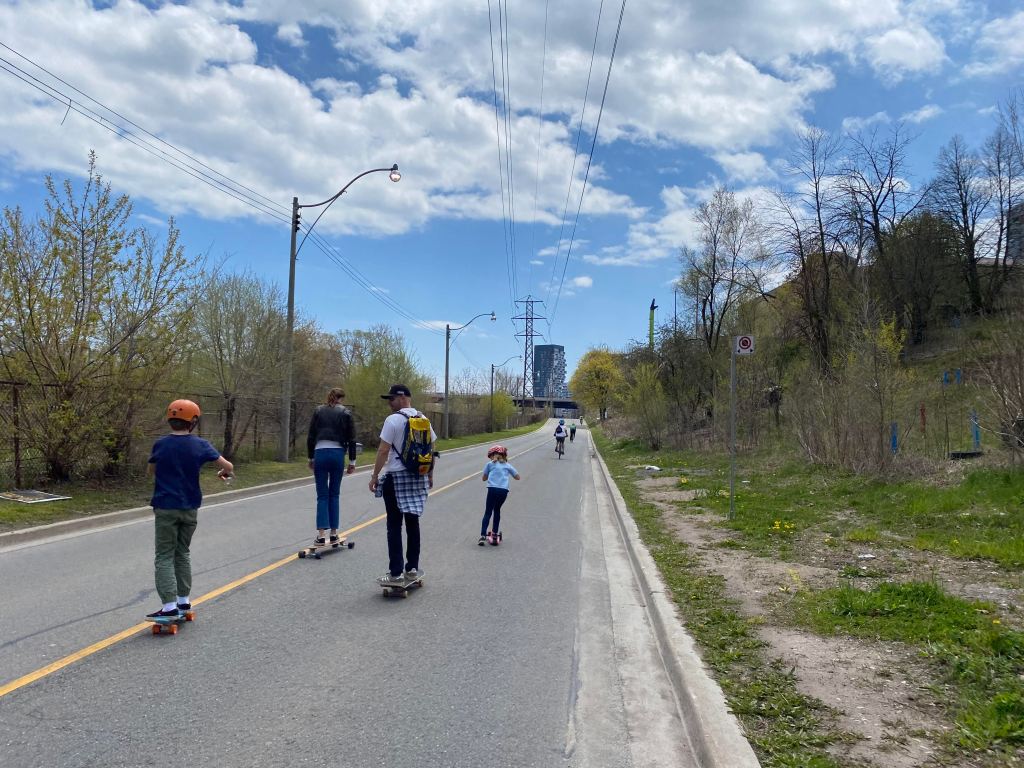
    But those curb lane closures — called CurbTO — later expanded to ActiveTO, which includes hundreds of kilometres of “Quiet Streets” for pedestrians and cyclusts and regular weekend road closures on Lake Shore Boulevard and Bayview Avenue. By June, CurbTO and ActiveTO were joined by CafeTO — which would expedite restaurant patio licences and even allow temporary patio space in parking lanes — as well as CampTO and SwimTO, programs to safely open up public pools and day camps for the summer.

    Most significantly, new cycle tracks and bike were approved by a wide margin at Council in May, including the entire stretch of Bloor-Danforth between Runnymede Road and Dawes Road.

    Map of ActiveTO Quiet Streets, weekend closures, and new cycling routes

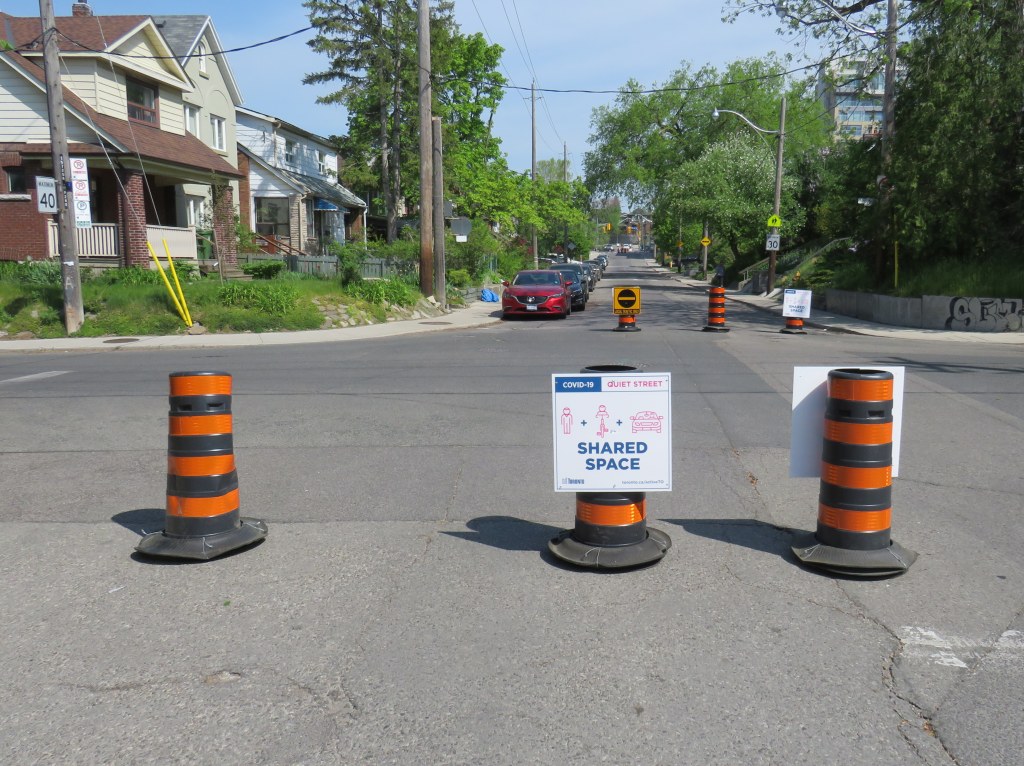
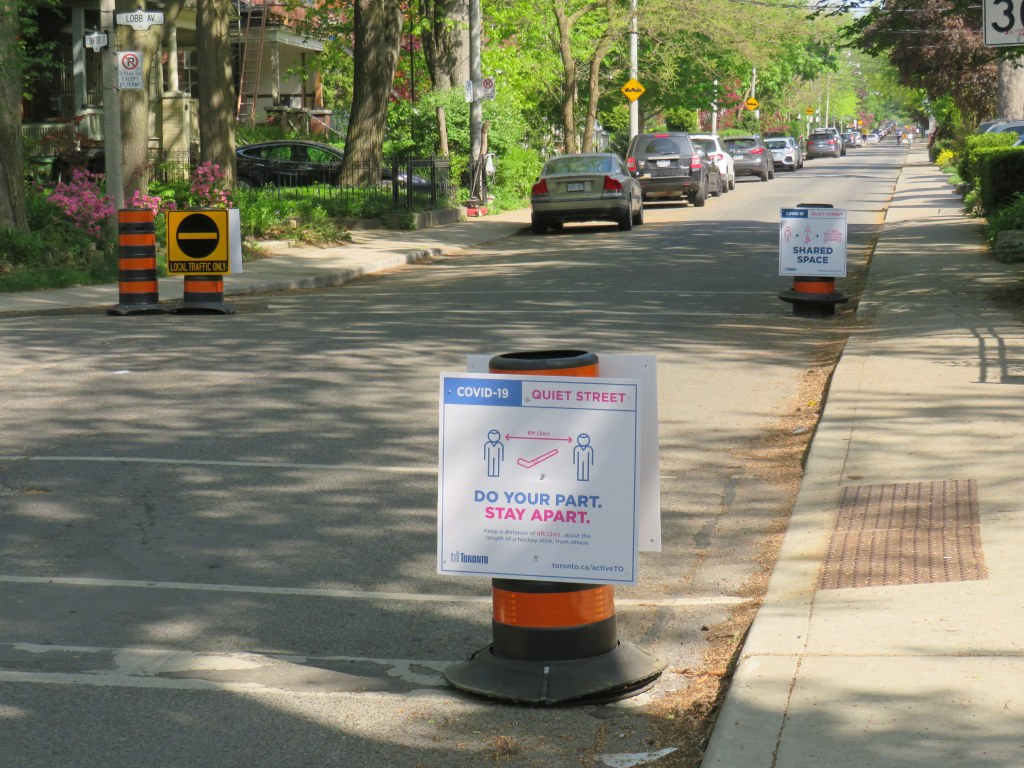
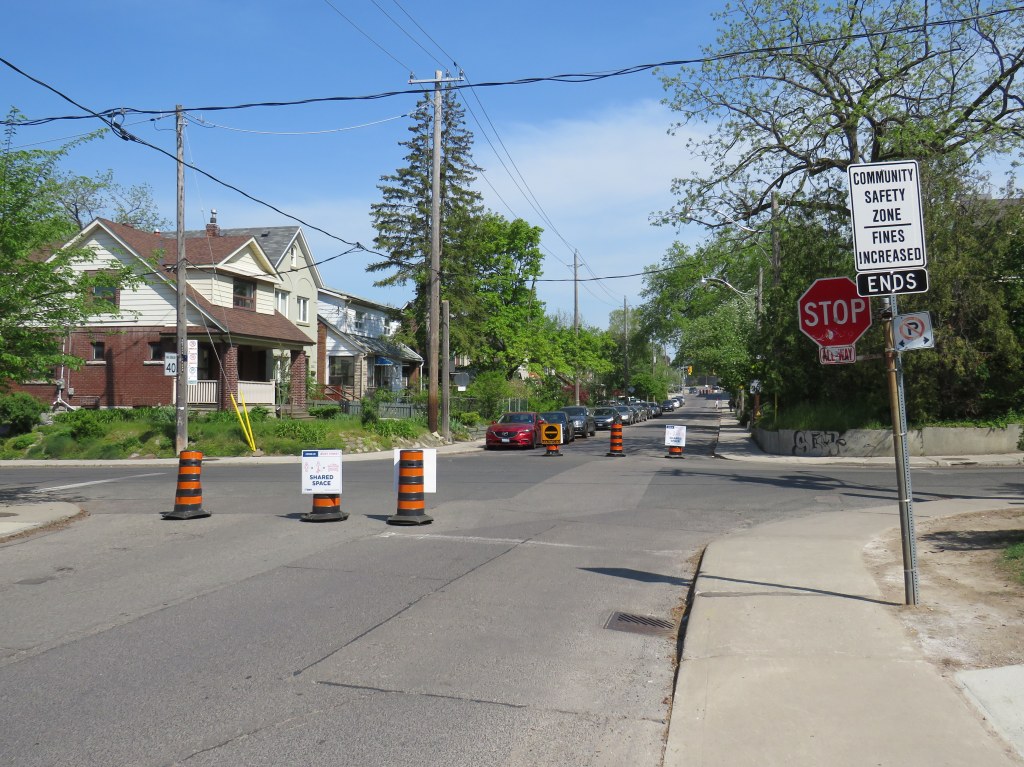
    Through the weekend road closures are closed off with metal barriers and enforced by police, the Quiet Streets are protected only by pylons and temporary signage. On Shaughnessy Boulevard, one of the first Quiet Street implementations, pylons were removed by angry motorists. Elsewhere, residents rearranged pylons to block half the street, doing more to discourage through traffic.

    In Kensington Market, pylons were moved by drivers onto the sidewalk, creating additional barriers to pedestrians, especially those with disabilities.

    Clearly, pylons are not enough.

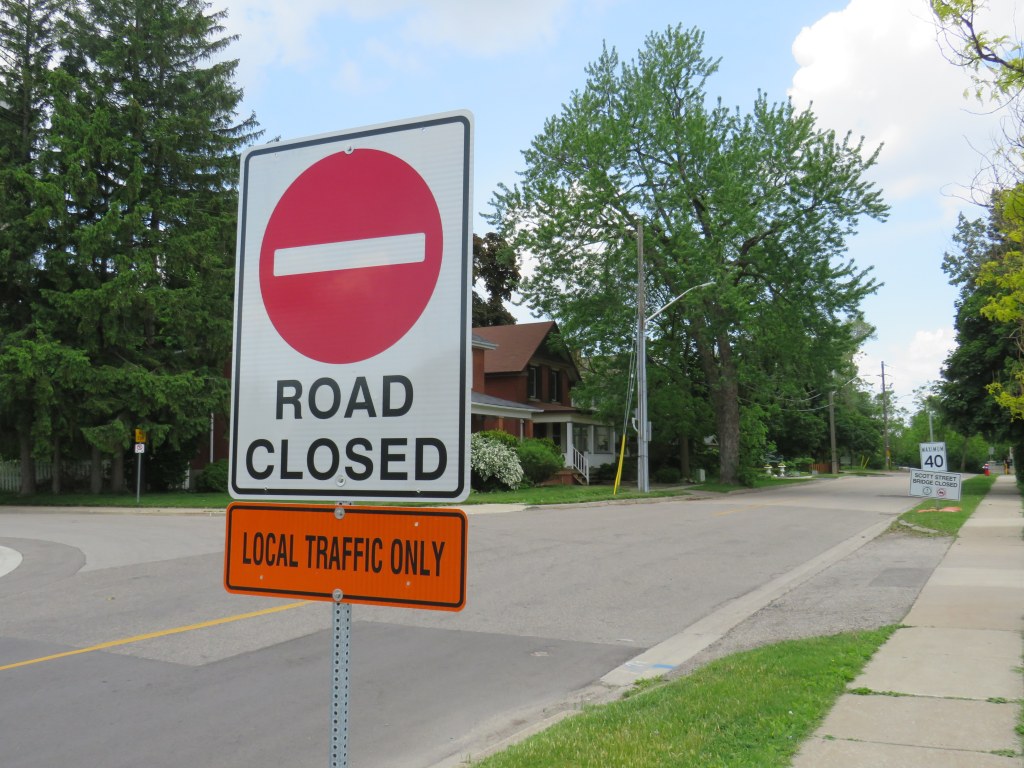
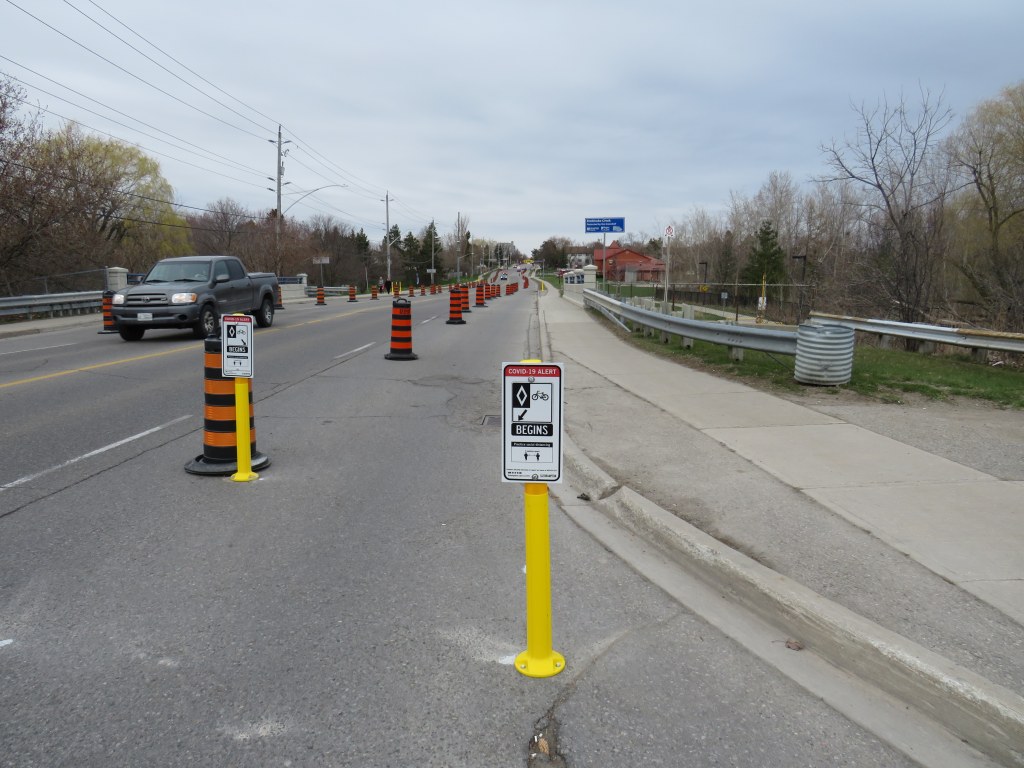
    While I was in Brampton recently, I noticed a more effective approach. On Scott Street, just east of the city’s downtown core, a narrow bridge was closed to motor traffic in order to provide a quiet and safe crossing of Etobicoke Creek to connect two sections of the Etobicoke Creek Trail. Instead of moveable pylons, rigid plastic bollards were bolted to the roadway, with a compliant “road closed” sign posted in the middle.

    Closely spaced yellow bollards on Scott Street

    Signage approaching the closed bridge was also also quite clear.

    Road closed sign on Scott Street

    I also noted that bolted bollards were also used to mark the interim bike lanes on Vodden Street and Howden Boulevard at every intersection, precluding their use by through traffic. On that early weekday afternoon, only one vehicle was illegally parked in the lane along the entire four-kilometre route. Not one pylon was out of place either.

    While Brampton was one of the first cities in Ontario to implement improved active transportation infrastructure during the COVID-19 pandemic, it has done little else since. However, Brampton has an ambitious new active transportation master plan to fix many gaps in its cycling infrastructure and expand its paths system; hopefully it will able to accelerate parts of its plan as Toronto is now doing.

    But what Brampton did right was putting in effective barriers and signage to protect its temporary walking and cycling routes. This is something Toronto could learn from.

  • A tale of two streets: Winona Drive and Shaughnessy Boulevard

    A tale of two streets: Winona Drive and Shaughnessy Boulevard

    Typical Quiet Street signage and pylon placement, Crawford Street

    Earlier this month, as part of Toronto’s long-overdue response to the ongoing COVID-19 pandemic, the city introduced ActiveTO. ActiveTO includes several measures addressing the need for safe active transportation and recreation routes as summer approaches and businesses slowly reopen.

    Current ActiveTO initiatives include weekend traffic closures of sections of Lake Shore Boulevard and Bayview Avenue to take pressure off narrow and busy multi-use paths, designating specific “quiet streets” to provide safer cycling and pedestrian corridors, and the construction of new bike lanes and cycle tracks, accelerating work on the painfully slow implementation of the city’s cycling network plan.

    One of many families enjoying the Bayview Avenue extension closure on May 16. The weekend closure provides a safe, spacious alternative to the crowded Lower Don Trail

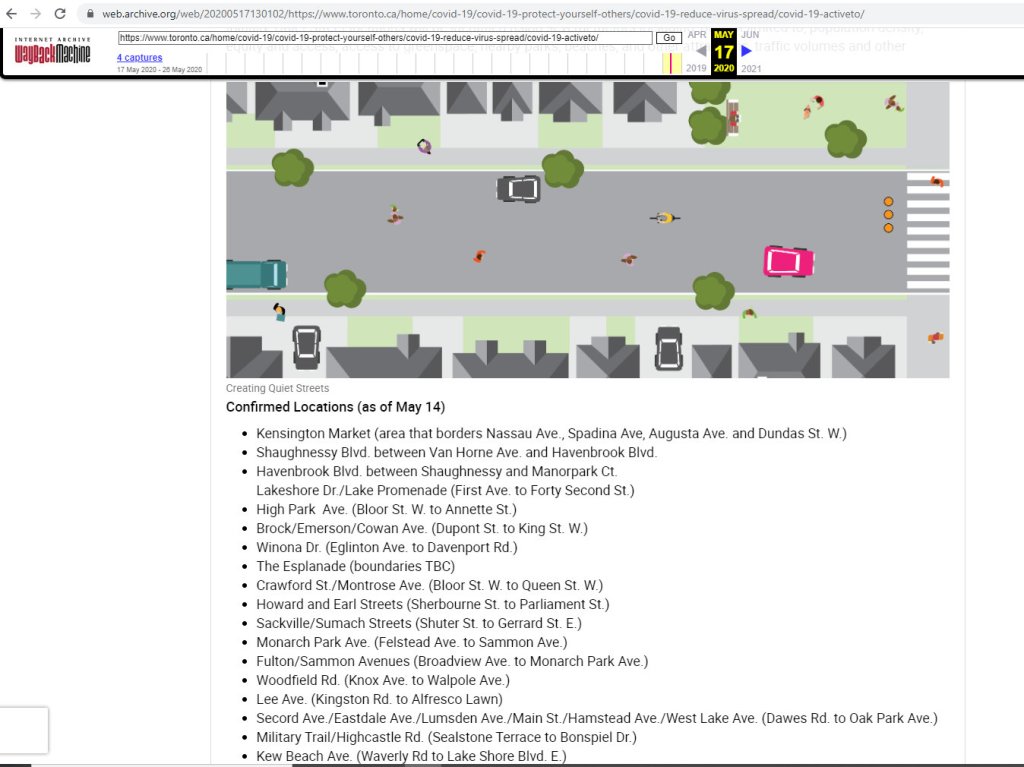
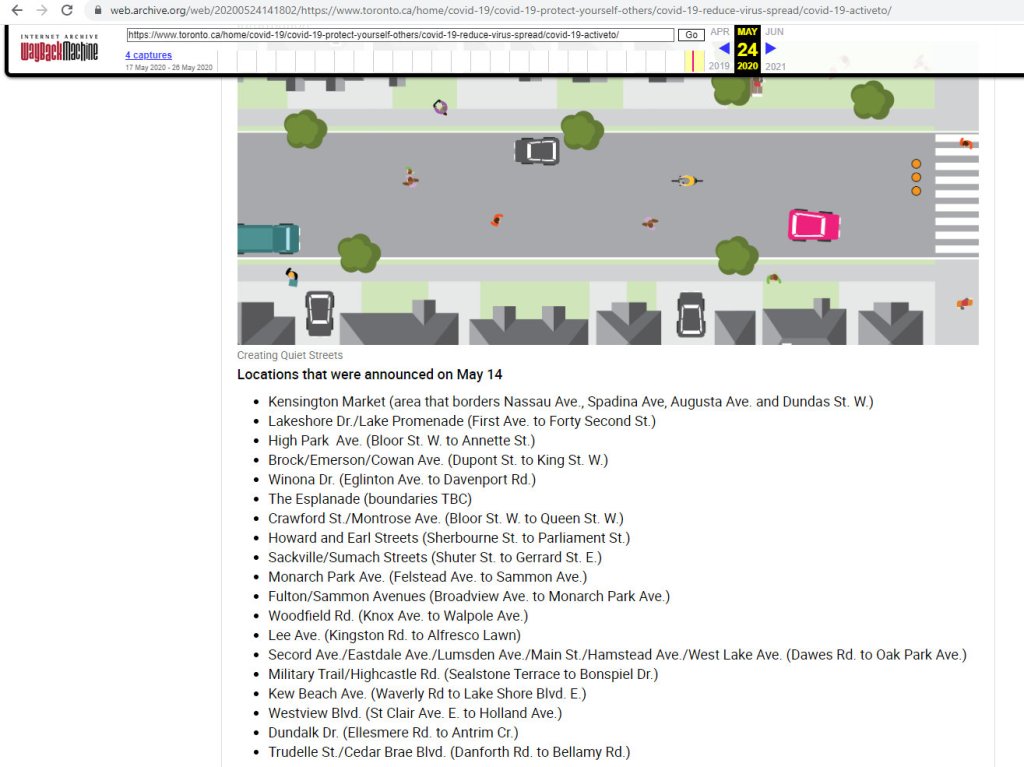
    I visited two Toronto streets this week included in the initial list of ActiveTO quiet streets that were announced on May 14, 2020.

    On Winona Drive, the pylons and signs placed by city work crews were moved by residents to block an entire lane of traffic at each intersection. This enhances their effectiveness in reminding motorists that the space is for local traffic only and that the roadway is shared with pedestrians and cyclists.

    Winona Drive at Benson Avenue, May 25, 2020
    Close-up of relocated pylons on Winona Drive

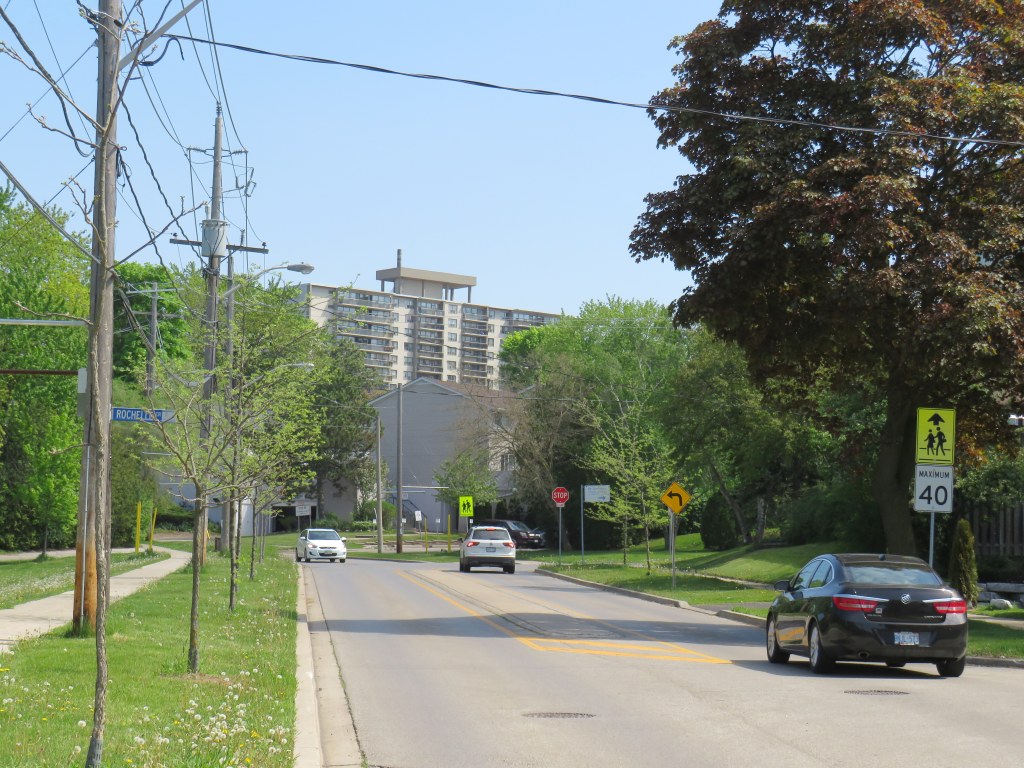
    Shaughnessy and Havenbrook Boulevards, near Sheppard Avenue and Don Mills Road, connect the densely populated Fairview Mall and Don Valley Village neighbourhoods with the Betty Sutherland Trail, part of the Don River ravine system. Though Shaughnessy is mostly fronted by comfortable, midcentury homes, it borders several apartment buildings and townhouse complexes, including several Toronto Community Housing properties.

    Shaughnessy Boulevard looking north at Rochelle Crescent

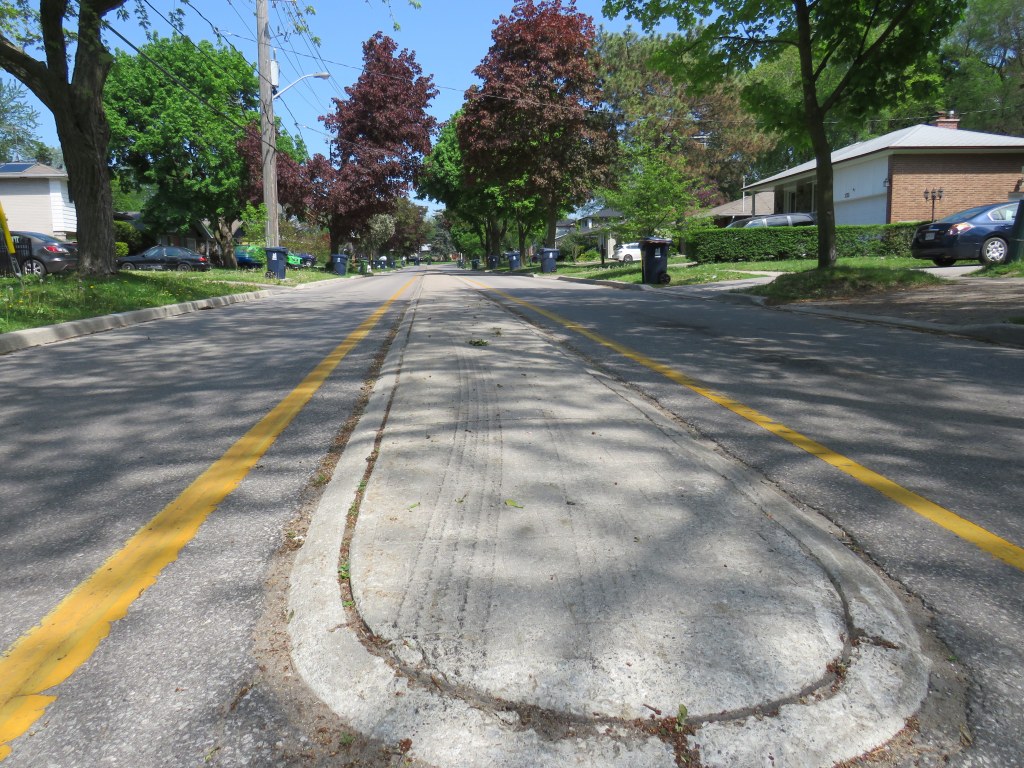
    In 2012, some road calming measures were undertaken on Shaughnessy to slow down traffic, particularly near local schools and parks. A four-lane section between Sheppard Avenue and Glenworth Road was narrowed, including a very short section of bike lanes. A shallow concrete median was added between Glenworth and Esterbrooke Avenue. However, the street remained problematic.

    The shallow median on Shaughnessy Boulevard does nothing to slow down aggressive motorists

    In a recent Toronto Star article, resident Robin Sacks noted that the street was unsafe as motorists used it as a bypass of parallel Don Mills Road. She, and many of her neighbours, supported Shaughnessy’s designation as an ActiveTO quiet street.

    Unfortunately, other residents took it upon themselves to remove the pylons and signs and complain to their local city councillor as soon as they were installed. By the weekend, they — along with concrete barriers placed in the median — were removed, and the street wiped from the city’s website.

    Councillor Shelley Carroll, a progressive, was quoted in the Star article that she felt those who objected to the traffic calming measures were on “solid ground,” as there were no community consultations before the measures were introduced. She also noted that Shaughnessy is “a safe street with ample sidewalks and, unlike denser parts of downtown, ‘no one’s having any trouble distancing.’”

    To Carroll’s credit, a consultation is planned for Wednesday, May 27. Overall, her track record has been supportive of safer streets in her community and in Toronto as a whole, so I was surprised by her comments. Hopefully, Shaughnessy, like many other suburban streets, will see improvements shortly.

    Quiet streets, if planned as a network, are helpful for encouraging active transportation, especially where wider sidewalks and cycle lanes are unable to be installed on parallel major roads (due to streetcar lines, for example), or where they can connect major parks, off-road trails, and other cycling corridors.

    To make such quiet streets permanent, curb extensions at intersections and other physical cues should be used to slow down traffic. Traffic circles and well-marked crosswalks could also take the place of four-way stops, which are easily ignored by motorists while frustrating cyclists.

    The COVID-19 pandemic has exposed severe inequities; between those who work in the logistics, healthcare, and food service industries, and those who are able to work at home; between those who have comfortable homes with access to ample green space and those who do not, and those can rely on their own automobiles, and those who must walk, cycle, or take transit. This is why expanding public space and providing safe routes to travel is so important.

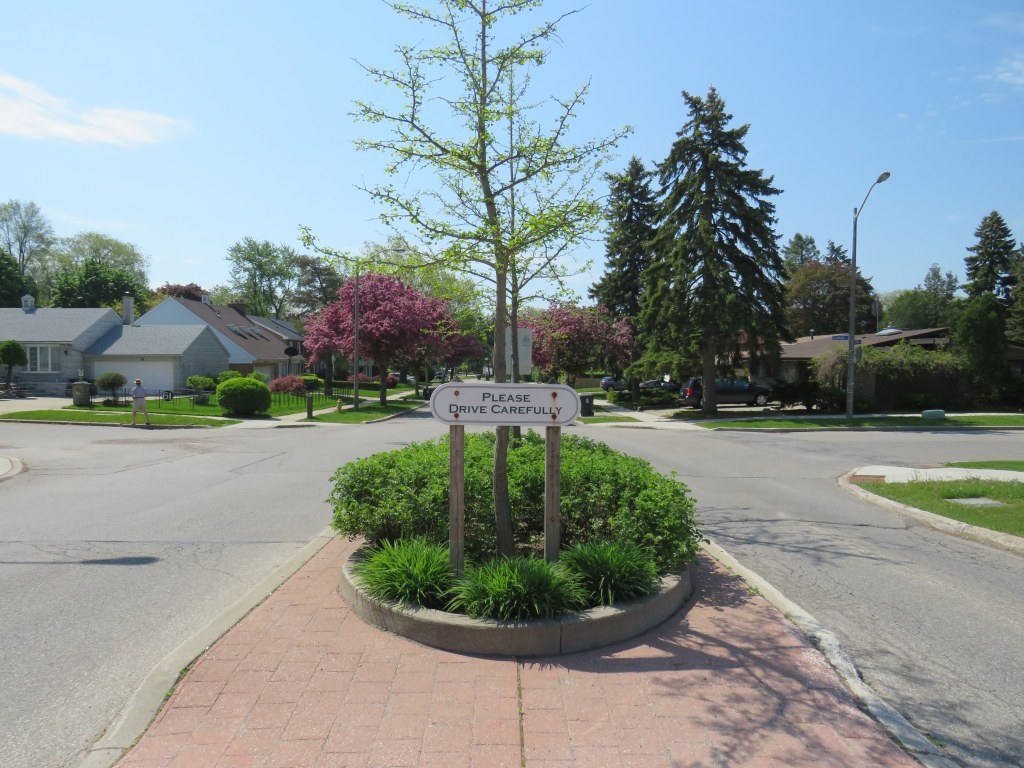
    “please drive carefully” – sign in median of Shaughnessy Boulevard

  • Room to share: How cities can make physical distancing work

    Room to share: How cities can make physical distancing work

    IMG_8405
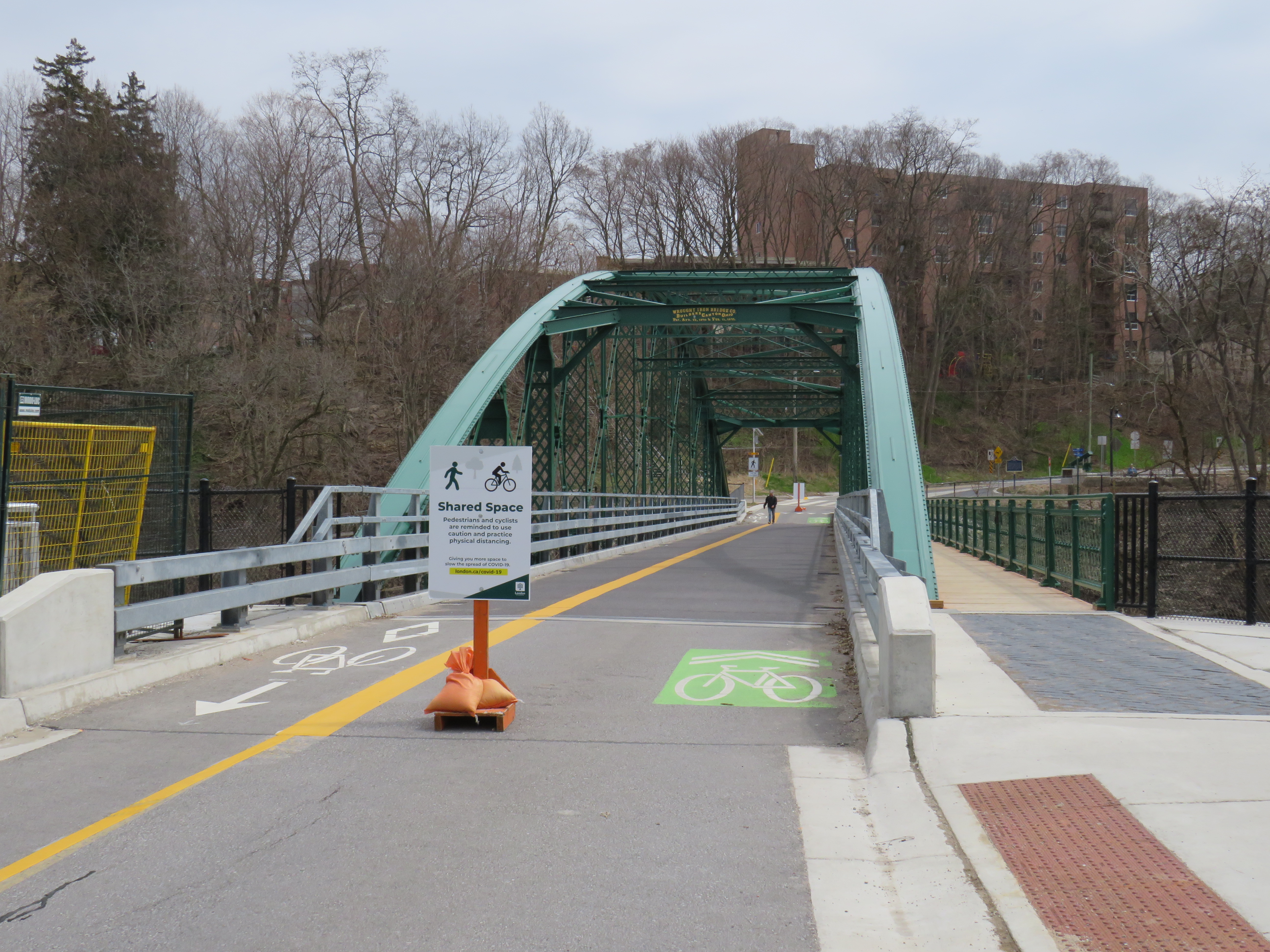
    Blackfriars Bridge open to pedestrians and cyclists in London, Ontario

    For my latest TVO article, I spoke with Councillor Shawn Menard in Ottawa, Councillor Rowena Santos in Brampton, and Ryerson University epidemiologist Anne Harris about how cities in Ontario are reallocating road space for pedestrians and cyclists during the ongoing COVID-19 pandemic, or why they may be hesitant to do so.

    In Brampton, five kilometres of new bike lanes, proposed in that city’s new transportation plan, were quickly approved as part of its response to COVID-19. This benefits both pedestrians and cyclists by reducing conflicts on sidewalks, reducing congestion on city paths, and recognizing that cycling is an increasingly important mode of transportation.

    IMG_8499-001
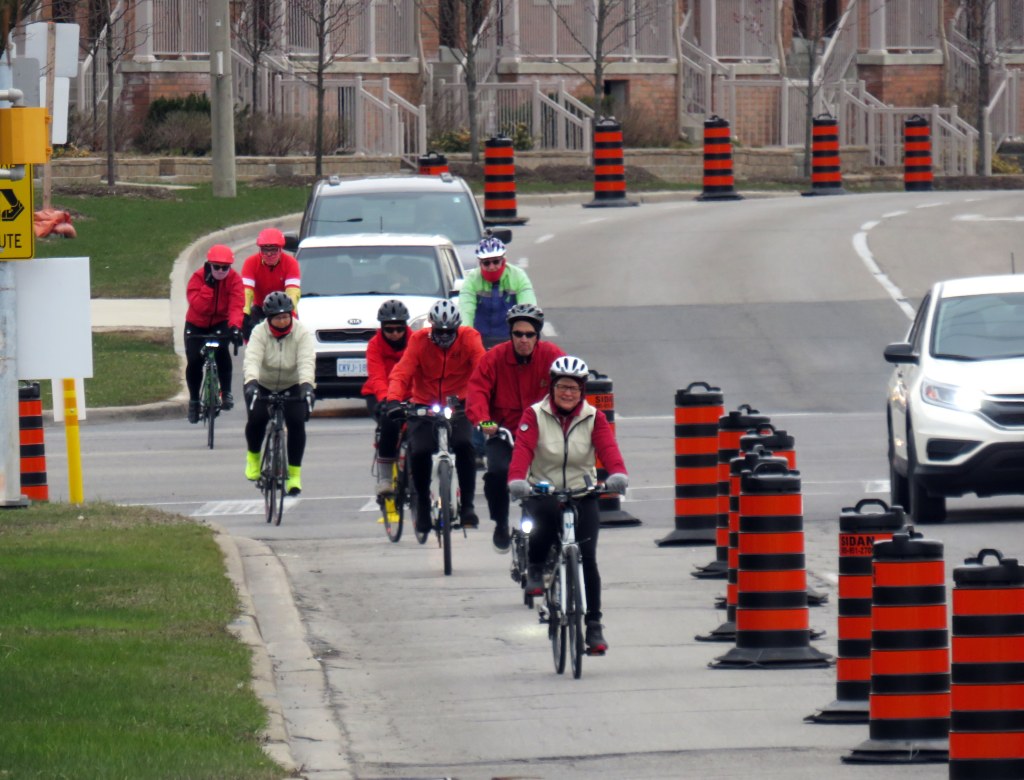
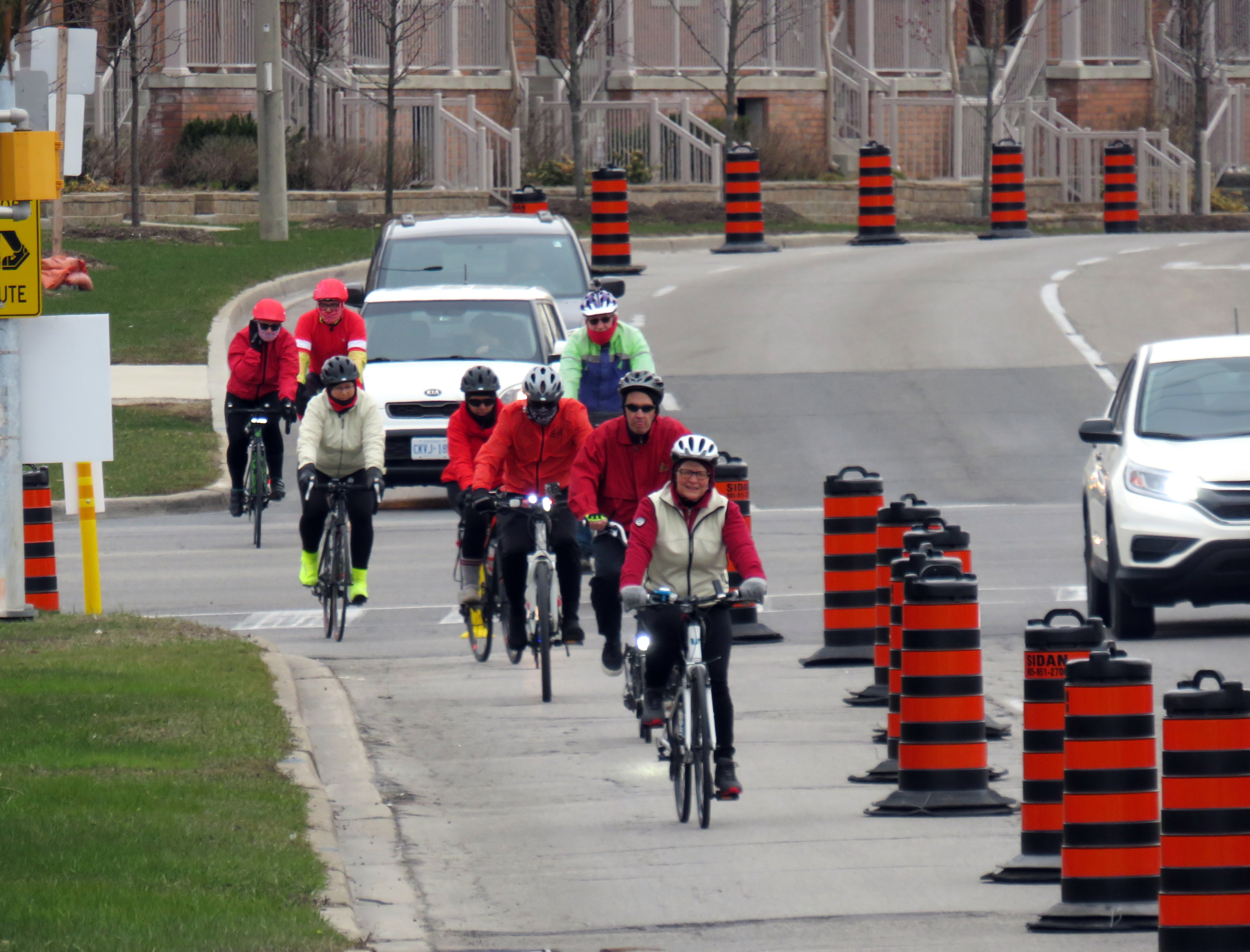
    Cyclists on Howden Boulevard, Brampton

    In Ottawa, despite resistance from the the mayor and council, Shawn Menard, who represents an urban ward just south of Parliament Hill, was able to temporarily close two lanes of traffic on a narrow bridge on a major retail street, and worked with the National Capital Commission to re-allocate a section of parkway for active transportation.

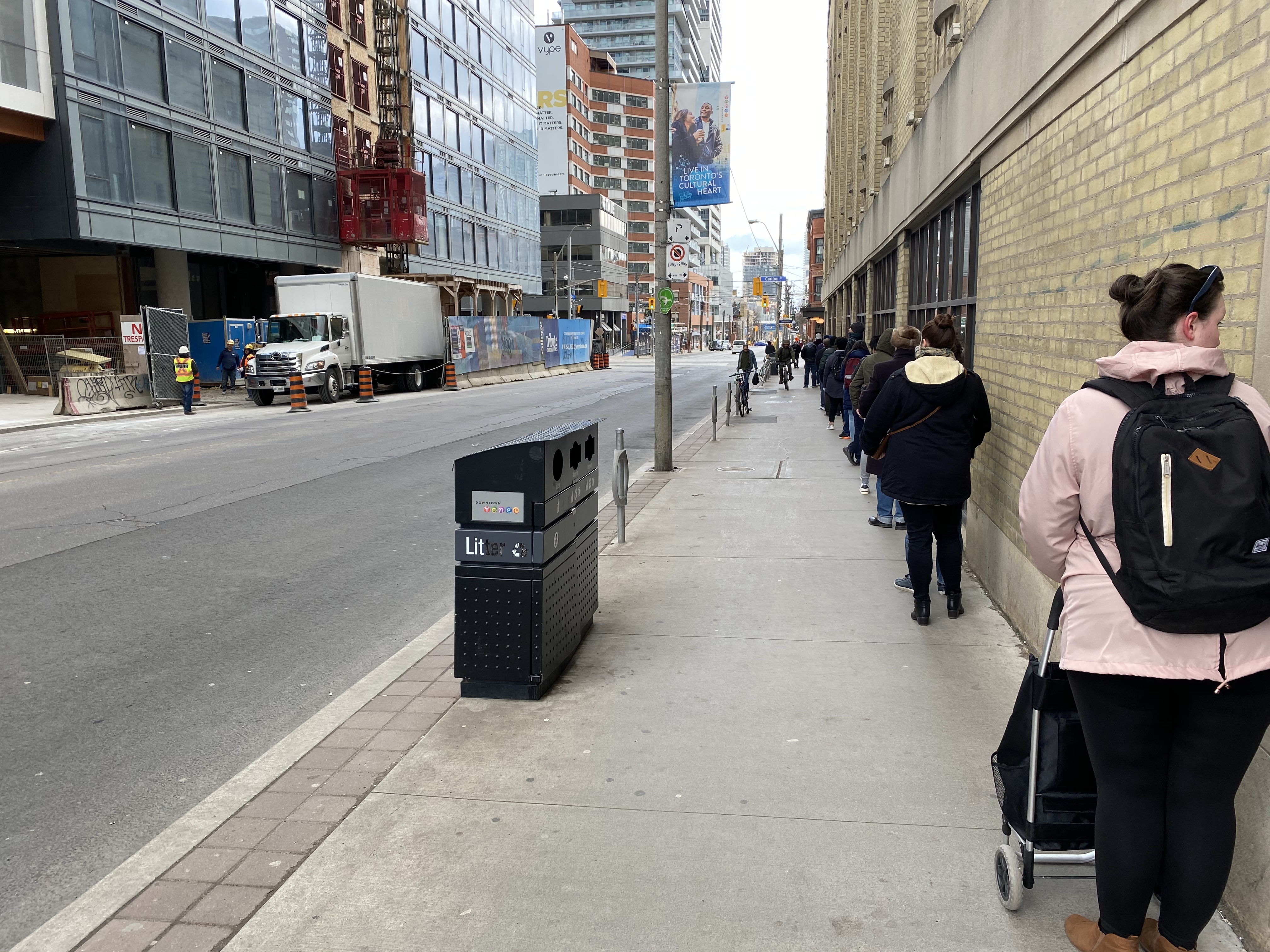
    Meanwhile in Toronto, the mayor and medical officer of health were resistant to increasing calls for sidewalk expansions in congested urban areas, including where queues formed to enter grocery stores, pharmacies, hardware stores, and LCBO outlets.

    This was one of my favourite articles I have written so far. 


    Loblaws queue on Church Street
    Queue on Church Street at Carlton to enter Loblaws supermarket

    With Walk Toronto, I have been involved with pushing the City of Toronto to take action, especially in pinch points where store queues, construction barriers, and other obstructions have made it difficult — if not impossible — to safely practice physical distancing when walking or cycling for essential purposes, or even getting a little bit of fresh air or light exercise in dense urban areas.

    The good news is that ten problem areas — including the intersection of Carlton and Church — have finally been identified for curb lane closures, with potentially more on the way. This is a timid first step, made after weeks of advocacy, but it is welcome.

  • How to reimagine our streets during a pandemic

    How to reimagine our streets during a pandemic

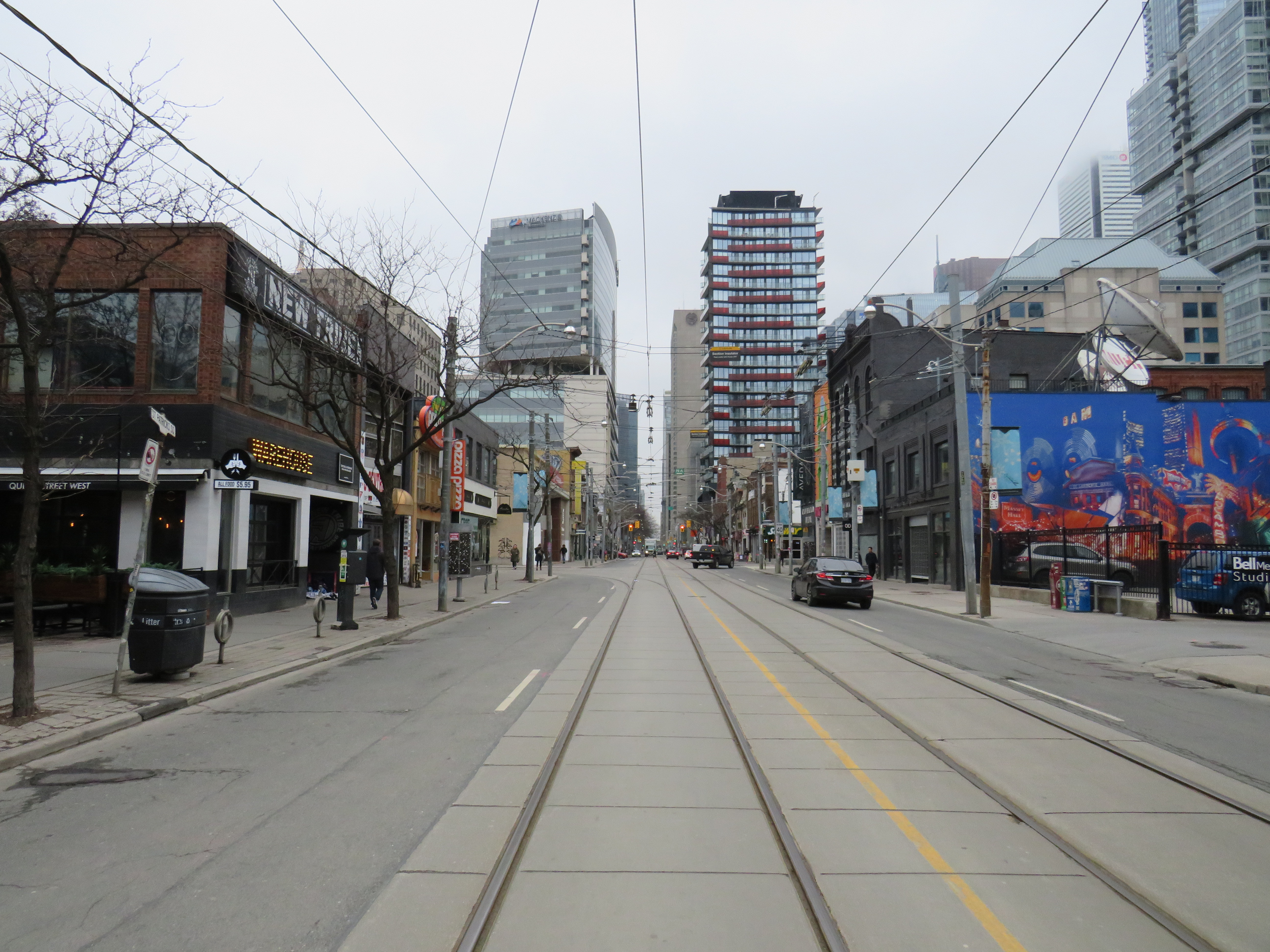
    Queen Street West, late March 2020
    Nobody’s going to be flocking to the streets during a pandemic

    In an interview with local news station CP24, Mayor John Tory said that the city was considering implementing one-way directional traffic on city sidewalks as part of a response to COVID-19. This idea was considered as a measure to ensure physical distancing on Toronto’s sidewalks.

    The mayor, however, does not support the alternate solution of increasing the amount of road space given to pedestrians and cyclists. With traffic on major routes such as Yonge, Queen, and Bloor reduced, and most businesses closed, it would be easy to provide additional space for pedestrians without causing traffic congestion. According to the mayor, “it could have the unintended effect of attracting more pedestrians to busy areas, something the city is actively trying to discourage right now.”

    That’s ridiculous.

    With businesses closed, no patios to linger at, and no programming (unlike at any other street closure, whether it be Taste of the Danforth, Open Streets, Pride Week, or Buskerfest), pedestrians will not be attracted to linger and crowd sidewalks in dense urban neighbourhoods. However, they will be able to walk to work, get to essential services, exercise the dog, or get some fresh air, without having to dodge other people or sidewalk barriers, such as construction scaffolding.

    Furthermore, enforcing one-way sidewalks — the city’s only other idea — would be extremely difficult to enforce. It would  only increase the distance pedestrians would have to walk to get to work or essential services. It would go against centuries of practice, and it would encourage less-safe midblock crossings. It would be especially cumbersome for seniors and pedestrians with disabilities. 

    While Toronto continues to do nothing to protect vulnerable road users during a pandemic, other cities — including Montreal, New York, Vancouver, Denver, and Oakland— have closed entire roads to better serve pedestrians and cyclists in parks and dense urban areas. Closer to home, Kitchener and Brampton have also taken steps to to assist active transportation during this unprecedented time.

    IMG_8335-001
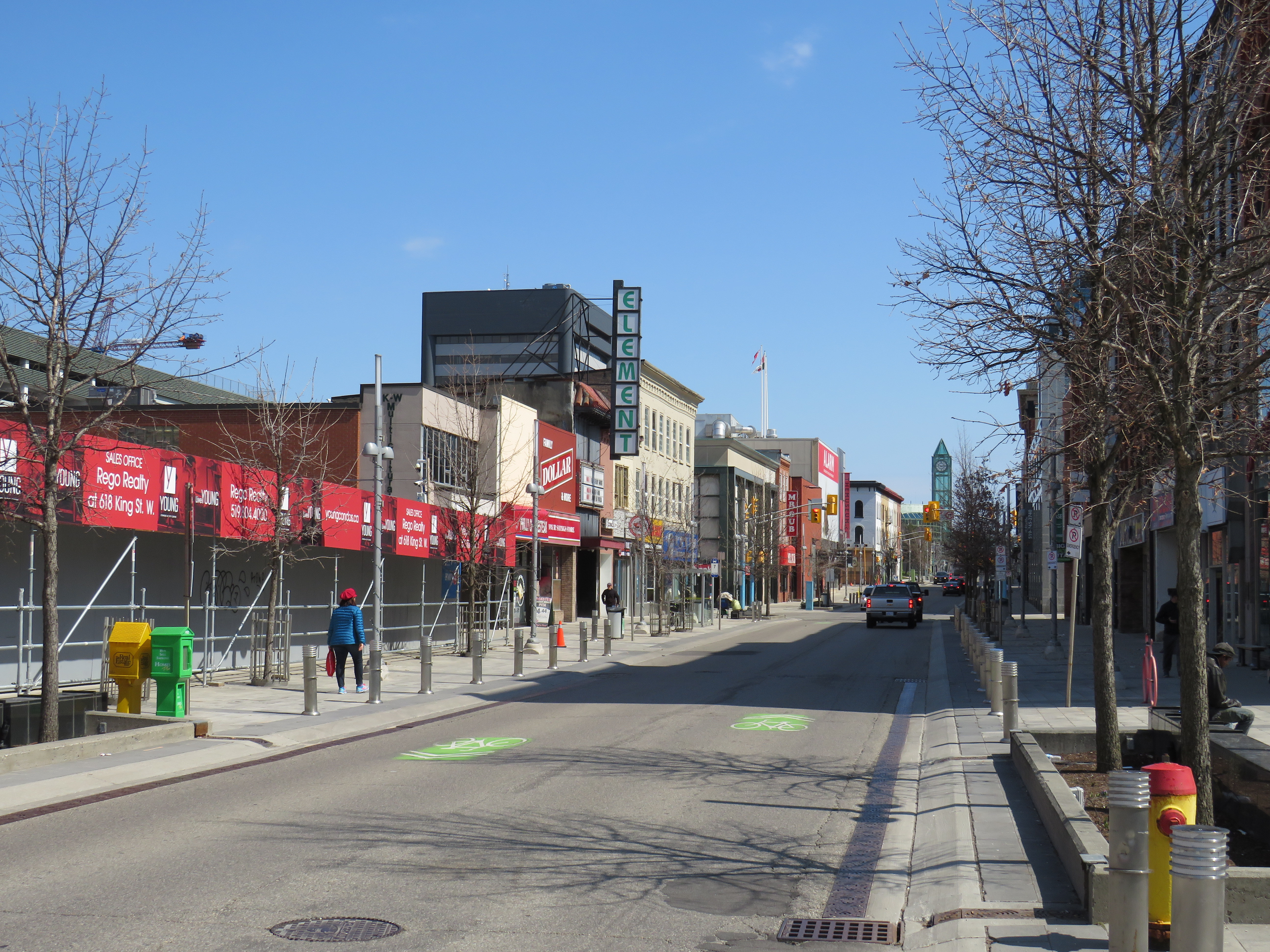
    King Street, Downtown Kitchener

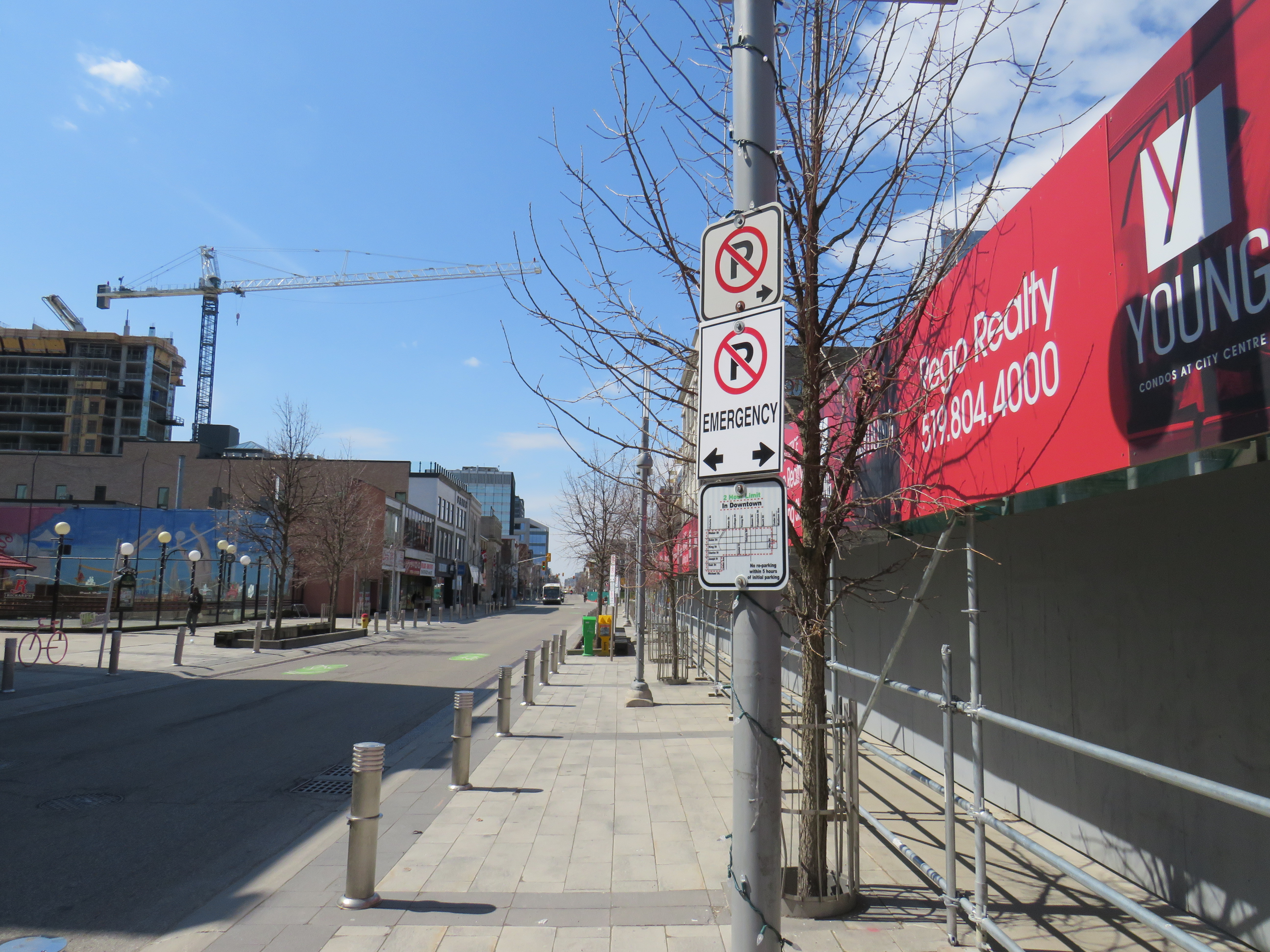
    A decade ago, King Street in Downtown Kitchener was reconstructed with new lighting, street furniture, trees, and a rolled curb separating the narrow street with sidewalk and street parking and loading areas, which were separated from the pedestrian area by removable bollards. As a response to COVID-19, most of the parking spots were blocked off, with the bollards moved towards the roadways, quickly and easily expanding the pedestrian zone. With new residential development in Downtown Kitchener, several portions of the regular sidewalk were covered with scaffolding. The widened pedestrian clearway made it easy and safe to get around the barriers, allowing pedestrians to practice physical distancing.
    IMG_8333-001
    Bollards moved close to the street, and parking banned. It’s much easier to get around the construction scaffolding.

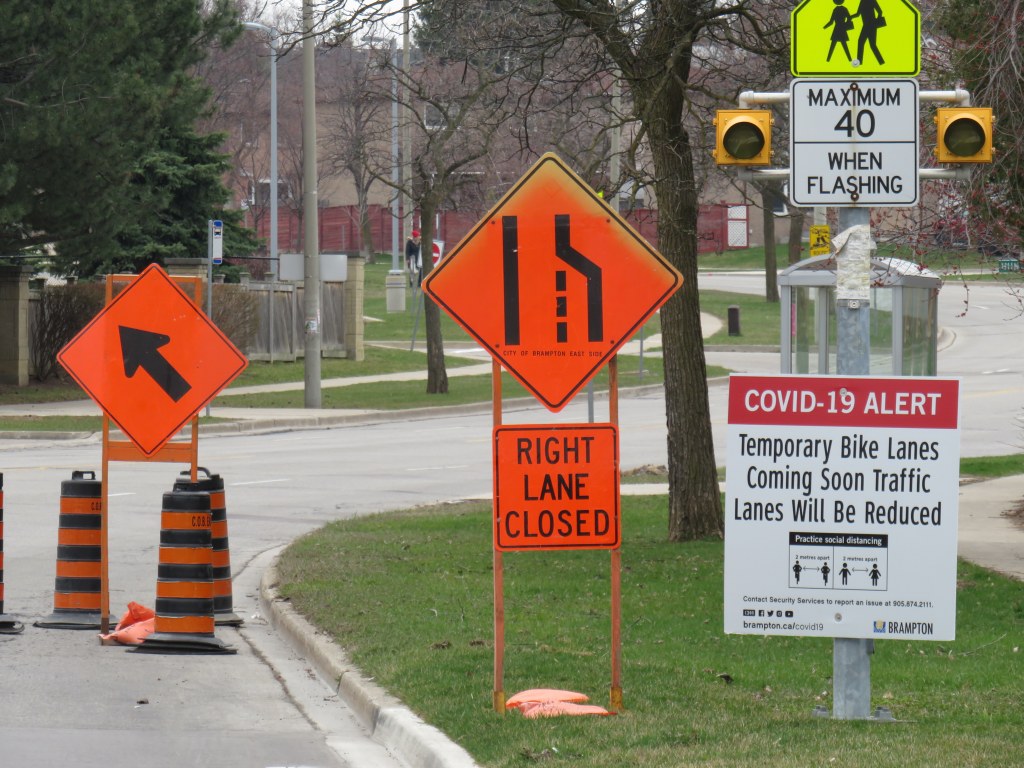
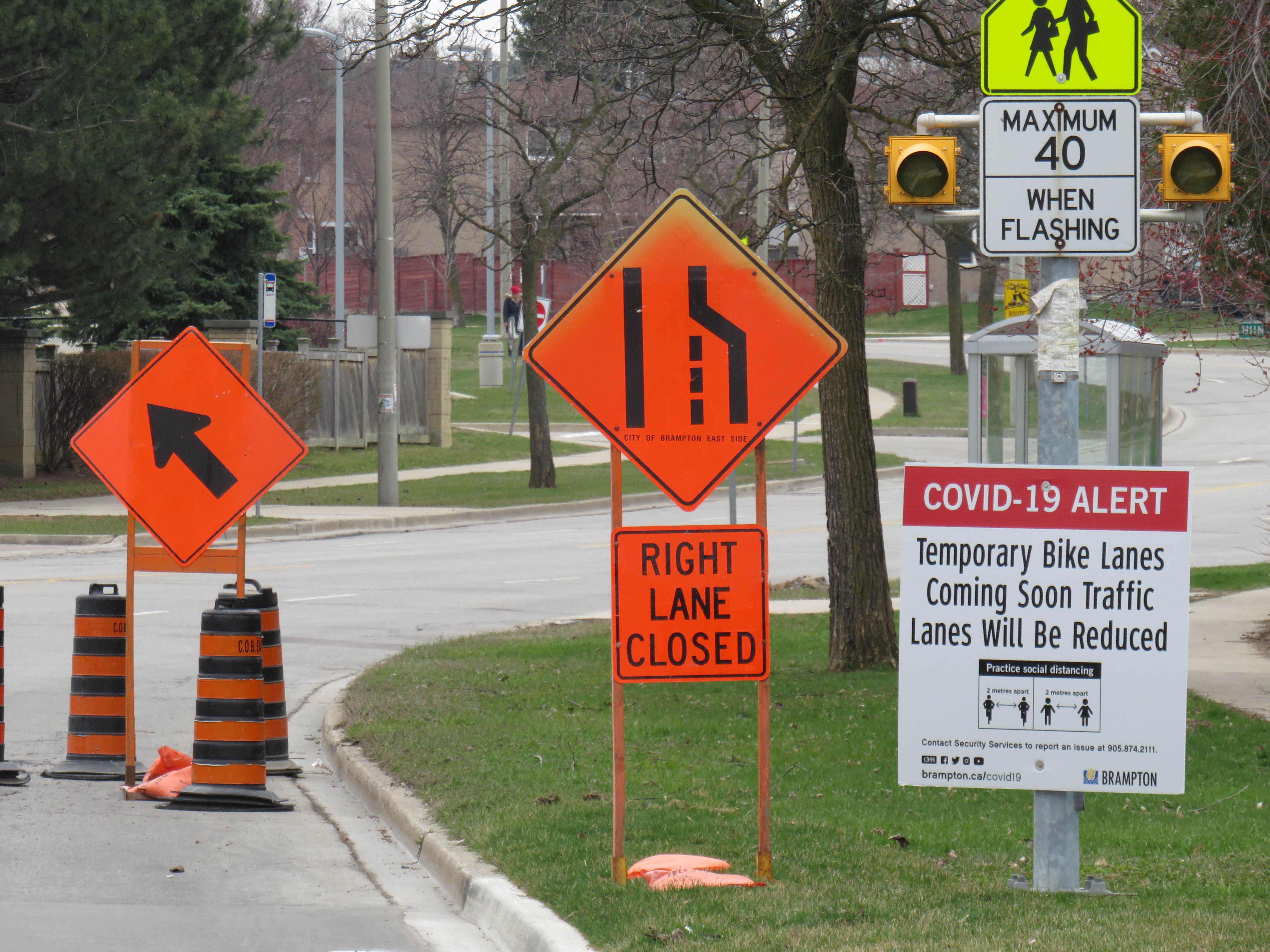
    Meanwhile, in Brampton, where sidewalk crowding isn’t usually a problem, the city government went ahead with a plan to close the right lanes of Howden Boulevard and Vodden Street — four-lane collector roads through residential areas — to install temporary bike lanes. This will provide a five-kilometre bikeway across the city between Etobicoke Creek and Chinguacousy Park, crossing Highway 410 at a safe location.

    Installing temporary lanes makes it easier in the future to make the lanes permanent — Vodden and Howden could use road diets after all — which could connect three north-south ravine paths and connect Downtown Brampton with Bramalea City Centre. City Council — including Mayor Patrick Brown — is committed to improving the city’s rather poor active transportation infrastructure.

    Brampton Temp Bike Lanes
    Temporary bike lanes coming to Howden Blvd. in Brampton

    While Toronto continues to drag its heels on providing safe spaces for its residents to walk and bike while being physically distant, its peer cities — and even one of its suburbs, are leading. One can only speculate about the reasoning behind Mayor Tory’s reluctance to do more.

  • One hundred years of Ontario’s provincial highways

    One hundred years of Ontario’s provincial highways

    IMG_2956

    On February 26, 1920, Ontario’s provincial highway network was born. That year, 16 highways were established across southern Ontario, between the Ottawa and Detroit Rivers. These highways, previously maintained by townships and counties, connected the province’s largest cities and provided important links to Quebec and the United States.

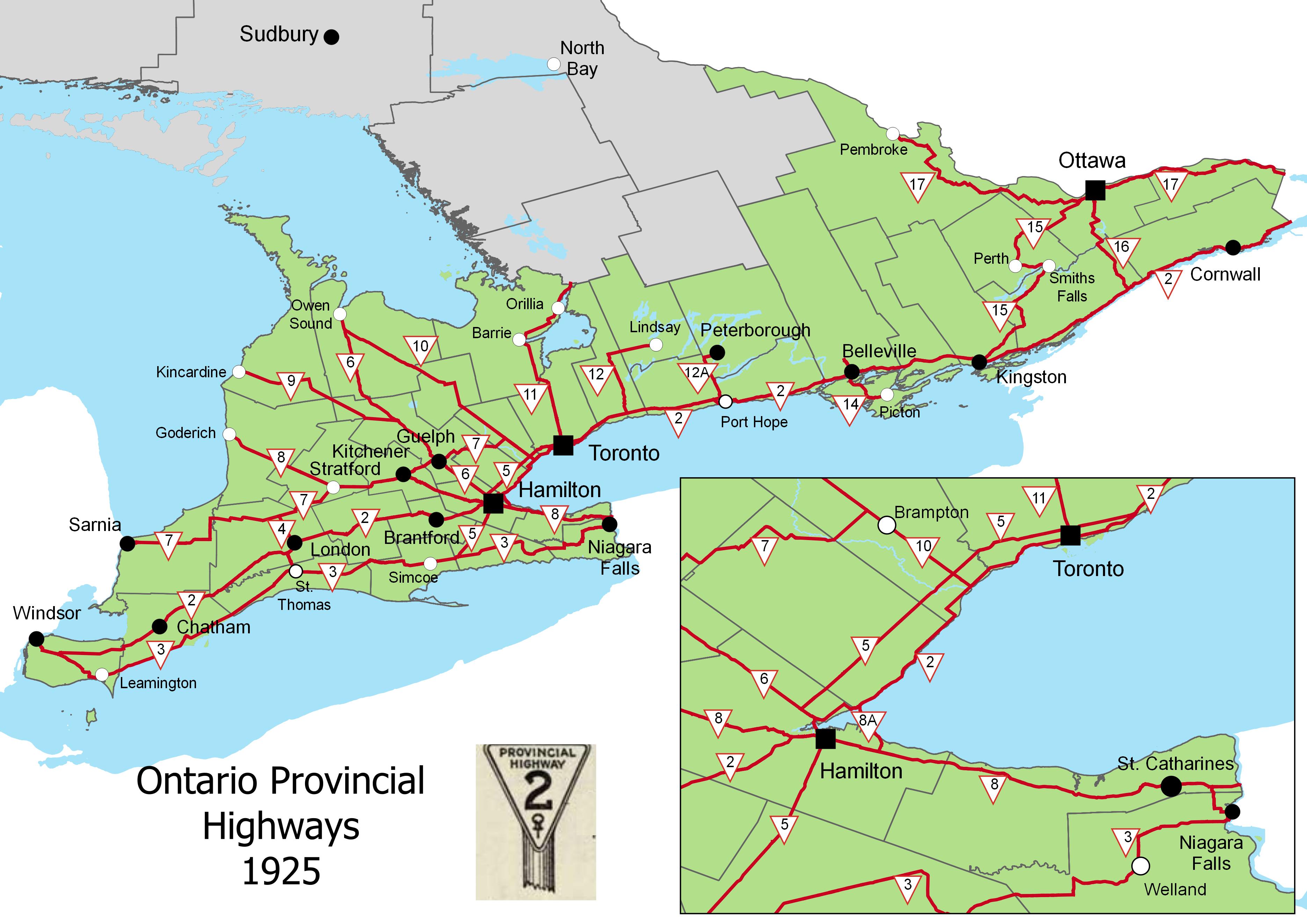
    In 1925, these highways were assigned numbers 2 through 17, in rough order from west to east. There was no Highway 13; instead, the Port Hope-Peterborough Highway was assigned Route 12A. Highway 2, alternatively known as the Trans-Provincial Highway, extended from Windsor to the west to the Quebec border in the east, continuing eastwards as Quebec Highway 2. (That province renumbered its entire highway system in the 1960s and 1970s.) Meanwhile, Highway 15, connecting Kingston and Ottawa, took a deviating “S” shaped route via Perth. Highway 7 only went as far east as Brampton. While the province used triangular highway markers at the time, in 1930, they were renamed “King’s Highways” and assigned crowned highway shields still in use today.

    The map below illustrates the highway system at the time.

    1920OntarioOntario Provincial Highways, 1925 (click for larger version)

    Several of Ontario’s first highways no longer exist. Highway 12A was later renumbered to Highway 28; that first section was later downloaded to Northumberland and Peterborough Counties. The first section of Highway 14, which originally ran between Foxboro and Picton via Belleville, was later integrated with the longer and more important Highway 62. The short stub of Highway 14 between Foxboro and Marmora was also downloaded in the 1990s.

    But Highway 11, formed out of Yonge Street and the Barrie-Muskoka Highway, eventually became the province’s longest and one of its most famous highways (even if it never was the world’s longest street). To mark the occasion, I wrote about Highway 11’s history for TVO. 

    If you’re interested in learning more about Ontario’s highways, nearly 100 years of digitized provincial road maps are available on the Archives of Ontario website. I also suggest visiting The King’s Highway website, which contains histories and photographs for most of Ontario’s highways.

  • Viva Rapidways: hurry up and wait

    Viva Rapidways: hurry up and wait

    IMG_6574.JPGA broken system

    When York Region Transit was formed in 2001, it promised great things for the large, growing suburban region north of Toronto. It amalgamated four local transit systems, and took over local services provided by GO Transit, and extended service to outlying communities, including Stouffville, King City, and Holland Landing. In 2005, YRT introduced Viva, a series of limited-stop bus routes along major corridors, offering distinct, comfortable buses, off-board fare payment, and signal priority to speed up service.

    Since YRT formed, Durham Region amalgamated its municipal transit systems, Brampton introduced Zum, a similar network of limited-stop bus routes, and Mississauga and Toronto rebranded and expanded their express bus routes. For a while, it appeared that York Region was leading the way in growing transit ridership in the suburbs.

    Unfortunately, by focusing on building new Rapidways in the median of Yonge Street, Highway 7, and Davis Drive while neglecting service levels, — even cutting back bus service on Viva routes — York Region has fallen behind. I also found that those Rapidways — meant to speed buses through congested arterials — are poorly designed for pedestrians and transit riders. (more…)

  • Deadly by design: Supertest Road

    Deadly by design: Supertest Road

    IMG_7204-001

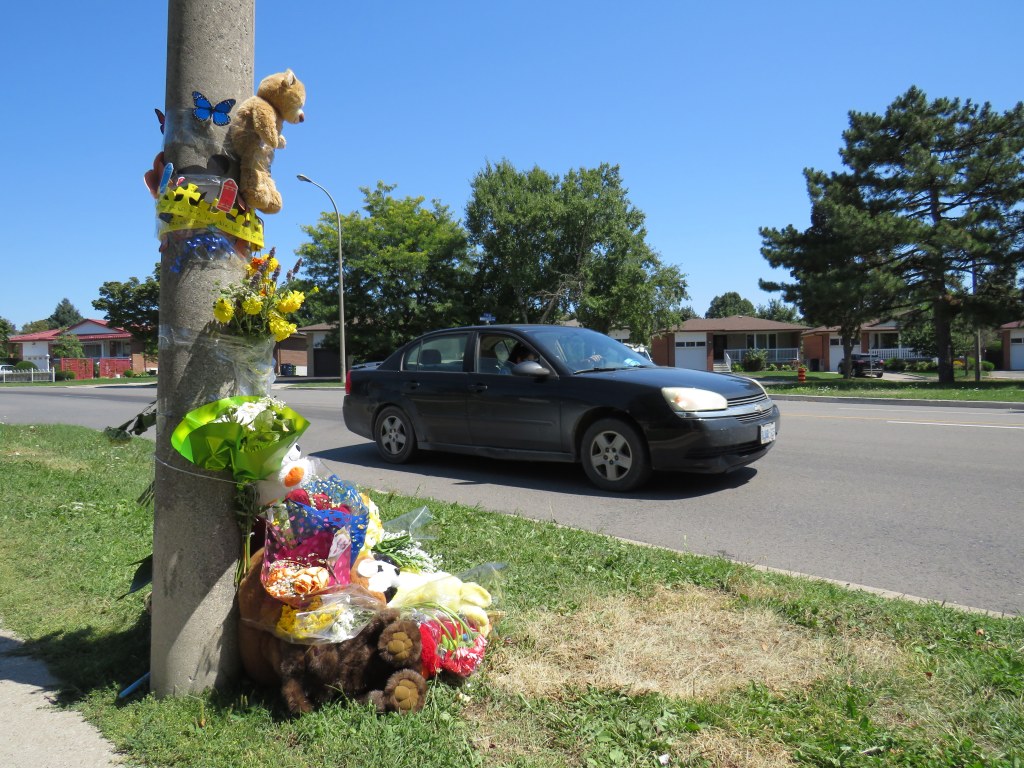
    On Tuesday, January 21, a 26-year-old woman was struck and killed by the driver of a tractor-trailer at the corner of Supertest Road and Alness Street in North York. According to police, the truck driver was making a right turn from Supertest south to Alness when he hit the pedestrian.

    Last week, I paid a visit to the intersection, located in an industrial area off Dufferin Street, just south of Steeles Avenue. It was immediately apparent that pedestrians are an afterthought in this part of the city, and tragedy was inevitable.

    The intersection of Alness and Supertest, with a makeshift memorial on the southwest cornerThe intersection of Alness and Supertest, with a makeshift memorial on the southwest corner

    I took the 105 Dufferin North bus from Sheppard West Station and got off at Supertest Road before walking west towards Alness Street. I pressed the beg button to cross Dufferin, but it did not work, so I crossed with the solid “don’t walk” sign. At least I had enough time to cross before traffic on Dufferin got the green light. With a bus stop at the intersection, G. Ross Lord Park to the east, and a busy supermarket on the southwest corner, there is no excuse for a malfunctioning pedestrian signal. In fact, the walk signal should appear by default.

    As I walked westward on Supertest, the lone sidewalk on the south side of the street came to an end at an industrial driveway about halfway between Dufferin and Alness. With the snow, I was forced to walk on the street, which was busy with cars and trucks. Without any sidewalk, anyone using a wheeled device would also be forced on the street.

    End of sidewalkThe only sidewalk on Supertest Road comes to an end halfway between Dufferin and Alness

    With my smartphone, I recorded my walk along the curb towards Alness Street, avoiding the snowbanks, debris, and motor traffic. It was not a pleasant walk.

    The intersection of Supertest and Alness is a signalized intersection, with pedestrian signals and crosswalks on all four sides. Alness has a through sidewalk, but only on the east side of the street. The intersection is surrounded by a scrapyard on the southwest corner, a bank on the northwest corner, and warehouses to the east. The missing sidewalk on the south side Supertest east of the intersection resumes west of Alness.

    The traffic lights are on a timer, and walk signals automatically appear, so there are no beg buttons at Alness and Supertest. What I noticed during my visit is that motorists will regularly rush to get through an amber signal, sometimes running a red. Truck drivers make wide right turns. Though the area is not pedestrian friendly, I did note several pedestrians in the area, running errands at the bank or walking to and from several of the nearby businesses.

    Truck turning from Supertest to Alness

    Finally, I noted the sharrows, the signed bicycle route on Supertest Road, and the TTC stop on the north side. The cycle route is supposed to connect G. Ross Lord Park on the east side of Dufferin to Flint Road to the west and south to the Finch Corridor Recreational Trail, but it’s not an enticing place to bike. Meanwhile, the TTC stop, for the limited-service 117 Alness route, is inaccessible without a sidewalk leading to it.

    Looking west on Supertest RoadLooking west on Supertest Road, with the sharrow, TTC stop, and bike route sign on the right

    Everything about this industrial intersection was designed to fail pedestrians and cyclists. Last week, it did exactly that.

  • Zero vision in suburban Toronto

    IMG_3684-001

    Though the city of Toronto has made some progress towards safer streets recently, the lack of police enforcement of traffic laws, the reluctance to spend serious money on road redesign, and the attitudes of some city officials continue to be obstacles towards making Toronto a safe place to walk and cycle.

    As part of the city’s Vision Zero 2.0 Plan, City Council voted in July to reduce speed limits from 60 km/h to 50 km/h on 37 sections of arterial roadways across the city, and from 50 km/h to 40 km/h on five more roads. Councillors Ana Bailão and Jim Karygiannis moved to extend several of these sections. However, rookie councillor Cynthia Lai (Ward 23-Scarborough North) moved to amend the item to remove three sections of arterial roads in her ward:

    • Brimley Road from Sheppard Avenue East to Steeles Avenue East,
    • Markham Road from Milner Avenue to Steeles Avenue East, and
    • McCowan Road from Milner Avenue to Steeles Avenue East.

    Councillor Lai claimed that her constituents were concerned about gridlock in her ward and opposed the speed restrictions. Scarborough is especially dangerous for pedestrians as it has the most kilometres of high-speed arterial roads in the city and the longest distances between crosswalks.

    High speeds and dangerous driving are major problems in Ward 23, a part of the city that I visit a few times a month. Brimley, Markham, and McCowan Roads are designed solely for car traffic: they are lined by plazas, warehouses, and backyard fences. Traffic signals are often far apart. Markham and McCowan Roads are also high-speed thoroughfares connecting Markham to Highway 401.

    Walking along McCowan Road between Finch and Steeles earlier this year, my spouse and I encountered a pedestrian refuge smashed in by a motorist. The refuge island was protected by reflective signage, as well as metal barriers, and was installed to help pedestrians cross at a TTC bus stop, though pedestrians are not given the right of way.

    IMG_1644Smashed pedestrian refuge island on McCowan Road

    This is why it was so disappointing to see Councillor Lai organize a “Senior Pedestrian Safety Initiative” with Toronto Police at Woodside Square, a community mall at the corner of McCowan Road and Finch Avenue. Councillor Lai, her staff, and local police were “educating” seniors about pedestrian safety, while giving out reflective armbands. Councillor Lai claimed it was part of the city’s Vision Zero strategy, and she doesn’t “think we should blame anybody.”

    This was just days after a police report showed a severe decline in traffic tickets issued and extremely limited police enforcement of unsafe driving in Toronto. On the Friday before, two seniors were seriously hurt when crossing the street.

    https://twitter.com/cynthiaToronto/status/1198323383538204673

    Needless to say, Councillor Lai and the Toronto Police taken to task by road safety advocates and even fellow councillors. Jessica Spieker of Friends and Families for Safe Streets called it a “form of victim blaming.”

    Supporting Councillor Lai’s position, on Monday November 25, Councillor James Pasternak said “wearing high visibility clothing or reflective gear is a key part of keeping everyone safe, including pedestrians, construction workers, cyclists, police officers and crossing guards. Let’s make VisionZeroTO work.” Councillor Pasternak is Mayor John Tory’s handpicked chair of the Infrastructure and Environment Committee, which among its duties is ensuring the safety of Toronto’s road infrastructure.
    Vision Zero 2.0 says nothing about armbands. Instead, the plan includes reducing speeds, road design improvements, and safer crossings at TTC stops.

    Though it is always a good idea for pedestrians to be aware of their surroundings and be predictable when crossing the street, most of the responsibility falls on the city, which designs the roads, the police, who have abandoned their duty to protect road users, and drivers, who are licensed and insured to operate multi-tonne vehicles. The rash of hit-and-runs after pedestrians were struck is especially alarming.

    In Waterloo, a crossing guard performing her duties was struck and seriously injured by the driver of a F-150 truck, who then fled the scene. This was the despite the school guard wearing a reflective vest, carrying a stop sign, in a marked school crosswalk. No amount of high-visibility clothing will protect pedestrians from dangerous drivers, who in Toronto this year, killed pedestrians walking on sidewalks, and injured pedestrians in transit shelters.

    Ironically, Woodside Square itself was hit twice by drivers in the last two years. In December 2017, a motorist crashed through both sets of doors at the mall entrance closest to Shoppers Drug Mart. In February 2018, a motorist, possibly dealing with medical problems, crashed into several cars and into a Subway restaurant at the mall. High-visibility clothing would not have helped in either of those cases.

    It’s unfortunate that a city councillor will choose giving out reflective armbands over effective speed reductions, road redesign, and traffic enforcement. Hopefully, Councillor Lai will take the criticism to heart and do better for Ward 23.

    Post script: A staff report to the Infrastructure and Environment Committee in October 2019 continued the recommendation for speed reductions in Ward 23, citing minimal impacts to travel times, and the dangerous conditions on Brimley, Markham, and McCowan Roads. Staff noted that there have been 6 fatalities and 20 serious injuries incidents on those three road segments. On October 29, Council voted to lower the speed limits on Brimley, Markham, and McCowan Roads against Councillor Lai’s objections.

  • O-Train impressions: this is what LRT looks like

    IMG_4614-001Confederation Line train approaching Tremblay Station

    Last weekend, I visited Ottawa to check out the new Confederation Line LRT. Canada’s newest rapid transit line, delayed by two years, finally opened on Saturday, September 14. It is the second LRT to open in Ontario this year; Waterloo Region’s ION service opened in June.

    The new 13-station Confederation Line includes a 2.5-kilometre tunnel under Downtown Ottawa, with three stations deep underground. Phase 2 will add 15 more stations to the Confederation Line. I was impressed with the speed, accessibility, and capacity of the new LRT, though I noticed a few flaws, some of which hopefully will be corrected.

    The Confederation Line is not the Ottawa Region’s first rapid transit project, however. The Transitway first opened in 1983, one of the world’s first true bus rapid transit systems. Rapibus, a BRT corridor in Gatineau similar to the Transitway, opened in 2013. In 2001, the Trillium Line, a diesel light rail service, opened. It operates on a disused Canadian Pacific Railway corridor through Carleton University. Collectively, the Confederation Line (Line 1) and the Trillium Line (Line 2) are marked at the O-Train.

    IMG_4567-001.JPG
    Trillium Line DMU train approaching Carleton University

    2018_Network_R.png

    O-Train and bus rapid transit map from the OC Transpo website. The Confederation Line is marked on maps and signs as Line 1; the diesel Trillium Line as Line 2.

    The first phase of Line 1 replaces the busiest section of the Transitway, including the congested on-street downtown section on Albert and Slater Streets. Though most sections of the Transitway are grade-separated — following the Queensway (Highway 417) on the east end and an abandoned railway corridor on the west end — the downtown section was the weak link. As OC Transpo, Ottawa’s transit agency operated dozens of suburban express routes into the Transitway during weekday peak periods, lines of buses would often stretch for blocks, an especially inefficient transit operation.

    6205682867_7d38a920b6_o.jpgBus congestion on the Mackenzie King Bridge in Downtown Ottawa in 2011

    With most buses gone from the downtown core, the LRT allows for much more efficient operations, even if many commuters no longer enjoy a one-seat ride to work.

    At several stations, including the Transitway connections at Blair, Tunney’s Pasture and Hurdman, fare-paid areas allow passengers to move between bus and train without having to tap at faregates or show fare payment to the bus operator, like many TTC subway stations. This helps to ensure the LRT is a backbone to a strong feeder bus network, rather than a stand-alone operation.

    Most stations are equipped with escalators as well as multiple stairways. There were two side-by-side elevators at most points, providing the necessary redundancy to ensure full barrier-free accessibility. Access is controlled with fare gates like those in Toronto, where Presto cards, paper tickets, and transfers provide access to platform level. All O-Train stations are identified by a simple red circle at each entrance that looks similar to a Lifesaver candy.

    IMG_4483-002.JPGDowntown entrance to Lyon Station, with the O-Train “Lifesaver” totem

    Unfortunately, some of those rail-bus connections require a long walk outside, such as at Hurdman Station. This was probably the greatest flaw I experienced during my visit last week. Though it was tolerable on a sunny September afternoon, it would be extremely unpleasant in winter or during a rainstorm. It’s unfortunate that the bus terminal was not better thought out to minimize distances between buses and train platforms.

    Ottawa - Hurdman Station
    Bus bay E at Hurdman Station. The bus in the distance is in front of the entrance to the train platforms

    A long-term challenge for the Confederation Line is the ability to direct transit-oriented development around many of the new stations. Though Hurdman Station is major transfer point with the Southeast Transitway, it is located in a floodplain next to the Rideau River. Iris and Blair Stations are located within highway interchanges. There is more potential around Pimisi Station (in the Lebreton Flats, which are already seeing new urban development), St-Laurent (where a second-tier mall could be urbanized), and possibly Cyrville. But all east-end stations are limited by the Queensway.

    These bus transfer and land use concerns were also raised by Alex Bozikovic at the Globe and Mail.


    Vicinity of Hurdman Station
    To the west, however, there is lots of potential for the government office complex at Tunney’s Pasture, which is surrounded by thousands of surface parking lots, as well as eastern Phase 2 stations, which will follow former railway and streetcar corridors, allowing for infill development and urbanization.

    IMG_4502-001Train arriving at the Tunney’s Pasture terminal

    Light rail transit is misunderstood in Toronto, where it is often equated with streetcars, rather than a flexible rapid transit solution. Indeed, light rail covers a wide spectrum, from traditional streetcars, like the TTC’s legacy street railway, to fully grade-separated high-speed LRTs, like Ottawa’s new line. (The Waterloo ION LRT, with a mix of reserved lanes, median operation, and off-road segments, fits somewhere in between.)

    The Confederation Line’s average speed is 31 km/h, with a top speed of 80 km/h. In comparison, TTC Line 1 has a weekday average speed of 28 km/h, and the 501 Queen Streetcar has an average speed of just 9.9 km/h during the morning rush hour. The Waterloo ION LRT currently has an average speed of 21 km/h.

    It is worth noting that the Scarborough RT replacement, once fully funded and ready to start construction six years ago, would have been just as fast and smooth as the Confederation Line. Instead, our local and provincial politicians continue to spin their wheels on planning a subway extension that’s going nowhere. Meanwhile, Ottawa has already started work on Phase 2 of its light rail network.

    IMG_4493-001The end of the beginning: the old Transitway is visible west of Tunney’s Pasture, where Phase 2 of the Confederation Line will continue towards Baseline and Moodie Stations

    The Eglinton-Crosstown LRT will have a long underground segment, with two-car LRT trains similar to those used in Ottawa. When that opens — planned for late 2021 — Torontonians will finally get a taste of high-order light rail transit.

  • Dysfunction junction: the Union Station malfunction

    IMG_3583-001.JPG
    Looking west to Union Station, August 2019

    Last year, the City of Toronto hastily installed Jersey barriers in front of Union Station. This was a response to a tragic criminal act on Yonge Street in North York on April 23, 2018. A single individual drove a rented cargo van down the busy sidewalk, killing 10 and injuring 16 more before he was apprehended by police. As one of Toronto’s busiest pedestrian areas, city officials decided that the plaza in front of Union Station required special protection in the wake of the attack in North York.

    Sixteen months later, the temporary barriers remain, needlessly restricting pedestrian flows. Temporary Jersey barriers, normally used on roadways to protect construction sites, are long and awkward for pedestrians, making it even more difficult to access some of the city’s busiest crosswalks. During peak periods, these become pinch points, making it especially difficult for anyone crossing against the flow to get through safely. Pedestrians using mobility devices, strollers, or carrying wheeled bags are especially affected.

    Afternoon rush hour crowds navigate around the Jersey barriers at Front and Bay Streets

    Union Station is adjacent to four of the ten busiest intersections in the city where pedestrian traffic was measured: Bay and King, Bay and Wellington, Front and Simcoe, and York and Wellington (traffic counts are not available for Front and Bay or Front and York/University). At Bay and Wellington, one block north of Union Station, 32,319 pedestrians crossed in an eight-hour period in 2009, compared to 16,188 cars, trucks, and buses. At York and Wellington, 32,338 pedestrians crossed in an eight-hour time period in 2017 compared to just 5,575 vehicles.

    Employment at the financial district with commuters headed to and from GO trains and the subway at Union Station, tourists, residents, and fans headed to and from games and concerts at Scotiabank Arena all contribute to the high pedestrian activity in this part of Downtown Toronto.

    IMG_3585-001.JPGJersey barriers at the southwest corner of Front and Bay Streets at Union Station

    Since the April 2018 attack, drivers have continued to mount sidewalks and crashing into bus shelters, buildings, and pedestrians. Early this morning, the driver of a stolen Range Rover crashed into a parked car on College Street, entered the sidewalk, hit a guidepost and then a transit shelter, injuring a pedestrian waiting for a streetcar. The driver then fled on foot. Other pedestrians have been injured and killed this year even when they are using signalized crosswalks correctly, and with all due care.

    At Bay and Front, despite the huge crowds of pedestrians, traffic signals favour motorists. Left turn signals make pedestrians wait longer at crossings before having to navigate around vehicles illegally blocking the crosswalk in addition to navigating the haphazardly placed Jersey barriers. The video below shows the danger of crossing this intersection.

    Motorists block the crosswalk with impunity while the left turn signal doesn’t help

    In his March 25 column in the Toronto Star, Jack “The Fixer” Lakey was not very sympathetic to complaints about the barriers, writing that “they are clearly a pain for people when foot traffic is heaviest, but we couldn’t help but think they would be effective in stopping a driver bent on another deadly attack.”

    Lakey then writes that the city is working on permanent barriers that will be “smaller, more aesthetically pleasing and easier to navigate for pedestrians,” with installation this year. It is now almost September, and nothing has been done.

    It is hard to argue against barriers in certain places to better protect pedestrians from dangerous motorists. But the Jersey barriers at Union Station are not a sufficient response. Permanent bollard-style barriers would be a definite improvement, and it is disappointing to see the city drag its heels on this.

    Meanwhile, the priority afforded to motorists at this downtown intersection, and the lack of enforcement of traffic laws makes it clear that little thought has been afforded to ensuring the safety of all road users. Dropping some road barriers on a sidewalk and calling it a day is unacceptable in a city that is supposedly committed to a Vision Zero action plan.