Category: Politics

  • On Brampton’s short-sighted Hurontario-Main LRT decision

    8742719319_adb77a0b03_k
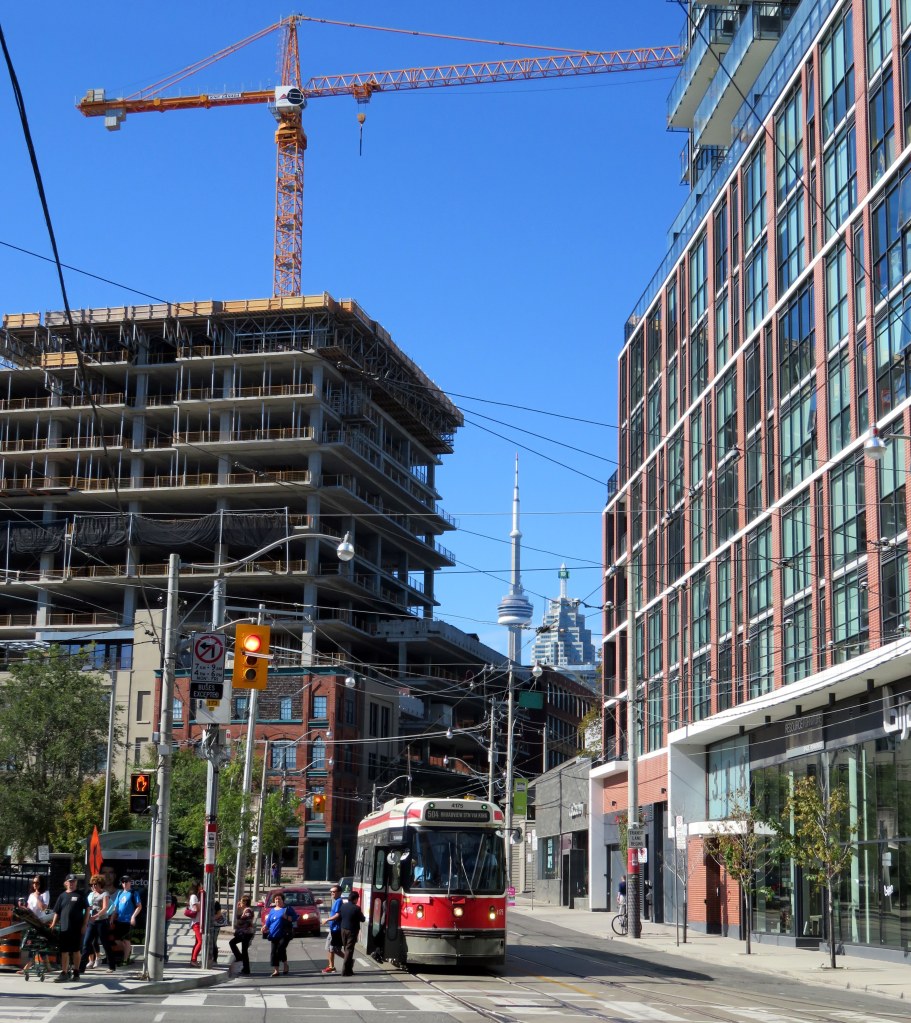
    LRT mockup at Gage Park, Brampton

    On late Tuesday night (actually, early Wednesday morning) Brampton City Council made disappointing and harmful decision by voting against the Hurontario-Main LRT, a 23.2 kilometre, $1.6-billion light rail line, whose construction costs would be fully covered by the province. This followed another marathon meeting back in July in which a final decision was delayed to allow for further study and a possible compromise.

    The mayor, Linda Jeffrey, and four councillors (Gurpreet Dhillon, Pat Fortini, Marco Medeiros, and Gael Miles) supported the project, but six councillors (Jeff Bowman, Grant Gibson, Elaine Moore, Michael Palleschi, John Sproveiri, and Doug Whillians) voted against. The final vote was 7-4 against the LRT, with Jeffrey mistakenly voting with the majority, but the 6-5 vote against a modified downtown routing in an last-minute attempt to sway opponents should be considered the true decision.

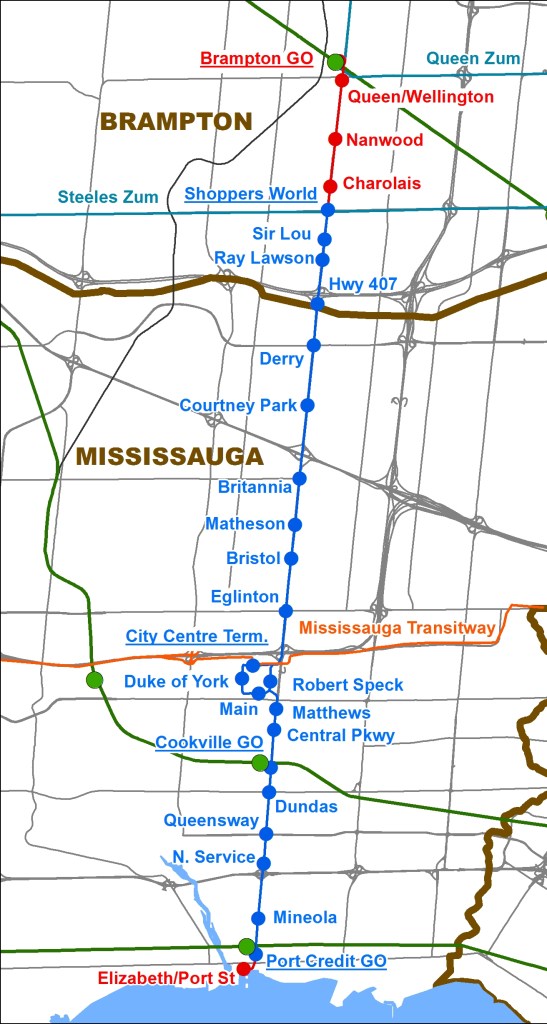
    Light rail transit will still be coming to Brampton – construction will start in 2018 – but it will terminate at Shoppers World at Steeles Avenue, with only three stops completely within Brampton’s borders. Nearly four kilometres and four stops have now disappeared, including the crucial terminal at Brampton GO Station. The map below shows the Hurontario-Main LRT route, with the eliminated sections in red. (A short section of the LRT’s route in Port Credit was eliminated due to community opposition; it would have brought light rail transit closer to Port Credit’s bustling core. The Hurontario LRT will now terminate adjacent to the Port Credit GO Station, north of Lakeshore Road.)

    The Hurontario-Main corridor was selected for LRT simply because it is one of the busiest transit corridors in the Greater Toronto Area outside the City of Toronto; it connects three GO lines and several major bus corridors, it would help urbanize south Brampton and several neighbourhoods in Mississauga. It’s part of a larger regional network, yet six city councillors in Brampton, looking out for narrow, local interests, sunk it.

    Now transit advocates elsewhere are looking to capitalize on Brampton’s loss: at least $200 million of the province’s money won’t be spend. For example, advocates in Hamilton are looking for an opportunity to expand their funded LRT network with Brampton’s cash.

    HMLRT
    The Hurontario-Main LRT, after Tuesday’s vote. 

    The arguments against the LRT included heritage concerns (as if trams aren’t found in the centres of historic cities such as Vienna, Istanbul, Brussels, and Amsterdam), claims of low ridership (which were written about by the Toronto Star’s San Grewal), concerns about operating expenses. Some councillors suggested that Queen Street should get LRT first. Others took exception to the fact that most of the route (17.6 kilometres, 19 stops) would be in Mississauga, while only a quarter of the line would operate within Brampton (5.6 kilometres and eight stops) But one cannot dismiss the NIMBY factor – some of the biggest opponents were wealthy homeowners on Main Street. Even former Premier Bill Davis, long regarded as a friend of cities and public transit, came out publicly against the LRT. Davis will long be remembered for stopping destructive expressways, but won’t support public transit when it runs down his street.

    Opponents suggested other routes, or tunneling under Main Street. But those alternatives were more expensive, more difficult, less convenient for riders, and weren’t going to be funded by the province. These suggestions were studied by city staff and outside consultants and rejected.

    Yes, Queen Street is Brampton Transit’s busiest corridor. Yes, the ridership will be lower north of Steeles Avenue than through central Mississauga. Yes, there will be some traffic impacts on Main Street.

    But there’s no current planning study for a potential Queen Street LRT; a route hasn’t been chosen (would it go to the Spadina Subway extension to Vaughan? York Region would have to be on board), there’s no funding on the table, and the Hurontario corridor in Mississauga is a lot busier than Highway 7 in York Region. And yes, Mississauga benefits more from the LRT. But Mississauga has a larger population, a much larger transit ridership, and more jobs. By connecting to Downtown Brampton, the LRT increases mobility for the entire region, connects to the Kitchener GO line, and allows for direct transfers to the 501 Queen Zum, Brampton’s busiest bus route. It is part of a regional transit network; it would have made it a lot easier for trips, for example, between Downtown Guelph and Mississauga City Centre.

    10671927_oriToday’s news that anti-LRT councillors are now going to seek federal funds for transit expansion makes me want to tear my hair out. This image of Frank Grimes pretty much describes how I’m feeling right now.


    Just adding to my frustration, I read today that Councillor Bowman, who helped sink the Main Street section of the LRT, is now going to look for transit funding from the newly elected Liberal federal government. In the article, Bowman suggests that since Brampton elected five new Liberal MPs, helping to defeat the Conservatives, it was time to “leverage” that support. Payback, if you will. But there are no other plans to hold up, nothing that’s “shovel-ready.” There will be no ribbon-cuttings for Liberal MPs and cabinet ministers to attend anytime soon.

    If looking for money from a new federal government – one that’s so far very friendly with their provincial counterpart – it would have looked a lot better to have approved the transit that the province, and a majority of Bramptonians, wanted, and then ask for additional funds to build on that. Advocating for a potential Queen Street LRT would be a lot when there’s an existing line to connect it, and a strong transit-focused hub to anchor it.

    So, to sum up, Brampton city councillors threw away at least $200 million for a light rail project that they didn’t want, a gift-wrapped transit opportunity from the provincial Liberal government. Now they will be looking for new transit funding for alternative transit routes, which have yet to be planned, from the federal Liberal government. Good luck with that. 
     

  • Not so FAST: SmartTrack gets a lobby group, raises many questions (Updated)

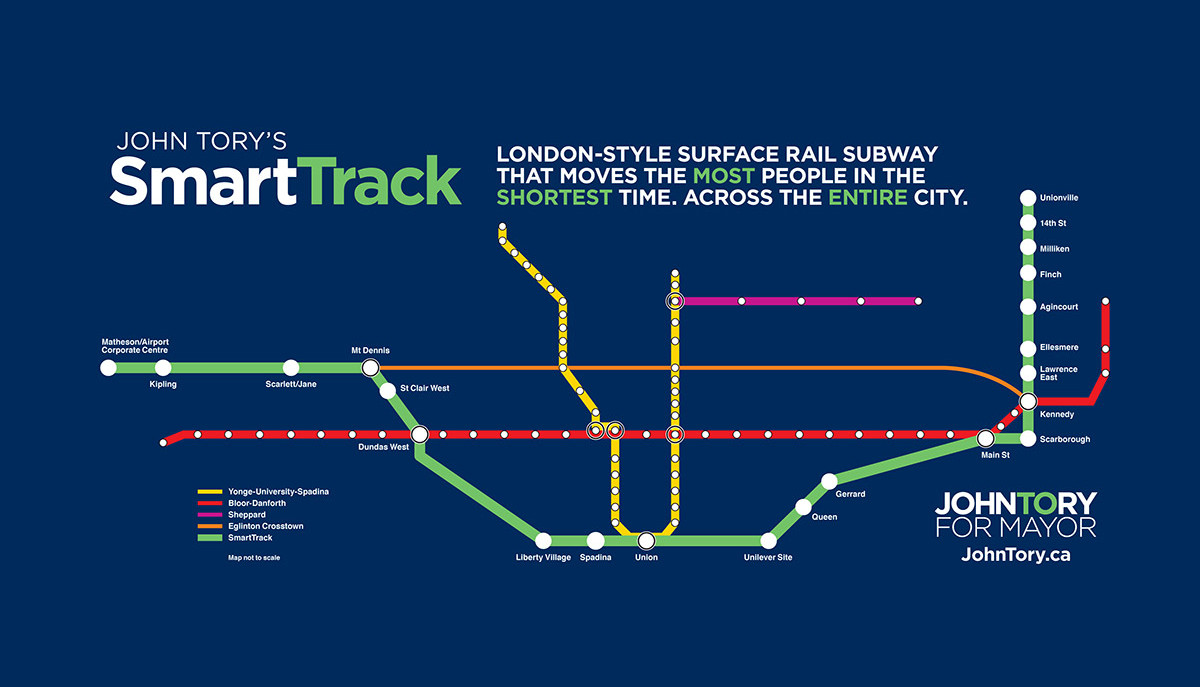
    smarttrack_fb
    I find myself feeling frustrated, worn down, and at times angry about this federal election that’s thankfully coming to an end on Monday. As a progressive voter, I’ve been disappointed by Thomas Mulcair and the New Democrats, for reasons that Desmond Cole explains so very well in today’s Toronto Star. (Locally, I ‘ve been supporting the NDP’s Linda McQuaig in Toronto Centre, whose progressive credentials are impeccable.) The bright side is that Stephen Harper’s Conservatives are going down to an almost-certain defeat, hopefully taking their narrow and divisive targeted politics with them. My wish is for a minority government in which the Liberals and New Democrats share power; this may check the Liberals’ record of running left and governing right.

    Happily, Torontonians also have the Blue Jays and municipal politics to watch. Last night, we all got to watch the strangest seventh inning in baseball history; today, we get to snicker at the efforts of an Astroturfing crew of lobbyists pushing SmartTrack – a mayoral campaign slogan masquerading as a transit plan. Municipal politics may be at times just as depressing as provincial or federal politics, but at least it’s a lot more fun.

    The Toronto Star’s fantastic transportation reporter, Tess Kalinowski, reported on a new booster group, known as FAST (Friends & Allies of SmartTrack). Its spokesperson would be Alvin Curling, a former provincial Liberal cabinet minister and Speaker of the Provincial Parliament. Other members of its Public Advisory Board include Kyle Rae, former city councillor who is now a City Hall lobbyist, and three prominent lawyers  – Andrea Geddes Poole, Michael Brooks, and David S. Young. Also involved is one Tom Allison. 

    According to a press release, FAST claims it’s “here to advocate for SmartTrack and to educate the public about how it could make a huge difference in cutting congestion and moving people around the region.” It would raise funds “devoted to creating a variety of awareness campaigns such as town halls and informational videos.” 

    FAST’s website – launched today – is comically full of spelling and syntax errors, misinformation, and complete fabrications of basic facts. Here are just a few. (more…)

  • Exploring the downtown federal election races: Part II

    Back in April 2015, I looked at the impact of changes to the new federal electoral districts in three key downtown races: Toronto Centre, University-Rosedale, and Spadina-Fort York. The three downtown ridings were created by splitting two larger electoral districts, Trinity-Spadina and a larger Toronto Centre.

    As a downtown resident and political junkie, I was very interested in how previous election results would look with the new electoral districts. Could Toronto Centre, long held by the Liberals, go orange with Rosedale and Yorkville lopped off? Would University-Rosedale and Spadina-Fort York become Liberal bastions with the new boundaries?

    When I wrote the original post, the Liberal Party had nominated candidates in all three ridings — Chrystia Freeland in University-Rosedale, Adam Vaughan in Spadina-Fort York, and first-time candidate Bill Morneau in Toronto Centre. I wrote more about all six candidates (and some of my personal opinions) in the original post.

    Back in April, the New Democrats nominated Jennifer Hollett in University-Rosedale and Linda McQuaig in Toronto Centre, but had yet to choose a candidate in Spadina-Fort York to run against Adam Vaughan. Vaughan, who took Trinity-Spadina in a 2014 by-election, was a popular Toronto city councillor. There were rumours that prominent criminal defense James Lockyer and former MP and mayoral candidate Olivia Chow were both considering running, but in late July, Chow formally sought, and won, the nomination.

    After the 2014 municipal election, in which Chow came in third place in the race for mayor, she accepted a position at Ryerson University. I expected that she was going to sit this election out, but I was proven wrong.

    All three ridings are proving to be interesting races. The Conservative Party of Canada (CPC) and Green Party have also nominated candidates in all three electoral districts, but only the Liberals and NDP are competitive.

    In this post, I added results and maps from the 2008 election, when the Harper Conservatives won a minority government, the Liberals were led by Stéphane Dion and the New Democratic Party, led by Jack Layton, came in fourth place in the seat count (after the Bloc Québécois) with 30 seats. Perhaps the 2011 election, in which the Bloc was nearly eliminated, the NDP became the Official Opposition and the Liberals relegated to third place, was an anomaly.

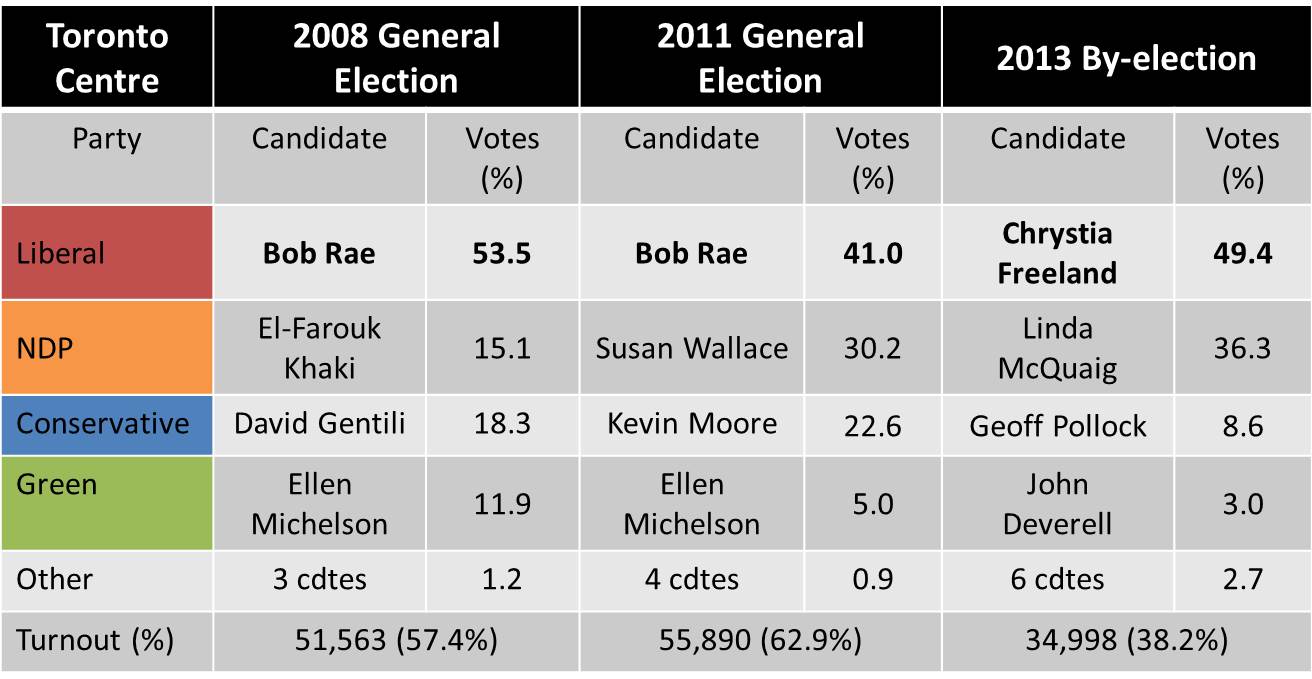
    Toronto Centre 2008-2013 Toronto Centre election results, 2008-2013

    In Toronto Centre, the NDP kept gaining support since the 2008 election, yet the Liberals held on with comfortable margins in 2011 and 2013. In the 2013 by-election, triggered by Bob Rae’s retirement from electoral politics, the CPC vote share collapsed (as did voter turnout), and Linda McQuaig, the new NDP standard-bearer, more than tripled the NDP’s share of the vote in 2008.

    Trinity-Spadina 2008-2014Trinity-Spadina election results, 2008-2014

    The NDP’s Olivia Chow, elected MP in 2006, was re-elected in 2008 and 2011. But her resignation in 2014 to run for Mayor of Toronto triggered a by-election in which Toronto city councillor Adam Vaughan took the riding for the Liberals in a by-election held on June 30, in the middle of the Canada Day long weekend. Voter turnout was a miserable 31.9%.  (more…)

  • A quick guide to the Toronto Ward Boundary Review

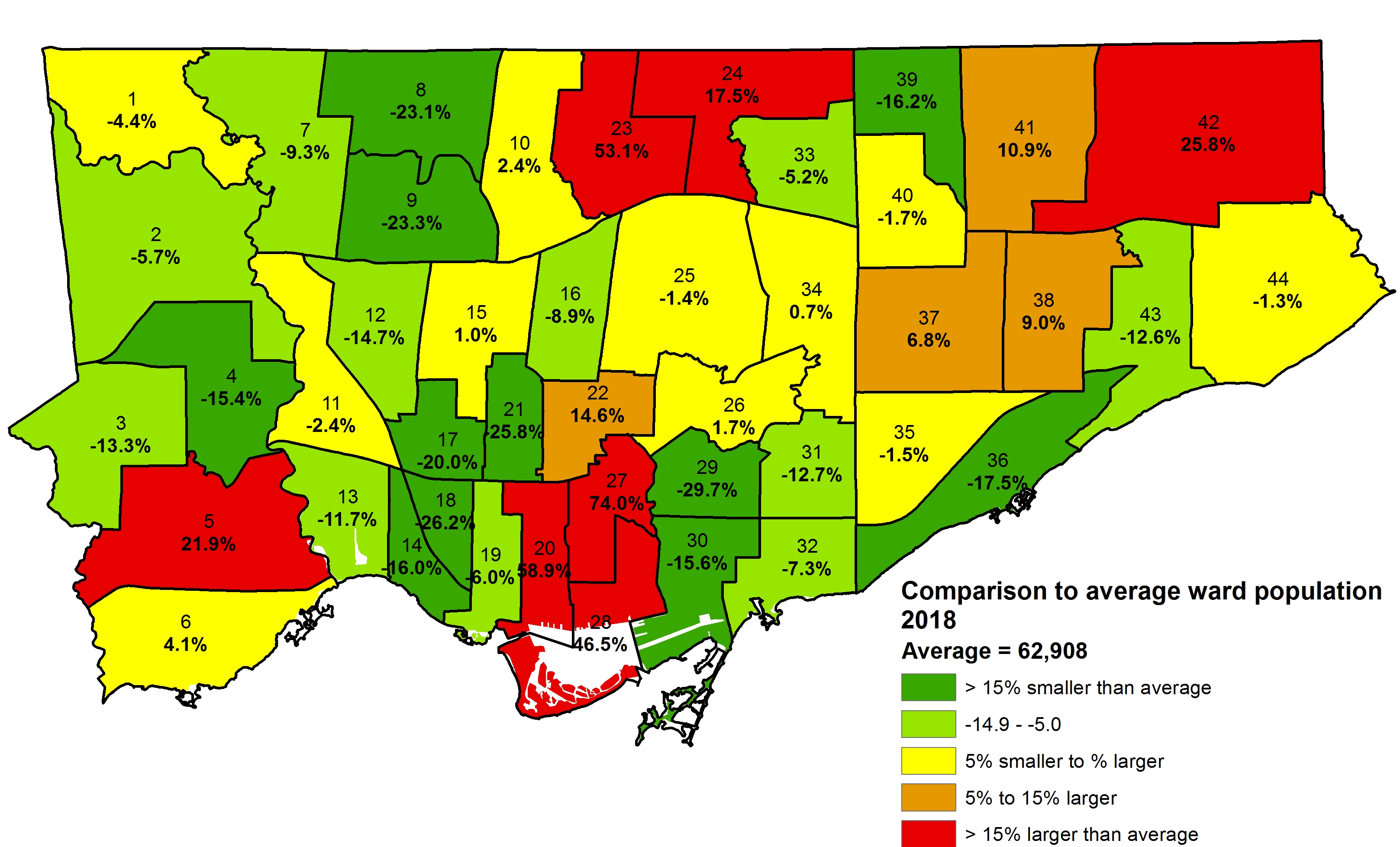
    2014 Election - 2018 Ward ProjectionsThe variance in ward populations in 2018; new ward boundaries will address the population inequities shown above.

    Back in March, I wrote about the City’s plans for new ward boundaries, outlining the history of Toronto’s post-amalgamation council and the need for fairer representation. While Toronto’s population continues to increase, most of the growth is concentrated in northeast Scarborough, central North York and Etobicoke, and especially Downtown, where new condo towers are going up by the dozen.

    Yesterday, on August 11, the Toronto Ward Boundary Options Report was released, setting the stage for further public consultations. With the report, we now have tangible details of what the new wards might look like, and how many politicians the new council, to be elected in 2018, will be comprised of.

    I wrote more about the report in Torontoist, with a discussion on the process, criteria, and the various options presented.

    While the mayor may disagre (“I think the last thing we need is more politicians,” he was quoted as saying), I personally prefer the options that add a few more councillors than the existing 44. Back in 1997, the newly amalgamated City of Toronto had 57 city councillors, and with a growing population, a small increase in the size of council is more than appropriate. “Option 1 – Minimal Change” adds three new councillors; two downtown and one in North York; it is not a bad option, though I think fifty is a workable number.

    There are plenty of opportunities for feedback, including a survey and a new round of public consultations in the Fall; I recommend taking part and sharing your own views.

  • Updated: The Toronto Star’s shameful reporting on the Hurontario-Main LRT

    IMG_6655

    As of Tuesday, July 28, the Toronto Star has not published any letter to the editor responding to last Tuesday’s front-page article by San Grewal questioning the ridership of the northern section of the Hurontario-Main LRT, or any corrections. I find myself very much disappointed by this. I know I was not the only reader to submit a letter to San Grewal’s poor reporting, to which I link below.

    Here is the letter that I wrote and submitted on July 21, 2015:

    Dear Editor,

    I wish to express my disappointment with the publication of a badly researched and one-sided article by San Grewal on the opposition to the Hurontario-Main LRT.

    The article starts with by getting its numbers wrong. In the second paragraph, it claims that the LRT’s capacity will be 15,000 riders per hour per direction (PPHPD). This is false. The City of Brampton’s own staff report, which recommended that council approve the funded Main Street LRT [which can be found here:http://www.brampton.ca/EN/City-Hall/meetings-agendas/PDD%20Committee%202010/20150622pis_H10.pdf], states that the maximum capacity of the LRT is 7200 PPHPD, less than half the figure Grewal claims.

    The comparison to the Sheppard Subway, which Grewal appears to take at face value, is especially inappropriate. The Sheppard Subway cost nearly $1 billion when it was constructed 15 years ago. The section of the LRT between Steeles Avenue and Downtown Brampton will be built entirely on the surface, and comprise only a short section of the corridor’s entire length. It is worth repeating that the province will be funding the entire project; any deviation from Main Street would be more expensive and will cost Brampton taxpayers more.

    The Hurontario-Main LRT is not only a transit project; it is a city-building exercise that will help direct investment and urban intensification in Brampton and Mississauga. The light rail project will connect three GO Station and several urban centres identified for growth, including Brampton’s Downtown Core.

    San Grewal’s article is misleading, one-sided and irresponsible. I expect better from the Toronto Star.

    Sincerely,

    Sean Marshall

    The original post follows:

    (more…)

  • Why Brampton’s Main Street needs the LRT

    IMG_6655

    For the first twenty-five years of my life, I lived in Brampton. I still have family and friends who live there, and while I was happy to move to a place of my own in Toronto (first in North York, later to the old City of Toronto), I still have a soft spot for my hometown, even if it is a gigantic, sprawling auto-centric suburb.  Tonight, it has the opportunity to vote for a transit project that will help to transform its long-neglected downtown core into a thriving urban centre.

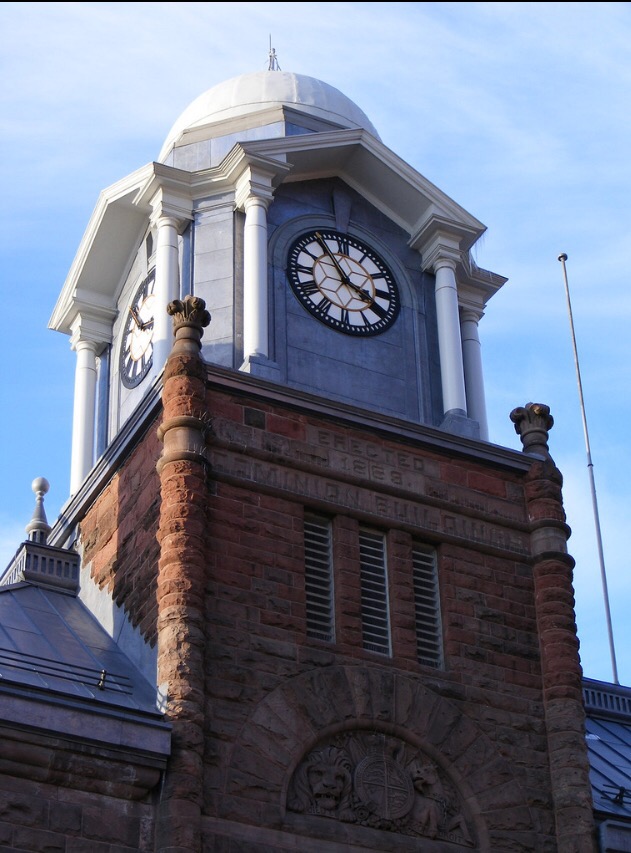
    Nearly a century ago, Brampton was a small town of about 5,000 people; the junction of two railways: the Grand Trunk mainline between Toronto and Chicago, and the Canadian Pacific branch line to Orangeville, Owen Sound, and other points in Midwestern Ontario. It was the seat of Peel County, with a beautiful 1867 Italianate courthouse, with a registry office and jail behind. Brampton had all the trappings of a prosperous rural service centre, including a hospital, a Romanesque federal building, a Carnegie Library, six historic brick or stone churches, a movie and vaudeville theatre, an armoury, and a fire hall. While there were manufacturing concerns by the railway junction  – both the Hewetson Shoe Company and Dominion Skate manufactured footwear – the leading industry was horicultural. The massive Dale and Calvert greenhouse complexes exported flowers and bulbs across Canada; as a result Brampton’s nickname was “Flower Town.” Grand houses lined Main Street, showing off the town’s booming economy.

    It wasn’t until the 1950s that Brampton began the transition from a small industrial and civic centre into a suburb of Toronto. In 1960, a new mall, anchored by Steinberg’s and Woolworth’s, opened south of downtown, new schools and factories, including a large American Motors assembly plant, opened here as well. In 1974, the same year that the first GO Train departed from Brampton for Toronto, the town was amalgamated with sections of several surrounding rural townships, becoming a city of nearly 100,000. Today, Brampton has a population of nearly 600,000.

    Apart from the greenhouses, which disappeared by 1980, and the hospital, which moved across town in 2008, all of the buildings I described are still standing (or in the case of Dominion Skate, partially standing). Downtown Brampton is blessed by its collection of historic buildings; many of these structures are lovingly preserved. The old Thomas Fuller designed Dominion Building on Main Street, which later became a police station and then a pub, was renovated and now has a Starbucks. GO Transit and VIA Rail still use the 1907 Grand Trunk Station. The Hewetson Shoe Factory is now a loft commercial space, and the old county buildings were preserved and now house the innovative Peel Art Gallery, Museum and Archives.

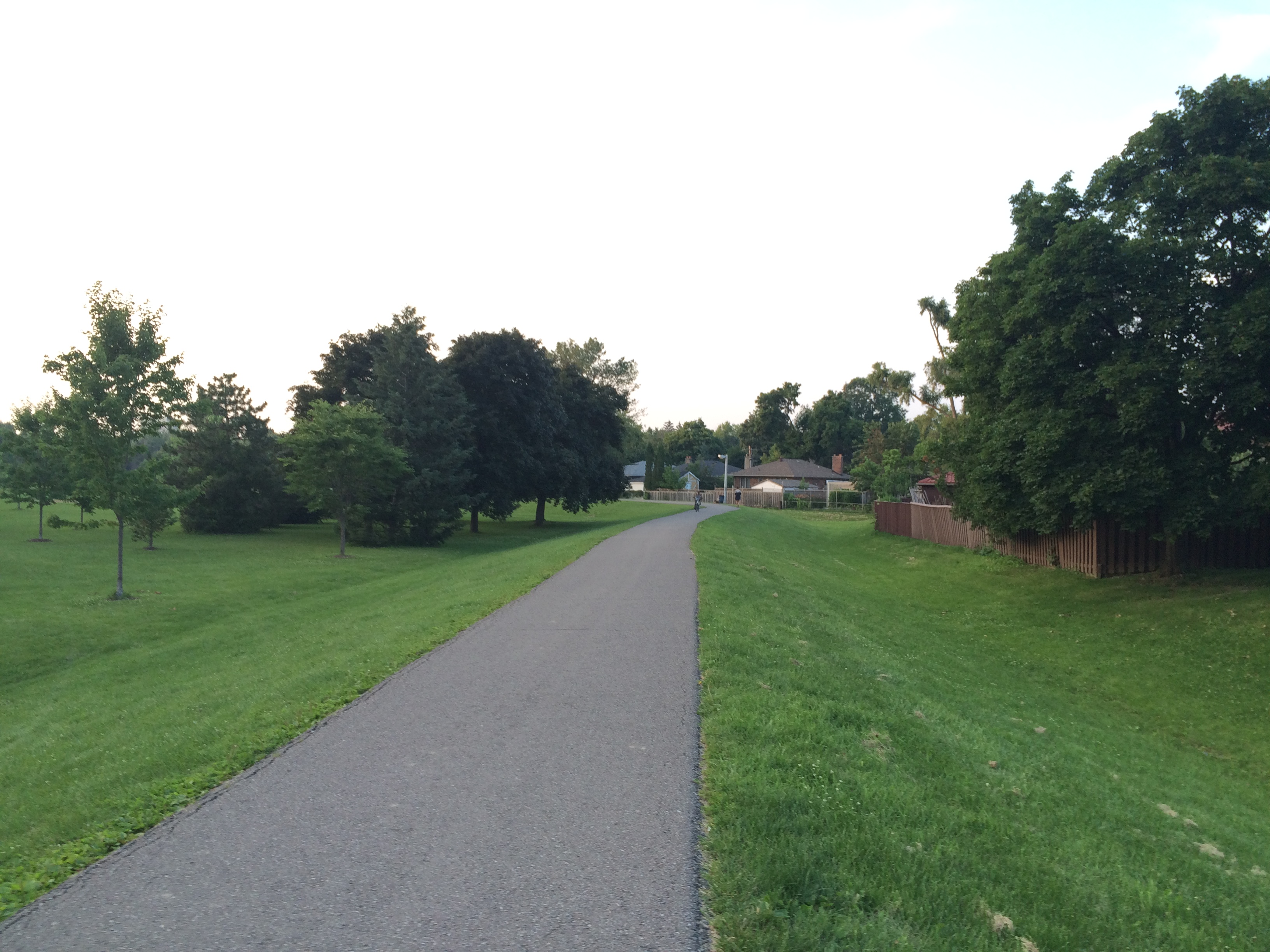
    While there’s lots of great built heritage in Downtown Brampton, but downtown struggles with retail vacancies; condominium towers built in the last decade have had difficulty with sales. A new condo tower planned for the Dominion Skate building, right across the tracks from the GO/VIA station, did not get built; it sits in a half-demolished state, awaiting a new use. Also awaiting a reuse is the old Capitol Theatre, which closed as Brampton’s civic performing arts centre when the new Rose Theatre opened at Brampton’s historic “Four Corners” in 2006. There’s the popular Gage Park, with its 25-year old skating path (which has since been copied in Etobicoke and elsewhere), but most attempts at urban renewal have been, at best, only partially successful.

    IMG_6642Thomas Fuller’s 1889 Dominion Building, Brampton
    Tonight, Brampton City Council will hold a special meeting to decide the fate of its section a fully funded $1.6 billion light rail project proposed for the Hurontario-Main Street corridor from Port Credit to Downtown Brampton. The LRT, which will be funded entirely by the Province of Ontario, will connect three GO corridors, the urban centres of Port Credit and Brampton, several major employment clusters, and Mississauga’s modern city centre, which includes Ontario’s largest mall.

    While most of the LRT route would operate in a reserved median in the centre of the street, in Downtown Brampton, it would operate in mixed traffic on the surface. It would require no private property, though it would require eliminating some surface parking on Main Street and turn restrictions at some intersections and driveways.

    The newly-elected mayor of Brampton, Linda Jeffrey, is in favour of the project, including the planned Main Street alignment, but at least five of ten councillors are against it. Tonight’s vote will be a nail-biter, a meeting for which a record 130-plus residents are registered to depute on this item; the city is clearly divided on this project.

    Opponents claim that the project mostly benefits Mississauga, and that light rail running along Main Street would ruin its heritage character, and would threaten the Saturday farmers market, which is set up on a closed Main Street. They also argue that the removal of street parking would hurt downtown businesses. These arguments are, of course, bunk; the heavy traffic, including light trucks and frequent buses do plenty to mar Main Street’s heritage; trams and light rail trains run through historic European cities like Brussels, Amsterdam, Prague, and Istanbul; the farmers market could simply re-locate to the new Garden Square or onto Queen Street. There are four large city-owned off-street parking garages with room to spare. These arguments are convenient strawmen hiding true NIMBY attitudes.

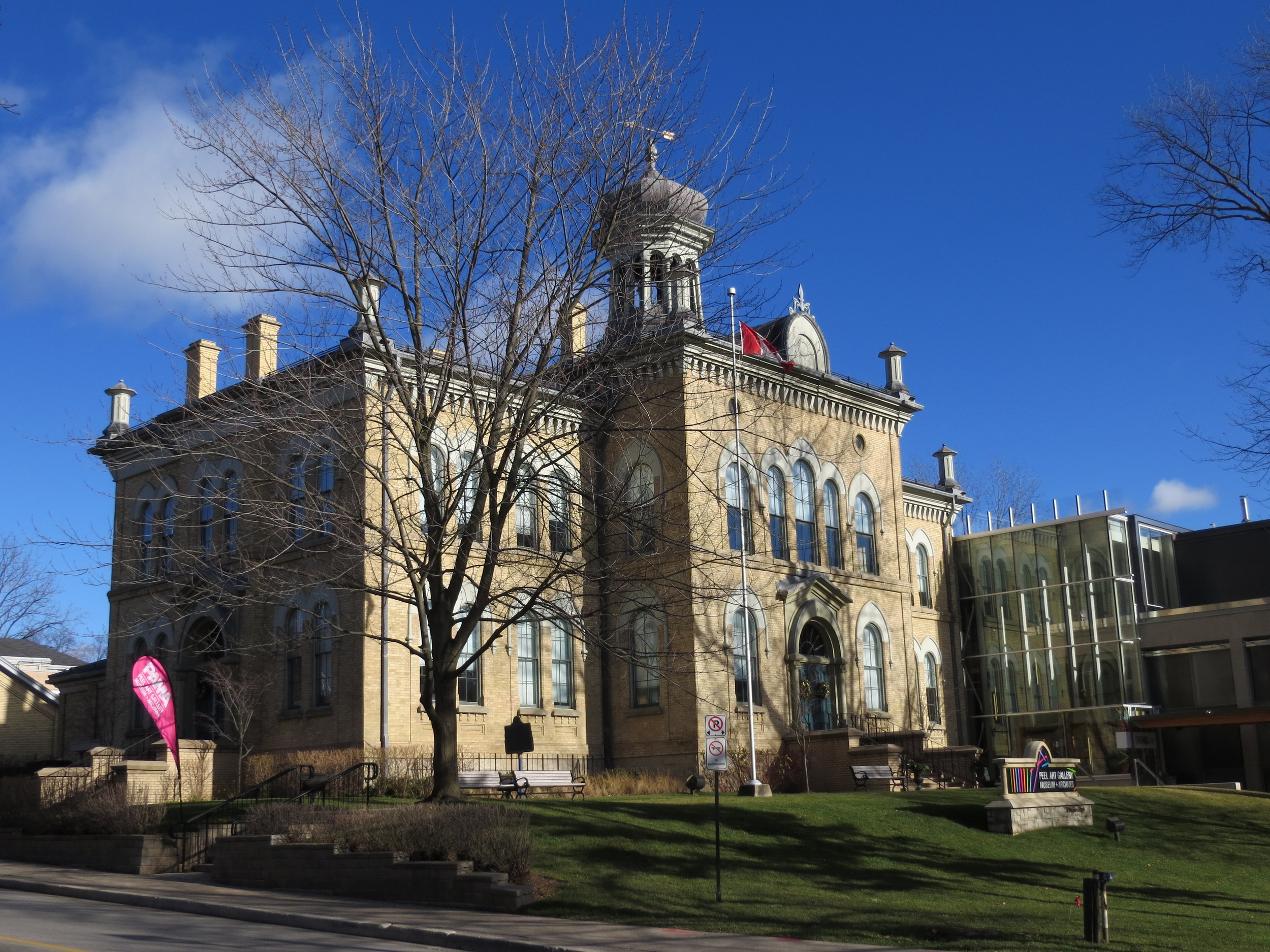
    8228039505_d6d424f22d_oThe Peel County Courthouse, now the Peel Art Gallery, Museum and Archives (PAMA)

    It is true that most of the route passes through Mississauga; it’s also true that the larger city to the south enjoys more benefits from residential and employment growth on its portion of the corridor. Main Street follows Etobicoke Creek north of Steeles Avenue; this limits new development. However, lands between Shoppers World (which has been losing major retail tenants like The Bay and Target) and Highway 407 are prime opportunities for intensification, as is the largely-vacant Brampton Mall at Nanwood Avenue. But the intermodal connections at Downtown Brampton and the opportunity to revitalize the downtown core make up for these drawbacks.

    Last year, at a 10-1 decisive vote, City Council voted against the proposed route, ordering staff and consultants to evaluate alternative alignments.

    These alternatives, nine of which were studied, included one that follows Etobicoke Creek through a floodplain and residential backyards. Other routes would have taken passengers far out of the way on McLaughlin or Kennedy Roads to reach the downtown core. A tunnel under Main Street, which would cost the City of Brampton $380 million, was looked at as well. Staff came back to Council in June with a report that evaluated all these possible alternatives and re-recommended the original surface alignment as being the most fiscally and technically responsible option and the best for transit users and for city-building.

    IMG_6675The Etobicoke Creek LRT alignment, proposed as a by-pass of Main Street

    The Hurontario-Main LRT is the boost Downtown Brampton needs. While expanded GO rail service will come, most Brampton commuters aren’t headed to Toronto’s financial core; they’re commuting to jobs elsewhere in Brampton, in Mississauga, and in other suburbs, and inter-suburb transport is lacking. Creating a higher-order transit network requires nodes, and Downtown Brampton, one of only a few historic and walkable neighbourhoods in Toronto’s suburban belt, is an ideal place for such a node. Not only is there the connection to GO and VIA trains (which would also benefit commuters to and from Mississauga, Guelph, Kitchener-Waterloo and elsewhere), but there are many opportunities for residential and employment intensification downtown, and along the Main Street corridor. Vacant storefronts that pockmark Main and Queen Streets say to me that more foot traffic is needed to revitalize these buildings. The LRT will help, not hinder, this goal.

    If Brampton votes a second time against the Hurontario-Main LRT, it will still be built, but will terminate at Steeles Avenue, four kilometres south of the downtown core. It will require a transfer to northbound buses at a third-rate shopping mall rather than at an urban transit hub with intercity rail connections. It would be a decision that Brampton will come to regret; offers of provincially funded transit don’t come around very often.

    Voting no will be, to put it mildly, a lost opportunity. Hopefully, Brampton City Council will see the sense of going with the province’s offer of a fully-funded LRT corridor.

  • Gardiner East: Or How I Learned to Stop Worrying and Love the Megacity

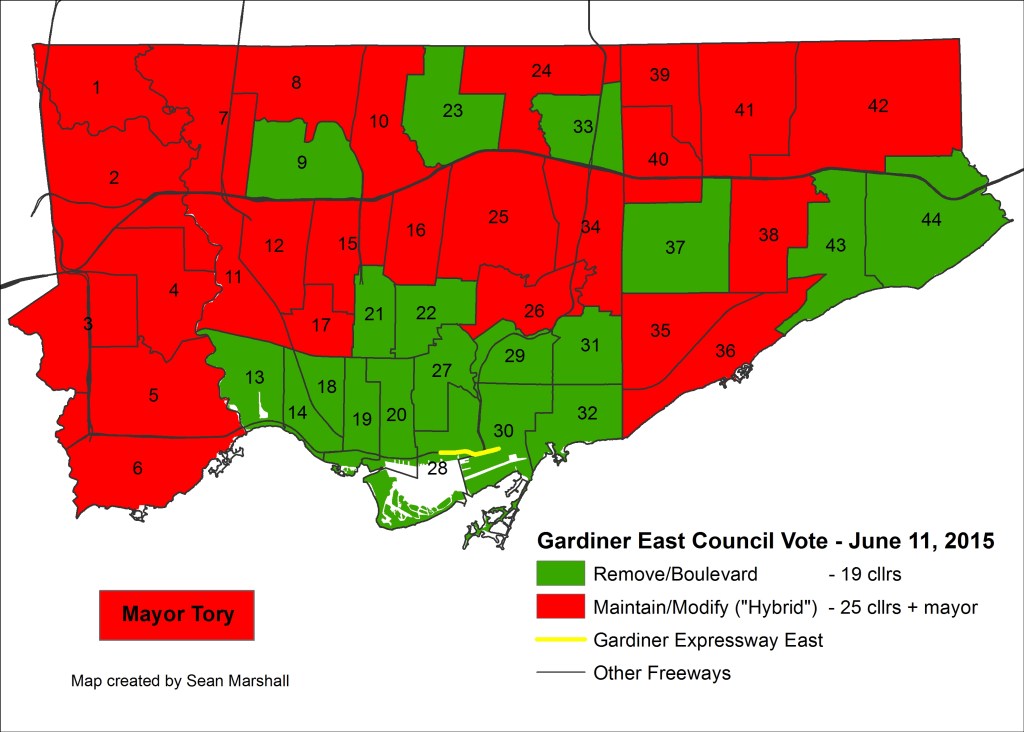
    On Thursday, June 11, Toronto City Council voted to maintain the Gardiner Expressway between Jarvis Street and the Don Valley Parkway, endorsing the “hybrid” option by a vote of 24-21. The previous vote, a motion to support the remove/boulevard option, was defeated by a 19-26 vote. The two inconsistent votes were by Councillors Anthony Perruzza (Ward 8) and Rob Ford (Ward 2), who didn’t like either of the two options on the table.

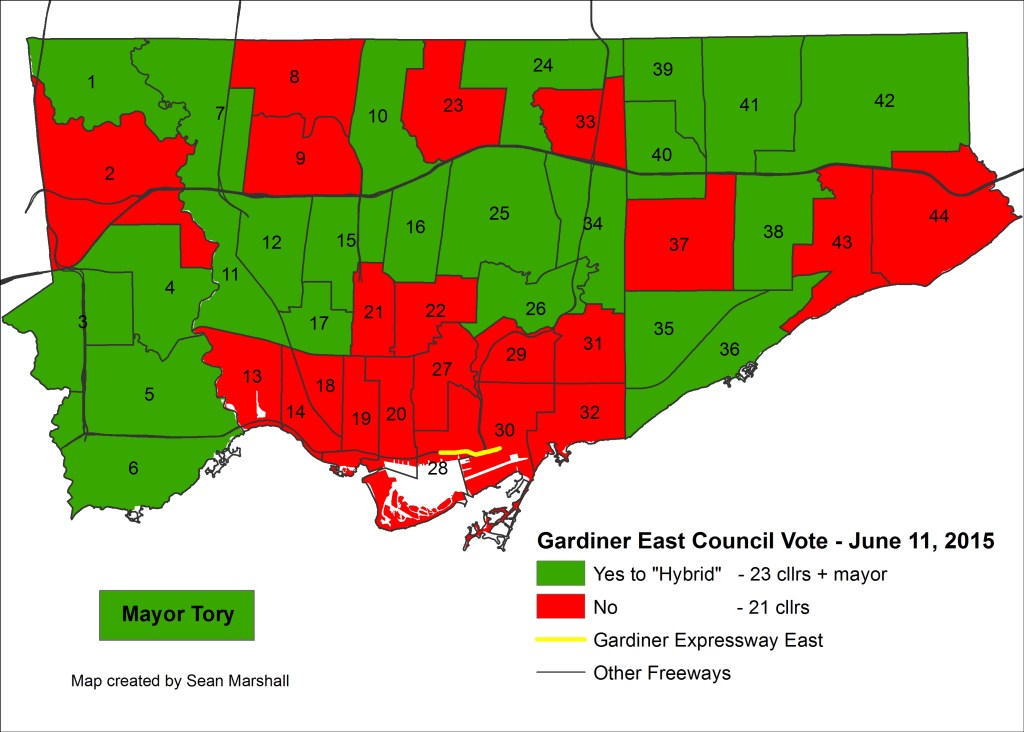
    Immediately after that vote, I created the two maps below. The first shows the vote on whether to go with the less expensive option, to replace the East Gardiner with a boulevard. The second shows the final vote on the “hybrid” option strongly supported by the mayor, despite all the evidence that maintaining that portion of the elevated freeway wasn’t necessary. I shared these maps on Twitter.

    TT - Gardiner VoteVote on the Remove/Boulevard option for the Gardiner East
    TT - Gardiner Vote v2Vote on the “Hybrid” option for the Gardiner East
    While all “downtown” councillors, representing nearly all the former City of Toronto and much of East York favoured the tear-down, it wasn’t entirely an urban-suburban split. Six councillors in Scarborough and North York, namely Paul Ainslie, Michael Thompson, Ron Moeser, Shelley Caroll, John Filion, and Maria Augimeri, voted for the Gardiner’s removal. Eight (including Perruzza and Ford) voted against the Mayor, making the decision to go with the “Hybrid” a close 24-21 vote, a blow to Tory’s promise as a reasoned “consensus builder.”

    But almost as troubling as the vote, I soon started to notice mentions and replies to my Twitter feed calling for de-amalgamation. Here is a sample:

    These reactionary responses, while understandable, ignore some inconvenient truths.

    It’s easy to forget that Gardiner Expressway, along with the Don Valley Parkway and the Allen Road (the completed section of the infamous Spadina Expressway), were built by Metropolitan Toronto, an upper-tier government that was created by the province in 1953 in order to accommodate and control Toronto’s rapid growth. Its boundaries were the same as those of the post-1997 City of Toronto.

    Metro Toronto was given the responsibility for many, including the TTC, all major roads, ambulances, police, most of the city’s public housing, waste collection, and the administration of social services. Metro had its own system of parks separate from the lower-tier cities and boroughs, and its own divisive politics. The Gardiner Expressway, one of Metro Toronto’s first mega-projects, was named for the first Chair of Metro Council, Frederick G. Gardiner. The old City of Toronto opposed Metro’s Spadina Expressway plans; it was the Province of Ontario that stepped in to stop the controversial freeway at Eglinton Avenue.

    Had Mike Harris’ PC government wasn’t elected in 1995 and the six cities and boroughs were never amalgamated, it would be a Metropolitan Toronto Council deciding the Gardiner’s fate, and we’d probably still see the same urban/suburban divide when it came to the final vote.

    The case for amalgamation

    I’ll come right out and say that the provincial government under Mike Harris made a terrible mistake when it decided, without warning, to amalgamate Metro and its six lower-tier municipalities into a megacity in 1997. Even though I lived in Brampton at the time, I opposed Bill 103 when it was introduced and enacted in 1997. But I think amalgamation was a mistake because the process was rushed, it was steamrolled over the objections of almost every local politician and engaged citizen, and the motivations were politically suspect – a left-leaning City of Toronto, led by an NDP-allied mayor was overwhelmed by a more Conservative-friendly suburban population, with Mel Lastman as the first mayor.

    The first few years were painful as departments and agencies were melded together. Mayor Lastman’s property tax freezes did not help when the need for city services was growing. But what amalgamation did do was provide taxation and service equity across Toronto. York, the poorest of the six lower-tier cities, did not even have a full-service recreation centre and had a relatively poor parks and library system. That all changed, and generally, for the better.

    The Toronto Public Library, which just opened its 100th branch, is the the envy of library systems around the world. It is the second largest system in North America (after New York’s) and has the highest circulation. When its budget was threatened in 2011 in the early days of the Ford administration, they had to back off due to an overwhelming public campaign.

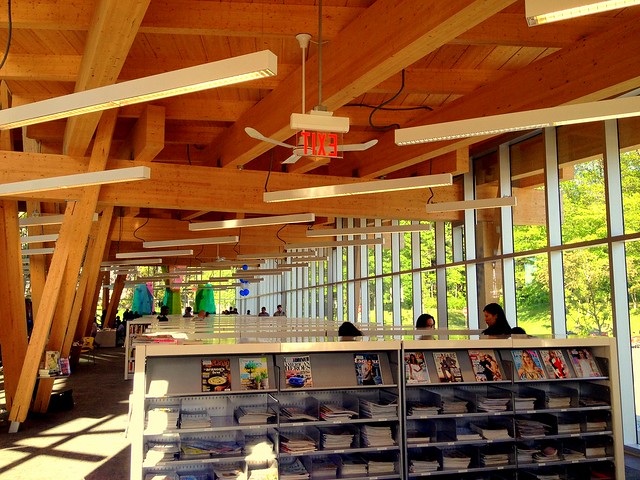
    Toronto Public Library - Scarborough Civic Centre BranchNew Scarborough Civic Centre Branch, photo by W Poon

    I would argue that the TPL makes the best case for amalgamation. Before, each of the six cities had their own library systems, and the Toronto Reference Library was a separate entity. Library access and budgets were limited in some of the smaller systems, especially in York and East York. Amalgamation of the library system has created a more equitable system that’s the envy of the world. It has been expanding and renovating branches all across the city without any cries of regional favouritism. While the library system is still mostly a collection of reading materials, the TPL has adapted to the digital age, providing communal study spaces, media labs, new computer equipment and 3-D printers, and access to vast digital resources through its website, including current periodicals. The Toronto Public Library is something all Torontonians should be proud of.

    So yes, there will often be an urban/suburban split on some issues, particularly on transportation items. I share the frustration after last week’s vote. We particularly need to elect a better council in 2018. And there always improvements that can be made to make this city work better for its diverse neighbourhoods, perhaps devolving more responsibilities to reformed community councils.

    But I have little time any more for calls for de-amalgamation. It won’t change politics all that much. Let’s focus on making this city work.

  • Gardiner East update: a close vote, but one Tory is likely to win (updated)

    East Gardiner Vote - June 8
    Projected Gardiner East council vote as of Monday, June 8.

    (Updated 5:00 PM, June 8)

    With Councillors Jon Burnside and Raymond Cho coming out in support of the “Hybrid” option for the Gardiner East, and Councillor John Filion supporting the Removal/Boulevard option, here’s the latest map. Only seven councillors are considered “unknown” in their intentions for this week’s vote; John Tory and pro-expressway advocates only need two more councillors on their side to win a razor thin 23-22 vote. The new map, based on Matt Elliott’s tally (PDF here), is above. Councillor Jim Karygiannis withdrew his support for the “Hybrid” and is asking constituents for their feedback on Twitter.

    As Council is divided mostly on suburban-urban lines, It’s worth noting that most Toronto commuters headed downtown take transit; even in the outer areas where transit access is lacking, and travel times long. In every ward completely north of Highway 401, more than 70 percent of weekday AM peak trips to Downtown Toronto are made by public transit – either TTC buses and subways or by GO train. In 39 of 44 wards, a majority of commuters take transit.

    In only seven wards do auto commuters have more than 40 percent of the mode share. Only one ward, Ward 32, which includes the affluent Beach(es) neighbourhood, do auto commuters outnumber transit riders in the AM Peak. Good road access, high auto ownership rates and lousy TTC surface routes (the notoriously slow, short-turning 501 Queen Car) are the likely explanations for this anomaly. Downtown, in Wards 20, 27, and 28, at least half the commuters to downtown jobs, schools or institutions take “other” means of transportation; mostly walking or cycling.

    Ironically, those councillors most in favour of rebuilding the Gardiner Expressway represent constituents who aren’t using the Gardiner Expressway – or any other road – to get downtown.

    I created these two maps with data from the table created by Laurence Lui (Google Drive PDF here). He obtained and disseminated survey data from the 2011 Transportation Tomorrow Survey,  a comprehensive travel survey conducted every five years in the Greater Toronto and Hamilton Area.

    Downtown AM Peak Mode Share - Transit

    Downtown AM Peak Mode Share - Auto

    (more…)

  • From “Boldness” to Madness?

    Tory

    As I find myself increasingly frustrated with John Tory’s first six months in office, I can’t help but wonder what his motivations are behind his stances on his signature SmartTrack transit plan, the Gardiner East, the Scarborough Subway, and police carding. Despite it’s many flaws, it’s still full steam ahead for SmartTrack; the Scarborough Subway is quickly becoming a fiscal quagmire, and his positions on other issues troubling.

    A subway alignment along Bellamy Road? That’s madness, not the “bold” transit plans John Tory campaigned on. Is John Tory stubborn? Or getting bad advice? Is he open to contradictory options? Or closed-minded? Is he afraid of admitting mistakes and moving forward?

    I have been thinking about Tory’s previous runs for office and a bit troubled that his campaign advisers, and even his son*, have become lobbyists representing for some of the most controversial issues at City Hall, such as taxi licencing. One of Tory’s senior strategists, John Duffy, is planning a PR blitz to support SmartTrack.

    To put it bluntly, I feel that there are serious clncerns about John Tory’s ability to govern. In my opinion, leadership in municipal politics is about making informed decisions, listening to senior staffers, consulting with stakeholders, and coming to sound decisions. With Mayor John Tory, it all appears to be bass-ackwards, with a small group of political advisers and lobbyists calling the shots. I also find myself thinking about Tory’s past leadership.

    In 2003, John Tory came in a reasonably close second place to David Miller, running on a centre-right platform of responsible governance after Mel Lastman’s turbulent two terms after the creation of the Megacity in 1997. Apart from a website Tory’s team created that attacked Miller for considering tolling the Gardiner Expressway and Don Valley Parkway, Tory’s 2003 campaign was respectable, fair and reasonable, building his name recognition and earning goodwill.

    Tory seemed like the perfect candidate for leader of the Ontario Progressive Conservatives. The party was looking to shift towards the centre after the Mike Harris/Ernie Eves era., and he had strong name recognition in the vote-rich Greater Toronto Area, where the PCs lost over 20 seats to the newly-elected Liberals in the provincial election that same year.

    Tory’s PCs ran in the 2007 election on a controversial platform of subsidizing religious private schools. He argued that taxpayers should fund Islamic, Jewish and other faith-based schools, just as the province funded public and Catholic school boards. It became his signature campaign plank, much like how SmartTrack became the most memorable campaign promise of Tory’s 2014 mayoral campaign.

    Tory’s plan for funding religious schools the wrong answer to a very legitimate question: why, in the twenty-first century, is a progressive, urban, and multicultural province still funding a separate, Catholic school system? In the 1860s, when Catholics were a disadvantaged religious minority in Ontario, and politicians were trying to woo French-Catholic majority Quebec to joining Confederation, it made sense, one of many compromises that made Canada work. But not 140 years later. After all, Quebec got out of its Constitutional obligation to provide Protestant schooling in the 1990s without too much fuss.

    The religious schools issue was a disaster. Tory mused that creationism could be taught alongside evolution in publicly-funded religious schools; the Liberals jumped on such gaffes. Tory could have made the election about the record of the somewhat unpopular Liberal government led by Dalton McGuinty, but the Liberals saw an advantage and ran with it, winning the election with a second majority government. To make matters worse, Tory, who decided to run in Don Valley West, lost to the Liberal Minister of Education, Kathleen Wynne.

    After losing a by-election in a rural, supposedly-safe PC seat in order to sit in the Ontario Legislature, Tory quit politics for six years, chairing Civic Action, a non-partisan, business-led urban think tank, an organization whose purpose is a bit mysterious. Tory also hosted an afternoon talk radio show on CFRB.

    Some of his views as Chair of Civic Action and an easy-going drive-time talk radio host don’t really match what he’s saying today as Mayor of Toronto.

    Back in 2010-2013, Tory spoke strongly about the need for new funding to pay for new transportation infrastructure, stating that politicians had to be ready to “make the admittedly tough choices about how to raise the money necessary to build a better transportation system.”  At the time Civic Action was promoting a public relations campaign, called “What Would You Do For 32?”  – the 32 being the number of minutes “saved” if Metrolinx’s “The Big Move” transportation plan – a mix of light rail and bus rapid transit projects, new and extended subways, GO Regional Express Rail, and some highway expansion projects in fringe urban areas.

    Civic Action declared the campaign to be about pressing for “bold leadership” to “dramatically improve transportation in the Greater Toronto and Hamilton Area (GTHA)” [There’s that b-word again, which would be used again and again to describe SmartTrack in Tory’s campaign speeches.] As I read it, Civic Action’s role would be mostly limited to public relations work to educate and promote new revenue tools (taxes, fees and tolls) to businesses and the public in order to fund these projects. In  January 2013, Tory was quite vocal about the need for investment in the high-level plan that Metrolinx put together, itself largely guided by the list of wants and needs brought forward by local municipalities.

    Interestingly, the Big Move identified the Scarborough and Sheppard LRTs to be built as part of the 15-year plan, while a “Relief Line” – a 13-kilometre subway corridor, was part of its 25-year plan. This was the plan that Civic Action, and Tory himself, were promoting.

    There’s a reason why SmartTrack never appeared on Metrolinx’ maps: it was interested in transforming the GO Transit commuter rail network into a regional express rail system, starting with the electrification of the Georgetown/UP Express and Lakeshore corridors, as well as the municipal rapid transit plans proposed or approved at the time. Eglinton Avenue west of Mount Dennis was to be served by an extension of the Eglinton-Crosstown LRT; it would meet the Mississauga Transitway at Renforth Drive. The combination of improvements to the Yonge subway line, the upgrades to GO’s rail network, and the eventual construction of the Downtown Relief Line subway didn’t leave any need for SmartTrack, which would have duplicated these other lines.

    But in May 2015, Tory is so committed to SmartTrack, he is now looking at even more expensive options for the Scarborough expansion of the Bloor-Danforth subway, as the two projects run in close parallel to each other through central Scarborough. This could increase the already expensive $3.56 billion subway extension’s cost by an extra $1 billion.


    Tory throwing more money at the Scarborough Subway extension

    On the Gardiner East, we hear John Tory call the “hybrid” solution – essentially a replacement of the existing expressway on a slightly different alignment “the right, balanced decision that made common sense,” in an interview with TVO’s Steve Paikin. But senior city staff like Chief City Planner Jenniffer Keesmaat and Medical Officer of Health David McKeown, and other experts such as former Chief City Planner Paul Bedford all call for the removal option, in which Lake Shore Boulevard is upgraded to handle the additional traffic.

    (Tory repeated that term, “common sense, ” four more times in that interview, which is worth watching. I can’t help but be reminded by another conservative who liked using “common sense” to implement many destructive policies in Ontario.)

    And today, May 27, David Rider at the Toronto Star revealed that Tory used “an outdated, inflated commute statistic” to justify the “hybrid” option in that same interview. (Rider later clarified that Tory did not know about the flaws in that statistic, and has stopped using it.)

    This statistic comes from the University of Toronto traffic study, which was commissioned by the Gardiner Coalition, which includes the Canadian Automobile Association, courier companies, and other industries. Eric Miller was one of the co-authors of that study.

    Perhaps not coincidentally, Miller was also the lead transportation adviser to Tory’s campaign and a key supporter of Tory’s SmartTrack platform, giving it an “A-plus” grading, while saying Chow’s plan “…lacks the vision and boldness that the city’s current situation calls for.” (There’s that b-word again.)

    But in a Toronto Life Informer article last October, Eric Miller, to his credit, also had this to say:

    “SmartTrack may lead us to revisit whether the Scarborough subway extension really does make sense or whether the LRT might be better to do. That frees up a billion dollars or more that might make up the shortfall.”

    Even Tory’s hand-picked transportation expert wondered if the Scarborough subway extension is such as good idea, but Tory, for some reason, remains entirely committed to it.

    Back in 2007, I don’t think that Tory himself even believed in the idea of funding private religious schools all that much; I have the feeling (and I’m not the only one) that he didn’t really believe in the idea himself, but allowed his advisers and confidants to push for this ill-advised platform. At Civic Action, Tory sounded rather progressive, as he surrounded himself with civic boosters, urban planners, and activists.

    On SmartTrack, like so many important and controversial issues, it sounds like Tory listened to a select group of campaign and policy advisers, and quickly closed his mind to any other ideas or criticism. On police carding, which is grossly racist and ineffective, Tory has also dismissed criticism and has done nothing to address this matter. Tory helped to select Mark Saunders as Toronto Police Chief, who unlike his rival, fellow Deputy Chief Peter Sloly, supported the practice, even going as far calling those persons innocent, yet carded anyway “collateral damage.” On Uber, Tory has been supportive of a full council debate, putting off much-needed taxi reforms until the courts can rule on the city’s previously-filed injunction against the controversial company’s Toronto operations.

    Tory ran for mayor with zero experience in municipal politics; he has been used to life on Bay Street, a chummy business environment. Perhaps that’s where Tory’s leadership style comes from, and maybe he’ll learn on the job. But with a small group of political advisers and lobbyists influencing the mayor, he is deprived of wider opinions and facts that I think are necessary for better decision-making.

    As long as he has the support of enough councillors, he’ll be successful implementing his so-far fiscally irresponsible agenda. But in his first year Rob Ford had the support of council on most important votes; what happens when the honeymoon is over?

    *(John A.D. Tory, the mayor’s son, is both president of a firm, Private Air Inc, based out of the Billy Bishop Toronto City (Island) Airport, and a registered lobbyist. His father, John H. Tory, would not be able to participate in any way in the Island Airport debate, nor vote on any related matter. Unlike his campaign advisers and campaign staff turned lobbyists, the younger Tory’s involvement was known months before the municipal election.)

  • The Sheppard Scarborough Subway Shitshow

    5279614296_c4bdaac003_b
    Building the Sheppard East LRT in December, 2010

    Nearly five years ago, in October 2010, work began on the Sheppard East light rail transit project, the first of three Transit City lines funded by the provincial government. This initial work was to build a grade separation between Sheppard Avenue East and Canadian National Railway’s Uxbridge Subdivision (better known as the GO Transit Stouffville Line), adjacent to the Agincourt GO Station. Metrolinx was still undertaking detailed design work for the connection to the Sheppard Subway at Don Mills Station, as well as the carhouse at Sheppard and Conlins Road, which would have also served the planned Scarborough RT replacement and extension and potentially the Scarborough-Malvern LRT, one of several Transit City lines that weren’t funded.

    Originally, the 13-kilometre Sheppard East line was to be the first to open, originally by the end of 2013. Finch West between Yonge Street and Humber College was to have opened by the end of 2015. But thanks to austerity measures enacted by the province in Spring 2010, the timelines were pushed back: the Sheppard Line would have opened in 2014; a shortened Finch line (only between the Spadina Subway extension at Keele Street and Humber College) in 2019.

    The completed Sheppard Avenue underpass at Agincourt GO Station, 2013. Note the median for light rail. Image via Google Street View.

    Construction was completed on the Agincourt underpass in May 2013, yet all other enabling work for Sheppard was halted after Mayor Rob Ford’s election. The incoming mayor declared Transit City dead; the province, up for re-election in 2011, was eager to oblige. Ford mused about extending the Sheppard Subway line west to Downsview and east to Scarborough Town Centre, and extend the Bloor-Danforth subway line instead of go with the fully funded, fully approved LRT replacement and extension. Ford was aided and abetted by councillors on both the right and the left, with Councillor Glenn De Baeremaeker the most prominent of Ford’s subway enablers.

    It’s almost a miracle that the Eglinton-Crosstown LRT project survived Ford’s bull-in-a-china-shop act. After some uncertainty, major work on that line continued, with the first boring machines launched in June 2013. That didn’t stop Ford from promising to bury the surface section of the route, at a cost of $1 billion, a plan that City Council defeated in February 2012.

    In March 2012, Council again voted to construct the Sheppard East LRT, in a 24-19 vote against Mayor Ford. Yet work never re-started. In October, 2013, Council voted to proceed with the extension of the Bloor-Danforth subway, even as Ford was losing control of the agenda overall. The provincial Liberal government again went along, hoping to retain power, perhaps even win back a majority government, in the next election. Even Adam Giambrone, an architect of the Transit City LRT plan, backed the expensive subway option as a NDP candidate in a Scarborough provincial by-election.

    That decision pretty much sealed the fate for the Sheppard East LRT. Why go back to building a light rail line on Sheppard if council couldn’t commit to building the Scarborough RT replacement? Why bother building an expensive maintenance facility to serve only one line? Why put any political capital in a project that had only tepid political support? After all, Scarborough was getting the subway extension most of its politicians demanded (even if its residents preferred an LRT), and there would be SmartTrack. Sheppard East was all but dead.

    A few weeks ago, the provincial government re-confirmed that it was funding the construction of the $1.2-billion Finch West LRT between Finch on the Spadina Subway extension, and Humber College, but that work would only start in 2016, and open five years later, in 2021. It also announced 2021 as the start date for construction on the Sheppard East LRT. That puts that project into never-never land. And not a word of protest from City Hall.

    Of course, this latest delay has emboldened subway boosters, hoping the city will push for the subway extension instead. This is despite the fact that the existing five-stop Stubway doesn’t have the ridership to fill four-car subway trains; transit experts are pretty much unanimous in their opinion that the ridership will never materialize to justify a subway extension; even the City of Toronto’s official plans only include subways for the Downtown Relief Line and on Yonge north from Finch Station into York Region. (The one amusing part of Tess Kalinowski’s article is that the pro-subway coalition member she spoke with didn’t want his name published.)

    IMG_2875A private car on the Sheppard Subway, mid-afternoon, May 19, 2015

    Why do we let politicians plan and then then destroy Toronto’s transit plans? Toronto is committed to spending billions on a subway extension we don’t need, while the subway we do need, the Downtown Relief Line, loses momentum as attention is focused elsewhere; on Sheppard and on John Tory’s dubious SmartTrack proposal, a plan that appeared almost out of nowhere in the middle of an election campaign, a half-baked plan that doesn’t provide the subway connectivity nor the redundancy required to function as an adequate relief line. Tory backed the Bloor-Danforth subway extension, even though the cheaper LRT plan was still open.

    Furthermore, Tory committed himself to the Gardiner East “hybrid” solution, which pretty much is a reconstruction of the existing elevated expressway east of Jarvis Street despite it being the more expensive short and long term option for a segment of road that is currently underutilized. It’s a plan that most urban experts and advocates dismiss, even warning that Toronto would be “a laughingstock” if it were implemented. Matt Elliott writes about this absurdity in more detail.

    To me, it appears that Tory surrounded himself with a small group of advisers like campaign chair and lobbyist John Duffy (who will be leading a public relations campaign for SmartTrack) and transportation adviser Eric Miller (who co-authored the pre-SmartTrack reports and whose University of Toronto Transportation Research Institute developed the case for the “hybrid” option backed by “The Gardiner Coalition”). Maybe council will overrule Tory’s preference for the “hybrid.” Maybe not.

    And because of that, John Tory is proving to be on the wrong side again and again on important issues; from carding, a racist police practice he seems to have no problem continuing, despite increasing public opposition; to limiting necessary tax increases; backing the Sheppard Subway; maintaining the East Gardiner Expressway;  his stubborn support for SmartTrack. I’m reminded of his myopic and stubborn support for religious school funding as Ontario Progressive Conservative leader back in 2007; a platform that might have cost him the election. I hope to be proven wrong, but I can’t say I have much faith in John Tory’s leadership.

    Of course, politicians of all stripes can be blamed for the Scarborough Subway Shitshow. But I feel we blew the last, best chance to get things right.