Category: Walking

  • Zero vision in suburban Toronto

    IMG_3684-001

    Though the city of Toronto has made some progress towards safer streets recently, the lack of police enforcement of traffic laws, the reluctance to spend serious money on road redesign, and the attitudes of some city officials continue to be obstacles towards making Toronto a safe place to walk and cycle.

    As part of the city’s Vision Zero 2.0 Plan, City Council voted in July to reduce speed limits from 60 km/h to 50 km/h on 37 sections of arterial roadways across the city, and from 50 km/h to 40 km/h on five more roads. Councillors Ana Bailão and Jim Karygiannis moved to extend several of these sections. However, rookie councillor Cynthia Lai (Ward 23-Scarborough North) moved to amend the item to remove three sections of arterial roads in her ward:

    • Brimley Road from Sheppard Avenue East to Steeles Avenue East,
    • Markham Road from Milner Avenue to Steeles Avenue East, and
    • McCowan Road from Milner Avenue to Steeles Avenue East.

    Councillor Lai claimed that her constituents were concerned about gridlock in her ward and opposed the speed restrictions. Scarborough is especially dangerous for pedestrians as it has the most kilometres of high-speed arterial roads in the city and the longest distances between crosswalks.

    High speeds and dangerous driving are major problems in Ward 23, a part of the city that I visit a few times a month. Brimley, Markham, and McCowan Roads are designed solely for car traffic: they are lined by plazas, warehouses, and backyard fences. Traffic signals are often far apart. Markham and McCowan Roads are also high-speed thoroughfares connecting Markham to Highway 401.

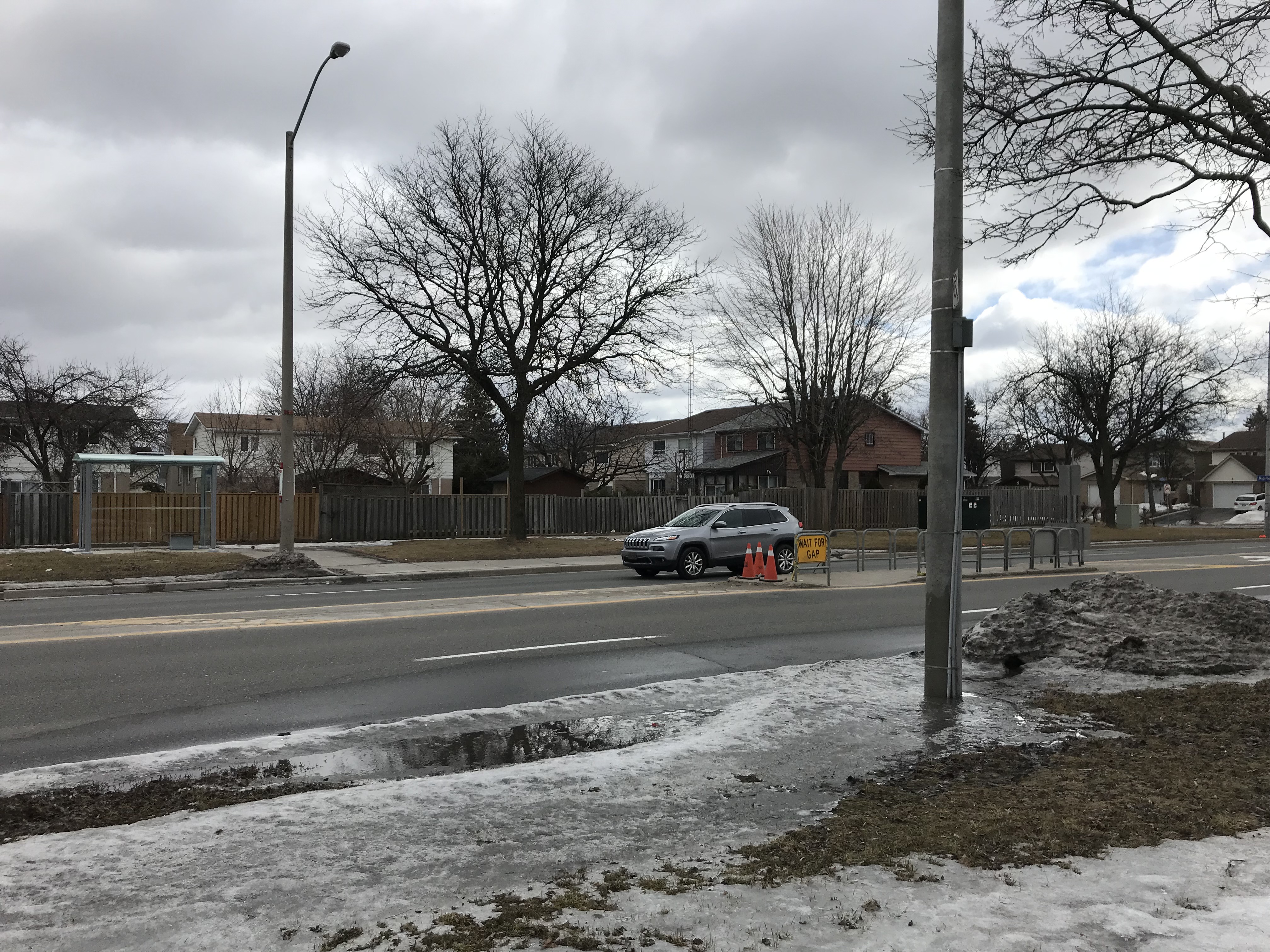
    Walking along McCowan Road between Finch and Steeles earlier this year, my spouse and I encountered a pedestrian refuge smashed in by a motorist. The refuge island was protected by reflective signage, as well as metal barriers, and was installed to help pedestrians cross at a TTC bus stop, though pedestrians are not given the right of way.

    IMG_1644Smashed pedestrian refuge island on McCowan Road
    This is why it was so disappointing to see Councillor Lai organize a “Senior Pedestrian Safety Initiative” with Toronto Police at Woodside Square, a community mall at the corner of McCowan Road and Finch Avenue. Councillor Lai, her staff, and local police were “educating” seniors about pedestrian safety, while giving out reflective armbands. Councillor Lai claimed it was part of the city’s Vision Zero strategy, and she doesn’t “think we should blame anybody.”

    This was just days after a police report showed a severe decline in traffic tickets issued and extremely limited police enforcement of unsafe driving in Toronto. On the Friday before, two seniors were seriously hurt when crossing the street.

    https://twitter.com/cynthiaToronto/status/1198323383538204673

    Needless to say, Councillor Lai and the Toronto Police taken to task by road safety advocates and even fellow councillors. Jessica Spieker of Friends and Families for Safe Streets called it a “form of victim blaming.”

    Supporting Councillor Lai’s position, on Monday November 25, Councillor James Pasternak said “wearing high visibility clothing or reflective gear is a key part of keeping everyone safe, including pedestrians, construction workers, cyclists, police officers and crossing guards. Let’s make VisionZeroTO work.” Councillor Pasternak is Mayor John Tory’s handpicked chair of the Infrastructure and Environment Committee, which among its duties is ensuring the safety of Toronto’s road infrastructure.

    Vision Zero 2.0 says nothing about armbands. Instead, the plan includes reducing speeds, road design improvements, and safer crossings at TTC stops.

    Though it is always a good idea for pedestrians to be aware of their surroundings and be predictable when crossing the street, most of the responsibility falls on the city, which designs the roads, the police, who have abandoned their duty to protect road users, and drivers, who are licensed and insured to operate multi-tonne vehicles. The rash of hit-and-runs after pedestrians were struck is especially alarming.

    In Waterloo, a crossing guard performing her duties was struck and seriously injured by the driver of a F-150 truck, who then fled the scene. This was the despite the school guard wearing a reflective vest, carrying a stop sign, in a marked school crosswalk. No amount of high-visibility clothing will protect pedestrians from dangerous drivers, who in Toronto this year, killed pedestrians walking on sidewalks, and injured pedestrians in transit shelters.

    Ironically, Woodside Square itself was hit twice by drivers in the last two years. In December 2017, a motorist crashed through both sets of doors at the mall entrance closest to Shoppers Drug Mart. In February 2018, a motorist, possibly dealing with medical problems, crashed into several cars and into a Subway restaurant at the mall. High-visibility clothing would not have helped in either of those cases.

    It’s unfortunate that a city councillor will choose giving out reflective armbands over effective speed reductions, road redesign, and traffic enforcement. Hopefully, Councillor Lai will take the criticism to heart and do better for Ward 23.

    Post script: A staff report to the Infrastructure and Environment Committee in October 2019 continued the recommendation for speed reductions in Ward 23, citing minimal impacts to travel times, and the dangerous conditions on Brimley, Markham, and McCowan Roads. Staff noted that there have been 6 fatalities and 20 serious injuries incidents on those three road segments. On October 29, Council voted to lower the speed limits on Brimley, Markham, and McCowan Roads against Councillor Lai’s objections.

  • Addressing the Toronto Police Services Board

    IMG_2922.PNG

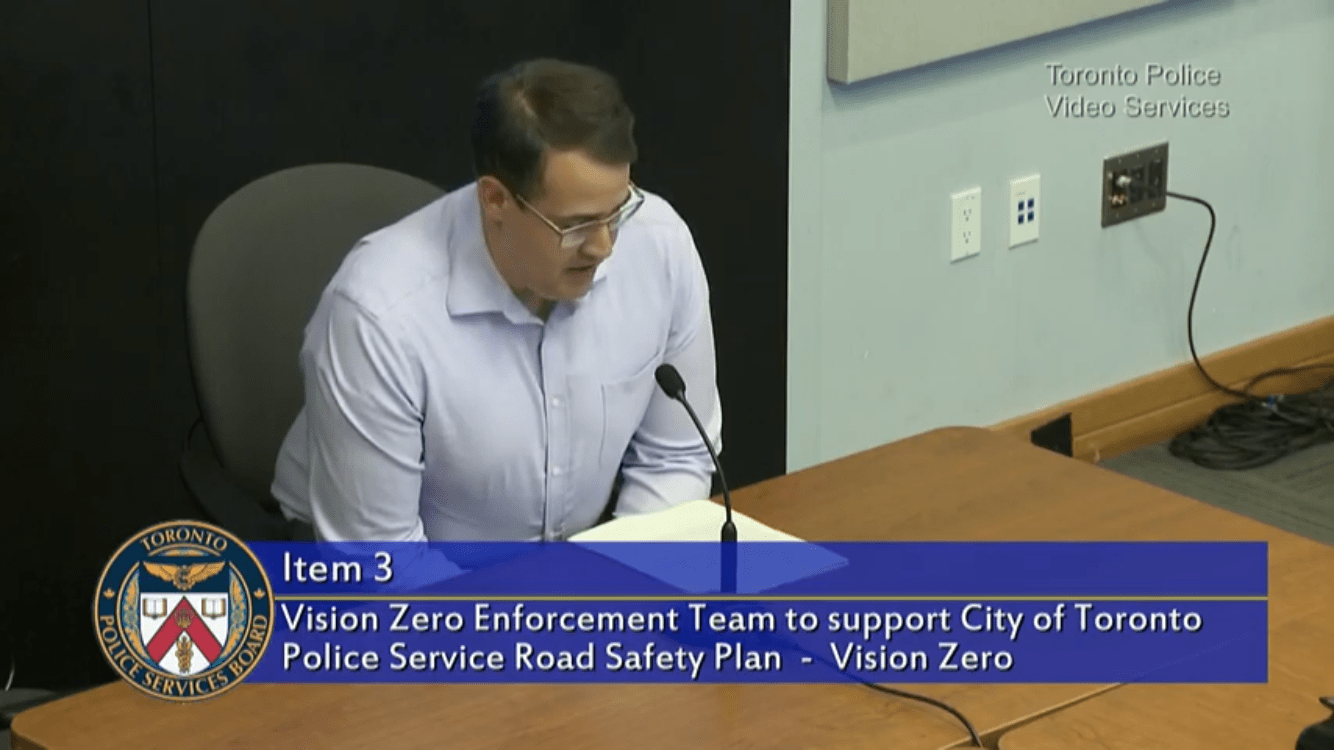
    Earlier today, on behalf of Walk Toronto, I made a deputation to the Toronto Police Services Board addressing the lack of traffic enforcement in the City of Toronto. After criticism from organizations such as Walk Toronto, Cycle Toronto, and Friends and Families for Safe Streets, the Toronto Police now plans to initiate a “Vision Zero enforcement team,” with the city funding the annual $1 million cost.

    As anyone who walks or cycles in the City of Toronto knows, aggressive, distracted, and careless driving is commonplace. They also know that apart from the well-publicized blitz, the Toronto Police Service (TPS) have not responded to the carnage on our streets.

    I spoke to express our disappointment of how the TPS completely failed vulnerable road users by not engaging in meaningful traffic enforcement and calling for a return to making this a priority. Similar deputations were made by John Sewell, former mayor and police critic, Keagan Gartz from Cycle Toronto, and Jessica Spieker from Families and Friends for Safe Streets.

    I found it was a bit intimidating. it was my first formal deputation in a long time, and I sat at a table in front the board, including Chief Mark Saunders and Mayor John Tory. But I did it! Next time I depute, I should find it easier.

    Mayor Tory, to his credit, convinced fellow police board members that the traffic enforcement team be made permanent, and funded from the Toronto police budget, starting in 2020. This motion passed unanimously.

    It is not enough, of course, but it’s an acknowledgement that we desperately needed. Walk Toronto and our partners will continue to push for safer streets.

    Unfortunately, Chief Saunders chose to blame airpods for the epidemic of pedestrian injuries and deaths, ignoring experts and the city’s own data:

    Chief Saunders and the board had the opportunity to ask questions of any member of the public who took the time to craft and make deputations today at Police Headquarters. Regretfully, they chose not to do so.

    Below is the complete text of my deputation to the Toronto Police Services Board. You can watch the whole meeting here (I speak just after the 1:00 mark).

    Vision Zero is an internationally recognized set of road safety tenets that aims to reduce all fatalities and severe injuries in a municipality to zero over the course of a year, while increasing safe, healthy, equitable mobility for all, especially vulnerable road users such as pedestrians.

    Road design, engineering controls and enforcement are all essential pillars for reducing road violence on our streets. Road improvements force vehicle operators to slow down and take notice, while improving the visibility and safety of vulnerable road users, especially pedestrians and cyclists.

    In the meantime, the City of Toronto has focused on reducing speed limits, adding traffic signals, and designating school safety zones and senior safety zones. But this has been more about putting up signs. Signs have no effect If there are no consequences for disobeying them.

    At Walk Toronto, we have noted the lack of police enforcement of safe speeds, red light running, illegal turns, and distracted driving. There may be the occasional well-publicized blitz, but for the most part, motorists in Toronto know that they can get away with risky and dangerous behaviour because the likelihood of being caught is negligible. At best, Toronto’s response to road violence has been reactive, rather than proactive.

    To date, 34 pedestrians were killed on Toronto’s streets in 2019; in 2018, 42 pedestrians were killed. Not just on city streets, but on sidewalks, at bus stops, and even inside a bus shelter. Earlier this year, a home was struck in East York. Meanwhile, police are being deployed downtown not to protect pedestrians, but to ensure traffic isn’t impeded at busy intersections during rush hours.

    We were outraged – but not shocked – by a recent Toronto Star report that found that the number of traffic tickets issued dropped from 700,000 in 2010 to just 200,000 in 2018, and that there are no officers assigned to full-duty local traffic enforcement. This is despite a growing city, an ageing population, and enhanced provincial penalties for distracted, reckless, and impaired driving introduced over the last few years.

    The Toronto Police Service has failed the city’s most vulnerable road users.

    Though red-light cameras, photo radar, and automated school bus “stop” signs are useful tools, there is no substitute for old-fashioned police enforcement. Additional new dedicated officers are a good step in recognizing this failure, as long as enforcement does not target indigenous, racialized, and other communities that are already disproportionately affected by policing. In the end, we need both better designed streets and a renewed direction that the Toronto Police Service will have no tolerance for unsafe driving in Toronto.

    Thank you.

  • The dangers of Don Mills Road

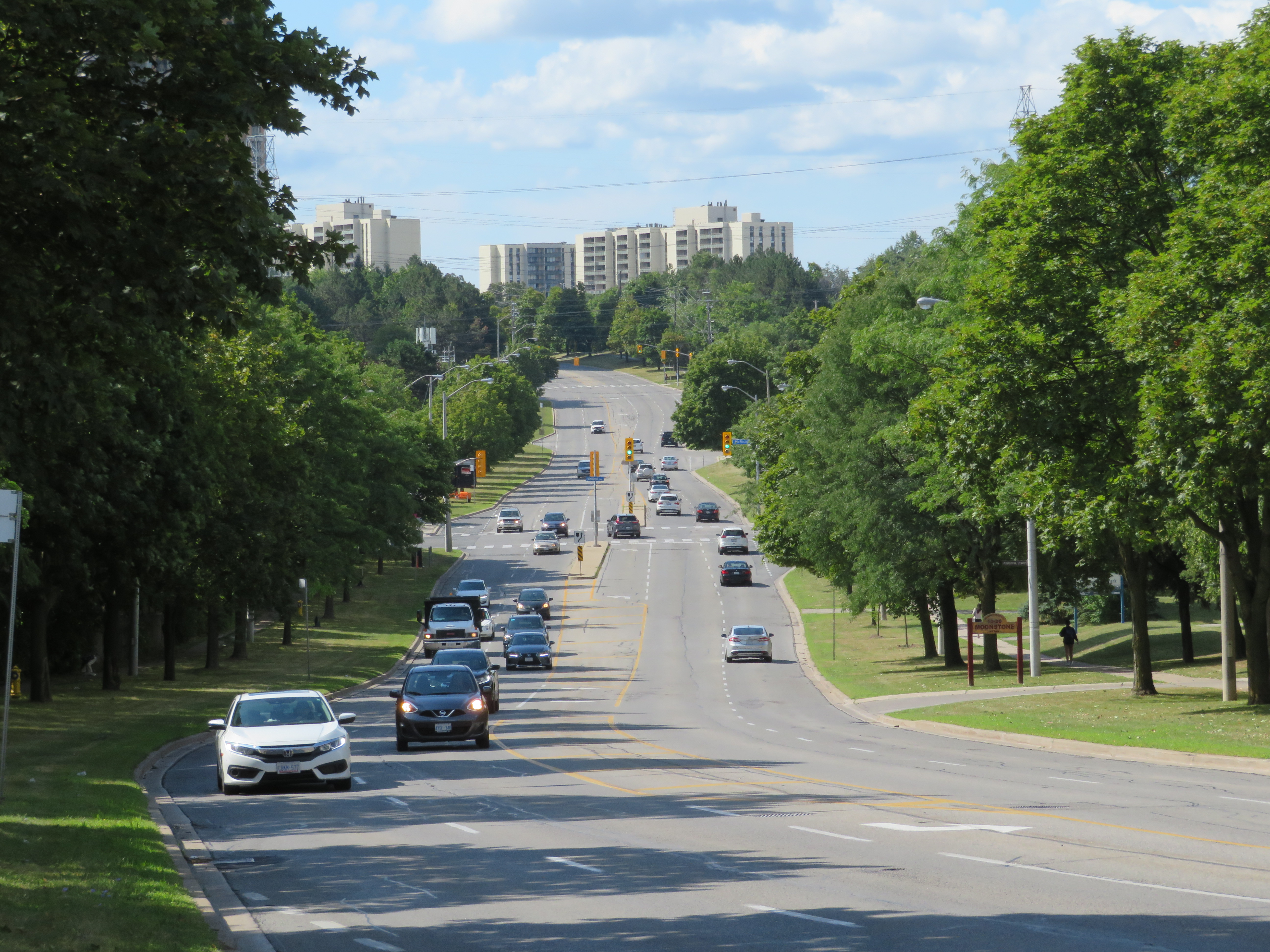
    IMG_3664.JPGDon Mills Road looking south towards McNicoll Avenue, North York
    On the afternoon of Tuesday July 16, a woman was struck and killed by the driver of a left-turning waste collection truck as she was crossing the street. The tragedy happened at the corner of Cliffwood Road and Barkwood Crescent, in a quiet North York residential neighbourhood. The 68-year old was the eighteenth pedestrian killed on Toronto’s streets in 2019. 

    Cliffwood Road is a typical suburban residential street in northeast North York, just south of the municipal boundary at Steeles Avenue. It meets Don Mills Road twice; at the north end, there are traffic signals, with a middle school and a plaza on the east side of the four-way intersection. On the south side, Cliffwood meets Don Mills at a three-way intersection, protected only by a a stop sign facing Cliffwood. As Cliffwood loops back on itself and has no direct connections to Steeles Avenue, it is not a useful short-cut for speeding motorists unlike many other suburban streets.

    What, in particular, contributed to this deadly crash? I paid a visit to the area to find out.

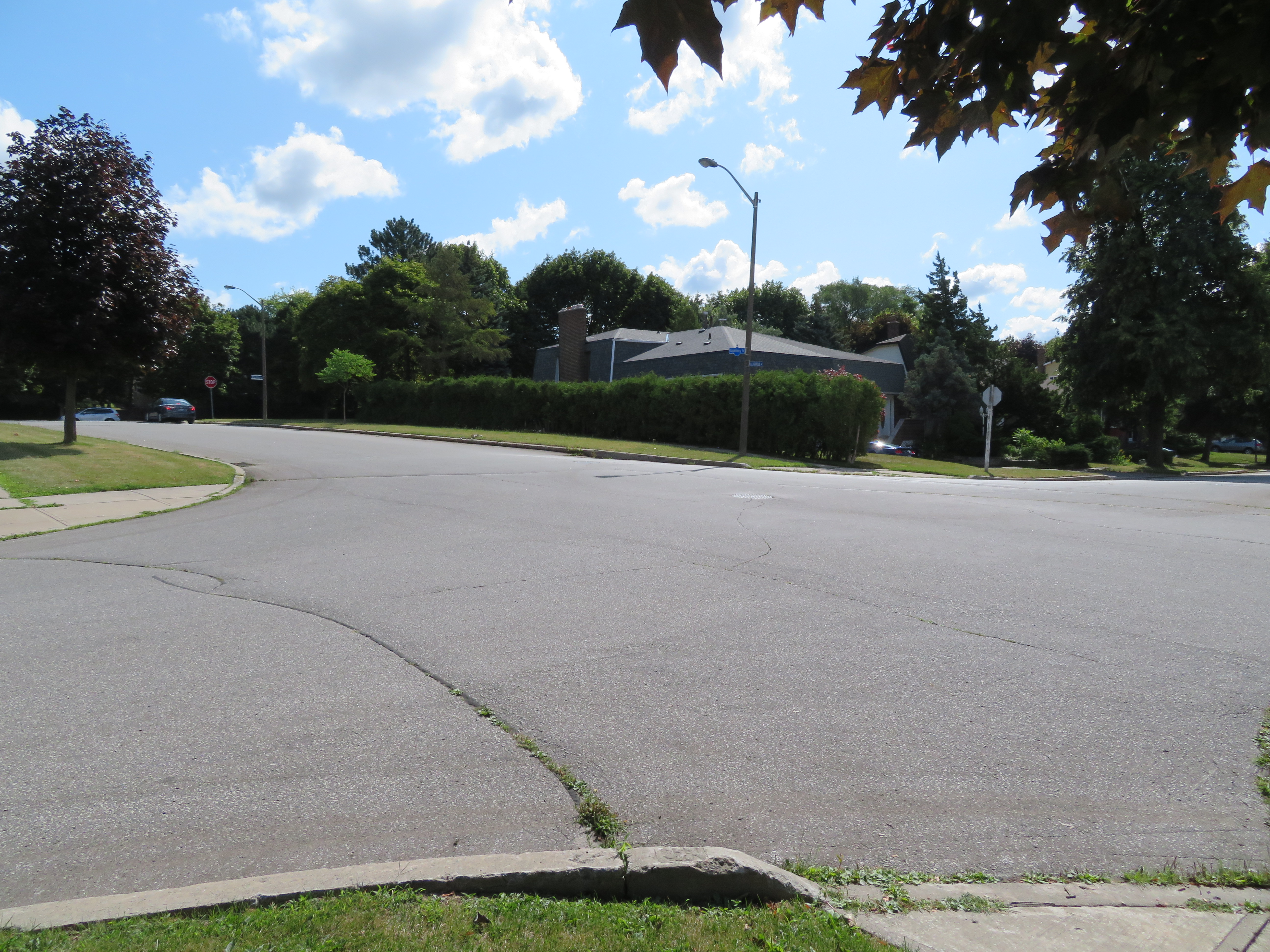
    IMG_3647.JPGThe intersection of Cliffwood Road and Barkwood Crescent, looking southeast
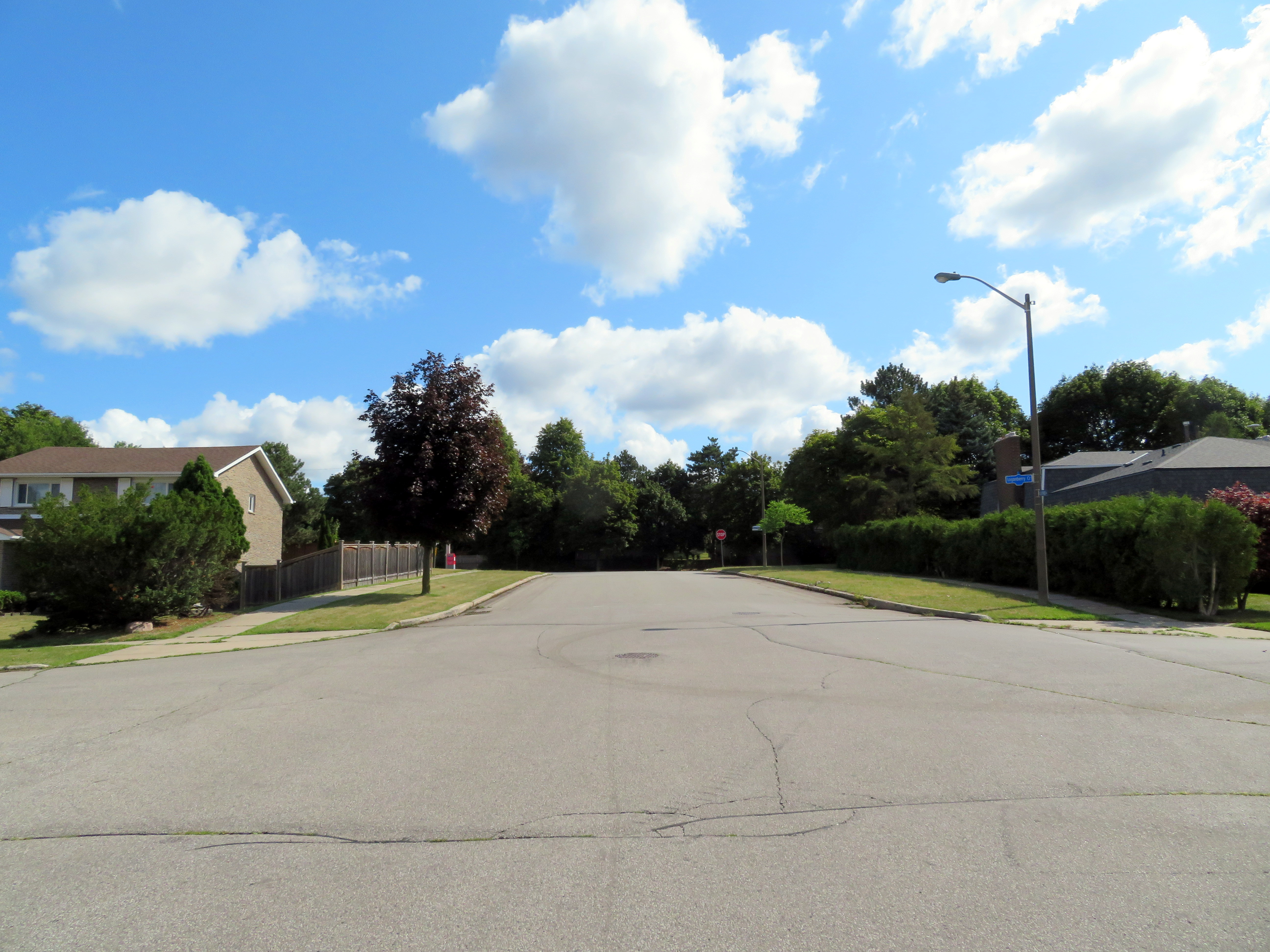
    Between Don Mills Road and Barkwood Crescent, Cliffwood Road is 12 metres wide without any lane markings or medians to separate traffic or slow vehicles turning off of busy Don Mills Road. West of Barkwood Crescent, Cliffwood Road narrows to 8.5 metres. Twelve metres is a lot of road space: Beverley Street in Downtown Toronto is the same width, but it has two driving lanes, a parking lane, and two unprotected bike lanes. The wide street width here only encourages motorists to drive fast after coming off Don Mills Road, while wide curb radii at the corners at Don Mills and at Barkwood Crescent also encourage motorists to take turns quickly.

    At Barkwood Crescent, Cliffwood Road has a speed limit of 50 km/h, the default speed limit in the City of Toronto. Closer to the schools to the north, a 40 km/h speed limit is posted, but there are no physical measures to slow down cars and trucks. Cliffwood Road, like so many other suburban streets, was built for speed, and not for local residents on foot.

    IMG_3648-001An unnecessarily large intersection at Cliffwood Road and Barkwood Crescent, and a wide approach to Don Mills Road
    I also noted the condition of nearby Don Mills Road, a busy thoroughfare connecting office parks in Richmond Hill and Markham with Fairview Mall to the south. Don Mills is a busy bus corridor, with both TTC and YRT buses providing frequent weekday service.

    Despite the frequent bus service, Don Mills Road is hostile to pedestrians and transit users. At the southern intersection of Don Mills and Cliffwood Roads, the nearest crosswalk is nearly 300 metres to the north, or 600 metres to the south. Understandably, most transit users will choose to cross at the nearest TTC stop, rather than walk an extra five or ten minutes twice a day, especially in inclement weather.

    In late August, a pedestrian was crossing Sheppard Avenue East in Scarborough to get to a nearby TTC bus stop when she was fatally struck by a motorist who then fled the scene. That stretch of Sheppard Avenue is flat and straight.

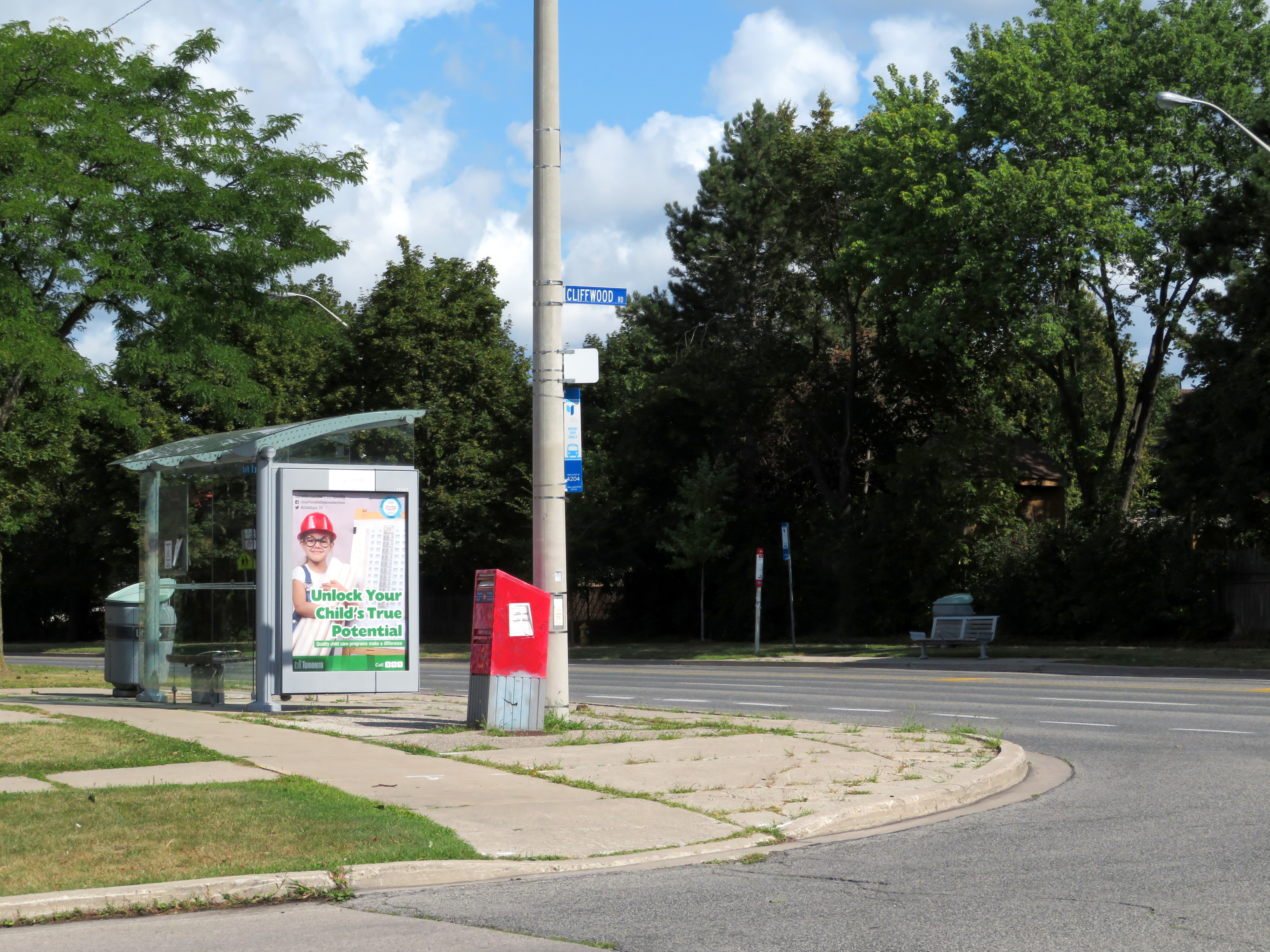
    IMG_3652-001The corner of Cliffwood and Don Mills Roads with bus stops
    Most area bus stops are adjacent to bus bays. Bus bays are designed to get buses out of the way of traffic while they are dropping off and picking up passengers. Once the bus is ready to leave the bus stop, it must then merge back into traffic. In addition, many of these bus bays double as right-turn lanes, increasing the distance a pedestrian must cross the street.

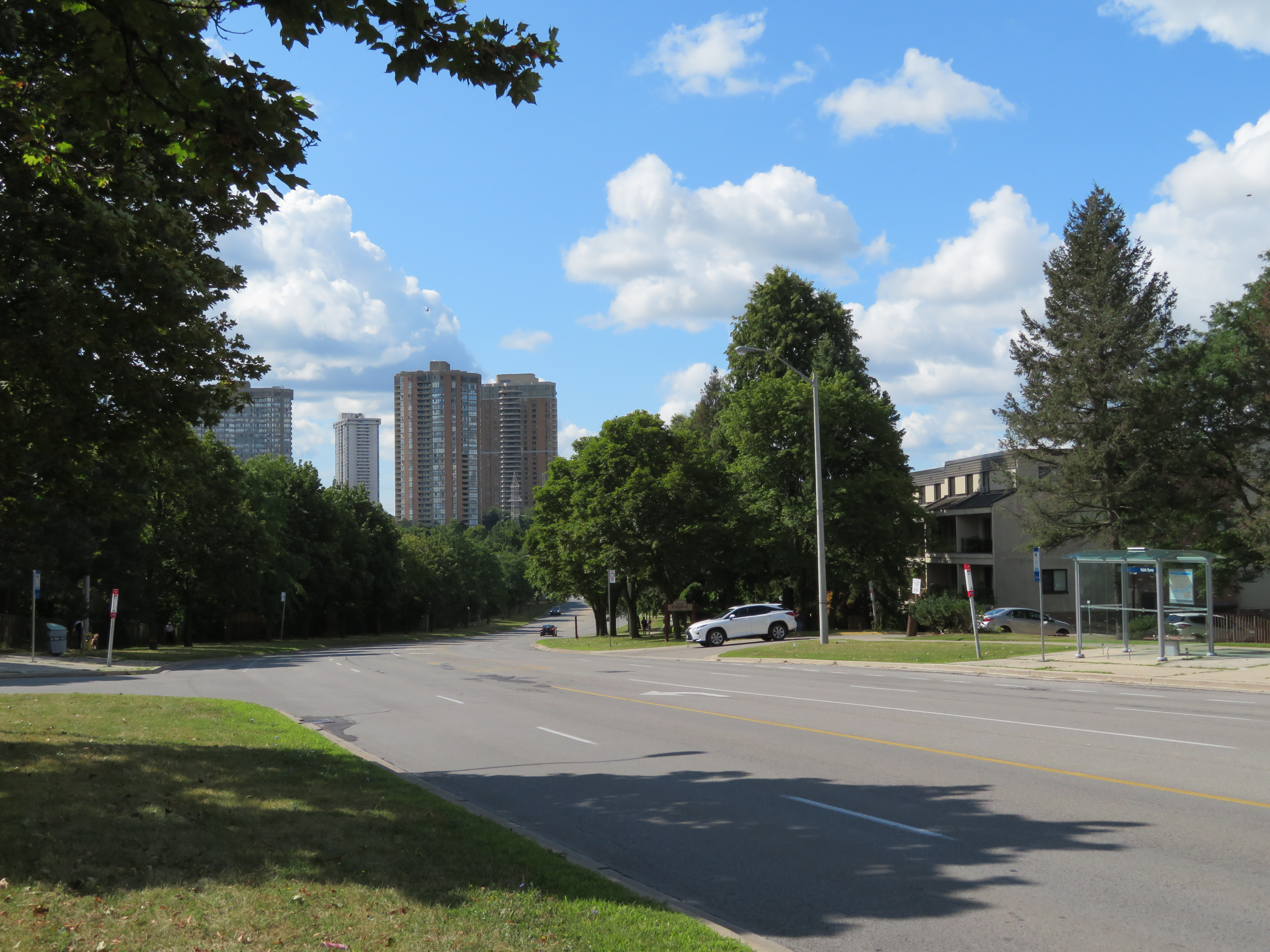
    Furthermore, Don Mills has several hills and curves north of Finch Avenue that makes this especially dangerous because of low visibility, making it difficult to judge how far or how fast traffic may be coming. There are five lanes plus bus bays/right turn lanes; the centre lane alternates between serving as a left turn lane or a striped buffer space between northbound and southbound traffic, which further encourages high speeds.

    IMG_3663-001.JPGBus stop at Don Mills Road and Mogul Drive, illustrating the high-speed curves
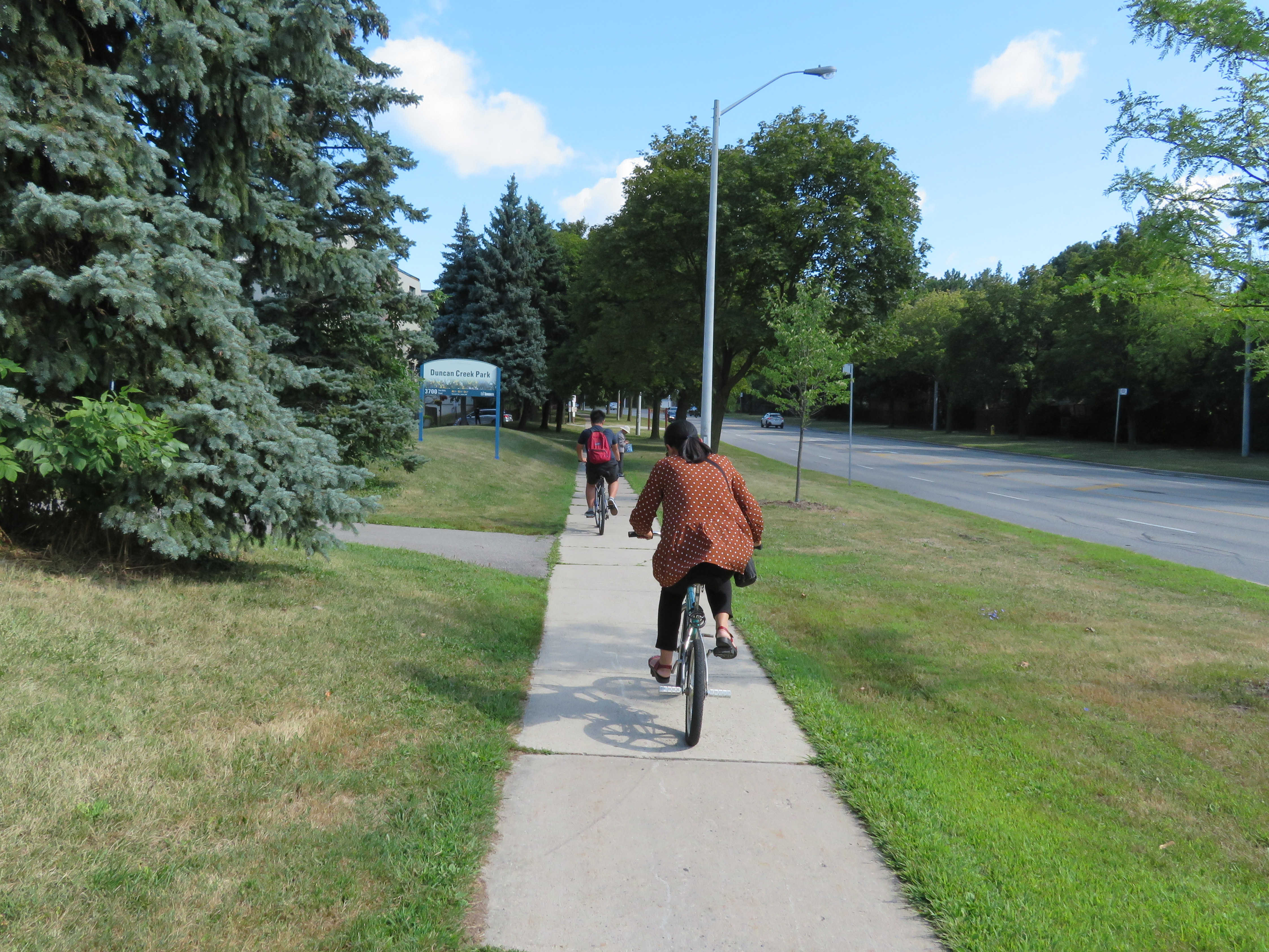
    It is no wonder too that cyclists choose the sidewalks. Despite the wide right-of-way with generous boulevards between the backyard fences and the curbs, no though has been made to improve cycling infrastructure in this part of Toronto. Separated bike lanes or a multi-use path, similar to those on Eglinton Avenue in Etobicoke, or in Peel Region, would make sense here, and along other suburban arterials.

    Cross-ride marking and signals at intersections would improve the safety for suburban cyclists and legitimize a common practice.

    IMG_3630-001Cyclists take the sidewalk on Don Mills Road
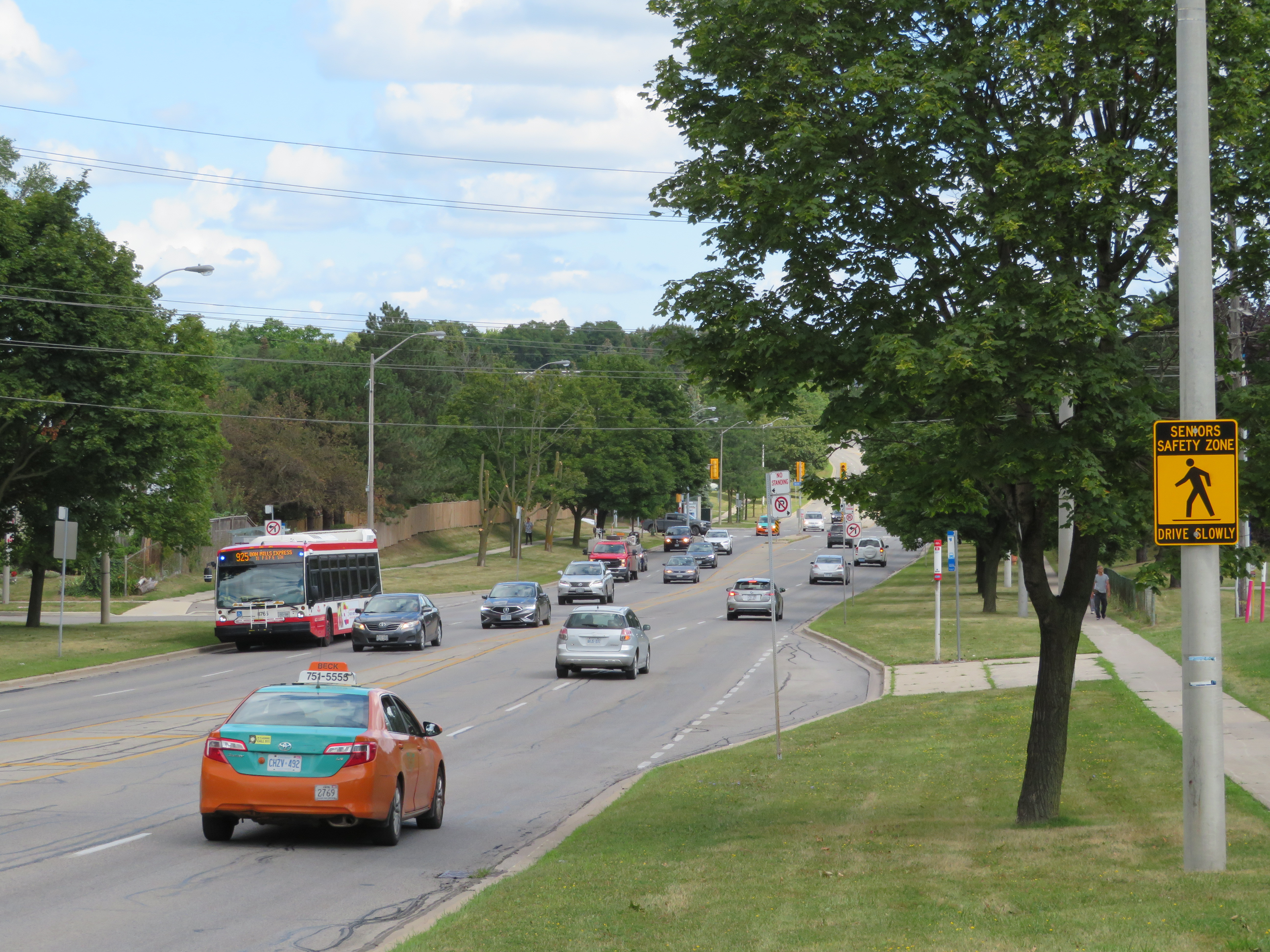
    At the end of my tour of upper Don Mills Road, I could not help but notice I was walking in a signed “Seniors Safety Zone.” As with Eglinton Avenue East in Scarborough, signs were put up but no measures were put in place to slow motorists down, and there was no sign of police enforcement of the posted limit either.

    IMG_3684-001.JPG“Seniors Safety Zone” – note the bus bay behind the sign

    There are a few things that can be done in Toronto’s suburbs to improve the safety of vulnerable road users (pedestrians and cyclists) and reduce the incidence and severity of crashes when they do happen. The installation of safer pedestrian crossings, such as traffic signals would reduce the distance required to get to a TTC stop safely. Bus bays should be eliminated with every road reconstruction project, as they do not benefit transit riders and encourage fast-moving traffic. Finally, residential streets should be narrowed, especially at intersections to slow motorists down, reduce the time a pedestrian is in the street while crossing, and improve their visibility.

    Finally, wide multi-use paths along suburban corridors like Don Mills Road would help promote active transportation and reduce conflicts between pedestrians and cyclists.

  • Dysfunction junction: the Union Station malfunction

    IMG_3583-001.JPG
    Looking west to Union Station, August 2019

    Last year, the City of Toronto hastily installed Jersey barriers in front of Union Station. This was a response to a tragic criminal act on Yonge Street in North York on April 23, 2018. A single individual drove a rented cargo van down the busy sidewalk, killing 10 and injuring 16 more before he was apprehended by police. As one of Toronto’s busiest pedestrian areas, city officials decided that the plaza in front of Union Station required special protection in the wake of the attack in North York.

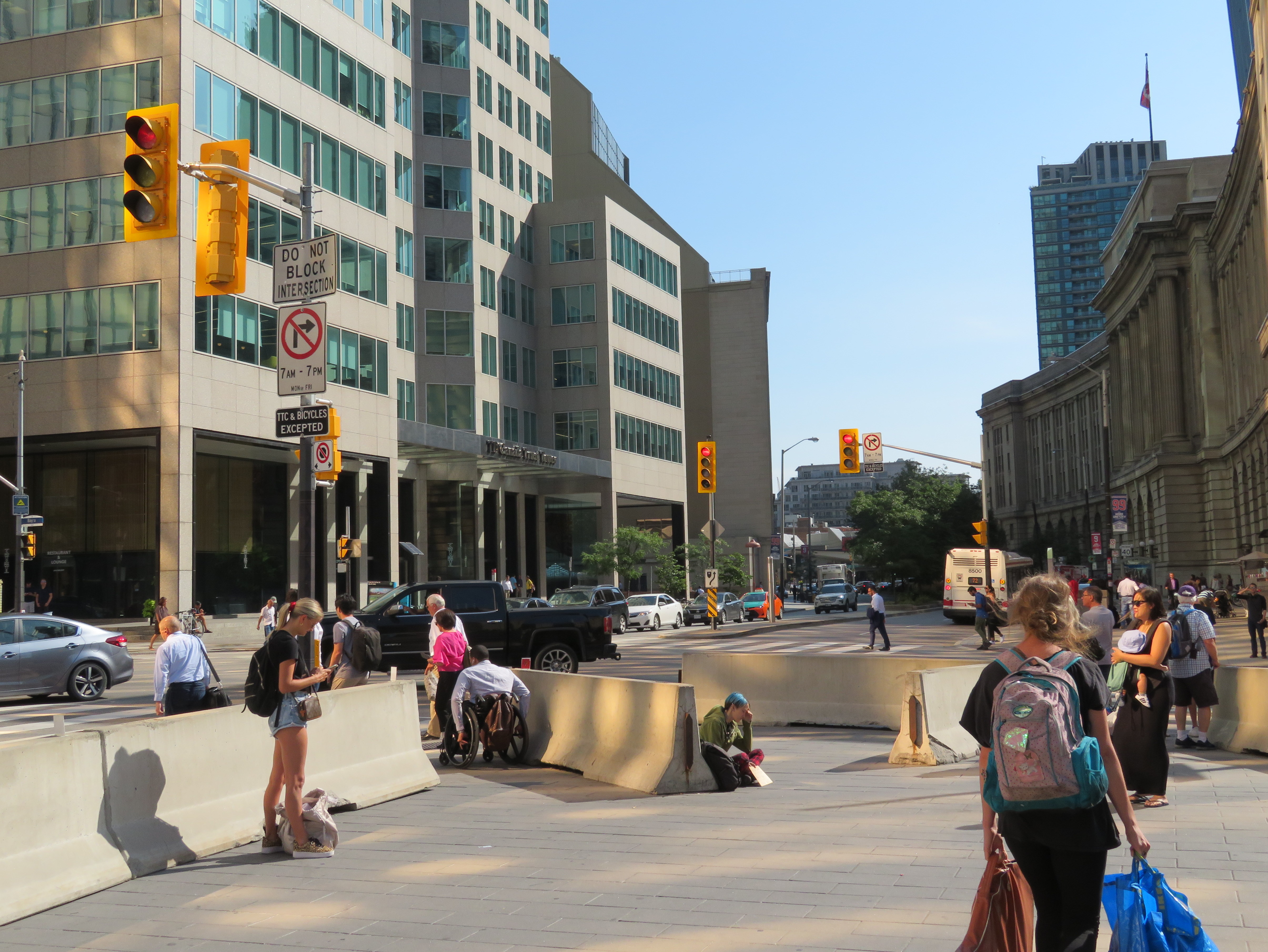
    Sixteen months later, the temporary barriers remain, needlessly restricting pedestrian flows. Temporary Jersey barriers, normally used on roadways to protect construction sites, are long and awkward for pedestrians, making it even more difficult to access some of the city’s busiest crosswalks. During peak periods, these become pinch points, making it especially difficult for anyone crossing against the flow to get through safely. Pedestrians using mobility devices, strollers, or carrying wheeled bags are especially affected.

    Afternoon rush hour crowds navigate around the Jersey barriers at Front and Bay Streets

    Union Station is adjacent to four of the ten busiest intersections in the city where pedestrian traffic was measured: Bay and King, Bay and Wellington, Front and Simcoe, and York and Wellington (traffic counts are not available for Front and Bay or Front and York/University). At Bay and Wellington, one block north of Union Station, 32,319 pedestrians crossed in an eight-hour period in 2009, compared to 16,188 cars, trucks, and buses. At York and Wellington, 32,338 pedestrians crossed in an eight-hour time period in 2017 compared to just 5,575 vehicles.

    Employment at the financial district with commuters headed to and from GO trains and the subway at Union Station, tourists, residents, and fans headed to and from games and concerts at Scotiabank Arena all contribute to the high pedestrian activity in this part of Downtown Toronto.

    IMG_3585-001.JPGJersey barriers at the southwest corner of Front and Bay Streets at Union Station
    Since the April 2018 attack, drivers have continued to mount sidewalks and crashing into bus shelters, buildings, and pedestrians. Early this morning, the driver of a stolen Range Rover crashed into a parked car on College Street, entered the sidewalk, hit a guidepost and then a transit shelter, injuring a pedestrian waiting for a streetcar. The driver then fled on foot. Other pedestrians have been injured and killed this year even when they are using signalized crosswalks correctly, and with all due care.

    At Bay and Front, despite the huge crowds of pedestrians, traffic signals favour motorists. Left turn signals make pedestrians wait longer at crossings before having to navigate around vehicles illegally blocking the crosswalk in addition to navigating the haphazardly placed Jersey barriers. The video below shows the danger of crossing this intersection.

    Motorists block the crosswalk with impunity while the left turn signal doesn’t help

    In his March 25 column in the Toronto Star, Jack “The Fixer” Lakey was not very sympathetic to complaints about the barriers, writing that “they are clearly a pain for people when foot traffic is heaviest, but we couldn’t help but think they would be effective in stopping a driver bent on another deadly attack.”

    Lakey then writes that the city is working on permanent barriers that will be “smaller, more aesthetically pleasing and easier to navigate for pedestrians,” with installation this year. It is now almost September, and nothing has been done.

    It is hard to argue against barriers in certain places to better protect pedestrians from dangerous motorists. But the Jersey barriers at Union Station are not a sufficient response. Permanent bollard-style barriers would be a definite improvement, and it is disappointing to see the city drag its heels on this.

    Meanwhile, the priority afforded to motorists at this downtown intersection, and the lack of enforcement of traffic laws makes it clear that little thought has been afforded to ensuring the safety of all road users. Dropping some road barriers on a sidewalk and calling it a day is unacceptable in a city that is supposedly committed to a Vision Zero action plan.

  • A year later, progress on Canongate Trail

    IMG_8531-001
    Canongate Trail, February 2019

    In February 2018, Duncan Xu, an 11-year old boy, was struck and killed crossing a residential street in North Scarborough on his way home from school. He was one of forty-two pedestrians unintentionally struck and killed by motorists in Toronto last year.

    Not long after Duncan’s death, I visited the neighbourhood and wrote about the tragedy.  Canongate Trail, where Duncan was struck, is a two-lane residential street. At the time, there were no traffic calming measures in place to slow down motorists, many of whom used Canongate as a shortcut around the busy intersection of Kennedy Road and Steeles Avenue. The local councillor, Jim Karygiannis, decided to unilaterally close a walkway linking the rear schoolyard with Canongate Trail, close to where Duncan was killed. Duncan used the walkway before he tried to cross the street.

    Since then, more permanent fixes were made. At the request of Karygiannis and local residents, city staff studied both reducing speed limit and installing traffic calming measures. While staff recommended reducing the speed limit to 30 kilometres an hour, they concluded that traffic calming measures such as speed humps were unwarranted.

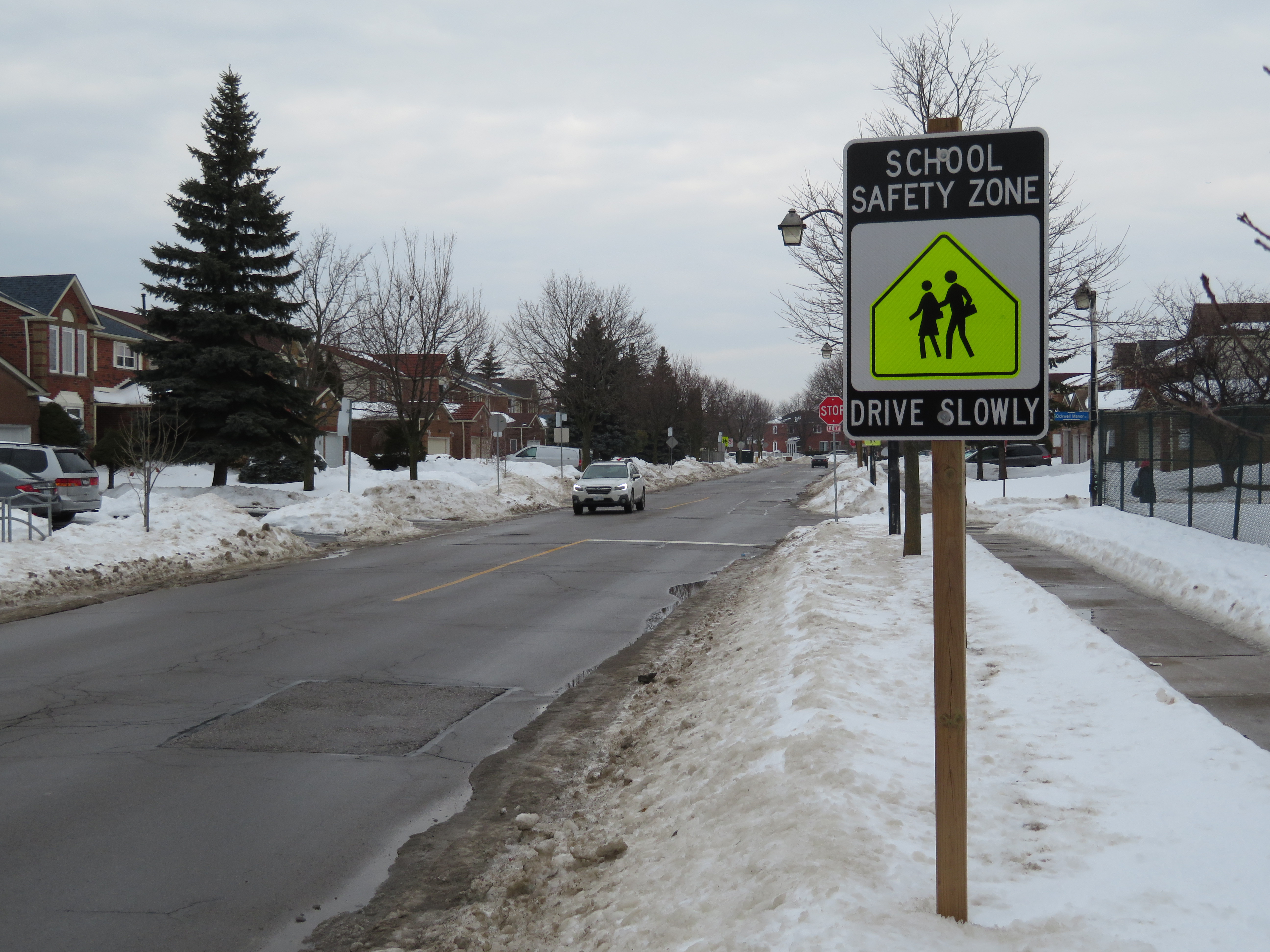
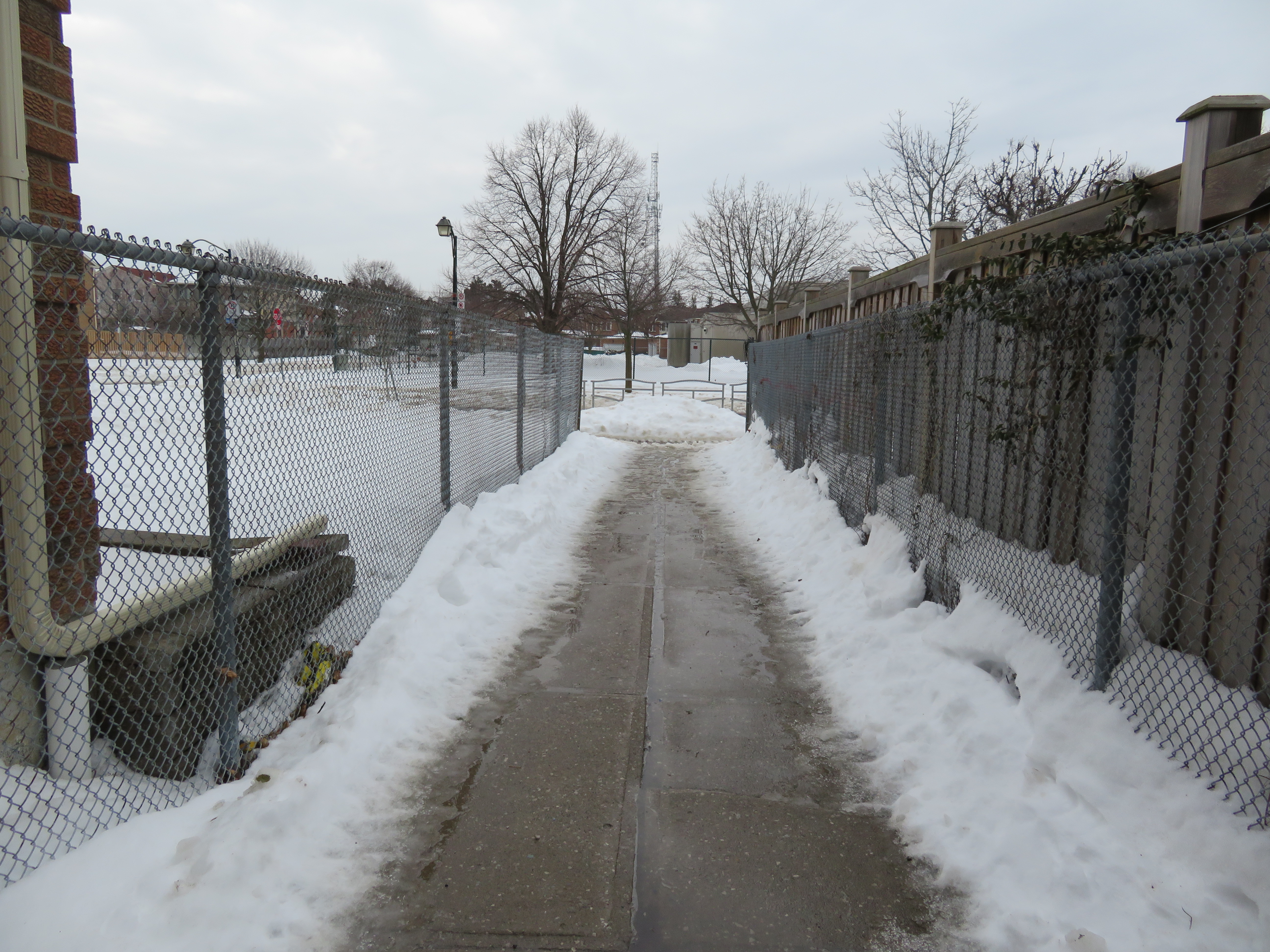
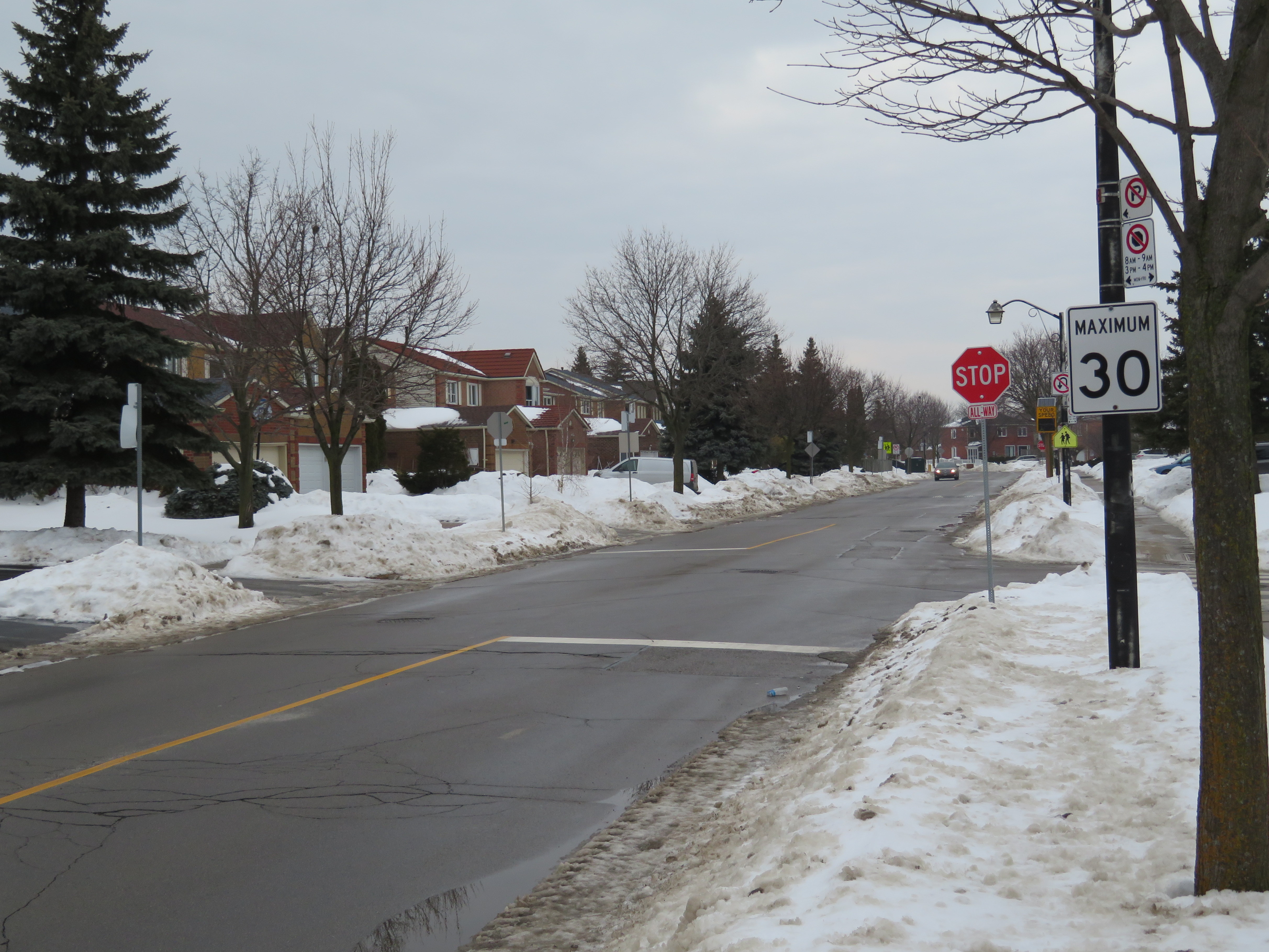
    The speed humps were added anyway, along with other measures. A new all-way stop was added at Ockwell Manor Drive, near where the walkway meets the Canongate Trail sidewalk. Beyond the point where the walkway meets the sidewalk, fencing was installed to discourage children from running into the street. These are significant improvements.

    IMG_8530-001The walkway to the school and a nearby park is reopened, with a metal barrier between the sidewalk and the roadway
    Still, more can always be done. Curb extensions or bulb-outs at intersections would be another effective traffic calming measure, narrowing the roadway, slowing down turning vehicles, and increasing pedestrian visibility while reducing pedestrian crossing distances.

    What’s most disheartening though is that it took a young child’s death for these measures to happen. All residential streets should have a 30 km/h limit and streets designed to slow motorists down, including measures such as curb extensions and speed humps. As with the “Slow Down – Kids at Play” lawn sign campaign, action only comes after a high-profile tragedy. Even then, it’s not enough.

    It’s good to see progress on Canongate Trail. But this should be the standard everywhere. We can and should do better in Toronto if we are all serious about implementing a true Vision Zero policy.

    IMG_8535-001New 30 km/h speed limit and a new stop sign on Canongate Trail, February 2019
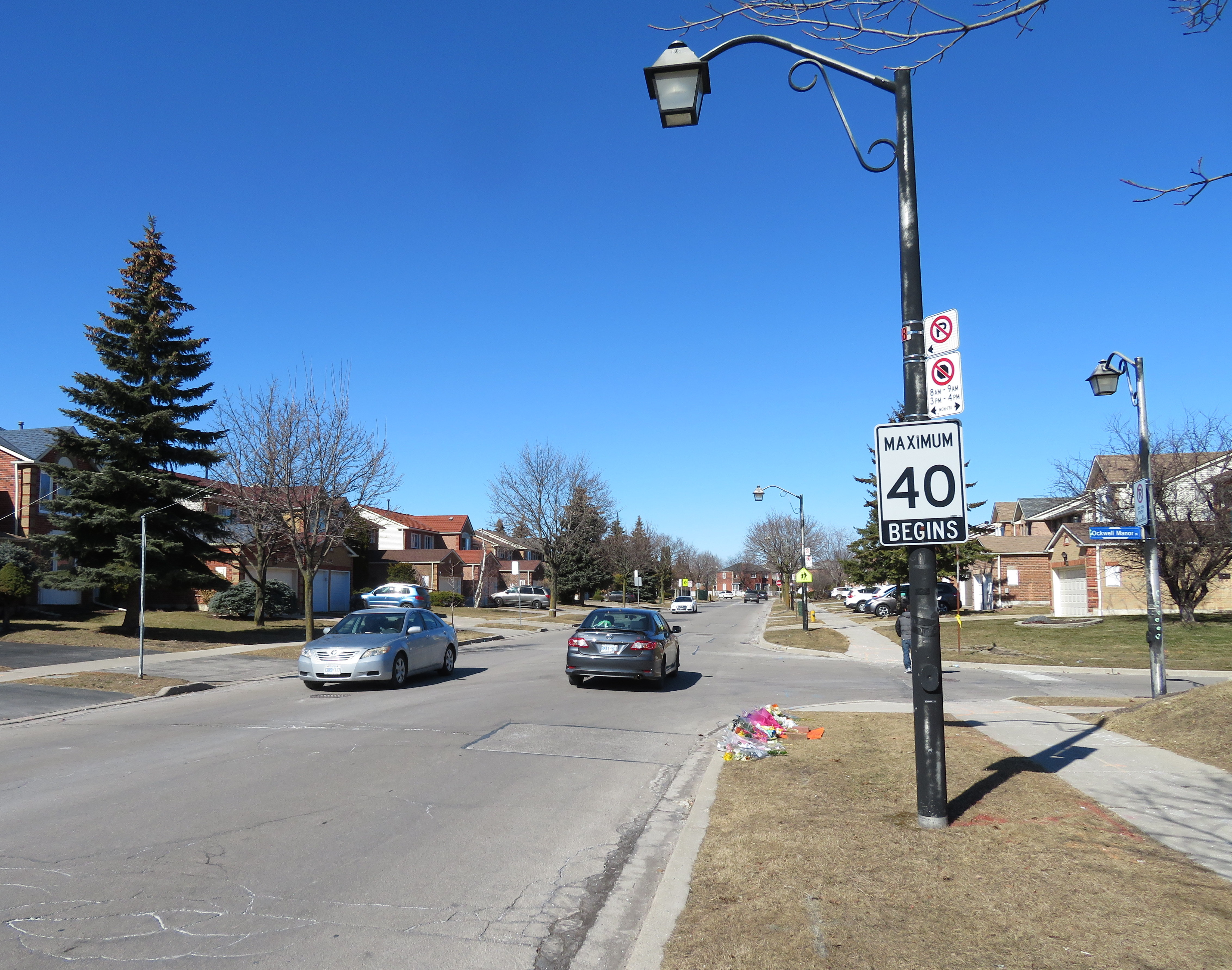
    IMG_6027-001What Canongate Trail looked like in March 2018
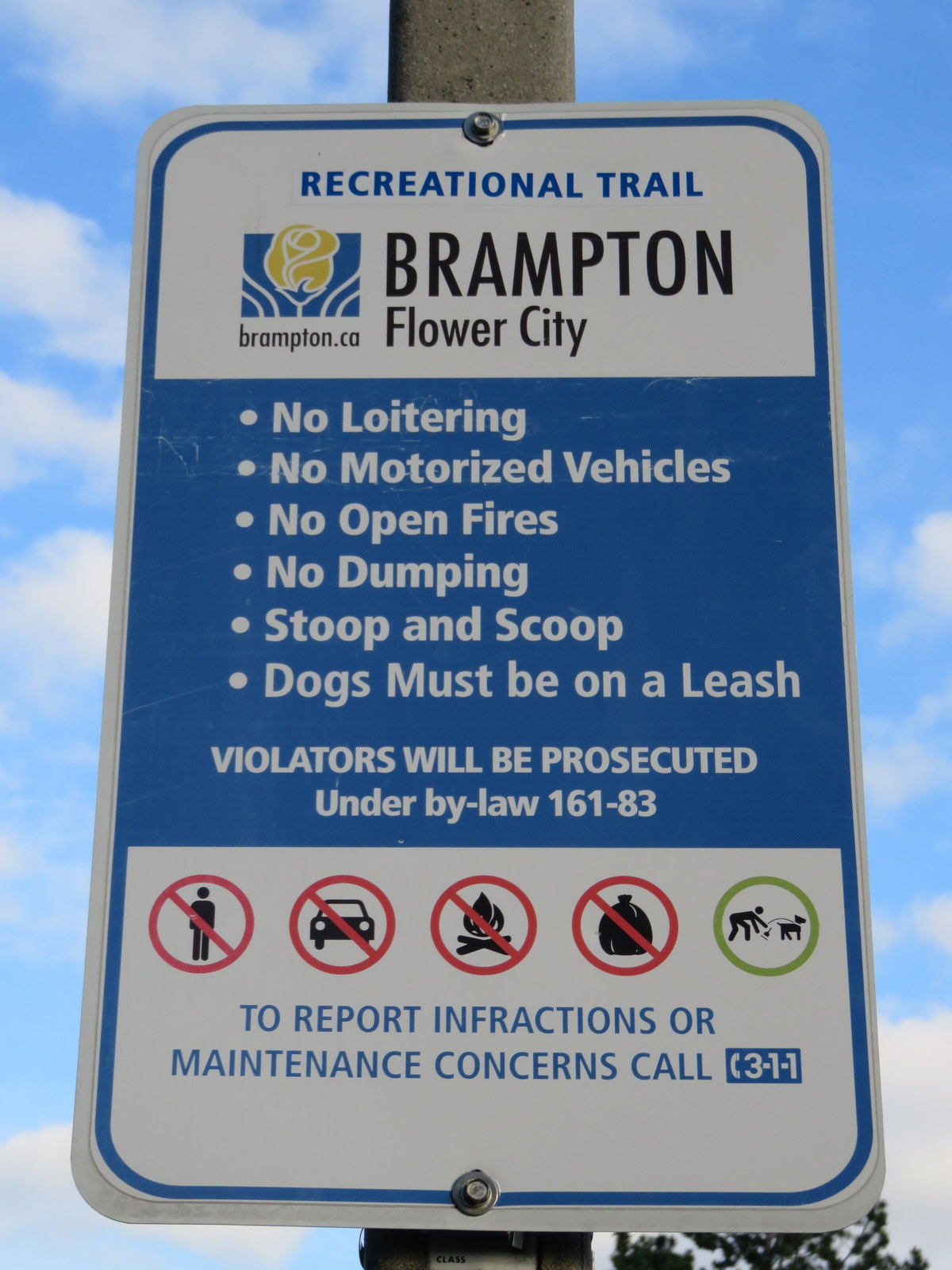
  • Brampton’s multi-use path problems

    IMG_2362-001Recreational Trail: no loitering

    Brampton, my hometown, has a great network of parks, many of which are connected by multi use paths that follow local waterways like the West Humber River and Etobicoke Creek. In suburban neighbourhoods where curvilinear street networks and cul-de-sacs predominate, these paths are necessary as shortcuts for pedestrians and cyclists, and for anyone looking to take a stroll away from the busy arterial roads.

    But these multi-use paths, called “recreational trails” by the City of Brampton, do not properly accommodate all users. And where these paths meet major streets, users must either detour far out of their way to a designated crossing, or attempt to cross a busy roadway. Where Toronto and even other suburban municipalities can get this right, Brampton consistently gets it wrong.

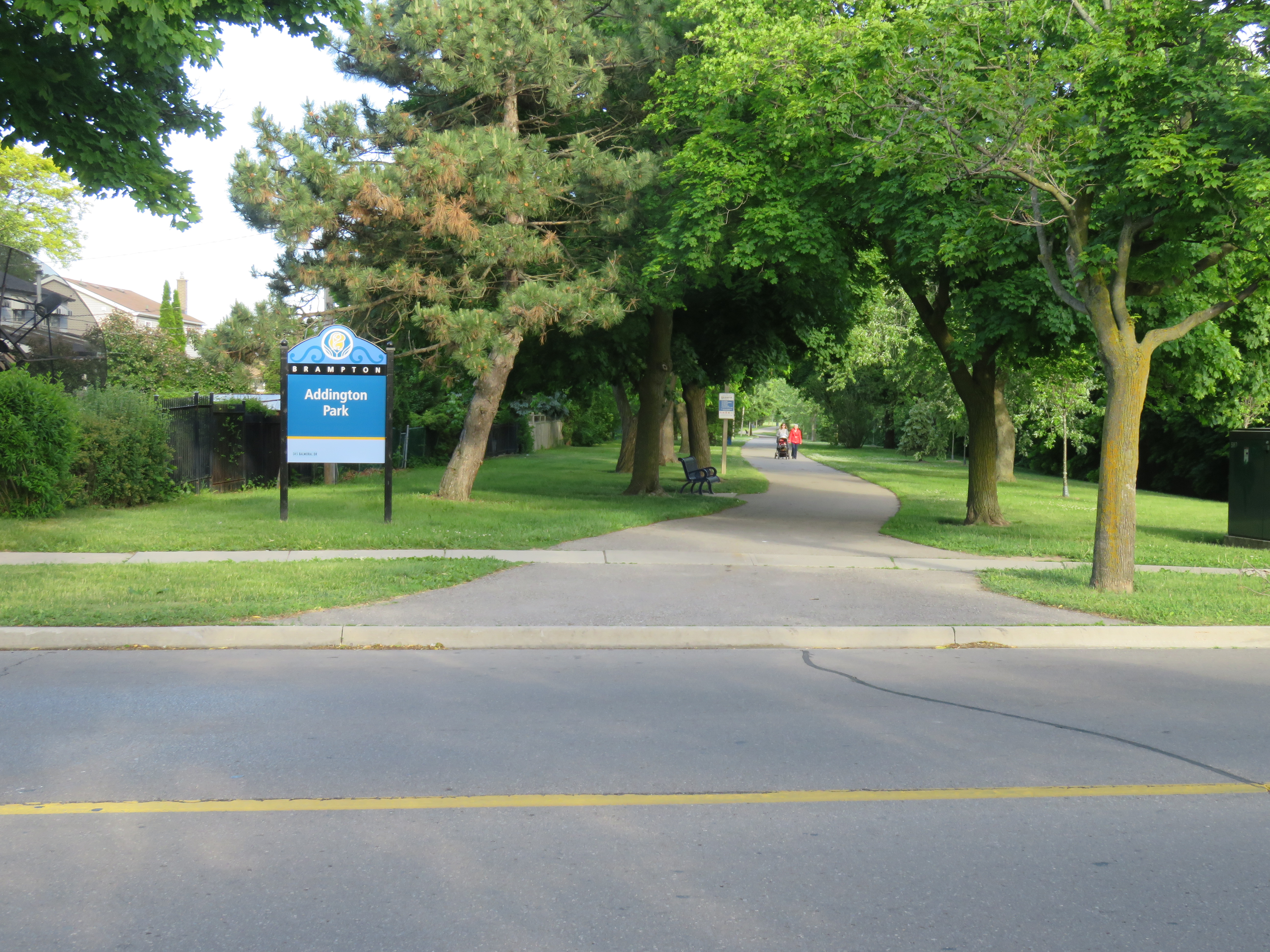
    IMG_2361-001Entrance to Addington Park at Balmoral Drive, Brampton. Part of the Don Doan Trail.
    The first problem Brampton has is the consistent lack of curb cuts where a park path meets any roadway, be it a residential side street or a busier road. Curb cuts are necessary not just for cyclists, but for pedestrians with strollers, or anyone using a mobility device such as a walker or wheelchair. In many cases, a nearby private driveway or a nearby intersection can provide the necessary curb cut, but this is not always the case. Perhaps the reason not to provide the cut is to discourage cyclists or children with wheeled toys crossing without stopping and dismounting, or preventing motor vehicles from entering the path. But it instead encourages cyclists to ride on the sidewalk instead, where most cyclists shouldn’t be, and makes it more difficult for parents with young children, or pedestrians with disabilities from using the paths.
    (more…)

  • Pedestrian flags at crosswalks are not a solution

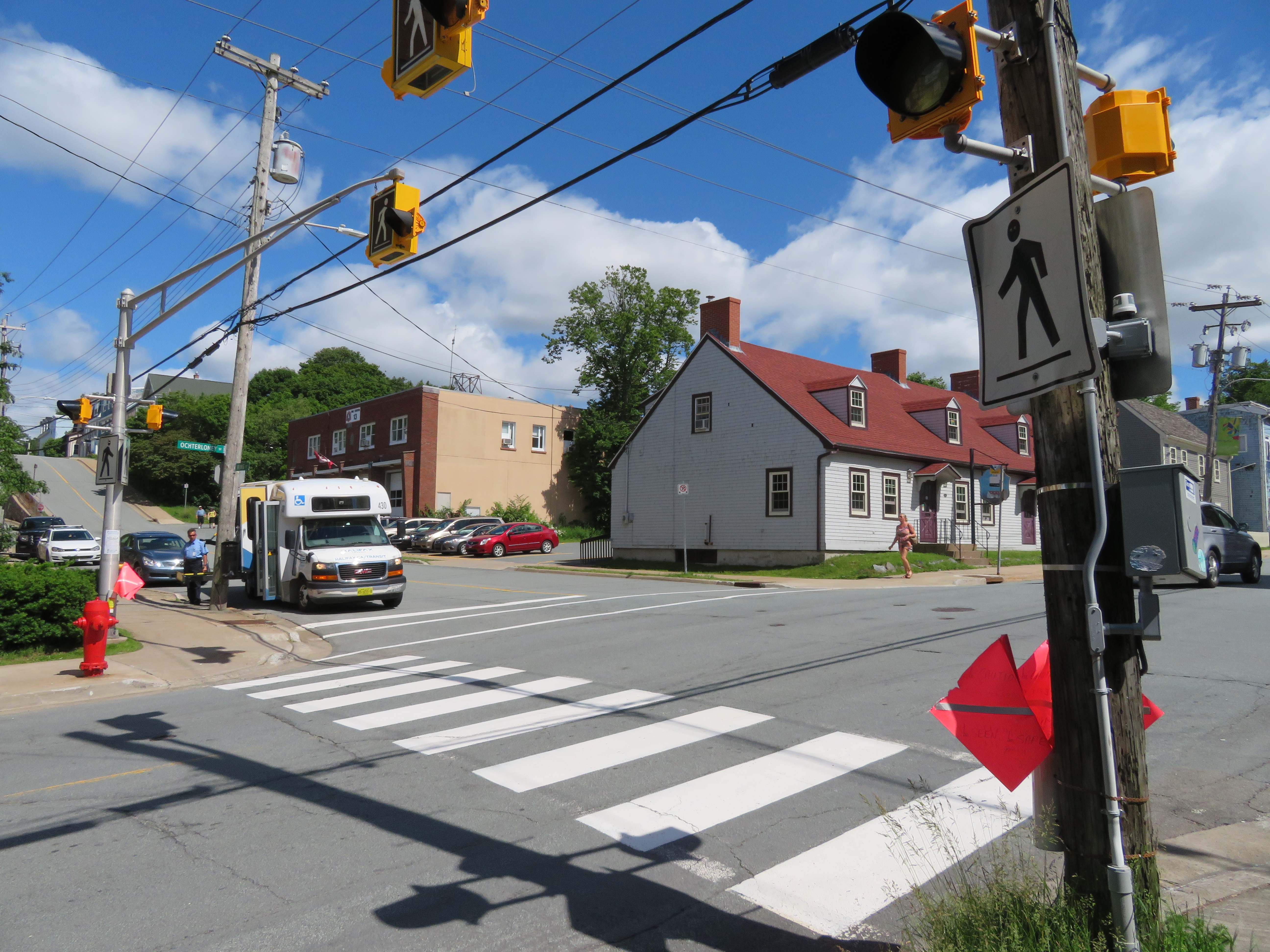
    IMG_0772-001Pedestrian crossing in Dartmouth Nova Scotia equipped with pedestrian flags
    Toronto Star article this weekend profiled three elementary school students installing pedestrian flags at local residential intersections near their school in Leaside. Pedestrian flags are not a new idea; they have been common in Halifax and other communities in Nova Scotia for several years. (I wrote about this before on my blog after visiting Halifax this past summer.)

    On the surface, it sounds like a good idea. Eleven-year old Arnav Shah describes their use in the Star: “what happens is when a pedestrian comes to cross, they look both ways, the regular stuff, maintaining eye contact with the drivers, and then they put the flag up and walk across. Not only does this make them more visible, but makes them (the drivers) more aware of the problem at hand.”

    Residents have complained about additional traffic in the neighbourhood as impatient drivers use residential streets to avoid transit construction on nearby Eglinton Avenue. Photos in the article show the flags being used at the corner of Rumsey Road and Donlea Drive, near the school. The intersection is already controlled by a four-way stop, it is located in a signed school zone, and the local speed limit is 40 km/h.

    The local councillor, Jon Burnside,  rightly praised the children for taking initative. But he added that “…it’s also a sad commentary on the state of our roads and the way people drive.” He’s right. Burnside further adds that adults “can take some cues from the kids’ creativity.”

    If we need bright flags to cross the street at a designated crosswalk because motorists wouldn’t see pedestrians otherwise, then we’ve failed to provide safe infrastructure. The adults — namely Toronto’s mayor and city council — have resisted investing in safe pedestrian and cycling infrastructure.

    The city has put up signs on wide five-lane and seven-lane roads designating them as “Seniors Safety Zones” but has done little to actually make those roads safer for the pedestrians using them. The mayor and the committee responsible for roads and infrastructure rejected making Yonge Street in North York safer and more pleasant to walk and cycle, deferring to motorists instead. And last week, it responded to a child killed while crossing the street in a residential area by closing a walkway to the school yard and not doing anything to slow down motorists speeding in a school zone.

    Simply installing flags at crosswalks for pedestrians to carry would be in line with Toronto’s ineffectual Vision Zero program. While I can admire the children’s action, I would really like to see this taken much farther by the leaders in charge.


    Correction: the local councillor quoted in the Toronto Star is Jon Burnside, not John Campbell. I regret the error

  • The wrong answer to a tragic death of a boy walking home from school

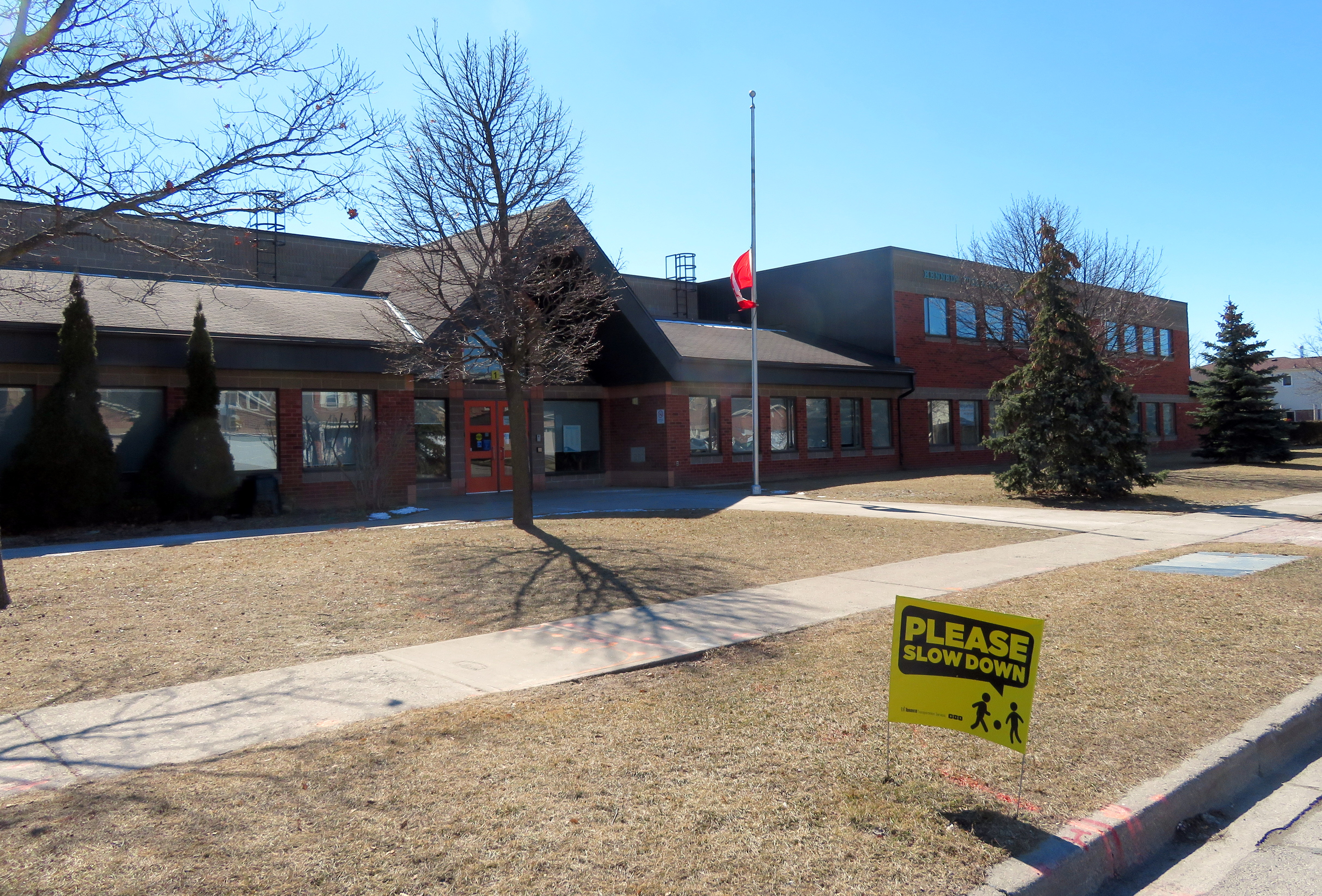
    IMG_6001-001.JPGKennedy Public School, where 11-year old Duncan Xu was in Grade 6. He was struck and killed on an adjacent residential street while walking home on Tuesday, February 27. 

    On Tuesday, February 27, around 3:30 PM, Duncan Xu, an 11-year old boy, was struck and killed by a motorist in a residential neighbourhood in north Scarborough. He was the tenth pedestrian killed on Toronto’s streets in 2018, and the second child killed on their way home from school.

    Duncan Xu was crossing Canongate Trail at Ockwell Manor Drive, near the school, when he was hit by a motorist driving north on Canongate. The intersection does not have a crosswalk, but is only 70 metres north of an intersection controlled by a four-way stop. Canongate Trail a residential street lined with houses, and has a 40 km/h speed limit. The collision occurred right in front of a school zone sign.  Despite its residential nature, Canongate Trail acts as shortcut for non-local traffic avoiding the busy intersection of Steeles Avenue and Kennedy Road.

    I visited the neighbourhood today to better understand the conditions in which a child is killed crossing the street on his way home to school, and the local councillor’s “solution” to that problem.


    Map of the neighbourhood surrounding Kennedy Public School, including the location where Duncan Xu was hit, and the walkway that will close on Monday morning.

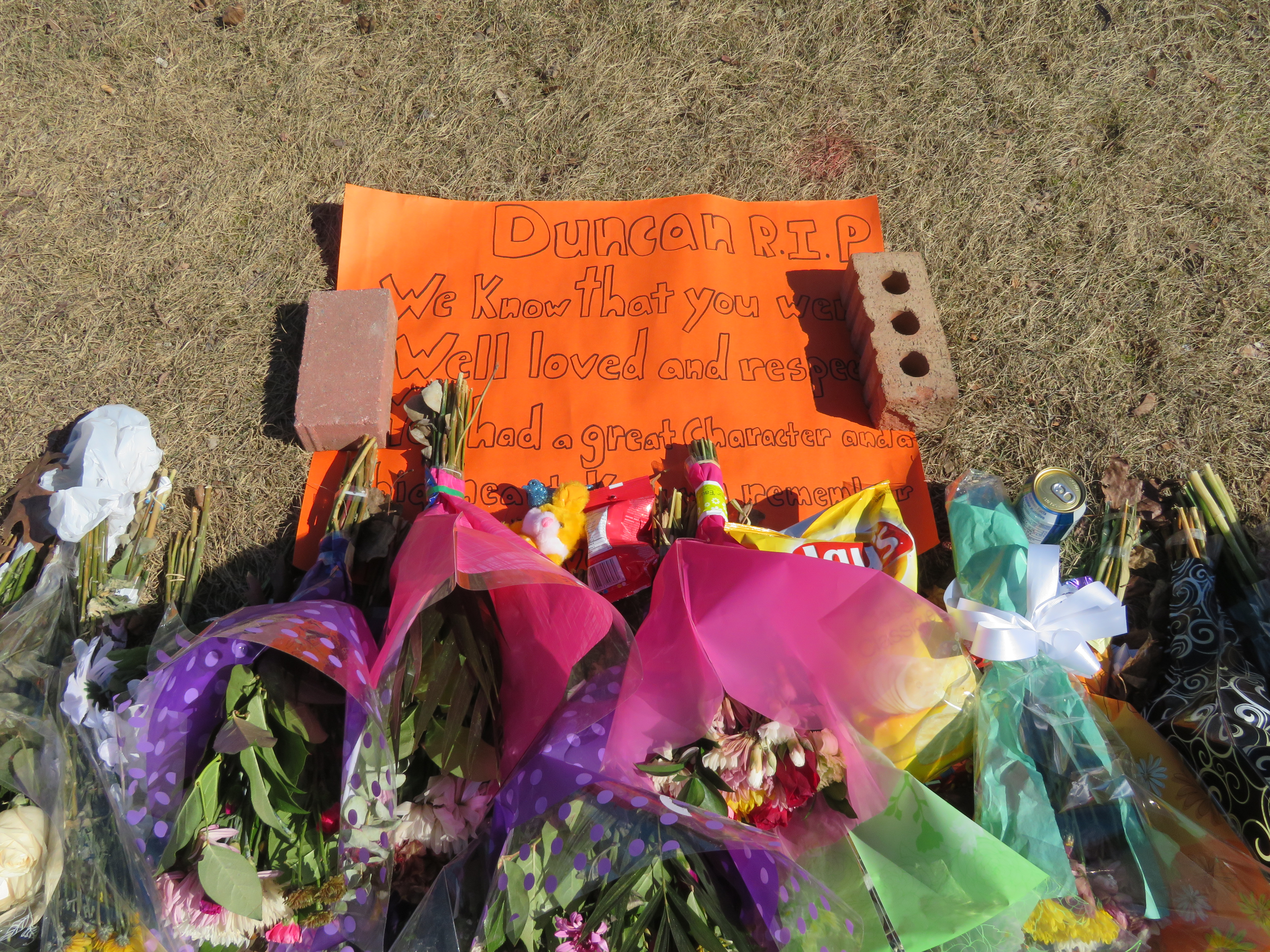
    IMG_6027-001Looking north on Canongate Trail at Ockwell Manor Drive, where Duncan Xu was killed. A memorial is at the curb. Note the speed limit sign, as well as the school zone sign, and also the heavy traffic on Canongate. 

    In the Toronto Star, school principal Kevin Liu described the traffic on Canongate as a problem: “I think we’re getting some thorough traffic, not necessarily residents, cutting through this neighbourhood to avoid a left-hand turn at Kennedy and Steeles during rush hours.”

    The school has long had concerns about their students’ safety.  Initiatives implemented in 2017 included new turning restrictions onto Elmfield Crescent, onto which the school fronts, and parking and stopping restrictions to better manage traffic from parents dropping off and picking up their children. A crossing guard is stationed at the corner of Canongate and Elmfield.

    Canongate is wide as far as local residential streets go. There are no attempts at traffic calming, such as speed humps, bump-outs or curb extensions, or effective traffic enforcement. There are several all-way stop signs on Canongate, but these on their own are not effective in slowing down motor traffic; rolling stops are common as well. When I visited the area today, I found that motorists accelerate quickly headed northbound from the Percell Square/Canongate intersection, and the 40 km/h speed limit is often not adhered to.

    Speeding motorist passes memorial to Duncan Xu on Sunday, March 4

    Sadly, the local councillor, Jim Karygiannis (Ward 39), has not championed measures to reduce and slow down traffic on Canongate Drive, despite local concerns. Instead, the councillor decided to unilaterally close a walkway linking the rear schoolyard with Canongate Trail, close to where Duncan was killed. Duncan used the walkway before trying to cross the street.

    Duncan Xu might not have crossed the street at a crosswalk, but he would still be alive had all motorists driven with the due care and speed befitting a school zone as children are heading home.

    The walkway is a convenient route for students to walk to school. It also connects residents to a nearby park. Councillor Karygiannis claimed that he proposed it earlier, but that local residents and the school refused it. Principal Liu said that he never heard about the proposal.

    The walkway Councillor Karygiannis will unilaterally close on Monday morning after Duncan Xu’s death

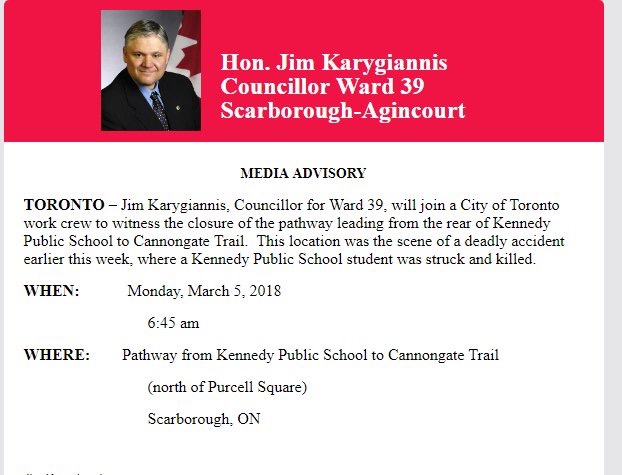
    On Monday morning, Councillor Karygiannis will make a show of closing the path and put out a media advisory indicating his intent. Orange plastic netting was already placed at both entries to the path, which cuts between two houses in preparation of the closure. But this is a classic case of “Zero Vision,” rather than Vision Zero, measures to improve road safety, such as improved pedestrian and cycling infrastructure and re-engineered roads that the city is at least nominally committed to.

    Councillor Jim Karygiannis media advisory

    Media advisory from Ward 39 Councillor Jim Karygiannis’ office announcing the closure of the pathway

    Closing the walkway will only serve to reduce walking to school, and increase traffic. It will do nothing to solve the problem of fast-moving cars in a residential area, nor will it necessarily prevent children from unsafely crossing the street. It’s the type of inexpensive, easy fix that make politicians look like they’re doing something, but without making the necessary changes to prevent future fatalities.

    Traffic calming measures, such as speed humps, tighter curbs at intersections, extending the curbs out at intersections, and planters would force motorists to slow down, and would be more effective than stop signs. More should be done to discourage impatient drivers from using the residential area as a shortcut. More should be done to encourage students to walk to school, rather than discouraged by closing walkways. Walking audits would allow the community to provide input. And this should be done around every school.

    The safety of pedestrians, especially children, should not be left to half-measures.

    IMG_6036-001

    Updated map of pedestrian fatalities on Toronto’s streets.

  • The John Tory Way

    32267768383_8c2f20d0d5_k
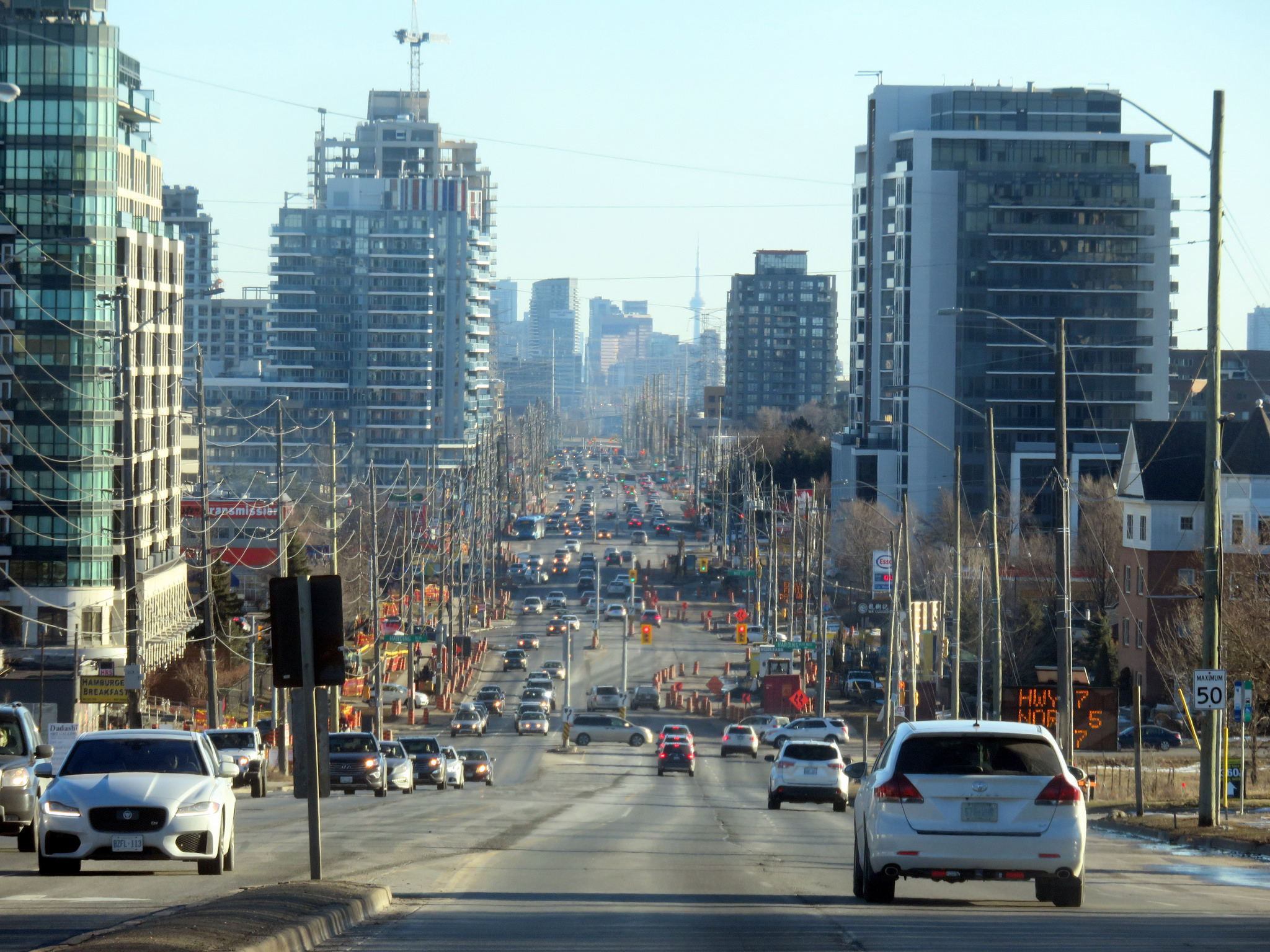
    Yonge Street looking south from Richmond Hill

    There’s an episode of The Simpsons where Homer Simpson changes his name to Max Power, after he’s ridiculed for sharing the name with a buffoonish television character. It’s not a great episode — it came out at the time the show was in transition from its glory years to the “Zombie Simpsons” era — but it has a few good laughs.

    There’s one good memorable quote:

    — “There’s the right way, the wrong way, and the Max Power way!”
    — “Isn’t that the wrong way?”
    — “Yeah, but faster!”

    On important transportation projects, the John Tory way is the wrong way, but costlier. We’ve seen this several times during his mayoralty.

    When it came time to replace the underused eastern section of the Gardiner Expressway, Tory and his suburban allies on council voted in favour of a more expensive “hybrid” option that maintains much of the elevated highway, instead of a cheaper at-grade option that would provide a better pedestrian realm on the Eastern Waterfront and better support new development.

    In Scarborough, Tory stubbornly supports building a one-stop subway extension that was last estimated to cost $3.35 billion dollars, instead of supporting a seven stop LRT route from Kennedy Station that would extend the existing grade-separated Scarborough RT route to Centennial College and Sheppard Avenue. A proposed SmartTrack station at Lawrence East (whose estimated construction cost has risen from $26 million to $155 million) may not be able to be built while the Scarborough RT is still in operation.

    And on February 27, Toronto’s Public Works and Infrastructure Committee (PWIC) voted against plans backed by city staff, the local councillor, John Filion, and many residents and road safety advocates, to transform Yonge Street in North York Centre between Sheppard and Finch Avenues. This section of Yonge Street is due for reconstruction, hence the opportunity to rethink the street to better serve the community.

    The REimagining Yonge Street plan seeks to improve the pedestrian realm with widened sidewalks, would add new cycling infrastructure. To make room for these improvements, two traffic lanes — used for street parking outside of weekday rush hours — would be removed. This stretch of Yonge Street has seen many new condominium towers built over the last decade, and there are three subway stations serving this stretch of Yonge Street.

    Mayor Tory, who has the power to select committee chairs and members, stated his preference for the status quo on Yonge Street, suggesting that the bike lanes be moved one block west, to Beecroft Avenue. PWIC moved for this alternative option as well, even though city staff reported that the change would cost an additional $20 million.

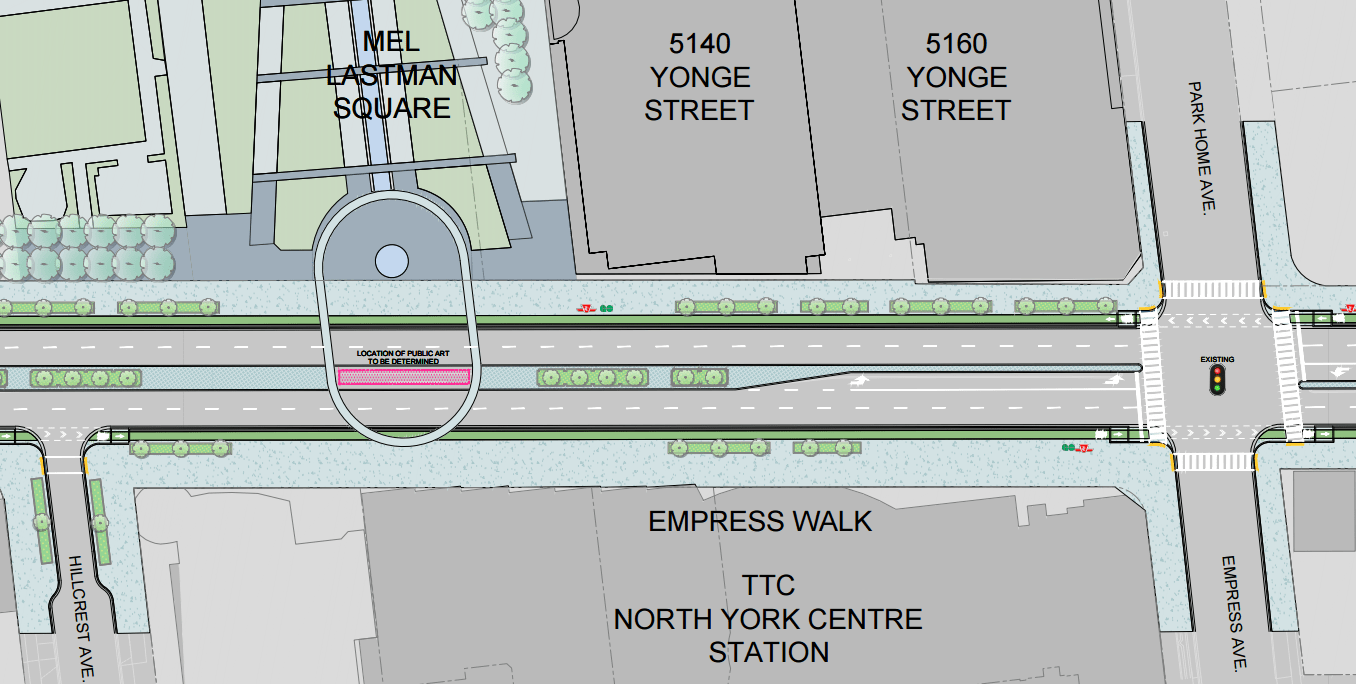
    YongeCrossSectionYonge Street between Sheppard and Finch Avenues would have seen new separated bike lanes, wider sidewalks, and new public art. (From the EA materials.)

    The decision to maintain the status quo on Yonge Street benefits commuters outside of Toronto more than local residents, so it is puzzling why Mayor Tory has declared his support — once again — for an option that puts drivers first. Nearly three-quarters of rush-hour drivers on Yonge Street through North York come from York Region. A majority of residents take transit, walk, or cycle; they would benefit from a safer, more pleasant street. Moving the bicycle route to Beecroft Avenue serves to move cyclists out of the way of cars, rather than providing a direct route with better access to transit, shops, and homes.

    With Doug Ford focused on the Ontario Progressive Conservative party leadership race, there are — as of yet — no high-profile challengers to Mayor Tory’s re-election bid. There is no need to pander to a voting bloc angered by a so-called “war on the car” unless Tory actually supports suburban commuters over his own constituents. And this decision will only cost more money.

    Once again, Mayor John Tory has chosen the wrong way.

  • The same tired pedestrian safety campaign ignores the real issues

    IMG_2560

    After five pedestrians were killed on Toronto’s streets during the two weeks of 2018, Toronto Police have announced another pedestrian safety campaign promising increased enforcement and education efforts. Sadly, I do not have faith that the local police service will properly address the safety of vulnerable road users.

    Police are once again advising pedestrians to avoid crossing mid-block, to make eye contact with motorists before crossing the street, remove earphones and hoods when crossing, put away mobile devices, and be visible. These are all generally good ideas, but they ignore the larger issue — aggressive and inattentive motorists are most at fault.  Most collisions in which pedestrians are seriously injured and killed are in the suburbs, and not in the downtown core, where most pedestrian safety blitzes take place. And some of the advice the police gives pedestrians is not that helpful.

    Previous pedestrian safety campaigns have targeted downtown pedestrians crossing with a flashing hand countdown signal or distracted by their phones. The message is usually the same: in 2012, Toronto police were also saying to “cross the street as if your life depends upon it,” the same as this year’s message. Targeting downtown walkers is an easy way to get a message across, but it is not a very effective one, yet we see it every year.

    Statistics collected by the City of Toronto show that most pedestrians hit by motorists were crossing legally in a crosswalk, with the right of way. This latest campaign ignores that very fact.

    On January 7, Jessica Renee Salickram was killed trying to cross the street after getting off a TTC bus at Steeles Avenue East and Eastvale Drive, on Toronto’s border with Markham. The intersection does not yet have a traffic signal, and it is nearly 300 metres from the nearest signalized crossing, at Tapscott Road. The eastbound TTC bus stop does not even have a sidewalk, one of many inaccessible bus stops in suburban Scarborough. This was not a mid-block crossing, as it was at an intersection. The TTC has since suspended service at this stop, but that is not an acceptable solution.


    Pedestrian fatalities in Toronto in 2018

    The Toronto Police’s advice to make eye contact with motorists is often difficult — persons with visual impairments have as much right to cross as anyone else. It is also very difficult to make eye contact with distracted motorists, and drivers in cars and trucks with deep-tint windows. Police are advising pedestrians to cross at crosswalks, yet they are often blocked by vehicles.

    IMG_1801.jpg
    It’s pretty much impossible to cross the street safely when the crosswalk is blocked. 

    Global News has found that the Toronto Police Service has been issuing far fewer traffic tickets in recent years. Last November, Global reported that Toronto police issued half the number of Highway Traffic Act infractions — fines for speeding, running red lights and stop signs and other unsafe driving — were down by half between 2011 and 2016, as well as a significant drop in impaired driving charges during the same time. It seems wrong that pedestrians are once again being targeted while bad drivers are let off the hook.

    https://twitter.com/sean_yyz/status/953343384122355712

    As I have written here before, civic leaders have not taken pedestrian and cyclist safety seriously enough. There are a few token gestures to Vision Zero, but “Senior Safety Zones” and reduced speed limits on a few streets are not enough to send the message that we truly value the lives of all vulnerable road users — particularly children and seniors, who are disproportionately at risk. One more quick and easy police blitz on pedestrians at busy downtown intersections does not address the problem.