
High speed rail: it’s an idea that has been talked about in Canada since the 1960s. But sadly, in 2016, we’re still just talking about it.
I’m a big fan of passenger rail. I’ve rode on most of VIA’s network, from coast to coast, as well as several long distance Amtrak lines in the United States, as well as trains in Britain, Continential Europe, and China. I enjoyed riding high speed rail (HSR) trains between London, Paris, and Amsterdam, but I also appreciate a leisurely cross-country ride. In Canada, the train isn’t very fast, nor is it very reliable, but it’s a comfortable, peaceful, and social way to travel. It’s still my favourite way to travel to Ottawa or Montreal.
Passenger rail — excepting commuter services such as GO Transit — declined in this country in the last 40 years, in terms of ridership, speed, and reliability. There are thousands of kilometres of track in Canada that hosted passenger trains only a few decades ago that are now torn up, the land sold off or turned into rail trails. In 1989, there were five trains a day in each direction through Kitchener and Stratford. Today, there are just two.
In 1976, a year before VIA Rail Canada was formally established, the fastest trains between Toronto and Montreal, (CN Trains 66 and 67, the famous Turbo,) were scheduled to take 4 hours and 10 minutes, stopping only at Guildwood and Dorval.
Today, the fastest train between Canada’s two largest cities, Train 68 from Toronto, takes 4 hours and 42 minutes, if it’s running on time. (It didn’t on Wednesday, March 23, arriving 41 minutes late into Montreal.) And there are only six direct trains in each direction between the two cities.
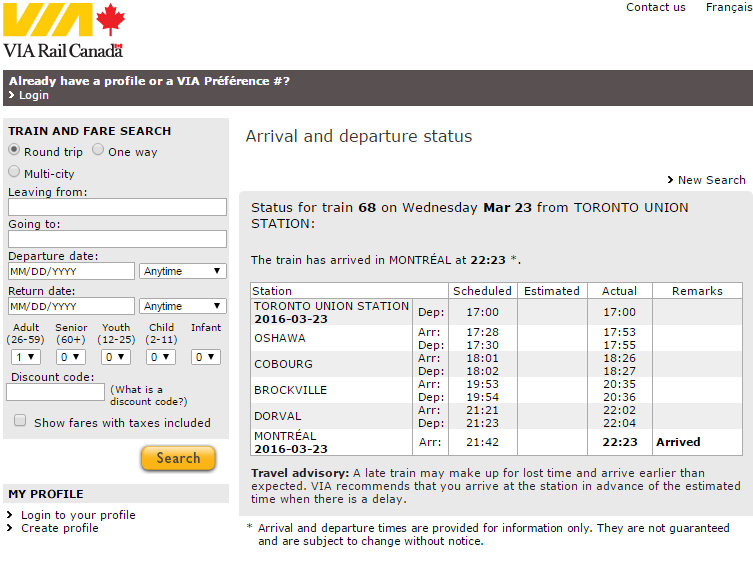
Delays, despite longer scheduled travel times, are common on the Corridor
While commuter rail services are expanding in Toronto and Montreal, passenger service has not. Since being formed in 1977, VIA Rail suffered through several major cutbacks in 1981 and 1990, and minor cuts in 2004 and 2012; but VIA held on despite the neglect – – or complete disdain — of both Liberal and Conservative governments. Ridership fell, not because people didn’t like riding trains, but because governments didn’t want to fund rail services, nor did freight railways like hosting them. Roads were seen as investment; passenger rail an expense.
Today, VIA only operates daily intercity rail service on several routes in Southern Ontario and Quebec. And that service is slow, infrequent, and unreliable. Competition from airlines — Air Canada, WestJet, and Porter operate on the busy Toronto-Ottawa-Montreal corridor — and Megabus have hurt VIA’s ridership, but its slow speeds and unreliable service have as much to do with it as price and alternative options.
VIA Rail operates most of its trains on tracks owned by Canadian National (CN), on its busy freight mainline. VIA owns most of the tracks between Brockville, Ottawa, and Coteau, and the rails between Chatham and Windsor, but these tracks see very little freight service. CN’s dispatching is largely to blame — that railway gives priority to its own lumbering, long freight trains over short, quick, and nimble passenger trains. And track conditions are terrible on some parts of the corridor: between Stratford and London, where CN-owned tracks were leased to a freight shortline operator, the deteriorating bolted rail has forced VIA trains to slow to 30-40 miles per hour (50-65 km/h).
The provincial government is interested in a high speed rail corridor between Toronto, Kitchener, London and Windsor, including a stop at Pearson International Airport. And there have been several high speed rail plans for Toronto-Ottawa-Montreal, sometimes these plans extend the HSR corridor east to Quebec City, and west to London or Windsor. These studies were undertaken by the federal government, the provinces of Ontario and Quebec, or by private advocacy and industry groups.
But despite the dreams of transportation advocates and many environmentalists, VIA’s latest plan doesn’t call for high speed rail, but a much more modest, $3-4 billion plan for dedicated tracks along the corridor. The plan calls for somewhat faster train service, running up to 110 miles per hour (177 km/h), using either conventional diesel or electric locomotives and coaches. This is either described as “higher speed rail” or “high frequency rail.” It’s not as sexy as HSR, but it’s a good start. VIA trains, using its best locomotives and coaches, are capable of speeds well over 100 MPH (160 km/h) but are restricted to top speeds of 95 MPH (153 km/h).
With dedicated tracks, free from delays caused by CN freight operations, VIA can operate faster trains, more frequently. VIA Rail’s CEO, Yves Desjardins-Siciliano, suggested that up to 15 trains a day, in each direction, could operate between Toronto and Montreal; travel times would be reduced by an hour between the two cities, making the train more competitive with air travel. Last fall Desjardins-Siciliano expressed optimism that the incoming Justin Trudeau-led Liberal government would fund VIA’s modest plan.
Of course, a dedicated rail corridor could be upgraded to full high speed rail in the future.
The first Liberal budget, presented in the House of Commons on Tuesday, was disappointing, despite much-needed investments in local transit projects, infrastructure in First Nations communities, among other things. The budget allocated a mere $3.3 million over three years (just over $1 million a year!) for more study into VIA’s proposal, while allocating $7.7 million in 2016-2017 for “pre-procurement activities for the renewal of VIA Rail’s fleet” and $34 million for improvements to its stations and maintenance facilities.
Maybe next year, there will be money for new rail cars and locomotives, not just more “pre-procurement activities.” Some of VIA’s rolling stock — the “HEP-I” and “HEP-II” coaches — were built in the 1950s, the more modern LRC coaches were built nearly 40 years ago. And hopefully the Liberals will fund VIA’s modest, but essential, rail project.
In the meantime, we’re still stalling on improved passenger rail. In true Canadian fashion.
2011 Rick Mercer Report video on high speed rail, still relevant five years later.


Leave a comment