Category: Maps

  • The Downtown Divide: Wards 19, 20, 27, and 28

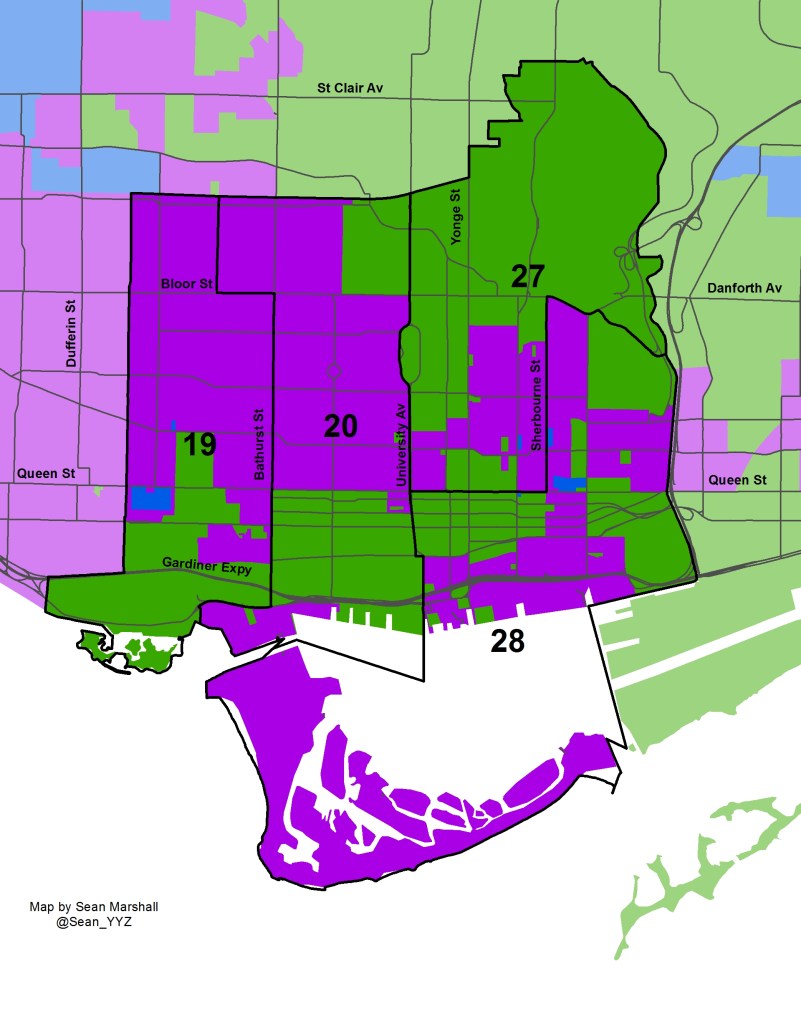
    2014 Election - Downtown Wards Mayor Solid A map of each poll’s first choice for mayor in Wards 19, 20, 27, and 28

    In this post, I examine the results in four downtown wards – Wards 19 and 20, Trinity-Spadina, and Wards 27 and 28, Toronto Centre-Rosedale.

    Olivia Chow, the early favourite to defeat Rob Ford, was a long-time city councillor. Chow represented Ward 20 before she ran and won in Trinity-Spadina for the New Democratic Party in the 2006 federal election. In order to run for mayor, Chow resigned as an MP early in 2014. A by-election was called for June 30. Joe Cressy hoped to keep the seat for the NDP, but Adam Vaughan, Chow’s successor as Ward 20 councillor, won the by-election for the Liberals by a wide margin. In the provincial election held earlier that month, Rosario Marchese, one of a very few NDP MPPs left from the Bob Rae era, lost to Liberal candidate Han Dong. Trinity-Spadina’s demographics were changing, especially with new condominium towers going up in new neighbourhoods like City Place and Liberty Village. And this mattered in the 2014 municipal election.

    Of the four downtown wards, John Tory came in first place in three: Wards 20, 27, and 28. Olivia Chow did not win her own ward, even though she represented it in municipal and federal politics for decades. Interestingly, John Tory is also a Ward 20 resident, so he, like Doug Ford, won his own ward. Tory makes his home in a large condominium apartment in Poll 013, Chow lives in a house in Poll 024. At least Chow won her poll.

    The map at the top of this article illustrates each poll’s first choice for mayor, without gradients based on the margin of the win. What can clearly be seen is that the older, more established neighbourhoods (with the exception of Rosedale and Yorkville) voted for Chow. The new condominium neighbourhoods voted for Tory. Doug Ford won a few polls – Moss Park and several other TCHC housing properties, but managed only to get 12.6% of the vote in these four wards.

    But what really strikes me is the north-south divide. Queen Street is a clear dividing line between the new condos to the south (Liberty Village, Fort York, City Place, Entertainment District, the Waterfront and Financial Districts) and the older neighbourhoods to the north. Other areas with many new condo towers, such as around Yonge/Church/Bloor and along Bay Street, also picked Tory.
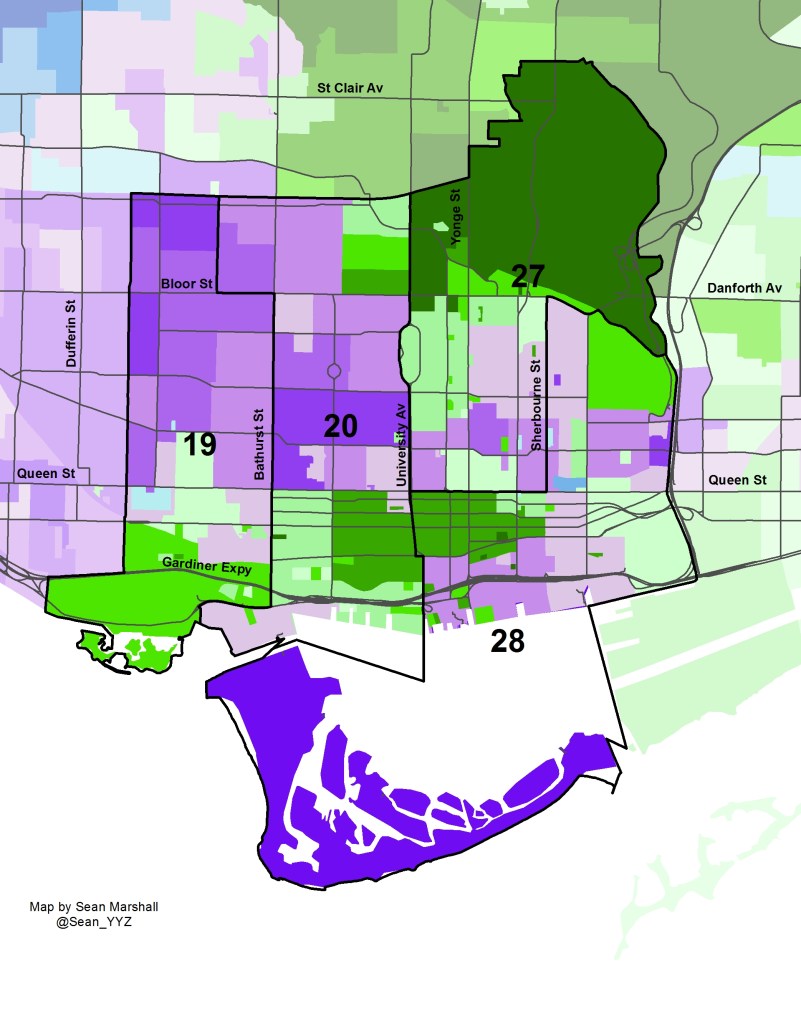
    2014 Election - Downtown Wards Mayor MarginMap of each poll’s first choice for mayor in Wards 19, 20, 27, and 28, with margin of win

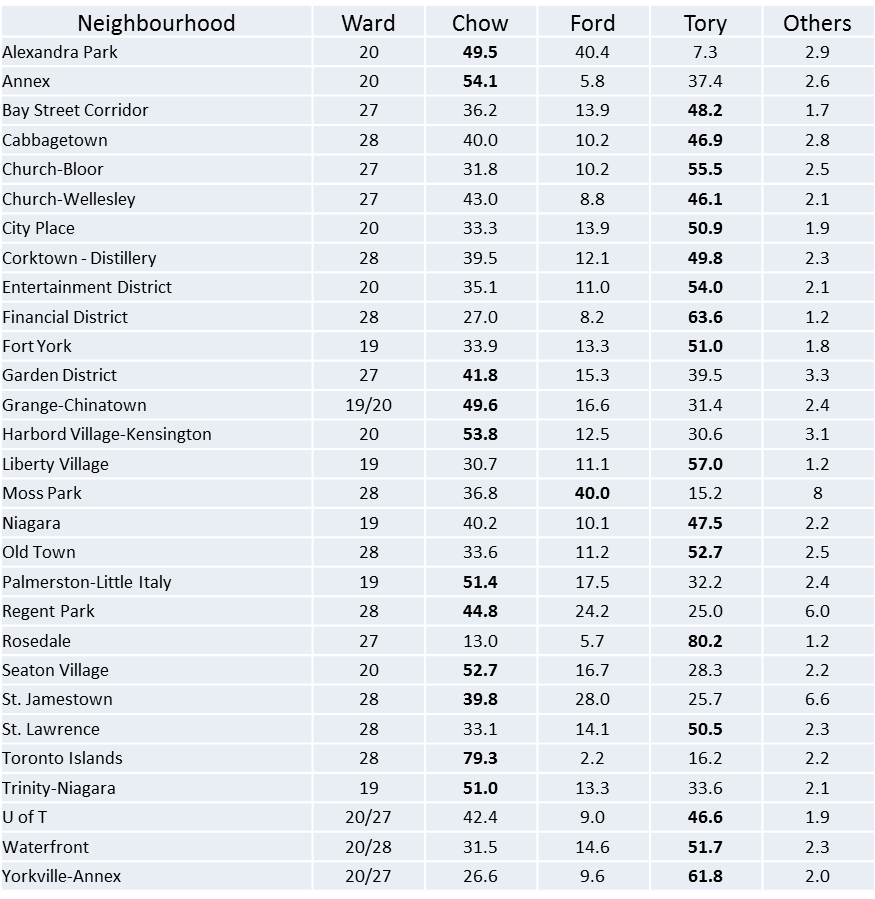
    Chow’s strongest support was in the Annex, Little Italy-Palmerston, and the Harbord Village/Kensington/Chinatown neighbourhoods. She did the best on Toronto Island, winning nearly 80% of the vote there. Chow also did well in Alexandra Park, a rare downtown neighbourhood where Ford came in second place and Tory got less than 10% of the vote. Tory did the best in Rosedale (not surprisingly), which he won with 82% of the vote, and did very well in those new condominium neighbourhoods.

    What really surprised me was that Tory came in first in the Church-Wellesley neighbourhood. Olivia Chow and her late husband Jack Layton were some of the greatest allies of the Toronto’s LGBT community, going back to the 1980s, when gays and lesbians did not enjoy the societal acceptance and support that they increasingly do now. I suspect that the spectre of a Doug Ford victory (the Fords have been rightly accused of being homophobic) convinced many voters to back Tory as Chow’s campaign floundered, and this might have been an important factor here.
    Table_Downtown

    Council races downtown

    Except in Ward 20, where Councillor Adam Vaughan moved on to federal politics (Ceta Ramkhalawansingh filled in as a interim council appointee), each incumbent councillor – Mike Layton in Ward 19, Kristyn Wong-Tam in Ward 27, and Pam McConnell in Ward 28, were easily re-elected.

    In Ward 20, Joe Cressy, after losing the federal by-election, ran for council in a crowded, open race, and won 42% of the vote and 54 of 68 election-day polls. There were other very good candidates, like Terri Chu (who came in second with 12.4%), Albert Koehl, and Anshul Kapoor, but Cressy had the organization and some name recognition from his run for MP. Cressy also had the endorsement of NOW, the Toronto Star, and the Labour Council. Fringe mayoral candidate Sarah Thomson also ran in Ward 20 after withdrawing from the mayoral race, despite her name recognition and nearly winning Trinity-Spadina for the Provincial Liberals in 2011, came in third with 9.5% of the vote.

    (more…)

  • Mapping the 2014 Toronto election: Wards 11 and 12

    Wards 11 and 12, York South-Weston, are located in the near northwest side of Toronto, stradding the former Cities of York and North York. Ward 11 includes the neighbourhoods of Weston, Pelmo Park, Mount Dennis, and Rockcliffe-Smythe. Thes outheast corner of the Ward 12 includes the former Toronto Stockyards and its associated industries; those lands are now mostly redeveloped into big-box retail and townhouse developments. Ward 12, east of Jane Street and the Metrolinx/Canadian Pacific rail corridor, includes the Rustic-Maple Leaf, Amesbury, Beechbrook, and Keelesdale neighbourhoods.  Compared to Toronto as a whole, both wards are relatively lower-income (the average household income in 2010 in Ward 11 was $61,883 in 2010; in Ward 12, it was $61,621); both wards are made up of a mix of housing types, from post-war subdivisions (many populated by older Italian and Portugese-Canadian families) and highrise residential towers.

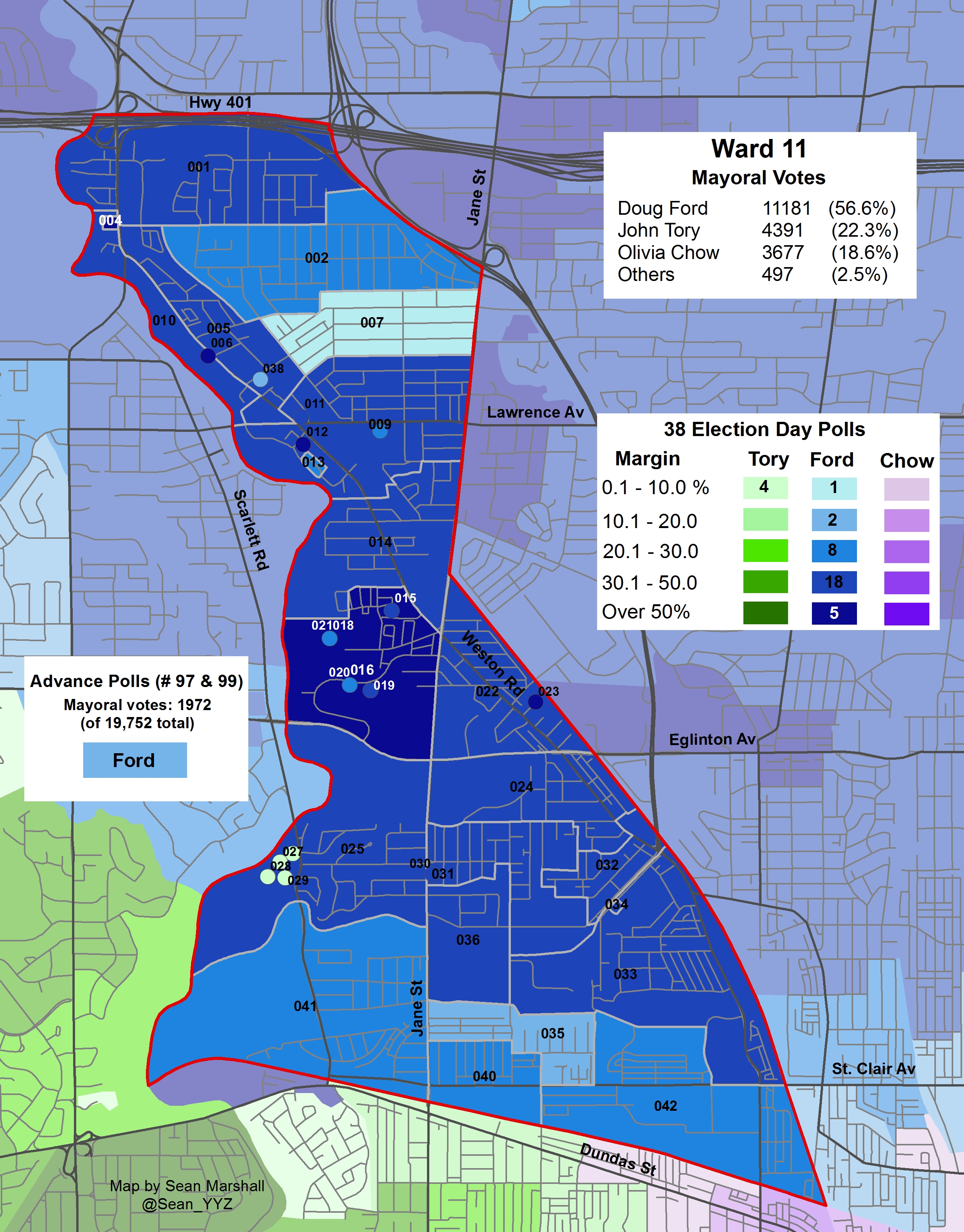
    2014 Election - WARD 11 MayorPoll results of the mayoral race in Ward 11

    2014 Election - WARD 12 MayorPoll results of the mayoral race in Ward 12

    In the mayoral race, Doug Ford took both wards by a landslide; Ford got 56.6% of the vote in Ward 11 and 62.3% in Ward 12. John Tory and Olivia Chow came in a distant second and third place, respectively.

    Ford came in first place in all but five polls in York South-Weston. In Ward 11, Tory won four polls located at 240-270 Scarlett Road, the Lambton Square condominium towers. In Ward 12, Tory placed first in Poll 027, a seniors’ residence near the old Northwestern Hospital.

    The councillor in Ward 11 is former York mayor Frances Nunziata, who has sat on Toronto City Council since amalgamation. She was one of Mayor Rob Ford’s closest allies; she served as council speaker in the last term. As speaker, she had trouble keeping order on council. though newly elected mayor John Tory has since nominated her for the job. Only 19 of 44 councillors were willing to challenge the nomination, so for now, she remains in her current role.

    In the last election, Frances Nunziata won with 71.3% of the vote. Only two other candidates ran: Jose Garcia (netting 17.4% of the vote) and Dory Chalhoub (who got 11.3%). I didn’t bother making a map for the council race in Ward 11 as Nunziata won every poll by a comfortable margin.

    On the other hand, the council race in Ward 12 was much more interesting. This was a bonafide four-way race between incumbent Frank Di Giorgio, returning challenger and former city staffer Nick Dominelli, former Liberal/Independent MP John Nunziata (Frances’ brother) and new challenger Lekan Olawoye, a Nigerian-Canadian immigrant and local community organizer.

    (Full disclosure: I met Lekan Olawoye and some of his campaign team at a local debate; I came away impressed. I contributed funds towards his campaign.)

    John Nunziata’s last-minute entry to the race (at about the same time that Rob Ford and Doug Ford traded places as mayoral candidate) shook things up. Olawoye found himself running against three Italian-Canadian candidates, all running to his right. Unfortunately (at least in my view), Di Giorgio won, but it was close. Only 238 votes separated the incumbent from Nunziata. Remarkably, all four candidates had the support of over 20 percent of the electorate. (It would be interesting to find out what the effect ranked ballots would have on such a close race.)

    2014 Election - WARD 12 CllrPoll results of the councillor race in Ward 12

    Olawoye won nine election day polls (more than Nunziata or Dominelli). Some of these polls, such as Poll 001 (which includes a large TCHC complex), are where Doug Ford did best in the mayoral race, similar to results seen in Ward 6. The polls that Olawoye won were mostly high-rise residental towers, including private rentals, co-operative homes, and TCHC properties. Di Giorgio and Dominelli did the best in the northeast, in the Maple Leaf/Rustic neighbourhoods.

    To repeat a point I made earlier, I am impressed to see great, young, passionate candidates in northwest Toronto who want to do better for this city. I strongly believe that we need more diversity on city council. I am inspired by people like Andray Domise, Idil Burale, Abukar and Olawoye. Happily, we will hear a lot more from these inspiring leaders in the years to come.

  • Mapping the 2014 Toronto election: Wards 5 and 6

    Wards 5 and 6, Etobicoke-Lakeshore, were both interesting races in the 2014 municipal election, but for different reasons. In Ward 5, there was no incumbent city councillor seeking re-election. Peter Milczyn, the long-time councillor for the area, was elected as the area’s MPP in the June 2014 provincial election. James Maloney was appointed as a caretaker councillor to serve Ward 5 until one was elected in the October election; Maloney promised that he wouldn’t stand for election in 2014.

    Meanwhile, in Ward 6, Russ Ford and Tony Vella were both serious challengers to incumbent Mark Grimes. In the 2010-2014 term, Grimes was a conservative councillor that rarely made a mark. Grimes voted with Ford on most of the important decisions at council meetings. Despite not having much power, Rob Ford gave him the nickname, “the midnight mayor” and seems to have been one of the Ford Brothers’ closest friends on council.

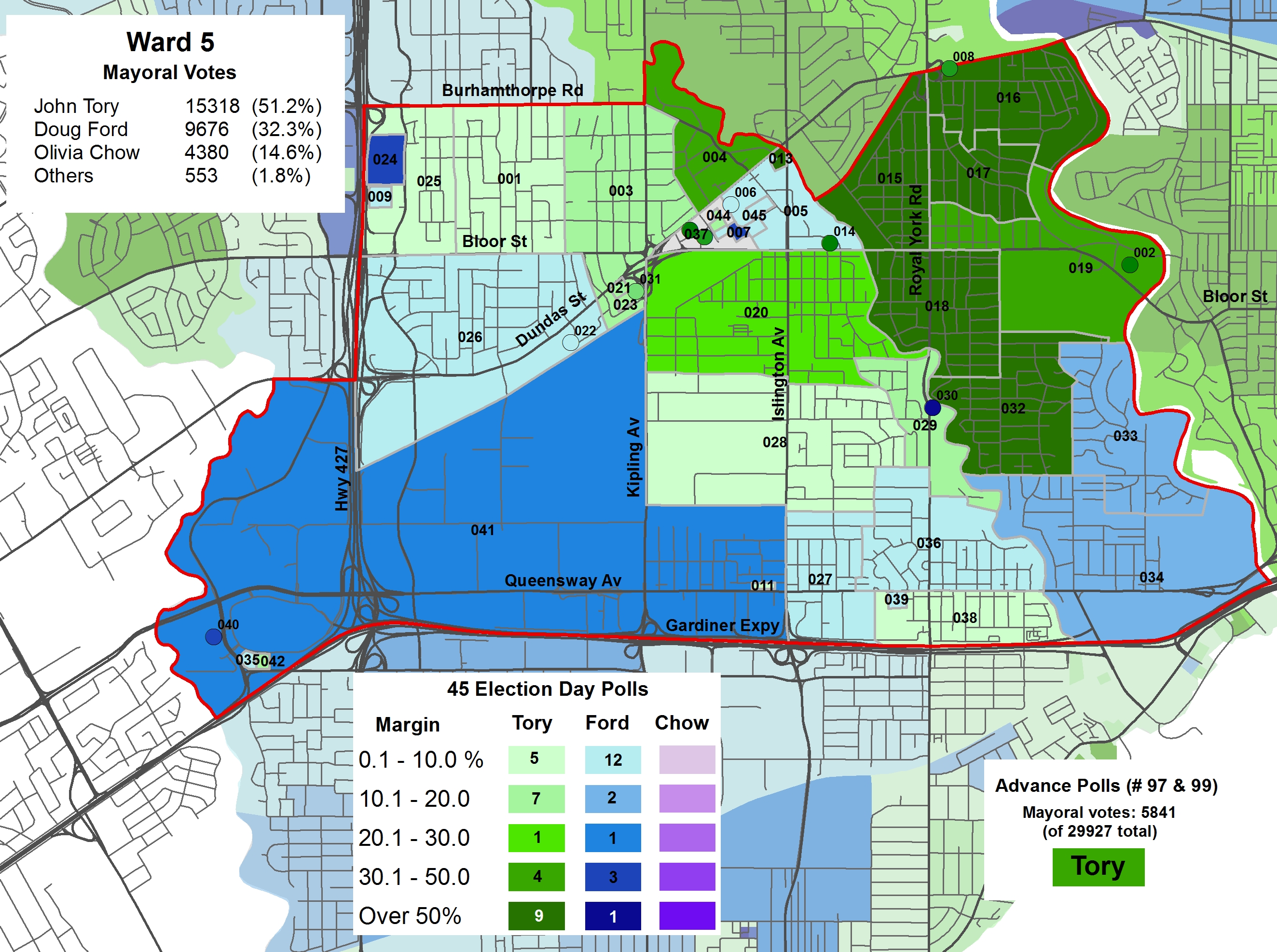
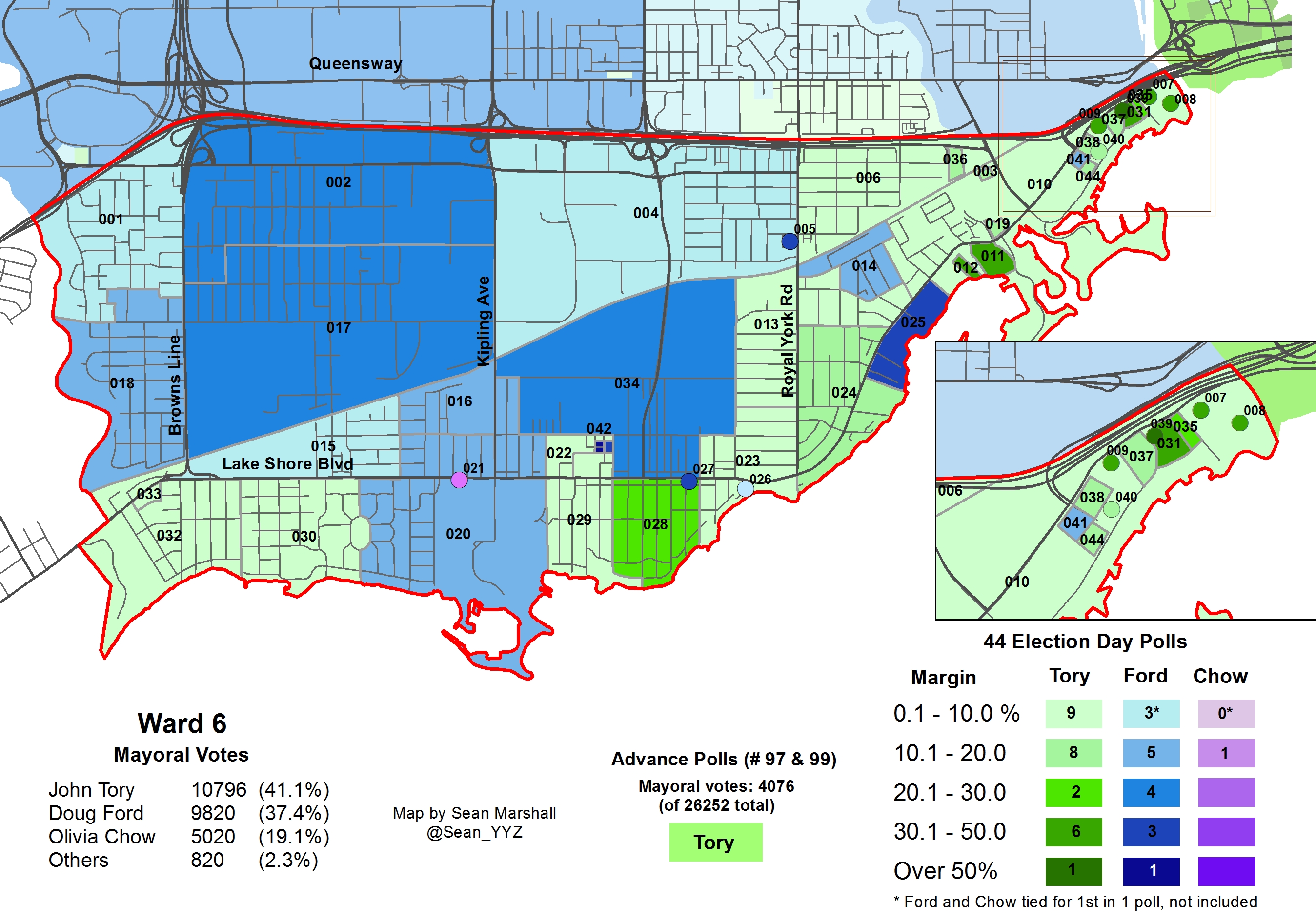
    In the mayoral race, John Tory came in first in both wards. He took 51.2% of the vote in Ward 5 and was selected by 41.1% of the electorate in Ward 6. Doug Ford came in second place in both polls, taking 32.3% of the vote in Ward 5, and a much closer 37.4% in Ward 6;  Olivia Chow came in a distant third place, winning only one poll, in Ward 6.

    2014 Election - WARD 5 MayorPoll results of the mayoral race in Ward 5

    2014 Election - WARD 6 MayorPoll results of the mayoral race in Ward 6

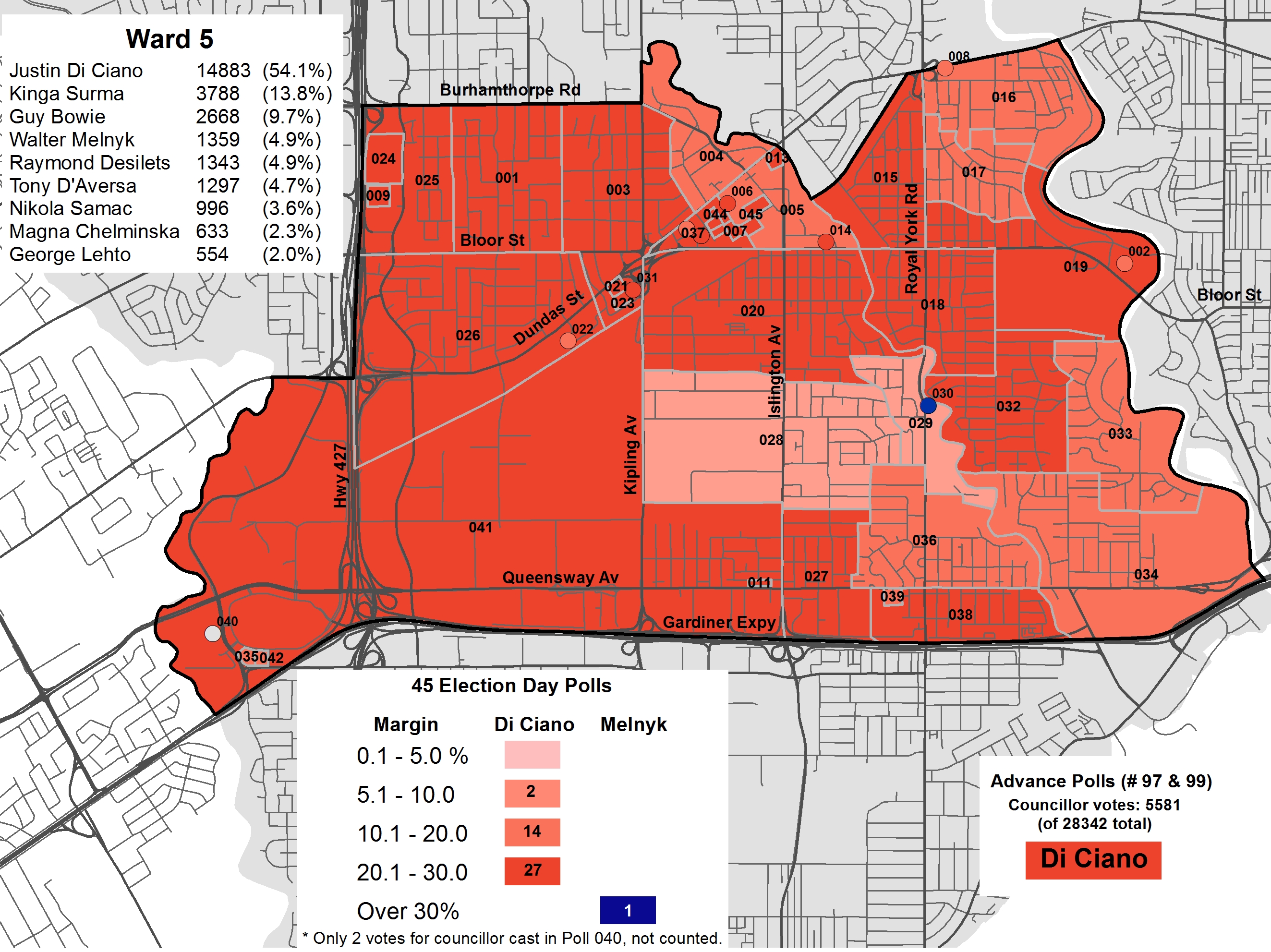
    Despite the Toronto Star calling Ward 5 one of “15 races to watch,” it wasn’t. Local businessman Justin Di Ciano won 54.1% of the vote and all but two polls. I didn’t count Poll 040 as only two votes for councillor were cast; Poll 030, a Ukrainian seniors’ home, chose fourth-place candidate Walter Melnyk. In 2010, Di Ciano ran against Peter Milczyn, losing to the incumbent by only 109 votes. Clearly, Di Ciano had the name recognition and organization to succeed in 2014.


    2014 Election - WARD 5 CllrPoll results of the council race in Ward 5

    Ward 6 was a little bit more interesting. Russ Ford, the executive director of the LAMP Community Health Centre, (a local health, recreational and social service agency and a former city staffer) made his first run for council. (He is not related to Rob or Doug Ford, or for that matter, former Long Branch reeve Len Ford, whom a waterfront park there is named for). Russ Ford ran a strong campaign on a progressive platform, winning the endorsement of the Toronto & York Region Labour Council, NOW Magazine, and the Toronto Star.

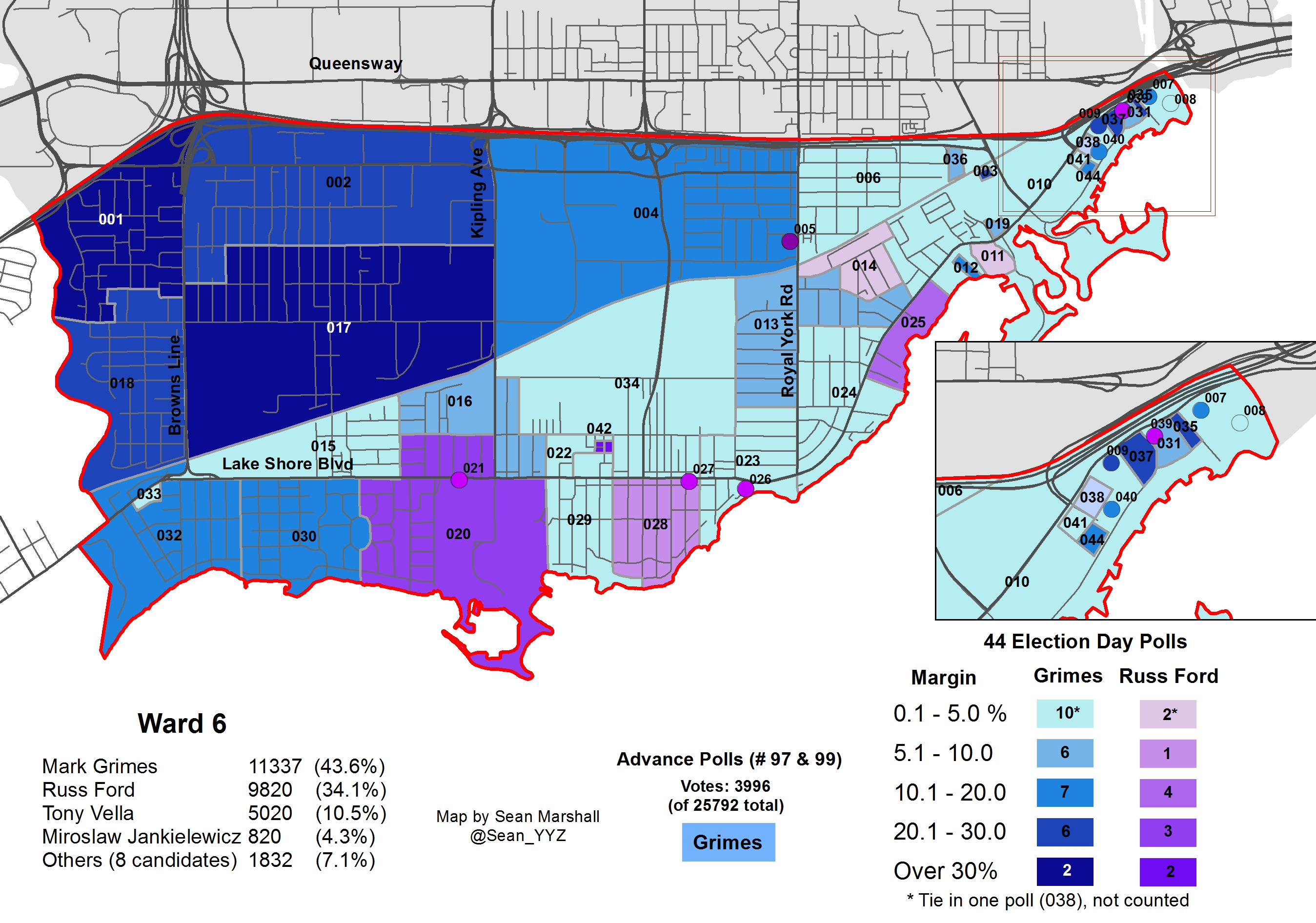
    Unfortunately, Russ Ford lost to Mark Grimes, 43.6% to 34.1%, a difference of just over 1500 votes. Tony Vella, a former spokesperson for the Toronto Police Service, also put his name forward as a candidate. Despite his local ties and name recognition, he was only able to get 10.5% of the vote.

    After my first tweets in November sharing early drafts of these maps, Russ Ford replied and shared some interesting information. He claimed that John Tory’s campaign was robo-calling residents in order to support Grimes by the end of the campaign. Tory and Grimes won Ward 6, both doing very well in the new condominium neighbourhood of Humber Bay Shores. Grimes also did well in the Alderwood neighbourhood, which also supported Doug Ford in the mayoral race.

    Russ Ford won some polls in New Toronto and Mimico; he did best in Polls 042 and 045, the same polls where Doug Ford won by the highest margin. In fact, every poll that Doug Ford won by at least a 30% margin, Russ Ford also came in first place. Russ Ford insisted that this was no mistake; that the same voters who were motivated to vote for Rob or Doug Ford were supportive of Russ Ford and his commitment to the community.

    2014 Election - WARD 6 Cllr
    Poll results of the council race in Ward 6

  • Mapping the 2014 Toronto election: Wards 3 and 4

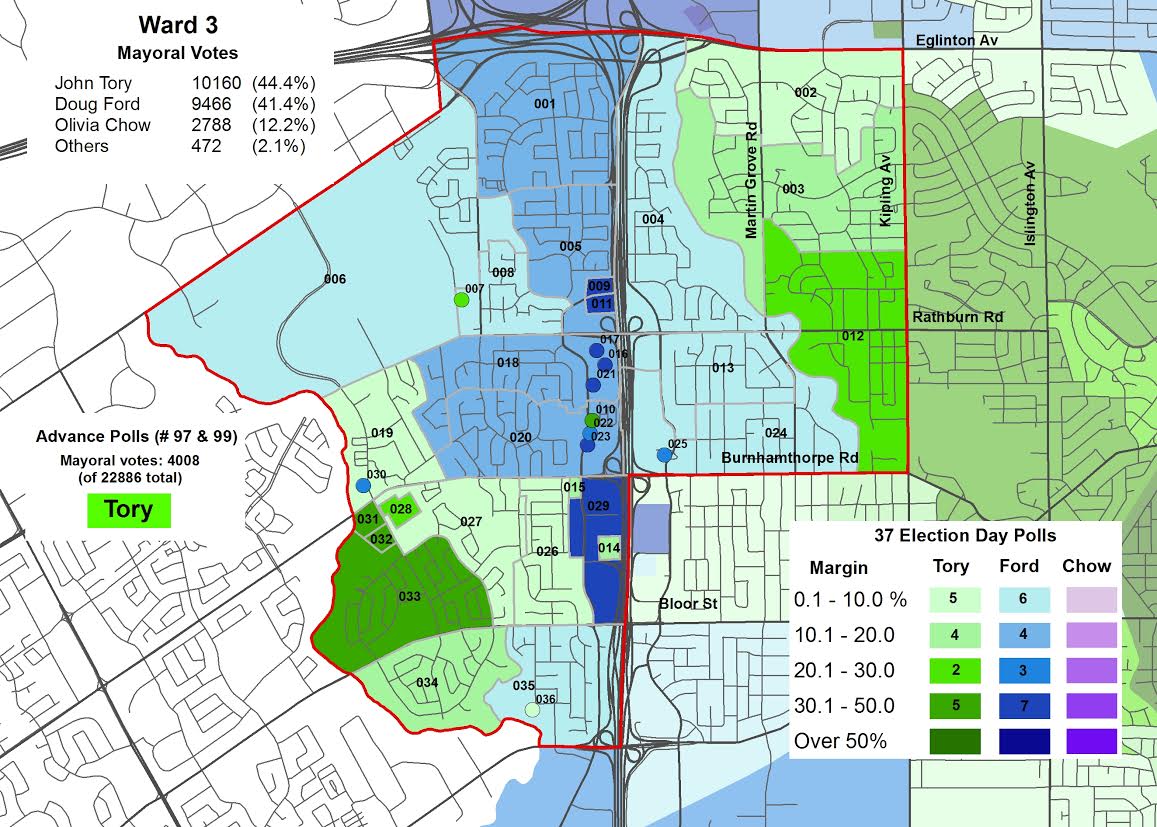
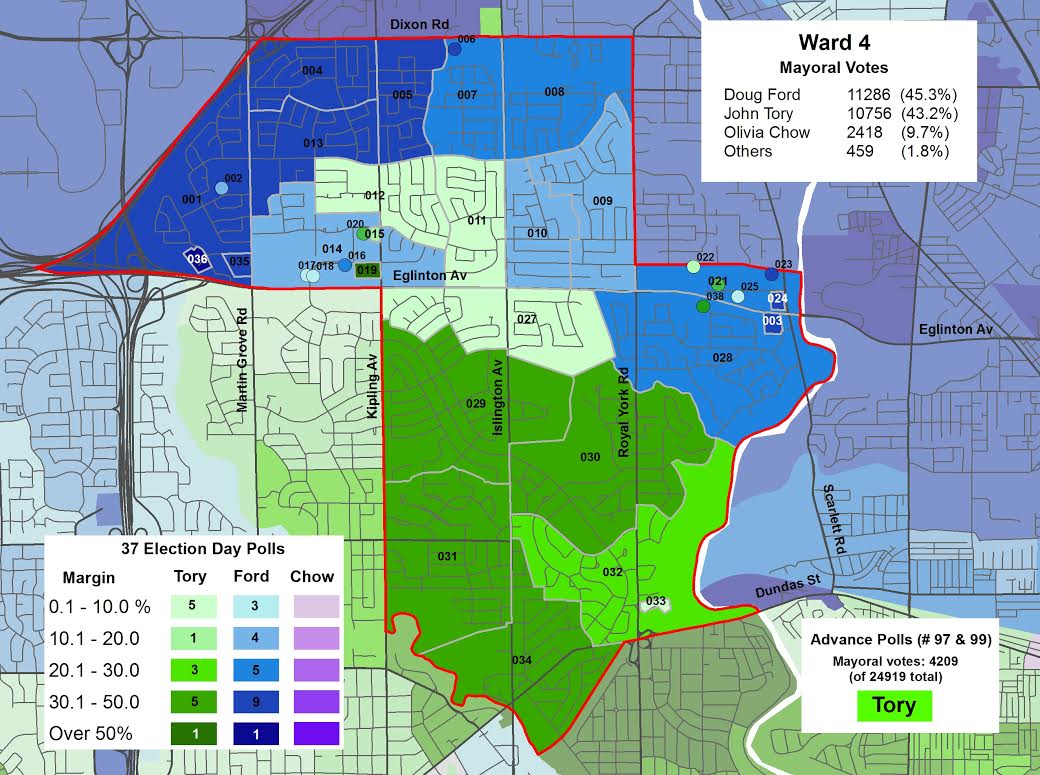
    Ward 3 and Ward 4, Etobicoke Centre, were both interesting races to watch. Neither ward had an incumbent councillor running for re-election. Mayoral candidates Doug Ford and John Tory were both very competitive in each ward. Tory came first in Ward 3, while Ford came first in Ward 4; both wards showed clear geographic splits in their choice for mayor. Olivia Chow came in a very distant third in both wards. Ward 4 was interesting for another reason; though Rob and Doug Ford have taken turns representing Ward 2, they both live in Ward 4.

    The incumbent in Ward 3, Peter Leon, was a caretaker councillor, appointed by council in 2013. When appointed, Leon promised that he would not run for election. The incumbent in Ward 4, Gloria Lindsay Luby, a moderate councillor and a Ford family foe, did not stand for re-election in 2014.

    Ward3_Mayor
    Poll results of the mayoral race in Ward 3

    As already noted in a few suburban wards (such as Ward 10 and Ward 15), there’s a clear distinction between areas where Tory did well and where Ford was the most popular mayoral candidate.

    In Ward 3, Doug Ford did best in polls in the north and northwest part of the ward, particularly in the high-rise residential towers and townhouse complexes that line Highway 427. Wealthier neighbourhoods such as Princess-Rosethorn and Markland Wood generally voted for Tory.

    Ward4_MayorPoll results of the mayoral race in Ward 4

    The same patterns can be found in Ward 4. Polls in affluent Edenbridge-Humber Valley neighbourhood voted for John Tory by wide margins, with one notable exception: Poll 028, Rob Ford’s home poll. Interestingly, mayoral candidate Doug Ford lost his own poll (Poll 027), he was the only top mayoral candidate to do so. Most polls north of Eglinton Avenue voted for Doug Ford by wide margins. Condominium towers, seniors’ residences, and high-end rental buildings (including Polls 015, 019, 020, 021, 022, 038) opted for Tory, while Ford did well in other rental highrises (such as Polls 003, 016, 023, 024, 036).

    (more…)

  • Mapping the 2014 Toronto election: Wards 9 and 10

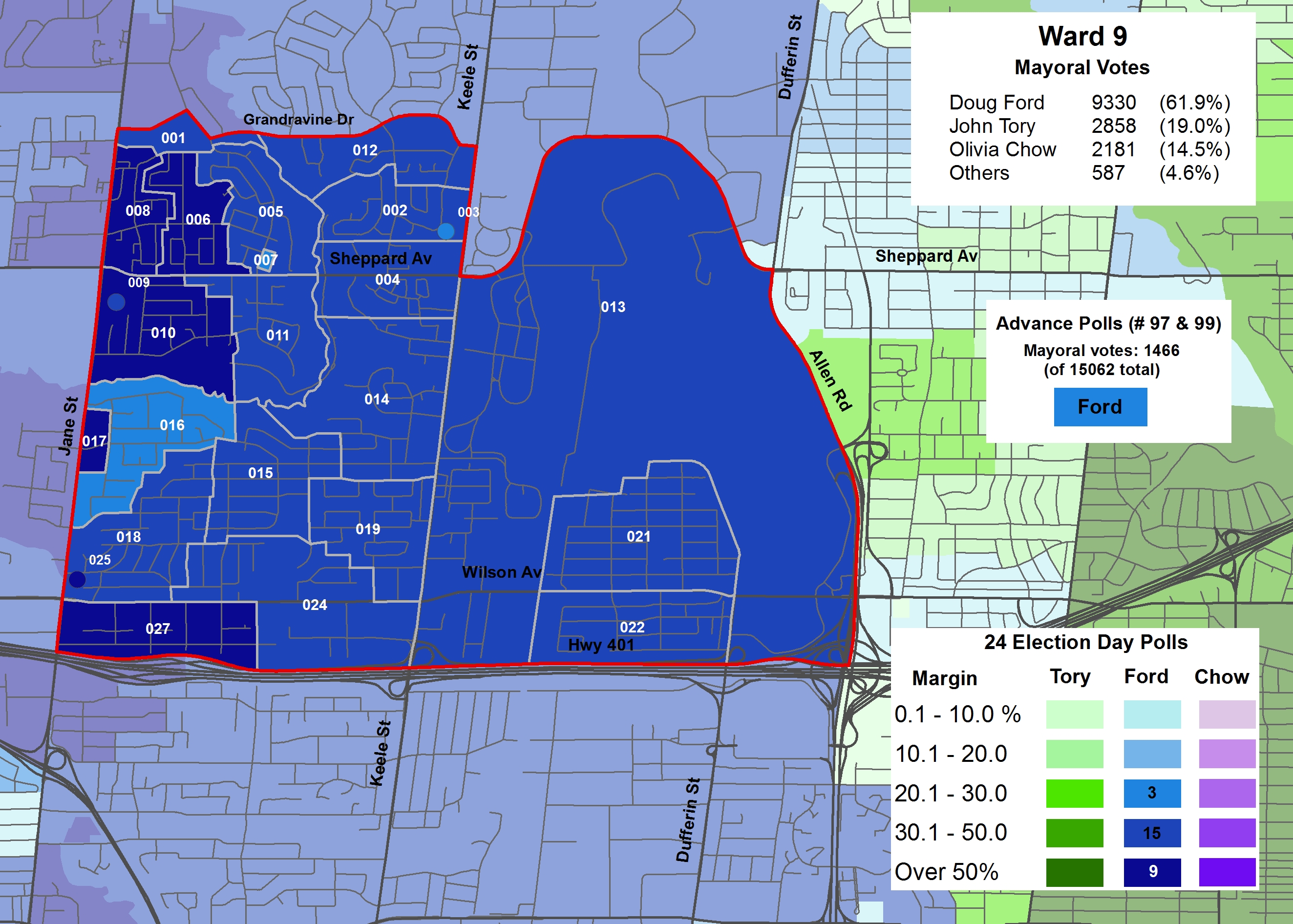
    2014 Election - WARD 9 Mayor
    Poll results of the mayoral race in Ward 9

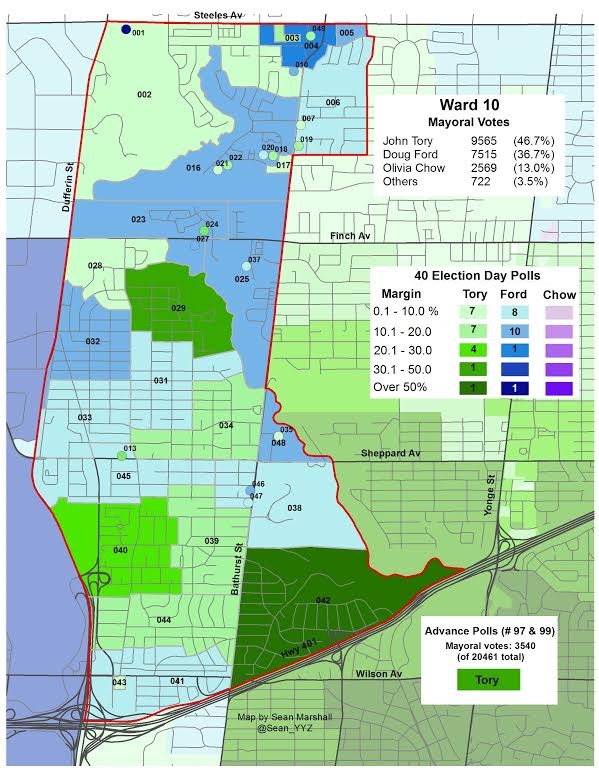
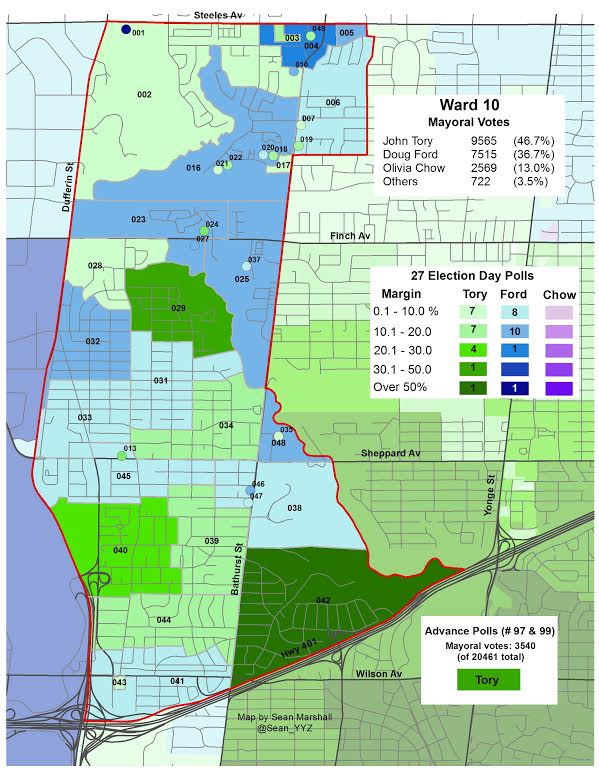
    Ward 10 Mayor
    Poll results of the mayoral race in Ward 10

    This weekend, let’s have a quick look at the 2014 election results in Wards 9 and 10, York Centre. Both wards are located north of Highway 401 in the former City of North York. Allen Road and Dufferin Street separate Ward 9 to the west and Ward 10 to the east. Ward 9 contains Downsview Park, and was my home from 2006 (when I moved from my parents’ house in Brampton) through 2011, when I sold a condo I owned there and moved closer downtown.

    Fifty-nine percent of Ward 9’s residents were born outside of Canada. Many of Ward 9’s residents are long-established Italian-Canadian families, but they are joined by immigrants from Southeast Asia, Latin America, and the Caribbean. The ward has a somewhat low average household income ($60,550 compared to the city-wide average of $87,038).

    Doug Ford won Ward 9 by a huge margin. Ford took 61.9% of the vote and came first in every poll, while John Tory was preferred by only 19.0% of the electorate; Olivia Chow only got 14.5% of the vote.

    Ward 10 is somewhat wealthier than Ward 9; it includes the affluent Armour Heights neighbourhood. Ward 10 has a large Jewish population, and it has hosts Russian-Canadian and Filipino-Canadian communities (the two largest immigrant populations in the ward). In Ward 10, John Tory came first with 46.7% of the votes (Ford got 36.7% and Chow 13.0%). Tory did best in Armour Heights, while Ford did best in areas with higher proportions of immigrants and lower incomes, especially in the high-rise residential towers at Bathurst and Steeles. The only major surprise is that despite charges of the Fords’ anti-Semitism, Doug Ford came in first in several polls located in Jewish seniors’ homes.

    (more…)

  • Mapping the 2014 Toronto election: Wards 1 and 2

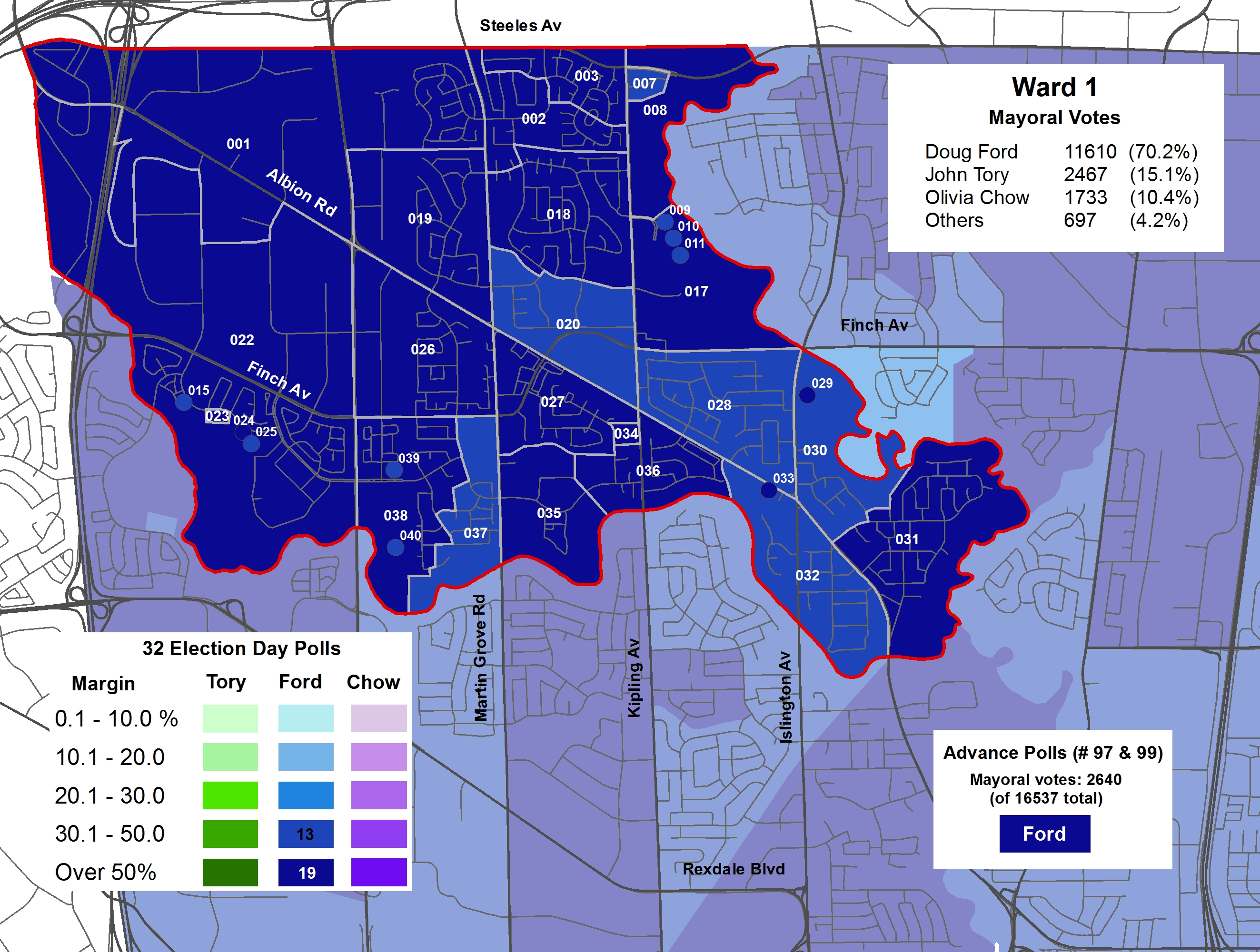
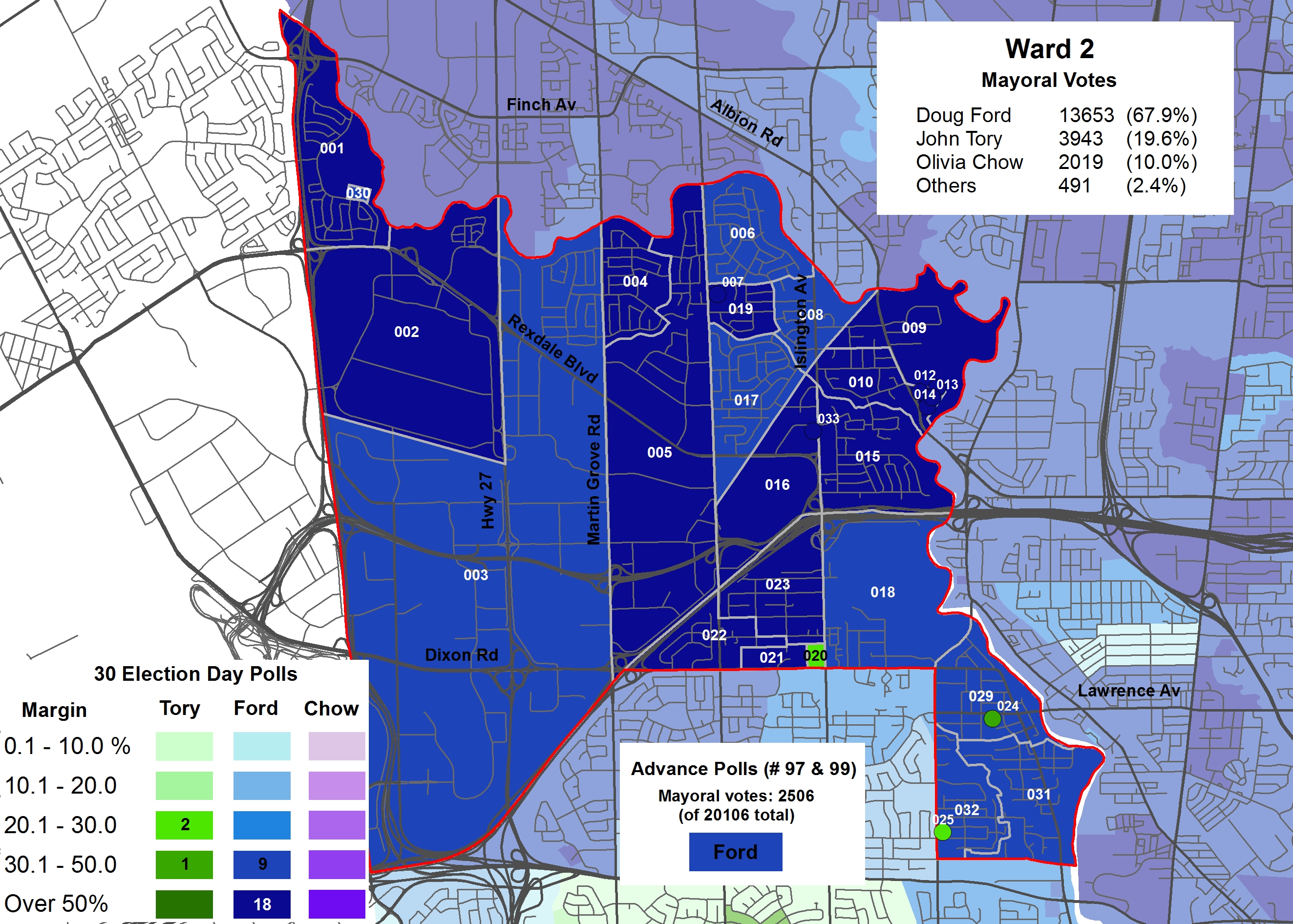
    2014 Election - WARD 1 MayorPoll results of the mayoral race in Ward 12014 Election - WARD 2 MayorPoll results of the mayoral race in Ward 2

    On this beautiful sunny Friday afternoon, let’s have a quick look at the results of the 2014 Toronto municipal election in Wards 1 and 2, Etobicoke North. Ward 2 is the Ford’s home turf (Rob Ford and Doug Ford now live in Ward 4, but their mother’s home, the venue for many “Ford Fest” backyard parties is located here, as is the family business, Deco Labels and Tags.

    Rob Ford represented Ward 2 on city council for ten years before running for mayor in 2010.  In that election, Rob Ford’s brother Doug ran for Rob’s old council seat, and won handily. After being diagnosed with cancer in September of 2014, after a scandal-prone term of office, Rob and Doug traded places. Doug, who did not intend to run for office, took Rob’s place as mayoral candidate. On October 27, 2014, Rob Ford, once again, was elected city councillor for Ward 2. A close ally was re-elected in Ward 1.

    Despite disappointing electoral results in Wards 1 and 2, there is hope for the future in northwest Toronto.

    (more…)

  • Mapping the 2014 Toronto election: Wards 7 and 8

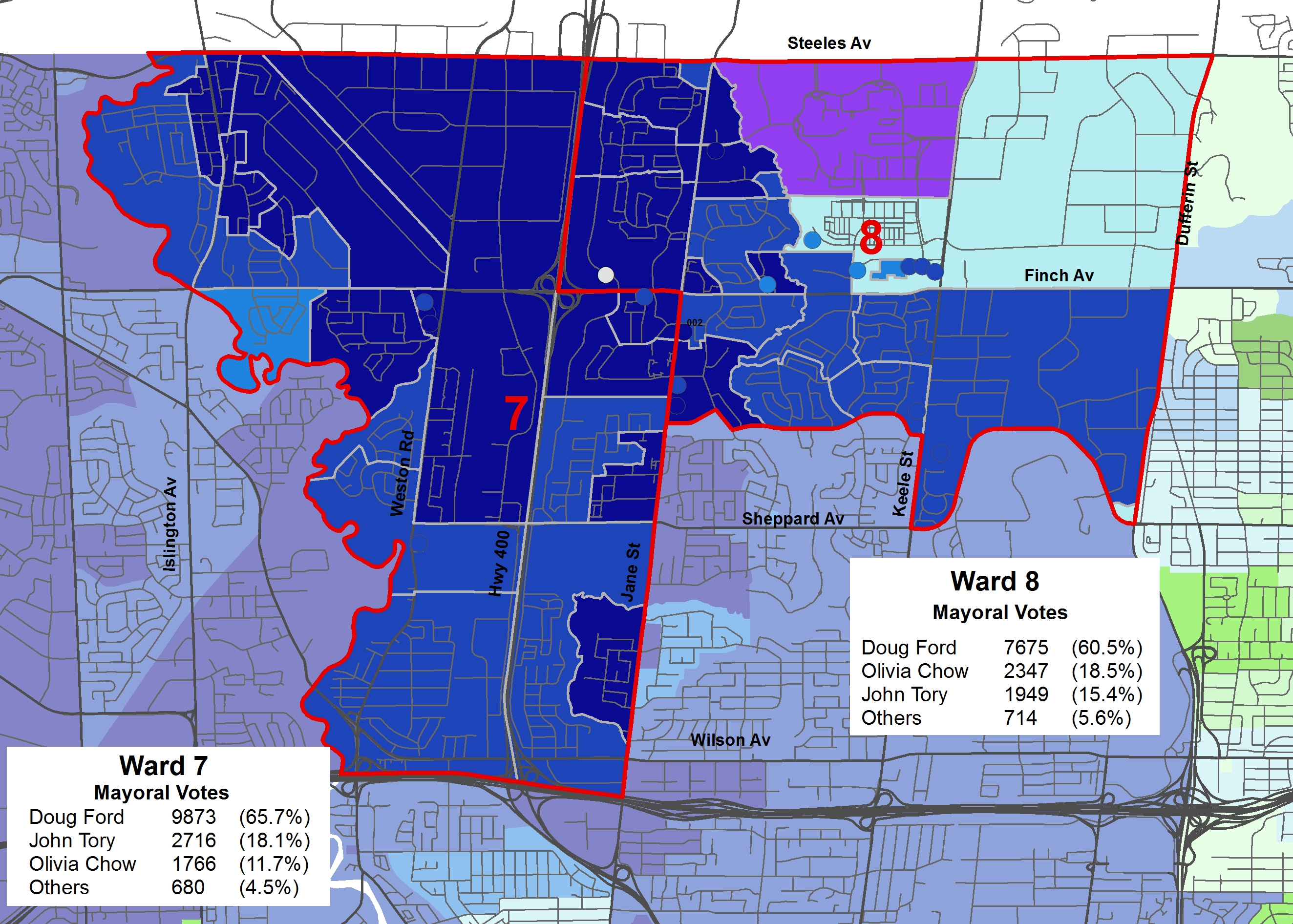
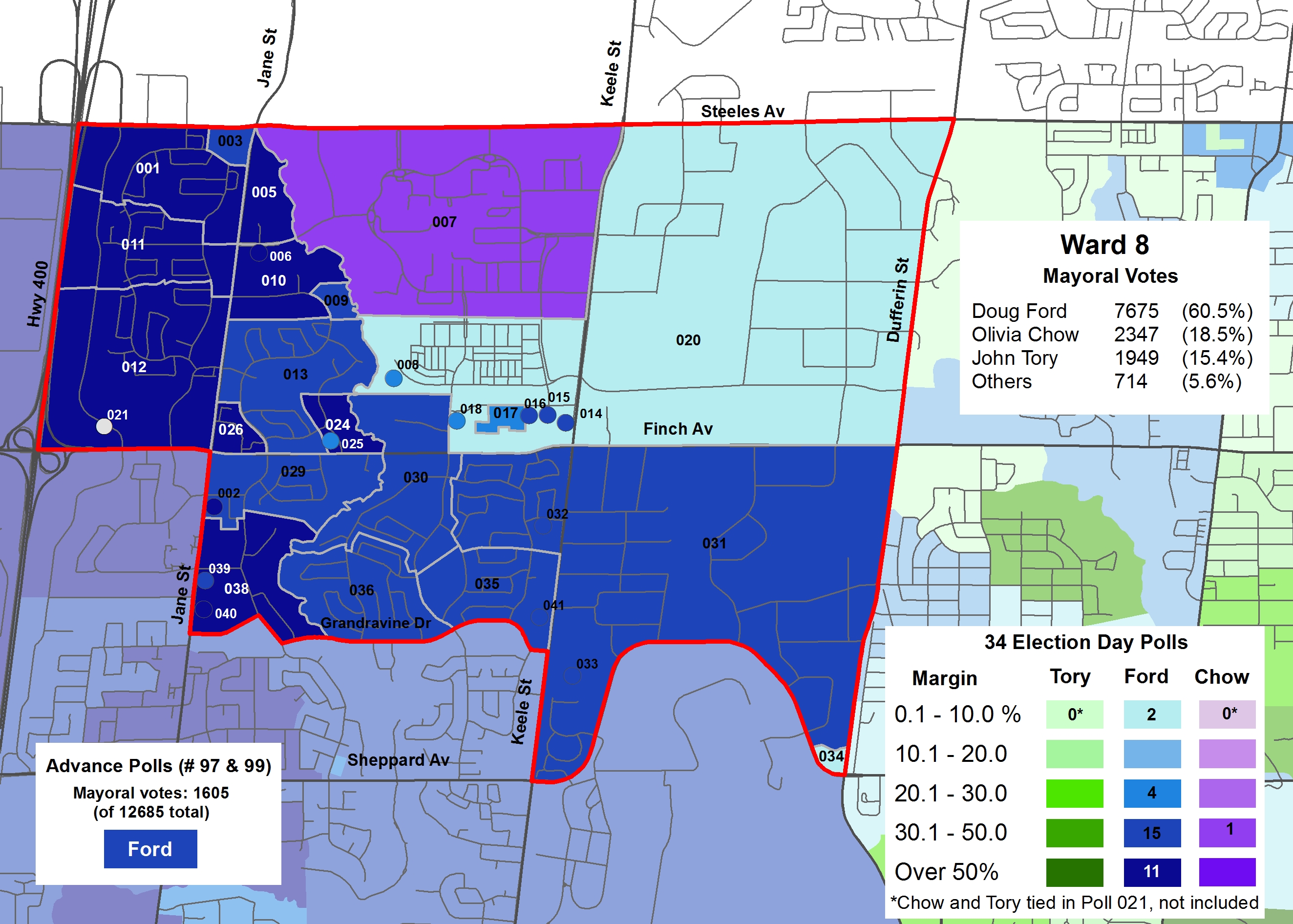
    Wards 7 and 8In this post, I take a look at how the good people of Wards 7 and 8 voted in the 2014 Toronto municipal election. Wards 7 and 8, located in North York, straddle the Jane-Finch neighbourhood. Ward 8 extends east to Dufferin Street and includes York University, while Ward 7 extends west to the Humber River.

    To say that I am disappointed by these election results, particularly in Ward 7, would be an understatement. Both wards voted overwhelmingly for Doug Ford for mayor. Ward 7 returned Giorgio Mammoliti to office.

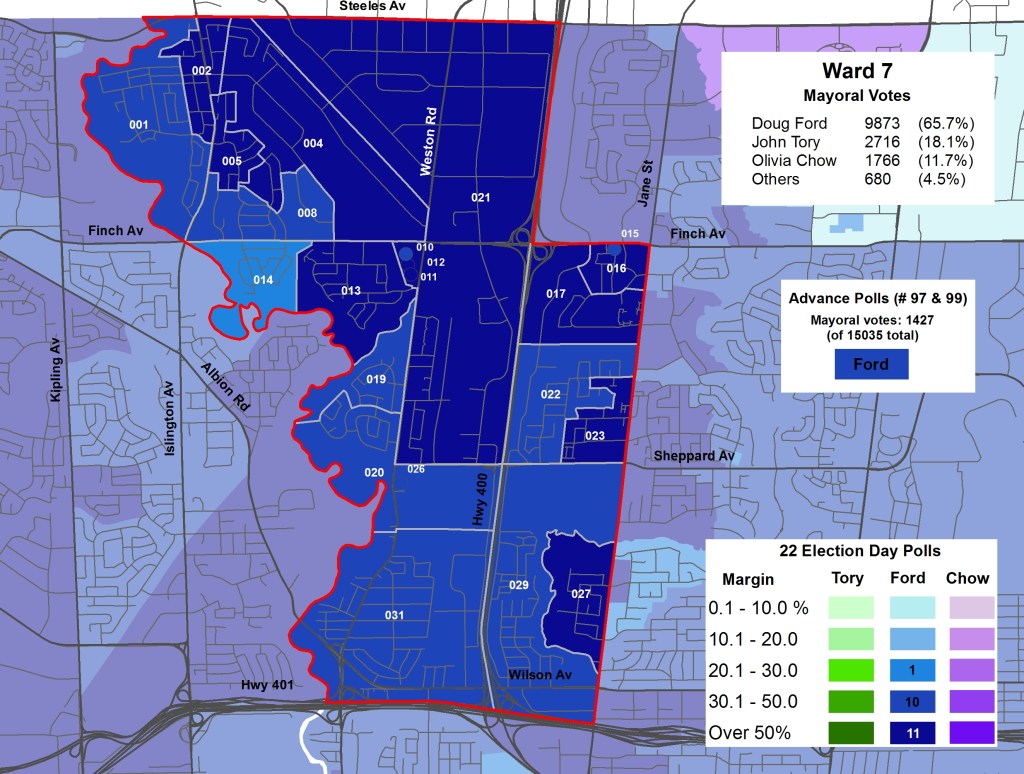
    2014 Election - WARD 7 MayorPoll results of the mayoral race in Ward 7
    In Ward 7, every poll voted for Doug Ford by at least a 20% margin. Ford won 65.7% of all votes cast for mayor, one of his best ward-level results.

    At least the results in Ward 8 were a bit more interesting. Along with Ward 17, it was one of only two where the winner, John Tory, came in third place. While over 60% of electors in Ward 8 voted for Doug Ford, two polls thought differently. Poll 007, York University, voted for Olivia Chow; Ford came in third place there. In Poll 021, a small poll located in a senior’s home, Chow and John Tory tied for first. In two more polls, Ford won by narrow margins; Poll 020, the townhouses adjacent to York University (Chow came in second), and Poll 034, new condos built near Downsview Station (where Tory came a close second).

    2014 Election - WARD 8 MayorPoll results of the mayoral race in Ward 8

    (more…)

  • Mapping the results of the 2014 election: Wards 15 and 16

    Wards 15 and 16 - mayoral raceMap of the mayoral race in Wards 15 and 16, Eglinton-Lawrence

    The second set of maps I posted on Twitter was the results for Ward 16, which had an interesting council race. In this post, I present poll results maps for both Wards 15 and 16;  the two wards named. Eglinton-Lawrence. The name Eglinton-Lawrence comes from the federal/provincial riding that was split into two civic wards at Bathurst Street. This post covers both wards.

    Bathurst Street represents an important east-west divide on the electoral map. It separates several affluent North Toronto neighbourhoods to the east (such as Lawrence Park) and relatively lower-income neighbourhoods to the west. In 2010, the average household income in Ward 15 was $71,529, slightly below the city’s average; in Ward 16, it was $175,528, the second highest in the city. Ward 15 contains the large Lawrence Heights TCHC housing development and has a larger proportion of immigrants than its eastern, wealthier, neighbour.

    Tory won an astounding 74.8% of all votes cast in Ward 16. This was the highest ward-level result for Tory in the last election and the largest winning margin of any mayoral candidate. Olivia Chow came in a very distant second place with 13.0% of the vote, and Doug Ford placed third, taking only 10.6% of all votes cast. Only one poll, Poll 033, located in a TCHC building, thought differently and voted for Ford. On the other side of Bathurst, in Ward 15, Ford won a plurality of votes cast  – 43.1% of the vote – and won 29 polls. Tory won mostly in polls on the eastern edge of the ward, closest to Bathurst Street, Ford won Lawrence Heights and every poll west of Dufferin Street.

    Ward 16 mayoral results
    2014 mayoral race results in Ward 16

    Ward 15 mayoral results
    2014 mayoral race results in Ward 15

    (more…)

  • Mapping the results of the 2014 election: Ward 17

    2014 Election - WARD 17 mayorPoll results of the mayoral race in Ward 17

    Ward 17 Davenport was the first set of ward-level election results maps I posted to Twitter. With a resurrected rivalry between a right-leaning incumbent and a left-leaning challenger, Ward 17 was one of the closest council races in 2014; indeed, it was one that several news outlets declared ‘one to watch’ (even if most political observers were focused on the mayoral race). Unfortunately, change did not come to this part of Toronto. (As it turns out, only one incumbent councillor seeking re-election, John Parker in Ward 26, lost his seat.)

    Ward 17 is relatively compact as far as Toronto’s wards go. It is bounded by the Canadian Pacific Railway to the south and Eglinton Avenue to the north, it extends east to Oakwood and St. Clair, and bounded by more railways to the west. It where the old City of Toronto meets the former City of York; it’s a transitional area where the pre-war inner city meets the inner-ring suburbs. Ward 17 has been represented by right-leaning councillor Cesar Palacio since 2000, though it has been contested by candidates in every election since.

    I’ll start off by admitting my personal bias. While the maps that I produce are completely objective (they only show which candidate placed first in each poll and by what margin), I am not afraid to acknowledge my left-leaning political views. I found myself disappointed by how Ward 17 voted. The incumbent, Cesar Palacio, was one of Mayor Rob Ford’s most loyal councillors. He voted with the mayor over 70 percent of the time in 2011, 2012, and 2013 and failed to make much of an impression over his fourteen years in office. On the other hand, hard-working Alejandra Bravo promised to be a more responsive representative for the community; she’s in tune with local issues such as transit, local infrastructure, and high unemployment. Torontoist’s endorsement of Bravo published on October 16 expresses these thoughts much more eloquently than I can.

    Interestingly, Ward 17 is one of only two polls in which the newly elected mayor, John Tory, came in third place (the other was Ward 8, which I will discuss later). Doug Ford came in first place, with 40.6% of all votes cast for mayor, while Olivia Chow came in second with 31.6%. John Tory came in third, at 24.6%. Chow and Tory were able to place first in several polls south of St. Clair Avenue and east of Dufferin Street, but polls in the northwest quadrant of the ward came out (relatively strongly) in favour of Doug Ford.

    2014 Election - WARD 17 cllrPoll results of the councillor race in Ward 17

    (more…)

  • Mapping the results of the 2014 Toronto municipal election: Part I

    2014 Election - Mayor Votes by Ward Solid Colours
    Immediately after John Tory was elected as the 65th mayor of Toronto*, maps were produced in the media, similar to the one above, that advanced a narrative of a divided city. A city divided between the downtown and suburbs, divided by class and income, and by political leanings. The wisdom was that Ford Nation retreated to the northeast and northwest corners of the city, but remains still a potent political force. But mapping which mayoral candidate (John Tory, Doug Ford, or Olivia Chow) ‘won’ which ward completely misses the bigger picture.

    I started this website after I began producing maps of the local council races and ward-level results of the 2014 municipal election and sharing them on Twitter. This was something that I was doing entirely for my own interest, but was related to work I have done with Ryerson Professor Myer Siematycki for the Maytree Foundation studying voter turnouts in the last three municipal elections.

    Once the full official results were released by the City of Toronto, along with geographic files of poll locations and boundaries (as part of the city’s wonderful Open Data Initiative), it became possible to dig deeper than just looking at ward-level maps. I was pleased — and a bit surprised — by how popular my maps were.

    (more…)