Category: Maps

  • Exploring the downtown federal election races: Part II

    Back in April 2015, I looked at the impact of changes to the new federal electoral districts in three key downtown races: Toronto Centre, University-Rosedale, and Spadina-Fort York. The three downtown ridings were created by splitting two larger electoral districts, Trinity-Spadina and a larger Toronto Centre.

    As a downtown resident and political junkie, I was very interested in how previous election results would look with the new electoral districts. Could Toronto Centre, long held by the Liberals, go orange with Rosedale and Yorkville lopped off? Would University-Rosedale and Spadina-Fort York become Liberal bastions with the new boundaries?

    When I wrote the original post, the Liberal Party had nominated candidates in all three ridings — Chrystia Freeland in University-Rosedale, Adam Vaughan in Spadina-Fort York, and first-time candidate Bill Morneau in Toronto Centre. I wrote more about all six candidates (and some of my personal opinions) in the original post.

    Back in April, the New Democrats nominated Jennifer Hollett in University-Rosedale and Linda McQuaig in Toronto Centre, but had yet to choose a candidate in Spadina-Fort York to run against Adam Vaughan. Vaughan, who took Trinity-Spadina in a 2014 by-election, was a popular Toronto city councillor. There were rumours that prominent criminal defense James Lockyer and former MP and mayoral candidate Olivia Chow were both considering running, but in late July, Chow formally sought, and won, the nomination.

    After the 2014 municipal election, in which Chow came in third place in the race for mayor, she accepted a position at Ryerson University. I expected that she was going to sit this election out, but I was proven wrong.

    All three ridings are proving to be interesting races. The Conservative Party of Canada (CPC) and Green Party have also nominated candidates in all three electoral districts, but only the Liberals and NDP are competitive.

    In this post, I added results and maps from the 2008 election, when the Harper Conservatives won a minority government, the Liberals were led by Stéphane Dion and the New Democratic Party, led by Jack Layton, came in fourth place in the seat count (after the Bloc Québécois) with 30 seats. Perhaps the 2011 election, in which the Bloc was nearly eliminated, the NDP became the Official Opposition and the Liberals relegated to third place, was an anomaly.

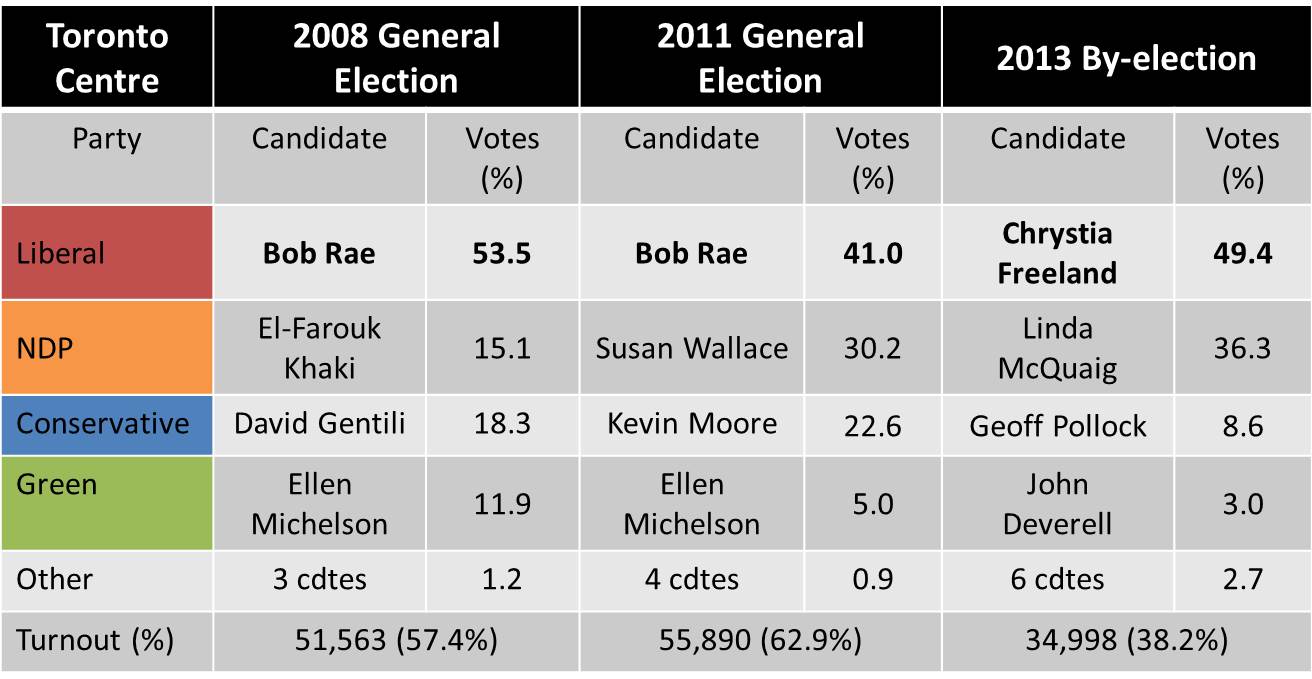
    Toronto Centre 2008-2013 Toronto Centre election results, 2008-2013

    In Toronto Centre, the NDP kept gaining support since the 2008 election, yet the Liberals held on with comfortable margins in 2011 and 2013. In the 2013 by-election, triggered by Bob Rae’s retirement from electoral politics, the CPC vote share collapsed (as did voter turnout), and Linda McQuaig, the new NDP standard-bearer, more than tripled the NDP’s share of the vote in 2008.

    Trinity-Spadina 2008-2014Trinity-Spadina election results, 2008-2014

    The NDP’s Olivia Chow, elected MP in 2006, was re-elected in 2008 and 2011. But her resignation in 2014 to run for Mayor of Toronto triggered a by-election in which Toronto city councillor Adam Vaughan took the riding for the Liberals in a by-election held on June 30, in the middle of the Canada Day long weekend. Voter turnout was a miserable 31.9%.  (more…)

  • Mapping Toronto’s Legal Rooming Houses

    unnamed

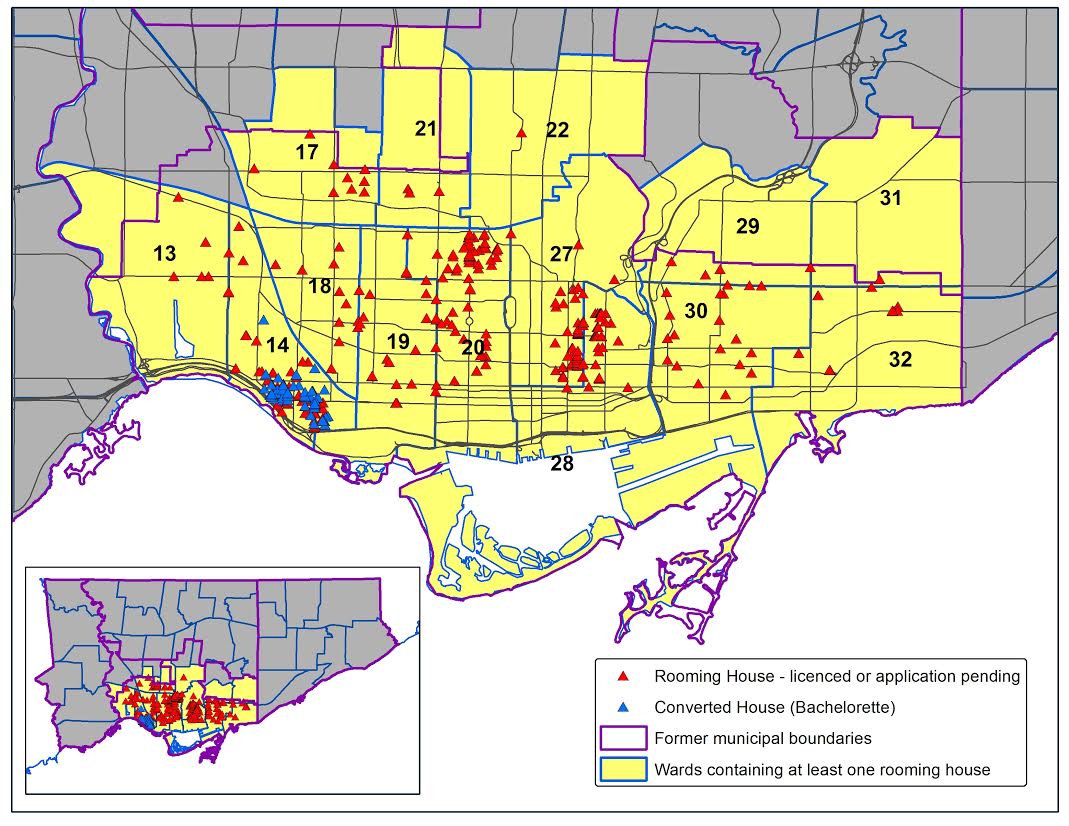
    Rooming houses are often-overlooked in Toronto, but they provide an essential form of affordable housing in a city that struggles with the issue. In Torontoist, I looked a little more closely at this issue and created a map of all licensed rooming houses located in the City of Toronto. (The list from which the map was created can be found here.)

    There are many, many more illegal rooming houses across Toronto that I didn’t map; currently they only legal in certain parts of the city  – the old City of Toronto and parts of the old cities of York and Etobicoke. These outdated laws predate amalgamation, and ignore the need for this form of affordable housing, as well as the variety of rooming arrangements. Illegal, undocumented rooming houses have the potential to be firetraps, licencing and inspections protect tenants from unsafe and unhealthy living conditions.

    It’s time for updated regulations that cover all of Toronto; landlords should be able to rent out rooms right across the city. Happily, the city is conducting a city-wide review of rooming houses; one of the goals is to modernize the city’s by-laws; another is to improve the conditions in existing rooming houses.

  • Mapping “Team Tory”

    Back in September 2014, I created a series of maps for Matt Elliott, journalist at Metro, blogger, city council observer, and all-round great guy. Elliott’s City Council Scorecard tracked how each councillor voted on major decisions at city hall, along with a “Ford Nation” score that measured how closely each councillor voted with the mayor. Matt’s Council Scorecard was one of several inspirations for the work that I undertook so far on this blog, especially mapping the results of the 2014 municipal election.

    On April 24, Elliott published a new edition of his excellent scorecard, a check-up on how Tory has been handling council so far. I wanted to map the new scorecard and compare it to Ford’s performance. You can read more about Elliott’s methodology here.

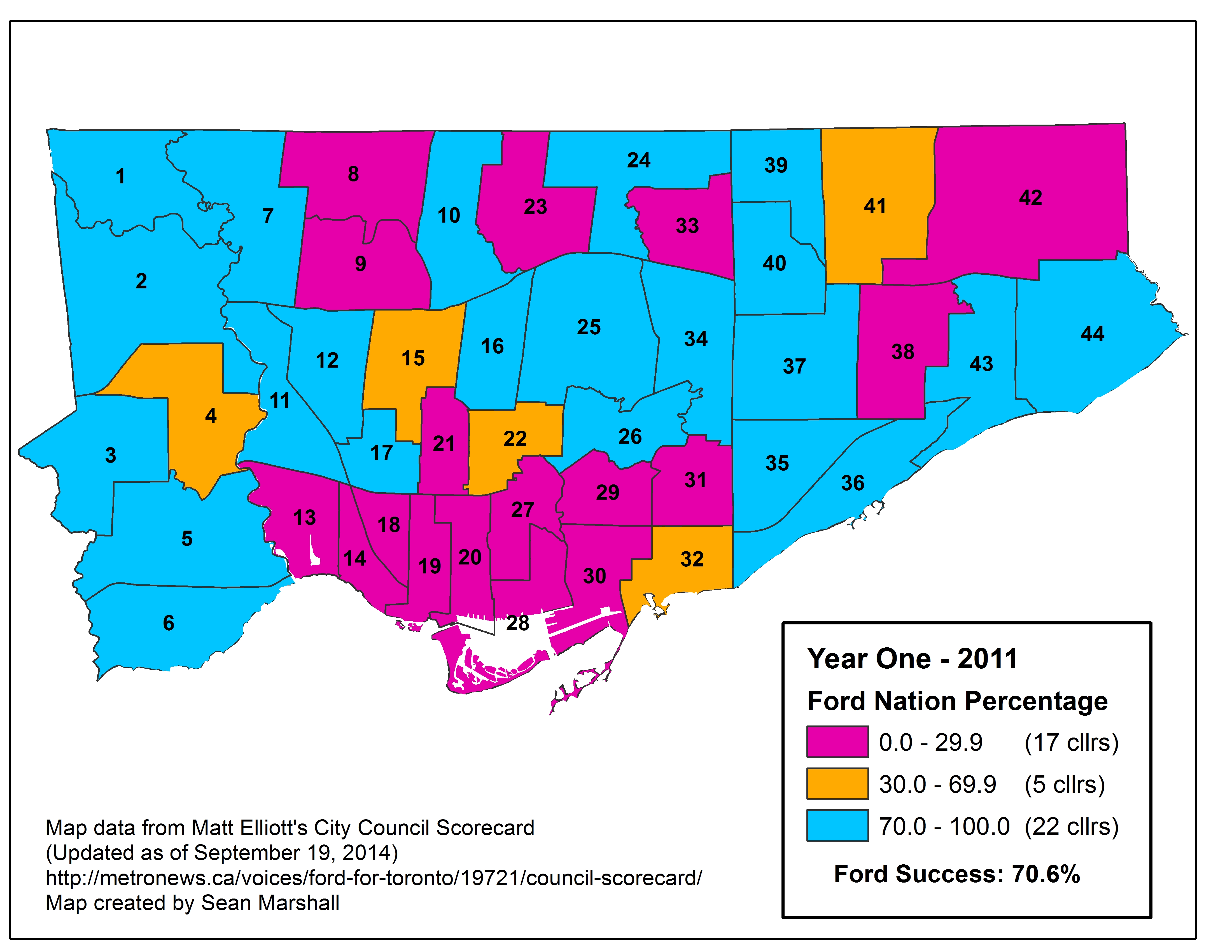
    In 2011, newly elected Mayor Rob Ford was able to count on the support of 22 councillors — a slim majority on the 45-member council when the mayor’s vote is added. From that bloc, Ford was able to pick his executive committee, who helped push forward his agenda of cost-cutting and mucking up Toronto’s transit plans. That year, council voted with Ford over 70 percent of the time. But by December, Ford’s control was already slipping; several potential proposed service cuts were rejected, as well as Doug Ford’s ridiculous plans to take control of the Waterfront development and build a Ferris wheel and mega-mall in Toronto’s Portlands.

    Many of the city councillors opposed to Ford’s agenda  — but not all — were elected in wards representing the Old City of Toronto and East York. But six suburban councillors  — Maria Augimeri, Anthony Perruzza, John Filion, Shelley Carroll, Glenn de Baeremaeker and Raymond Cho  — were all reliable opponents. Except for Cho, who ran for the provincial Progressive Conservatives and lost in the 2014 election, the rest identified with either the Liberals or New Democrats and re-elected in 2010 despite their wards voting overwhelmingly for Rob Ford.
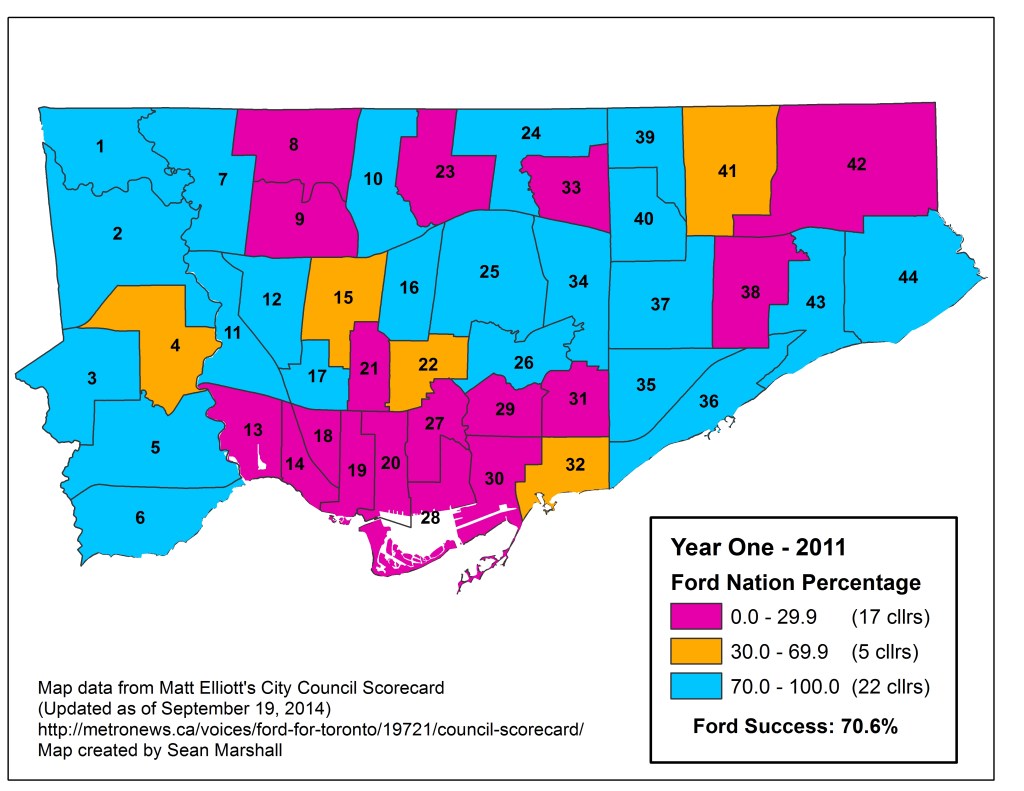
    Ford Nation Percentage 2011 HiRes

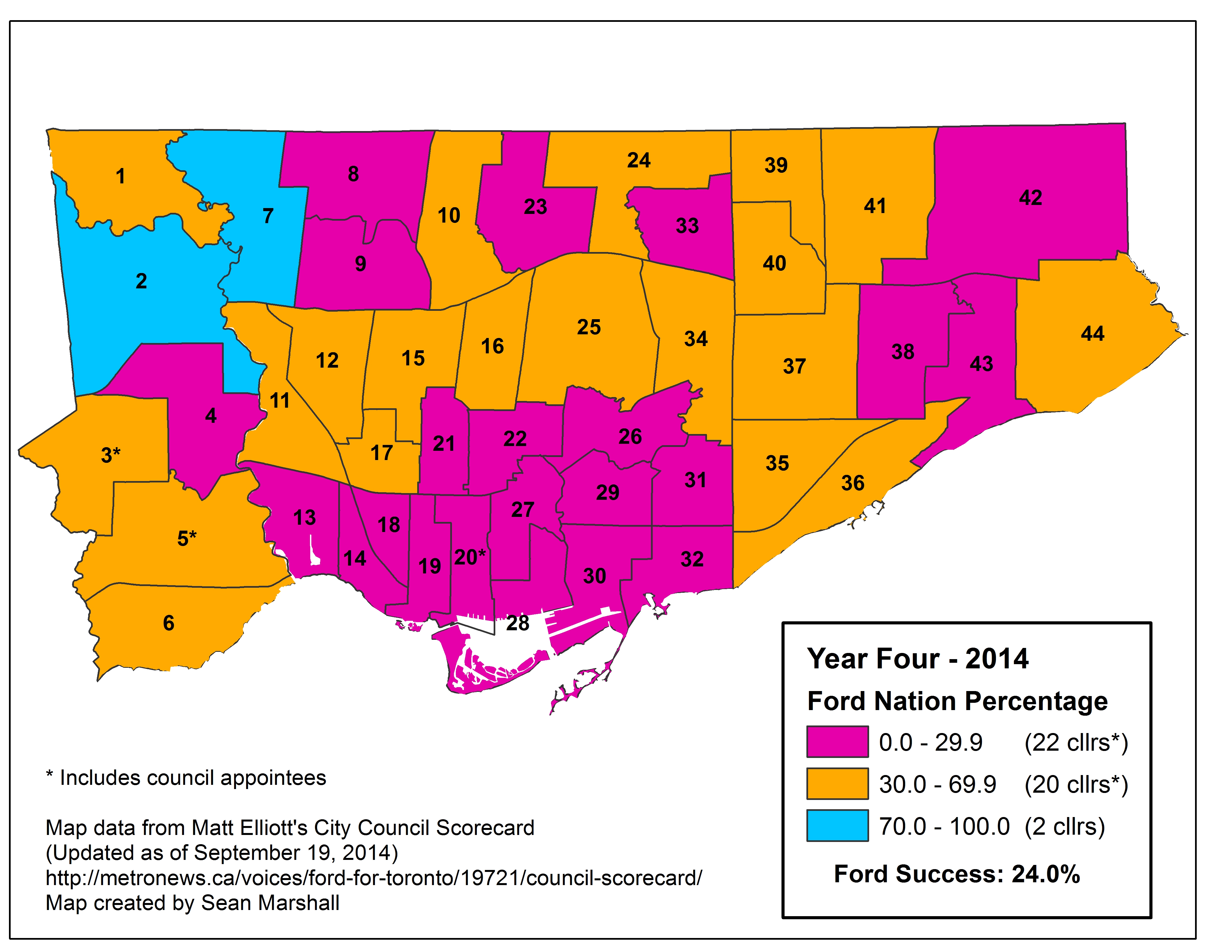
    It’s important to note that the Ford brothers’ agenda and control over council fell apart even before the Garrison Ball debacle and the crack-smoking allegations and council meltdown of 2013. In 2012, Rob Ford was only able to count on the loyal support of 17 councillors; he only had a 32 percent success rate at council that year. By 2014, Mayor Ford could only count on two reliable allies — his brother Doug, and Ward 7’s Giorgio Mammoliti; council only voted with the mayor 24 percent of the time.
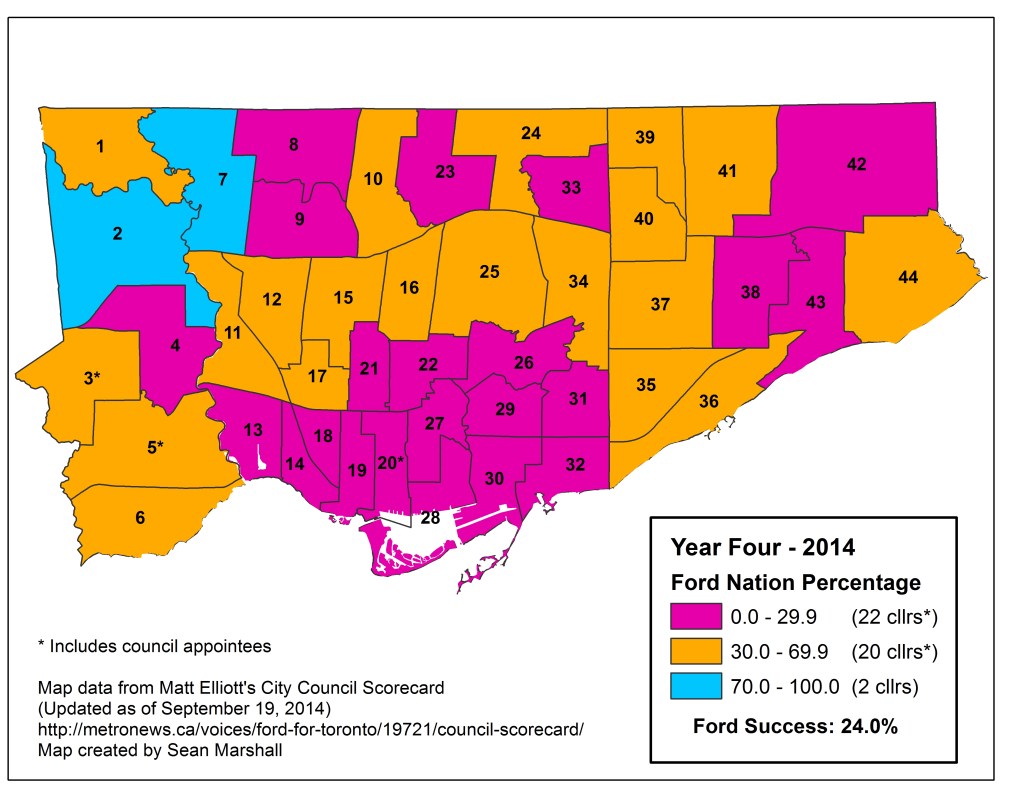
    Ford Nation Percentage 2014 HiRes

    John Tory was elected in 2014 on an uninspiring, yet effective centre-right campaign, promising better governance, limited tax increases, and his own problematic transit plan. But after four years of Rob and Doug Ford, voters were looking for change. Sadly, candidates running on more substantive/progressive platforms, such as early front runner Olivia Chow and former councillor David Soknacki, either dropped out of the race or came far behind second-place Doug Ford, Rob’s obnoxious and bigoted enabler.

    Those looking for a brave new era at City Hall were disappointed by the incoming mayor’s picks for committee chairs/executive committee, speaker and TTC Chair, all plum posts that help steer the mayor’s agenda. Denzil Minnan-Wong (Ward 34), one of council’s most conservative and divisive members was named Deputy Mayor, while Rob Ford’s enabler on the council floor, Frances Nunziata (Ward 12), was re-appointed Speaker. All but two of Tory’s executive committee members were reliable Ford allies in 2011, seven of whom were on Ford’s original executive committee. (It should be said that some of those councillors, notably Paul Ainslie (Ward 43) and Jaye Robinson (Ward 25), later quit or were kicked off the Executive Committee.)
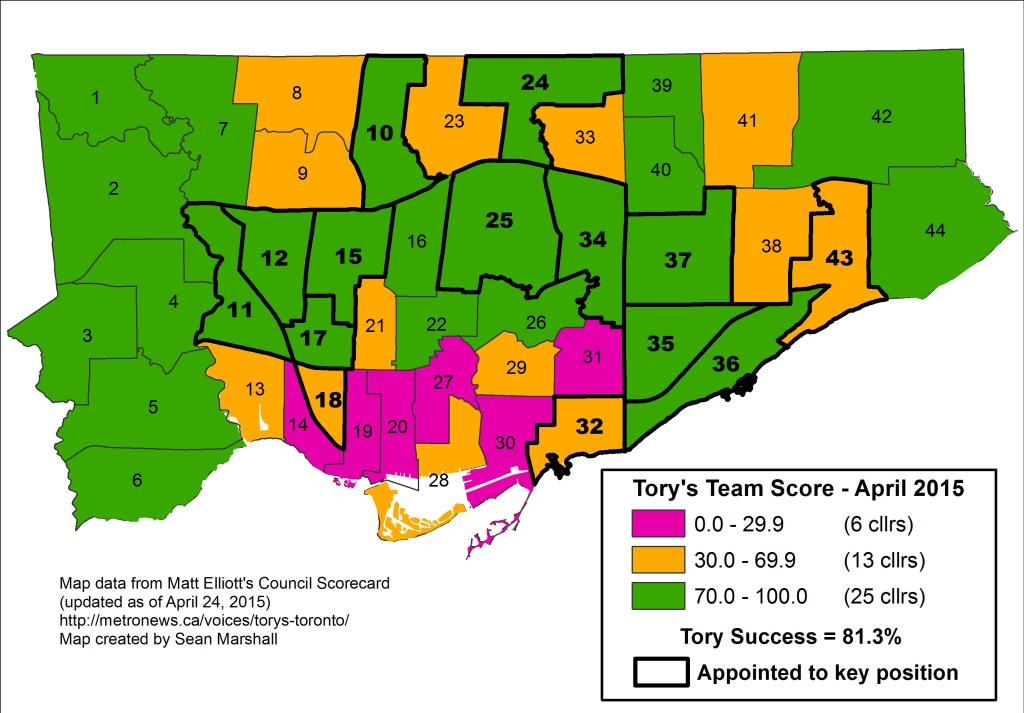
    Tory Team - April 24 2015

    Tory’s Team Score 

    Only five months into his term, John Tory had a good, but not stellar, record of getting his agenda through council. Matt Elliott found that 25 councillors have been reliable allies of Tory; voting with the mayor at least 70 percent of the time, including 5 of the 6 new councillors elected. Only six councillors — Gord Perks, Mike Layton, Joe Cressy, Kristyn Wong-Tam, Paula Fletcher, and Janet Davis, all representing “downtown” wards  — have voted with the mayor less than 30 percent on all important votes. Other anti-Ford councillors, so far, find themselves part of the “mushy middle” or “mighty middle,” though they are at this point a minority of 13. Interestingly, Councillors Rob Ford and Giorgio Mammoliti are voting with Ford most of the time so far. So much for Ford leading an “official opposition” against Tory.

    As expected, councillors that John Tory endorsed and supported in the last election  — Christin Carmichael Greb in Ward 16, Jon Burnside in Ward 26, and Mark Grimes in Ward 6 — were among Tory’s most loyal votes on council, even though none got a plum appointment (Carmichael Greb and Burnside are rookies, Grimes a three-term councillor). All three faced challenges from qualified, less conservative opponents.

    John Tory’s budget and early agenda has been less confrontational and ideological as what Ford pushed in 2011; this could be helping his score. Left-leaning councillors like Joe Mihevc (Ward 21) and Pam McConnell (Ward 28) are, for now, voting 35 percent with the mayor. The budget approved by council keeps tax increases low (I’d argue unsustainably low), but TTC cuts implemented by Rob Ford are being reversed; no services are being slashed. It’s true that council not doing enough on policing issues (especially carding/racial profiling; Tory doesn’t seem to have any interest here), nor is there enough action on the TCHC’s capital repair backlog, but so far, there haven’t been many divisive votes.

    John Tory’s budget and early agenda has been less confrontational and ideological as what Ford pushed in 2011; this could be helping his score. Left-leaning councillors like Joe Mihevc (Ward 21) and Pam McConnell (Ward 28) are, for now, voting 35 percent with the mayor. The budget approved by council keeps tax increases low (I’d argue unsustainably low), but TTC cuts implemented by Rob Ford are being reversed; few services are being slashed. It’s true that council is not doing enough on policing issues (especially carding/racial profiling; Tory doesn’t seem to have any interest in this important matter), nor is there enough action on the TCHC’s capital repair backlog. But so far, there haven’t been many divisive votes. With upcoming labour negotiations and more big-ticket budget items (the decision on what to do about the crumbling and under-capacity east Gardiner Expressway, for example), this will change.

    At times, Tory has seen to be either ignorant or dismissive of how City Council works; had he known better, there would be someone else in the Speaker’s chair, a less polarizing deputy mayor, and a few more centrist or left-leaning councillors in key positions to unite council. Mid-term, in early 2016, there’s an opportunity for Tory to revisit his committee appointments if necessary.

    It’s very possible that Tory will lose political capital as the term goes on, though it is nearly impossible to imagine him losing control of the agenda so dramatically as Ford did. In any case, it will be interesting to see if Tory learns on the job and continues to have the confidence of council, or if he starts to lose his grip as most mayors experienced later in their terms.
  • Exploring the downtown federal election races: New ridings, new candidates

    Note: On October 2, I wrote a follow-up to this post, including a few new maps, some additional insights. All three races  — Toronto Centre, University-Rosedale, and Spadina-Fort York, remain interesting and close Liberal-NDP battles. 

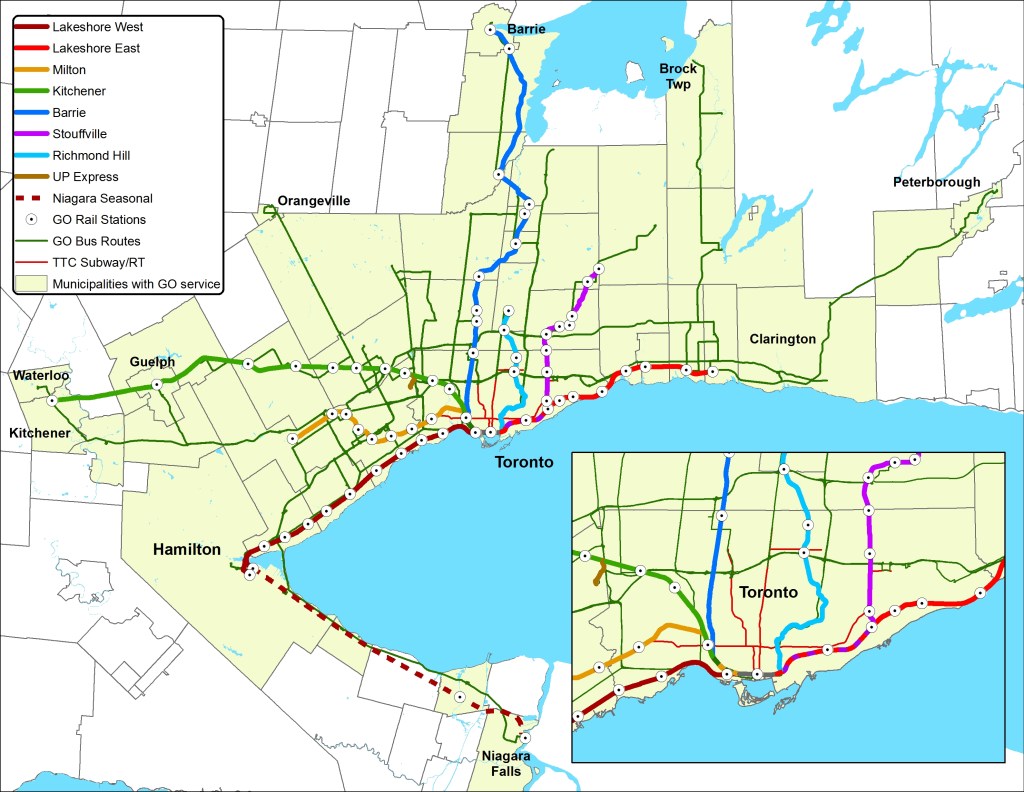
    As I mentioned on this blog previously, describing the “Drawing the Lines” ward boundary review now underway, there are new federal electoral district boundaries for the upcoming Fall 2015 election. Toronto will have 25 Members of Parliament (MPs) after the next election; Downtown Toronto and North York both get an additional seat and Scarborough gets half a seat (it currently shares a electoral district with Pickering).

    As a downtown resident, I wanted to explore how the new electoral map might look like in the next election, and see whether the New Democratic Party (NDP) would have a chance at picking up one of those three downtown seats, as both Toronto Centre and Trinity-Spadina are currently represented by high-profile Liberals.

    (An aside: my politics have long leaned left and towards the New Democrats; though I am not my any means a strict or loyal partisan. I have friends who are loyal Liberals,  New Democrats, and Greens; my own voting decision depends on the race – in the 2011 general election, I voted Liberal, as I lived in York Centre, a riding held by NHL Hall of Famer, lawyer and great Liberal Ken Dryden, who sadly lost to Conservative Mark Adler. I soon moved to Davenport, joking that I had traded Dryden for [newly elected NDP MP Andrew] Cash. Brampton West Liberal MP Colleen Beaumier earned my very first vote when I was 18 years old, but I have since voted NDP provincially and federally in most other elections.)

    2011 General Election

    In the 2011 general election, in which Stephen Harper’s Conservatives won a majority government (and Jack Layton led the NDP to its greatest federal victory, winning 103 seats and official opposition status), both Toronto Centre and Trinity-Spadina re-elected their popular incumbents – Olivia Chow in Toronto Centre, former Toronto city councillor and Layton’s spouse, and Bob Rae, former New Democrat and Premier of Ontario, later a Liberal MP and leadership candidate. Chow won with 54.5% of the vote in Trinity-Spadina; Rae won with 41.0% of the vote in Toronto Centre.

    As you can see in the map below, Chow placed first to most polls in in Toronto Centre, except for a few polls near the Waterfront (the Conservatives came in first in the Harbour Square condo complex), in the east Annex closest to Yorkville and a few condominium and seniors’ residences buildings elsewhere. Christine Innes, running for the Liberals, came in a distant second with 23.4% of the vote.

    In Toronto Centre, Liberal Bob Rae won with 41.0% of the vote; the NDP’s Susan Wallace took a respectable 30.2%, while Conservative Kevin Moore took 22.6% of the vote. In Toronto Centre, the Conservatives took several polls in the wealthiest parts of the riding; the “old money” Rosedale neighbourhood and several polls in Bloor-Yorkville, home of many of the most expensive condominium high-rises in Canada. The Liberals did well in polls throughout the riding (in Rosedale, Yorkville, Cabbagetown and St. Lawrence), while the NDP came in first most polls in Church-Wellesley, St. Jamestown, Moss Park, and Regent Park.

    2011 Fed Election - Downtown (1)Results by poll in the 2011 federal election in Trinty-Spadina and Toronto Centre
    (more…)

  • Mapping Toronto’s Rental Complaints

    MLS - Draft 2

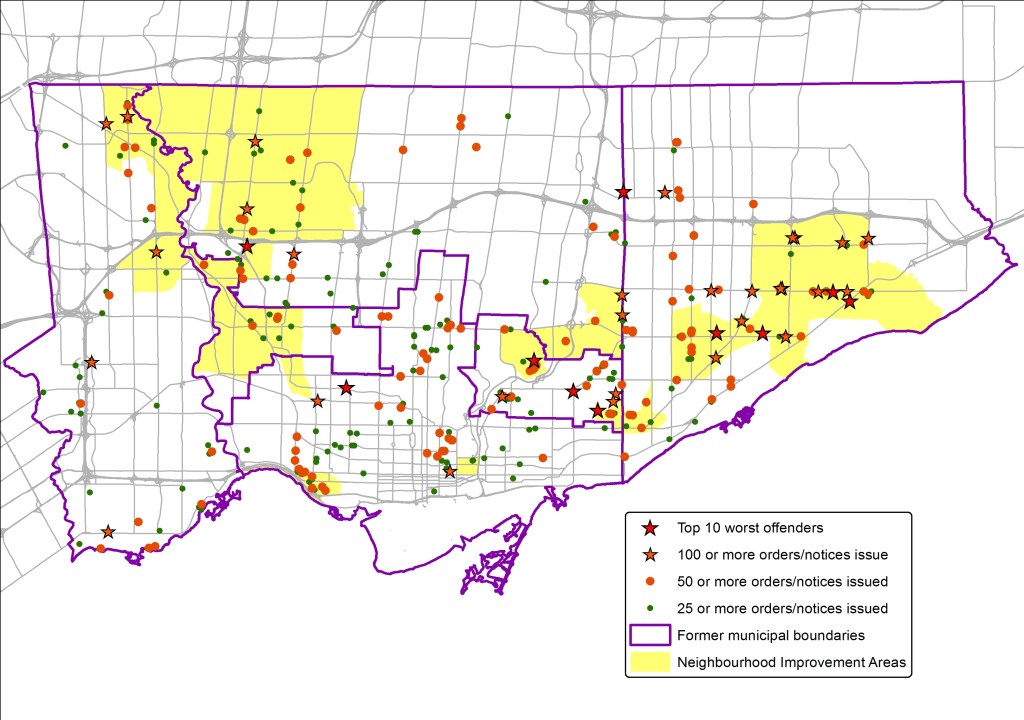
    Over at Torontoist, I took a look the City of Toronto’s data on complaints made to Municipal Licensing and Standards (ML&S) on multi-residential apartment buildings. All properties with at least 25 notices or orders that are either open, or issued and closed within the last two years are mapped; the ten properties with the highest number of offenses are highlighted and listed.

    Many ML&S investigations are the results of neighbours’ complaints of improper waste disposal, graffiti, long grass, unkempt grounds, or fence disputes; these complaints are distributed all over the city. These are usually quickly solved, resulting in only one or a handful of orders issued. However, troubled buildings might have dozens, even hundreds of violations, ranging from poor groundskeeping, to poor interior lighting, to more cringe-worthy deficiencies such as failures to guard against pest infestations, leaking pipes, damaged and stained ceilings and walls, and unsanitary waste collection and storage. Failure to comply with enforcement officers’ orders can result in prosecution.

    Most of the properties that I mapped are found in the inner suburbs, or in the Church-Wellesley, St. Jamestown, Midtown and Parkdale neighbourhoods of the old City of Toronto, where many older rental towers are located. A disproportionate number of problematic residential properties can be found in Neighbourhood Improvement Areas (previously known as priority neighbourhoods) —25 of the 40 properties with at least 100 ML&S notices or orders are in NIAs. Of the 10 worst buildings, five are large, private rental buildings, the other five are owned by the Toronto Community Housing Corporation.

    You can search the ML&S database by address for yourself here. It’s not a bad resource if you’re in the rental market and looking at perspective apartments.

  • Why Toronto needs new ward boundaries

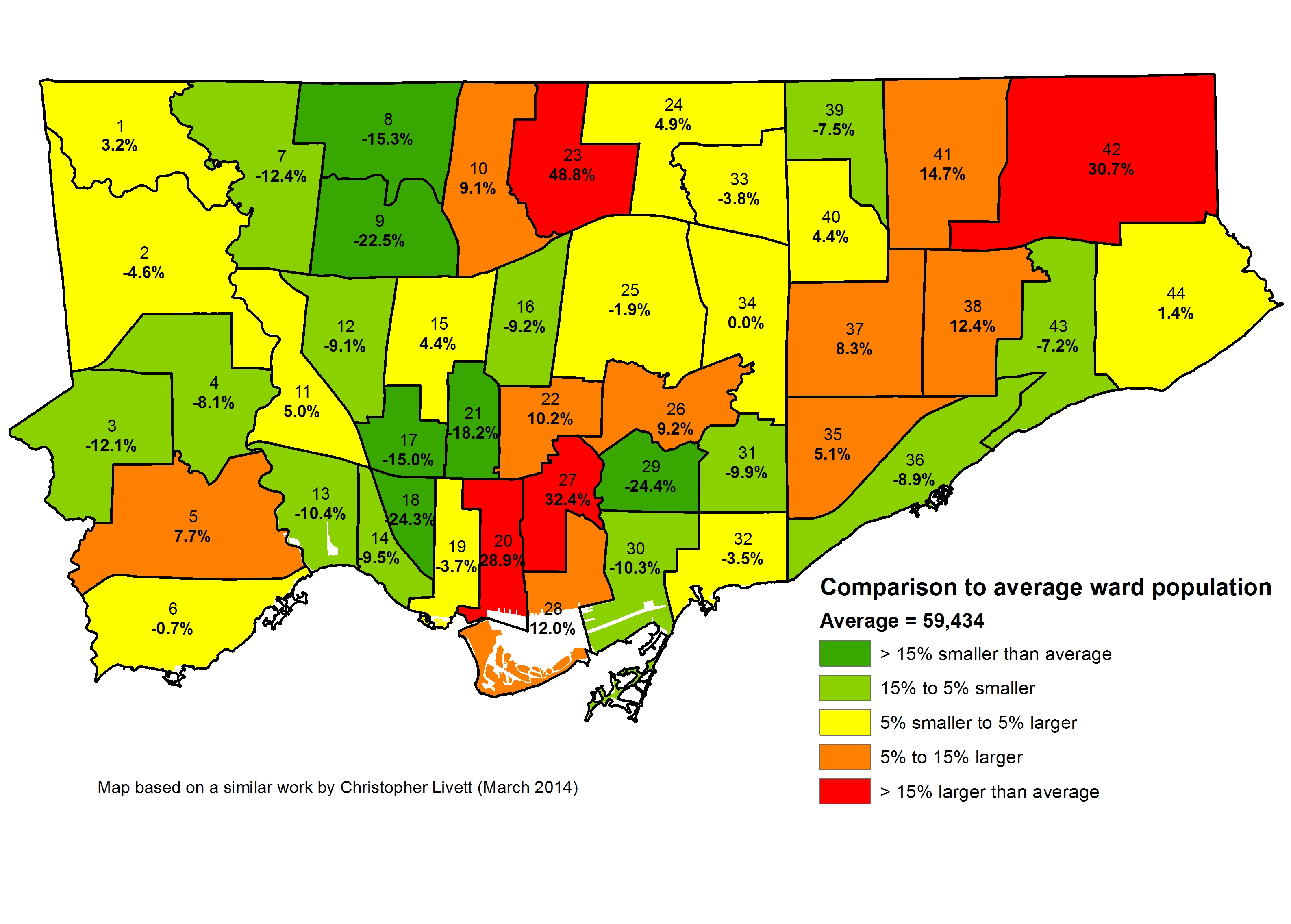
    The City of Toronto is in the process of reviewing the ward boundaries. This is an overlooked and much needed initiative. Due to population increases in central Toronto, North York and in Scarborough, parts of the city are unrepresented at City Hall. Some councillors are overworked with development proposals in their wards, while other parts of the city are relatively quiet.

    While some will argue for fewer politicians (the idea has a populist appeal), I would like to see more city councillors, elected by ranked ballot (which Mayor John Tory supports), to best serve the needs of our diverse and dynamic city. Based upon the population from 2011 census, Wards 20, 23, 27, and 42 are the most underrepresented at City Hall; Ward 42 includes the new Morningside Heights neightbourhood, while condominium construction have swollen the number of residents in Wards 20, 23 and 27. Simply put, the boundaries have to be changed to provide more equal representation. Ward representation 2011 census Map of how each ward is under-represented or over-represented in Toronto, map based on one previously created by Christopher Livett

    The city’s review process, which you can find more about here, is being conducted by independent consultants, so far free of political influence. Though the first round of public consultations have already occurred, there will be further opportunity to participate in the development of ward boundary options. There has yet to be a decision as to how many councillors Toronto should have going forward, or what the boundaries will look like. The committee will report to city council in early-mid 2016 with their recommendations, giving plenty of time before the next election, which will be held in October, 2018.

    (more…)

  • Mapping an accessible TTC

    IMG_3898

    Last week in Torontoist
    , I wrote about the challenges of getting around on the TTC for passengers who rely on mobility devices, such as wheelchairs. Most of us never think about this problem unless we’re directly affected by the consequences of an inadequate system, as I was after a cycling injury in 2012.

    But for TTC users with mobility disabilities (or even passengers with strollers, wheeled carts, or luggage), it’s an issue. While the bus system is (mostly) fully-accessible, the backlog in the delivery of new streetcars and the installation of elevators in subway stations leaves the system failing many of its riders. The alternative, Wheel-Trans, is also underfunded, inconvenient and useless for last-minute travel plans.

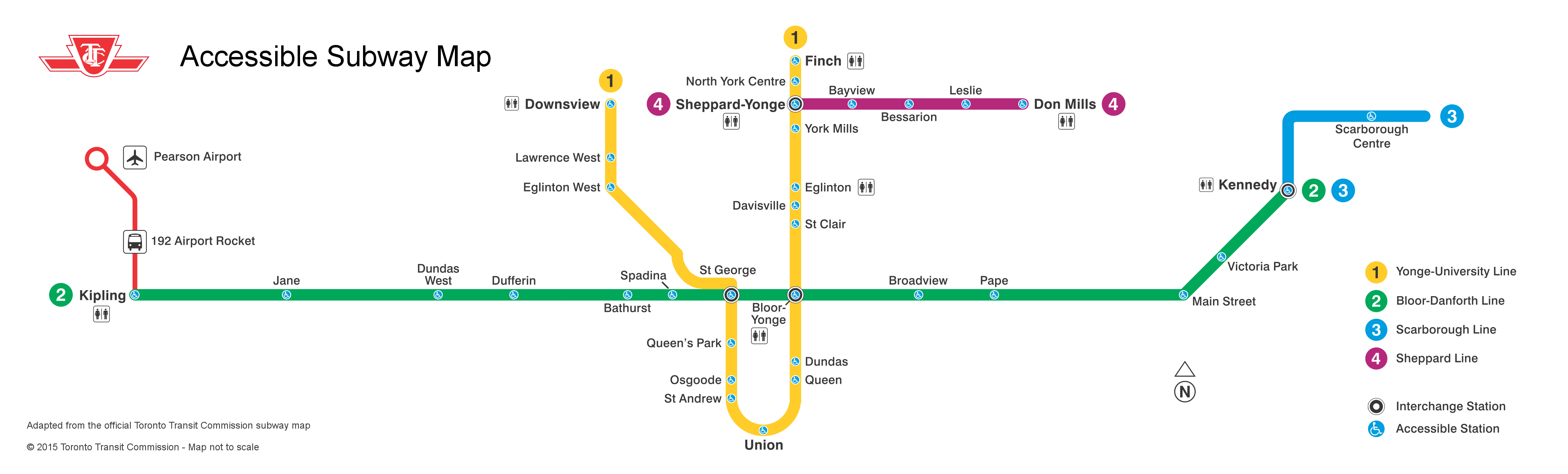
    Here’s what the subway system looks like if you require the use of elevators to navigate the system:

    accessible map - now 2015

    By 2016, only one more station  — St. Clair West  — will be equipped, by 2017, Wilson, Ossington, Coxwell, and Woodbine (and hopefully the Spadina Subway Extension to Vaughan Centre, with its six new fully-accessible stations, will open by then) will follow. But there’s not enough funding to make the entire system accessible by 2025, the deadline set by the Accessibility for Ontarians with Disabilities Act (AODA). Seventeen stations, including Islington and Warden, remain unfunded.

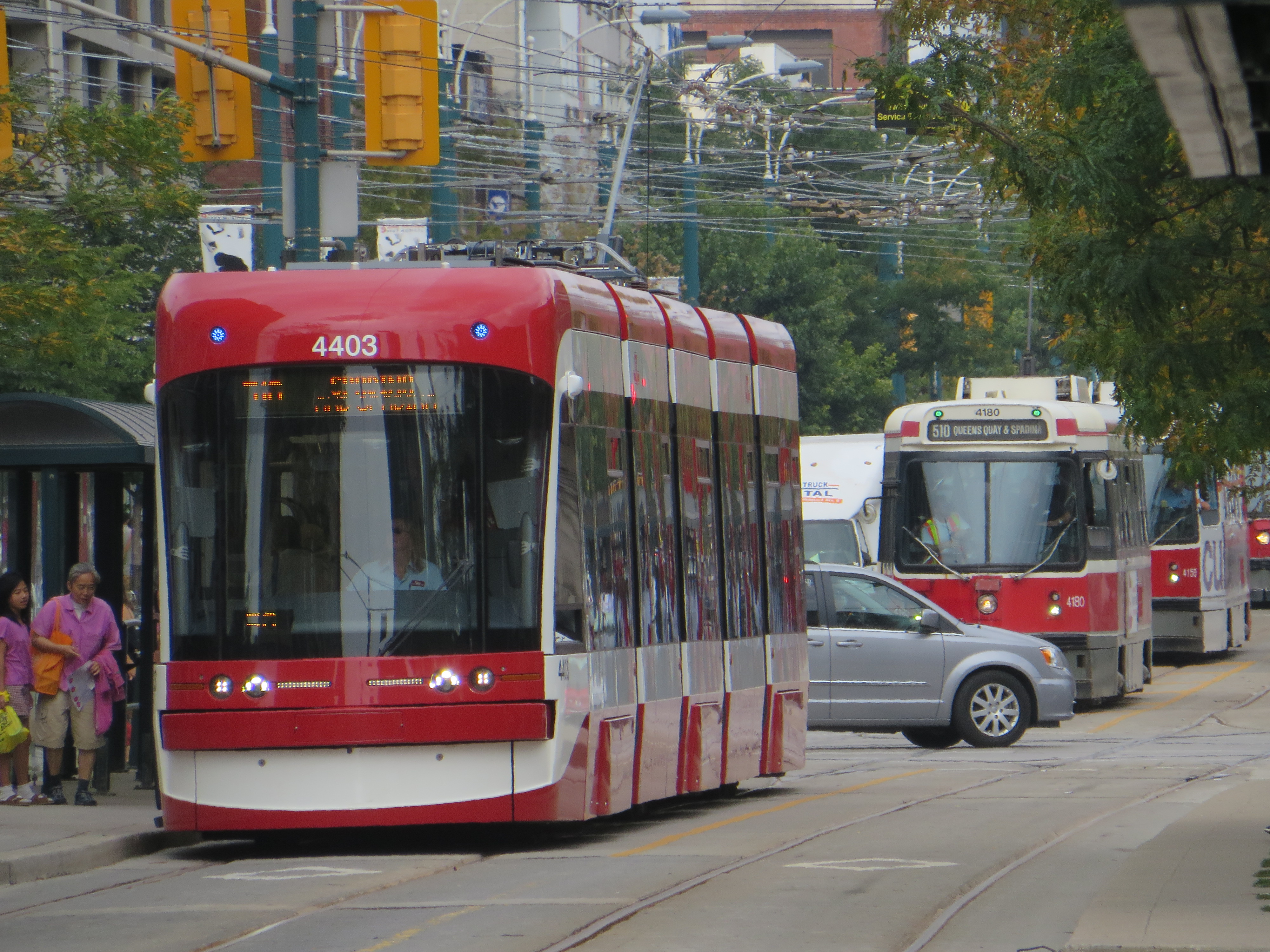
    The entire bus fleet is accessible, though not all bus stops are (the TTC requires a solid, concrete or asphalt place to deploy the ramp or lift, and room for the passenger to board; some suburban stops without a bus pad, or narrow urban sidewalks make loading a passenger in a wheelchair difficult). The first four low-floor streetcars are operating on Spadina Avenue, 200 more are still to be delivered. By now, the Spadina, Bathurst and Harbourfront cars were to have been fully-equipped with the new trams.

    In the meantime, the few bus routes that operate in the central core don’t have many accessible connections; east-west travel is particularly difficult. For example, the 47 Lansdowne bus is inaccessible from either subway station it services (Lansdowne and Yorkdale), and offers no barrier-free transfers south of Dupont Street. The map below shows this problem:

    TTC - Downtown v3 Crop

    Elevators at Ossington would connect the subway with three accessible bus routes, including the 94 Wellesley, a useful east-west alternative. (The 94 serves four subway stations and enters three of them, not one is equipped with elevators.) Meanwhile, both Toronto Western and St. Joseph’s Hospitals are isolated from the accessible transit network.

  • Mapping the 2014 Toronto Election: Wards 43 and 44

    Last, but not least, in my series of posts examining the results of the  Toronto municipal election of October 2014, are Wards 43 and 44, Scarborough East.

    I started these series of maps of the 2014 Toronto election as a few tweets. To me, it was a simple, interesting exercise. At first, I only sought to map the most interesting wards, where there were competitive races for city council – wards where the incumbent wasn’t running again, or where great candidates like Alejandra Bravo, Russ Ford, Lekan Olawoye, Dan Fox, and Andray Domise, were taking on established councillors and offering a better alternative to local voters. After requests to have a place to have these maps available somewhere, I resolved to set up a blog and to map every poll. It has taken me a bit longer than I expected, but I hope that these maps become useful between now and the 2018 election.

    While my politics certainly lean left, and my commentary on my blog at times pointed, all the maps I created are available to everyone. Despite my cynicism, I genuinely believe most people run for public office for the right reasons. Putting your name on the ballot takes courage; making a serious run for any elected office, even school trustee, is a long, difficult, exhausting, and expensive undertaking. I respect nearly every candidate who make that effort, regardless of their political leanings.

    And now, with the ward maps done, I’ve thought of more ideas to pursue in the near future. I’m interested in voter turnout; with esteemed Ryerson Professor Myer Siemiatycki, I co-wrote a study commissioned by the Maytree Foundation studying voter turnout in previous municipal elections. With poll-level data, it would be most interesting to look at voter turnout by housing type (such as TCHC vs. private rentals vs. condominium residences, for example) and other local determinants.


    Ward 43

    Ward 43 is represented by Paul Ainslie, a centre-right leaning councillor who I’ve come to respect. Ainslie was picked Chair of the Government Management Committee (and a member of Mayor Rob Ford’s executive committee) after the 2010 election.

    But unlike most Scarborough politicians, Ainslie parted with Ford on many issues. In 2011, Ainslie voted 97% of the time with Ford; but by 2013, he only voted 40.5% of the time with Ford. In 2014, Ainslie’s “Ford Nation” score (as developed by Metro columnist Matt Elliot) was only 20%, a difference of 77%. This was the greatest drop in Elliot’s “Ford Nation Percentage”score. In a CBC article dated October 15, 2013, Ainslie started to “butt heads” with Ford early that year “over budget issues.”

    That October, after the first Ford crack scandal hit but before Rob Ford’s November meltdown that ended up seeing Norm Kelly assume most of Ford’s responsibilities, Ainslie resigned from Ford’s executive. Ainslie supported the Scarborough LRT replacement project (which would include an extension to Progress Road and Sheppard Avenue) instead of the Bloor-Danforth Subway extension. For his actions, Rob Ford then recorded a “robocall” message to Ward 43 residents that read:

    “It was extremely, extremely unfortunate that your councillor, Paul Ainslie, was the only Scarborough councillor who did not listen to his constituents, and voted against the Scarborough subway. In fact, he led the charge against building subways in Scarborough; unfortunately it has led to his resignation from my executive committee. We are moving forward with a team who support the mandate Toronto taxpayers gave me…”

    The calls were made from Ford’s own City Hall telephone number. Eventually, Mayor Ford was forced to apologize on the council floor in 2014, in one of many rulings the City’s integrity commissioner made against the mayor. Despite Ford’s outrageous claims, Ainslie regularly engages with his constituents, including discussing the subway/LRT issue.

    Ainslie’s position on the Scarborough Subway/LRT dovetailed with the transit platform of mayoral candidate David Soknacki, who represented Ward 43 before Paul Ainslie was elected in 2006. Ainslie got his start at city hall as Councillor Soknacki’s executive assistant. (In February 2006, Ainslie was appointed to council to represent neighbouring Ward 41, filling in for former councillor Bas Balkisoon, who was elected as a Liberal MPP in a provincial by-election. Ainslie’s run for Ward 43 councillor later that year was controversial, as appointed councillors are typically expected not to run in the next general election.)

    As in neighbouring Scarborough Ward 36, most polls on the Lake Ontario shoreline in Ward 43 voted for John Tory. Conversely, all but one poll north of the GO Lakeshore East Line, a City of Toronto long term care home near Scarborough Centenary Hospital, voted for Doug Ford. Ford came in first place in Ward 43, netting 45.7% of the vote, while Tory came in second place with 35.3%. Olivia Chow only took 15.5% of the vote.

    Paul Ainslie handily won re-election in 2014 (despite Rob Ford’s robocalls) with 74.3% of the vote. Second place candidate Mark Harris had the vote of only 10.5% of the electorate.

    2014 Election - WARD 43 Mayor
    Poll results of the mayoral race in Ward 43

    Ward 44

    2014 Election - WARD 44 Mayor

    Poll results of the mayoral race in Ward 44

    East of Highland Creek, the residential areas between Kingston Road/Highway 401 and the lake mostly voted for Tory, continuing Tory’s pattern of coming in first in middle and upper-income polls in Scarborough that straddle Lake Ontario. West of Highland Creek; Polls 027, 028 and 029, while also bordering Lake Ontario, are for all intents and purposes inland; the GO Lakeshore East line (CN Kingston Subdivision) separates residential areas to the north with the parks, factories and municipal facilities (water treatment plants). These polls, which supported Doug Ford by wide margins, are located in the West Hill Neighbourhood Improvement Area (the new nomenclature for what used to be called “priority neighbourhoods); Poll 027 includes the Danzig Street TCHC community where one of Toronto’s worst mass shootings occurred on Monday, July 16, 2012. Most polls north of Kingston Road also voted for Doug Ford.

    Ford came in first place in Ward 44, taking 44.1% of the vote to Tory’s 38.6%. Chow only got 14.9%. As in Ward 43, Tory won the advance poll by a comfortable margin despite coming in second place in both wards.

    Ward 44 also had one of the closest council races as three viable candidates sought to unseat 71-year old Ron Moeser, who left everyone guessing whether he’d run for council again despite a poor attendance record attributed to health concerns. Moeser has long been a dead weight on council, quite possibly its least active member. Moeser was first elected to Scarborough council in 1988, he has been a city councillor since then, except betweeen 2003 and 2006, when Gay Cowbourne defeated him; she did not run again in 2006 and Moeser took back the seat.

    In the 2010 election, Moeser narrowly won in Ward 44, taking 47.4% of the vote to second-place Diana Hall’s 46.1%, a difference of 284 votes.

    In 2014, the Toronto Star endorsed Hall, Cowbourne’s former executive assistant, describing her as a “thoughtful conservative” while NOW Magazine halfheartedly endorsed Amarjeet Shhabra, explaining that the main reason to vote for her was to defeat Moeser. Shhabra, a union organizer, had the Labour Council’s endorsement.

    It’s too bad the Toronto Star and NOW overlooked Moeser’s strongest challenger.

    Moeser unfortunately won in a crowded field of 15 candidates; several of whom had name recognition and organized campaigns. But Moeser won just 25.7% of the vote in the 2014 election, 3769 fewer votes than in 2010. But was Jennifer McKelvie, an environmental scientist and adjunct professor at Ryerson University, who came closest to defeating Moeser, taking 23.4% of the vote, a difference of 572 votes. Hall came in third with 22.2%, and Chhabra came in fourth, netting 11.4% of the vote. McKelvie came in first in 14 election day polls as well as the advance poll, Moeser won in 16 polls, Hall in 5. Most polls that supported Doug Ford the strongest stuck with Moeser for council, while polls where Tory came in mostly voted for Hall or McKelvie, the remainder might have voted for Moeser, but by very small margins.

    Had there been a less crowded field, I suspect that Moeser would not have won in 2014.

    (Interestingly, the advance polls reflected the election day results, there would be two more women on Toronto City Council; Alejandra Bravo also won the advance poll in Ward 17, but couldn’t dislodge Cesar Palacio.)

    McKelvie, who was running for public office for the first time, has some impressive credentials; had she won, she’d be great fresh voice at City Hall. But in several wards, including 3, 5, and 26, the second-place candidate in the 2010 election went on to prevail in 2014. This should be welcome news for Jennifer McKelvie, who I hope will be interesting in running again.

    2014 Election - WARD 44 Cllr

  • Mapping the 2014 Toronto Election: Wards 41 and 42

    I was hoping to have this series of analyses of the 44 wards complete last week, however many things got in the way. But with my life getting back to normal, and with my eagerness to move on to new projects, I bring you the penultimate post in the series the results of the 2014 municipal election.

    In this post, I look at Wards 41 and 42, Scarborough-Rouge River. Ward 41 is represented by Chin Lee, Ward 42 by Raymond Cho. Despite the Fords’ popularity in northeast Scarborough, neither councillor was much of a support of the Ford agenda in 2011-2014. Raymond Cho, despite his Conservative leanings, voted with Ford less than 20% of the time, while Chin Lee voted with Ford 36% of the time, according to Matt Elliot’s Council Scorecard.

    In Ward 41, which is located north of Highway 401, between the GO Stouffville Line (CN Uxbridge Sub) and McCowan/Markham Roads, Doug Ford came in first place in all but one poll, 014, where Olivia Chow won. Poll 014 represents one of several Yee Hong Centres for Geriatric Care.

    In Ward 42, which covers the Malvern and Morningside Heights neighbourhoods, as well as the Toronto Zoo and much of Rouge Park, Doug Ford came in first place in every single poll, doing best in the Malvern neghbourhood, but with less support in the newer subdivisions of Morningside Heights to the north of Finch Avenue.

    John Tory did not win a single poll in either Scarborough-Rouge River ward.

    2014 Election - WARD 41 MayorPoll results of the mayoral race in Ward 41

    2014 Election - WARD 42 Mayor
    Poll results of the mayoral race in Ward 42

    (more…)

  • Mapping Which Neighbourhoods Could Be Most Affected by TDSB School Closures

    Last week the Toronto District School Board released a much-anticipated list of schools under review for closure as the beleaguered board looks to reduce expenses and raise funds for capital projects.

    Over at Torontoist, I take a look at which neighbourhoods are most affected by this review, and discuss the impacts that school closures might have. Please leave comments in that thread.