Category: Maps

  • Mapping the Ward 2 by-election

    Ward 2 By-election
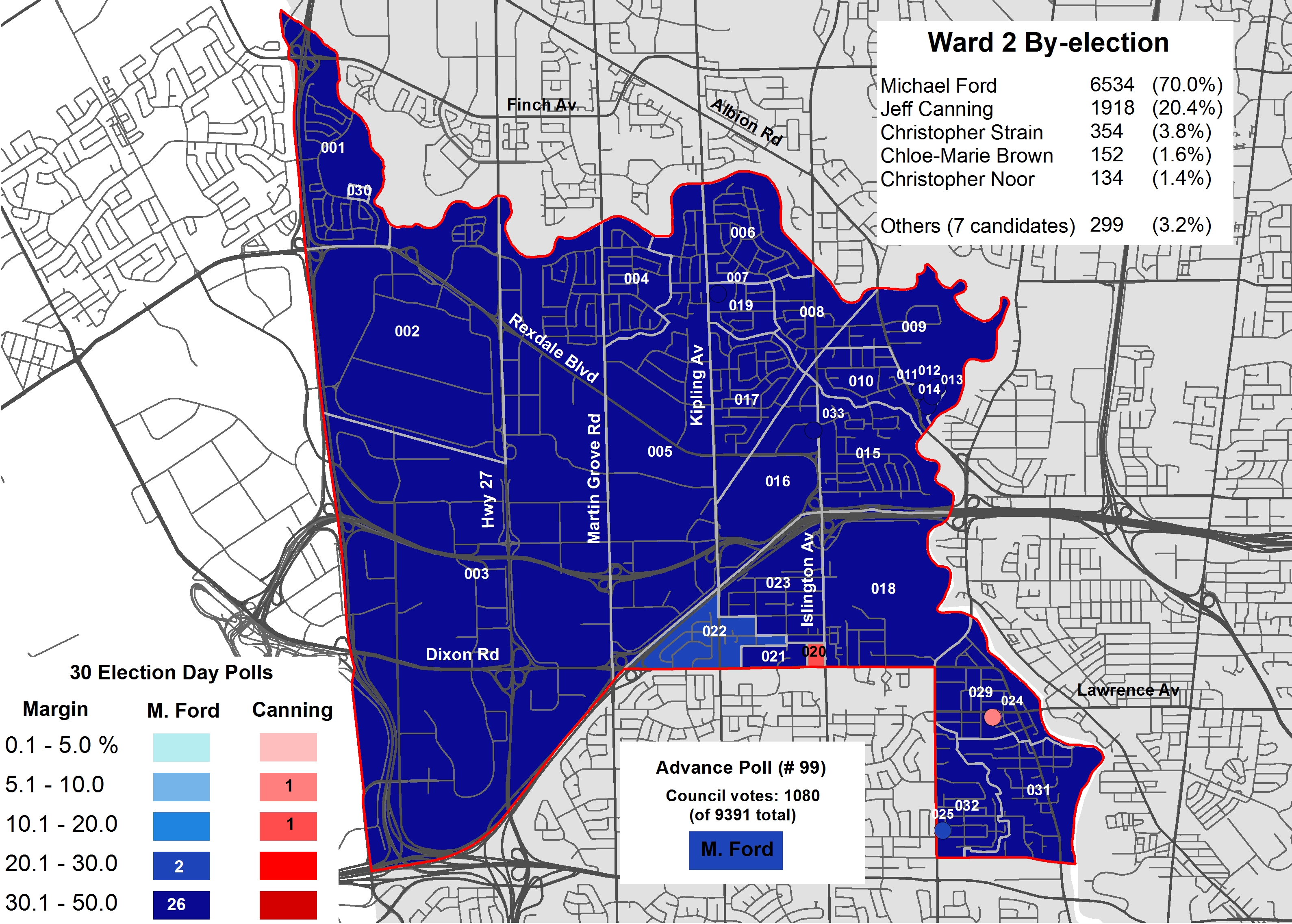
    Poll results of the 2016 council race in Ward 2

    On Monday, July 25, residents of Ward 2 (Etobicoke North) went to the polls to elect a new councillor to replace the late Rob Ford, who was elected as councillor in the 2014 general election after a disastrous four years as mayor.

    After Rob Ford’s death in March 2016, it was widely expected that the Ford family would field a candidate; it would either be former Ward 2 councillor Doug Ford or Rob and Doug’s nephew Michael Ford (née Stirpe).

    Michael Ford, then 20 years old, ran for councillor in the 2014 general election. He withdrew in September 2014 to run for the local Toronto District School Board trustee position, so that Rob Ford could run for councillor instead, abandoning his bid for re-election as Mayor of Toronto due to his poor health. Doug Ford, who originally wasn’t going to run again for municipal office, ran for mayor in Rob’s place, coming in a strong second to John Tory. I mapped those results in a previous post. 

    Right away, Michael Ford was the clear favourite to win the by-election. The Ford name is famous in north Etobicoke; Doug Ford Senior was a Progressive Conservative MPP from 1995 to 1999; Rob Ford represented Ward 2 from 2000 through 2010 before running for mayor, and winning against George Smitherman. But Michael Ford, only 22, claimed to be his own person; his brief tenure on the TDSB board has been without the buffoonery or intolerance that Rob and Doug exhibited; Michael attended the 2016 Pride Parade in 2016, something the other Fords made a point of avoiding. But Michael Ford campaigned on a platform of “customer service” — the same philosophy that made Rob Ford popular in his ward.

    There were eleven candidates running against Michael Ford. They included:

    • Entrepreneur Justin Canning, a right-of-centre candidate who made a point of saying that Michael isn’t like Rob and Doug Ford when quoted in the Toronto Star;
    • Christopher Strain, a New Democrat who managed Russ Ford’s campaign for councillor in Ward 6 in the 2014 election;
    • Chloe-Marie Brown, a volunteer and City Hall intern who sought to represent her community and bring attention to the needs of lower income residents of North Etobicoke.

    Voter turnout was low, as they often are for municipal by-elections. Only 9391 residents voted in 2016, less than half the 19,793 votes for councillor that were cast in 2014. And to no one’s surprise, Michael Ford won, with 70.0%of the vote. Justin Canning came in a very distant second, with 20.4%, Chris Strain had only 3.8% of the vote, Chloe-Marie Brown only got 1.6%.

    Michael Ford came in first place in all by two polls by wide margins, as shown in the map above. Only two polls, 020 and 024, chose Justin Canning. Poll 020 represents two condo towers on Islington Avenue at Dixon Road, while Poll 024 represents a seniors’ residence on Lawrence Avenue. Both polls voted for Rob Ford for council in 2014, but for John Tory for mayor over Doug Ford.

    Even though I am willing to give Michael Ford a chance to prove himself as city councillor (and we will see how different he truly is from his uncles), the low voter turnout and the inevitability of Ford’s win still troubles me. Perhaps the low turnout was partly due to the assumption that Ford would win this by-election; holding it in the middle of summer wouldn’t have helped either. But there was a solid choice of alternative, qualified candidates that deserved voters’ consideration. Ward 2 deserved a real contest, not another coronation.

  • Mapping Toronto’s proposed new ward boundaries

    18506683800_6c96dcc66b_k

    Toronto is way overdue for ward boundary reform. Finally, in time for the 2018 election, Toronto will have reshaped ward boundaries — and probably three new wards. This will give quickly-growing Downtown Toronto and North York Centre more representation at City Council.

    Consultants retained by the City of Toronto have been tasked with reviewing the size and shape of Toronto’s wards, and providing a recommendation for new ward boundaries. Back in August 2015, an options report was released with five distinct options. After further consultation, the final report was released yesterday, May 16.

    The final report’s recommendation is similar to the “Minimal Change” option in last August’s options report, but there have been some minor tweaks to the ward boundaries. If the recommendations are approved by City Council, there will be 47 wards, up from 44. Each new ward will have an average population of 61,000, with a range between 51,800 and 72,000 (+/- 15%). These new wards are designed to last for four election cycles, and will be re-drawn again in time for the 2034 election.

    The report will be considered by the Executive Committee on May 24, 2016, which will vote on a recommendation to take to City Council on June 7, 2016. If there are no further hiccups, this gives just over two years for aspiring council candidates and city staff to prepare for the next election, which will be held on Monday, October 22, 2018.

    The recommendation brought forward is a compromise that improves representation in high-growth areas, while minimizing the loss of council representation elsewhere. It increases the number of councillors, but by a minimal amount. (Had Toronto maintained the practice of having two wards per provincial/federal riding, there would be 50 councillors.) Happily, proposals to cut the number of representatives at City Council were not a very popular idea. In terms of staffing and associated costs, each councillor costs approximately $290,000; it would therefore cost about $870,000 to add three new wards, which in my opinion, is a bargain.

    While Downtown Toronto will gain three new seats, and North York gaining one, one seat is lost in Toronto’s west end, in current wards 14, 17, 18. This probably squeezes out Cesar Palacio, a rather poor city councillor who remains in office despite strong competition in the last few elections. Otherwise, despite ward boundary shifts across most of the city, every incumbent councillor should easily find a home that’s mostly made up of their current turf.

    I created the CartoDB interactive map, linked below, for Torontoist; my full article is available there.

    I mapped the results of the 2014 election for every ward in the city — that was the primary reason why I started this blog in November 2014. That previous work should be helpful for predicting the results of the 2018 election with the new boundaries.

    https://seanmarshall1.cartodb.com/viz/5c5c1540-1b21-11e6-8cfa-0ecd1babdde5/map


  • Mapping Major League Baseball’s stadiums by walkablity, transit access

    22078160783_012aad4fb6_k

    What major league ballpark is the easiest to get to by public transit? Which stadium has the highest walk score? And where does the phrase “take me out to the ball game” absolutely require getting in a car and fighting traffic to do so?

    Over at Torontoist, I explore these questions in more detail. I created a map of all thirty major league stadiums (and the 2017 home of the Atlanta Braves). About half the stadiums are located in downtown areas or urban neighbourhoods, close to transit stations, bars, restaurants, and shopping; the other half are generally surrounded by parking lots.

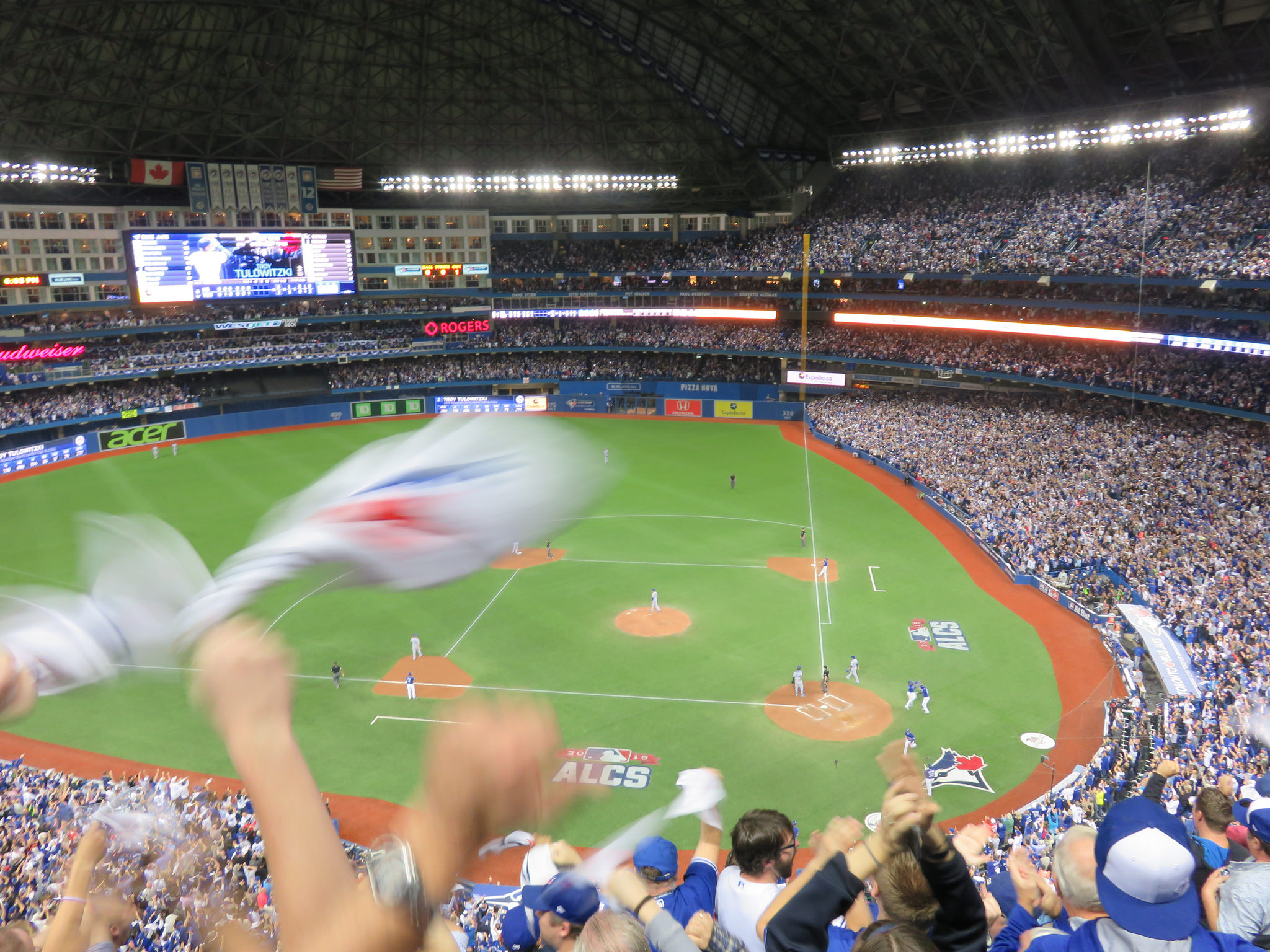
    SkyDome isn’t a great ballpark, especially when the dome is closed, but in these rankings, it does really well.

  • Where the sidewalk ends in Toronto (Updated)


    IMG_3357
    McNicoll Avenue at Boxdene Avenue. There’s no sidewalk on the south side of this busy Scarborough road.

    Update: I posted a revised and updated version of the map and article on Spacing Toronto. There, I mention a new absurdity in the war on sidewalks: on Glen Scarlett Road, near the old Stockyards in Toronto’s Junction neighbourhood, the city is proposing  a new sidewalk for 2016 as part of a road reconstruction project.

    The local councillor, Frances Nunziata, is siding with local industry in opposing a sidewalk. Local industries — including slaughterhouses and warehouses — oppose a sidewalk as it would cross their loading docks; Nunziata’s office claims that since the street “is unsafe for pedestrians to be walking on due to heavy traffic, [the City] should not be encouraging pedestrians to use this road by installing a sidewalk.”

    This logic is completely counter-intuitive. It ignores the needs of workers walking to work, and local residents walking to the streetcar loop at St. Clair Avenue and Gunns Road, or to nearby shopping and residential areas.


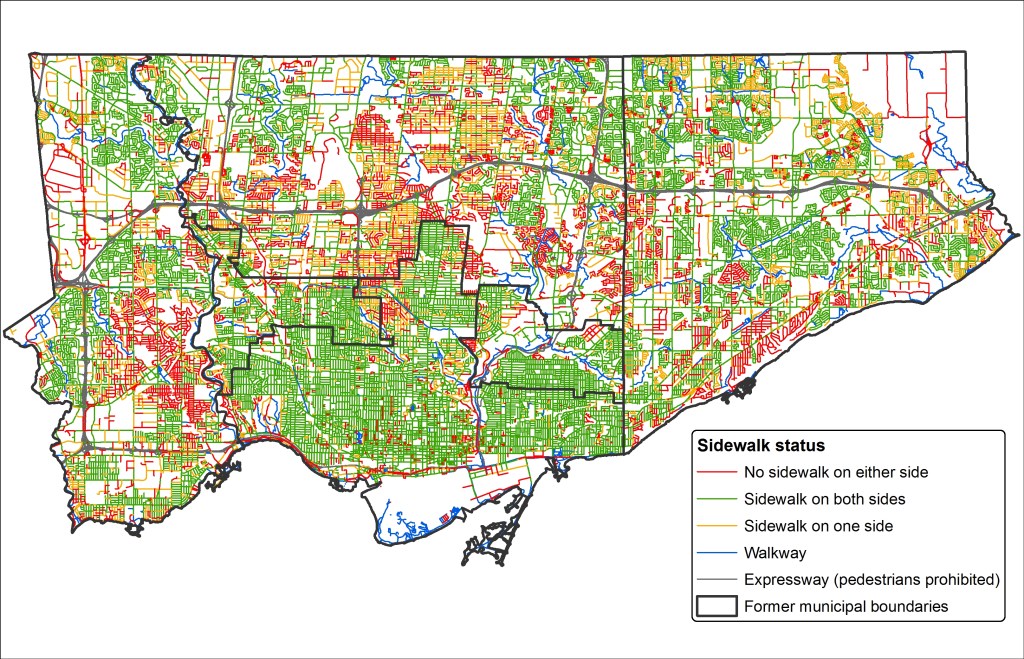
    There was a very interesting interview on CBC Radio’s Metro Morning on Tuesday, February 16). Host Matt Galloway spoke with Fiona Chapman, the City of Toronto’s manager of pedestrian projects, on missing sidewalks. Nearly one-quarter of all local streets in Toronto don’t have a sidewalk; many more only have a sidewalk on one side of the street. Chapman was discussing a presentation to the City’s Disability, Access, Inclusion and Advisory Committee on staff recommendations that would seek to fix this problem.

    CityData - SidewalksStatic map showing the City of Toronto’s sidewalk inventory as of 2011.

    Most local streets that don’t have sidewalks are found outside the old Cities of Toronto, East York and York, particularly in parts of Etobicoke, North York and Scarborough built in the 1950s and 1960s. Some of these residential and industrial streets were built with ditches instead of storm drains; others were laid out without sidewalks in mind. In the master-planned Don Mills development, there are many walkways connecting parks, major roads, and schools; it was likely intended that these would be used for getting around on foot rather than sidewalks. In other post-war subdivisions, particularly affluent areas like those in central Etobicoke, it was probably assumed that everyone would get around by car.

    The City of Toronto is hoping to change this. As roads come up for reconstruction, the new policy, recommended by staff, is to install a sidewalk where there isn’t one already, even despite local opposition. The current policy, in place since 2002, is that a new sidewalk could only be installed on an existing local street after the local councillor completed a consult of the neighbourhood and there was a consensus supporting the installation.

    In Toronto, the installation of new sidewalks has been surprisingly controversial. But the city’s presentation lists some of the reasons why sidewalks are often opposed. Sidewalks have to be cleared by the adjoining landowner. Residents can’t park their cars in the driveway if they block the sidewalk. They might result in the removal of landscaping or trees. And there is a minority who just want to keep outsiders out of their neighbourhoods. You could call this NIMBY-ism, even though sidewalks are technically is in the front yards, not the backyards, of local opponents.

    Sidewalks provide safe, accessible routes for pedestrians, especially important for people using strollers or mobility devices. They promote the city’s initiatives encouraging children to walk to school, for all persons to engage in physical activity, and for seniors to age at home. City policy, including the Toronto Pedestrian Charter, supports sidewalks.

    On Chine Drive, in an affluent part of Scarborough near the Bluffs, local residents opposed the construction of a sidewalk, even though it would provide a safe path to a nearby school. Since 2004, some residents opposed the sidewalk, claiming that they were afraid it would “take away from the rustic look of the neighbourhood.” Supporters, including parents with young children, wanted a safe route to the local school. It took ten years, but in 2014, the sidewalk was installed.

    Last year, on nearby Midland Avenue South, there was a similar fight to keep sidewalks off of that street. This is despite the fact this section of Midland Avenue is designated as a collector road, and is part of the Waterfront Trail’s route in the Scarborough Bluffs area. The city owns the land, known as a boulevard, where the sidewalks would go, but without the consent of local homeowners, the city was left in a bind. This new city policy will hopefully solve this problem.

    Below, I created an interactive map of the City of Toronto’s sidewalk inventory, created with data from the City of Toronto’s Open Data Initiative. It shows each public street in the city of Toronto (excluding private roads and laneways), as of 2011. I made a few edits, such as including the new Chine Drive sidewalk, and correcting a few errors that I was aware of.

    Almost every arterial and collector road in Toronto has a sidewalk on at least one side of the street. Exceptions include Highway 27 and Black Creek Drive, where, like expressways, pedestrians and cyclists are prohibited, the Bayview Drive Extension though the Don Valley, and in the far northeastern part of Scarborough, in Rouge Park. But it’s the local streets, marked in orange and red that are most apparent.

    https://seanmarshall1.cartodb.com/viz/3f206014-d4f2-11e5-b47b-0e787de82d45/public_map


    Providing safe, accessible, and consistent pedestrian infrastructure is simply the right thing to do. The city owns the land on which sidewalks can be put down, if they aren’t already. There are legitimate concerns that need to be taken into account when new sidewalks are proposed — trees and landscaping especially — but at the end of the day, the needs of vulnerable road users need to be addressed first and foremost.

  • A new, improved TTC system map

    Last week, the Toronto Transit Commission quietly introduced a new system map on its website. The map, a 3.8 MB PDF file, can be directly accessed here.

    This new system map, which includes all scheduled routes including the limited-service community buses and the Blue Night network, is very different than previous editions of the TTC’s “Ride Guide,” but I think it is the best edition yet. That said, there are a few tweaks that I would like to see.

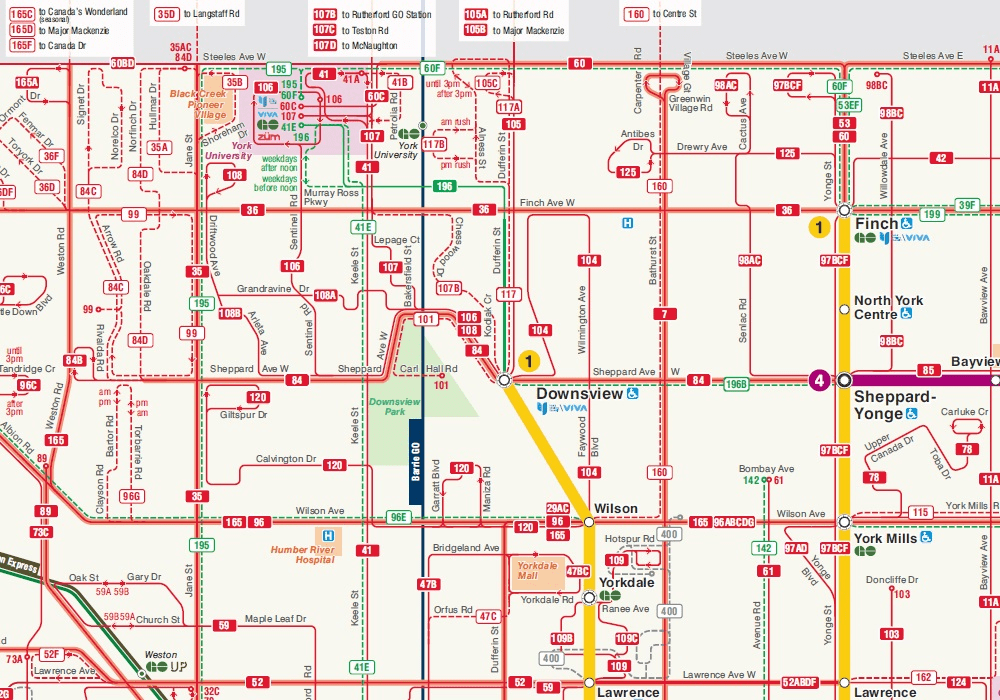
    Below is a screenshot of the new 2016 map, showing York University, Downsview Station, and North York Centre.

    TTCJan2016

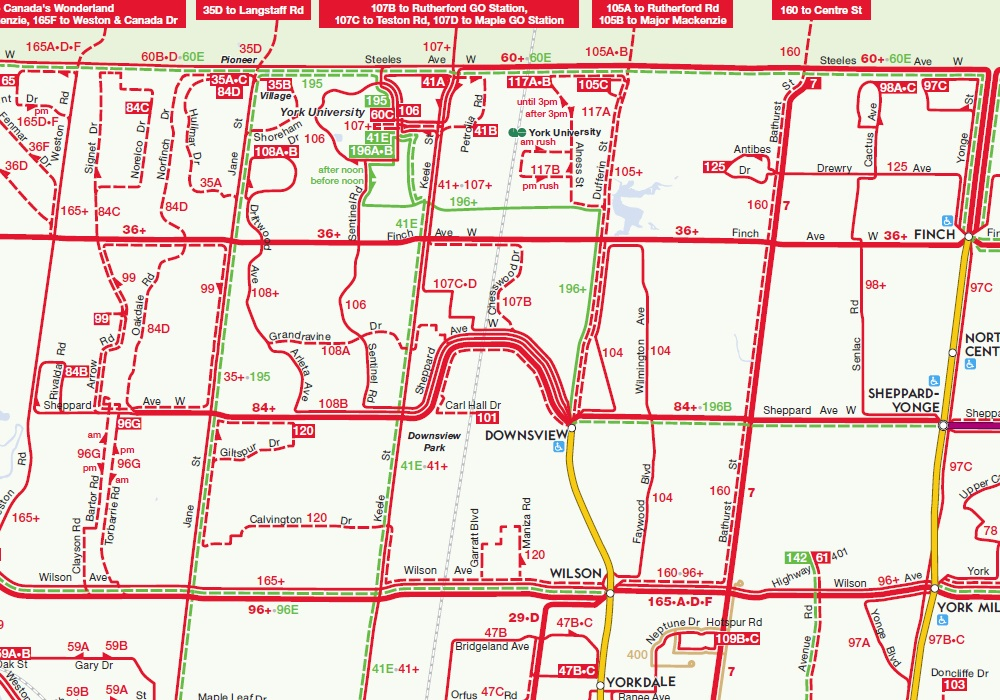
    Unlike previous editions, the new Ride Guide is not to scale; subtle curves and bends in the road network are dispensed with in favour of a diagrammatic style, which shows transfer points very well. (It reminds me of the Los Angeles Metro system map.) Like the 2012 edition, shown below, only the streets served by surface routes are illustrated, but landmarks (such as hospitals, post-secondary education institutions, and major parks) are given more prominence than in previous maps. GO Transit rail lines are more prominent (with the same colours used on GO Transit maps and schedules), and there’s an effort to show connections with other transit systems, such as GO buses, and suburban agencies such as York Region Transit, Miway, and Brampton Transit.

    TTCAug2014
    Screenshot of the 2014-2015 edition of the TTC Ride Guide, showing the same area as the 2016 map.

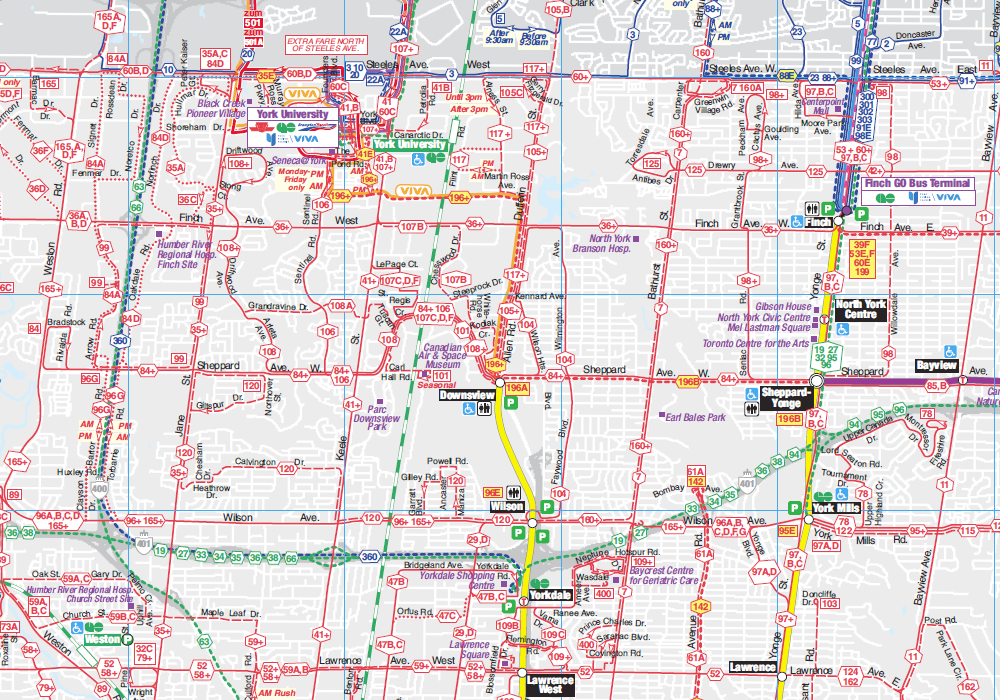
    From 1994 to 2012, the TTC’s official system map included the routes of adjoining transit systems (see screenshot below). Note the YRT, GO Transit and Brampton Transit Züm routes converging on a very crowded York University. Depicting the connecting networks was certainly useful, but it added to a very cluttered map (which included the entire street network); it also relied on every other agency to provide timely updates. Removing the other transit agencies’ bus routes in 2014 allowed the TTC design team and cartographers to concentrate on their own system.

    In 2014, the system map was stripped of almost all features apart from the TTC’s own routes, a decision I criticized in a previous post. All landmarks were removed, as were all connections, apart from faint lines showing GO Transit rail corridors. It was easier to read, but went too far in removing important and use information. But it had a few improvements, such as highlighting the “frequent service network” – surface routes that operated every ten minutes or better at most times of the day. Express bus routes were better depicted.

    The 2016 edition restores these features lost in 2014. In a few places, the logos of the suburban transit agencies are once again shown, such as York University (where Brampton Transit, GO Transit and York Region Transit connect) and Pearson Airport (where Brampton, Miway and GO also operate). The contact information for the five neighboring systems is also included on the map. The addition of the frequent service category remains.

    TTCNov2012November 2012 Ride Guide

    Overall, I think the new map looks great. Surface routes are clearer, GO Transit rail lines are more prominent, and more points of interest are shown. Not only does downtown Toronto get a new inset, so does a complex section in north Scarborough, where the 102 Markham Road, the 53 Steeles East, and the 42A Cummer routes converge. The TTC design team has done a fine job.

    But I did find a few things about the new 2016 edition that I would like to see improved:

    • Hospitals are labelled inconsistently. Humber River, Sunnybrook, and Scarborough Centenary are, but North York General, Etobicoke General, Scarborough General, St. Joseph’s, East Toronto General, and the downtown hospitals are not.
    • Some suburban connections are shown, most are not. Pearson Airport shows GO, Brampton, and Miway logos, and York U shows GO, Zum, and YRT logos, but they are missing from Humber College, a major terminal for Brampton Transit (511, 11, 50) and Miway (22, 107), it’s a terminus for a YRT route as well. Rouge Hill GO shows a DRT logo, even though this is a very limited service, but there isn’t one for Miway at Long Branch, where two major routes, 5 and 23, terminate.
    • I’m not sure I like how branches are labeled now; I miss the use of the “+” that denoted a section of a route on which all branches operated on.

    Hopefully, we will see these relatively minor issues corrected in the next edition of the Ride Guide, which will likely be issued later in 2016.


    If you’re interested in the history of TTC maps, Transit Toronto has a fine archive of old system and subway maps dating back to the 1930s. It’s worth a look.

  • Yet another transit plan for Scarborough (Updated)

    Updated with a link and discussion of the Scarborough Transit Planning Update, released earlier today.

    It’s been an eventful few days for transit watchers. Late last week, we found out that John Tory’s SmartTrack plan will be clipped to an initial phase between Mount Dennis and Kennedy Station, and the Eglinton-Crosstown extended in the west to the Airport Corporate Centre and probably Pearson Airport itself. The section north from Kennedy Station to Unionville Station in Markham has been deferred to a later Phase II. And the announcement of a preferred alignment to the Gardiner East “Hybrid” was announced on Tuesday.

    Back in December, 2014, I suggested that there was no need for the Scarborough Subway extension, and that a good transit plan had already been developed in the last ten years. A combination of the Scarborough RT replacement and extension to Malvern, the Transit City light rail plan, and GO Transit Regional Express Rail (RER) would have served the eastern part of Toronto quite well.

    But then, in 2010, Toronto elected Rob Ford as mayor, who ran on a transportation platform of “subways, subways, subways” and ending the so-called “war on the car.” The Scarborough RT replacement was dropped in favour of a subway, planning and construction work on the Finch and Sheppard East LRT routes was suspended, and the TTC surface network was cut back. For a while, it looked like maybe the Scarborough LRT line would be resurrected. But then municipal and provincial politicians, looking for votes, pushed the more expensive and shorter subway option. Candidates in a by-election in Scarborough-Guildwood all claimed to be “subway champions,” even the NDP’s Adam Giambrone, the TTC Chair at the time Mayor David Miller put forward the seven-line Transit City LRT plan. The three-stop Scarborough Subway extension would cost over $3.5 billion.

    John Tory, who won the 2014 mayoral election, ran on a platform that included “SmartTrack,” a single-line regional rail concept that he claimed would provide relief to the Yonge Subway, completed by 2021. Tory’s campaign claimed that SmartTrack would carry  200,000 riders a day, and be fully integrated with the TTC, including fares. Tory also promised not to re-open the Scarborough LRT vs. subway debate, committing himself to the three-stop subway. Tory never showed much commitment to the Finch West and Sheppard East LRTs, which were funded by the province, but left dormant.

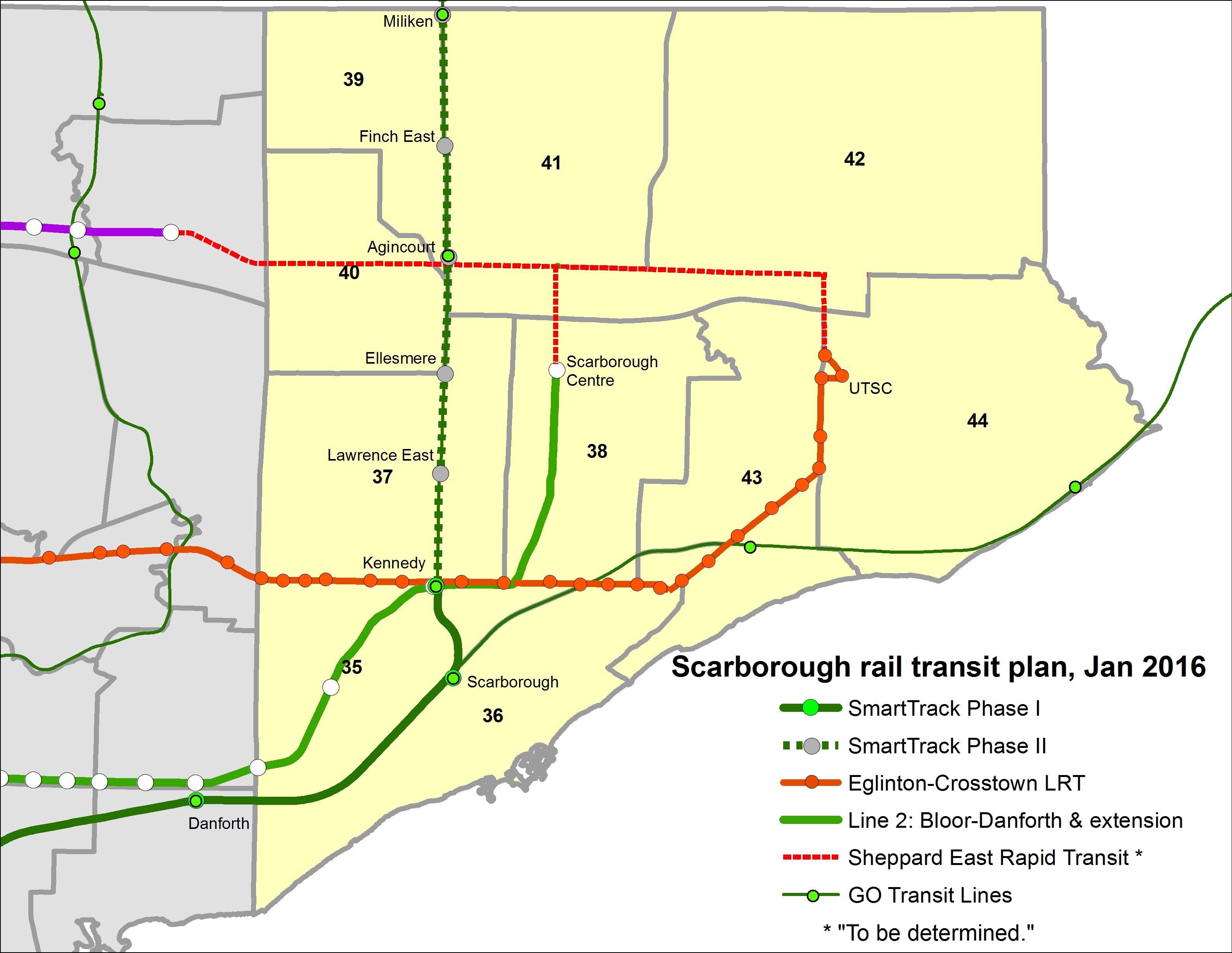
    The trouble with committing to SmartTrack and the Scarborough Subway was having two new parallel transit lines three kilometres from each other between Eglinton and Sheppard Avenues, as depicted in the map below. The Eglinton-Crosstown LRT, currently under construction, the Bloor-Danforth Subway and the SmartTrack line would intersect at Kennedy Station.

    Scarborough - 2015Active rail transit proposals in Scarborough, as of 2015

    But on Wednesday, January 20, Oliver Moore and Marcus Gee at the Globe and Mail and Tess Kalinowski at the Toronto Star broke news on a City of Toronto planning report that would re-allocate part of that $3.5 billion from the subway to extending the Eglinton-Crosstown line to the University of Toronto’s Scarborough Campus (UTSC), and reducing the number of stops on the subway from three (excluding Councillor Glenn De Baeremaeker’s proposal for a fourth) to one. The subway, therefore, would run five or six kilometres, non-stop, between Scarborough Centre and Kennedy. The 12-kilometre, 17-stop extension of the Eglinton-Crosstown line resurrects most of the proposed, but unfunded Scarborough-Malvern LRT

    Today, on January 21, the Scarborough Transit Planning Update staff report was released, with more details.

    I created this map below based on a map tweeted by the Star’s Tess Kalinowski on Wednesday afternoon:
    https://twitter.com/TessKalinowski/status/689890493409300484

    Scarborough - 2016The Latest plan for Scarborough, including the one-stop subway extension and the additional 17 stops planned for the Eglinton-Crosstown LRT, as well as SmartTrack Phases I and II, as recommended in a separate study.

    It’s worth noting that the Sheppard East LRT, which won’t start construction until 2021 (essentially leaving it in limbo) is marked on the staff report map as “rapid transit to be determined.” Maybe it will connect to the subway at Scarborough Town Centre. Maybe it will connect to the Eglinton-Crosstown. Maybe it will remain a bus route. In the original Transit City plan, Sheppard East was to be started first; indeed construction did start on the Sheppard Avenue rail underpass at Agincourt GO Station; an empty median is where the LRT tracks are planned to go. The Scarborough-Malvern LRT was supposed to continue north of UTSC to Sheppard Avenue (and potentially further north along Morningside), but this isn’t part of this latest study.

    Transit City planned for a LRT maintenance and storage facility (MSF) on Sheppard East at Conlins Road, near Morningside Avenue. The Conlins MSF would have served three routes: the Sheppard East LRT, the Scarborough RT replacement, and the Scarborough-Malvern LRT. The MSF has been scaled back due to the deferral or cancellation of the other two lines, but will be essential if this latest plan goes through. So the ECLRT is built to UTSC, a rail connection from Sheppard will probably be necessary, and maybe the Sheppard and Crosstown lines were converge here.

    What makes the least sense for me is the long, non-stop section of the subway between Kennedy and Scarborough Centre. There was clearly a problem of having two prioritized high-capacity rail proposals serving similar markets: SmartTrack, and the Scarborough subway extension both championed by the mayor. Cutting out the Sheppard and Lawrence stops delivers passengers to SmartTrack. That is, of course, SmartTrack makes it north of Kennedy Station.

    A separate study by Metrolinx staff, recommending a shorter SmartTrack line between Mount Dennis and Kennedy, along with a western extension of the Eglinton-Crosstown LRT,  was reported in the Globe and Mail last Friday, with the Unionville-Markham section part of a later Phase II. It appears that the City-led Scarborough Transit Planning Study is assuming a full build-out of SmartTrack, at least on the east end.

    I’m happy, though, to see LRT seriously considered as a solution for intermediate transit needs. What I find somewhat ironic, though, is that the Eglinton-Crosstown LRT is becoming what SmartTrack was eighteen months ago: a single line that solves all transit planning problems. Of course, my wish is to go back to building the Scarborough LRT extension, the original Scarborough-Malvern line, and letting Metrolinx and GO Transit do their thing with implementing RER.

    The city planning report notes that “…of the 206,000 transit trips that begin in Scarborough, 99,000 or 48% end in Scarborough. This means that only 14% of all trips that begin and end in Scarborough use transit (99,000 of 692,000).” (Pages 14-15.)

    This is why improving the local transit network – be it streetcars or buses – is so important. We’re often fixated on moving commuters long distances, but we never pay enough attention to short-distance commuters as well. For all the “subways, subways, subways” hot air we’re still hearing from some Scarborough councillors, most of their transit-riding constituents rely on buses. As a friend pointed out, since most of those local trips are by car, we need to ask whether this new plan will make transit more competitive for trips within Scarborough.

    Will we see yet another proposal for Scarborough? I bet we will. Maybe SmartTrack could be routed to a spur to Scarborough Centre (has anyone looked at that?). But at some point, fatigue will set in, and we’ll have to pick something – anything – and build it in order to avoid looking indecisive. But I believe that these planned revisions to SmartTrack, LRT, and the Scarborough subway are steps in the right direction.

  • On the 2016 City of Toronto budget (Updated)

    Updated Jan. 12 with a thought on a progressive property tax. 

    It’s budget time at Toronto City Hall. Right now, city councillors are in the process of debating the city’s expenses and revenues. While the City of Toronto, like all municipalities in the province, is prohibited from operating at a deficit, there’s a ever-growing gap between revenue (taxes, fees, grants, etc.) and the necessary operating and capital expenses required to successfully run a city of 2.6 million people.

    Operating expenses are being held back due to “gapping,” in which vacant staff positions aren’t filled immediately. This is an easy way to cut costs, especially at a time when all city departments – the Toronto Police Service excepted – were requested by Mayor John Tory to reduce costs by 2 percent. But as Neville Park explains in Torontoist, this is not a viable long-term strategy.

    Meanwhile, the capital costs keep piling up. The Toronto Community Housing Corporation (TCHC) has hundreds of uninhabitable units; thousands more are at risk of being closed up unless its capital backlog is addressed. The Toronto Transit Commission (TTC) has a backlog of state-of-good-repair projects necessary to maintain its sophisticated transit system operating, as well as unfunded projects to improve accessibility and purchases of new vehicles to keep up with demand and grow ridership.
    2016Budget
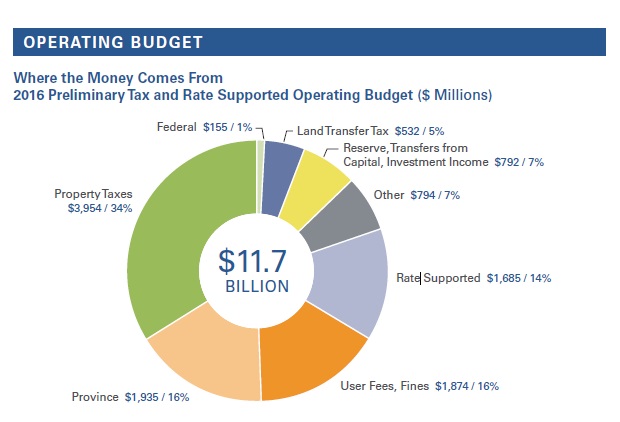
    Estimated City of Toronto 2016 operating budget revenue (source)

    In 2016, $3.95 billion will be collected from property taxes in order to fund the City of Toronto’s operating budget, just over a third of all revenue. It’s the largest source of revenue, but provincial grants, user fees (such as TTC fares) and fines, water and waste management charges are other important sources of revenue. The much-loathed municipal land transfer tax will contribute $532 million to the city’s budget, an increasingly important source of revenue. But there’s still a projected gap, estimated between $90 and $124 million, that still has to be filled. That’s where the debate will largely focus on.

    Property taxes mostly do not fund the city’s capital budget; utility and parking rates are the largest single-source of funds (water, waste and city parking are self-financing), followed by provincial and federal grants (largely to fund transit and other infrastructure), development fees, and debt-financing and from the city’s capital reserves.

    Mayor Tory, despite wanting to hold the line on expenses, also wants to build his signature – yet unrealistic – SmartTrack line, among other transit projects, as well as social housing. He proposed a new levy (not calling it a “tax”) in December, if approved, it would be phased-in, starting in 2017.

    I’ve been critical of Mayor Tory’s administration, but his proposed infrastructure levy is a step in the right direction. It’s an acknowledgement that the backlog of necessary capital projects needs to be addressed.

    But I was concerned to read last week in the Toronto Star that senior city staff and Tory’s advisers were considering, even laying some of the groundwork, for a sale of a minority stake of Toronto Hydro to pay for new infrastructure. While it might raise $1.5 billion, it would be a one-time source of funds, and would reduce or eliminate an annual dividend that raised $60 million for the city in 2014. There were also rumours of a partial or complete sale of the Toronto Parking Authority. But responding in the Toronto Sun, Tory denied having such plans.

    The City of Toronto desperately needs to seek new, stable, and sustainable revenue sources beyond the property tax and user fees, neither of which are progressive or especially fair. Reinstating the vehicle registration tax would be a good place to start, at least to fund the city’s unfunded anti-poverty strategy, but income and sales taxes, currently prohibited by provincial legislation, tied to inflation, would help. So would increased, sustained provincial and federal assistance.

    You can find out more about the 2016 budget at the city’s website here. I’m not following the debates that closely, but Torontoist can be counted on for good issue-based coverage, the Toronto Star’s Ed Keenan provides excellent commentary.


    On property taxes, current value assessments, and a progressive property tax

    Property taxes are a very difficult subject to explain, but David Hains at Torontoist explains how they work far better than I, or most people, can. Property taxes are not well understood, but it’s important to note that despite rising property values, the city does not necessarily collect more taxes on each property. In many cases, even with a tax hike, the amount paid by some property owners may stay the same, or even decrease.

    Property taxes provide a predictable and reliable revenue source, but unlike income and sales taxes, they do not increase automatically with inflation; annual tax increases determined by City Council allows the city budget to grow with inflation and support city priorities, such as improved transit, infrastructure repairs, or other city services.

    The city is also phasing in changes to property taxes in order to reduce the burden on commercial properties (including multi-unit residential rental buildings) and increase it on freehold units. This is why, in 2013, I received a rent reduction notice as the property taxes in the apartment building I was living in at the time was reduced.

    To satisfy my interest in property taxes, property values, and assessments, I created three maps based on a City of Toronto 2016 budget briefing note on changes to the current value assessment (CVA) from 2015 to 2016. The Municipal Property Assessment Corporation (MPAC) conducts property tax assessments for all properties on behalf of municipal governments in Ontario every four years. It is upon these assessments that the city calculates each property’s tax rates.

    The first map, below, shows the average assessed residential property value for 2016, using a standard deviation classification scheme. Ward 25 has, by far, the highest average property value, at $1,375,568. Ward 25 includes the exclusive Bridle Path neighbourhood, as well as the affluent Lawrence Park East and York Mills neighbourhoods. Other Midtown Wards (16, 22, 21) are well above the city’s average property value, assessed at $549,586. Lowest is Ward 8, whose average residential property is assessed at $301,320.

    It’s interesting to note that, with the exception of Ward 4, which narrowly voted for Doug Ford in 2014, the map closely resembles that of John Tory’s support base.
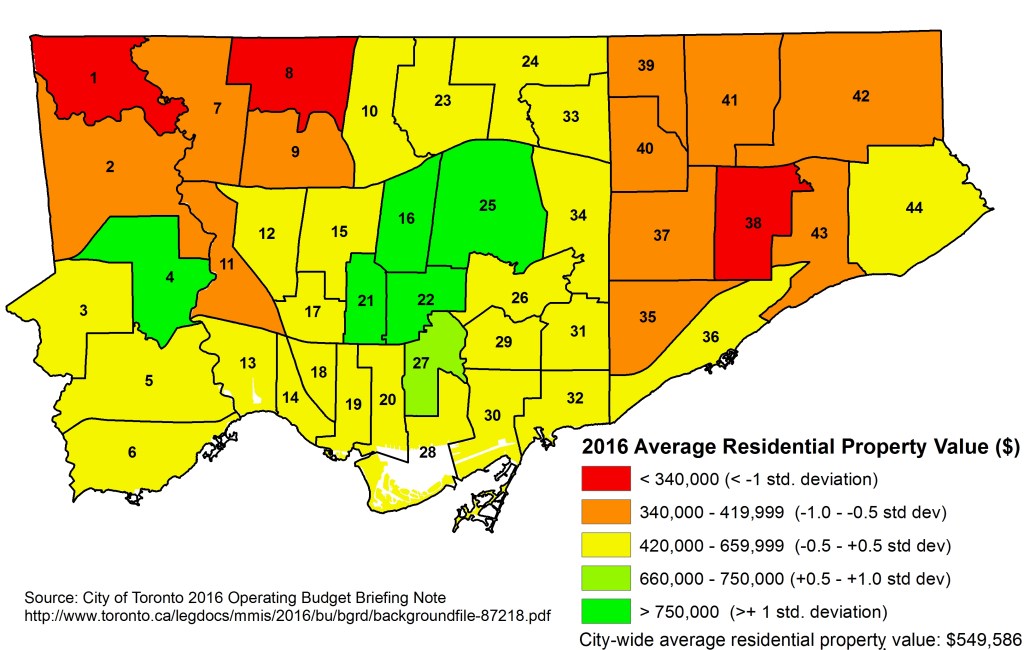
    2016 Average Residential Propery Value std deviation

    The second map, below, shows the change in the average CVA in each ward. Ward 18, which includes the gentrified or gentrifying Queen West, Brockton, Junction Triangle, and Dovercourt Village neighbourhoods had the highest annual average CVA increase, at 6.6 percent. Other downtown wards, such as 14 (which includes gentrifying Parkdale, Roncesvalles, and part of the Junction), 19, and 28 did well, as well as Wards 23, 24 and 41 in the suburbs. The northwest had the smallest average increases in assessments, with Ward 8 again coming in at the bottom, with only a 3.3% increase.
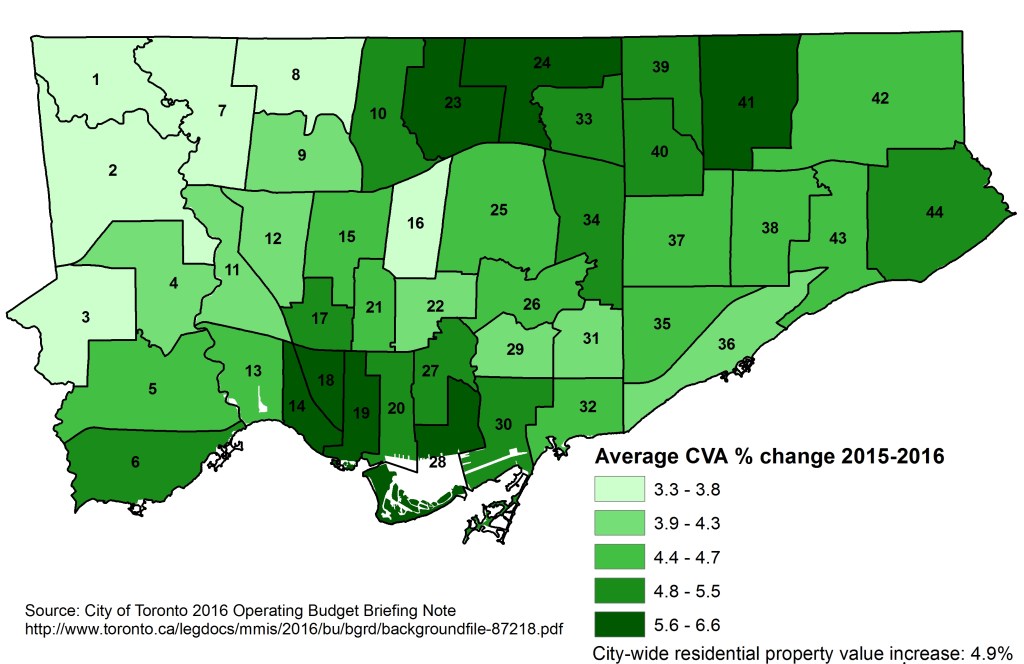
    CVA Change 2015-2016

    Finally, the map below shows the entire aggregate value of residential assessments in 2016. Not surprisingly, Wards along the dense Yonge Street corridor had the highest values. Except for Wards 16 and 25, all have higher than average ward populations, and housing in most neighbourhoods largely consists of expensive detached houses and highrise condominiums.
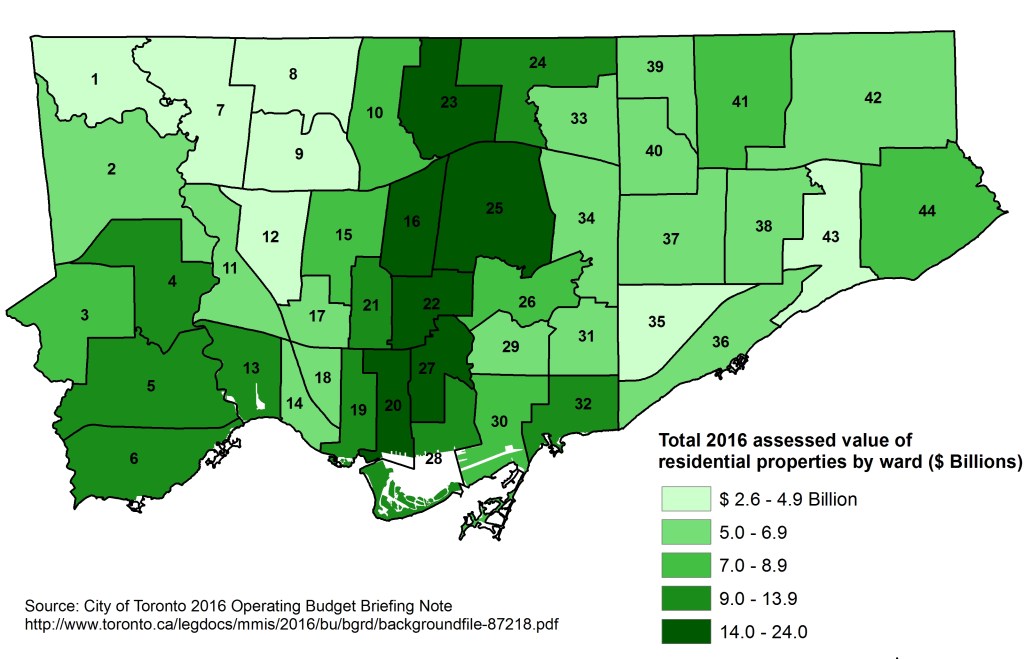
    2016 Total Residential Propery Values

    In today’s Toronto Star, Ryerson Professor (and friend) Myer Siemiatycki discusses the idea of a progressive property tax. A progressive property tax would be similar to income taxes, in which tax brackets are set up, lowering taxes on lower-value properties, and raising them on properties with high assessed values. Siemiatycki proposes that a first bracket, if a system was implemented this year, would ensure that properties worth under $400,000 would pay less property tax than they paid in 2015. A second bracket would apply to properties assessed at between $400,000 to $600,000, which would be subject to the currently proposed tax increase. Properties worth over $600,000 would be subject to higher property tax increases, the highest bracket topping out at properties worth over $2.5 million. Siemiatycki argues that the most expensive properties have benefited most from Toronto’s increasing housing prices.

    This is an interesting idea that would raise more revenue for the City of Toronto, give many “Ford Nation” residents a tax reduction, and provide more fairness in the flat property tax rate. It would be much more easily implementable than, say, sales and income taxes. But given that John Tory’s base (and wards represented by some of his staunchest allies) would be most affected by such a progressive tax system, I don’t hold out much hope for its adoption.
  • Not so fair-by-distance: GO Transit’s problematic fare system

    Not so fair-by-distance: GO Transit’s problematic fare system

    GO Network 2015GO’s bus and rail system serves 39 municipalities and reaches points over 130 kilometres from Union Station

    In 1967, GO Transit started out as a simple commuter service from Oakville to Pickering (with two additional trains to and from Hamilton). In 1970, it started its first bus service, connecting Oshawa and Hamilton to the hourly train service at Pickering and Oakville. Eventually, GO expanded to other corridors, inaugurating the Georgetown service in 1974, and taking over former suburban Grey Coach and TTC routes in the 1970s. By 1981, GO was operating trains on all seven of its current corridors, expanding and extending its bus rail services ever since. As a commuter rail and bus system, GO Transit is a great success story, there were over 68 million boardings in 2014, and service continues to expand. Regular bus service goes all the way to Niagara Falls, Peterborough, and Waterloo, serving post-secondary institutions and long-distance commuters. But there are many ways in which it can improve; its fare structure is just one of them.

    Previously, I explained why GO Transit should consider charging for parking at its commuter lots. GO Transit provides over 60,000 free parking spaces, but the cost of servicing those lots is borne by all passengers, whether or not they drive to the train or not. This isn’t terribly fair to those customers who arrive by foot, by bicycle, or are able to get a ride. In the suburbs outside the City of Toronto, most transit agencies offer a co-fare – a discounted fare for taking local buses to connect to and from GO Transit, but no such fare integration exists with the TTC. But the parking subsidy enjoyed by drivers is only part of the unfair pricing scheme levied by GO Transit.

    GO Transit describes its fare scheme as “fare by distance.” And to a degree, this is accurate. Generally, the farther one travels, the more expensive the fare. So far, so good. But fares for short trips cost far more than longer ones per kilometre traveled, and fare increases for short trips have risen at a greater percentage rate than fare hikes for long trips.

    Steve Munro wrote about the myth of GO’s fare-by-distance scheme last year. As Munro put it, “the fare structure is rigged against short distance trips, and this has been getting progressively worse for a decade.”

    If GO Transit wishes to fully become a regional transit service, it needs to address both its unfair fare scheme and its lack of fare integration with the TTC.

    go_rail_and_bus_network,_2015_by_seanmarshall1_11_18_2015_02_29_09

    I created a map of the full GO transit bus and rail system in CartoDB to illustrate GO Transit’s reach; all stations and major bus stops include some fare information (the distance and cash fare to Union Station) and the number of parking spots. 

    (more…)

  • Mapping Toronto’s homeless shelters: an interactive mapping exercise

    Earlier this week,  I mapped the locations of Toronto’s homeless shelters for Torontoist. While there are shelters located across the city, the capacity is located almost entirely within the old city of Toronto, especially in the Downtown east side, between Church Street and the Don River. This is despite the fact that the need for shelters, like all social services and affordable housing, is city wide. I obtained the homeless shelter data from the City of Toronto’s Open Data catalog.

    https://seanmarshall1.cartodb.com/viz/418097ea-71f9-11e5-8d00-0e787de82d45/embed_map

    Unlike previous mapping exercises, I used CartoDB to create an interactive map, rather than relying on Quantum GIS (open source GIS software) or ESRI ArcGIS (software developed and maintained by the leading GIS firm) to create static maps. Importing data into CartoDB is quite easy; the selection of simple base maps is also very helpful. Creating legends and classifications had a bit of a learning curve, but on the whole, I was quite pleased with the result.

  • A disappointing step backwards for ranked ballots

    I’ve long been a fan of ranked ballots, a voting system that Dave Meslin and the good people at RaBIT have been promoting for a long time. At the municipal level, ranked ballots —also known as instant run-off voting — is a simple, yet effective way of improving local democracy.

    Ranked ballots ensure that politicians are elected because they can enjoy the support of a majority of electors, so they are fairer than the first-past-the-post system we currently use to elect city councillors. To some degree, it reduces the advantage that incumbent councillors enjoy due to name recognition, and they promote diversity in local politics. I think they’re a better idea than term limits, recalls, or municipal parties.

    The provincial government is currently reviewing the Municipal Elections Act; reforms may allow municipalities to adopt ranked ballots. At first the City of Toronto seemed to be eager to sign on; in 2013, Council adopted a motion to ask the province to allow ranked ballots to replace the current electoral system; more recently Mayor John Tory expressed his support for the idea.

    But during a recent council meeting, newly-elected Councillor Justin Di Ciano (Ward 5) just threw a wrench into the works. Calling ranked ballots “confusing,” he put forward a motion to ask the province not to allow ranked ballots. It passed, 25-18.

    The map below illustrates the result of that vote by ward.

    Ranked ballots vote

    Incumbent councillors might be wary of ranked ballots, especially if they face multiple opponents. Fifteen councillors (and Mayor Tory) were elected with less than 50% of the vote; they would be vulnerable to ranked ballots. Three of those councillors: Ana Bailão (Ward 18), Joe Cressy (Ward 20), and Raymond Cho (Ward 42), were brave enough to vote the right way on Di Ciano’s motion.

    Conversely, councillors such as Norm Kelly (Ward 40, who won with 86% of the vote), Michael Thompson (Ward 37, 84%) and Jaye Robinson (Ward 25, 83%) voted for the motion. Justin Di Ciano himself won with 54% of the vote in Ward 5. The “yes” votes were mostly from Council’s right wing, but left leaning councillors such as Maria Augimeri (Ward 9) and Paula Fletcher (Ward 30) joined in. Augimeri would have almost definitely lost in 2010 had ranked ballots been adopted; it’s possible that Fletcher would have been voted out in 2010 and in 2014 under this voting system.

    2014 Election - Councillor win percentMap of the share of votes each councillor was elected by in 2014.  

    The fight for ranked ballots is far from over; Mayor Tory still has plenty of political capital and sway with the provincial government. I’m hopeful that council will reverse itself yet again.

    In happier news, Council voted 25-18 in favour of asking the province to allow non-citizen permanent residents to vote in municipal elections. As local government is closest to the people, and makes decisions that affect most individuals on a day-to-day basis, I am in favour of such a move. That said, I still believe that electing federal and provincial representatives should remain a privilege afforded to Canadian citizens.