
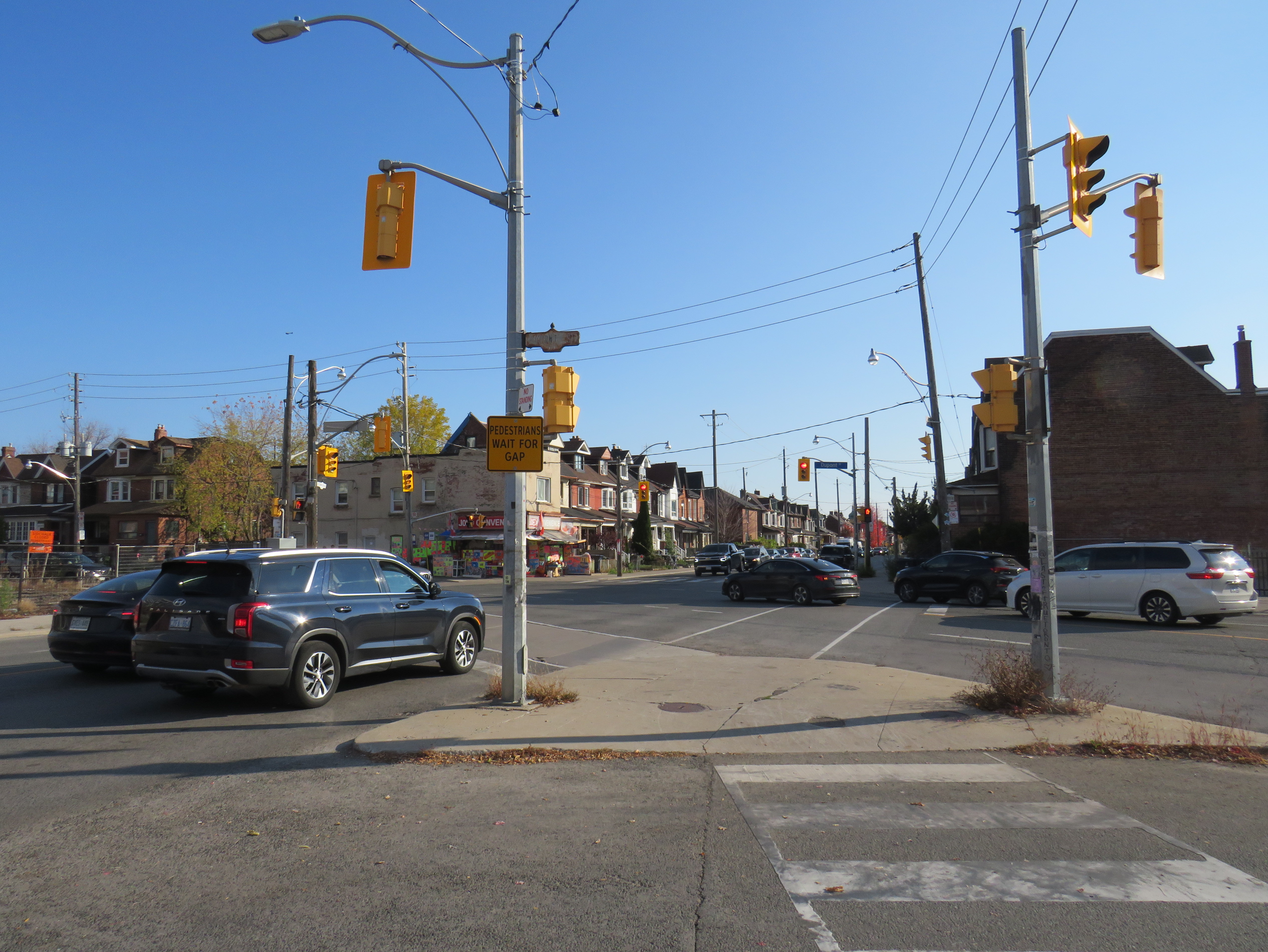
There are many ways that road design acts to facilitate vehicle drivers yet impede pedestrian mobility. There’s the beg button (traffic engineers prefer the term “pedestrian call button”) that ensures maximum traffic throughput unless a pesky pedestrian or cyclist decides they want to cross the road too when the light turns green. There’s the two-phase pedestrian crossing that guarantees a long wait to cross a wide traffic artery on foot. Wide curb radii at intersections allow drivers to easily turn, yet they intrude into the crosswalk space. And there’s the slip lane, also known as a channelized right turn.
Most slip lanes are designed to allow right-turning motor vehicles to bypass an intersection. Where an intersection may be controlled by a traffic signal or a stop sign, typically, a slip lane is only controlled by a yield sign, reminding motorists to give way to pedestrians crossing and/or oncoming traffic on the roadway being turned into. They are typically built for higher speeds, with turn radii even greater than those afforded by generous curved curbs at many urban intersections. The space left over in the triangular bit of concrete is where pedestrians must wait to cross the main roadways.
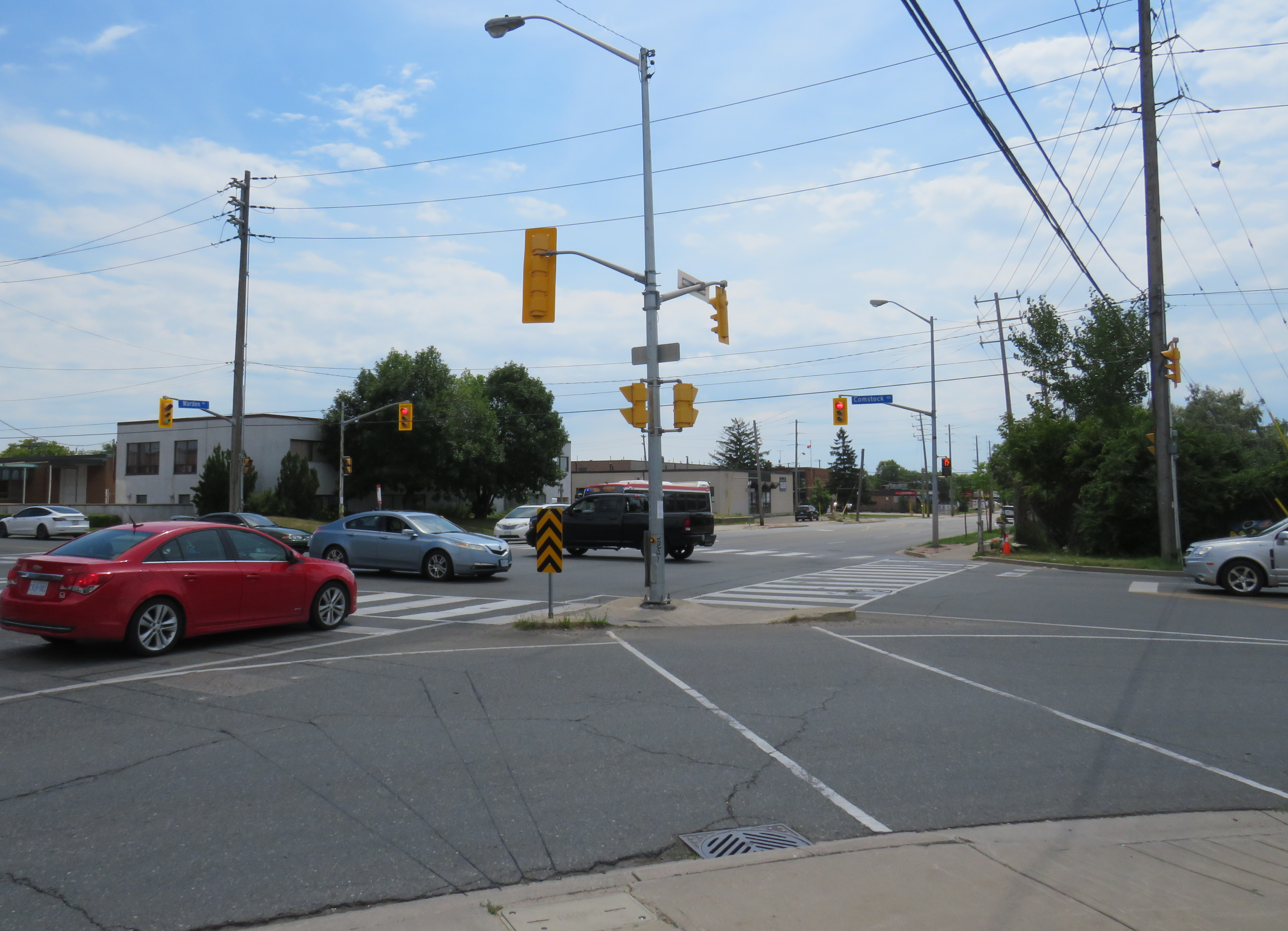
Occasionally, slip lanes are used to discourage or prevent certain turning movements. At shopping plaza entrances, for example, slip lanes are used to prevent left turns into or out of the driveway. They may also be used at one-way streets for the same purpose.
Thankfully, slip lanes are not the standard in the City of Toronto. At least forty slip lanes were removed between 2005 and 2025, including Front Street eastbound at Yonge, from Coxwell Avenue southbound at Dundas Street East, and a half dozen on Danforth Road in Scarborough. In the downtown core, there are only three remaining examples that cross pedestrian pathways: from southbound Bay Street to Queen Street West, from eastbound Bloor Street to Parliament Street, and from Mount Pleasant Road to Jarvis Street. There are several other intersections in the city centre that allow some right-turning vehicles to bypass the main intersection, such as Adelaide and Richmond Streets at Jarvis, University at Front, or Parliament at Gerrard, but these still require a full turn at their start or end point, mitigating their danger.
A map of slip lanes in Toronto, and those removed in the last twenty years, is below. This work was assisted my followers on BlueSky for their additions and corrections, and I appreciate their help.
By removing slip lanes, pedestrians and cyclists are better protected, and there can often be new space for seating, public art, or even plant life.
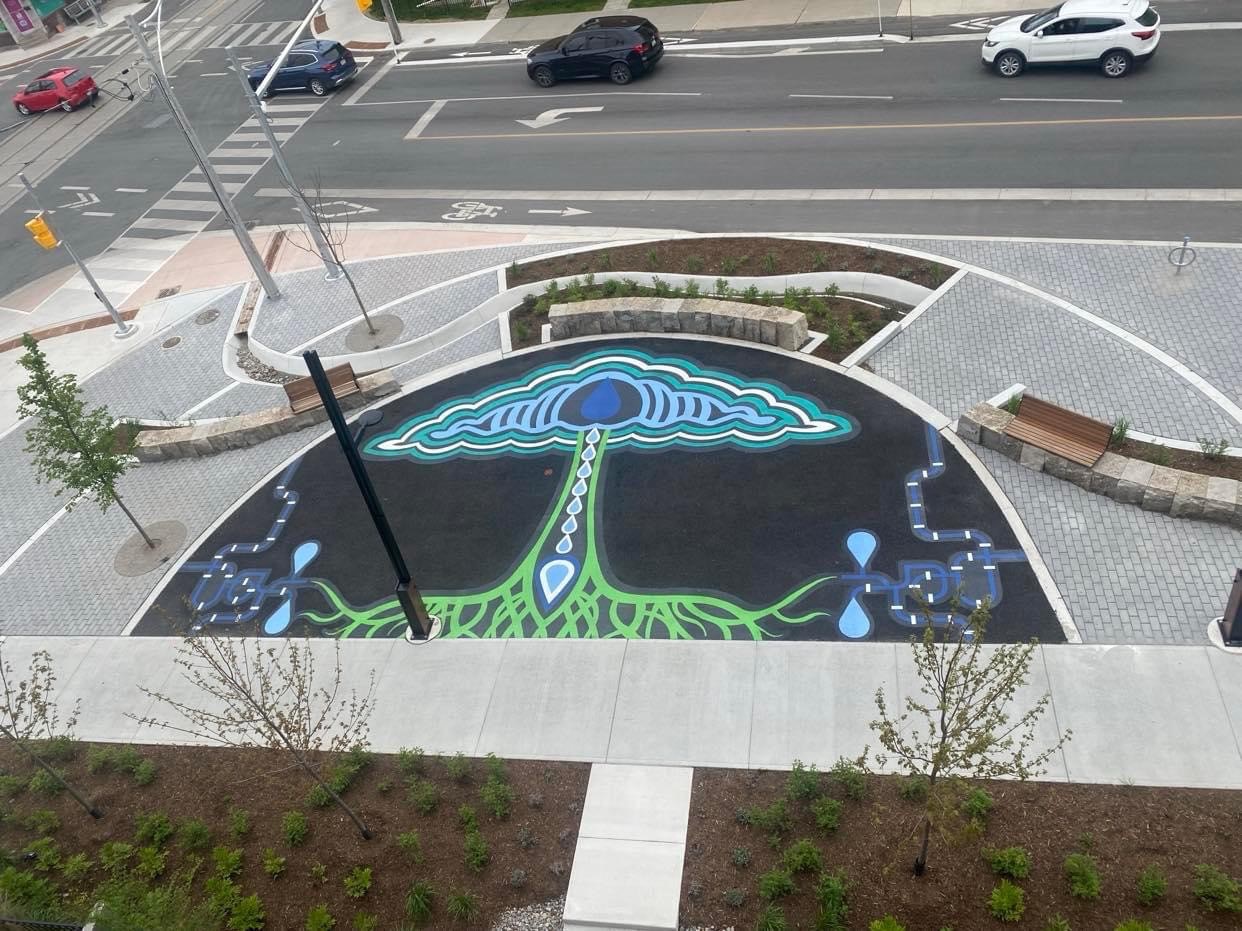
(City of Toronto, 2025 Water Summit winner)
Slip lanes are far more common in suburban neighbourhoods outside the City of Toronto. In Brampton and Mississauga, slip lanes are common on regional roads such as Steeles Avenue, Dixie Road, or Erin Mills Parkway. These six-lane roads are designated as goods movement corridors, and are designed for heavy traffic, including tractor-trailers. Even in Peel, though, slip lanes are being rethought. Several were removed on Bovaird Drive in Brampton two years ago (replaced by signalized crossrides), while others are being repainted to empathize the pedestrian crossing and encourage slower movements. More signage tells motorists to stop for pedestrians.

Though the City of Toronto has done some good work eliminating or modifying slip lanes in the name of traffic safety and an improved pedestrian realm, there are many more that still should be examined, such as the one at Ossington and Dupont, where, unusually, pedestrians are instructed to wait for a gap, rather than motorists instructed to yield. These “wait for gap” signs are found at the entrances and exits to expressways, such as the Gardiner Expressway or Highway 401. But these, too, can be changed. At the eastbound ramp to northbound Don Valley Parkway on the Prince Edward Viaduct, a free-flowing on-ramp was changed to a signalized right turn, improving safety and comfort for pedestrians and cyclists.

Hopefully, City of Toronto staff work to correct the situation at Dupont and Ossington (there’s no reason why pedestrians should be expected to yield to traffic in this revitalizing part of the city) and continue the work to make our streets safer for all.
If you like my work and you would like to help out with my webhosting costs (I just had to renew my ad-free WordPress subscription), consider buying me a coffee. Thank you!
 Sean Marshall
2 replies on “It’s time to rethink slip lanes”
Two-phase crossings aren’t inherently bad, it’s just that they are being misused in many places, such as York Region, to screw over pedestrians. There are other places, such as the Netherlands, that instead use the additional flexibility of the multi-stage crossing to reduce delays for pedestrians by essentially providing “green waves”. The benefit is that with multi-stage crossings, you can allow pedestrians to cross one part of the intersection, even when there is traffic still going across the some other part. Plus, you don’t have to deal with one very long crosswalk.
Here’s a video I found that explains this well: https://www.youtube.com/watch?v=LSnSeyG74fw
And here some examples of it actually being done in North America: https://www.youtube.com/watch?v=t7V3npNCCTg, https://www.youtube.com/watch?v=LzlLTLuAkiU
Another change that I believe would be welcome is to have more “fully-protected turns”, and right-turn-on-red restrictions (though right turns should ideally be given a green arrow when the cross street has an advance left turn). I’ve observed that Ottawa is generally more likely than most of the GTA to do both of these. If they don’t want to make turns fully protected, they should at least give a few-second delay before allowing turning vehicles to proceed if there is a pedestrian present.
To add to your map, Forest Hill also has a few legacy slipways that the city has/is now controlling though not eliminating:
Eliminated: Hilltop at both Ridge Hill (SW corner) and Old Forest Hill Rd (NE corner)
Longstanding stop sign on slipway: Old Park Rd at Old Forest Hill Rd
Stop signs recently installed: Russell Hill Rd at Old Forest Hill Rd (x2)