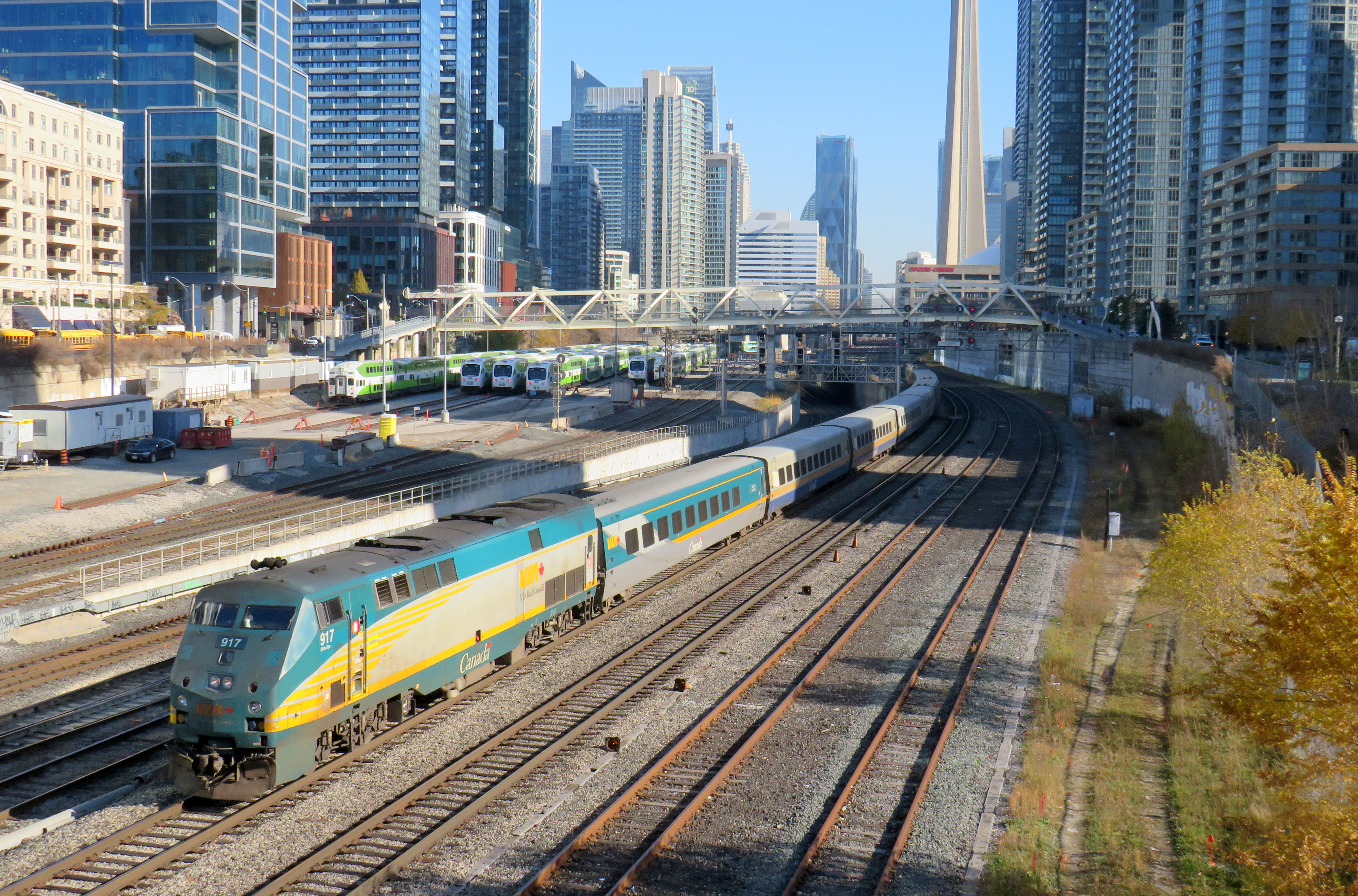
On an unseasonably mild Thursday, November 19, I decided to take one last ride on VIA Rail’s LRC coaches for a short jaunt to London, Ontario. It turned out to be a longer goodbye than I anticipated. Trains 73 and 76, from Toronto to Windsor and back again, is one of the few trainsets still made up of these disappearing coaches. Fuelled by nostalgia for my first VIA train ride over 25 years ago, I wanted to take one more trip before they’re gone.
My plan was to visit Attic Books in Downtown London — one of Canada’s greatest used bookstores — check out progress on the BRT system, and have a dinner at Milo’s before heading back home. I expected there would be some delays along the way, as is sadly common when riding the rails in North America, but because of cascading problems on CN’s tracks west of Woodstock, it turned out to be an especially bad day for everyone aboard Train 73 that Thursday.
As VIA Rail completes the replacement of its older locomotives and cars on its main Quebec-Windsor Corridor, there are only a few operating trainsets left with the aluminum body LRC coaches and the stainless steel HEP-II coaches. The P42 locomotives, acquired to replace LRC locomotives retired in 2000-2001, are now at least 25 years old and will also disappear from VIA’s fleet.
Why the LRCs matter
The LRC cars and locomotives were the first brand new additions to VIA’s fleet, which up to that point were acquired from CN’s and CP’s former passenger operations, and began operating in 1981. LRC stands for “Light, Rapid, Comfortable,” designed with an aluminum body and active tilting for a smooth, faster ride on conventional railway lines. LRC trains were permitted for 100 MPH (161 km/h) speed on designated sections of track, with the fastest Toronto-Montreal train scheduled at just 3 hours, 59 minutes. By the late 1990s, the poor reliability of the LRC engines and unfriendly CN dispatching made that under-four-hours travel time an increasingly rare occurrence.
(My first VIA rail trip was between Toronto and Montreal in Summer 2001. On the way there, the LRC locomotive encountered problems near Cobourg, and we arrived in Montreal over one hour late. The return trip on Train 67, the express, arrived at Union Station in that promised four hours.)
Despite their problems (the banking systems were deactivated and removed in the 2000s), the LRC coaches allowed VIA to maintain service on the corridor throughout an unstable period of passenger rail when cuts in 1981 and 1990 decimated the network, especially outside of Southern Ontario and Quebec. Those cuts left VIA with just the LRCs and a hardy collection of 1950s-era stainless steel coaches and sleeping car equipment, which were rebuilt with new electric heating systems fed from a locomotive, an arrangement known as head-end power, or HEP. The HEP-I cars, designed for longer rides, were generally assigned to the remaining long-distance and remote services, while the HEP-IIs were rebuilt to resemble the LRC coach interiors and used in conjunction with the LRCs, sometimes even on the same trainsets. Though VIA acquired additional railcars in the early 2000s, the so-called “Renaissance” fleet of surplus sleeper cars and coaches from Great Britain, they did not last particularly long on the Corridor; they were the first trains to be replaced by the new Siemens trainsets made up of Charger locomotives and Venture rail cars.
Today, most trains operating on the Corridor are provided by the new Siemens fleet, which have their own teething problems: the locomotives sometimes struggle with winter weather conditions and CN currently restricts their speed due to alleged grade crossing problems caused by lack of shunt. LRC and HEP trains (as well as longer Venture trains) do not have this issue.
A very late arrival in London
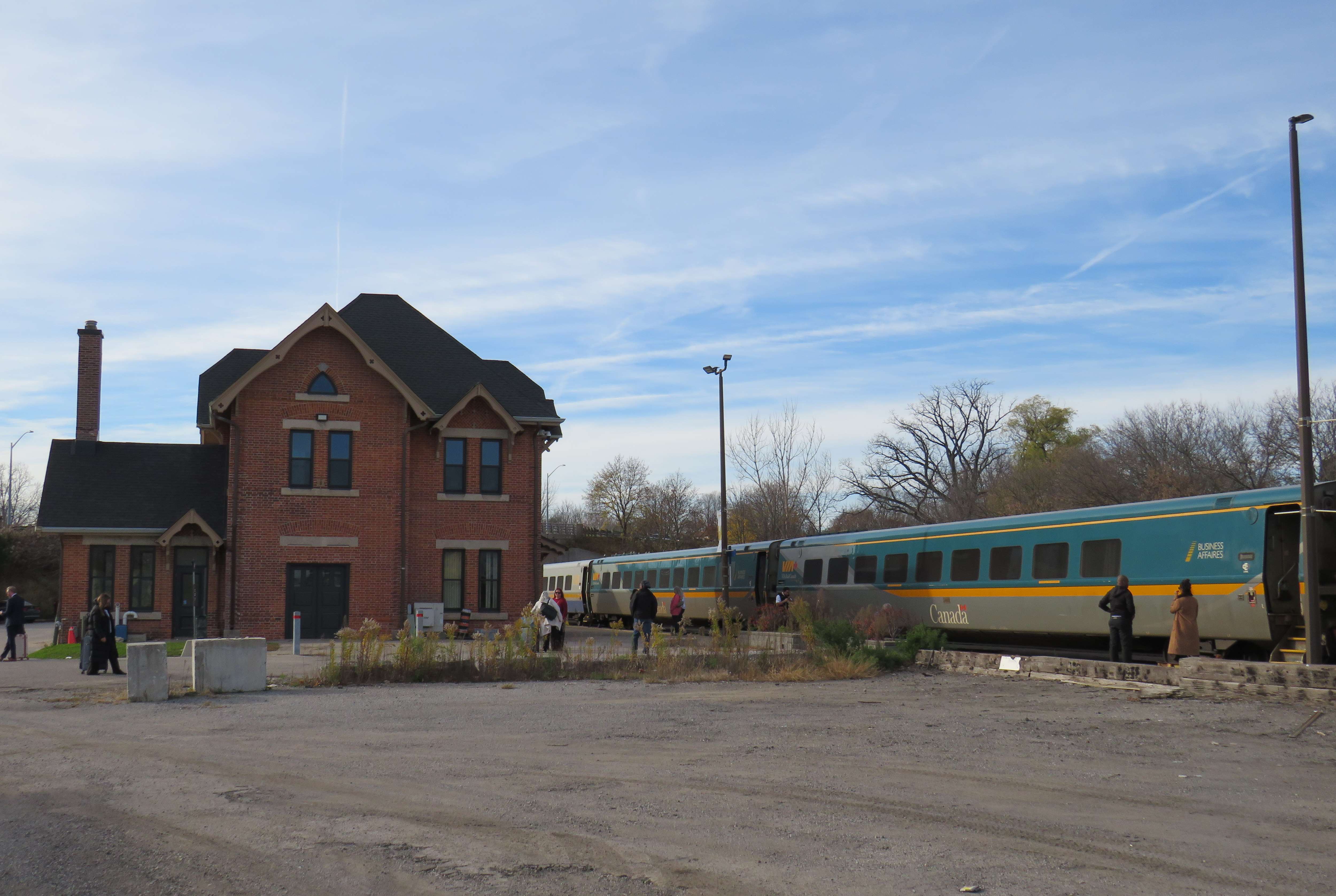
Train 73 left Union Station as scheduled at 11:35 AM and remained mostly on time until Woodstock, just one stop away from London, where it was supposed to arrive at 1:43 PM. There, our train stopped, with crew members informing passengers that due to an incident near London where a vehicle was struck by a CN freight train, we would be forced to wait for that to clear.
At 2:40, Train 73 was on the move again, briefly. We were stopped again west of Ingersoll due to a second delay caused by another vehicle that struck a railway bridge; CN needed to inspect that track before trains would be cleared to pass over. An hour after that, once inside London city limits near Clarke Road, we stopped again due to a system-wide CN communications failure that affected signalling.
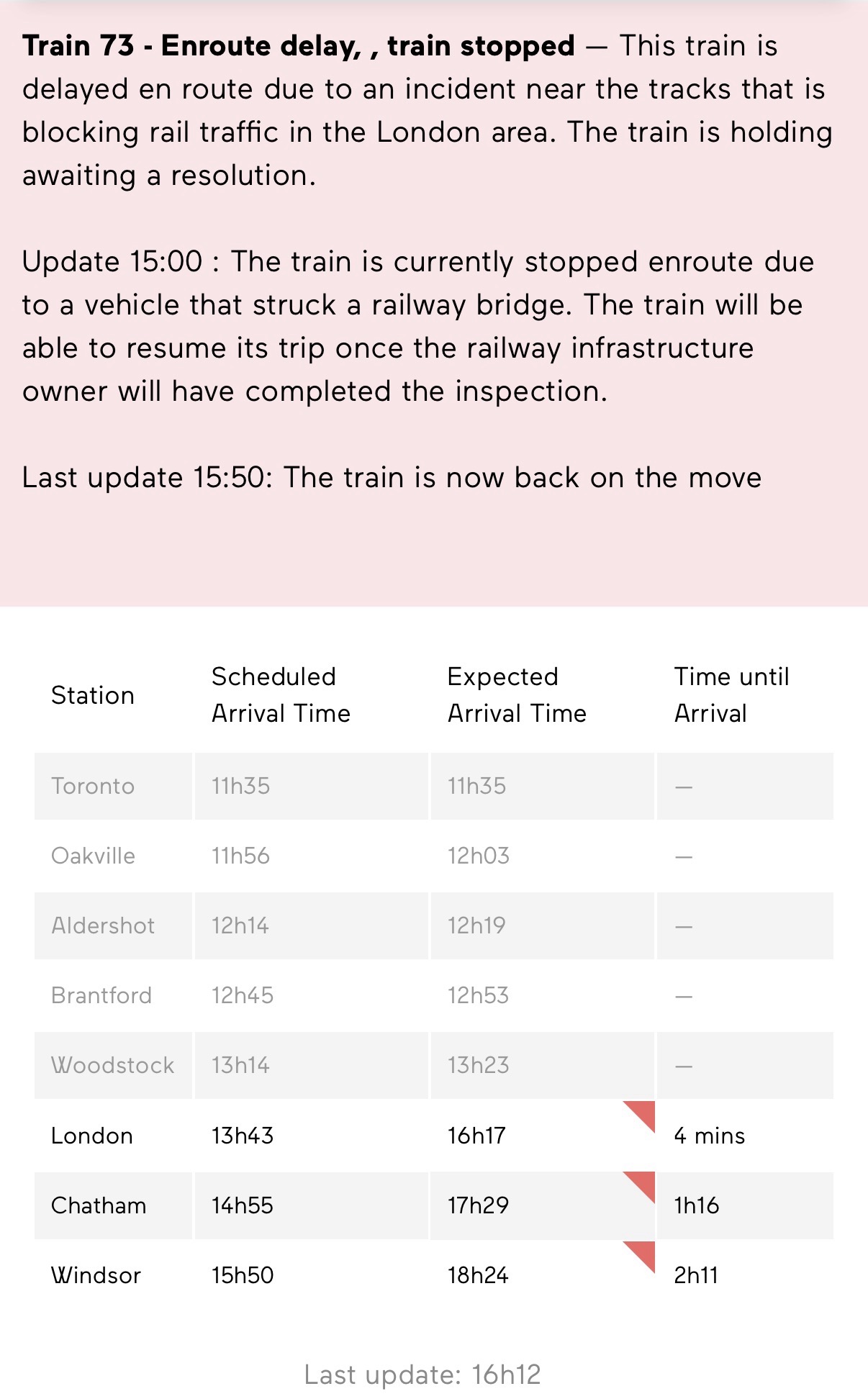
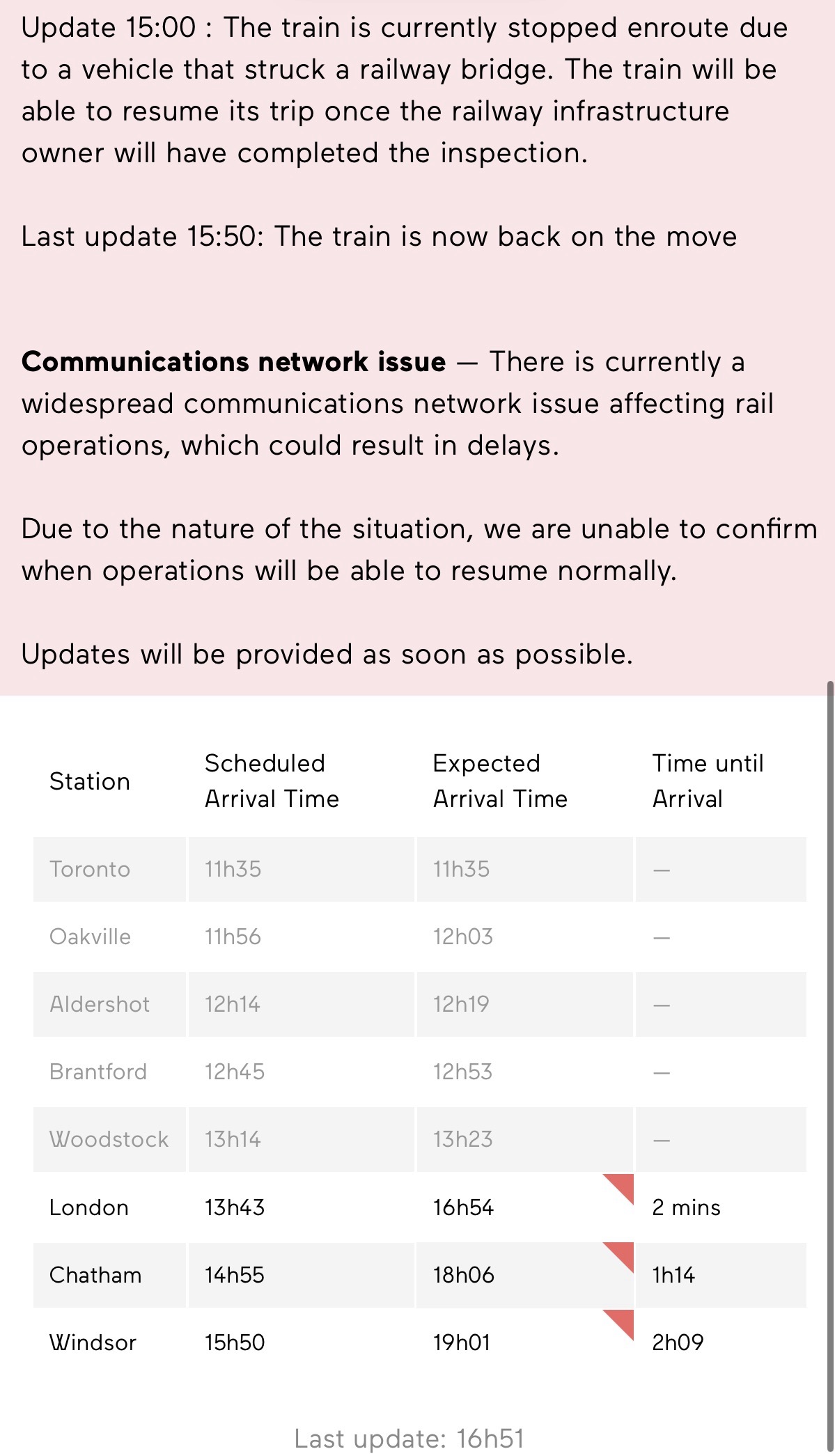
To its credit, VIA is more prepared for major delays than it has been in the past. After departing Woodstock, the on-board crew passed out water bottles and light snacks to all passengers. After the Ingersoll stop, they came around again with more water, along with cookies and small bags of salty snacks. Pizzas were ordered at London for those passengers continuing on. For the most part, communications were clear, and the staff took it in stride. My car only had one verbally irate passenger, but even he was not disrespectful to the crew.
Because of all the signal issues and a blocked Train 76 waiting at London Station to head east to Toronto, once we finally arrived in London, our train had to pass by the station to the west, then back into the main Track 1 platform, even though London has multiple platforms with two tracks accessed by a seldom-used underground concourse. This was confusing to everyone on board, as there was no announcement about this unusual procedure.
By the time we had disembarked, it was 5:05 PM, Attic Books had closed for the day, and it was starting to get dark. The train was scheduled for a 2 hour, 8 minute jaunt. By then, it was 5 hours and 30 minutes since Train 73 departed Toronto.
I had time to see some of the BRT work on Wellington Road south of the Thames River and I rode a short section of the new median BRT along Wellington (I am not impressed so far). I also had plenty of time for dinner as I had to wait for Train 73 to get to Windsor and return as Train 78.
Train 78, scheduled to depart London for Toronto at 7:32 PM, left instead at 10:25. There were no further delays between London and Aldershot, and it looked like our train would arrive at Union at 12:34 AM. Unfortunately, once on Metrolinx-owned tracks, we hit one last delay near Oakville, as we sat for 20 minutes near Dorval Drive before stopping at Oakville Station. More water was handed out, and the crew offered free coffee and tea, as well as pizza slices that were brought on board at London.
We were finally off the train at 1:05 AM, with just enough time to catch the last northbound subway trains. But the Union Station arrival experience was the final insult at the end of a very long day.
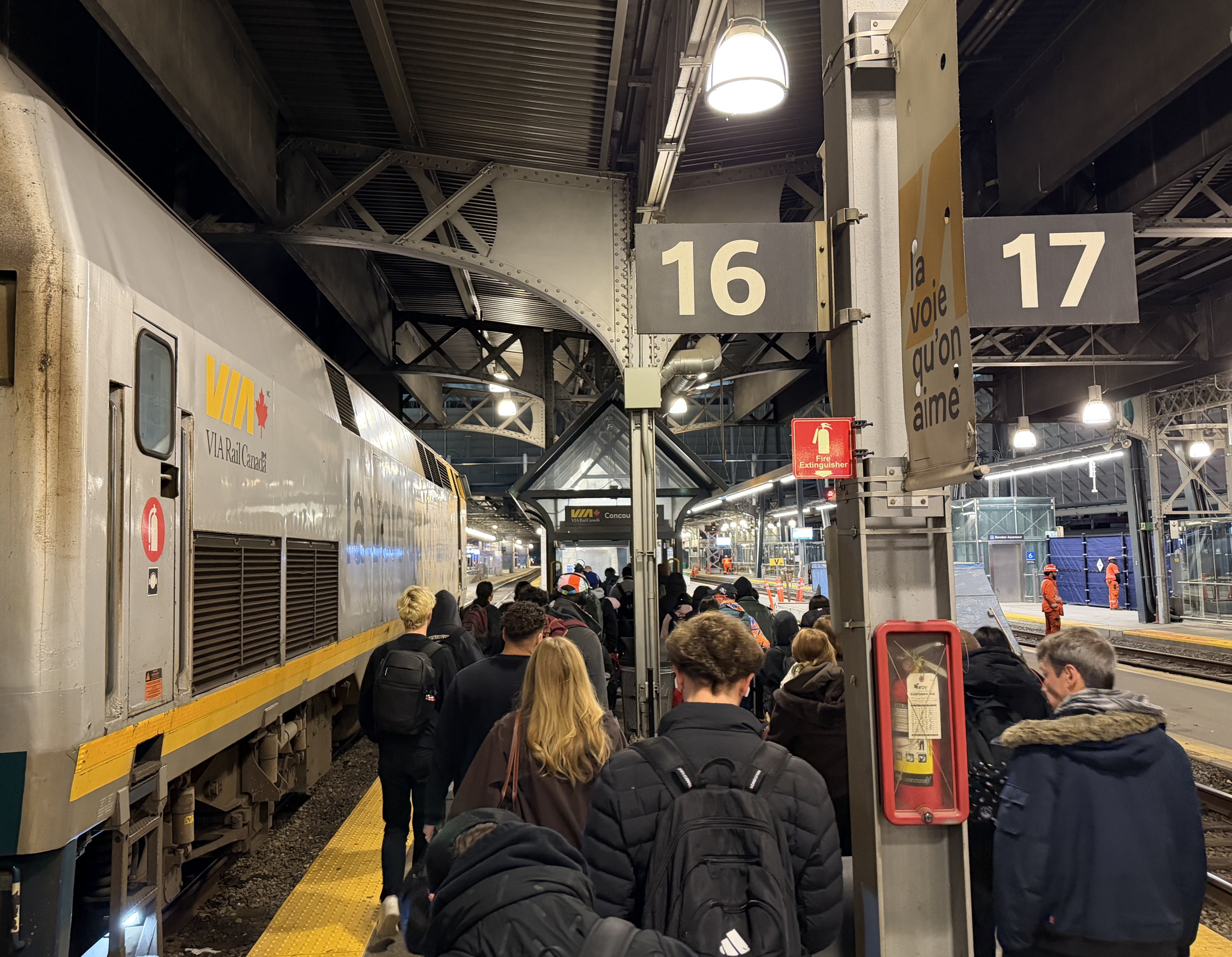
Egress from the train to the station itself was slowed by the escalator to the VIA Concourse not working, forcing passengers to navigate the static steps, often with large bags in tow. Additionally, as it was after hours at Union Station after the last GO train departed, security guards were on hand not to assist tired passengers, but to stand by with a surly look, blocking all but one access to Front Street. It’s a needlessly hostile end of a journey by a provider whose previous slogan was “A more human way to travel.”
As I had no commitments that day and was taking this trip mostly on a whim, I felt that despite all the trouble, I was able to roll with it. However, anyone with a late afternoon engagement in London, or trying to make it onwards by GO Transit at Union Station, would be completely out of luck, as both of those trips on November 19 went beyond any previous delay I’ve ever encountered on the Corridor.
Of course, none of this was VIA’s fault, but was entirely on CN and Metrolinx, with Union Station management (including the City of Toronto and Metrolinx) to blame for the rude arrival. To its credit, VIA is providing 50% travel credits for both delayed trips, and its onboard staff were very helpful and accommodating. Sadly, experiences like mine will turn people off rail travel.
As the federal government continues to promote the Alto high speed rail project between Toronto and Quebec City, it must do everything it can to ensure that VIA remains vital so it can serve the corridor in the meantime, while continuing to connect smaller communities and Southwestern Ontario even once high speed rail is up and running. This means minimizing existing delays to VIA trains, including the spat with CN over shunt, protecting major road crossings with upgraded infrastructure and additional grade separations, and providing more funding to VIA so it can reduce the effects of cascading delays caused by host railways like CN and Metrolinx. As I wrote before, Alto needs to be seen as an addition, rather than a replacement, in Canada’s transport network, and VIA needs to remain a strong component of that.
Unfortunately, the costs of maintaining this website and the portal to my maps continue to rise; I also just had to renew my WordPress subscription. However, I am committed to provide an ad-free, paywall-free resource. If you enjoy my work, please consider buying me a coffee to help with those costs. Thank you!


Leave a Reply