

Previously on this website, I wrote about the renaming of two GO Transit stations: Oshawa and Brampton. I explained why renaming transit infrastructure is problematic, especially when they violate wayfinding standards, which call for simple, accurate, unique, and self-locating names.
Both GO Transit stations were renamed by provincial agency Metrolinx, on behalf of the provincial government. Metrolinx operates GO Transit buses and trains, the UP Express airport link, administers the Presto fare payment system, and oversees the construction of new rapid transit projects in the Greater Toronto and Hamilton Area. The Hurontario LRT, which is currently under construction between Port Credit GO Station in Mississauga and Steeles Avenue in Brampton, is just one of many transit projects managed by Metrolinx.
On February 14, 2022, at Cooksville GO Station, Premier Doug Ford, then Transportation Minister Caroline Mulroney, then Mississauga Mayor Bonnie Crombie, and Metrolinx CEO Phil Verster joined former Mississauga mayor Hazel McCallion announcing the name change from the Hurontario LRT to the Hazel McCallion LRT. The occasion also marked McCallion’s 101st birthday.

This is the first rapid transit line in North America to be named for a person, contradicting established standards for transit projects.1 Though McCallion was a formidable and popular mayor whose political career spanned seven decades, she was also very close to the Ford government in the last few years of her life. She also had many other public facilities named in her honour — a senior public school in Mississauga’s Streetsville neighbourhood, the library at University of Toronto’s Mississauga campus, the City of Mississauga’s central public library, a walkway leading to Square One Shopping Centre, and the Mississauga campus of Sheridan College. There is also the Hazel McCallion Auditorium at Mississauga Valley Community Centre and the Hazel McCallion Hall at Vic Johnston Community Centre. There was no need for yet another civic asset to be renamed for her.
In Toronto, most former mayors have just one public asset named for them: David Crombie, Art Eggleton, June Rowlands, and Barbara Hall have parks dedicated in their honour. Mel Lastman — mayor of North York for 24 years before being elected mayor of amalgamated Toronto for another six — and Nathan Phillips have major public squares.2 In Mississauga, there was no need to rename yet another piece of civic infrastructure for the same person.
Furthermore, there was no public consultation about the name change — even officials at the cities of Brampton and Mississauga were kept in the dark — while the name itself contravenes Metrolinx’s own naming conventions.
In July, 2023, I submitted an access to information request to Metrolinx, the second time I went through the freedom of information process to find out more about the light rail transit project. There were several delays, and I did not receive my requested documents and communications until late January 2024.
A deep dive into the background of the Hurontario LRT project, the person it is being renamed for, and my findings and impressions follow.
Who was Hazel McCallion?
Born February 14, 1921 on Quebec’s Gaspe Peninsula, Hazel Journeaux moved first to Montreal, and then, with her husband Sam, settled in Streetsville, now part of the City of Mississauga. She was elected mayor of that village in 1970 and again in 1972. She opposed the 1974 amalgamation of Streetsville, Port Credit and the Town of Mississauga, though she successfully ran for councillor to the new Mississauga City Council.
In 1978, McCallion was elected mayor of the City of Mississauga for the first time. A year later, on November 10, 1979, a Canadian Pacific Railway train, laden with hazardous chemicals, derailed at the Mavis Road crossing. Though over 200,000 people were evacuated for fear of a chorine gas leak and explosion, no one was injured. Mayor McCallion, who remained front and centre during the disaster, became famous and unbeatable in future mayoral campaigns.
As mayor, McCallion was known for frugality, feistiness, and stamina, both at city hall and in her personal life. After her first re-election bid in 1980, she became famous for not even campaigning in her bids for re-election, reporting zero campaign expenditures. But without serious competition, municipal election turnouts were often below 25 percent. Fawning profiles from the Toronto media did not hurt either.
McCallion was notable for attracting businesses to Mississauga, including the Canadian headquarters of Microsoft, DuPont, PepsiCo, Nissan, and General Mills. During this time, she also became known as the “Queen of Sprawl” due to the prevalence of low-density subdivisions that proliferated in the 1980s and early 1990s, before developable lands ran out. Property taxes were kept low thanks largely to the low costs of maintaining new infrastructure, development charges, and a surplus of commercial and industrial lands, with the costs of building and maintaining water and wastewater infrastructure to service that development pooled across Peel Region. However, a lot of Mississauga’s success can simply be attributable due to its proximity to Toronto and to Pearson Airport, along with excellent provincial highway links.
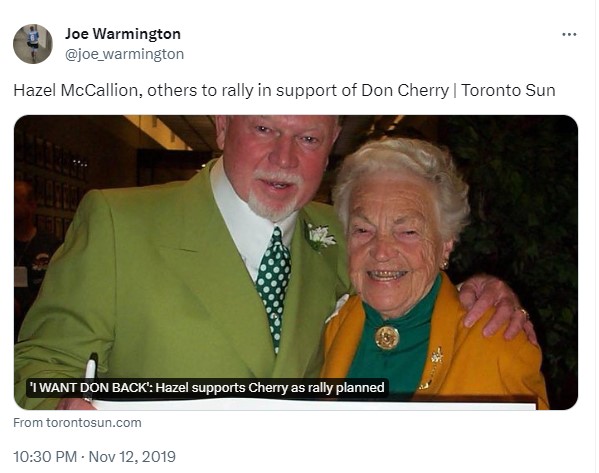
There were several controversies during her time in office, including two conflict-of-interest charges (her first in 1981, when she voted for a large tract of land that included her own property), racially charged comments made after a visit to Credit Valley Hospital’s emergency room in 2001,3 and her friendships with controversial figures such as sports commentator Don Cherry (fired for racist on-air comments) and former Toronto mayor Rob Ford.
McCallion’s political career was in jeopardy after World Class Developments (WCD) — a company co-owned by her son Peter McCallion — proposed to build a hotel and convention centre near Mississauga City Hall in 2005. The mayor, despite her obvious conflict of interest, dealt in person with landowners AIM and OMERS to support WCD’s bid. When the land deal collapsed, McCallion encouraged OMERS (whose property development arm, Oxford, also owns Square One Shopping Centre) to pay WCD $4 million to settle legal issues. Though Justice Douglas Cunningham, who presided over a judicial inquiry found Mayor McCallion in a position of conflict, both real and apparent, he did not find her in breach of the law, which Justice Cunningham found lacking.4
Since the mid 1990s, McCallion was a fierce proponent of abolishing the Region of Peel, the upper tier municipality that also includes Brampton and Caledon that supplies water, waste services, housing, public health, major roads, and other services to the region. As Mississauga got built out, Brampton’s and Caledon’s populations continued to grow, increasing their vote share on Peel Regional Council while requiring expansion of the water and road infrastructure that Mississauga benefited from during its periods of growth.
At the age of 93, in 2014, McCallion announced her retirement after 36 years as mayor. At first, she promised to not back a successor, but late in the campaign, McCallion gave her support to councillor and former Liberal MP Bonnie Crombie, who was running against a fellow Liberal, former MPP and MP Steve Mahoney. Though Hazel McCallion retired from municipal politics that year, she remained active in business and provincial politics, supporting Doug Ford’s government and policies.
In 2015, McCallion joined Revera, an operator of retirement and long-term care homes, as Chief Elder Officer. She sat on the boards of the Greater Toronto Airports Authority and several private sector corporations. She was also named Chancellor of Sheridan College, who named their new Mississauga campus after her.

In 2018, McCallion backed the provincial Progressive Conservatives, led by Doug Ford, in a recorded endorsement, in which she described Ford as “the people’s premier.” She endorsed the Ontario PCs again in 2022.
After the 2018 election, McCallion was offered a $150,000/year position as an advisor to the Premier’s Office and the Minster of Municipal Affairs and Housing, but backed away, citing other commitments. In 2022, at the age of 101, McCallion was appointed Chair of the province’s Greenbelt Council, and praised the government’s plans for opening up the Greenbelt for development.
McCallion died on January 29, 2023, 15 days shy of her 102nd birthday. Premier Ford declared a state funeral in her honour, which was held on February 14, 2023. Soon after her funeral, Ford announced the Hazel McCallion Act, the enabling legislation that would finally abolish the Region of Peel by 2025, with Mississauga, Brampton, and Caledon becoming single-tier municipalities, claiming he promised to break up Peel Region at her death bed. However, in December 2023, the provincial government announced that it would be repealing the legislation amid warnings of major tax increases by Brampton mayor Patrick Brown.
The Hurontario LRT
The Hurontario LRT was originally planned as a new at-grade transit line between Port Credit and Downtown Brampton, connecting three GO Transit rail lines, the historic urban cores in Port Credit, Cooksville, and Brampton, and several high-density development areas, particularly Mississauga City Centre. As Hurontario Street is known as Main Street through central Brampton, the project was originally known as the Hurontario-Main LRT
There were several rounds of initial consultations early last decade; a detailed plan was developed, with the provincial government promising to cover the costs. Project development became the responsibility of Metrolinx, which is responsible for regional transit planning, the operation of GO Transit and the Union Pearson airport rail link, and overseeing rapid transit construction projects.

In October 2015, the Brampton City Council voted narrowly to reject the section of LRT through the downtown core, thanks to a small, yet affluent and influential group of residents and business owners; the city opted to examine longer, alternative routes before a new council was elected in October 2018. In Port Credit, a stop adjacent to the waterfront was also cut due to local opposition.
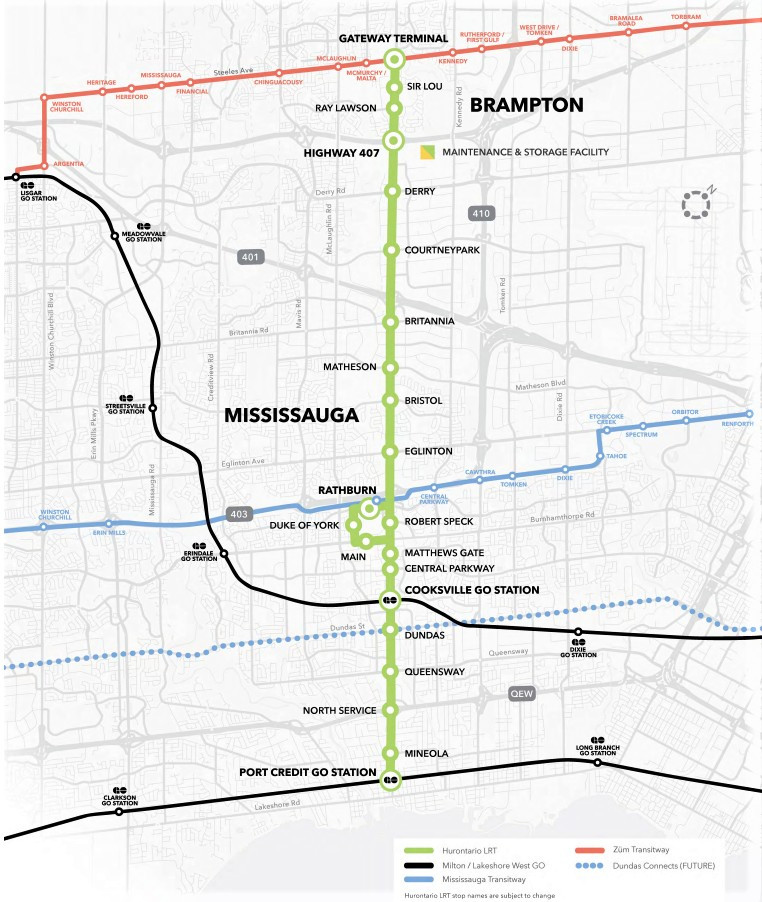
In 2019, three stops on the Mississauga Downtown Loop were cut from the project to reduce costs. Initial work began that year, with construction initially scheduled to finish in 2022. Though officially, the opening of the LRT is now planned for September 2024, there is still lots of construction still ongoing, including the Square One terminal and approaches, as well track installation on the south and north ends of the line. An opening in early-to-mid 2025 is looking much more likely.
On January 17, Transportation Minister Prabmeet Singh Sarkaria directed Metrolinx to “proceed with the development of an initial business plan along with a strategy to go to market for bids to build both Mississauga loop and the Brampton extension.”
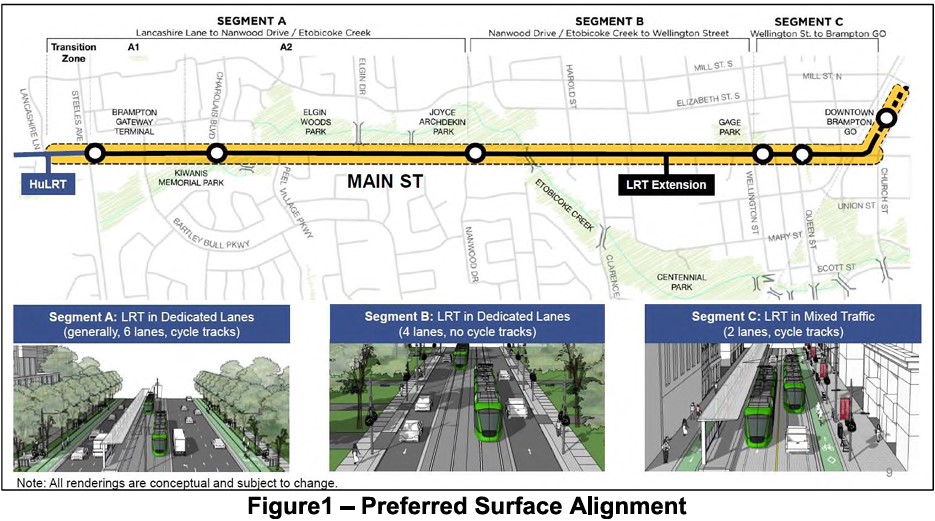
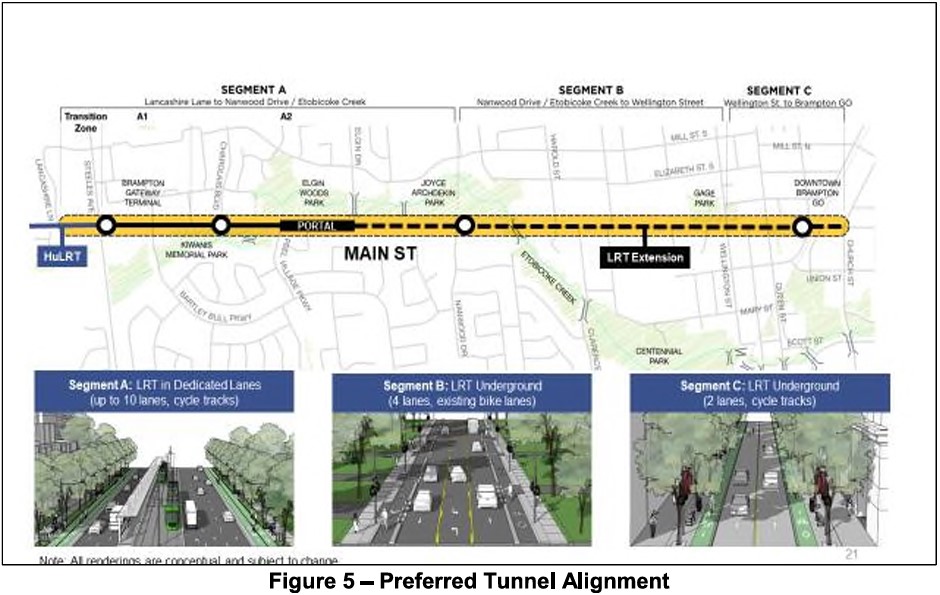
Recently, Brampton City Council has been much more supportive of the LRT extension into Downtown Brampton; only one councillor who opposed the LRT in 2015 is still in office. However, the city supports a bored tunnel under Main Street through the downtown core, with the tunnel segment beginning at Elgin Drive. The proposed $2.8 billion tunnel extension would feature two underground stops, at Nanwood Drive and near the Brampton GO Station. An at-surface alignment would require mixed-traffic operations but would be significantly cheaper and easier to construct ($933 million, including a below-grade terminal at the GO Station). The surface alignment would allow for additional stops at Wellington Street (for Gage Park and City Hall) and at Queen Street.
It remains unknown whether the province will fund the tunnel, or the surface option.
Renaming the Hurontario LRT
My freedom of information request to Metrolinx, sent in July 2023, asked for documents between Metrolinx, the Ministry of Transportation (MTO), and the City of Mississauga, with the purpose of determining the origin and rationale of the LRT’s proposed renaming, impacts on Metrolinx’s communications and community relations, and precedents for future transit project renaming/rebranding. On January 24, 2024, I received a PDF with over 1600 pages of highly redacted emails and communications between Metrolinx and MTO.
Here is what I was able to find out.
The Cities of Brampton and Mississauga were already working together on a brand for the LRT
In 2020, Metrolinx agreed to a request from officials at the City of Mississauga (CoM) and the City of Brampton to allow the two municipalities to propose the Hurontario LRT branding, including the line’s logo, name, line colour (which would appear on maps and wayfinding signage) and the line’s number.
There was rationale for this. According to internal Metrolinx emails, the two cities “considered that it makes sense for the branding and marketing of LRT to be integrated with MiWay and Brampton Transit.” Brampton and Mississauga “wanted to take ownership of branding and marketing so that they could receive customer feedback directly and respond accordingly.’
The two cities hired a consultant to develop the branding and were ready to announce their proposal to Metrolinx in December 2021, with a public unveiling to follow. That process was kyboshed on December 3, 2021, as the MTO wanted to “name the line and have a say on the final product.”
Details of the municipalities’ proposed branding was redacted in the package provided to me under Section 18(1) of the Freedom of Information and Protection of Privacy Act (FIPPA) which covers “economic and other interests of Ontario.”
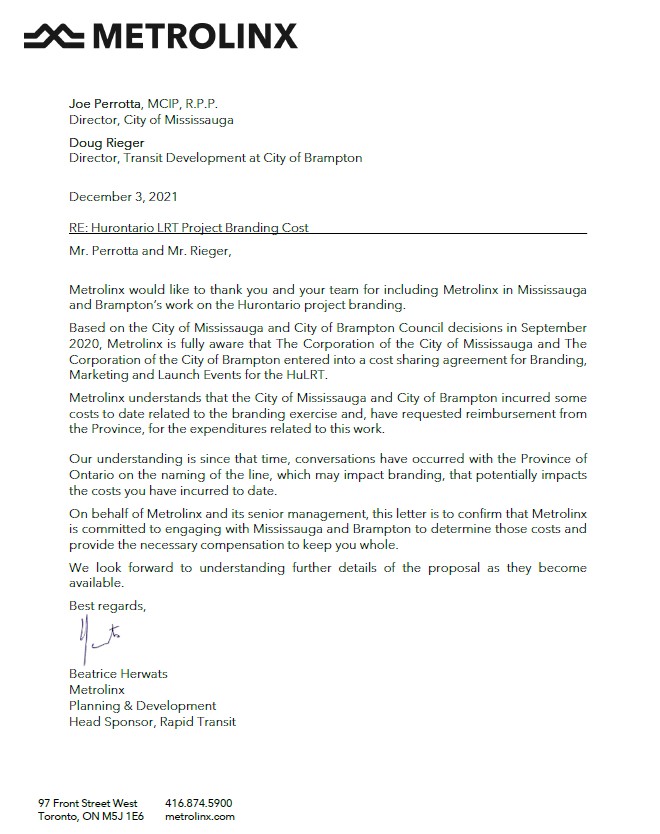
Furthermore, Metrolinx promised to compensate the two municipalities for their sunk costs in branding the LRT. Those costs are also redacted.
The decision to rename the LRT for Hazel McCallion came from the top
The direction to Metrolinx to rename the LRT for Hazel McCallion came from the Minister’s Office. At the time, the Minister of Transportation was Caroline Mulroney. Given Doug Ford’s close relationship with McCallion, it is almost certain that the Minister’s Office was acting on behalf of the premier.
James Pearce, the director of transit capital & operations at MTO and previously a senior policy advisor at the Ontario Cabinet Office, notified Metrolinx of the province’s intent of naming the LRT after McCallion on January 13, 2022, with the direction that it be kept confidential, and that a meeting with the Minister’s Office (MO) would soon follow. Pearce also revealed that the official announcement would take place on February 14, McCallion’s birthday. MTO’s communications branch would prepare materials for the official announcement.
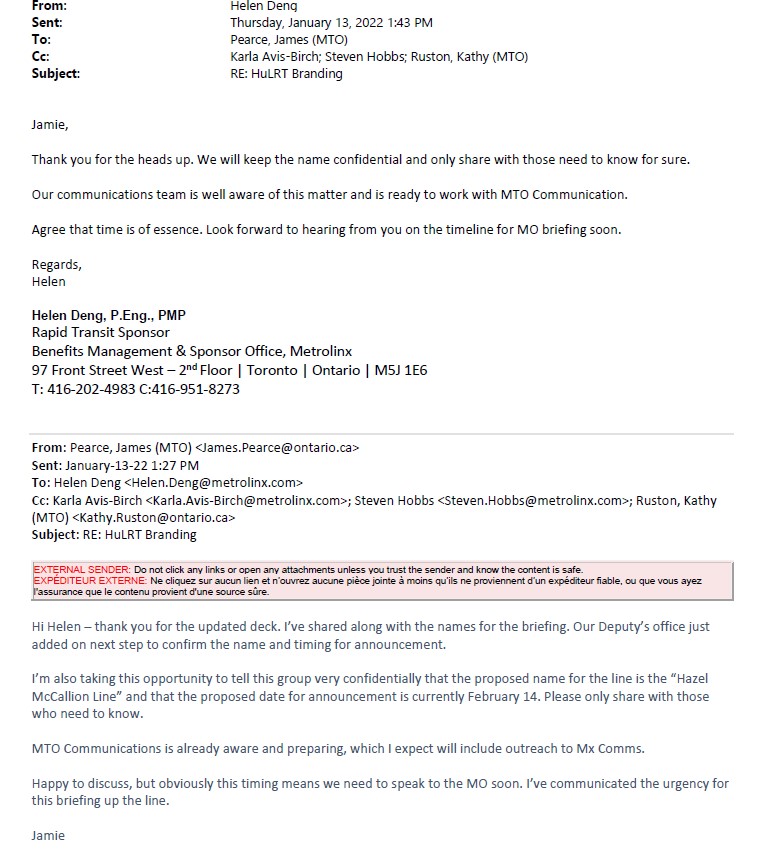
Though most of the communications were handled by MTO, Metrolinx was given the task of purchasing proposed domain names ahead of the February 14 announcement, namely:
- HazelMcCallionLine.com
- HazelMcCallionLine.ca
- HMcCallionLine.com
- HMcCallionLine.ca
- HazelMcCallionLRT.com
- HazelMcCallionLRT.ca
- TheHurricaneLine.com
- TheHurricaneLine.ca
Most other details were redacted under Section 13 (advice to government) and Section 18(1) (economic and other interests of Ontario) of FIPPA.
Communications were tightly controlled by MTO
The communications for the February 14 announcement were tightly controlled by MTO communications staff, with input from Metrolinx and sign-off from the Premier’s Office.
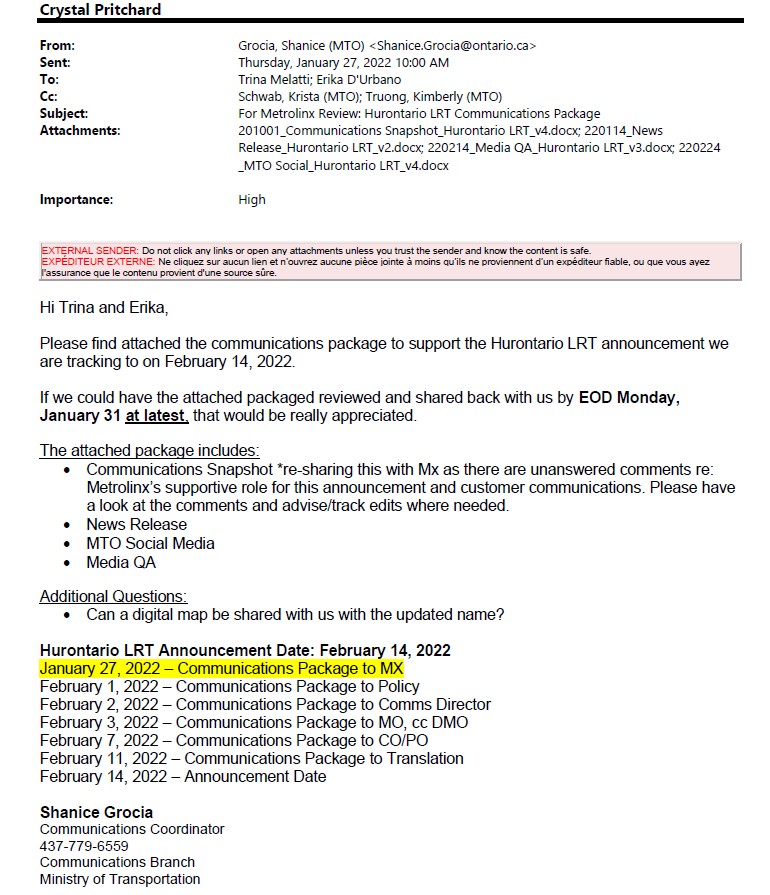
The draft communications package from MTO noted that the renaming announcement would be a “Premier’s Event.” Speakers identified included Minister Mulroney, Premier Ford, Associate Minister Stan Cho, Metrolinx CEO Phil Verster, and five local government MPPs. Mayor Crombie was identified as a “supportive stakeholder” but noticeably absent was Brampton Mayor Patrick Brown.
Anticipating media questions about renaming the LRT after McCallion and whether there was any negative reaction or criticism from the City of Brampton, the mitigating strategy was just to repeat the messaging about “the legacy and contributions made by Hazel McCallion as Mississauga’s longest sitting mayor.” The same advice was given if there were questions about the extra costs of rebranding the line after the cities were ready to present their proposal.
It was going to be nothing more than a Valentine’s Day love-in for one of Doug Ford’s closest political allies.

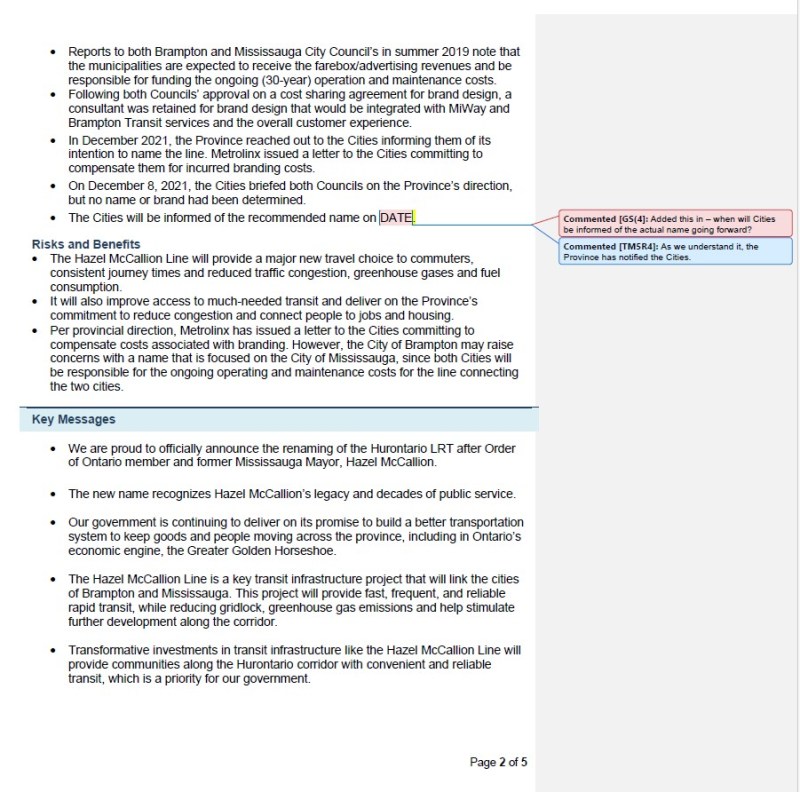
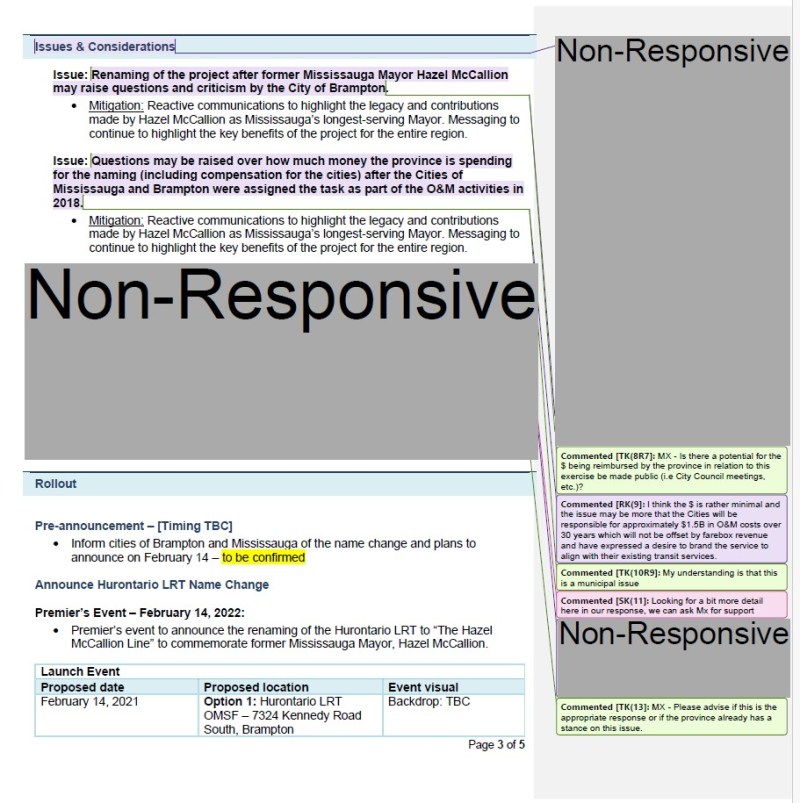

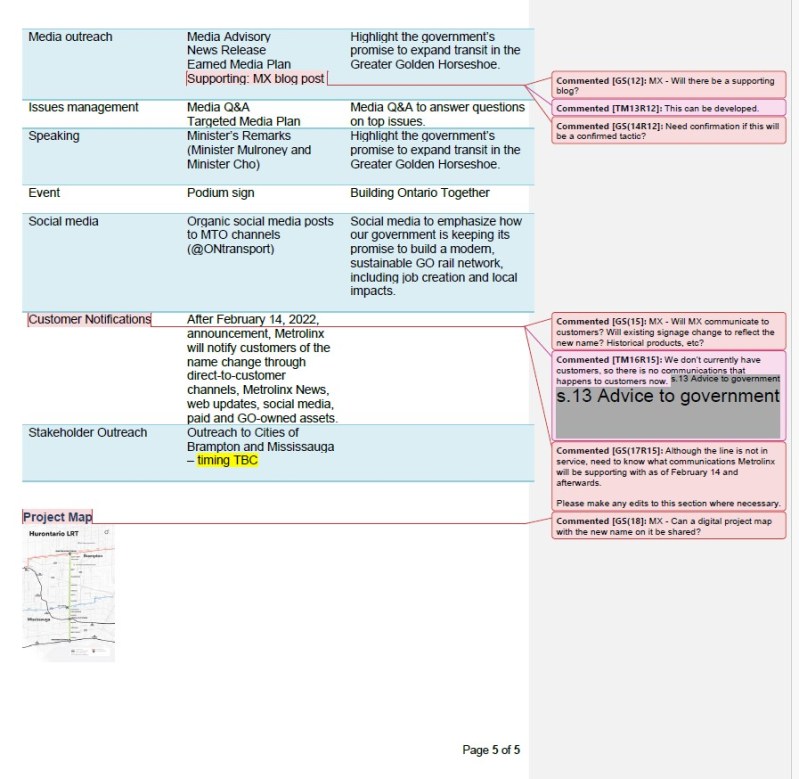
Draft communications snapshot (five pages), dated January 17, 2022, with Metrolinx’s comments
On February 11, the Premier’s Office changed the format of the media announcement to be “more streamlined”. It would be a photo opportunity, with no questions taken from reporters. Only Premier Ford, Mississauga Mayor Crombie, and McCallion would speak at the event.
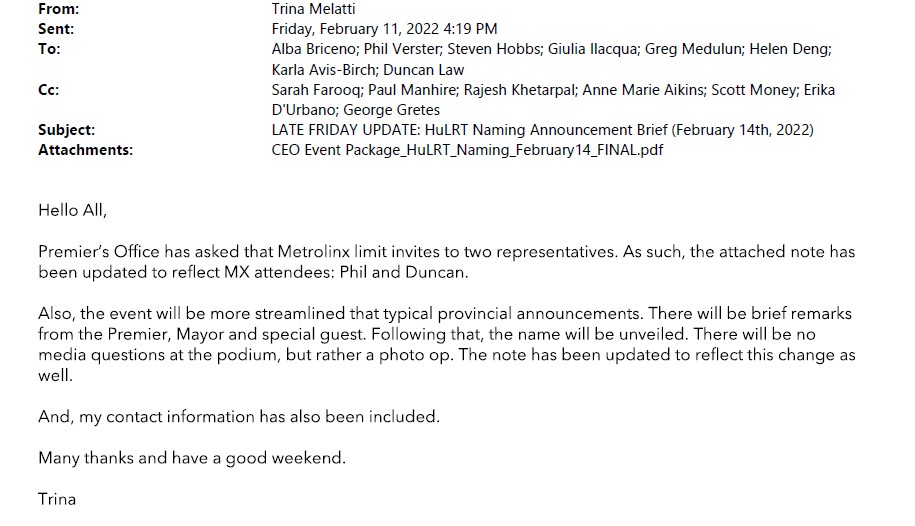
Though the province handled most of the messaging, Metrolinx, however, published a blog post and a podcast episode that featured softball questions pitched to McCallion about the project, along with social media posts and website updates.
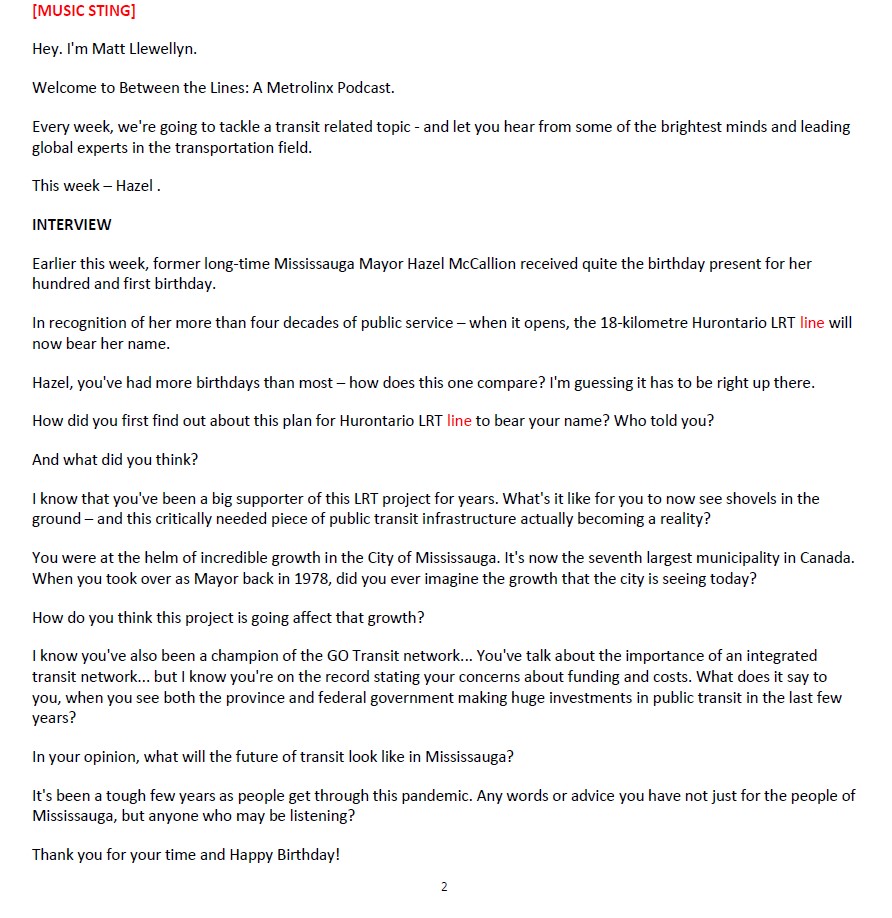
The municipalities did not find out about the new name until it was made public
The new name was to be kept secret until the public announcement on February 14; provincial staff indicated that it will “engage the municipalities after the announcement” and that “the municipalities will have access to the line name through the provincial announcement.” Though the province would decide the “upgraded brand” including name, logo, and line colour, the municipalities could still choose the line number.
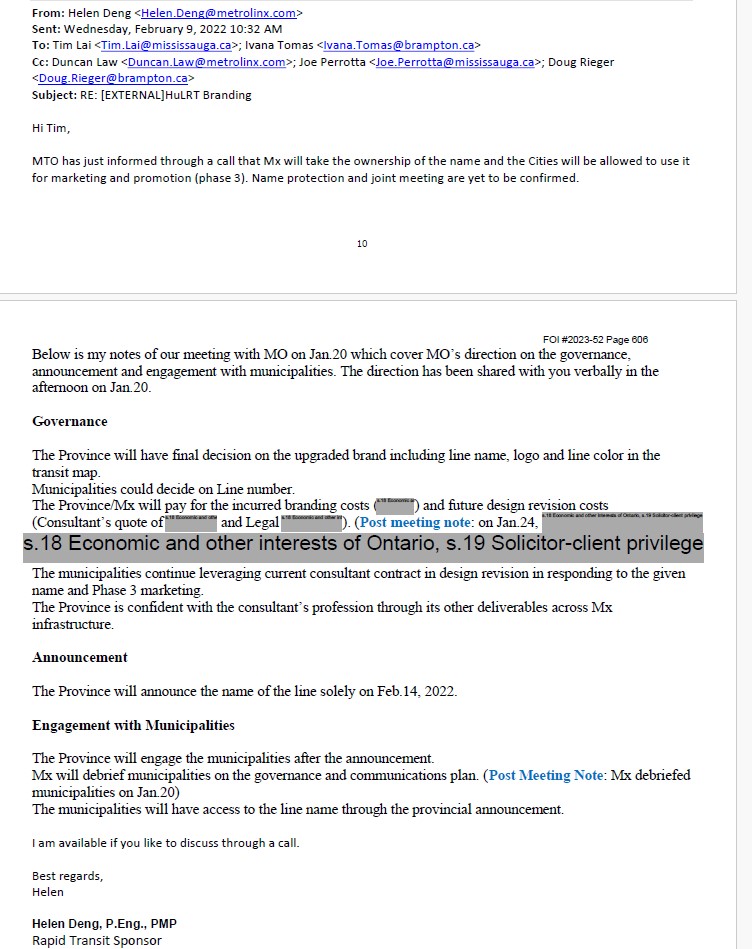
The new line branding (logo, number, colour) remains a secret
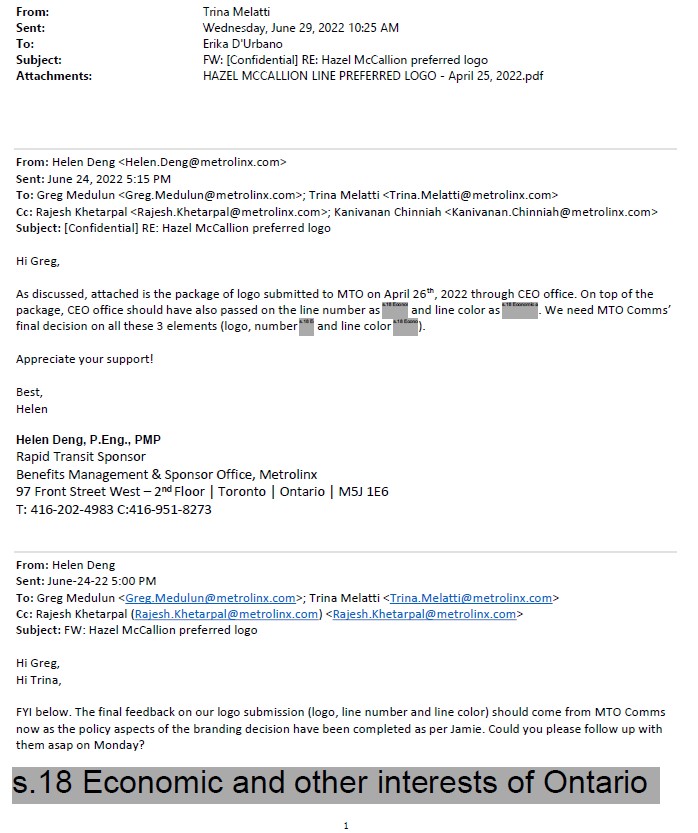
After the announcement in February 2022, most of the remaining communications in the FOI package related to choosing the LRT’s line number, colour, and logo. Those were all redacted under Section 18(1) of the FIPPA.
According to emails from September 2022, those details were approved by MTO. However, as of February 2024, those details remain a secret. As the line is still scheduled to open by the end of 2024 (though mid-2025 is more likely, as much of the track, and all the overhead wiring, is not installed yet), this is rather ridiculous at this point. We have known for several years that still-incomplete Eglinton-Crosstown will be named Line 5, and will show up as orange on TTC maps, and that the Finch West LRT will be named Line 6 and appear as silver/grey.
If any Brampton Transit or MiWay bus routes need to be renumbered to avoid conflict with the LRT’s new number, it is also useful to do that well in advance of the new line’s opening, as the TTC did with the former 5 Avenue Road (now 13 Avenue Road) and 6 Bay (now 19 Bay) bus routes.
Concluding thoughts
For a provincial government that constantly talks about “finding efficiencies” and “respect for taxpayers,” there is a surprising lack of transparency over the amount of money spent on undoing decisions that were already made, in order to further burnish the image of a close personal and political ally. Naming a transit line for someone indifferent to the City of Brampton is disrespectful, considering Brampton’s continued involvement in the project.
I was hoping to see at least some pushback from Metrolinx, which at one time developed clear naming principles for stations:
1. Simple. Simple names are easier to remember
2. Logical. Logical names provide a mental link when trip planning: they should be relevant to the area they reside
3. Durable. Names should be relevant as long as the station exists
4. Self-Locating. Names should allow users to mentally locate themselves within the region
5. Unique. A unique name is one that cannot be confused with any other.
The Hazel McCallion name violates all five principles. It is needlessly long, as a person’s name, it is not relevant to the area, especially in Brampton, it is not durable (as it’s not relevant for wayfinding), it is not self-locating. It isn’t even unique, given everything else named for McCallion in Mississauga.
What is increasingly clear is that Metrolinx, once touted as a transit planning agency arm’s length from the provincial government, simply does the province’s bidding without question. We saw this in 2023, when the Toronto Star reported that the provincial government directed Metrolinx not to communicate to two local NDP MPPs about Ontario Line construction impacts.5 Why is Metrolinx still relevant, then?
Finally, I have one question I would ask Mississauga, even though they were not directly involved with this name change: with a diverse population of over 700,000 and fifty years of history as a city, do you have anyone else that you can name stuff for, if you feel you must name civic assets after people?
One more thing…
To my longtime followers as well as my occasional readers, thank you for your interest and support. This FOI request cost me $525.00. Sadly, freedom of information isn’t free. If you like this post and if you are in a position to help out with offsetting the costs of obtaining this information, or just want to contribute to my online mapping and webhosting costs, please consider buying me a coffee.
Notes and asides
- I know of just one other major transit line named specifically and directly for a person: the Elizabeth Line in Greater London, a regional rail project originally known as Crossrail. It was renamed in 2016, with Queen Elizabeth attending the ceremony. (London’s Victoria Line, which shares its name with another British queen, takes its name from Victoria Railway Station, which it serves.)
Generally, rapid transit lines are named for local geography (i.e. a major street it follows, a neighbourhood, landmark, or terminus), or simply identified by a letter, number, or colour. Occasionally, rapid transit routes may be named for the time that they are opened: Vancouver’s Expo Line (for the 1986 Expo) and Millennium Line (opened in 1999) are examples, as is London’s Jubilee Line (which opened in 1979, Queen Elizabeth II’s silver jubilee year). Vancouver’s Canada Line and Toronto’s under-construction Ontario Line are named for their key funder.
Unlike transit lines, individual stations are more commonly named for people, especially in continental Europe and Latin America. Many metro stations in Mexico City are named for famous revolutionaries and politicians, including Emiliano Zapata and Benito Juárez, but the metro lines themselves are numbered. Paris, of course, has metro stations named for Victor Hugo, Charles de Gaulle, and even Franklin Roosevelt. Montreal’s Lucien-L’Allier Metro Station was named for the chief engineer of the Metro project, though officially, the metro station takes its name from a nearby street that was also named in his honour.
↩︎ - Former Toronto mayors John Sewell (1978-1980), David Miller (2003-2010) and John Tory (2014-2023) do not have any civic assets named in their honour. Rob Ford, mayor from 2010 to 2014, will get an existing football stadium named after him.
↩︎ - “Mayor McCallion under fire for alleged anti-immigrant remarks” CBC News, May 23, 2001
↩︎ - “Mississauga mayor found in conflict of interest” CBC News, October 3, 2011 ↩︎
- “Doug Ford government interfered in Metrolinx tree removal communications, emails show” Lex Harvey, Toronto Star, February 9, 2023. ↩︎
 Sean Marshall
9 replies on “Heavy interference in a light rail transit project”
Hazel annd Sam actually lived outside of the Towen of Streetsville, in the Township of Toronto, but had a business in Streetsville.
Steve Mahoney was a former, not fellow, Councillor, and former MPP and MP.
Informative article!
Thanks! I’ll correct the 2014 election info.
I think the reason for the Hazel McCallion name (or even any distinct branding for that matter) for the LRT is because an LRT line in a suburban city like Mississauga is so unprecedented that there’s a tendency for politicians to get carried away over it.
What a long winded,unnecessary article I’ve wasted my time reading.Hazel was a wonderful,caring Canadian Woman who cared for our Country and our city too.
Your comments are against her legacy.
Hazel deserves the honor,case closed.
Line #10. Blue.
Thanks. I must say I like “Line 10” given the history of Highway 10 here. Perhaps, the name, like the Macdonald-Cartier Freeway, will fade away with the line number taking precedence.
On a street like Hurontario in an aspiring suburban municipality that faces an uphill battle for credibility as a street, encouraging use of “Highway 10” should hardly be reinforced. Use the number for the Hamilton LRT and number this one 9.
I was going to make exactly the same point! When is the last time anyone heard “Macdonald-Cartier Freeway”?
As to the “Elizabeth Line” in London, it’s used by some, but still resisted by many. I still call it “Crossrail”, some call it “the Purple Line” (due to the map marking).
Although almost exactly two years old, this article goes into depth on the subject:
What Will You Call The Elizabeth Line?
https://londonist.com/london/transport/elizabeth-line-crossrail-names-nicknames
Public consultation PLEASE! Could you not have thought about possible negative results before you went ahead and did what you wanted anyway? And you can bet your Lexus none of you boys will be using it in any case.